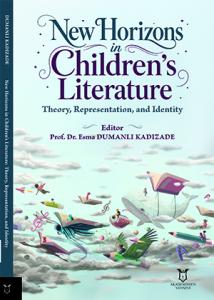
New Horizons in Children’s Literature: Theory, Representation, and Identity
Özet
Children’s literature extends far beyond a mere genre addressed to young readers; it plays a decisive role in the individual’s process of making sense of the world, internalising cultural codes, constructing identity and encountering social values. In recent years, children’s literature research has gained an interdiciplinary perspective, interacting with literary theory, sociology, psychology, philospohy, ecology, translation studies, and visual arts, thereby offering a rich ground for scholarly inquiry. This volume aims to bring together current and multidimensional discussions on children’s literature within a theoretical and critical frame work. The book consists of ten chapters organised around four thematic axes. The first thematic axis: “Theoretical Approaches and Literary Movements” comprises two chapters that interrogate the theoretical underpinnings of children’s literature. The opening chapter engages in a theoretical and critical discussion of the complex relationship between children’s literature and popularity, examining how the concept of “popular” is perceived within the context of children’s literature, its connection with literary value, and the points of convergence and divergence between the two fields. The second chapter presents an original analytical framework for the application of magical realism theory to the study of children’s literature, systematically exploring narrative structures in which the boundaries between the real and the unreal become blurred, the characterictic codes of magical realist fiction, and their reflections within the context of children’s literature. The second thematic axis: “Sociopolitical Themes and Representation” comprises, three chapters that discuss the relationship between children’s literature and social issues. The first chapter focuses on the representations of migration in picturebooks, examining narrative strategies and models of representation across different geographical contexts as well as the impact of the these narratives on multicultural leraning environments, from a comparative perspective. The second chapter offers a comprehensive framework fort he treatment of differences in children’s literature - particularly special needs and multiculturalism – evaluating both original and translated. Works, as well as the relevant literature in a holistic manner. The third chapter addresses the concept of inclusive representation across a broad spectrum ranging from social diversity to body image, discussing idealised body representations, bodily transformation in fantastic narratives, and the transformation of body image in contemporary children’s literature from a multidimensional perspective. The third thematic axis: “Child Subjectivity and Development” comprises three chapters that interrogate the position of the child within literature and culture. The first chapter discusses the transformation of the representation of the child and forms of subjectivity in children’s literature and culture, centring on the concept of agency. It deeply analyses the position of the child within narrative through conceptual tools such as adult authority, control of knowledge, temporary agency, and narratives in which norms are suspended. The second cahpter comprehensively presents the role and significance of acquiring reading culture in child development, outlining the theoretical framework of reading, literacy and reading culture, discussing the stages of reading culture acquisition according to developmental periods from 0 to 14 years, and addressing the necessity of multiliteracy skills in the digital age. The third chapter holistically examines the Philosophy for Children (P4C) approach, including its historical development theoretical foundations, the community of inquiry model and practical examples while discussing the profound relationship between children’s literature and philosophical inquiry on both ontoological and pedagogical levels. The fouth thematic axis: “Cultural Codes, Nature and Visual Narratives” comprises two chapters that examine the aesthetic and ecological dimensions of children’s literature. The first chapter analyses the percepiton of nature in Turkish children’s literarure in light of ecocritical theory, revealing the potential of children’s literature to foster ecological awareness through thematic headings such as the representation of nature the position of the child, human nature conflict, reflections of the adult world, and the resolution of conflict. The second chapter discusses the significance of illusrtations in children’s literature works in terms of identity and cultural codes, evaluating the reflections of cultural transmission through visual narratives and identity construction visual storytelling on the child reader, drawing on range of sources. This volume aims to create a polyphonic platform that approaches children’s literature not merely as an educational field but also in its aesthetic, ideological, political, philosophical andcultural dimensions. Each chapter offers original contributions that question the existing body of knowledge in the fiels, propose new conceptualisations, and provide practical implications. With its broad perspective ranging from theoretical debates to concrete textual analyses, and from historical transformations to current trends, the work seeks to make a theoretical and practical contribution to academics, teachers, gradute students, editors, publishers and all readers who are devoted to the field of children’s literature. We sincerely thank all the contributing authors for their dedicated work and valuable contributions to the preparation of this volume. We also extend our gratitude to the publisher for their support throughout the publication process. We hope that this work will bring an interdsciplinary and critical perspective to children’s literature research and make a meaningful contribution to the international scholarly literature.
Bölümler
-
Children’s Literature and Popularity: A Theoretical and Critical Discussion
-
Childrens Literature and the Theory of Magical Realism in Fiction Analysis
-
Migration in Picturebooks: Representations, Boundaries, and Narrative Possibilities
-
Children’s Literature and Differences
-
Inclusive Representation in Children’s Literature: From Social Diversity to Body Image
-
Agency in Children’s Literature and Culture: the Transformation of the Representation of the Child and Forms Of Subjectivity
-
The Role And Significance of Reading Culture Acquisition in Child Development
-
Big Questions at a Young Age: Philosophy For Children (P4C)
-
Identity And Cultural Codes in Illustrations in Children’s Books
-
Narrating Nature in Turkish Children’s Literature
Referanslar
Yayınlanan
Lisans
LisansBu İnternet Sitesi içeriğinde yer alan tüm eserler (yazı, resim, görüntü, fotoğraf, video, müzik vb.) Akademisyen Kitabevine ait olup, 5846 sayılı Fikir ve Sanat Eserleri Kanunu ve 5237 sayılı Türk Ceca Kanunu kapsamında korunmaktadır. Bu hakları ihlal eden kişiler, 5846 sayılı Fikir ve Sanat eserleri Kanunu ve 5237 sayılı Türk Ceza Kanununda yer alan hukuki ve cezai yaptırımlara tabi olurlar. Yayınevi ilgili yasal yollara başvurma hakkına sahiptir.
