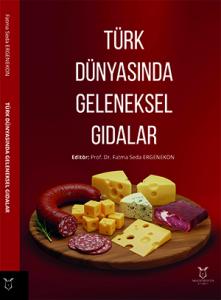
Balkanlarda Geleneksel Et Ürünleri
Özet
Tarih boyunca farklı kültür ve medeniyetlerin etkisi altında kalan Balkanlar, yüzyıllar içinde oluşan zengin mutfak mirasını özellikle geleneksel et ürünleri ile günümüze taşımıştır. Osmanlı, Bizans, Roma ve Antik Yunan izleri, bölgedeki yemek geleneklerine derinlemesine işlemiştir. Et, hem gündelik sofraların hem de bayram, düğün gibi özel günlerin vazgeçilmezidir. Sığır, kuzu ve domuz etleri; tuzlama, kurutma ve tütsüleme gibi geleneksel yöntemlerle işlenmektedir. Bosna-Hersek’te cevapi ve sudžuka, Bulgaristan’da lukanka, Sırbistan’da kulen, Hırvatistan’da pršut çeşitleri, Romanya’da ise pastramă ve cârnați gibi ürünler öne çıkan örneklerden bazılarıdır. Coğrafi işaretli bu geleneksel et ürünleri, sadece damak tadı değil, aynı zamanda kültürel kimliğin korunması açısından da değer taşır. Üretimlerinde yerel iklim, malzeme ve tekniklerin rolü büyüktür; bu sayede her ülke kendi özgün lezzetini yaşatmayı sürdürmektedir. Bu bölümde önemli Balkan ülkelerinde yaygın olarak tüketilen geleneksel et ürünleri hakkında bilgiler derlenmektedir.
Referanslar
Ambrosiadis, I. (2005). New production technologies for traditional Greek meat products. Biotechnology in Animal Husbandry, 21(5-6), 321-330.
Arfini, F., Bellassen, V. (Eds.). (2019). Sustainability of European food quality schemes: Multi-performance, structure, and governance of PDO, PGI, and organic agri-food systems. Springer Nature.
Baltic, M. Z., Janjic, J., Popovic, M., Baltic, T., Jankovic, V., Starcevic, M., Sarcevic, D. (2018). Meat in traditional Serbian cuisine. Scientific journal" Meat Technology", 59(1), 54-62.
Barjolle, D., Brecic, R., Cerjak, M., Giraud, G. (2015). Traditional Food in Western Balkan Countries Consumers’ Perceptions and Habits. 145th EAAE Seminar “Intellectual Property Rights for Geographical Indications: What is at Stake in the TTIP?” April 14-15, 2015, Parma, Italy.
Bernardoni, P., Paus, M. (2008). The Ham of beef meat of Uzice-Užićka Goveđa Pršuta, Serbia. Case studies on the Products with Quality Sign in the Balkans, 9-58.
Bradatan, C. (2003). Cuisine and cultural identity in Balkans. Anthropology of East Europe Review, 21(1), 43-47.
Briški, M., Jarec, M. (2014). Cultural and geographical overview of traditional diet in Croatia. Collegium antropologicum, 38(3), 1081-1092.
Cruz, R. M., Vieira, M. M. (Eds.). (2017). Mediterranean foods: Composition and processing. CRC Press.
Drăghıcı, O., Soroștıneanu, V. (2022). Hıstory of "Salam De Sıbıu". Acta Musei Brukenthal, 17(1).
FAO. 2021. Atlas tipicne hrane iz Crne Gore. Atlas of typical food from Montenegro. Rome.
Ghinea, C., Prisacaru, A. E. (2023). Romanian Traditional Dishes and Certified Food Products. Food and Environment Safety Journal, 22(2).
Gostin, A. I., Bogueva, D., Kakurinov, V. (Eds.). (2021). Nutritional and health aspects of food in the Balkans. Academic Press.
Hernik, J., Walczycka, M., Sankowski, E., Harris, B. J. (Eds.). (2021). Cultural Heritage—Possibilities for Land-Centered Societal Development (Vol. 13). Springer Nature.
Jasar, D., Curcic Trajkovska, B., Kubelka-Sabit, K., Filipovski, V., Kakurinov, V. (2021). Health issues and nutrition in the Balkans. Journal of Hygienic Engineering and Design (JHED), 35, 96-105.
Jokanović, M., Petrović, L., Ikonić, P., Tomović, V., Džinić, N., Savatić, S., Tasić, T. (2010). Sensory properties of Petrovská Klobása (dry-fermented sausage) ripened in traditional and industrial conditions. Journal on Processing and Energy in Agriculture, 14(3), 153-156.
Kristbergsson, K., Oliveira, J. (2016). Traditional foods. General and Consumer Aspects. Springer Nature.
Krvavica, M., Friganović, E., Đugum, J., Kegalj, A. (2009). Dalmatinska kaštradina [koštradina]. Meso, 11(5), 285-290.
Krvavica, M., Lasić, D., Kljusurić, J. G., Đugum, J., Janović, Š., Milovac, S., Bošnir, J. (2021). Chemical characteristics of croatian traditional Istarski pršut (PDO) produced from two different pig genotypes. Molecules, 26(14), 4140.
Maksan, M. T., Brečić, R. (2019). PGI dalmatian Ham in Croatia. Sustainability of European Food Quality Schemes: Multi-Performance, Structure, and Governance of PDO, PGI, and Organic Agri-Food Systems, 305-317.
Matalas, A. L., Yannakoulia, M. (2000). Greek street food vending: an old habit turned new. Street Foods, 86, 1-24.
Nistoreanu, P., Tanase, M. O., Gheorghe, G. (2019, May). PGI and PDO logos and products in the Romanian market. An exploratory study. In Proceedings of the 2019 BASIQ International Conference: New Trends in Sustainable Business and Consumption, Bari, Italy (pp. 537-542).
Panagou, E. Z., Nychas, G. J. E., Sofos, J. N. (2013). Types of traditional Greek foods and their safety. Food Control, 29(1), 32-41.
Pashova, S. (2020) Protected Bulgarian Traditional Foods. https://www.researchgate.net/publication/343850762.
Popova, T. (2021). Traditional Pork Sausages in Bulgaria: Composition and Shelf Life. In Pork (pp. 217-249). CRC Press.
Stanciu, S., Iordăchescu, G., Sârbu, R., Dumitrache, B. (2023). Traditional Foods Market. Evolution, Concentration, and Growth Potential in Romania.
Stevanović, J. L., Okanović, Đ. G., Stevanetić, S. V., Mirilović, M., Karabasil, N., & Pupavac, S. (2016). Traditional products: Base for the sustainable development of Serbian animal origin products. Food and Feed Research, 43(2), 127-134.
Stojković, S., Grabež, V., Bjelanović, M., Mandić, S., Vučić, G., Martinović, A., Egelandsdal, B. (2015). Production process and quality of two different dry-cured sheep hams from Western Balkan countries. LWT-Food Science and Technology, 64(2), 1217-1224.
Trbovic, D., Petronijevic, R., Lakicevic, B., Nikolic, A., Bajcic, A., Sefer, M., Parunovic, N. (2021, October). Traditional meat preparations in the Balkans region. In IOP Conference Series: Earth and Environmental Science (Vol. 854, No. 1, p. 012100). IOP Publishing.
Urbanc, M., Šmid Hribar, M., Kumer, P. (2020). Culture in Slovenia. The Geography of Slovenia: Small But Diverse, 193-208.
Vukasovič, T. (2014). Consumer preference for traditional products in west balkans countries. Journal of International Food & Agribusiness Marketing, 26(3), 173-188.