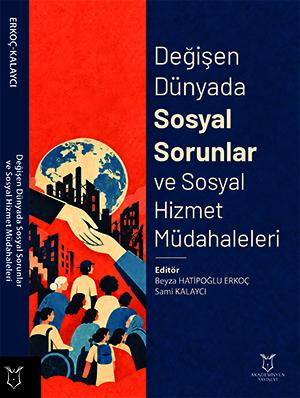
Şiddetin Değişen Biçimleri ve Sosyal Boyutları
Synopsis
Violence is a multidimensional social problem that extends beyond physical aggression and affects individuals and social relationships in different ways. Its occurrence and consequences are associated not only with individual characteristics but also with power relations, social environments, and broader social conditions. This chapter examines the physical, psychological, sexual, and economic forms of violence and their changing manifestations in society. Particular attention is given to how digital technologies enable stalking, harassment, threats, and controlling behaviors to continue across different settings in everyday and working life. These developments are considered not simply as the emergence of entirely new forms of violence but as changes in the ways existing patterns of power and control operate. The discussion also addresses the individual and social consequences of violence, emphasizing the importance of recognizing less visible forms of harm and the conditions in which violence occurs. The chapter further considers the role of social work in preventing violence and supporting individuals exposed to it. Addressing individual needs alongside relational, institutional, and social conditions provides a broader basis for preventive efforts and support services.
References
Benítez-Hidalgo, V., Pastor-Moreno, G., Ruiz-Pérez, I. ve Amaya-Santos, S. (2026). Technology-facilitated sexual violence against women and its health impact: A mixed-methods systematic review. BMC Public Health, 26, 543. https://doi.org/10.1186/s12889-026-26260-4
Böhret, I. A., Pillai, V. S. ve Steinert, J. I. (2025). What works in reducing economic violence against women: Global evidence from a systematic review and meta-analysis. Trauma, Violence, & Abuse. Advance online publication. https://doi.org/10.1177/15248380251383915
Farmer, P. (2004). An anthropology of structural violence. Current Anthropology, 45(3), 305-325. https://doi.org/10.1086/382250
Galtung, J. (1969). Violence, peace, and peace research. Journal of Peace Research, 6(3), 167-191. https://doi.org/10.1177/002234336900600301
Heise, L. L. (1998). Violence against women: An integrated, ecological framework. Violence Against Women, 4(3), 262-290. https://doi.org/10.1177/1077801298004003002
Heise, L., Pallitto, C., García-Moreno, C. ve Clark, C. J. (2019). Measuring psychological abuse by intimate partners: Constructing a cross-cultural indicator for the Sustainable Development Goals. SSM - Population Health, 9, 100377. https://doi.org/10.1016/j.ssmph.2019.100377
International Federation of Social Workers. (2014). Global definition of social work. https://www.ifsw.org/what-is-social-work/global-definition-of-social-work/
International Labour Organization. (2019). Violence and Harassment Convention, No.190. https://normlex.ilo.org/dyn/nrmlx_en/f?p=NORMLEXPUB:12100:0::NO::P12100_ILO_CODE:C190
Johnson, L., Chen, Y., Stylianou, A. ve Arnold, A. (2022). Examining the impact of economic abuse on survivors of intimate partner violence: A scoping review. BMC Public Health, 22, 1014. https://doi.org/10.1186/s12889-022-13297-4
Krug, E. G., Dahlberg, L. L., Mercy, J. A., Zwi, A. B. ve Lozano, R. (Eds.). (2002). World report on violence and health. World Health Organization.
Piippo, S., Kaittila, A. ve Nyqvist, L. (2026). Technology-facilitated client violence in Finnish social services: A street-level bureaucracy perspective. The British Journal of Social Work, bcag130. https://doi.org/10.1093/bjsw/bcag130
Quilty, E. ve Flynn, A. (2026). Technology-facilitated violence in the Indo-Pacific: A scoping review. Trauma, Violence, & Abuse, 27(3), 704-716. https://doi.org/10.1177/15248380251323217
Rogers, M. M., Fisher, C., Ali, P., Allmark, P. ve Fontes, L. (2023). Technology-facilitated abuse in intimate relationships: A scoping review. Trauma, Violence, & Abuse, 24(4), 2210-2226. https://doi.org/10.1177/15248380221090218
Vidal-Marti, C. ve Ruiz Bueno, A. (2024). Consequences of client violence towards the social worker: A systematic review. International Social Work, 67(5), 1179-1194. https://doi.org/10.1177/00208728241237934
Weekes, C. J., Storey, J. E. ve Pina, A. (2026). Cyberstalking perpetrators and their methods: A systematic literature review. Trauma, Violence, & Abuse, 27(3), 1009-1025. https://doi.org/10.1177/15248380251333411
Wijamuni, N., Elneil, S., Phiri, P., Sundarapperuma, T., Warushahennadi, J., Pathiraja, V., ... Delanerolle, G. (2026). Intersecting inequities: A systematic review of socio-cultural, economic, and legal determinants of violence against women and girls in Asia (ANULA project-WP1 Evidence Synthesis). BMC Public Health, 26, 873. https://doi.org/10.1186/s12889-026-26360-1
Wilson, C., Sheridan, L. ve Garratt-Reed, D. (2022). What is cyberstalking? A review of measurements. Journal of Interpersonal Violence, 37(11-12), NP9763-NP9783. https://doi.org/10.1177/0886260520985489
Wolf, A., Gray, R. ve Fazel, S. (2014). Violence as a public health problem: An ecological study of 169 countries. Social Science & Medicine, 104, 220-227. https://doi.org/10.1016/j.socscimed.2013.12.006
World Health Organization. (2016). INSPIRE: Seven strategies for ending violence against children. World Health Organization.
World Health Organization. (2022). WHO Violence Prevention Unit: Approach, objectives and activities, 2022-2026. World Health Organization.
World Health Organization. (2025). RESPECT women: Preventing violence against women (2nd ed). World Health Organization.