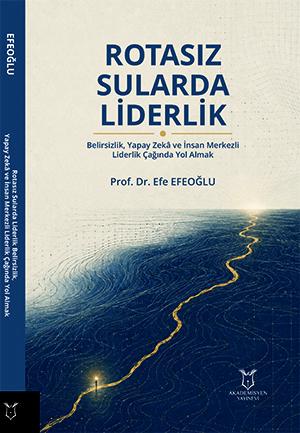
Rotasız Sularda Liderlik: Belirsizlik, Yapay Zekâ ve İnsan Merkezli Liderlik Çağında Yol Almak
Özet
-
Referanslar
Bennett, N., & Lemoine, G. J. (2014). What a difference a word makes: Understanding threats to performance in a VUCA world. Business Ho- rizons, 57(3), 311–317.
Burns, J. M. (1978). Leadership. Harper & Row.
European Parliament and Council of the European Union. (2024). Regulation (EU) 2024/1689 laying down harmonised rules on artificial intelligence (Ar- tificial Intelligence Act). Official Journal of the European Union.
Heifetz, R. A. (1994). Leadership without easy answers. Harvard University Press.
Heifetz, R. A., & Linsky, M. (2002). Leadership on the line: Staying alive through the dangers of leading. Harvard Business School Press.
Johansen, B. (2012). Leaders make the future: Ten new leadership skills for an uncertain world (2nd ed.). Berrett-Koehler.
Johansen, B. (2020). Full-spectrum thinking: How to escape boxes in a post-cate- gorical future. Berrett-Koehler.
Kahneman, D. (2011). Thinking, fast and slow. Farrar, Straus and Giroux. Mintzberg, H. (1994). The rise and fall of strategic planning. Free Press.
Raisch, S., & Krakowski, S. (2021). Artificial intelligence and management: The automation–augmentation paradox. Academy of Management Review, 46(1), 192–210.
Shneiderman, B. (2022). Human-centered AI. Oxford University Press.
Stacey, R. D. (2001). Complex responsive processes in organizations: Learning and knowledge creation. Routledge.
Teece, D. J., Pisano, G., & Shuen, A. (1997). Dynamic capabilities and strategic management. Strategic Management Journal, 18(7), 509–533.
Weick, K. E. (1995). Sensemaking in organizations. Sage.
Bennett, N., & Lemoine, G. J. (2014). What VUCA really means for you. Har- vard Business Review, 92(1–2).
Graham, N. (2025, March 11). A world of VUCA to FLUX. Substack. Hines, A. (2021, August 20). Real options, scenarios, & sensemaking.
International Labour Organization. (2020). Teleworking during the COVID-19 pandemic and beyond: A practical guide. International Labour Office.
Johansen, B. (2012). Leaders make the future: Ten new leadership skills for an uncertain world (2nd ed.). Berrett-Koehler.
Kergroach, S., & Héritier, J. (2025). Emerging divides in the transition to artificial intelligence (OECD Regional Development Papers No. 147). OECD Publis- hing. https://doi.org/10.1787/7376c776-en
Lawrence, K. (2013). Developing leaders in a VUCA environment. UNC Execu- tive Development.
OECD. (2025). Emerging divides in the transition to artificial intelligence. OECD.
Schoemaker, P. J. H., Krupp, S., & Howland, S. (2013). Strategic leadership: The essential skills. Harvard Business Review, 91(1–2).
Syamsir, Saputra, N., & Mulia, R. A. (2025). Leadership agility in a VUCA world: A systematic review, conceptual insights, and research directions. Cogent Business & Management, 12(1). https://doi.org/10.1080/23311975. 2025.2482022
Telli, E. (2025). Agility and leadership in the VUCA environment: A view of global research tendencies. Erciyes Üniversitesi İktisadi ve İdari Bilimler Fa- kültesi Dergisi, 71, 195–201. https://doi.org/10.18070/erciyesiibd.1531595
Weconomy. (2026, January 7). Leading in times of FLUX: Strategy and leadership in the AI era.
Wollmann, D. G., & Steiner, M. T. A. (2017). The strategic decision-making as a complex adaptive system: A conceptual scientific model. Complexity, 2017, Article 7954289. https://doi.org/10.1155/2017/7954289
World Economic Forum. (2025). The Future of Jobs Report 2025. World Econo- mic Forum.
World Health Organization. (2020, March 11). WHO Director-General’s opening remarks at the media briefing on COVID-19—11 March 2020.
Amodei, D., & Hernandez, D. (2018, May 16). AI and compute. OpenAI. https://openai.com/index/ai-and-compute/
CrowdStrike. (2024, August 6). External technical root cause analysis—Channel File 291.
https://www.crowdstrike.com/wp-content/uploads/2024/08/Channel-Fi- le-291-Incident-Root-Cause-Analysis-08.06.2024.pdf
Heifetz, R. A., Grashow, A., & Linsky, M. (2009). The practice of adaptive leaders- hip: Tools and tactics for changing your organization and the world. Harvard Business Press.
Moore, G. E. (1965). Cramming more components onto integrated circuits. Ele- ctronics, 38(8), 114–117.
Nordhaus, W. D. (2007). Two centuries of productivity growth in computing.
The Journal of Economic History, 67(1), 128–159. https://doi.org/10.1017/S0022050707000058
Shneiderman, B. (2022). Human-centered AI. Oxford University Press. Snowden, D. J., & Boone, M. E. (2007). A leader’s framework for decision making. Harvard Business Review, 85(11), 68–76.
Weston, D. (2024, July 20). Helping our customers through the CrowdStrike outa- ge. The Official Microsoft Blog.
https://blogs.microsoft.com/blog/2024/07/20/helping-our-customers-throu- gh-the-crowdstrike-outage/
World Economic Forum. (2025). The future of jobs report 2025. https://www.weforum.org/publications/the-future-of-jobs-report-2025/
Heifetz, R. A., Grashow, A., & Linsky, M. (2009). The practice of adaptive leaders- hip: Tools and tactics for changing your organization and the world. Harvard Business Press.
Kahneman, D. (2011). Thinking, fast and slow. Farrar, Straus and Giroux. Klein, G. (1998). Sources of power: How people make decisions. MIT Press.
OpenAI. (2023, November 29). Sam Altman returns as CEO, OpenAI has a new initial board. https://openai.com/index/sam-altman-returns-as-ceo-ope- nai-has-a-new-initial-board/
OpenAI. (2024, March 8). Review completed & Altman, Brockman to continue to lead OpenAI.
Senge, P. M. (2006). The fifth discipline: The art and practice of the learning orga- nization (Rev. ed.). Doubleday.
Simon, H. A. (1955). A behavioral model of rational choice. The Quarterly Jour- nal of Economics, 69(1), 99–118. https://doi.org/10.2307/1884852
Snowden, D. J., & Boone, M. E. (2007). A leader’s framework for decision ma- king. Harvard Business Review, 85(11), 68–76.
Stacey, R. D. (1996). Strategic management and organisational dynamics (2nd ed.). Pitman Publishing.
Weick, K. E. (1995). Sensemaking in organizations. Sage.
Argyris, C. (1977). Double-loop learning in organizations. Harvard Business Re- view, 55(5), 115–125.
Argyris, C., & Schön, D. A. (1978). Organizational learning: A theory of action perspective. Addison-Wesley.
Arkes, H. R., & Blumer, C. (1985). The psychology of sunk cost. Organizatio- nal Behavior and Human Decision Processes, 35(1), 124–140. https://doi. org/10.1016/0749-5978(85)90049-4
Asch, S. E. (1956). Studies of independence and conformity: I. A minority of one against a unanimous majority. Psychological Monographs: General and Applied, 70(9), 1–70. https://doi.org/10.1037/h0093718
Bazerman, M. H., & Moore, D. A. (2013). Judgment in managerial decision ma- king (8th ed.). Wiley.
Beshears, J., & Gino, F. (2015). Leaders as decision architects. Harvard Business Review, 93(5), 52–62.
Dweck, C. S. (2006). Mindset: The new psychology of success. Random House. Janis, I. L. (1982). Groupthink: Psychological studies of policy decisions and fias-
coes (2nd ed.). Houghton Mifflin.
Johnson-Laird, P. N. (1983). Mental models: Towards a cognitive science of langu- age, inference, and consciousness. Cambridge University Press.
Kahneman, D. (2011). Thinking, fast and slow. Farrar, Straus and Giroux.
NIKE, Inc. (2024, June 27). NIKE, Inc. reports fiscal 2024 fourth quarter and full year results. https://investors.nike.com/investors/news-events-and-re- ports/investor-news/investor-news-details/2024/NIKE-Inc.-Reports-Fis- cal-2024-Fourth-Quarter-and-Full-Year-Results/default.aspx
Powell, T. C., Lovallo, D., & Fox, C. R. (2011). Behavioral strategy. Strategic Ma- nagement Journal, 32(13), 1369–1386. https://doi.org/10.1002/smj.968
Schön, D. A. (1983). The reflective practitioner: How professionals think in action. Basic Books.
Senge, P. M. (2006). The fifth discipline: The art and practice of the learning organization (Rev. ed.). Doubleday.
Staw, B. M. (1976). Knee-deep in the big muddy: A study of escalating commitment to a chosen course of action. Organizational Behavior and Human Performance, 16(1), 27–44. https://doi.org/10.1016/0030-5073(76)90005-2 Tabassum, J., & Venugopal, A. (2024, September 20). Nike’s new CEO may look to mend retailer ties in sales revival push. Reuters. https://www.reuters. com/business/retail-consumer/nikes-new-ceo-may-look-fix-retailer-ties-
sales-revival-push-2024-09-20/
Thaler, R. H., & Sunstein, C. R. (2008). Nudge: Improving decisions about health, wealth, and happiness. Yale University Press.
Deloitte. (2026). 2026 Gen Z and Millennial Survey. https://www.deloitte.com/ global/en/issues/work/genz-millennial-survey.html
De Meuse, K. P., Dai, G., & Hallenbeck, G. S. (2010). Learning agility: A const- ruct whose time has come. Consulting Psychology Journal: Practice and Re- search, 62(2), 119–130. https://doi.org/10.1037/a0019988
Edmondson, A. (1999). Psychological safety and learning behavior in work teams. Administrative Science Quarterly, 44(2), 350–383. https://doi. org/10.2307/2666999
Fernández-Aráoz, C. (2014). 21st-century talent spotting. Harvard Business Review, 92(6), 46–54, 56, 138. https://hbr.org/2014/06/21st-century-ta- lent-spotting
Grant, A. M. (2012). An integrated model of goal-focused coaching: An evi- dence-based framework for teaching and practice. International Coac- hing Psychology Review, 7(2), 146–165. https://doi.org/10.53841/bpsi- cpr.2012.7.2.146
Kierein, N. M., & Gold, M. A. (2000). Pygmalion in work organizations: A me- ta-analysis. Journal of Organizational Behavior, 21(8), 913–928. https:// doi.org/10.1002/1099-1379(200012)21:8%3C913::AID-JOB62%3E3.0. CO;2-%23
Kram, K. E. (1985). Mentoring at work: Developmental relationships in organiza- tional life. Scott, Foresman.
LinkedIn Economic Graph. (2025, January). Work Change Report: AI is coming to work. LinkedIn. https://economicgraph.linkedin.com/research/work-c- hange-report
Lombardo, M. M., & Eichinger, R. W. (1996). The career architect development planner. Lominger.
McCauley, C. D., Ruderman, M. N., Ohlott, P. J., & Morrow, J. E. (1994). Asses- sing the developmental components of managerial jobs. Journal of Applied Psychology, 79(4), 544–560. https://doi.org/10.1037/0021-9010.79.4.544
Schneider Electric. (2024). 2023 Human Resources Report. https://www.se.com/ ww/en/assets/564/document/466152/2023-human-resources-report.pdf
Silzer, R., & Church, A. H. (2009). The pearls and perils of identifying poten- tial. Industrial and Organizational Psychology, 2(4), 377–412. https://doi. org/10.1111/j.1754-9434.2009.01163.x
Stone, D., & Heen, S. (2014). Thanks for the feedback: The science and art of rece- iving feedback well. Viking.
World Economic Forum. (2025). The future of jobs report 2025. https://www. weforum.org/publications/the-future-of-jobs-report-2025/
Youthall. (2025, November 13). Gençlerin Beklenti ve Yönelimleri Araştırma Ra- poru 2025. https://blog.youthall.com/genclerin-beklenti-ve-yonelimleri-a- rastirma-raporu-2025/
Colquitt, J. A. (2001). On the dimensionality of organizational justice: A const- ruct validation of a measure. Journal of Applied Psychology, 86(3), 386–400. https://doi.org/10.1037/0021-9010.86.3.386
Dirks, K. T., & Ferrin, D. L. (2002). Trust in leadership: Meta-analytic findings and implications for research and practice. Journal of Applied Psychology, 87(4), 611–628. https://doi.org/10.1037/0021-9010.87.4.611
Edmondson, A. (1999). Psychological safety and learning behavior in work teams. Administrative Science Quarterly, 44(2), 350–383. https://doi. org/10.2307/2666999
Edmondson, A. C., & Lei, Z. (2014). Psychological safety: The history, renais- sance, and future of an interpersonal construct. Annual Review of Orga- nizational Psychology and Organizational Behavior, 1, 23–43. https://doi. org/10.1146/annurev-orgpsych-031413-091305
French, J. R. P., Jr., & Raven, B. H. (1959). The bases of social power. In D. Cartw- right (Ed.), Studies in social power (pp. 150–167). Institute for Social Rese- arch, University of Michigan.
Mayer, R. C., Davis, J. H., & Schoorman, F. D. (1995). An integrative model of organizational trust. Academy of Management Review, 20(3), 709–734. https://doi.org/10.5465/amr.1995.9508080335
Microsoft. (2026, May 5). 2026 Work Trend Index Annual Report: Agents, human agency, and the opportunity for every organization. WorkLab.
Neeley, T. (2021). Remote work revolution: Succeeding from anywhere. Harper Business.
Shneiderman, B. (2022). Human-centered AI. Oxford University Press. Tyler, T. R. (1990). Why people obey the law. Yale University Press.
Uhl-Bien, M. (2006). Relational leadership theory: Exploring the social proces- ses of leadership and organizing. The Leadership Quarterly, 17(6), 654–676. https://doi.org/10.1016/j.leaqua.2006.10.007
Woolley, A. W., Chabris, C. F., Pentland, A., Hashmi, N., & Malone, T. W. (2010). Evidence for a collective intelligence factor in the performance of human groups. Science, 330(6004), 686–688. https://doi.org/10.1126/scien- ce.1193147
Zenger, J., & Folkman, J. (2016, July 14). What great listeners actually do. Har- vard Business Review.
Arkes, H. R., & Blumer, C. (1985). The psychology of sunk cost. Organizatio- nal Behavior and Human Decision Processes, 35(1), 124–140. https://doi. org/10.1016/0749-5978(85)90049-4
Doz, Y. L., & Kosonen, M. (2010). Embedding strategic agility: A leadership agenda for accelerating business model renewal. Long Range Planning, 43(2–3), 370–382. https://doi.org/10.1016/j.lrp.2009.07.006
Heifetz, R. A., Linsky, M., & Grashow, A. (2009). The practice of adaptive leaders- hip: Tools and tactics for changing your organization and the world. Harvard Business Press.
Khanna, T. (2014). Contextual intelligence. Harvard Business Review, 92(9), 58–68.
Klein, G. (2007). Performing a project premortem. Harvard Business Review, 85(9), 18–19.
March, J. G. (1991). Exploration and exploitation in organizational learning.
Organization Science, 2(1), 71–87. https://doi.org/10.1287/orsc.2.1.71 Mintzberg, H., & Waters, J. A. (1985). Of strategies, deliberate and emergent.
Strategic Management Journal, 6(3), 257–272. https://doi.org/10.1002/ smj.4250060306
O’Reilly, C. A., III, & Tushman, M. L. (2013). Organizational ambidexterity: Past, present, and future. Academy of Management Perspectives, 27(4), 324– 338. https://doi.org/10.5465/amp.2013.0025
Osborn, R. N., Hunt, J. G., & Jauch, L. R. (2002). Toward a contextual theo- ry of leadership. The Leadership Quarterly, 13(6), 797–837. https://doi. org/10.1016/S1048-9843(02)00154-6
Renault Group. (2024, January 29). Renault Group decides to cancel Ampe- re’s IPO and confirms its EV and software strategy. https://media.rena- ultgroup.com/renault-group-decides-to-cancel-amperes-ipo-and-confir- ms-its-ev-and-software-strategy/
Shimizu, K., & Hitt, M. A. (2004). Strategic flexibility: Organizational prepa- redness to reverse ineffective strategic decisions. Academy of Management Executive, 18(4), 44–59. https://doi.org/10.5465/ame.2004.15268683
Binns, R. (2018). Fairness in machine learning: Lessons from political philosop- hy. In S. A. Friedler & C. Wilson (Eds.), Proceedings of the 1st Conference on Fairness, Accountability and Transparency (Vol. 81, pp. 149–159). PMLR.
Dastin, J. (2018, October 10). Amazon scraps secret AI recruiting tool that showed bias against women. Reuters. https://www.reuters.com/article/wor- ld/insight-amazon-scraps-secret-ai-recruiting-tool-that-showed-bias-aga- inst-women-idUSKCN1MK0AG/
European Parliament & Council of the European Union. (2024). Regulation (EU) 2024/1689 of the European Parliament and of the Council of 13 June 2024 laying down harmonised rules on artificial intelligence and amending Regulations (EC) No 300/2008, (EU) No 167/2013, (EU) No 168/2013,
(EU) 2018/858, (EU) 2018/1139 and (EU) 2019/2144 and Directives 2014/90/EU, (EU) 2016/797 and (EU) 2020/1828 (Artificial Intelligence Act). Official Journal of the European Union, L, 2024/1689.
European Parliament & Council of the European Union. (2026). Regulation (EU) 2026/1744 of the European Parliament and of the Council of 8 July 2026 amending Regulations (EU) 2024/1689, (EU) 2018/1139 and (EU) 2023/1230 as regards the simplification of the implementation of harmoni- sed rules on artificial intelligence (Digital Omnibus on AI). Official Journal of the European Union, L, 2026/1744.
Floridi, L. (2023). The ethics of artificial intelligence: Principles, challenges, and opportunities. Oxford University Press. https://doi.org/10.1093/ oso/9780198883098.001.0001
Floridi, L., Cowls, J., Beltrametti, M., Chatila, R., Chazerand, P., Dignum, V., Lu- etge, C., Madelin, R., Pagallo, U., Rossi, F., Schafer, B., Valcke, P., & Vayena,
E. (2018). AI4People—An ethical framework for a good AI society: Op- portunities, risks, principles, and recommendations. Minds and Machines, 28(4), 689–707. https://doi.org/10.1007/s11023-018-9482-5
Hao, K. (2025). Empire of AI: Dreams and nightmares in Sam Altman’s OpenAI. Penguin Press.
Jarrahi, M. H. (2018). Artificial intelligence and the future of work: Human– AI symbiosis in organizational decision making. Business Horizons, 61(4), 577–586. https://doi.org/10.1016/j.bushor.2018.03.007
Mittelstadt, B. D., Allo, P., Taddeo, M., Wachter, S., & Floridi, L. (2016). The ethics of algorithms: Mapping the debate. Big Data & Society, 3(2), Article 2053951716679679. https://doi.org/10.1177/2053951716679679
Parasuraman, R., & Manzey, D. H. (2010). Complacency and bias in human use of automation: An attentional integration. Human Factors, 52(3), 381–410. https://doi.org/10.1177/0018720810376055
Raisch, S., & Krakowski, S. (2021). Artificial intelligence and management: The automation–augmentation paradox. Academy of Management Review, 46(1), 192–210. https://doi.org/10.5465/amr.2018.0072
Shneiderman, B. (2022). Human-centered AI. Oxford University Press. https:// doi.org/10.1093/oso/9780192845290.001.0001
Vallor, S. (2016). Technology and the virtues: A philosophical guide to a future worth wanting. Oxford University Press. https://doi.org/10.1093/acprof:o- so/9780190498511.001.0001
Wachter, S., Mittelstadt, B., & Russell, C. (2018). Counterfactual explanations without opening the black box: Automated decisions and the GDPR. Har- vard Journal of Law & Technology, 31(2), 841–887.
Wilson, H. J., & Daugherty, P. R. (2018). Collaborative intelligence: Humans and AI are joining forces. Harvard Business Review, 96(4), 114–123. https://hbr. org/2018/07/collaborative-intelligence-humans-and-ai-are-joining-forces
Ardern, J. (2023, January 19). Prime Minister Jacinda Ardern announces resigna- tion. New Zealand Government.
Bakker, A. B., & Demerouti, E. (2007). The job demands–resources model: State of the art. Journal of Managerial Psychology, 22(3), 309–328. https://doi. org/10.1108/02683940710733115
Bonanno, G. A. (2004). Loss, trauma, and human resilience: Have we underesti- mated the human capacity to thrive after extremely aversive events? Ameri- can Psychologist, 59(1), 20–28. https://doi.org/10.1037/0003-066X.59.1.20
Edmondson, A. C. (2018). The fearless organization: Creating psychological safety in the workplace for learning, innovation, and growth. John Wiley & Sons.
Frankl, V. E. (2006). Man’s search for meaning. Beacon Press. (Original work published 1946)
Lips-Wiersma, M., & Morris, L. (2009). Discriminating between “meaningful work” and the “management of meaning.” Journal of Business Ethics, 88(3), 491–511. https://doi.org/10.1007/s10551-009-0118-9
Loehr, J., & Schwartz, T. (2003). The power of full engagement: Managing energy, not time, is the key to high performance and personal renewal. Free Press.
Manz, C. C. (1986). Self-leadership: Toward an expanded theory of self-influ- ence processes in organizations. Academy of Management Review, 11(3), 585–600. https://doi.org/10.5465/AMR.1986.4306232
Maslach, C., & Leiter, M. P. (2016). Burnout. In G. Fink (Ed.), Stress: Concepts, cognition, emotion, and behavior (pp. 351–357). Academic Press.
Pratt, M. G., & Ashforth, B. E. (2003). Fostering meaningfulness in working and at work. In K. S. Cameron, J. E. Dutton, & R. E. Quinn (Eds.), Positive organizational scholarship: Foundations of a new discipline (pp. 309–327). Berrett-Koehler.
Schaufeli, W. B., & Bakker, A. B. (2004). Job demands, job resources, and their relationship with burnout and engagement: A multi-sample study. Journal of Organizational Behavior, 25(3), 293–315. https://doi.org/10.1002/job.248
Sutcliffe, K. M., & Vogus, T. J. (2003). Organizing for resilience. In K. S. Came- ron, J. E. Dutton, & R. E. Quinn (Eds.), Positive organizational scholarship: Foundations of a new discipline (pp. 94–110). Berrett-Koehler.
Sy, T., Côté, S., & Saavedra, R. (2005). The contagious leader: Impact of the leader’s mood on the mood of group members, group affective tone, and group processes. Journal of Applied Psychology, 90(2), 295–305. https://doi. org/10.1037/0021-9010.90.2.295
Bakker, A. B., & Demerouti, E. (2007). The job demands–resources model: State of the art. Journal of Managerial Psychology, 22(3), 309–328. https://doi. org/10.1108/02683940710733115
Dirks, K. T., & Ferrin, D. L. (2002). Trust in leadership: Meta-analytic findings and implications for research and practice. Journal of Applied Psychology, 87(4), 611–628. https://doi.org/10.1037/0021-9010.87.4.611
Doz, Y. L., & Kosonen, M. (2010). Embedding strategic agility: A leadership agenda for accelerating business model renewal. Long Range Planning, 43(2–3), 370–382. https://doi.org/10.1016/j.lrp.2009.07.006
Edmondson, A. C. (1999). Psychological safety and learning behavior in work teams. Administrative Science Quarterly, 44(2), 350–383. https://doi. org/10.2307/2666999
Floridi, L., Cowls, J., Beltrametti, M., Chatila, R., Chazerand, P., Dignum, V., Lu- etge, C., Madelin, R., Pagallo, U., Rossi, F., Schafer, B., Valcke, P., & Vayena,
E. (2018). AI4People—An ethical framework for a good AI society: Op- portunities, risks, principles, and recommendations. Minds and Machines, 28(4), 689–707. https://doi.org/10.1007/s11023-018-9482-5
Kahneman, D. (2011). Thinking, fast and slow. Farrar, Straus and Giroux. Loehr, J., & Schwartz, T. (2003). The power of full engagement: Managing energy, not time, is the key to high performance and personal renewal. Free Press. McCall, M. W., Jr. (2010). Recasting leadership development. Industrial and Organizational Psychology, 3(1), 3–19. https://doi.org/10.1111/j.1754- 9434.2009.01189.x
Shneiderman, B. (2022). Human-centered AI. Oxford University Press. Snowden, D. J., & Boone, M. E. (2007). A leader’s framework for decision making. Harvard Business Review, 85(11), 68–76.
Weick, K. E. (1995). Sensemaking in organizations. SAGE Publications.
İndir
Yayınlanan
Lisans
LisansBu İnternet Sitesi içeriğinde yer alan tüm eserler (yazı, resim, görüntü, fotoğraf, video, müzik vb.) Akademisyen Kitabevine ait olup, 5846 sayılı Fikir ve Sanat Eserleri Kanunu ve 5237 sayılı Türk Ceca Kanunu kapsamında korunmaktadır. Bu hakları ihlal eden kişiler, 5846 sayılı Fikir ve Sanat eserleri Kanunu ve 5237 sayılı Türk Ceza Kanununda yer alan hukuki ve cezai yaptırımlara tabi olurlar. Yayınevi ilgili yasal yollara başvurma hakkına sahiptir.
