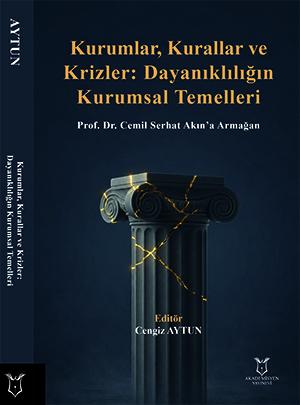
Devlet Kapasitesi, Yönetişim Sorunları ve Kurumsal Kalite
Özet
Bu çalışma, ülkeler arasındaki gelişmişlik ve refah farklarının temel belirleyicisinin fiziki veya beşerî sermaye stokundan ziyade kurumsal yapı olduğunu ortaya koyarak devlet kapasitesi, yönetişim kalitesi ve kurumsal performans arasındaki dinamik ilişkiyi incelemektedir. Literatürde devletin varlığının ekonomik büyüme ve toplumsal refah için tek başına yeterli olmadığını, devletin yapısal niteliğini ifade eden kurumsal kalite ile vadedilen politikaları hayata geçirme gücü olan devlet kapasitesinin de önemli olduğunu gösteren çok sayıda çalışma mevcuttur. Şoklar karşısında ekonomik ve toplumsal dayanıklılığın sağlanmasında şeffaflık, hesap verebilirlik, liyakat ve hukukun üstünlüğü ilkeleri önemli roller üstlenmektedir. Yapısal yönetişim sorunları kurumsal kalite üzerindeki tahrip edici etkilere sahiptir. Kurumsal kalitenin aşınması devletin meşruiyetini tartışmalı hale getirirken, ekonomi politikalarına güvenin aşınmasına, rüşvet ve rant kollama faaliyetlerinin artmasına, yolsuzluğun yaygın hale gelmesine neden olmaktadır. Böylece kaynaklar etkinsiz alanlara kaymakta, verimlilik azalmakta ve nihayetinde ekonomik büyüme ve kalkınma süreçleri sekteye uğramaktadır. Sürdürülebilir büyüme ve ekonomik dayanıklılık, ancak katı hiyerarşik yapılardan arınmış, esnek, öğrenen ve kapsayıcı bir kurumsal ekosistemin inşasıyla mümkündür.
Referanslar
Acemoğlu, D., & Robinson, J. A. (2012). Ulusların düşüşü: güç, zenginlik ve yoksulluğun kökenleri. Doğan Kitap.
Acemoğlu, D., & Robinson, J. A. (2019). Dar koridor: devletler, toplumlar ve özgürlüğün geleceği. Doğan Kitap.
Acemoğlu, D., Johnson, S., & Robinson, J. A. (2001). The colonial origins of comparative development: An empirical investigation. American Economic Review, 91(5), 1369–1401. https://doi.org/10.1257/aer.91.5.1369
Acemoglu, D., Johnson, S., & Robinson, J. (2004). Institutions as the fundamental cause of long-run growth (Working Paper No. 10481). National Bureau of Economic Research. http://www.nber.org/papers/w10481
Alfaro, L., Kalemli-Ozcan, S., & Volosovych, V. (2005, December). Why doesn’t capital flow from rich to poor countries? An empirical investigation (Working Paper No. 11901). National Bureau of Economic Research. https://doi.org/10.3386/w11901
Beck, T., & Levine, R. (2005). Legal institutions and financial systems revisited. In C. Ménard & M. M. Shirley (Eds.), Handbook of New Institutional Economics, 2nd Ed. (pp. 359–390). Springer.
Besley, T. (2006). Principals and agents: The political economy of good government. Oxford University Press.
Besley, T., Torsten. P. (2011) Pillars of Prosperity: The Political Economics of Development Clusters, Princeton: Princeton University Press. https://doi.org/10.1515/9781400840526
Besley, T., & Persson, T. (2013). Taxation and development. In A. J. Auerbach, A. W. Chetty, M. Feldstein, & E. Saez (Eds.), Handbook of Public Economics (Vol. 5, pp. 51–110). Elsevier. https://doi.org/10.1016/B978-0-444-53759-1.00002-9
Cardenas, M. (2010). State capacity in Latin America. Economía, 10(2), 1–45. https://www.jstor.org/stable/25800045
Dünya Bankası. (2017). World development report 2017: Governance and the law. World Bank Publications.
Evans, P. B. (1995). Embedded autonomy: States and industrial transformation. Princeton University Press.
Evans, P. B., & Rauch, J. E. (1999). Bureaucracy and growth: A cross-national analysis of the effects of "Weberian" state structures on economic growth. American Sociological Review, 64(5), 748–765. https://doi.org/10.1177/000312249906400508
Gervasoni, C. (2010). A rentier theory of subnational regimes: Fiscal federalism, democracy, and authoritarianism in the Argentine provinces. World Politics, 62(2), 302–340. https://doi.org/10.1017/S0043887110000067
Greif, A. (2006). Institutions and the path to the modern economy: Lessons from medieval trade. Cambridge University Press.
Gwartney, J., Lawson, R., Hall, J., & Murphy, R. (2020). Economic freedom of the world: 2020 annual report. Fraser Institute. https://dx.doi.org/10.2139/ssrn.3924422
Kaufmann, D., & Kraay, A. (2002). Growth without governance. Economía, 3(1), 169–229.
Kaufmann, D., Kraay, A., & Mastruzzi, M. (2011). The worldwide governance indicators: Methodology and analytical issues. Hague Journal on the Rule of Law, 3(2), 220–246. https://doi.org/10.1017/S1876404511200046
Knack, S., & Keefer, P. (1995). Institutions and economic performance: Cross-country tests using alternative institutional measures. Economics & Politics, 7(3), 207–227. https://doi.org/10.1111/j.1468-0343.1995.tb00111.x
Krueger, A. O. (1974). The political economy of the rent-seeking society. American Economic Review, 64(3), 291–303. http://www.jstor.org/stable/1808883
La Porta, R., Lopez-de-Silanes, F., Shleifer, A., & Vishny, R. (1999). The quality of government. Journal of Law, Economics, and Organization, 15(1), 222–279. https://doi.org/10.1093/jleo/15.1.222
Mauro, P. (1995). Corruption and growth. Quarterly Journal of Economics, 110(3), 681–712. https://doi.org/10.2307/2946696
North, D. C. (1990). Institutions, institutional change and economic performance. Cambridge University Press.
Ostrom, E. (2005). Understanding institutional diversity. Princeton University Press.
Rodrik, D., Subramanian, A., & Trebbi, F. (2004). Institutions rule: The primacy of institutions over geography and integration in economic development. Journal of Economic Growth, 9(2), 131–165. https://doi.org/10.1023/B:JOEG.0000031425.72248.85
Ross, M. L. (2012). The oil curse: How petroleum wealth shapes the development of nations. Princeton University Press.
Rothstein, B. (2011). The quality of government: Corruption, social trust, and inequality in international perspective. University of Chicago Press.
Voigt, S. (2017). How to measure informal institutions. Journal of Institutional Economics, 14(1), 1-22.
Wade, R. (2018). Conclusions (I): Governing the market in East Asia. Governing the market: Economic theory and the role of government in East Asian industrialization içinde (ss. 297-344). Princeton University Press. https://doi.org/10.1515/9780691187181-015
Williamson, O. E. (2000). The new institutional economics: Taking stock, looking ahead. Journal of Economic Literature, 38(3), 595–613. https://doi.org/10.1257/jel.38.3.595