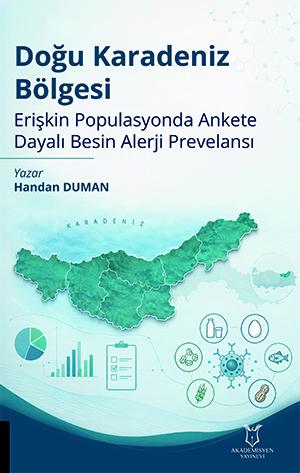
Doğu Karadeniz Bölgesi Erişkin Populasyonda Ankete Dayalı Besin Alerji Prevelansı
Özet
Amaç: Erişkinlerde besin alerjisi hakkında sınırlı ve tutarsız bilgiler vardır. Sosyokültürel durumlar ve diyet alışkanlıkları bu tutarsızlığı açıklayabilir. Bu çalışmada genel yetişkin popuklasyonda kendisinde besin alerjisi olduğunu düşünenlerin prevelansını bulmak amaçlanmıştır.
Metod: Kesitsel web tabanlı anket çalışması planlandı. Besin alımını takiben gelişen sağlık sorunlarını ile ilişkili 12 soruyu kapsayan anket hazırlandı. Türkiye’de Doğu Karadeniz Bölgesi erişkin populasyonu hedef kitle olarak seçildi. Anket 3 ay süresince yerel sanal yazılı medyada yayınlanarak katılımcıların doldurması sağlandı.
Sonuçlar: Çalışma populasyonu anketi gönüllü olarak dolduran 920 (VK/E:V604/316) kişiden oluşturuldu. Ortalama yaş 38,9 +_15,2 (18-88) idi. En az bir ek atopik hastalık katılımcıların oranı %36’ı ve birinci derece akrabalarında en az bir atopik hastalık olanların oranı ise %28.5 idi. Katılımcıların 157’ si (%17) kendisinde besin alerjisi olduğunu belirtti, kendisinde besin alerjisi olduğunu söyleyenler arasında cinsiyet açısından anlamlı fark tespit edilmedi. En sık alerjen besinler baharat (%15), domates (%10,9), inek sütü (%7,5) turunçgiller (%4,1) olarak tespit edildi. En sık semptomalr ürtiker (%63,5), gastrointestinal semptomlar (%30,2), rinit (%15,1), oral alerji sendromu (% 11,3 ) olarak bildirildi. Genç yaş (p= 0.004), kendisinde veya ailesinde atopik hastalık varlığı (p=0.001) besin alerjisi gelişimi için risk faktörü olarak bulundu.
Çıkarım: Doğu Karadeniz Bölgesi’nde erişkin populasyonda besin alerji prevelansı %17 olarak oldukça yüksek tespit edildi.
Background: There is limited data on the prevalence of food hypersensitivity (FH) in adult population. Sociocultural conditions and dietary habits may be responsible for the discordance. The aim of the study was to determine the self-reported prevalence of FH in general adult population.
Method: A cross-sectional web-based structured survey was designed. The questionnaire was consisted of 12 items related to complaints about the food intake. Adults born, raised and still living in the Eastern Black Sea region of Turkey were chosen as a targeted population. Several invitations were made on the local virtual media during 3 months in the previous year.
Results: The study population consisted of 920 (F/M: 604/316) subjects who answered voluntarily. The mean age was 38.9±15.2 (18-88) years. At least one atopic comorbidity was determined 36% of the subjects and 28.5% of their first-degree relatives. FH was reported by 157 (17.3%) subjects among them without statistical significant differences related to gender. The most allergen foods were spicery (15%), tomato (10.9%), cow milk (7.5%) and citrus fruit (4.1%). The most common reported symptom was urticaria (63.5%) followed by gastrointestinal symptoms (30.2%), worsening of rhinitis (15.1%) and oral allergy symptoms (11.3%). We found younger age (p=0.004), personal and familial history of any atopic disease (p=0.001) as a risk factor for having FH.
Conclusion: The prevalence of self-reported FH based on web based survey in Eastern Black Sea residents is relatively high and specific to the region.
Referanslar
Burney PGJ, Potts J, Kummeling E, et al. The prevelance and distribution of food sensitization in European adults. Allergy 2013; DOI: 10. 1111/all.12341
Rona RJ, Keil T, Summers C, et al. The prevelance of food allergy: a meta-analysis. J Allergy Clin Immunol 2007 120: 638-646.
Kivity S. Adult-onset food allergy. Isr Med Assoc J. 2012 Jan;14(1):70-2.
Gelincik A, Büyüköztürk S, Gül H, Işik E, Işsever H, Ozşeker F, Colakoğlu B, Dal M, Ayvaz O, Güngör G, Akkor A. Confirmed prevalence of food allergy and non-allergic food hypersensitivity in a Mediterranean population. Clin Exp Allergy. 2008 Aug; 38(8):1333-41.
Orhan F, Karakas T, Cakir M, Aksoy A, Baki A, Gedik Y. Prevalence of immunoglobulin E-mediated food allergy in 6-9-year-old urban schoolchildren in the eastern Black Sea region of Turkey. Clin Exp Allergy. 2009 Jul;39(7):1027-35.
Sampson HA. Food allergy. J Allergy Clin Immunol 2003;lll(2):S540-7.
Sampson HA, Burks AW. Adverse reactions to food. In: Adkınson NF, Bochner BS, Busse WW, Holgate ST, Lemanske RF, Simons, FER (eds). Middleton’s Allergy Principles & Practice. 7th ed. USA, China: Elsevier, 2009:1139-67.
Sicherer SH, Sampson HA. Food allergy. J Allergy Clin Immunol 2010;125:116-25.
Branum AM, Lukacs SL. Food allergy among U.S. children: Trends in prevelance and hospitalizations. NCHS Data Brief 2008;(10):1-8.
Lack G. Clinical practice. Food allergy. N Engl J Med 2008;359: 1252-60.
Celik G, Mungan D, Bavbek S, Sin B, Ediger D, Demirel Y, et al. The prevalence of allergic diseases and atopy in Ankara, Turkey: A two-step population-based epidemiological study. J Asthma, 1999;36:281-90.
Sidenius KE, Hallas TE, Poulsen LK, Mosbech H. Allergen cross-reactivity between house-dust mites and other invertebrates. Allergy 2001;56:723–733.
The EAACI Food Allergy and Anaphylaxis Public Declaration: http://www.anaphylaxisireland.ie/wp-content/uploads/2013/04/ FoodAllergyAnaphylaxisPublic DeclarationCombined-1.pdf (Accessed 27 May 2013).
Muraro A, Werfel T, Hoffmann-Sommergruber k et al. Diagnosiis and management of food allergy. İn :EAACI Guidlines:Food Allergy and Anaphylaxis. Ed(s). Murano A, Roberts G. EAACI, Zurich –Switzerland. 2014; 73-116
Deckers IA, McLean S, Linssen S, Mommers M, van Schayck CP, Sheikh A. Investigating international time trends in the incidence and prevalence of atopic eczema 1990–2010: a systematic review of epidemiological studies. PLoS ONE 2012;7:e39803.
Schoenwetter WF, Dupclay L Jr, Appajosyula S, Botteman MF, Pashos CL. Economic impact and quality of life burden of allergic rhinitis. Curr Med Res Opin 2004;20:305–317
Anandan C, Nurmatov U, van Schayck OC, Sheikh A. Is the prevalence of asthma declining? Systematic review of epidemiological studies Allergy 2010;65:152–167.
Allen JK, Koplin JJ. The epidemiology of IgE-mediated FA and anaphylaxis. Immunol Allergy Clin N Am 2012;32:35–50
Sicherer SH. Epidemiology of FA. J Allergy Clin Immunol 2011;127:594–602.
Prescott S, Allen KJ. FA: riding the second wave of the allergy epidemic. Pediatr Allergy Immunol 2011;22:155–160.
Nwaru BI, Hickstein L, Panesar SS et al.The epidemıology of food allergy in europe sysstematic review and metaa-analysis. İn: EAACI Guidlines: Food Allergy and Anaphylaxis. Ed(s) .Muraro A, Roberts G. EAACI, Zurich –Switzerland. 2014; 3-23.
Eggesbø M, Botten G, Stigum H, Nafstad P, Magnus P. Is delivery by cesarean section a risk factor for FA? J Allergy Clin Immunol2003;112:420–426.
Eggesbø M, Botten G, Halvorsen R, Magnus P. The prevalence of CMA/CMPI in young children: The validity of parentally perceived reactions in a population-based study. Allergy 2001b;56:393–402.
Host A, Halken S, Jacobsen HP, Christensen AE, Herskind AM, Plesner K. Clinical course of cow’s milk protein allergy/intolerance and atopic diseases in childhood. Pediatr Allergy Immunol 2002;13:23–28.
Penard-Morand C, Raherison C, Kopferschmitt C, Caillaud D, Lavaud F, Charpin D et al. Prevalence of FA and its relationship to asthma and allergic rhinitis in schoolchildren. Allergy 2005;60:1165–1171.
Pyrhonen K, Hiltunen L, Kaila M, Nayha € S, Laara E. Heredity of food allergies in an unselected child population: an epidemiological survey from Finland. Pediatr Allergy Immunol 2011;22:e124–e132.
Rance F, Grandmottet X, Grandjean H. Prevalence and main characteristics of schoolchildren diagnosed with food allergies in France. Clin Exp Allergy 2005;35: 167–172.
Steinke M, Fiocchi A, Kirchlechner V, Ballmer-Weber B, Brockow K, Hischenhuber C et al. Perceived FA in children in 10 European nations: a randomised telephone survey. Int Arch Allergy Immunol 2007;143:290–295.
Dean T, Venter C, Pereira B, Arshad SH, Grundy J, Clayton CB et al. Patterns of sensitization to food and aeroallergens in the first 3 years of life. J Allergy Clin Immunol 2007;120:1166–1171.
Pereira B, Venter C, Grundy J, Clayton CB, Arshad SH, Dean T. Prevalence of sensitization to food allergens, reported adverse reaction to foods, food avoidance, and food hypersensitivity among teenagers. J Allergy Clin Immunol 2005;116:884–892.
Mossakowska M, Pawlinska-Chmara R, Broczek KM. Asthma, allergy, and respiratory symptoms in centenarians living in Poland. J Physiol Pharmacol 2008;59(Suppl. 6):483–489
Du Toit G, Katz Y, Sasieni P, Mesher D, Maleki SJ, Fisher HR et al. Early consumption of peanuts in infancy is associated with a low prevalence of peanut allergy. J Allergy Clin Immunol 2008;122:984991
Rance F, Grandmottet X, Grandjean H. Prevalence and main characteristics of schoolchildren diagnosed with food allergies in France. Clin Exp Allergy 2005;35: 167–172.
Sampson H.Adverse reaactions to food.In Middleton E Jr,Recd CE, Ellis EF(eds), Allergy :Principles and practice,Washington,CV Mosby,1994:1661-86
Zeiger RS, Friedman NJ. The relationship of breastfeeding to the development of atopic disorders. Nestle Nutr Workshop Ser Pediatr Program 2006;57:93-105.
Cingi C, Demirbas D, Songu M. Allergic rhinitis caused by food allergies. Eur Arch Otorhinolaryngol 2010;267:1327-35.
Sampson HA, Lung DYM. Adverse reactions to food. In Kliegman RM, Behrman RE, Jenson HB, Stanton BF (eds). Nelson Textbook of Pediatrics 18th ed. USA, Elsevier, 2008:986-93.
Benhamou AH, Caubet JC, Eigenmann PA, Nowak-Wegrzyn A, Marcos CP, Reche M,et al. State of the art and new horizons in the diagnosis and management of egg allergy. Allergy 2010;65: 283-9.
Oberritter H.Food allergies.Zentralbl Hyg Umweltmed 1991 191:316-26
Eigenmann PA,Sampson HA.Adverse reaction to foods.İn Kaplan AP(ed).Allergy 2 ed. USA, WB Saunders Co.1997:54321.
Harmanyeri Y,Doğan B.,Besin alerjileri.Dermatolojide Gelişmeler -4,Deri ve Zührevi Hastalıklar Derneği, İstanbul 1995:45-56. .
Yakacaklı S, Öneş Ü, Akçakaya N,Ezer G,Çocuklarda besin alerjileri .1.Allerjik Hastalıklar Sempozyumu ,Ankara ,2-4 Haziran 1983:30-8
Bone J, Claver A, Guallar I, Plaza AM. Allergic proctocolitis, food-induced enterocolitis: Immune mechanisms, diagnosis and treatment. Allergol et Immunopathol 2009;37:36-42.
Food Allergy Emine Dibek Mısırlıoğlu, İlknur Bostancı, Türkiye Çocuk Hast Derg/Turkish J Pediatr Dis / 2013; 4: 206-213
American Gastroenterological Association technical review on the evaluation of food allergy in gastrointestinal disease. Gastroenterol 2001; 120: 1026-40.
Bischoff S, Crowe SE. Gastrointestinal food allergy new insights into pathophysiology and clinical perspectives. Gastroenterol 2005; 128: 1089-113.
Mari A, Ballmer-Weber BK, Vieths S. The oral allergy syndrome improved diagnostic and treatment methods. Curr Opin Allergy Clin Immunol 2005; 5: 267-73.
Murch SH. Clinical manifestations of food allergy the old and the new. Eur J Gastroenterol Hepatol 2005; 17: 1287-91.
Spergel JM, Pawlowski NA. Food allergy mechanisms, diagnosis and management in children. Pediatr Clin N Am 2002; 49: 73-96.
Murch SH. Clinical manifestations of food allergy the old and the new. Eur J Gastroenterol Hepatol 2005; 17: 1287- 91.
Liacouras CA, Ruchelli E. Eosinophilic esophagitis. Curr Opin Paeditr 2004; 16:560-6.
Rothenberg ME. Eosinophilic gastroentestinal disorders (EGID). J Allergy Clin Immunol 2004;113:11-28.
Kondo Y, Uriso A. Oral allergy syndrome.Allergol Int 2009;58(4):485-91.
Black AK ,Champion RH.Urticaria .In:Rook A,Wilkinson DS, Champion RH,Burton JG,Ebling FJG(eds).Textbook of Dermatology, Vol:III , 6 ed, Oxford ,Blackwell Scientific Publication ,1998:2113-39
Gordon BR. Approaches to testing for food and chemical sensitivities. Otolaryngol Clin NorthAm. 2003:36(5):917-40.
Mygind N, Dahi R, Pederson S, et alGastrointestinal reactions and food sensitivity Second edition Blackwell Science limited in Essential allergy. 1996; 129-151.
Hofman KM,Sampson H.Adverse reactions to foods.In :Bierman CW, Pearlman DS,Shapiro GG,Busse WW(eds), Allergy,Asthma and Immunology from infancy to adulthood,4 Ed.Phieledelphia,1996:665-86
Magazzu G, Scoglio R.Gastrointestinal manifestations of cow’ milk allergy .Ann Allergy Asthma Immunol 2002:89;65-8
Beyer K, Teuber SS. Food allergy diagnostics scientific and unproven procedures. Curr Opin Allergy Clin Immunol, 2005; 5: 261-6.
Roberts S. Challenging times for food allegy tests. ArchDis Child 2005; 90: 565-6.
Wang J. Management of the patient with multiple food allergies. Curr Allergy Asthma Rep 2010;10:271-7
Bindslev-Jensen C, Ballmer-Weber BK, Bengtsson U, Blanco C,Ebner C, Hourihane J, et al. Standardization of food challenges inpatients with immediate reactions to foods-position paper from theEuropean Academy of Allergology and Clinical Immunology. Allergy 2004;59:690-7.
Ceyda Tuna Kırsaçlıo Lu1, Ali Özden 2 Güncel Gastroenteroloji 10/2
Bischoff S, Crowe SE. Gastrointestinal food allergy new insights into pathophysiology and clinical perspectives. Gastroenterol 2005; 128: 1089-113.
Moneret-Vautrin DA. Gastrointestinal allergy in adults. Eur J Gastroenterol Hepatol 2005; 17: 1293-7.
Bischoff S, Crowe SE. Food allergy and the gastrointestinal tract. Curr Opin Gastroenterol 2004; 20: 156-61.
Heine RG. Pathophysiology, diagnosis and treatment of food protein induced gastrointestinal disease. Curr Opin Allergy Clin Immunol 2004; 4: 221-9
Hefle SL. Hidden food allergens. Curr Opin Allergy Clin Immunol 2001; 1: 269-71.
Fisher HR, Toit GD, Lack G. Specific oral tolerance induction in food allergic children: is oral desensitisation more effective than allergen avoidance?:A meta-analysis of published RCTs.Arch Dis Child 2010. (Epub ahead of print)99;36:281-90.
Leung DYM, Sampson HA, Yunginger JW, Burks AW Jr, Schneider LC, Wortel CH, et al. Effect of anti-IgE therapy in patient with peanut allergy. N Engl J Med 2003;348:986-93.
Papatya Bayrak. Besin Alerjileri, Sağlıkta Birikim Cilt:1 Sayı:1 sayfa 112-121
Giudice MM, Luca MG. The role of probiotics in the clinicalmanagement of food allergy and atopic dermatitis. J Clin Gastroenterol 2004; 38: 84-5.
Sampson AH. Food Allergy. Part 2: Diagnosis and management. J Allergy Clin Immunol 1999; 103:981-989. 10.
Sampson HA. Food Allergy. Part 1:Immunopathogenesis and clinical disorders. J Allergy Clin Immunol 1999;103: 717-728.
Sampson HA. Food Allergy. Part 1:Immunopathogenesis and clinical disorders. J Allergy Clin Immunol 1999;103: 717-728.
Bock SA, Atkins FM.The naturel history of penaut allergy.J.Allergy Clin Immunol 1989;83:900-4
Grundy J, Matthews S, Bateman B, Dean T, Arshad SH. Rising prevalence of allergy to peanut in children: Data from 2 sequential cohorts. J Allergy Clin Immunol 2002; 110 :784-9.
Asher MI, Montefort S, Björkstén B, et al. Worldwide time trends in the prevalence of symptoms of asthma, allergic rhinoconjunctivitis, and eczema in childhood: ISAAC Phases One and Three repeat multicountry cross-sectional surveys. Lancet 2006
McBride D, Keil T, Grabenhenrich L, et al. The EuroPrevall birth cohort study on food allergy: baseline characteristics of 12,000 newborns and their families from nine European countries. Pediatr Allergy Immunol 2012; 23: 230-9.
Roehr CC, Edenharter G, Reimann S, et al. Food allergy and nonallergic food hypersensitivity in children and adolescents. Clin Exp Allergy 2004; 34: 1534-41.
Osterballe M, Mortz CG, Hansen TK, Andersen KE, BindslevJensen C. The prevalence of food hypersensitivity in young adults. Pediatr Allergy Immunol 2009; 20: 68-92.
Branum AM, Lukacs SL. Food allergy among U.S. children: trends in prevalence and hospitalizations. NCHS Data Brief 2008; 10:1-8.
Obeng BB, Amoah AS, Larbi IA, et al. Food allergy in Ghanaian schoolchildren: data on sensitization and reported food allergy. Int .Arch Allergy Immunol 2011; 155: 63-73.
Bock SA, Muñoz-Furlong A, Sampson HA. Fatalities due to anaphylactic reactions to foods. J Allergy Clin Immunol 2001;107: 191-3.
Ercan H, Ozen A, Karatepe H, Berber M, Cengizlier R. Primary school teachers’ knowledge about and attitudes toward anaphylaxis Pediatr Allergy Immunol 2012; 23: 428-32
Barlık Faruk, Güner Ş. N., Barlık M. ,Söğüt A.,Sancak R. et al. Prevalence of food allergy in nursery and kindergarten children in Samsun. Turk Arch Ped 2013; 288-293
Bedolla-Barajas Martin , et al, Food Hypersensitivity in Mexican Adults at 18 to 50 Years of Age: A Questionnaire Survey, Allergy Asthma Immunol Res. 2014 Nov; 6(6): 511–516.
Jansen JJ, Kardinaal AF, Huijbers G, Vlieg-Boerstra BJ, Martens BP, Ockhuizen T. Prevalence of food allergy and intolerance in the adult Dutch population. J Allergy Clin Immunol. 1994;93:446–456. [PubMed]
Altman DR, Chiaramonte LT. Public perception of food allergy. J Allergy Clin Immunol. 1996;97:1247–1251. [PubMed]
Sampson HA. Epidemiology of food allergy. Pediatr Allergy Immunol. 1996;7:42–50. [PubMed]
Young E, Stoneham MD, Petruckevitch A, Barton J, Rona R. A population study of food intolerance. Lancet. 1994;343:1127–1130. [PubMed]
Schäfer T, Böhler E, Ruhdorfer S, Weigl L, Wessner D, Heinrich J, Filipiak B, Wichmann HE, Ring J. Epidemiology of food allergy/food intolerance in adults: associations with other manifestations of atopy. Allergy. 2001;56:1172–1179. [PubMed]
Zeiger RS, Heller S. The development and prediction of atopy in high-risk children: follow-up at age seven years in a prospective randomized study of combined maternal and infant food allergen avoidance. J Allergy Clin Immunol. 1995;95:1179–1190. [PubMed]
Woods RK, Abramson M, Bailey M, Walters EH. International prevalences of reported food allergies and intolerances. Comparisons arising from the European Community Respiratory Health Survey (ECRHS) 1991-1994. Eur J Clin Nutr. 2001;55:298–304. [PubMed]
Zuberbier T, Edenharter G, Worm M, Ehlers I, Reimann S, Hantke T, Roehr CC, Bergmann KE, Niggemann B. Prevalence of adverse reactions to food in Germany-a population study. Allergy.2004;59:338–345. [PubMed]
Falcão H, Lunet N, Lopes C, Barros H. Food hypersensitivity in Portuguese adults. Eur J Clin Nutr. 2004;58:1621–1625. [PubMed]
Vierk KA, Koehler KM, Fein SB, Street DA. Prevalence of self-reported food allergy in American adults and use of food labels. J Allergy Clin Immunol. 2007;119:1504–1510.
Soller L, Ben-Shoshan M, Harrington DW, Fragapane J, Joseph L, St Pierre Y, Godefroy SB, La Vieille S, Elliott SJ, Clarke AE. Overall prevalence of self-reported food allergy in Canada. J Allergy Clin Immunol. 2012;130:986–988. [PubMed]
Marrugo J, Hernández L, Villalba V. Prevalence of self-reported food allergy in Cartagena (Colombia) population. Allergol Immunopathol (Madr) 2008;36:320–324. [PubMed]
Rona RJ, Kell T, Summers C, Gisiason D, Zuidmeer L, Sodergren E. The prevelance of food allergy:a meta-analysis. J Allergy Clin İmmunol 2001;120:638-64
Kanny G, Moneret-Vautrin DA, Flabbee J, Beaudouin E, Morisset M, Thevenin F. Population study of FA in France. J Allergy Clin Immunol 2001;108:133–140.
Pyhonen K, Hiltunen L, Kalla M.Heredity of food allergies in an unselected child population:an epidemiological survey from Finland .Pediatr Allergy Immunol 2011;22;e124-e132
Kanny G, Moneret-Vautrin DA, Flabbee J, Beaudouin E, Morisset M, Thevenin F. Population study of FA in France. J Allergy Clin Immunol 2001;108:133–140.
Du Toit G, Katz Y, Sasieni P, Mesher D. Early consumption of peanutsi in infancy is associated with a low prevelance of peanut allergy
Tariq SM, Matthews SM, Hakim EA. Egg Allergy in infancy predicts respiratory allergic disease by 4 years of age.Pediatr Allergy Immunol 2000;11:162-167
Alvarado MI, Pérez M. Study of food allergy in the Spanish population. Allergol Immunopathol (Madr)2006;34:185–1924.
Sicherer SH, Muñoz-Furlong A, Sampson HA. Prevalence of seafood allergy in the United States determined by a random telephone survey. J Allergy Clin Immunol. 2004;114:159–165
Osterballe M, Hansen TK, Mortz CG, Høst A, Bindslev-Jensen C. The prevalence of food hypersensitivity in an unselected population of children and adults. Pediatr Allergy Immunol. 2005;16:567–573
Yoneyama K, Ono A. Study of food allergy among university students in Japan. Allergol Int.2002;51:205–208.
Gupta RS, Springston EE, Smith B, Warrier MR, Pongracic J, Holl JL. Geographic variability of childhood food allergy in the United States. Clin Pediatr (Phila) 2012; 51: 856-61.
Caffarelli C, Coscia A, Ridolo E, et al. Parents’ estimate of food allergy prevalence and management in Italian school-aged children. Pediatr Int 2011; 53: 505-10.
Yayınlanan
Lisans
LisansBu İnternet Sitesi içeriğinde yer alan tüm eserler (yazı, resim, görüntü, fotoğraf, video, müzik vb.) Akademisyen Kitabevine ait olup, 5846 sayılı Fikir ve Sanat Eserleri Kanunu ve 5237 sayılı Türk Ceca Kanunu kapsamında korunmaktadır. Bu hakları ihlal eden kişiler, 5846 sayılı Fikir ve Sanat eserleri Kanunu ve 5237 sayılı Türk Ceza Kanununda yer alan hukuki ve cezai yaptırımlara tabi olurlar. Yayınevi ilgili yasal yollara başvurma hakkına sahiptir.
