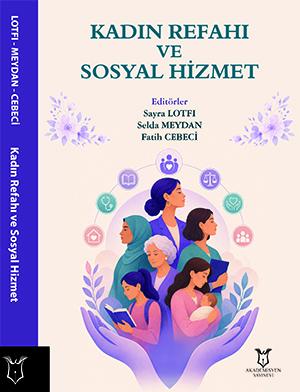
Kadın Refahını Anlamak: Kavramsal Çerçeve ve Sosyal Hizmet Perspektifi
Özet
Bu bölümde kadın refahı; toplumsal cinsiyet, kesişimsellik ve sosyal hizmet perspektifleri doğrultusunda kavramsal ve kuramsal bir çerçevede incelenmektedir. Kadınlığın yalnızca biyolojik bir kategori olmadığı; toplumsal, kültürel ve tarihsel süreçler içinde şekillenen dinamik bir sosyal konuma işaret ettiği vurgulanmakta, kadınların yaşam deneyimlerinin sınıf, etnisite, yaş, engellilik durumu ve diğer toplumsal konumlarla kesişen yapısı tartışılmaktadır. Bu kapsamda ekonomik bağımsızlık, sağlık, güvenlik, eğitim, sosyal katılım ve güçlenme kadın refahının temel bileşenleri arasında ele alınmaktadır. Ayrıca Sen’in yapabilirlik yaklaşımı ve Nussbaum’un yaklaşımı doğrultusunda kadın refahı; özgürlük, fırsatlara erişim ve bireylerin yaşamlarını şekillendirebilme kapasitesi bağlamında değerlendirilmektedir. Bölümde kadınların çoklu eşitsizlik deneyimleri incelenmekte; insan hakları, sosyal adalet ve güçlendirme ekseninde sosyal hizmetin kadın refahının geliştirilmesindeki rolü mikro, mezzo ve makro düzeylerde tartışılmaktadır. Bu yönüyle bölüm, kadın refahına ilişkin temel kavramsal tartışmaları bütüncül bir bakış açısıyla ele alarak kitabın ilerleyen bölümleri için kuramsal bir zemin sunmayı amaçlamaktadır.
This chapter examines women's welfare through the perspectives of gender, intersectionality, and social work within a conceptual and theoretical framework. It emphasizes that womanhood extends beyond a biological category and reflects a dynamic social position shaped by historical, cultural, and social processes. Women's lived experiences are addressed in relation to intersecting social positions such as class, ethnicity, age, disability, and other structural factors. Within this context, economic independence, health, safety, education, social participation, and empowerment are considered fundamental dimensions of women's welfare. Drawing on Sen’s capability approach and Nussbaum’s perspective, women's welfare is evaluated in relation to freedom, access to opportunities, and individuals’ capacity to shape their own lives. The chapter also explores women’s experiences of multiple inequalities and discusses the role of social work in promoting women’s welfare at micro, mezzo, and macro levels within the framework of human rights, social justice, and empowerment. In this respect, the chapter aims to provide a holistic understanding of women's welfare and establish a theoretical foundation for the subsequent chapters of the book.
Referanslar
Amitay, G., & Yassour-Borochowitz, D. (2025). Feminist community social work during COVID-19. Journal of Social Work, 25(6), 826–845. https://doi.org/10.1177/14680173251336088
Anam, B. E. (2024). Understanding gender in development: Core concepts, theories, and contemporary issues. International Journal of Advanced Research in Public Policy, Social Development and Enterprise Studies, 5(1), 284–310. https://doi.org/10.48028/iiprds/ijarppsdes.v5.i1.20
Aulia, S. S., Marzuki, Suyato, & Arpannudin, I. (2024). Women in gender equality movement: A systematic literature review. Frontiers in Sociology, 9, Article 1432383. https://doi.org/10.3389/fsoc.2024.1432383
Bohren, M., Iyer, A., Barros, A., Williams, C. R., Hazfiarini, A., Arroyave, L., et al. (2024). Towards a better tomorrow: Addressing intersectional gender power relations to eradicate inequities in maternal health. eClinicalMedicine, 67, Article 102180. https://doi.org/10.1016/j.eclinm.2023.102180
Cookson, T. P., Fuentes, L., Kuss, M. K., & Bitterly, J. (2023). Social norms, gender and development: A review of research and practice. UN Women. https://www.unwomen.org/en/digital-library/publications/2023/10/discussion-paper-social-norms-gender-and-development-a-review-of-research-and-practice
Dominelli, L. (2002). Feminist social work theory and practice. Palgrave Macmillan.
Gupta, S., Wei, M., Tzempelikos, N., & Shin, M. M. (2024). Women empowerment: Challenges and opportunities for sustainable development goals. Qualitative Market Research: An International Journal, 27(4), 608–630. https://doi.org/10.1108/QMR-11-2023-0160
Haman, O. B. (2025). Women and intersectional barriers in social exclusion. Women's Studies International Forum, 112, Article 103142. https://doi.org/10.1016/j.wsif.2025.103142
International Federation of Social Workers. (2025). Women. https://www.ifsw.org/women/
Iyer, A., Sen, G., Rao Seshadri, S., Snow, R., Ataullahjan, A., Liang, M., Baird, S., Drake, J. K., Sharafi, L., & Bhutta, Z. (2026). Women's health and well-being over the life course: Conceptual framing supported by a scoping review. BMJ Open, 16(2), e107988. https://doi.org/10.1136/bmjopen-2025-107988
Kabeer, N. (2005). Gender equality and women’s empowerment: A critical analysis of the third millennium development goal 1. Gender & Development, 13(1), 13–24. https://doi.org/10.1080/13552070512331332273
Knaifel, E., & Rubinstein, L. (2024). Intersectionality and caregiving: The exclusion experience and coping resources of immigrant women caring for a family member with severe mental illness. Qualitative Health Research, 35(6), 611–625. https://doi.org/10.1177/10497323241271996
Laine, E., & Anis, M. (2024). Female-specific perspectives in social work research in sub-Saharan Africa: Literature review. Nordic Social Work Research, 1–15. https://doi.org/10.1080/2156857X.2024.2373736
Lwamba, E., Shisler, S., Ridlehoover, W., Kupfer, M., Tshabalala, N., Nduku, P., Langer, L., Grant, S., Sonnenfeld, A., Anda, D., Eyers, J., & Snilstveit, B. (2022). Strengthening women's empowerment and gender equality in fragile contexts towards peaceful and inclusive societies: A systematic review and meta-analysis. Campbell Systematic Reviews, 18(1), e1214. https://doi.org/10.1002/cl2.1214
Martopullo, I., Neves, P. A., Baird, S., Liang, M., Keats, E. C., et al. (2024). Understanding progress and challenges in women's health and wellbeing in exemplar countries: A time-series study identifying positive outliers. The Lancet Global Health, 12(12), e2012–e2023. https://doi.org/10.1016/S2214-109X(24)00364-4
Mor Çatı Women's Shelter Foundation. (2023). Feminist approaches to social work in the struggle against male violence: World experiences conference book. Mor Çatı Women's Shelter Foundation. https://en.morcati.org.tr/wp-content/uploads/2023/07/feminist-approaches-to-social-work-in-the-struggle-against-male-violence-world-experiences-conference-book.pdf
Nussbaum, M. C. (2000). Women and human development: The capabilities approach. Cambridge University Press.
Nyahunda, L. (2021). Social work empowerment model for mainstreaming the participation of rural women in the climate change discourse. Journal of Human Rights and Social Work, 6, 120–129. https://doi.org/10.1007/s41134-020-00148-8
Organisation for Economic Co-operation and Development. (2024). Harnessing the green and digital transitions for gender equality: Policy insights from the 2024 OECD Forum on Gender Equality (OECD Public Governance Policy Papers No. 61). OECD Publishing. https://doi.org/10.1787/860d0901-en
Sen, A. (1999). Development as freedom. Alfred A. Knopf.
Staab, S., Williams, L., Tabbush, C., & Turquet, L. (2024). Harnessing social protection for gender equality, resilience and transformation. UN Women.
Taylor, D., Vseteckova, J., & Wainwright, J. (2025). Care, poverty and inequalities. International Journal of Care and Caring, 9(3), 425–433. https://doi.org/10.1332/23978821Y2025D000000127
Tinner, L., & Alonso Curbelo, A. (2024). Intersectional discrimination and mental health inequalities: A qualitative study of young women's experiences in Scotland. International Journal for Equity in Health, 23, 45. https://doi.org/10.1186/s12939-024-02133-3
Tombak İlhan, B. (2026). An intersectional perspective on education in Türkiye: Gender, social class, and school type. European Educational Research Journal. https://doi.org/10.1177/14749041261429800
Turner, S. G., & Maschi, T. M. (2015). Feminist and empowerment theory and social work practice. Journal of Social Work Practice, 29(2), 151–162. https://doi.org/10.1080/02650533.2014.941282
Udegbulem, O. C. (2025). Women empowerment and community development: Voices and perspectives of marginalised women in Nigeria. Integral Research, 2(8), 135–148.
United Nations. (2024). World social report 2024. https://www.un.org/development/desa/dpad/wp-content/uploads/sites/45/DESA-World-Social-Report_2024_FINAL_WEB.pdf
United Nations, Department of Economic and Social Affairs, Population Division (2024). World Population Prospects 2024, Online Edition. https://population.un.org/wpp/downloads
United Nations Development Programme. (2022). Gender equality strategy 2022–2025.
UN Women. (2024). Progress on the Sustainable Development Goals: The gender snapshot 2024. UN Women.
UN Women. (2025a). Executive Board of the United Nations Entity for Gender Equality and the Empowerment of Women: Annual report. https://docs.un.org/en/UNW/2025/2
UN Women. (2025b). How gender inequality and climate change are interconnected. https://www.unwomen.org/en/articles/explainer/how-gender-inequality-and-climate-change-are-interconnected
UN Women. (2025c). IANWGE intersectionality-informed gender analysis toolkit. https://www.unwomen.org/sites/default/files/2025-07/ianwge-intersectionality-informed-gender-analysis-toolkit-en.pdf
UN Women. (2026). Ideologies, institutions and power: Addressing discriminatory social norms. UN Women.
Women Against Violence Europe. (2023). WAVE country report 2023: Reality check on data collection and European services for women and children survivors of violence. WAVE Network. https://wave-network.org/wp-content/uploads/WAVE_CountryReport2023.pdf
World Bank Group. (2024). World Bank Group gender strategy 2024–2030: Accelerate gender equality to end poverty on a livable planet. World Bank. https://documents.worldbank.org/en/publication/documentsreports/documentdetail/099061124182033630
World Health Organization (WHO). (2021). Gender and health. https://www.who.int/news-room/questions-and-answers/item/gender-and-health
Zhu, N., Gaweł, A., & Toikko, T. (2025). Impacts of women's political and economic empowerment on social protection expenditures in the EU. International Journal of Sociology and Social Policy, 45(13–14), 113–129. https://doi.org/10.1108/IJSSP-04-2025-02