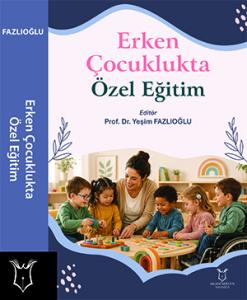
Dil Konuşma Güçlüğü Olan Küçük Çocuklar ve Aileleri
Özet
Çocuğun gelişimine dair temel göstergelerden biri dil ve konuşma becerilerini kazanmasıdır. Gelişimsel yetersizlikleri olan çocukların birçoğunda dil gelişiminde gecikme ve aksaklıklar dikkat çeker. Bunun yanı sıra dil alanındaki sorunlar başta iletişim olmak üzere çocuğun sosyal, duygusal, akademik alanlarda işlev göstermesini olumsuz etkiler. Dolayısıyla çocuğun dil becerilerinin değerlendirilmesi ve gerek duyuluyorsa desteklenmesi gelişimsel izlem açısından son derece önemlidir. Çocukta dil becerilerinin geliştirilmesini amaçlayan müdahalenin ayrılmaz bileşeni ailedir. Uzmanların doğrudan yürüttüğü uygulamalar, özellikle küçük çocuklarla uzun süreli verimli çalışmanın güçlüğü düşünüldüğünde tek başına yeterli olmayabilir. Çocuğa doğal ortamında ve doğal çevresi yoluyla öğrenme deneyimleri sunmayı hedefleyen erken özel eğitim programları mutlaka aileyi de kapsamalıdır. Ebeveynler hem değerlendirme hem de müdahale süreçlerinin en önemli bileşenlerindendir. Bu nedenle anne ve babaların çocuklarındaki problemler, tedavi hedefleri, çocuklarına sağlayabilecekleri destekler, ihtiyaç duyulan çevresel düzenlemeler ve doğru yaklaşım hakkında bilgilendirilmesi gerekir. Çocuğun ve ailenin bütüncül bir bakış açısıyla ele alındığı bu bölümde çocuğun dil ortamı, erken çocuklukta iletişim becerilerinin gelişimi ve bu gelişimdeki aksaklıklar, dil-konuşma güçlüğü bulunan küçük çocukların ve ebeveynlerinin desteklenmesi konularından söz edilmektedir.
One of the key indicators of a child's development is the acquisition of speech-language skills. Many children with developmental disabilities show delays and disruptions in language development. In addition, language problems negatively affect a child's functioning in communication, social, emotional, and academic areas. Therefore, assessing a child's language skills and providing support if needed is extremely important for developmental monitoring. The family is an integral component of any intervention aimed at developing a child's language skills. Direct interventions may not be sufficient, especially considering the difficulties in working with young children. Early special education programs that aim to provide children with learning experiences in and through their natural environment must also include the family. Parents are the most important components of both assessment and intervention processes. Therefore, parents need to be informed about their children's problems, treatment goals, the support they can provide, necessary environmental adjustments, and the right approach. It is necessary to understand the parents' expectations and to help them correct any mistakes they may have made. The interaction between family and child, the child's language environment, communication methods, language level, and the strengths and weaknesses of both family and child should be evaluated, and intervention goals should be determined. This section discusses the child's language environment, the development of communication skills in early childhood and disruptions in this development, and the support of young children with language and speech difficulties and their parents.
Referanslar
APA: American Psychiatric Association, DSM-5 Task Force. (2013). Diagnostic and statistical manual of mental disorders: DSM-5™ (5th ed.). Washington, DC: American Psychiatric Association.
Beaudoin, A. J., Sébire, G., & Couture, M. (2014). Parent training interventions for toddlers with autism spectrum disorder. Autism Research and Treatment, 2014(15), 1-15. doi: 10.1155/2014/839890
Bishop, D. V. M., Snowling, M. J., Thompson, P. A., Greenhalgh, T., & the Catalise-2 Consortium. (2017). Phase 2 of CATALISE: A multinational and multidisciplinary Delphi consensus study of problems with language development: Terminology. The Journal of Child Psychology and Psychiatry, 58(10), 1068–1080.
Curlee, R., & Yairi, E. (1997). Early intervention with early childhood stuttering: A critical examination of the data. American Journal of Speech-Language Pathology, 6(2), 8–18.
Diken, O. (2019). Describing and comparing pragmatic language skills of Turkish students with typical development and inclusive education students with mild intellectual disability. International Journal of Progressive Education, 15, 157–166. https://doi.org/10.29329/ijpe.2019.189.11.
Dunst, J., & Espe-Sherwindt, L. (2016) Parent mediated intervention in early childhood. In B. Reichow, B. A. Boyd, E. E. Barton & S. L. Odom (Eds.), Handbook of Early Childhood Special Education. (pp.37-56) Switzerland: Springer International.
Engelhardt, P. E., Ferreira, F., & Nigg, J. T. (2009). Priming sentence production in adolescents and adults with attention-deficit/hyper-activity disorder. Journal of Abnormal Child Psychology, 37(7), 995–1006
Eigsti, I. M., Bennetto, L., & Dadlani, M. B. (2007). Beyond pragmatics: Morphosyntactic development in autism. Journal of Autism and Developmental Disorders, 37(6), 1007-1023
Fisher, E. L. (2017). A Systematic Review and Meta-Analysis of Predictors of Expressive-Language Outcomes Among Late Talkers. Journal of Speech, Language & Hearing Research, 60(10), 2935–2948.
Hofmann, V., & Müller, C. M. (2021). Language skills and social contact among students with intellectual disabilities in special needs schools. Learning, Culture and Social Interaction, 30, 100534.
Hooper, C.R. (2004) Treatment of Voice Disorders in Children, Language Speech and Hearing Services in Schools, 35, 320-326.
Kent RD, Vorperian HK. Speech impairment in Down syndrome: a review. J Speech Lang Hear Res. 2013 Feb;56(1):178-210. doi: 10.1044/1092-4388(2012/12-0148). Epub 2012 Dec 28. PMID: 23275397; PMCID: PMC3584188.
Kim, O. H., & Kaiser, A. P. (2000). Language characteristics of children with ADHD. Communication Disorders Quarterly, 21(3), 154–165.
Kurt, O., & Subaşı Yurtçu, AB. (2017). Otizm spektrum bozukluğu olan bireylere yönelik kapsamlı uygulamalar. Sakarya University Journal of Education, 7(1), 155-182.
Lang S, Bartl-Pokorny KD, Pokorny FB, Garrido D, Mani N, Fox-Boyer AV, Zhang D, Marschik PB. Canonical Babbling: A Marker for Earlier Identification of Late Detected Developmental Disorders? Curr Dev Disord Rep. 2019;6(3):111-118. doi: 10.1007/s40474-019-00166-w. Epub 2019 May 30. PMID: 31984204; PMCID: PMC6951805
Madigan, S., Prime, H., Graham, S. A., Rodrigues, M., Anderson, N., Khoury, J., & Jenkins, J. M. (2019). Parenting behavior and child language: A meta-analysis. Pediatrics, 144(4), Article e20183556. https://doi.org/10.1542/peds.2018-3556
Mahoney, G., & Nam, S. (2011). The parenting model of developmental intervention. International Review of Research in Developmental Disabilities, 41(2011), 73-125.
McGregor KK. How We Fail Children With Developmental Language Disorder. Lang Speech Hear Serv Sch. 2020 Oct 2;51(4):981-992. doi: 10.1044/2020_LSHSS-20-00003
Mendez-Freije, I., Areces, D., & Rodriguez, C. (2023). Language skills in children with attention deficit hyperactivity disorder and developmental language disorder: a systematic review. Children, 11(1), 14.
Næss KA, Lyster SA, Hulme C, Melby-Lervåg M. Language and verbal short-term memory skills in children with Down syndrome: a meta-analytic review. Res Dev Disabil. 2011 Nov-Dec;32(6):2225-34. doi: 10.1016/j.ridd.2011.05.014. Epub 2011 May 31. PMID: 21628091.
Norbury, C. F., Gooch, D., Wray, C., Baird, G., Charman, T., Simonoff, E., Vamvakas, G., & Pickles, A. (2016). The impact of nonverbal ability on prevalence and clinical presentation of language disorder: Evidence from a population study. The Journal of Child Psychology and Psychiatry, 57(11), 1247–1257.
Odom, S. L., Boyd, B. A., Hall, L. J., & Hume, K. (2010). Evaluation of comprehensive treatment models for individuals with autism spectrum disorders. Journal of Autism and Developmental Disorders, 40(4), 425–436
Orum-Çattık, E., Yetkin, A. İ., & Diken, İ. H. (2019). Parent-implemented interventions in autism spectrum disorder in early childhood. Ankara University Faculty of Educational Sciences Journal of Special Education, 21(3), 589-610
Ökcün-Akçamuş, M. Ç. (2016). Otizm spektrum bozukluğu olan çocukların sosyal iletişim becerileri ve dil gelişim özellikleri. Ankara Üniversitesi Eğitim Bilimleri Fakültesi Özel Eğitim Dergisi, 17(02), 163-192
Parks, K.M.; Hannah, K.E.; Moreau, C.N.; Brainin, L.; Joanisse, M.F. Language Abilities in Children and Adolescents with DLD and ADHD: A Scoping Review. J. Commun. Disord. 2023, 106, 106381.
Paul, R. (2008). Communication development and assessment. In K. Chawarska, A. Klin & F. R. Volkmar (Eds.), Autism spectrum disorders in infants and toddlers (pp.76-103). New York: The Guilford Press.
Reilly S, Wake M, Ukoumunne OC, Bavin E, Prior M, Cini E, et al. (2010) Predicting language outcomes at 4 years of age: Findings from Early Language in Victoria Study. Pediatrics 126: E1530–E1537. doi: 10.1542/peds.2010-0254 PMID: 21059719
Rescorla, L. (2011). Late talker: Do good predictors of outcome exist? Developmental Disabilities Research Reviews, 17(2), 141–150.
Rescorla, L. A., 2013, Late-talking toddlers. A 15-year follow-up. In Rescorla, L. A. and Dale, P. S. (eds), Late Talkers: Language Development, Interventions and Outcomes (Baltimore, MD: Paul H. Brookes), pp. 219–239.
Richels, C. G., & Conture, E. G. (2007). An indirect treatment approach for early intervention for childhood stuttering. In E. G.Conture & R. F. Curlee (Eds.), Stuttering and related disorders of fluency (3rd ed., pp. 77–99). New York, NY: Thieme.
Seidenberg, M. (2018). Language at the speed of sight: How we read, why so many can’t and what can be done about it. New York: Basic Books.
Sidavi, A., & Fabus, R. (2010). A review of stuttering intervention approaches for preschool-age and elementary school-age children. Contemporary issues in communication science and disorders, 37(Spring), 14-26.
Snowling, M. J., Hayiou‐Thomas, M. E., Nash, H. M., & Hulme, C. (2020). Dyslexia and developmental language disorder: Comorbid disorders with distinct effects on reading comprehension. Journal of Child Psychology and Psychiatry, 61(6), 672-680.
Snowling, M. J., Moll, K., & Hulme, C. (2021). Language difficulties are a shared risk factor for both reading disorder and mathematics disorder. Journal of Experimental Child Psychology, 202, 105009.
Ullman, M. T. (2004). Contributions of memory circuits to language: The declarative/procedural model. Cognition, 92(1-2), 231-270.
van Witteloostuijn, M., Haggiyannes, A., de Bree, E., & Blom, E. (2025). Parental Input and Its Relationship with Language Outcomes in Children With (Suspected) Developmental Language Disorder: A Systematic Review. Journal of Speech, Language, and Hearing Research, 68(4), 1982-2005.
Vassiliu, C., Mouzaki, A., Antoniou, F., Ralli, A. M., Diamanti, V., Papaioannou, S., & Katsos, N. (2022). Development of Structural and Pragmatic Language Skills in Children With Attention-Deficit/Hyperactivity Disorder. Communication Disorders Quarterly, 44(4), 207-218