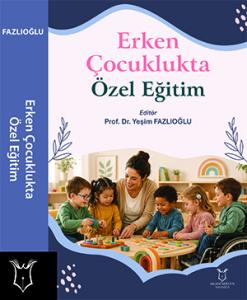
Erken Çocukluk Döneminde Özel Eğitim Kaynaştırma Ortamında Özel Gereksinimli Çocukların Desteklenmesi
Referanslar
Alberto, P. A. & Troutman, A. C. (2012). Applied behavior analysis for teachers (9th ed.). Pearson.
Barton, E. E. & Wolery, M. (2008). Teaching pretend play to children with disabilities: A review of the literature. Topics in Early Childhood Special Education, 28(2), 109-125. https://doi.org/10.1177/0271121408318799
Batu, E. S. & Kırcaali İftar, G. (2005). Kaynaştırma. Kök Yayıncılık.
Blue-Banning, M., Summers, J. A., Frankland, H. C., Nelson, L. L. & Beegle, G. (2004). Dimensions of family and professional partnerships: Constructive guidelines for collaboration. Exceptional Children, 70(2), 167–184. https://doi.org/10.1177/001440290407000203
Bondy, A. S. & Frost, L. A. (1994). The Picture Exchange Communication System. Focus on Autistic Behavior, 9(3), 1-19. 10.1177/108835769400900301
Buysse, V. & Bailey, D. B. (1993). Behavioral and developmental outcomes in young children with disabilities in integrated and segregated settings: A review of comparative studies. The Journal of Special Education, 26(4), 434-461. https://doi.org/10.1177/002246699302600407
Buysse, V., Goldman, B. D. & Skinner, M. L. (2002). Setting effects on friendship formation among young children with and without disabilities. Exceptional Children, 68(4), 503–517. https://doi.org/10.1177/001440290206800406
DEC/NAEYC. (2009). Early Childhood Inclusion. NAEYC.
Denham, S. A. (2006). Social-emotional competence as support for school readiness: What is it and how do we assess it? Early Education and Development, 17(1), 57–89. https://doi.org/10.1207/s15566935eed1701_4
Dettmer, S., Simpson, R. L., Myles, B. S. & Ganz, J. B. (2000). The use of visual supports to facilitate transitions of students with autism. Focus on Autism and Other Developmental Disabilities, 15(3), 163–169. https://doi.org/10.1177/108835760001500307
Diamond, K. E. & Huang, H. (2005). Preschoolers’ ideas about disabilities. Infants & Young Children, 18(1), 37-46. https://doi.org/10.1097/00001163-200501000-00005
Diamond, K. E., Hong, S. Y. & Tu, H. (2008). Context influences preschool children’s decisions to include a peer with a physical disability in play. Exceptionality, 16(3), 141-155. https://doi.org/10.1080/09362830802198328
Favazza, P.C., Ostrosky, M.M. & Mouzourou, C. (2020). Arkadaş Edinme Programı - The Making Friends Program (Çev. Edi.) E. Ahmetoğlu & T. Spendi-Şirin. Nobel Akademi.
Fish, W. W. (2008). The IEP meeting: Perceptions of parents of students who receive special education services. Preventing School Failure: Alternative Education for Children and Youth, 53(1), 8–14. https://doi.org/10.3200/PSFL.53.1.8-14
Garbacz, S. A., McIntyre, L. L. & Santiago, R. T. (2016). Family involvement and parent-teacher relationships for students with autism spectrum disorders. School Psychology Quarterly, 31(4), 478–490. https://doi.org/10.1037/spq0000157
Gray, C. (2015). The new social story book (15th anniversary ed.). Future Horizons.
Guralnick, M. J. (2001). A framework for change in early childhood inclusion. Early Childhood Inclusion: Focus on Change, 3-35.
Gürgür, H. (2009). Kaynaştırma uygulamalarının yürütüldüğü bir ilköğretim sınıfında işbirliği ile öğretim yaklaşımının incelenmesi [Yayınlanmamış Doktora tezi]. Anadolu Üniversitesi.
Gürgür, H. (2020). Kaynaştırma (bütünleştirme) ve destek özel eğitim hizmetleri. İçinde İ. H. Diken (Ed.), Özel eğitim ve kaynaştırma (ss. 123-141). Pegem Akademi.
Gürsoy Kızılaslan, İ. & Durukan, H. (2022). Okul Öncesi Öğretmen Adaylarının Kaynaştırma Eğitimine İlişkin Görüşlerinin İncelenmesi. Adnan Menderes Üniversitesi Eğitim Fakültesi Eğitim Bilimleri Dergisi, 13(1), 47-64.
Hamre, B. K. & Pianta, R. C. (2001). Early teacher–child relationships and the trajectory of children’s school outcomes through eighth grade. Child Development, 72(2), 625–638. https://doi.org/10.1111/1467-8624.00301
Hirsh-Pasek, K., Golinkoff, R. M., Berk, L. E. & Singer, D. G. (2009). A mandate for playful learning in preschool: Presenting the evidence. Oxford University Press.
Horner, R. H., Dunlap, G., Koegel, R. L., Carr, E. G., Sailor, W., Anderson, J., ... & O’Neill, R. E. (1990). Toward a technology of “nonaversive” behavioral support. Journal of the Association for Persons with Severe Handicaps, 15(3), 125-132. https://doi.org/10.1177/154079699001500301
Juvonen, J., Lessard, L. M., Rastogi, R. & Schacter, H. L. (2019). Promoting social inclusion in educational settings: Challenges and opportunities. Educational Psychologist, 54(4), 250–270. https://doi.org/10.1080/00461520.2019.1655645
Katz, J. & Mirenda, P. (2002). Including students with developmental disabilities in general education classrooms: Educational benefits. International Journal of Special Education, 17(2), 14-24.
Landreth, G. L. (2012). Play therapy: The art of the relationship (3rd ed.). Routledge.
Lindsay, S. & Edwards, A. (2013). A systematic review of disability awareness interventions for children and youth. Disability and Rehabilitation, 35(8), 623–646. 10.3109/09638288.2012.702850
McAfee, O., Leong, D. J. & Bodrova, E. (2004). Basics of assessment: A primer for early childhood educators. National Association for the Education of Young Children.
McLean, Hemmeter, M. L. & Snyder P. A. (2013). Essential elements for assessing infants and preschoolers with special needs (pp. 123-147). Pearson.
Millî Eğitim Bakanlığı. (2022). Kaynaştırma/Bütünleştirme Yoluyla Eğitim Uygulamaları Ulusal Eylem Planı (2022-2026). Özel Eğitim ve Rehberlik Hizmetleri Genel Müdürlüğü.
Mirenda, P. (2003). Toward functional augmentative and alternative communication for students with autism: Manual signs, graphic symbols, and voice output communication aids. Language, Speech, and Hearing Services in Schools, 34(3), 203-216. 10.1044/0161-1461(2003/017)
Mulligan, S. (2016). Occupational therapy evaluation for children: A pocket guide. Slack Incorporated.
Odom, S. L., Buysse, V. & Soukakou, E. (2012). Inclusion for young children with disabilities: A quarter century of research perspectives. Journal of Early Intervention, 33(4), 344-356. https://doi.org/10.1177/1053815111430094
Pfeiffer BA, Koenig K, Kinnealey M, Sheppard M, Henderson L. (2011). Effectiveness of sensory integration interventions in children with autism spectrum disorders: A pilot study. American Journal of Occupational Therapy, 65(1), 76-85. 10.5014/ajot.2011.09205
Rafferty, Y., Piscitelli, V. & Boettcher, C. (2003). The impact of inclusion on language development and social competence among preschoolers with disabilities. Exceptional Children, 69(4), 467-479. https://doi.org/10.1177/001440290306900405
Salend, S. J. & Garrick Duhaney, L. M. (1999). The impact of inclusion on students with and without disabilities and their educators. Remedial and Special Education, 20(2), 114-126. https://doi.org/10.1177/074193259902000209
Shonkoff, J. P. & Phillips, D. A. (2000). From neurons to neighborhoods: The science of early childhood development. National Academies Press. 10.17226/9824
Sugai, G., Horner, R. H., Dunlap, G., Hieneman, M., Lewis, T. J., Nelson, C. M., ... & Ruef, M. (2000). Applying positive behavior support and functional behavioral assessment in schools. Journal of Positive Behavior Interventions, 2(3), 131-143. https://doi.org/10.1177/109830070000200302
Turnbull, A., Turnbull, R., Erwin, E. J., Soodak, L. C. & Shogren, K. A. (2015). Families, professionals, and exceptionality: Positive outcomes through partnerships and trust (7th ed.). Pearson.
UDLL. (2017). Universal Design for Learning: A Best Practice Guideline. UDLL
UNESCO. (1994). The Salamanca Statement and Framework for Action on Special Needs Education. UNESCO.
United Nations. (1989). Convention on the Rights of the Child. United Nations.
Villa, R. A. & Thousand, J. S. (2016). Leading an inclusive school: Access and success for ALL students. ASCD.
Vygotsky, L. S. (1978). Toplum İçindeki Zihin: Yüksek Zihinsel İşlevlerin Gelişimi. Doruk Yayınları.
Wolfensberger, W., Nirje, B., Olshansky, S., Perske, R. & Roos, P. (1972). The principle of normalization in human services. Georgia Advocacy Office.