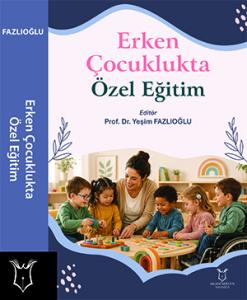
Erken Müdahalede Disiplinlerarası Yaklaşımlar
Özet
Erken çocuklukta müdahalede disiplinlerarası yaklaşımlar, biyolojik, psikolojik, eğitsel ve sosyal boyutların bütüncül biçimde değerlendirilmesiyle ele alınmaktadır. Bölüm, erken destek programlarının çocukların gelişimsel sonuçları kadar aile etkileşimleri ve bakım ortamları üzerindeki etkilerini vurgulamaktadır. Multidisipliner, interdisipliner ve transdisipliner iş birliği modelleri tanıtılarak iletişim, rol paylaşımı ve ortak sorumluluk süreçlerindeki farklı bakış açılarına göre ele almaktadır. Psikoloji, özel eğitim, dil ve konuşma terapisi, fizyoterapi, pediatri ve sosyal hizmet gibi disiplinlerin müdahale sürecine katkılarının bütüncül çerçevede ele alınmasının önemine değinmektedir. Bölüm etkili erken müdahalenin ekip çalışması, aile katılımı ve bağlamsal duyarlılık gerektirdiği ve bu sayede sürdürülebilir gelişimsel ilerlemeye etkisi vurgulanmaktadır.
Interdisciplinary approaches in early childhood intervention are examined with emphasis on the integration of biological, psychological, educational, and social dimensions. The chapter focuses on the significance of early support programs for both children’s developmental outcomes and family dynamics. Three collaboration models—multidisciplinary, interdisciplinary, and transdisciplinary—are described from different perspectives in the process of communication, role distribution, and shared responsibility. Contributions of psychology, special education, speech therapy, physiotherapy, pediatrics, and social work are discussed as complementary elements of holistic intervention. The text focuses the necessity of coordinated teamwork, family involvement and context-sensitive practices in effective early intervention and by this means fosters the sustainable developmental progress.
Referanslar
American Speech-Language-Hearing Association (ASHA). (2020). Roles and responsibilities of speech-language pathologists in early intervention.
Bakkaloğlu, H. (2013). Ebeveynlerin gözüyle özel gereksinimli çocukların erken müdahaleden okul öncesi programlara geçiş süreci. Education and Science, 38(169), 311-327.
Bricker, D., Xie, H., & Bohjanen, S. (2018). A history of EI/ECSE in the United States: A personal perspective. Journal of Early Intervention, 40(2), 121-137.
Bruder, M. B. (2010). Early childhood intervention: A promise to children and families for their future. Exceptional children, 76(3), 339-355.
Bruder, M. B., & Dunst, C. J. (2019). Family-centered practices in early childhood intervention. Topics in Early Childhood Special Education, 39(1), 3–15.
Case-Smith, J., O’Brien, J. C., & DeLany, J. V. (2020). Occupational therapy for children and adolescents (8th ed.). Elsevier.
DEC (Division for Early Childhood). (2020). DEC recommended practices. Council for Exceptional Children.
DeCoster, D. (2009). Early intervention in the home for children under the age of three with developmental delays: An in-depth examination of the interactions between service providers and family members. California State University, Long Beach.
Dunst, C. J., & Espe-Sherwindt, M. (2019). Family-centered practices in early childhood intervention. Handbook of Early Childhood Special Education, 1, 37–55.
Er-Sabuncuoğlu, M., & Diken, I. H. (2010). Early childhood intervention in Turkey: Current situation, challenges and suggestions. International Journal of Early Childhood Special Education, 2(2), 149-160.
Guralnick, M. J. (2019). Early intervention for children with intellectual disabilities: Current knowledge and future prospects. Journal of Applied Research in Intellectual Disabilities, 32(2), 343–354.
Hutchon, B., Gibbs, D., Harniess, P., Jary, S., Crossley, S. L., Moffat, J. V., ... & Basu, A. P. (2019). Early intervention programmes for infants at high risk of atypical neurodevelopmental outcome. Developmental Medicine & Child Neurology, 61(12), 1362-1367.
Keilty, B. (2010). The early intervention guidebook for families and professionals: Partnering for success. Teachers College Press.
Khetani, M. A., McManus, B. M., Albrecht, E. C., Kaelin, V. C., Dooling-Litfin, J. K., Scully, E. A., & High Value Early Intervention Research Group. (2020). Early intervention service intensity and young children’s home participation. BMC pediatrics, 20(1), 330.
King, G., Williams, L., & Hahn Goldberg, S. (2021). Family-oriented services in pediatric rehabilitation: A scoping review. Child: Care, Health and Development, 47(3), 357–366.
Litt, J. S., Glymour, M. M., Hauser-Cram, P., Hehir, T., & McCormick, M. C. (2018). Early intervention services improve school-age functional outcomes. Academic Pediatrics, 18(4), 468–474. https://doi.org/10.1016/j.acap.2017.07.011
Pretis, M. (2016). Early childhood intervention and inclusion in Austria. Infants & Young Children, 29(3), 188- 194.
Richardson, Z. S., Scully, E. A., Dooling-Litfin, J., Murphy, N. J., Rigau, B., Khetani, M. A., & McManus, B. M. (2020). Early intervention service intensity and change in children’s functional capabilities. Archives of Physical Medicine and Rehabilitation, 101(5), 815–821. https://doi.org/10.1016/j.apmr.2019.10.188
Rosenbaum, P., King, S., Law, M., King, G., & Evans, J. (2018). Family-centred service: A conceptual framework and research review. Physical & Occupational Therapy in Pediatrics, 38(1), 1–15.
Saracho, O. N., & Spodek, B. (2010). Classroom diversification: A strategic future perspective for equal rights. In O. N. Saracho & B. Spodek (Eds.), Contemporary perspectives on language and cultural diversity in early childhood education (pp. 253–264). IAP Information Age Publishing.
Pınar, E. S. (2006). Dünyada ve Türkiye'de erken çocukluk özel eğitiminin gelişimi ve erken çocukluk özel eğitim uygulamaları. Ankara Üniversitesi Eğitim Bilimleri Fakültesi Özel Eğitim Dergisi, 7(02), 71-83.
Tollan, K., Jezrawi, R., Underwood, K., & Janus, M. (2023). A review on early intervention systems. Early Childhood Education Journal, 51, 147–153. https://doi.org/10.1007/s40474-023-00274-8
Tomris, G., & Çelik, S. (2021). Erken çocukluk özel eğitimi: Kuramsal ve yasal temeller, Dünya’daki ve Türkiye’deki son eğilimler. Ankara Üniversitesi Eğitim Bilimleri Fakültesi Özel Eğitim Dergisi, 23(1), 243-269.
World Health Organization (WHO). (2020). Nurturing care for early childhood development: A framework for helping children survive and thrive.
Zwaigenbaum, L., Bauman, M. L., Choueiri, R., Fein, D., Kasari, C., Pierce, K., ... & Wetherby, A. (2015). Early identification and interventions for autism spectrum disorder: executive summary. Pediatrics, 136(Supplement_1), S1-S9.