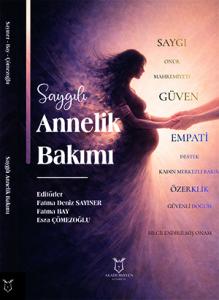
Ebelik Mesleğinde Saygılı Bakım Uygulamalarını Güçlendirme; Toplum Temelli Farkındalık ve Kadın Güçlendirme
Özet
Bu metin, ebelik mesleği bağlamında saygılı annelik bakımının güçlendirilmesini; etik ilkeler, kadın güçlendirme yaklaşımları, toplum temelli farkındalık çalışmaları ve politika düzeyindeki müdahaleler çerçevesinde ele almaktadır. Saygılı bakım, yalnızca saygısız veya istismarcı uygulamaların ortadan kaldırılması değil; kadının onurunu, özerkliğini, mahremiyetini ve karar verme hakkını merkeze alan bütüncül bir bakım anlayışı olarak değerlendirilmektedir. Metinde, saygılı annelik bakımının temel bileşenleri ayrıntılı biçimde ele alınmış; ebe–kadın ortaklığı, etkili iletişim, bilgilendirilmiş onam, kültürel duyarlılık ve kapsayıcı bakım ilkeleri üzerinden ebelik pratiğine yansımaları tartışılmıştır. Kadının güçlenmesini destekleyen unsurların, hem kadınların bakım süreçlerine aktif katılımını artırdığı hem de ebelerin mesleki tatminini ve etik duyarlılığını güçlendirdiği vurgulanmıştır. Ayrıca, saygılı bakımın yalnızca bireysel klinik uygulamalarla sınırlı kalamayacağı; toplum temelli farkındalık kampanyaları, sosyal hesap verebilirlik mekanizmaları, vatandaş izleme uygulamaları ve dijital izleme sistemleri aracılığıyla sistem düzeyinde desteklenmesi gerektiği ortaya konmuştur. Bu yaklaşımların, hizmet kalitesini artırdığı, sistemine duyulan güveni güçlendirdiği, kadınların doğum deneyimini olumlu yönde etkilediği belirtilmiştir. Metnin son bölümünde, saygılı annelik bakımının sürdürülebilirliği için politika geliştirme gereksinimleri ele alınmış; ebelerin normal gebelik ve doğum bakımında merkezî rol üstlenmesi, ulusal rehberlerin geliştirilmesi, uygulamaların izlenebilirliğinin artırılması ve yapısal engellerin azaltılmasına yönelik öneriler sunulmuştur. Genel olarak metin, saygılı annelik bakımını sağlık sistemlerinin kalitesini ve kadınların doğum deneyimini dönüştüren temel bir yaklaşım olarak ele almaktadır.
This text explores the strengthening of respectful maternity care within the context of the midwifery profession, grounded in ethical principles, women’s empowerment, community-based awareness initiatives, and policy-level interventions. Respectful maternity care is defined not merely as the absence of disrespect or abuse, but as a comprehensive approach that prioritizes women’s dignity, autonomy, privacy, and informed decision-making throughout pregnancy, childbirth, and the postpartum period. The text discusses the core components of respectful maternity care and their implications for midwifery practice, including woman–midwife partnership, effective communication, informed consent, cultural sensitivity, and inclusive care. It emphasizes that empowering women supports their active participation in care processes while also enhancing midwives’ professional satisfaction and ethical awareness. Furthermore, the text highlights that respectful maternity care cannot be sustained through individual clinical practice alone and requires system-level support. Community-based awareness campaigns, social accountability mechanisms, citizen monitoring initiatives, and digital monitoring systems are identified as key strategies for promoting and institutionalizing respectful care. These approaches contribute to improved service quality, increased trust in health systems, and more positive childbirth experiences. Finally, the text addresses the importance of policy development to ensure the sustainability of respectful maternity care, emphasizing the central role of midwives, the need for national guidelines, improved monitoring of practices, and the reduction of structural barriers. Overall, respectful maternity care is presented as a transformative approach that strengthens health systems and improves women’s childbirth experiences.
Referanslar
World Health Organization. Compendium on respectful maternal and newborn care. Geneva: WHO; 2025. Available from: https://iris.who.int/server/api/core/bitstreams/2ccf29b8-2c8d-45ba-a44c-a45138b88df4/content. [Accessed: 16 Ekim 2025].
International Confederation of Midwives. The International Childbirth Initiative (ICI): 12 Steps to Safe and Respectful MotherBaby-Family Maternity Care. 2020. Available from: file:///C:/Users/DK/Downloads/International-Childbirth-Initiative-Complete%20(1).pdf. [Accessed: 16 Ekim 2025].
FIGO. Ethical Framework for Respectful Maternity Care During Pregnancy and Childbirth. 2021. Available from: https://www.figo.org/resources/figo-statements/ethical-framework-respectful-maternity-care-during-pregnancy-and-childbirth [Accessed: 24 Ekim 2025].
Bowser D, Hill K. Exploring evidence for disrespect and abuse in facility-based childbirth: Report of a landscape analysis. USAID–TRAction Project; 2010.
White Ribbon Alliance. Respectful Maternity Care Charter: Universal Rights of Women & Newborns. 2019. Available from: https://www.healthynewbornnetwork.org/hnn-content/uploads/Respectful-Maternity-Care-Charter-2019.pdf [Accessed: 06 Kasım 2025].
Shakibazadeh E, Namadian M, Bohren MA, et al. Respectful care during childbirth in health facilities globally: A qualitative evidence synthesis. BJOG. 2018;125(8):932–942. doi: 10.1111/1471-0528.15015.
Miller S, Abalos E, Chamillard M, et al. Beyond too little, too late and too much, too soon: A pathway towards evidence-based, respectful maternity care worldwide. The Lancet. 2016;388(10056):2176–2192. doi: 10.1016/S0140-6736(16)31472-6.
World Health Organization. WHO and partners launch global guide to advance respectful maternal and newborn care. 2025. Available from: https://www.who.int/news/item/07-08-2025-who-and-partners-launch-global-guide-to-advance-respectful-maternal-and-newborn-care [Accessed: 06 Kasım 2025].
Bohren MA, Vogel JP, Hunter EC, et al. The mistreatment of women during childbirth in health facilities globally: A mixed-methods systematic review. PLOS Medicine. 2015;12(6):e1001847. doi: 10.1371/journal.pmed.1001847.
Freedman LP, Ramsey K, Abuya T, et al. Defining disrespect and abuse of women in childbirth: a research, policy and rights agenda. Bulletin of the World Health Organization. 2014;92(12):915–917. doi: 10.2471/BLT.14.137869. Epub
Manning A, Schaaf M. Respectful Maternity Care and Social Accountability. Columbia University; 2017. Available from: https://www.publichealth.columbia.edu/file/6412/download?token=HpC2Lp7v [Accessed: 06 Kasım 2025].
Mira-Catalá P, Hernández-Aguado I, Chilet-Rosell E. Respectful maternity care interventions to address women mistreatment in childbirth: What has been done? BMC Pregnancy and Childbirth. 2024;24(1):322. doi: 10.1186/s12884-024-07003-y.
Pathfinder International. Promoting Respectful Maternity Care Through the Maternity Open Day Approach: Lessons Learned. 2021. Available from: https://www.pathfinder.org/wp-content/uploads/2023/03/Promoting-Respectful-Maternity-Care.pdf. [Accessed: 06 Kasım 2025].
TC Sağlık Bakanlığı. Doğal Olan Normal Doğum. 2025. Available from: https://sggm.saglik.gov.tr/TR-106002/dogal-olan-normal-dogum.html. [Accessed: 08 Kasım 2025].
Houtzager PP, Joshi A. Introduction: Contours of a research field. IDS Bulletin. 2009;38(6). https://doi.org/10.1111/j.1759-5436.2007.tb00413.x
Feruglio F. Do more empowered citizens make more accountable states? Power and legitimacy in legal empowerment initiatives in Kenya and South Africa. The Institute of Development Studies and Partner Organisations. Online resource. 2017. https://hdl.handle.net/20.500.12413/13172.
Banerjee A, Duflo E. Addressing Absence. Journal of Economic Perspectives. 2006;20:117–132. http://dx.doi.org/10.1257/089533006776526139.
Freedman LP, Kruk ME. Disrespect and abuse of women in childbirth: challenging the global quality and accountability agendas. The Lancet. 2014;384(9948):e42–e44. doi: 10.1016/S0140-6736(14)60859-X.
Gullo S, Galavotti C, Sebert Kuhlmann A, Msiska T, Hastings P, Marti CN. Effects of a social accountability approach, CARE's Community Score Card, on reproductive health-related outcomes in Malawi: A cluster-randomized controlled evaluation. PLoS One. 2017;10;12(2):e0171316. doi: 10.1371/journal.pone.0171316.
Gullo S, Galavotti C, Altman L. A review of CARE's Community Score Card experience and evidence. Health Policy Plan. 2016;31(10):1467-1478. doi: 10.1093/heapol/czw064.
Schatz F. Fighting corruption with social accountability: a comparative analysis of social accountability mechanisms potential to reduce corruption in public administration. Public Administration and Development. 2013;33:161-174. https://doi.org/10.1002/pad.1648.
Fink H, Steingrüber S, Bhargava V. Civil society monitoring in the health sector The Partnership for Transparency Fund’s work to ensure clean procurement and quality service provision. 2022. https://www.u4.no/api/publications/civil-society-monitoring-in-the-health-sector/pdf.
UNICEF. mTrac Using innovations to improve healthcare. 2013. https://www.unicef.org/uganda/what-we-do/mtrac?utm_source=chatgpt.com. [Accessed: 06 Kasım 2025].
NAZDEEK, PAJHRA & ICAAD. No Time to Lose: Adivasi Women Demand Accountable Health System. 2015. https://icaad.ngo/2015/04/20/no-time-to-lose-adivasi-women-demand-a-more-accountable-health-system/
Dasgupta J. Ten years of negotiating rights around maternal health in Uttar Pradesh, India. BMC Int Health Hum Rights. 2011;16;11 Suppl 3(Suppl 3):S4. doi: 10.1186/1472-698X-11-S3-S4.
Dasgupta, J., Sandhya, Y., & Menon, S. Mera Swasthya, Meri Aawaz: Community-based monitoring of maternal health services in India. 2015.https://www.hhrjournal.org/2015/12/08/using-technology-to-claim-rights-to-free-maternal-health-care-lessons-about-impact-from-the-my-health-my-voice-pilot-project-in-india/
Fox, J. A. Social accountability: what does the evidence really say?. World Development, 2015;72, 346-361. https://doi.org/10.1016/j.worlddev.2015.03.011.
Tunçalp Ӧ, Were WM, MacLennan C, Oladapo OT, Gülmezoglu AM, Bahl R, Daelmans B, Mathai M, Say L, Kristensen F, Temmerman M, Bustreo F. Quality of care for pregnant women and newborns-the WHO vision. BJOG. 2015;122(8):1045-9. doi: 10.1111/1471-0528.13451.
Fontein-Kuipers, Y., de Groot, R., van Beeck, E., van Hooft, S., & van Staa, A. (2019). Dutch midwives' views on and experiences with woman-centred care – A Q-methodology study. Women Birth. 2019; 32(6), e567–e575. doi: 10.1016/j.wombi.2019.01.003
International Confederation of Midwives (ICM). Philosophy and model of midwifery care.2025. https://internationalmidwives.org/resources/philosophy-and-model-of-midwifery-care/. [Accessed: 06 Kasım 2025].
Prussing, E., Browne, G., Dowse, E., Hartz, D., & Cummins, A. (2023). Implementing midwifery continuity of care models in regional Australia: A constructivist grounded theory study. Women Birth. 2023;36(1), 99–107. doi: 10.1016/j.wombi.2022.03.006.
The Lancet. Empowering women during childbirth. Lancet. 2025;5;406(10498):1. doi: 10.1016/S0140-6736(25)01382-0.
Chalmers B, Solomon D. Actually empowering women during childbirth. Lancet. 2025;4;406(10511):1470-1471. doi: 10.1016/S0140-6736(25)01815-X. PMID: 41046142.
Prosen, M. A systematic integrative literature review of the factors influencing the professionalization of midwifery in the last decade (2009–2019). Midwifery. 2022;06, 103246. doi: 10.1016/j.midw.2021.103246.
Wang X, Wang X, Wan X, Wen X, Lv C, Zhai J. Empowering women with fetal malpositions: enhancing childbirth experience and empowerment through educational interventions: a randomized controlled clinical trial. BMC Pregnancy Childbirth. 2024;24;24(1):859. doi: 10.1186/s12884-024-07092-9.
Kruk, M. E., et al. High-quality health systems in the Sustainable Development Goals era: time for a revolution. The Lancet Global Health. 2018;6(11), e1196–e1252.
Gaillard A, Le Strat Y, Mandelbrot L, Keïta H, Dubertret C. Predictors of postpartum depression: prospective study of 264 women followed during pregnancy and postpartum. Psychiatry Res. 2014;28;215(2):341-6. doi: 10.1016/j.psychres.2013.10.003.
International Confederation of Midwives (ICM). International definition and scope of practice of the midwife (Core document). 2024. https://www.internationalmidwives.org/assets/files/definition-files/2023/06/en_definition-scope-of-the-practice-of-midwife_approved-1.pdf. [Accessed: 16 Ekim 2025].
Kabakian-Khasholian T, Makhoul J, Ghusayni A. "A person who does not have money does not enter": a qualitative study on refugee women's experiences of respectful maternity care. BMC Pregnancy Childbirth. 2022;5;22(1):748. doi: 10.1186/s12884-022-05083-2.
World Health Organization (WHO). Midwifery education and care. 2019. https://www.who.int/teams/maternal-newborn-child-adolescent-health-and-ageing/maternal-health/midwifery. [Accessed: 16 Ekim 2025].
International Confederation of Midwives. (ICM). Global Standards for Midwifery Education. 2014. https://internationalmidwives.org/resources/global-standards-for-midwifery-education/. [Accessed: 16 Ekim 2025].
Bohren MA, Hofmeyr GJ, Sakala C, Fukuzawa RK, Cuthbert A. Continuous support for women during childbirth. Cochrane Database Syst Rev. 2017;6;7(7):CD003766. doi: 10.1002/14651858.CD003766.pub6.
Amod HB, Ndlovu L, Brysiewicz P. Clinical mentorship of midwifery students: The perceptions of registered midwives. Health SA. 2024;30;29:2492. doi: 10.4102/hsag.v29i0.2492.
Amod H, Mkhize SW. Supporting Midwifery Students During Clinical Practice: Results of a Systematic Scoping Review. Interact J Med Res. 2023;21;12:e36380. doi: 10.2196/36380.
Dhakal P, Mohammad KI, Creedy DK, Gamble J, Newnham E, McInnes R. Midwifery and nursing students' perceptions of respectful maternity care and witnessing of disrespect and abuse: A comparative study from Nepal and Jordan. Midwifery. 2022;112:103426. doi: 10.1016/j.midw.2022.103426.
Sadler M, Santos MJ, Ruiz-Berdún D, Rojas GL, Skoko E, Gillen P, Clausen JA. Moving beyond disrespect and abuse: addressing the structural dimensions of obstetric violence. Reprod Health Matters. 2016;24(47):47-55. doi: 10.1016/j.rhm.2016.04.002.
Samuel J. The role of civil society in strengthening intercultural maternal health care in local health facilities: Puno, Peru. Glob Health Action. 2016;15;9:33355. doi: 10.3402/gha.v9.33355.
World Health Organization (WHO). (2019b). Strategies toward ending preventable maternal mortality (EPMM). Geneva.2019b. https://platform.who.int/docs/default-source/mca-documents/qoc/quality-of-care/strategies-toward-ending-preventable-maternal-mortality-(epmm).pdf?sfvrsn=a31dedb6_4. [Accessed: 16 Ekim 2025].
Afulani PA, Okiring J, Aborigo RA, Nutor JJ, Kuwolamo I, Dorzie JBK, Semko S, Okonofua JA, Mendes WB. Provider implicit and explicit bias in person-centered maternity care: a cross-sectional study with maternity providers in Northern Ghana. BMC Health Serv Res. 2023;14;23(1):254. doi: 10.1186/s12913-023-09261-6.
Moyer CA, McNally B, Aborigo RA, Williams JEO, Afulani P. Providing respectful maternity care in northern Ghana: A mixed-methods study with maternity care providers. Midwifery. 2021;94:102904. doi: 10.1016/j.midw.2020.102904.
Vogel JP, Bohren MA, Tunçalp Ӧ, Oladapo OT, Gülmezoglu AM. Promoting respect and preventing mistreatment during childbirth. BJOG. 2016;123(5):671-4. doi: 10.1111/1471-0528.13750. Epub 2015 Dec 1.
Asefa A, Morgan A, Bohren MA, Kermode M. Lessons learned through respectful maternity care training and its implementation in Ethiopia: an interventional mixed methods study. Reprod Health. 2020;2;17(1):103. doi: 10.1186/s12978-020-00953-4.
Abuya T, Warren CE, Miller N, Njuki R, Ndwiga C, Maranga A, Mbehero F, Njeru A, Bellows B. Exploring the prevalence of disrespect and abuse during childbirth in Kenya. PLoS One. 2015;17;10(4):e0123606. doi: 10.1371/journal.pone.0123606.
Pathak P, Ghimire B. Perception of Women regarding Respectful Maternity Care during Facility-Based Childbirth. Obstet Gynecol Int. 2020;4;2020:5142398. doi: 10.1155/2020/5142398.
Sriram S, Almutairi FM, Albadrani M. Midwife-Led Versus Obstetrician-Led Perinatal Care for Low-Risk Pregnancy: A Systematic Review and Meta-Analysis of 1.4 Million Pregnancies. J Clin Med. 2024;5;13(22):6629. doi: 10.3390/jcm13226629.
Santosh S. En Route to Midwifery Professionalisation: Contextualising Midwifery Care in the Indian Public Health System. Community Health Equity Research & Policy. 2025;0(0). doi:10.1177/2752535X251340760
Koblinsky M, Moyer CA, Calvert C, Campbell J, Campbell OM, Feigl AB, Graham WJ, Hatt L, Hodgins S, Matthews Z, McDougall L, Moran AC, Nandakumar AK, Langer A. Quality maternity care for every woman, everywhere: a call to action. Lancet. 2016;5;388(10057):2307-2320. doi: 10.1016/S0140-6736(16)31333-2.
World Health Organization. SRMNCAH national policy survey 2018-2019 full report: sexual, reproductive, maternal, newborn, child and adolescent health. WHO. 2023;https://www.who.int/docs/default-source/mca-documents/policy-documents/policy-survey-reports/srmncah-policysurvey2018-fullreport-pt-1.pdf?utm_source=chatgpt.com
Ministry of Health and Family Welfare. Guidelines on Midwifery Services in India: A midwifery initiative under National Health Mission. Government of India. 2018;https://nhm.gov.in/New_Updates_2018/NHM_Components/RMNCHA/MH/Guidelines/Guidelines_on_Midwifery_Services_in_India.pdf?utm_source=chatgpt.com
Sando D, Ratcliffe H, McDonald K, et al. The prevalence of disrespect and abuse during facility-based childbirth in urban Tanzania. BMC Pregnancy and Childbirth. 2016;16:236. doi:10.1186/s12884-016-1019-4.
Boyle, S., Thomas, H., & Brooks, F. Women's views on partnership working with midwives during pregnancy and childbirth. Midwifery. 2016;32, 21–29. doi: 10.1016/j.midw.2015.09.001
Zwane, S.P.; Chauke, L. Providers’ Perceptions of Respectful Maternity Care and Enabling Conditions in a Regional Hospital: A Qualitative Study. Int. J. Environ. Res. Public Health 2025; 22, 1570. https://doi.org/10.3390/ijerph22101570
Wang J, Tang N, Jin C, Yang J, Zheng X, Jiang Q, Li S, Xiao N, Zhou X. Association of Digital Health Interventions With Maternal and Neonatal Outcomes: Systematic Review and Meta-Analysis. J Med Internet Res. 2025;14;27:e66580. doi: 10.2196/66580.