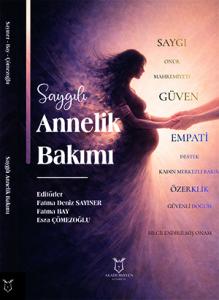
Gebelik, Doğum ve Postpartum Dönemde Saygılı Annelik Bakımı: Bilgilendirme ve Süreç Takibi
Özet
Gebelik, doğum ve postpartum dönem; kadının fizyolojik, psikolojik ve sosyal açıdan en hassas olduğu süreçlerdir. Bu süreçlerde kaliteli bakımın temelini, Dünya Sağlık Örgütü’nün olumlu gebelik, doğum ve doğum sonrası deneyim modelleri doğrultusunda şekillenen saygılı annelik bakımı oluşturmaktadır. Saygılı bakım, kadının özerkliğine, mahremiyetine, onuruna ve karar verme hakkına saygıyı esas alır; gereksiz müdahalelerden kaçınarak kadın merkezli yaklaşımı güçlendirir. Gebelik döneminde beslenme danışmanlığı, anne-fetüs izlemi, koruyucu önlemler ve yaşam tarzı önerileri gibi kanıta dayalı uygulamalar kadının bilgilendirilmiş katılımıyla yürütülmelidir. Doğum eyleminde ise etkili iletişim, sürekli destek, hareket özgürlüğü, pozisyon seçimi, ağrı yönetimi ve bilgilendirilmiş onam temel bileşenlerdir. Ebelik bakım modelleri, kadınların doğuma aktif katılımını ve güven duygusunu güçlendirmektedir. Postpartum dönemde saygılı bakım; fiziksel iyilik hâlinin değerlendirilmesi, duygusal destek, psikososyal ihtiyaçların tanınması, sosyal destek mekanizmalarının güçlendirilmesi ve anne bebek etkileşiminin desteklenmesini kapsar. Bu bütüncül yaklaşım hem maternal hem de neonatal sağlık sonuçlarını iyileştirirken, kadınların doğum deneyimlerini daha güvenli, olumlu ve güçlendirici bir yaşam olayına dönüştürmektedir.
Pregnancy, childbirth, and the postpartum period are the most sensitive stages for women in terms of their physical, psychological, and social well-being. Respectful maternity care, shaped by the World Health Organization's models for positive pregnancy, childbirth, and postpartum experiences, forms the basis of quality care during these stages. Respectful care is based on respect for the woman's autonomy, privacy, dignity, and right to make decisions; it avoids unnecessary interventions and reinforces a woman-centered approach. Evidence-based practices such as nutritional counseling, maternal-fetal monitoring, preventive measures, and lifestyle recommendations during pregnancy should be carried out with the informed participation of the woman. During labor, effective communication, continuous support, freedom of movement, choice of position, pain management, and informed consent are fundamental components. Midwifery care models strengthen women's active participation in childbirth and their sense of confidence. Respectful care in the postpartum period includes assessment of physical well-being, emotional support, recognition of psychosocial needs, strengthening of social support mechanisms, and support for mother-infant interaction. This holistic approach improves both maternal and neonatal health outcomes while transforming women's birth experiences into safer, more positive, and empowering life events.
Referanslar
World Health Organization. WHO recommendations: Intrapartum care for a positive childbirth experience. Geneva: WHO; 2018.
Renfrew MJ, et al. Midwifery and quality care. Lancet. 2014;384:1129–45.
World Health Organization. WHO recommendations on maternal and newborn care for a positive postnatal experience. Geneva: WHO; 2022.
International Federation of Gynecology & Obstetrics. Ethical framework for respectful maternity care. London: FIGO; 2021.
Downe S, Finlayson K, Tunçalp Ö, Metin Gülmezoglu A. What matters to women during childbirth. PLoS One. 2016;13:e0194906.
Deki S, Wangmo K. Women’s views of respectful maternity care. Int J Nurs Educ. 2020;12(2):141–6.
Puthussery S, Bayih WA, Brown H, Aborigo RA. Promoting a global culture of respectful maternity care. BMC Pregnancy Childbirth. 2023;23:798.
Afulani PA, Diamond-Smith N, Golub G, Sudhinaraset M. Person-centered maternity care. BMC Pregnancy Childbirth. 2021;21:1–15.
Bohren MA, Vogel JP, Hunter EC, et al. Mistreatment of women during childbirth. PLoS Med. 2015;12:e1001847.
Gurung R, Bask M. Mistreatment during childbirth and postpartum depressive symptoms. Glob Health Action. 2024;17:2381312.
Lunda S, Minnie CS, Benadé P. Women’s experiences of continuous support during childbirth. BMC Pregnancy Childbirth. 2018;18:167.
Ayers S, Bond R, Bertullies S, Wijma K. Post-traumatic stress following childbirth. Psychol Med. 2016;46:1121–34.
Sandall J, Soltani H, Gates S, Shennan A, Devane D. Midwife-led continuity models. Cochrane Database Syst Rev. 2018;4:CD004667.
International Confederation of Midwives. Essential competencies for midwifery practice. ICM; 2021.
Bohren MA, Hofmeyr GJ, Sakala C, Fukuzawa RK, Cuthbert A. Continuous support for women during childbirth. Cochrane Database Syst Rev. 2017;7:CD003766.
Lunda S, Minnie CS, Benadé P. Women’s experiences of continuous support during childbirth. BMC Pregnancy Childbirth. 2018;18:167.
Kabakian-Khasholian T, Portela A. Companion of choice at birth. Reprod Health. 2017;14:129.
Devi SP, Meetei ST, Suriya P, et al. Respectful maternity care during childbirth. J Family Med Prim Care. 2024;13:1766–71.
Lawrence A, Lewis L, Hofmeyr GJ, Styles C. Maternal positions and mobility during first stage labour. Cochrane Database Syst Rev. 2021;8:CD003934.
Smith CA, Levett KM, Collins CT, Jones L. Massage, reflexology and other manual methods for pain management in labour. Cochrane Database Syst Rev. 2018;3:CD009290.
Miller S, Abalos E, Chamillard M, Ciapponi A, Colaci D, Comandé D, et al. Beyond too little, too late and too much, too soon: A pathway towards evidence-based, respectful maternity care worldwide. Lancet. 2016;388(10056):2176–92.
Renfrew MJ, Craig D, Dyson L, McCormick F, Rice S, King SE, et al. Beginning the postnatal care pathway: A systematic review of the evidence for postnatal care models. Midwifery. 2014;30(4):e1–e14.
Bohren MA, Mehrtash H, Fawole B, Maung TM, Balde MD, Maya ET, et al. How women are treated during facility-based childbirth: Development and validation of measurement tools in four countries. BMJ Glob Health. 2019;4:e001749.
Afulani PA, Phillips B, Aborigo RA, Moyer CA. Person-centred maternal care in low-income settings: How women are treated during facility-based childbirth. Glob Health Action. 2019;12(1):1603045.
Oladapo OT, Tunçalp Ö, Bonet M, Lawrie TA, Portela A, Downe S, et al. WHO model of intrapartum and postnatal care: Integrating supportive, respectful and evidence-based practices. Lancet Glob Health. 2018;6(12):e1688–e1696.
Oladapo OT, Tunçalp Ö, Bonet M, Lawrie TA, Portela A, Downe S, et al. WHO model of intrapartum and postnatal care: Integrating supportive, respectful and evidence-based practices. Lancet Glob Health. 2018;6(12):e1688–e1696.
McLachlan HL, Forster DA, Davey MA, Farrell T, Gold L, Biro MA, et al. Continuity of midwifery care and maternal and newborn outcomes. Birth. 2016;43(1):3–8.
Chalmers B, Dzakpasu S, Heaman M, Kaczorowski J. Care in the postpartum period: Women’s experiences and views. J Obstet Gynaecol Can. 2014;36(8):703–11.
Forster DA, McLachlan HL, Davey MA, Biro MA, Farrell T, Gold L, et al. Continuity of care and postnatal outcomes. BMC Pregnancy Childbirth. 2016;16:312.
Toma TS, Högberg U, Fernandes P, Moreira ME, Edvardsson K. Improving quality of postnatal care through health systems strengthening: A scoping review. Lancet Glob Health. 2022;10(12):e1690–e1702.
Kennedy HP, Yoshida S, Costello A, Declercq E, Dias MA, Duff E, et al. Asking different questions: Research priorities to improve the quality of care for every woman, every child. Lancet. 2016;388(10056):2063–76.
Moore ER, Bergman N, Anderson GC, Medley N. Early skin-to-skin contact for mothers and their healthy newborn infants. Cochrane Database Syst Rev. 2016;11:CD003519.
Rollins NC, Bhandari N, Hajeebhoy N, Horton S, Lutter CK, Martines JC, et al. Why invest in breastfeeding? Lancet. 2016;387(10017):491–504.
Kent JC. Breastfeeding: More than just nutrition. Acta Paediatr. 2020;109(12):2282–8.
Toma TS, Högberg U, Fernandes P, Moreira ME, Edvardsson K. Improving quality of postnatal care through health systems strengthening: A scoping review. Lancet Glob Health. 2022;10(12):e1690–e1702.
Sacks E. Respectful care: What it means for the postpartum period. Reprod Health. 2020;17(1):76.
Dennis CL, Falah-Hassani K, Shiri R. Prevalence of antenatal and postnatal anxiety: Systematic review and meta-analysis. Br J Psychiatry. 2017;210(5):315–23.
Woody CA, Ferrari AJ, Siskind DJ, Whiteford HA, Harris MG. A systematic review and meta-regression of the prevalence and incidence of perinatal depression. J Affect Disord. 2017;219:86–92.
Shorey S, Chee CYI, Ng ED, Chan YH, Tam WWS, Chong YS. Prevalence and incidence of postpartum depression among healthy mothers. J Psychiatr Res. 2018;104:235–41.
Altman MR, Oseguera T, McLemore MR. “She was there for me”: Patient–provider communication and respectful maternity care. Birth. 2020;47(4):366–74.
McLemore MR, Altman MR, Cooper N, Williams S, Rand L. Healthcare experiences of postpartum women of color. J Perinat Neonatal Nurs. 2018;32(3):222–31.
Renfrew, M. J., McFadden, A., Bastos, M. H., Campbell, J., Channon, A. A., Cheung, N. F., ... & Declercq, E. (2014). Midwifery and quality care: findings from a new evidence-informed framework for maternal and newborn care. The Lancet, 384(9948), 1129-1145.
Kılıç, S., & Yılmaz, S. (2025). Her Kadına Onurlu Bir Doğum: Saygılı Annelik Bakımı. KTO Karatay Üniversitesi Sağlık Bilimleri Dergisi, 6(2), 327-343.