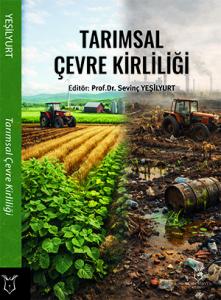
Çevre Ekonomisi ve Tarım
Özet
Bu bölüm, tarımsal faaliyetlerden kaynaklanan çevresel etkileri çevre ekonomisinin temel kavramlarıyla (dışsallıklar, kamu malları ve ortak havuz kaynakları) ilişkilendirerek tarım–çevre etkileşiminin iktisadi boyutunu açıklamaktadır. Tarımsal kirliliğin önemli bir kısmının noktasal olmayan (dağınık) nitelik taşıması nedeniyle ölçüm, izleme ve kaynağa atfetme güçlükleri vurgulanmakta; bu durumun politika tasarımında hedefleme, uygulanabilirlik ve maliyet-etkinlik kriterlerini öne çıkardığı gösterilmektedir. Bölümde fayda-maliyet analizi, maliyet-etkinlik analizi ve çevresel değerleme gibi analitik araçlar kısaca tanıtılmakta; tarımın gübre/pestisit kullanımı, su çekimleri, hayvancılık kaynaklı emisyonlar, arazi kullanımı ve atık yönetimi üzerinden toprak, su ve hava/iklim üzerinde yarattığı baskılar ekonomik bir çerçevede değerlendirilmektedir. Bu etkilerin sağlık maliyetleri, arıtma/iyileştirme harcamaları, ekosistem hizmetlerindeki kayıplar ve uzun dönemli riskler yoluyla refaha yansıması tartışılmakta; son bölümde düzenleyici, ekonomik ve bilgi temelli araçların güçlü/zayıf yönleri karşılaştırılarak uygulanabilir karma politika yaklaşımlarına ilişkin öneriler sunulmaktadır.
This chapter examines the economic dimension of agricultural environmental impacts through the core concepts of environmental economics, emphasizing market failures such as externalities, public goods and common-pool resources. Because many agricultural pressures are predominantly nonpoint-source, the chapter highlights monitoring, attribution and enforcement constraints and explains how these constraints shape feasible and cost-effective policy design. It briefly introduces key analytical tools—cost–benefit analysis, cost-effectiveness analysis and environmental valuation—and reviews the main channels through which farming affects soil, water and air/climate, including fertilizer and pesticide use, water withdrawals, livestock-related emissions, land-use pressures and waste management. The discussion links these impacts to welfare outcomes via health damages, remediation and treatment costs, losses in ecosystem services and long-run economic risks. Finally, the chapter compares regulatory, economic and information-based instruments and outlines practical directions for monitorable and incentive-compatible policy mixes in the agricultural context.
Referanslar
Pigou AC. The Economics of Welfare. 4th ed. London: Macmillan; 1932.
Coase RH. The Problem of Social Cost. J Law Econ.1960; 3:1-44. doi:10.1086/466560.
Tietenberg T, Lewis L. Environmental and Natural Resource Economics. 11th ed. New York: Routledge; 2018.
Freeman AM III, Herriges JA, Kling CL. The Measurement of Environmental and Resource Values: Theory and Methods. 3rd ed. New York: Routledge; 2014. doi:10.4324/9781315780917.
Daly HE, Farley J. Ecological Economics: Principles and Applications. 2nd ed. Washington (DC): Island Press; 2011.
Costanza R, Daly HE. Natural capital and sustainable development. Conserv Biol. 1992;6(1):37-46. doi:10.1046/j.1523-1739.1992.610037.x.
Millennium Ecosystem Assessment. Ecosystems and Human Well-being: Synthesis. Washington (DC): Island Press; 2005.
Rockström J, Steffen W, Noone K, Persson Å, Chapin FS III, Lambin EF, et al. A safe operating space for humanity. Nature. 2009; 461:472-475. doi:10.1038/461472a.
Foley JA, Ramankutty N, Brauman KA, Cassidy ES, Gerber JS, Johnston M, et al. Solutions for a cultivated planet. Nature. 2011; 478:337-342. doi:10.1038/nature10452.
Tilman D, Balzer C, Hill J, Befort BL. Global food demand and the sustainable intensification of agriculture. Proc Natl Acad Sci U S A. 2011;108(50):20260-20264. doi:10.1073/pnas.1116437108.
Galloway JN, Townsend AR, Erisman JW, Bekunda M, Cai Z, Freney JR, et al. Transformation of the nitrogen cycle: recent trends, questions, and potential solutions. Science. 2008;320(5878):889-892. doi:10.1126/science.1136674.
Sutton MA, Howard CM, Erisman JW, Billen G, Bleeker A, Grennfelt P, et al, editors. Our Nutrient World: The challenge to produce more food and energy with less pollution. Edinburgh: Centre for Ecology & Hydrology; 2013.
Pimentel D. Environmental and economic costs of the application of pesticides primarily in the United States. Environ Dev Sustain. 2005; 7:229-252. doi:10.1007/s10668-005-7314-2.
Carpenter SR, Caraco NF, Correll DL, Howarth RW, Sharpley AN, Smith VH. Nonpoint pollution of surface waters with phosphorus and nitrogen. Ecol Appl. 1998;8(3):559-568. doi:10.1890/1051-0761(1998)008[0559: NPOSWW]2.0.CO;2.
FAO. The State of Food and Agriculture 2020: Overcoming water challenges in agriculture. Rome: Food and Agriculture Organization of the United Nations; 2020.
OECD. Agriculture and Water Policies: Main Issues and Reform Options. Paris: OECD Publishing; 2010.
Steinfeld H, Gerber P, Wassenaar T, Castel V, Rosales M, de Haan C. Livestock's Long Shadow: Environmental Issues and Options. Rome: Food and Agriculture Organization of the United Nations; 2006.
Gerber PJ, Steinfeld H, Henderson B, Mottet A, Opio C, Dijkman J, et al. Tackling climate change through livestock: A global assessment of emissions and mitigation opportunities. Rome: Food and Agriculture Organization of the United Nations; 2013.
IPCC. Climate Change 2023: Synthesis Report. Geneva: Intergovernmental Panel on Climate Change; 2023.
IPCC. Climate Change 2022: Mitigation of Climate Change. Cambridge: Cambridge University Press; 2022. doi:10.1017/9781009157926.
IPBES. Global assessment report on biodiversity and ecosystem services of the Intergovernmental Science-Policy Platform on Biodiversity and Ecosystem Services. Bonn: IPBES Secretariat; 2019. doi:10.5281/zenodo.3553579.
FAO; UNEP. Global Assessment of Soil Pollution. Rome: Food and Agriculture Organization of the United Nations; 2021. doi:10.4060/cb4894en.
Shortle JS, Horan RD. The economics of nonpoint pollution control. J Econ Surv. 2001;15(3):255-289. doi:10.1111/1467-6419.00140.
World Bank; Institute for Health Metrics and Evaluation. The Cost of Air Pollution: Strengthening the economic case for action. Washington (DC): World Bank; 2016.
WHO. Preventing disease through healthy environments: a global assessment of the burden of disease from environmental risks. Geneva: World Health Organization; 2016.
UNEP. Global Chemicals Outlook II: From Legacies to Innovative Solutions. Nairobi: United Nations Environment Programme; 2019. ISBN:978-92-807-3745-5.
Pretty JN, Brett C, Gee D, Hine RE, Mason CF, Morison JIL, et al. An assessment of the total external costs of UK agriculture. Agric Syst. 2000;65(2):113-136. doi:10.1016/S0308-521X(00)00031-7.
Pimentel D, Harvey C, Resosudarmo P, Sinclair K, Kurz D, McNair M, et al. Environmental and economic costs of soil erosion and conservation benefits. Science. 1995;267(5201):1117-1123. doi:10.1126/science.267.5201.1117.
Wunder S. Payments for environmental services: Some nuts and bolts. CIFOR Occasional Paper No. 42. Bogor (Indonesia): Center for International Forestry Research; 2005.
TEEB. The Economics of Ecosystems and Biodiversity: Mainstreaming the Economics of Nature: A synthesis of the approach, conclusions and recommendations of TEEB. Geneva: United Nations Environment Programme; 2010.
World Resources Institute. World Resources Report: Creating a Sustainable Food Future. Washington (DC): World Resources Institute; 2019.
OECD. Environmental Performance of Agriculture in OECD Countries Since 1990. Paris: OECD Publishing; 2008.