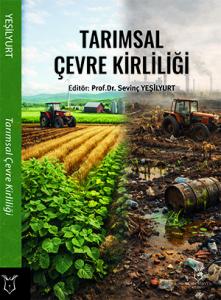
Tarım ve Çevre İlişkisi: Sorunlar, Sürdürülebilirlik ve Dijital Dönüşüm
Özet
Tarım ve çevre arasındaki ilişki; doğal kaynakların korunması, gıda güvenliği ve ekosistem sürdürülebilirliği açısından kritik bir öneme sahiptir. Tarım alanlarında artan üretim baskısı; toprak bozulumu, su kaynaklarının kirlenmesi, biyolojik çeşitlilik kaybı ve iklim değişikliğine bağlı riskleri beraberinde getirmektedir. Bu sorunların yönetiminde, bilgi yönetimi yaklaşımları ile geleneksel tarımsal bilginin modern bilimsel yöntemlerle entegrasyonu önemli bir potansiyel sunmaktadır. Yerel üreticilerin deneyime dayalı bilgileri, dijital veri sistemleriyle bütünleştirildiğinde tarım alanlarının daha etkin ve çevreyle uyumlu yönetilmesine katkı sağlamaktadır. Nanoteknoloji uygulamaları; gübre ve pestisit kullanımının optimize edilmesi, besin maddelerinin kontrollü salımı ve çevresel kirliliğin azaltılması açısından yenilikçi çözümler sunarken, bu teknolojilerin çevresel ve insan sağlığı üzerindeki olası etkileri çevresel risk yönetimi çerçevesinde dikkatle değerlendirilmelidir. Bu bağlamda, politika uyumu ve yönetişim mekanizmaları; ulusal tarım ve çevre planları ile yerel uygulama süreçleri arasında bütünlüğün sağlanmasında belirleyici rol oynamaktadır. Ayrıca, hassas tarım uygulamaları ve veri tabanlı karar destek sistemleri; sensörler, uzaktan algılama ve büyük veri analitiği aracılığıyla tarım alanlarında kaynak kullanımını optimize ederek verimliliği artırmakta ve çevresel baskıları azaltmaktadır. Sonuç olarak, tarım alanlarının sürdürülebilir yönetimi; bilgi temelli yaklaşımlar, geleneksel bilginin entegrasyonu, ileri teknolojiler, etkin risk yönetimi ve güçlü yönetişim yapılarının bir arada ele alındığı bütüncül bir çerçeve ile mümkün olacaktır.
The relationship between agriculture and the environment is of critical importance in terms of natural resource conservation, food security and ecosystem sustainability. Increasing production pressure in agricultural areas brings with it risks such as soil degradation, water pollution, loss of biodiversity and climate change. In managing these issues, knowledge management approaches and the integration of traditional agricultural knowledge with modern scientific methods offer significant potential. When the experience-based knowledge of local producers is integrated with digital data systems, it contributes to the more efficient and environmentally compatible management of agricultural areas. Nanotechnology applications offer innovative solutions in terms of optimising fertiliser and pesticide use, controlled release of nutrients, and reducing environmental pollution. However, the potential effects of these technologies on the environment and human health must be carefully assessed within the framework of environmental risk management. In this context, policy coherence and governance mechanisms play a decisive role in ensuring consistency between national agricultural and environmental plans and local implementation processes. Furthermore, precision farming practices and data-driven decision support systems optimise resource use in agricultural areas through sensors, remote sensing, and big data analytics, thereby increasing productivity and reducing environmental pressures. In conclusion, the sustainable management of agricultural areas will be possible through a comprehensive framework that combines knowledge-based approaches, the integration of traditional knowledge, advanced technologies, effective risk management, and strong governance structures.
Referanslar
Bongiovanni R, Lowenberg-DeBoer J. Precision agriculture and sustainability. Precision Agriculture. 2024; 5(4), 359–387. https://doi.org/10.1023/B:PRAG.0000040806.39604.aa
Contreras-Medina D.I, Contreras-Medina L.M, Cerroblanco-Vázquez V. Sustainable agriculture management: Environmental, economic and social conjunctures for coffee sector in Guerrero, via traditional knowledge management. Sustainability. 2024; 16(16), 6864. https://doi.org/10.3390/su16166864
Woortman DV, Fuchs T, Striegel L, Fuchs M, Weber N, Brück T.B, Rychlik M. Microalgae a Superior Source of Folates: Quantification of Folates in Halophile Microalgae by Stable Isotope Dilution Assay. Front. Bioeng. Biotechnol. 2020; 7:481. doi: 10.3389/fbioe.2019.00481
Güngör S.S, Çakıralar Altuntaş E, Yılmaz M. Çevre kirliliğinin tarımsal üretime etkilerine ilişkin öğretmen adayı görüşlerinin incelenmesi. International Journal of Contemporary Educational Studies (IntJCES), 2022; 8(1), 88–105.
Haktanır K. Çevresel değişimlerde tarımın etkileri ve yönetim arayışları. Ankara Üniversitesi Çevrebilimleri Dergisi. 2009;1(1), 1–6. https://doi.org/10.1501/Csaum_0000000001
Jhariya M.K, Banerjee A, Meena R.S, Yadav D.K. (Eds.)., Agriculture, Forestry and Environmental Sustainability: A Way Forward. Springer Nature Singapore. 2019. https://doi.org/10.1007/978-981-13-6830-1
Keeney D.R, Sustainable agriculture and the environment. In Sustainable agricultural development compatible with environmental conservation in Asia: The 4th JIRCAS International Symposium., 1998. Japan International Research Center for Agricultural Sciences (JIRCAS). 1998;73–82.,
Nath SA. vision of precision agriculture: Balance between agricultural sustainability and environmental stewardship. Agronomy Journal. 2024;116, 1126–1143. https://doi.org/10.1002/agj2.21405
Öncü R. Türkiye’de tarımın durumu, sorunları ve çözüm önerileri (Yüksek lisans tezi). Bursa Uludağ Üniversitesi, Fen Bilimleri Enstitüsü. 2022.
T.C. Cumhurbaşkanlığı Strateji ve Bütçe Başkanlığı. On İkinci Kalkınma Planı (2024–2028) (Rapor). 2023. https://www.sbb.gov.tr/wp-content/uploads/2023/12/On-Ikinci-Kalkinma-Plani_2024-2028_11122023.pdf
Sümer A, Adiloğlu S, Çetinkaya O, Adiloğlu A, Sungur A, Akbulak C. An investigation of some heavy metals (Cr, Ni, Pb) pollution of karamenderes basin soils in Çanakkale. Journal of Tekirdag Agricultural Faculty, 2013; 10(1): 83-89
Tok HH, Adiloğlu A, Öner N, Gönülsüz E, Adiloğlu S. Heavy Metal Concentrations in Irrigation Waters and Rice Crops in the Central Trakya Region, Journal of Environmental Protection and Ecology. 2005;6: 550-552.
Yeşilyurt S, Adiloğlu A. Tarımsal Yapılar ve Sulama, Bölüm: Phytoremediation and Plants Used in Wastewater Pollution. Yaz Yayınları, 2024. E_ISBN 978-625-6171-10-7
Adiloğlu S, Sağlam M.T, Adiloğlu A, Süme A. Phytoremediation of nickel (Ni) from agricultural soils using canola (Brassica napus L.). Desalination and Water Treatment. 2016;57(6): 2383-2388.
Adiloğlu S, Açıkgöz F.E, Adiloğlu A. The effect of increasing doses of sulfur application of some nutrient elements, vitamin C, protein contents and biological properties of canola plant (Brassica'Napus' L.). Tekirdağ Ziraat Fakültesi Dergisi. 2013;10(3): 59-63.
Meena R.S, Kumar S, Datta R, Lal R, Vijayakumar V, Brtnicky M, Sharma MP, Yadav G.S, Jhariya M.K, Marfo T.D. Impact of agrochemicals on soil microbiota and management: A review. Land, 2020; 9(2): 34.
Topçu P, Yavuz Ö, Tolunay A. Sürdürülebilir toprak yönetiminde toprakorganik karbonunun önemi Turkish Journal of Forest Science. 2022; 6(2), 604-614.
Erpul G, Akgöz R. Türkiye’de toprak sağlığı kavramının ülkesel politika ve stratejilere bütünleştirilmesi. Toprak Bilimi ve Bitki Besleme Dergisi. 2025; 13(1): 81-95.
Yeşilyurt S. Toprak Kirliliği. (Ed. A.Horuz). Akademisyen Yayınevi. 2025. ISBN: 978-625-375-637-6.
Adom R.K, Simatele M.D. Analysis of public policies and programmes towards water security in post-apartheid South Africa. Water Policy 2021; 23: 503–520.
Jun X, Qiting Z. Utilization and Protection of Water Resources in China: 1978–2018. Chin. J. Urban Environ. Stud. 2018; 6: 1850022.
Mwendera E, Atyisi Y.A. Review of Water Storage for Socio-Economic Development in South Africa. J. Water Resour. Prot. 2018; 10: 266–286.
Makanda K, Nzama S, Kanyerere, T. Assessing the role of water resources protection practice for sustainable water resources management: A review. Water. 2022; 14(19): 3153.
Duru S, Sürdürülebilir tarım ve iklim değişikliği. Muş Alparslan Üniversitesi Tarım ve Doğa Dergisi. 2025; 5(1): 21-32.
Boekhout T, Amend A.S, El Baidouri F, Gabaldón T, Geml J, Mittelbach M, Yurkov A. Trends in yeast diversity discovery. Fungal Diversity. 2022; 114(1): 491-537.
Díaz S,Malhi Y. Biodiversity: concepts, patterns, trends, and perspectives. Annual Review of Environment and Resources. 2022; 47(1): 31-63.
Altieri M.A. The ecological role of biodiversity in agroecosystems. In Invertebrate biodiversity as bioindicators of sustainable landscapes (pp. 19-31). Elsevier. 1999.
Tscharntke T, Klein A.M, Kruess A, Steffan‐Dewenter I, Thies C. Landscape perspectives on agricultural intensification and biodiversity–ecosystem service management. Ecology letters. 2005; 8(8), 857-874.
Adiloğlu S, Adiloğlu A, Açıkgöz F.E, Yeniaras T, Solmaz Y. Phytoremediation of Cadmium from Soil Using Patience Dock (Rumex patientia L.). Analytical Letters 2016; 49(4): 601–606.
Kelley C.P, Mohtadi S, Cane M.A, Seager R, Kushnir Y. Climate change in the Fertile Crescent and implications of the recent Syrian drought. Proceedings of the national Academy of Sciences. 2015; 112(11): 3241-3246.
Mach K.J, Kraan C. M, Adger W.N, Buhaug H, Burke M, Fearon J.D, von Uexkull N, Climate as a risk factor for armed conflict. Nature, 2019; 571(7764): 193-197.
Meaza H, Hishe S, Gebrehiwot M. Effects of war and siege on farmers’ livelihoods in Tigray, Ethiopia: Lessons for conflict-vulnerable areas. Human Ecology. 2014; 52(4): 877-890.
Arar A.A. T.C. Dışişleri Bakanlığı. Yerel Gündem 21. 2002. https://www.mfa.gov.tr/yerel-gundem-21.tr.mfa
Wahab A, Muhammad M, Ullah S, Abdi G, Shah G.M, Zaman W, Ayaz A. Agriculture and environmental management through nanotechnology: Eco-friendly nanomaterial synthesis for soil-plant systems, food safety, and sustainability. Science of the Total Environment. 2024;926:171862. https://doi.org/10.1016/j.scitotenv.2024.171862