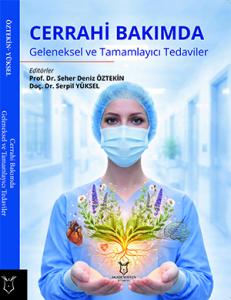
Geleneksel ve Tamamlayıcı Tıp Uygulamalarının Cerrahi Hemşireliğindeki Yeri: Antik Çağdan Günümüze
Özet
Cerrahi hemşireliği, modern cerrahi bakım süreçlerinin ayrılmaz bir parçası olarak, geleneksel ve tamamlayıcı tıp uygulamalarının kontrollü ve kanıt temelli araştırma sonuçlarından hareketle bakım planlarına entegre edilmesini gerektirirken, aynı zamanda uzmanlık alanlarını da genişletmektedir. Hasta sonuçlarını olumlu yönde etkileme çabası, cerrahi hastasının bakımında geleneksel ve tamamlayıcı tıp uygulamalarının antik çağdan günümüze yolculuğu, klinik araştırmalar ve hasta sonuçlarının modern bakım süreçlerine entegrasyonu, günümüz kanıt temelli cerrahi hemşireliği literatüründe önemli bir araştırma ve uygulama alanı olarak öne çıkmaktadır.
Surgical nursing, as an integral part of modern surgical care processes, requires the integration of traditional and complementary medicine practices into care plans based on controlled and evidence-based research findings, while also expanding its areas of expertise. Efforts to positively influence patient outcomes, the journey of traditional and complementary medicine practices in surgical patient care from ancient times to the present day, clinical research, and the integration of patient outcomes into modern care processes stand out as an important area of research and practice in today's evidence-based surgical nursing literature.
Referanslar
Sharoff L. Holistic nursing and medical-surgical nursing: A natural integration. Medsurg Nursing. 2008;17(3): 206-208.
Whiteside D. Integrating holistic and complementary care in perioperative nursing. OR Today Magazine. Available from: https://ortoday.com/integrating-holistic-and-complementary-care-in-perioperative-nursing/ (Accessed 26th August 2025)
Association of periOperative Registered Nurses (AORN). Guidelines for perioperative practice. Available from: https://www.aorn.org/guidelines-resources/guidelines-for-perioperative-practice (Accessed 26th August 2025)
World Health Organization. Global strategies and plans of action that are scheduled to expire within one year. WHO traditional medicine strategy: 2014–2023. WHO Press. 2022; 1-6. Available from: https://apps.who.int/gb/ebwha/pdf_files/EB152/B152_37-en.pdf (Accessed 26th August 2025)
World Health Organization. WHO global report on traditional and complementary medicine 2019. World Health Organization. 2019; 1-226. Available from: https://iris.who.int/handle/10665/312342 (Accessed 26th August 2025)
European Federation for Complementary and Alternative Medicine. CAM Definition. Available from: http://www.efcam.eu/cam/cam-definition/ (Accessed 26th August 2025)
Ünal M, Dağdeviren HN. Geleneksel ve tamamlayıcı tıp yöntemleri. Eurasian Journal of Family Medicine. 2019;8(1):1-9. doi:10.33880/ejfm.2019080101
Chao MT, Tippens KM, Connelly E. Utilization of complementary and alternative medicine in surgical patients: A systematic review. Anesthesia & Analgesia. 2012; 115(5): 1253–1266. doi:10.1213/ANE.0b013e31826d5c64
Hunt DD, Klainberg M, Lusk B, et al. Nursing and Medicine: First Century CE to the Early Middle Ages. In: Hunt DD (eds), Fast Facts About the Nursing Profession. New York: Springer Publishing Company; 2017. p. 27-34.
Talhaoğlu D. Geleneksel ve tamamlayıcı tedavi uygulamaları. Journal of Integrative and Anatolian Medicine. 2021; (3)1: 16-29.
Öztekin SD, Akyolcu N. Cerrahi hastalarda tamamlayıcı ve alternatif tedavilerin kullanımı. Türkiye Klinikleri Cerrahi Hemşireliği Özel Dergisi. 2020;11(2): 75–82.
Dossey, BM, Frisch N, Forker J, et al. Holistic nursing: A handbook for practice. Canada: Jones and Bartlett Publishers; 1998.
Braun LA, Cohen M. Use of complementary medicines by cardiac surgery patients; undisclosed and undetected. Heart, Lung and Circulation. 2011;20:305–311.
National Center for Complementary and Integrative Health (NCCIH). NCCIH 2016 strategic plan. Available from: https://www.nccih.nih.gov/about/nccih-2016-strategic-plan (Accessed 20th August 2025)
Cevahir F, Kaya G, Altındiş M. Geleneksel ve tamamlayıcı tıp (GETAT) uygulamalarında hijyen, enfeksiyonlardan korunma ve hasta güvenliği. Türk Hijyen ve Deneysel Biyoloji Dergisi. 2025; 82(2): 335-360.
Özer N. Cerrahinin tarihçesi, sınıflandırılması ve cerrahi gerektiren durumlar ile hasta üzerindeki etkileri. Eti Aslan, F. (ed.) Kanıt Temelli -Cerrahi Bakım Vaka Analizleri ile Birlikte içinde. İstanbul: Akademisyen Yayınevi; 2024. p.3-28.
Aksoy G. Cerrahi ve cerrahi hemşireliği. Aksoy G, Kanan N, Akyolcu N. (ed.) Cerrahi Hemşireliği I içinde. İstanbul: Nobel Tıp Kitabevi. 2017. p.1-28.
Hall PED, Card EB. Uses of complementary and alternative medicine for perioperative and other patients. The Nursing Clinics of North America. 2020; 55(4): 537–542. doi:10.1016/j.cnur.2020.06.020
Öztekin İ. Bilimsel veriler ışığında ağrı tedavisinde akupunktur. İstanbul: Selen Yayıncılık; 2024.
Hakami N. Integrating complementary and alternative medicine in surgical care: A narrative review. Medicine. 2024; 103(41): e40117. doi:10.1097/MD.0000000000040117
Adusumilli PS, Ben-Porat L, Pereira M, et al. The prevalence and predictors of herbal medicine use in surgical patients. Journal of the American College of Surgeons. 2004;198:583–590.
Field, T. Massage therapy research review. Complementary Therapies in Clinical Practice. 2016; 24: 19–31. doi:10.1016/j.ctcp.2016.04.005
World Health Organisation (WHO) Traditional medicine has a long history of contributing to conventional medicine and continues to hold promise. 2019. Available from: https://www.who.int/news-room/feature-stories/detail/traditional-medicine-has-a-long-history-of-contributing-to-conventional-medicine-and-continues-to-hold-promise (Accessed 21st August 2025)
Uysal Aİ, Altıparmak B, Korkmaz Toker M, et al. Ameliyat planlanan hastalar arasında bitkisel ürün kullanımı ve bitkisel ürünlerin nötrofil lenfosit oranına etkisi: Kesitsel araştırma. JARSS 2020;28(3):158-162. doi: 10.5222/jarss.2020.95866
Lucenteforte E, Gallo E, Pugi A, et al. Complementary and alternative drugs use among preoperative patients: A cross‐sectional study in Italy. Evidence-Based Complementary and Alternative Medicine. 2012;1:527238. doi:10.1155/2012/527238
Schiff E, Attias S, Hen H, et al. Integrating a complementary medicine service within a general surgery department: From contemplation to practice. The Journal of Alternative and Complementary Medicine. 2012; 18(3):300-305. doi:10.1089/acm.2011.056
Maizes V, Rakel D, Niemiec C. Integrative medicine and patient-centered care. Explore. 2009; 5(5): 277-289. doi:10.1016/j.explore.2009.06.008
National Center for Complementary and Integrative Health (NCCIH). NCCIH’s new strategic plan: Exploring the science of complementary and integrative health. Available from: https://www.nccih.nih.gov/research/blog/nccihs-new-strategic-plan-exploring-the-science-of-complementary-and-integrative-health (Accessed 20th August 2025)
Thornton L. A brief history and overview of holistic nursing. Integrative medicine (Encinitas, Calif.). 2019; 18(4), 32–33.
Bastable SB. Nurse as educator: Principles of teaching and learning for nursing practice. 5th ed. USA: Jones & Bartlett Learning, LLC; 2019.
Türkiye Cumhuriyeti Sağlık Bakanlığı. Sağlık istatistikleri yıllığı 2023. Ankara: T.C. Sağlık Bakanlığı Yayınları; 2025.
Stephens C, Porter J, Nettleton C, et al. Disappearing, displaced, and undervalued: A call to action for Indigenous health worldwide. The Lancet. 2006; 367(9527): 2019–2028. doi:10.1016/S0140-6736(06)68892-2
Topol E. Deep medicine: How artificial intelligence can make healthcare human again. New York: Basic Books; 2019.
Türkiye Cumhuriyeti Sağlık Bakanlığı. Geleneksel ve Tamamlayıcı Tıp Uygulamaları Yönetmeliği. Resmî Gazete Sayı: 29158. 27 Ekim 2014. (26/08/2025 tarihinde https://www.resmigazete.gov.tr/eskiler/2014/10/20141027-3.htm adresinden ulaşılmıştır.)
Lindquist R, Tracy MF, Synder M. Complementary therapies in nursing. Germany: Springer Publishing Company; 2022.
Kakde A, Lim MJ, Shen H, et al. Effect of music listening on perioperative anxiety, acute pain and pain catastrophizing in women undergoing elective cesarean delivery: A randomized controlled trial. BMC Anesthesiology. 2023; 23(1): 109. doi:10.1186/s12871-023-02060-w
Benze C, Spruce L, Groah L. Perioperative nursing: Scopes and standards of practice. Denver, CO: AORN; 2021.
National Library of Medicine. Medicine and miracle in a medieval monastery. Available from: https://circulatingnow.nlm.nih.gov/2023/01/05/medicine-and-miracle-in-a-medieval-monastery/ (Accessed 5th Jan 2025)
Yaman B. Selçuklular zamanında hastalıkların tedavisi ve sağlık hizmetleri. Giresun Üniversitesi Sosyal Bilimler Enstitüsü, Yüksek Lisans Tezi. 2017. p.1-124.
Saad B, Azaizeh H, Said O. Tradition and perspectives of arab herbal medicine: A review. Evidence‐Based Complementary and Alternative Medicine. 2005; 2(4): 475–479. doi: 10.1093/ecam/neh133
Atıcı T, Atıcı E, Şahin N. Geçmişten günümüze cerrahi dikiş ipliklerinin tarihsel gelişimi. Ulusal Cerrahi Dergisi. 2010; 26(4): 233-242.
Mądra-Gackowska K, Gackowski M, Główczewska-Siedlecka E, et al. Medications of medieval monastery medicine. Journal of Education, Health and Sport. 2018; 8(9), 1667–1674. doi: 10.5281/zenodo.1438770
Pekesen M. Abu Al Qasim Al Zahrawi (Albucasis): The father of modern surgery. Health Sciences Quarterly. 2021;1(2):83-86. doi:10.26900/hsq.1.2.05
Nightingale F. Notes on nursing: What it is, and what it is not. New York: D.Appleton;1860.
Pitt D, Aubin JM. Joseph Lister: Father of modern surgery. Canadian Journal of Surgery. 2012;55(5): E8–E9. doi:10.1503/cjs.007112
McDonald L. Florence Nightingale and Mary Seacole on nursing and health care. Journal of Advanced Nursing. 2014; 70(6), 1436-1444. doi: 10.1111/jan.12291
McDonald L. (2013). Wonderful adventures: How did Mary Seacole come to be viewed as a pioneer of modern nursing? Times Literary Supplement. 2013; 5775:14-16.
Cheesman MJ, Ilanko A, Blonk B, et al. developing new antimicrobial therapies: Are synergistic combinations of plant extracts/compounds with conventional antibiotics the solution? Pharmacognosy reviews. 2017; 11(22): 57–72. doi:10.4103/phrev.phrev_21_17
World Health Organization (WHO). Traditional, complementary and integrative medicine. 2023. Available from: https://www.who.int/health-topics/traditional-complementary-and-integrative-medicine#tab=tab_1 (Accessed 20th August 2025)
Akalın B, İrban A, Özargun G. Türkiye’de geleneksel ve tamamlayıcı tıp uygulamalarının mevcut standartları ve iyileştirme önerileri. Sağlık Profesyonelleri Araştırma Dergisi. 2023; 5(1), 49-69. doi: 10.57224/jhpr.1230794
Değirmen N, Gür S, Kanan N. Ameliyat sonrası ağrıda tamamlayıcı terapiler. Lokman Hekim Dergisi. 2022;12(1):55-66. doi: 10.31020/mutftd.1018094
Lennox PH, Henderson CL. Herbal medicine use is frequent in ambulatory surgery patients in Vancouver Canada. Canadian Journal of Anesthesia. 2003;50:21–25.
Shakeel M, Bruce J, Jehan S, et al. Use of complementary and alternative medicine by patients admitted to a surgical unit in Scotland. The Annals of The Royal College of Surgeons of England. 2008;90(7):571–576. doi: 10.1308/003588408X30104
Wang S-M, Caldwell-Andrews AA, Kain ZN. The use of complementary and alternative medicines by surgical patients: A follow-up survey study. Anesthesia & Analgesia. 2003;97(4):1010–1015. doi: 10.1213/01.ANE.0000078578.75597.F3
Velanovich V, Hallal N, Shah M. Patterns of usage of complementary and alternative medicine in general surgical patients. International Journal of Surgery. 2006;4(4):206–211. doi: 10.1016/j.ijsu.2006.03.005
Schiff E, Attias S, Hen H, et al. Integrating a complementary medicine service within a general surgery department: from contemplation to practice. The Journal of Alternative and Complementary Medicine. 2012; 18(3): 300-305. doi: 10.1016/j.ijsu.2006.03.005
Jörgenfelt C, Partington H. A critical analysis of JC Smuts’ theory of holism. European Journal of Integrative Medicine. 2019;31:100980. doi: 10.1016/j.eujim.2019.100980
Kirchgessner JC. Fast facts about the nursing profession: Historical perspectives in a Nutshell. Nursing History Review. 2019; 27(1): 172-173. doi:10.1891/1062-8061.27.172
American Holistic Nurses Association, & American Nurses Association. Holistic nursing: Scope and standards of practice. 3rd ed. USA: American Holistic Nurses Association; 2019.
Truant TL, Porcino AJ, Ross BC, et al. Complementary and alternative medicine (CAM) use in advanced cancer: A systematic review. The Journal of Supportive Oncology. 2013;11:105–113.