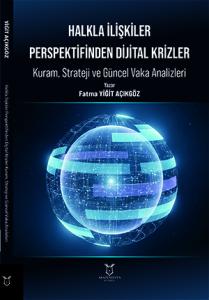
Halkla İlişkiler Perspektifinden Dijital Krizler: Kuram, Strateji ve Güncel Vaka Analizleri
Özet
Referanslar
Benoit, W. L. (1997). Image repair discourse and crisis communication. Public Relations Review, 23(2), 177–186. https://doi.org/10.1016/S0363-8111(97)90023-0
Botan, C. H., & Hazleton, V. (2010). Public relations theory II. Routledge.
Boyd, d. (2014). It’s complicated: The social lives of networked teens. Yale University Press.
Castells, M. (2015). Networks of outrage and hope: Social movements in the Internet age (2nd ed.). Polity Press.
Christensen, L. T., Cheney, G., & Morsing, M. (2008). Corporate communications: Convention, complexity and critique. Sage.
Coombs, W. T. (2015). The value of communication during a crisis: Insights from strategic communication research. Business Horizons, 58(2), 141–148.
Coombs, W. T., & Harker, J. L. (2021). Strategic sport communication: Traditional and transmedia strategies for a global sports market. Routledge.
Coombs, W. T., & Holladay, S. J. (2014). How publics react to crisis communication efforts: Comparing crisis response reactions across crises. Journal of Communication Management, 18(1), 40–57. https://doi.org/10.1108/JCOM-03-2013-0029
Cornelissen, J. (2020). Corporate communication: A guide to theory and practice (6th ed.). Sage.
Diers-Lawson, A. (2020). Applying the stakeholder relationship model as an issue management and risk communication tool. In Themes in issues, risk and crisis communication: A multi-dimensional perspective. Peter Lang.
Eberl, J. M., Huber, R. A., & Greussing, E. (2021). From populism to “plandemic”: Why populists believe in COVID-19 conspiracy theories. West European Politics, 44(5–6), 1114–1139.
Eriksson, M., & Olsson, E. K. (2016). Facebook and Twitter in crisis communication: A comparative study of crisis communication professionals and citizens. Journal of Contingencies and Crisis Management, 24(4), 198–208.
Eriksson, M. (2018). Lessons for crisis communication on social media: A systematic review. International Journal of Strategic Communication, 12(5), 526–551. https://doi.org/10.1080/1553118X.2018.1510405
Falkheimer, J., & Heide, M. (2018). Strategic communication: An introduction. Routledge.
Fearn-Banks, K. (2016). Crisis communications: A casebook approach (5th ed.). Routledge.
Fearn-Banks, K., & Kawamoto, K. (2024). Crisis communications: A casebook approach (7th ed.). Routledge.
Fombrun, C. J., & Van Riel, C. B. (2004). Fame & fortune: How successful companies build winning reputations. FT Press.
Frandsen, F., & Johansen, W. (2017). Organizational crisis communication: A multivocal approach. Sage.
Gilpin, D. R., & Murphy, P. J. (2010). Reframing crisis management through complexity. In C. H. Botan & V. Hazleton (Eds.), Public relations theory II (pp. 329–344). Routledge.
Grunig, J. E. (2009). Paradigms of global public relations in an age of digitalisation. PRism, 6(2), 1–19.
Hallahan, K., Holtzhausen, D., Van Ruler, B., Verčič, D., & Sriramesh, K. (2007). Defining strategic communication. International Journal of Strategic Communication, 1(1), 3–35. https://doi.org/10.1080/15531180701285244
Heath, R. L. (Ed.). (2018). The SAGE handbook of public relations (2nd ed.). Sage.
Jin, Y., Pang, A., & Cameron, G. T. (2012). Toward a publics-driven, emotion-based conceptualization in crisis communication. Public Relations Review, 38(3), 425–432. https://doi.org/10.1016/j.pubrev.2012.03.001
Jin, Y., Austin, L., & Liu, B. F. (2022). Social-mediated crisis communication research. In The handbook of crisis communication (pp. 151–167). Wiley.
Kent, M. L., & Taylor, M. (2016). From homo economicus to homo dialogicus. Public Relations Review, 42(1), 60–67. https://doi.org/10.1016/j.pubrev.2015.11.003
Kietzmann, J. H., Hermkens, K., McCarthy, I. P., & Silvestre, B. S. (2011). Social media? Get serious! Business Horizons, 54(3), 241–251. https://doi.org/10.1016/j.bushor.2011.01.005
Liu, B. F., Austin, L., & Jin, Y. (2011). How publics respond to crisis communication strategies. Public Relations Review, 37(4), 345–353.
Lovejoy, K., Waters, R. D., & Saxton, G. D. (2012). Engaging stakeholders through Twitter. Public Relations Review, 38(2), 313–318.
Luoma-aho, V., & Vos, M. (2010). Towards a more dynamic stakeholder model. Corporate Communications: An International Journal, 15(3), 315–331.
Macnamara, J. (2016). Organizational listening. Public Relations Review, 42(3), 367–378.
Macnamara, J., & Zerfass, A. (2017). The integrated evaluation of communication. Public Relations Review, 43(1), 1–12.
Maitlis, S., & Sonenshein, S. (2010). Sensemaking in crisis and change. Journal of Management Studies, 47(3), 551–580.
Maitlis, S., & Christianson, M. (2014). Sensemaking in organizations. Academy of Management Annals, 8(1), 57–125.
Pang, A., Hassan, N. B. A., & Chong, A. C. Y. (2014). Negotiating crisis in the social media environment. Corporate Communications: An International Journal, 19(1), 96–118.
Papacharissi, Z. (2015). Affective publics: Sentiment, technology, and politics. Oxford University Press.
Pekkala, K., & Erkkilä, T. (2024). Organizational voicing architecture in the age of social media. International Journal of Strategic Communication, 18(4), 366–381.
Schwarz, A., Seeger, M. W., & Auer, C. (2016). Significance and structure of international crisis communication research. In The handbook of international crisis communication research (pp. 1–10). Wiley.
Sellnow, T. L., & Seeger, M. W. (2021). Theorizing crisis communication (2nd ed.). Wiley-Blackwell.
Taylor, M., & Kent, M. L. (2014). Dialogic engagement through social media. Public Relations Review, 40(3), 384–392.
Veil, S. R. (2011). Mindful learning in crisis management. Journal of Business Communication, 48(2), 116–147.
Vos, M., Schoemaker, H., & Luoma-aho, V. (2014). Setting the agenda for research on issue arenas. Corporate Communications: An International Journal, 19(2), 200–215.
Zerfass, A., Verčič, D., Nothhaft, H., & Werder, K. (2018). Strategic communication: Defining the field and its contribution. Routledge.
Yayınlanan
Lisans
LisansBu İnternet Sitesi içeriğinde yer alan tüm eserler (yazı, resim, görüntü, fotoğraf, video, müzik vb.) Akademisyen Kitabevine ait olup, 5846 sayılı Fikir ve Sanat Eserleri Kanunu ve 5237 sayılı Türk Ceca Kanunu kapsamında korunmaktadır. Bu hakları ihlal eden kişiler, 5846 sayılı Fikir ve Sanat eserleri Kanunu ve 5237 sayılı Türk Ceza Kanununda yer alan hukuki ve cezai yaptırımlara tabi olurlar. Yayınevi ilgili yasal yollara başvurma hakkına sahiptir.
