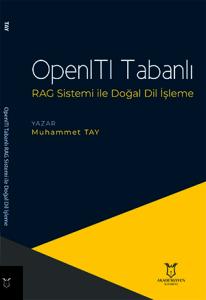
OpenITI Tabanlı RAG Sistemi ile Doğal Dil İşleme
Özet
-
Referanslar
ALPAC. (1966). Languages and machines: Computers in translation. National Academy of Sciences.
Alrabiah, M., Al-Salman, A. S., Atwell, E., Alsaif, A. (2014). The design and construction of the 50-million-word KSUCCA. International Journal of Computational Linguistics, 5(2), 1–14.
Bender, E. M., Friedman, B. (2018). Data statements for natural language processing. Transactions of the Association for Computational Linguistics, 6, 587–604.
Bender, E. M., Koller, A. (2020). Climbing towards NLU: On meaning, form, and understanding in the age of data. Proceedings of the 58th Annual Meeting of the Association for Computational Linguistics, 5185–5198. https://doi.org/10.18653/v1/2020.acl-main.463
Bender, E. M., Gebru, T., McMillan-Major, A., Shmitchell, S. (2021). On the dangers of stochastic parrots: Can language models be too big? Proceedings of the ACM Conference on Fairness, Accountability, and Transparency, 610–623. https://doi.org/10.1145/3442188.3445922
Bengio, Y., Ducharme, R., Vincent, P., Janvin, C. (2003). A neural probabilistic language model. Journal of Machine Learning Research, 3, 1137–1155.
Bengio, Y., Simard, P., Frasconi, P. (1994). Learning long-term dependencies with gradient descent is difficult. IEEE Transactions on Neural Networks, 5(2), 157–166.
Berry, D. M. (2012). Understanding digital humanities. Palgrave Macmillan.
Blei, D. M., Lafferty, J. D. (2009). Topic models. In Text mining: Classification, clustering, and applications (pp. 71–94).
Brown, T. B., Mann, B., Ryder, N., Subbiah, M., Kaplan, J., Dhariwal, P., et al. (2020). Language models are few-shot learners. Advances in Neural Information Processing Systems, 33, 1877–1901.
Chomsky, N. (1957). Syntactic structures. Mouton.
Cho, K., van Merriënboer, B., Gulcehre, C., Bahdanau, D., Bougares, F., Schwenk, H., Bengio, Y. (2014). Learning phrase representations using RNN encoder–decoder for statistical machine translation. Proceedings of EMNLP, 1724–1734.
Deerwester, S., Dumais, S. T., Furnas, G. W., Landauer, T. K., Harshman, R. (1990). Indexing by latent semantic analysis. Journal of the American Society for Information Science, 41(6), 391–407.
Devlin, J., Chang, M.-W., Lee, K., Toutanova, K. (2019). BERT: Pre-training of deep bidirectional transformers for language understanding. Proceedings of NAACL-HLT, 4171–4186.
Floridi, L., Cowls, J., Beltrametti, M., et al. (2018). AI4People—An ethical framework for a good AI society. Minds and Machines, 28(4), 689–707. https://doi.org/10.1007/s11023-018-9482-5
Francis, W. N., Kučera, H. (1979). Brown corpus manual. Brown University.
Goldberg, Y. (2017). Neural network methods for natural language processing. Morgan Claypool.
Habash, N. (2010). Introduction to Arabic natural language processing. Morgan Claypool.
Harris, Z. S. (1954). Distributional structure. Word, 10(2–3), 146–162.
Hochreiter, S., Schmidhuber, J. (1997). Long short-term memory. Neural Computation, 9(8), 1735–1780.
Hutchins, J. (2004). The Georgetown–IBM experiment demonstrated in January 1954. Machine Translation, 19(2), 91–114.
Jockers, M. L. (2013). Macroanalysis: Digital methods and literary history. University of Illinois Press.
Johnson, J., Douze, M., Jégou, H. (2019). Billion-scale similarity search with GPUs. IEEE Transactions on Big Data, 7(3), 535–547. https://doi.org/10.1109/TBDATA.2019.2921572
Jurafsky, D., Martin, J. H. (2023). Speech and language processing (3rd ed. draft). Prentice Hall.
Larkey, L. S., Ballesteros, L., Connell, M. E. (2007). Light stemming for Arabic information retrieval. In Arabic Computational Morphology (pp. 221–243). Springer.
Lewis, P., Perez, E., Piktus, A., Petroni, F., Karpukhin, V., Goyal, N., Küttler, H., Lewis, M., Yih, W.-T., Rocktäschel, T., Riedel, S., Kiela, D. (2020). Retrieval-augmented generation for knowledge-intensive NLP tasks. Advances in Neural Information Processing Systems, 33, 9459–9474.
Liu, P., Yuan, W., Fu, J., Jiang, Z., Hayashi, H., Neubig, G. (2023). Pre-train, prompt, and predict: A systematic survey of prompting methods in NLP. ACM Computing Surveys, 55(9), 1–35. https://doi.org/10.1145/3560815
Manning, C. D., Schütze, H. (1999). Foundations of statistical natural language processing. MIT Press.
Manning, C. D., Raghavan, P., Schütze, H. (2008). Introduction to information retrieval. Cambridge University Press.
McGillivray, B., Hengchen, S., et al. (2019). A computational approach to lexical semantic change. Computational Linguistics, 45(3), 427–472.
Mikolov, T., Chen, K., Corrado, G., Dean, J. (2013). Efficient estimation of word representations in vector space. arXiv preprint arXiv:1301.3781.
Mitchell, M., Wu, S., Zaldivar, A., et al. (2019). Model cards for model reporting. Proceedings of FAT, 220–229.
Moretti, F. (2013). Distant reading. Verso.
Nadeau, D., Sekine, S. (2007). A survey of named entity recognition and classification. Lingvisticae Investigationes, 30(1), 3–26.
Nenkova, A., McKeown, K. (2012). A survey of text summarization techniques. In Mining text data (pp. 43–76).
Powers, D. M. W. (2011). Evaluation: From precision, recall and F-measure to ROC. Journal of Machine Learning Technologies, 2(1), 37–63.
Rabiner, L. R. (1989). A tutorial on hidden Markov models. Proceedings of the IEEE, 77(2), 257–286.
Rajpurkar, P., Zhang, J., Lopyrev, K., Liang, P. (2016). SQuAD. Proceedings of EMNLP, 2383–2392.
Romanov, M. (2017). Calculating similarity and relative dating of Arabic texts. Digital Scholarship in the Humanities, 32(1), 125–144.
Romanov, M. (2019). Computational reading of Arabic biographical collections. Digital Scholarship in the Humanities, 34(2), 248–268.
Ruder, S. (2017). An overview of multi-task learning in deep neural networks. arXiv preprint arXiv:1706.05098.
Russell, S., Norvig, P. (2021). Artificial intelligence: A modern approach (4th ed.). Pearson.
Sebastiani, F. (2002). Machine learning in automated text categorization. ACM Computing Surveys, 34(1), 1–47.
Sennrich, R., Haddow, B., Birch, A. (2016). Neural machine translation of rare words with subword units. Proceedings of ACL, 1715–1725.
See, A., Liu, P. J., Manning, C. D. (2017). Get to the point. Proceedings of ACL, 1073–1083.
Sokolova, M., Lapalme, G. (2009). A systematic analysis of performance measures. Information Processing Management, 45(4), 427–437.
Tjong Kim Sang, E. F., De Meulder, F. (2003). CoNLL-2003 shared task. Proceedings of CoNLL, 142–147.
Turing, A. M. (1950). Computing machinery and intelligence. Mind, 59(236), 433–460.
Vaswani, A., Shazeer, N., Parmar, N., et al. (2017). Attention is all you need. Advances in Neural Information Processing Systems, 30, 5998–6008.
Wei, J., Wang, X., Schuurmans, D., et al. (2022). Chain-of-thought prompting. NeurIPS, 35, 24824–24837.
Weizenbaum, J. (1966). ELIZA. Communications of the ACM, 9(1), 36–45.
Winograd, T., Flores, F. (1986). Understanding computers and cognition. Ablex.
Young, S., Gašić, M., Thomson, B., Williams, J. D. (2013). POMDP-based spoken dialog systems. Proceedings of the IEEE, 101(5), 1160–1179.
Yayınlanan
Lisans
LisansBu İnternet Sitesi içeriğinde yer alan tüm eserler (yazı, resim, görüntü, fotoğraf, video, müzik vb.) Akademisyen Kitabevine ait olup, 5846 sayılı Fikir ve Sanat Eserleri Kanunu ve 5237 sayılı Türk Ceca Kanunu kapsamında korunmaktadır. Bu hakları ihlal eden kişiler, 5846 sayılı Fikir ve Sanat eserleri Kanunu ve 5237 sayılı Türk Ceza Kanununda yer alan hukuki ve cezai yaptırımlara tabi olurlar. Yayınevi ilgili yasal yollara başvurma hakkına sahiptir.
