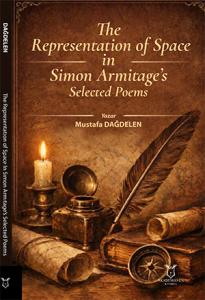
The Representation of Space in Simon Armitage’s Selected Poems
Özet
-
Referanslar
Abyzov, V. (2017, October). Modern conditions and the impacts of the creation of architectural environment. In IOP Conference Series: Materials Science and Engineering (Vol. 245, No. 8). IOP Publishing.
Adelfio, M., Navarro Aguiar, U., Fertner, C., & Brandão, E. D. C. (2021). Translating ‘New Compactism’, circulation of knowledge and local mutations: Copenhagen’s Sydhavn as a case study. International Planning Studies, 27(2), 173-195.
Adelman, J. S., Estes, Z., & Cossu, M. (2018). Emotional sound symbolism: Languages rapidly signal valence via phonemes. Cognition, 175, 122-130.
Agnew, J. (1987). The United States in the World Economy (1st Ed.). Cambridge University Press, Cambridge.
Alsalloum, A., & Brown, A. (2019). Towards a heritage-led sustainable post-conflict reconciliation: A policy-led perspective. Sustainability, 11(6), 1686.
Alzahlan, A. (2024). Controlled Childhood and the Moulding of the Children's Characters; Critical Analysis of Oliver Twist, David Copperfield, Hard Times, and Great Expectations. International Journal of Linguistics, Literature and Translation, 7(3), 12-21.
Armitage, S. (1993). Book of Matches. London, UK: Faber & Faber.
Armitage, S. (1995). The Dead Sea Poems. London, UK: Faber & Faber.
Armitage, S. (2001). Selected Poems of Simon Armitage. London, UK: Faber & Faber.
Armitage, S. (2014). Paper Aeroplane: Selected Poems 1989-2014. London, UK: Faber & Faber.
Armitage, S. (2021). Magnetic Field: The Marsden Poems. London, UK: Faber & Faber.
Armitage, S. (2022). A Vertical Art: Oxford Lectures. Cornwall, UK: Faber & Faber.
Auden, W. H. (1995). As I walked out one evening: songs, ballads, lullabies, limericks, and other light verse. Vintage.
Bachelard, G. (1994). The Poetics of Space. Beacon Press, Boston.
Bakhtin M M (1981) The Dialogic Imagination: Four Essays by M. M. Bakhtin. Austin, TX: University of Texas Press
Beydemir, R. E. Ö. A Poetic “Distance”: Defamiliarisation in Simon Armitage’s Early Works. Hacettepe Üniversitesi Edebiyat Fakültesi Dergisi, 40(2), 703-714.
Brown, L., Cromartie J.B. (2004). The Nature of Rurality in Postindustrial Society. In Champion, T., Graeme, H. (eds.), New Forms of Urbanization: Beyond the Urban-Rural Dichotomy (pp. 269–283). Aldershot: Ashgate.
Bryant, C.R., Russwurm, L.H., McLellan, A.G. (1982). The City’s Countryside: Land and its Management in the Rural-Urban Fringe. London: Longman.
Certeau, D. E. Michel. 1984. The Practice of Everyday Life. Trans. by Steven Rendall. Berkeley: University of California Press.
Childs, T. (2012). The Poetry of Simon Armitage: A Study Guide for GCSE Students. London, UK. Cambridge University Press.
Clancy, M. (2017). Exploring an autoethnographic stance with poetry in children’s nursing. Journal of Research in Nursing, 22(6-7), 465-476.
Cloke, P., Johnston, R. (2005). Deconstructing human geography’s binaries. In Cloke, P., Johnston, R. (eds.), Spaces of Geographical Thought: Deconstructing Human Geography’s Binaries (pp. 1–41). London: Sage Publications.
Cortizo, R. (2019). The calming womb family therapy model: Bonding mother and baby from pregnancy forward. Journal of Prenatal and Perinatal Psychology and Health, 33(3), 207-220.
Cresswell, T. (2004). Place a short introduction. Blackwell, Oxford.
Evans, G., McPherson, T., & Soja, E. (1991). Watch this space: An interview with Edward Soja. Discourse, 14(1), 41-57.
Fechner, M. (2023). The Unaccompanied: Poetic Expressions of the Working Classes in England. ANGLICA-An International Journal of English Studies, 32(3), 67-85.
Fivush, R. (2022). Autobiographical memory and narrative in childhood. Cambridge University Press.
Flood, A. (2020, July 1). Lockdown: Simon Armitage writes poem about coronavirus outbreak. The Guardian.https://www.theguardian.com/books/2020/mar/21/locdown-simon-armitage-writes -poem-about-coronavirus-outbreak
Foucault, M. (2008). Of other spaces*(1967). In Heterotopia and the City (pp. 25-42). Routledge.
Gavins, J., & Stockwell, P. (2012). About the heart, where it hurt exactly, and how often. Language and Literature, 21(1), 33-50.
Greene, D., Tehranifar, P., Hernandez-Cordero, L. J., & Fullilove, M. T. (2011). I used to cry every day: A model of the family process of managing displacement. Journal of Urban Health, 88, 403-416.
Gregson, I. (2011). Simon Armitage. London, UK. Salt Publishing.
Harrington, D. J. (1991). The Gospel of Matthew. http://ci.nii.ac.jp/ncid/BA27401855
Harvey, D. (1996). Justice, Nature and Geography of Difference. Blackwell Publishers, Cambridge.
Howarth, D. (2006). Space, subjectivity, and politics. Alternatives, 31(2), 105-134.
Hughes, T. (2009). Birthday letters. Faber and Faber.
Hurova, I. V., & Shkurov, Y. V. (2023). Man in Digitized Urban Socio-Cultural Space. Anthropological Measurements of Philosophical Research, (24), 75-87.
Hühn, P. (2023). Forms of Sequentiality in Contemporary English: Simon Armitage and Glyn Maxwell Poetry. ANGLICA-An International Journal of English Studies, 32(3), 121-138.
Jones, T. (2009). RACE, ECONOMIC CLASS, AND EMPLOYMENT OPPORTUNITY. Law and Contemporary Problems, 72(4), 57–87.
Kūle, L. (2008, January). Concepts of rurality and urbanity as analytical categories in multidimensional research. In Proceedings of the Latvian Academy of Sciences. Section B. Natural, Exact, and Applied Sciences. (Vol. 62, No. 1-2, pp. 9-17).
Lefebvre, H. (1991). The production of space. Blackwell.
Lenzi, C., & Perucca, G. (2023). Economic inequalities and discontent in European cities. npj Urban Sustainability, 3(1), 26.
Maran, A. (2023). Integrating Oldenburg’s concept of place and Soja’s concept of space: a spatial enquiry of denial, repression, and closure in Ishiguro’s “The Remains of the Day”. Humanities and Social Sciences Communications, 10(1), 1-8.
Massey, D. (2004). Politics and space/time 1. In Place and the Politics of Identity (pp. 139-159). Routledge.
Montgomery, A. F. (2011). The Sight of Loss. Antipode, 43(5), 1828–1850. https://doi.org/10.1111/j.1467-8330.2011.00856.x
Oldenburg, R. (1999). The great good place: Cafes, coffee shops, bookstores, bars, hair salons, and other hangouts at the heart of a community. Da Capo Press.
Pred, A. R. (1984). 1984 Place as Historically Contingent Process: Structuration and the Time-Geography of Becoming Places Annals of the Association of American Geographers 74 (2), 279-297.
Relph, E. (1976). Place and Placelessness. Pion, London.
Richardson, M. A., & Parmer, C. (2023). Perceptions of death and memory transmission among residents of Hiroshima and Nagasaki, Japan: A qualitative study. PLOS Glob Public Health 3 (8): e0002061.
Sapir, E. (1912). Language and Environment. American Anthropologist, 14(2), 226–242.
Seamon, D. (1979). A Geography of the Lifeworld: Movement, Rest, and Encounter. St. Martin’s Press, New York.
Sinha, A., Harkness, T., & Harkness, T. (2009). Views of the Taj—Figure in the Landscape. Landscape Journal, 28(2), 198–217.
Smith, S. M., & Vela, E. (2001). Environmental context-dependent memory: A review and meta-analysis. Psychonomic bulletin & review, 8, 203-220.
Soja, E.W. (1989). Postmodern Geographies: The Reassertion of Space in Critical Social Theory. Verso, London.
Soja, E. W. (1996). Thirdspace: Expanding the geographical imagination. Blackwell.
Szpakowska-Loranc, E. (2022). An ideal city vs 21st-century pragmatism. In Utopian Thinking in Law, Politics, Architecture and Technology (pp. 188-207). Edward Elgar Publishing.
Thain, M. (2001). An ‘Uncomfortable Intersection’: The Meeting of Contemporary Urban and Rural Environments In The Poetry of Simon Armitage. Worldviews: Global Religions, Culture, and Ecology, 5(1), 58-79.
Tuan, Y.F. (1974). Space and Place: Humanistic Perspective Progress in Human Geography 6, 211-252. Edward Arnold, London.
Tuan, Y.F. (1977). Space and Place: The Perspective of Experience. University of Minnesota Press, Minneapolis.
Tuan, Y.F. (1991). Language and the Making of Place: A Narrative-Descriptive Approach Annals of the Association of American Geographers 81(4), 684-696. https://doi.org/10.1111/j.1467-8306.1991.tb01715.x
Vale-Taylor, P. (2009). “We will remember them”: a mixed-method study to explore which post- funeral remembrance activities are most significant to bereaved people living with loss and why those particular activities are chosen. Palliative Medicine, 23(), 537-544.
Vincent, A. (2020). Poet, Teacher, Acadie: Using Poetic Inquiry as a Tool for Unearthing Identity. Journal of the Canadian Association for Curriculum Studies, 18(1).
Wang, L., Miao, C., & Feng, L. (2023). Narrative Study on Successful Career Transition Based on Experiences of Chinese Vocational College Maritime Students. International Journal of Higher Education, 12(5), 1-1.
Webster, H. C. (1934). Facing Futility: Aldous Huxley’s Really Brave New World. The Sewanee Review, 42(2), 193–208.
Zussman, R. (2021, March). A Boy’s Journey and the Journey to Freedom. In Sociological Forum (Vol. 36, No. 1, pp. 280-28
Yayınlanan
Lisans
LisansBu İnternet Sitesi içeriğinde yer alan tüm eserler (yazı, resim, görüntü, fotoğraf, video, müzik vb.) Akademisyen Kitabevine ait olup, 5846 sayılı Fikir ve Sanat Eserleri Kanunu ve 5237 sayılı Türk Ceca Kanunu kapsamında korunmaktadır. Bu hakları ihlal eden kişiler, 5846 sayılı Fikir ve Sanat eserleri Kanunu ve 5237 sayılı Türk Ceza Kanununda yer alan hukuki ve cezai yaptırımlara tabi olurlar. Yayınevi ilgili yasal yollara başvurma hakkına sahiptir.
