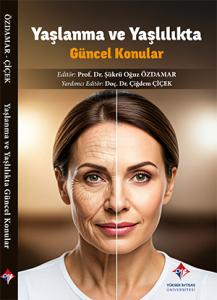
Yaşlı Bireylere Yönelik Yaş Ayrımcılığı
Referanslar
Adibelli D. (2011). The Validity and Reliability of Kogan’s Attitude Towards Old People Scale in The Turkish Society. Health, 3(09):602.
Allen JO, Solway E, Kirch M, Singer D, Kullgren JT, Moïse V, Malani PN. (2022). Experiences of everyday ageism and the health of older US adults. JAMA Network Open, 5(6), e2217240-e2217240.
Alquwez N, Cruz JP, Almazan JU, Alamri MS, Mesde JJ. (2018). The Arabic version of the Kogan Attitudes toward Older People Scale among Saudi nursing students: A psychometric analysis. Annals of Saudi medicine, 38(6):399-407. DOI: 10.5144/0256-4947.2018.399
Ayalon L, Tesch-Römer C. (2018). Contemporary Perspectives on Ageism. Chapter 1 Introduction to the Section: Ageism-Concept and Origins. Springer Open.
Bi̇ri̇nci̇ E. (2021). Yaşlı Bakımı Programı Öğrencilerinin Kariyer Seçimlerinin İncelenmesi. Journal of Academic Value Studies, 6(4):364-371.
Burnes D, Sheppard C, Henderson CR Jr, Wassel M, Cope R, Barber C, Pillemer K. (2019). Interventions to Reduce Ageism Against Older Adults: A Systematic Review and Meta-Analysis. Am J Public Health, 109(8):e1-e9. doi: 10.2105/AJPH.2019.305123. Epub 2019 Jun 20. PMID: 31219720; PMCID: PMC6611108.
Chang ES, Kannoth S, Levy S. Wang SY, Lee JE, Levy BR. (2020). Global Reach Of Ageism on Older Persons’ Health: A Systematic Review. PloS one, 15(1):e0220857. DOI: 10.1371/ journal.pone.0220857
Cooney C, Minahan J, Siedlecki KL. (2021). Do Feelings And Knowledge About Aging Predict Ageism? Journal of Applied Gerontology, 40(1):28-37. DOI: 10.1177/0733464819897526.
De la Fuente-Núñez V, Cohn-Schwartz E, Roy S, Ayalon L. (2021). Scoping Review on Ageism against Younger Populations. Int J Environ Res Public Health, 10;18(8):3988. DOI: 10.3390/ijerph18083988. PMID: 33920114; PMCID: PMC8069403.
Duyan V, Gelbal S. (2013). The Adaptation of Attitudes Towards the Elderly Scale to Turkish With a Group of University Students. Turkish Journal of Geriatrics, 16(2):202-209.
Gallo V. (2019). Ageism in Nursing Education: A Review of the Literature. Teaching and Learning in Nursing, 14(3):208-215. DOI:10.1016/j.teln.2019.04.004
Hutchison P, Fox E, Laas AM, Matharu J, Urzi S. (2010). Anxiety, Outcome Expectancies, and Young People's Willingness to Engage in Contact with the Elderly. Educational Gerontology, 36(10-11):1008-1021.
Kogan N. (1961). Attitudes Toward Old People: The Development of a Scale and an Examination of Corraletes. J Abnorm Soc Psychol,64:44-54.
Kutlu Y, Kucuk L, Yildiz Findik U. (2012). Psychometric Properties of The Turkish Version of the Fraboni Scale of Ageism. Nursing & Health Sciences, 14(4):464-471.
Levy SR, Macdonald JL. (2016). Progress on Understanding Ageism. Journal of Social Issues, 72(1):5-25.
Meisner BA. (2021). Are you OK, Boomer? Intensification of Ageism and Intergenerational Tensions on Social Media Amid COVID-19. Leisure Sciences, 43(1-2):56-61.
Mikton C, de la Fuente-Núñez V, Officer A, Krug E. (2021). Ageism: A Social Determinant of Health That Has Come of Age. The Lancet, 397(10282):1333-1334. DOI: 10.1016/ S0140-6736(21)00524-9
Nelson TD. (2002). Ageism: Stereotyping and Prejudice Against Older Person. The MIT Press.
Nelson TD. (2016). Ageism. In T. D. Nelson (Ed.), Handbook of Prejudice, Stereotyping, and Discrimination (pp. 337–353). Psychology Press.
Officer A, de la Fuente-Núñez V. (2018). A Global Campaign to Combat Ageism. Bulletin of the World Health Organization, 96(4):295.
Officer A, Thiyagarajan JA, Schneiders ML, Nash P, de la Fuente-Núñez V. (2020). Ageism, Healthy Life Expectancy and Population Ageing: How Are They Related? Int J Environ Res Public Health. 1;17(9):3159. DOI: 10.3390/ijerph17093159. PMID: 32370093; PMCID: PMC7246680.
Otrar M. (2016). Yaşlılık ve Yaşlanmaya İlişkin Tutum Ölçeği: Geçerlik ve Güvenirlik Çalışması. İstanbul University Journal of Sociology, 36(2):527-550.
Previtali F, Allen LD, Varlamova M. (2020). Not Only Virus Spread: The Diffusion of Ageism During the Outbreak of COVID-19. Journal of Aging & Social Policy, 32(4-5):506-514. DOI: 10.1080/08959420.2020.1772002
Rababa M, Al-Dwaikat T, Almomani MH. (2021). Assessing Knowledge and Ageist Attitudes and Behaviors Toward Older Adults Among Undergraduate Nursing Students. Gerontology & Geriatrics Education, 42(3):347-362. DOI: 10.1080/02701960.2020.1827398
Rababa M, Hammouri AM, Hweidi IM, Ellis JL. (2020). Association of Nurses' Level of Knowledge and Attitudes to Ageism Toward Older Adults: Cross‐Sectional Study. Nursing & Health Sciences, 22(3):593-601. DOI: 10.1111/nhs.12701
Reuben DB, Lee M, Davis JW, Eslami MS, Osterweil DG, Melchiore S, Weintraub NT. (1998). Development and Validation of a Geriatrics Attitudes Scale for Primary Care Residents. Journal of the American Geriatrics Society, 46(11):1425–1430. DOI:10.1111/j.1532-5415.1998.tb06012.x
Rosales A, Fernández-Ardèvol M. (2020). Ageism in the Era of Digital Platforms. Convergence, 26(5-6):1074-1087. DOI: 10.1177/1354856520930905
Sahin S, Mandiracioglu A, Tekin N, Senuzun F, Akcicek F. (2012). Attitudes Toward The Elderly Among The Health Care Providers: Reliability and Validity of Turkish Version of the UCLA Geriatrics Attitudes (UCLA-GA) Scale. Archives of Gerontology and Geriatrics, 55(1):205-209.
Statista (2022). Proportion of selected age groups of world population and in regions in 2022. https://www.statista.com/statistics/265759/world-population-by-age-and-region/
Statistical Handbook of Japan. (2022). Population. https://www.stat.go.jp/english/data/handbook/pdf/2022all.pdf#page=23
Şahin H. (2017). Hemşirelik Öğrencilerinin Yaşlılara Yönelik Tutumlarının Belirlenmesi. Türkiye Sosyal Araştırmalar Dergisi, 21(1):219-232.
Turkish Statistical Institute. (2022). Elderly Statistics. https://data.tuik.gov.tr/Bulten/Index?p=Istatistiklerle-Yaslilar-2021-45636.
Uğurlu Z, Kav S, Karahan A, Akgün Çıtak E. (2019). Correlates of Ageism Among Health Care Professionals Working with Older Adults. Journal of Transcultural Nursing, 30(3):303-312. DOI: 10.1177/1043659618810128
Van Wicklin SA. (2020). Ageism in Nursing. Plastic Surgical Nursing, 40(1):20-24.
Velikuluçay D. (2008). Üniversitede Öğrenim Gören Öğrencilerin Yaşlı Ayrımcılığına İlişkin Tutumları. Hacettepe Üniversitesi Sağlık Bilimleri Enstitüsü Doğum ve Kadın Hastalıkları Hemşireliği Programı Doktora Tezi. Ankara.
WHO (2020). Campaigning to Tackle Ageism: Current Practices and Suggestions for Moving Forward. https://cdn.who.int/media/docs/default-source/3rd-edl-submissions/campaigning-to-tackle-ageism.pdf?sfvrsn=c89079ac_1&download=true.
Wilson DM, Errasti Ibarrondo B, Low G. (2019). Where Are We Now in Relation to Determining the Prevalence of Ageism in This Era of Escalating Population Ageing? Ageing Research Reviews, 51:78-84. DOI: 10.1016/j.arr.2019.03.001R
World Bank (2021). Population ages 65 and above (% of total population). https://data.worldbank.org/indicator/SP.POP.65UP.TO.ZS?locations=EU.
World Health Organization. (2021a). Decade of Healthy Ageing: Baseline Report. https://www.who.int/publications/i/item/9789240017900
World Health Organization. (2021b). Global Report on Ageism: Executive Summary. https://www.who.int/publications/i/item/9789240016866.
Yurttaş S, Sarıkoca E. (2018). Pozitif ve Negatif Yaşlı Ayrımcılığı Ölçeği (PNYAÖ) Geçerlilik ve Güvenirlik Çalışması. Atatürk Üniversitesi Sosyal Bilimler Enstitüsü Dergisi, 22(Özel Sayı 2):1977-1991.