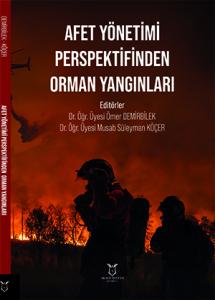
Orman Yangınlarının Nedenleri, Risk Faktörleri ve Yayılım Dinamikleri
Özet
Ormanlar, ekosistemlerin sürdürülebilirliği açısından kritik öneme sahip doğal kaynaklardır. Ancak doğal ve insan kaynaklı faktörlerden kaynaklanan yangınlar, orman ekosistemlerinin yapısal bütünlüğünü ve işlevsel dinamiklerini bozarak, ormanlara bağımlı türler ile onların yaşam alanları üzerinde ciddi olumsuz etkiler yaratmaktadır. Ampirik çalışmalar ve mevcut alanyazın orman yangınlarının başlıca nedenlerinin insan ve doğal kaynaklı faktörler olduğunu göstermektedir. Dünya genelinde meydana gelen orman yangınlarının yaklaşık %4’ü yüksek sıcaklık, kuraklık, yıldırım, fırtına gibi doğal tetikleyici etmenlere bağlıyken, geriye kalan %96’sı kasıtlı veya ihmalkârlık sonucu ortaya çıkan insan kaynaklı faktörlerle ilişkilendirilmektedir. Doğal kaynaklı orman yangınları arasında en yaygın tetikleyici yıldırımdır. İnsan kaynaklı etmenler ise ormanlık alanların tarımsal faaliyete açılması, geleneksel tarım uygulamaları, rekreasyonel aktiviteler, ekipman kullanımı ve enerji altyapısı (trafo ve elektrik hatları) gibi faktörleri kapsamaktadır. Ayrıca, sigara izmariti, kundaklama, moloz yakma, çocukların kontrolsüz davranışları, anız yakma, ot ve tarla temizliği, askeri faaliyetler ve havai fişek kullanımı, orman yangını riskini artıran diğer önemli faktörler olarak öne çıkmaktadır. Orman yangınlarının oluşum sürecinde birçok faktör belirleyici rol oynamaktadır; iklimsel ve meteorolojik koşullar, mekânsal ve demografik özellikler, mevsimsel ve zamansal değişkenler, topografik unsurlar ve doğal tetikleyici faktörler yangın riskini şekillendiren başlıca etmenler olarak öne çıkmaktadır. Diğer yandan, orman yangınlarının yayılım dinamiklerini etkileyen faktörler, yüksek sıcaklık, düşük bağıl nem, rüzgâr, orman yakıtının özellikleri, bakı, eğim ve ağaç türleri gibi değişkenlerle ilişkilendirilmekte olup, yangınların başlama olasılığı, yayılma hızı ve davranışını doğrudan belirlemektedir.
Referanslar
Aponte, C., de Groot, W. J., & Wotton, B. M. (2016). Forest fires and climate change: causes, consequences and management options. International Journal of Wildland Fire, 25(8), i-ii. https://doi.org/10.1071/WFv25n8_FO
Artés, T., Oom, D., de Rigo, D., Durrant, T. H., Maianti, P., Libertà, G., & San-Miguel-Ayanz, J. (2019). A global wildfire dataset for the analysis of fire regimes and fire behaviour. Scientific Data, 6, 296. https://doi.org/10.1038/s41597-019-0312-2
Attri, V., Dhiman, R., & Sarvade, S. (2020). A review on status, implications and recent trends of forest fire management . Archives of Agriculture and Environmental Science, 5(4), 592-602. https://doi.org/10.26832/24566632.2020.0504024
Balch, J. K., Bradley, B. A., Abatzoglou, J. T., Nagy, R. C., Fusco, E. J., & Mahood, A. L. (2017). Human-started wildfires expand the fire niche across the United States. Proceedings of the National Academy of Sciences, 114(11), 2946-2951.
https://doi.org/10.1073/pnas.1617394114
Baltacı, U., & Yıldırım, F. (2020). Effect of slope on the analysis of forest fire risk. Hacettepe Journal of Biology and Chemistry, 48(4), 373-379. https://doi.org/10.15671/hjbc.753080
Barni, P. E., Pereira, V. B., Manzi, A. O., & Barbosa, R. I. (2015). Deforestation and forest fires in Roraima and their relationship with phytoclimatic regions in the Northern Brazilian Amazon. Environmental Management, 55, 1124-1138. https://doi.org/10.1007/s00267-015-0447-7
Beer, T. (1991). The interaction of wind and fire. Boundary-Layer Meteorol, 54, 287–308. https://doi.org/10.1007/BF00183958
Bonazountas, M., Kallidromitou, D., Kassomenos, P. A., & Passas, N. (2005). Forest fire risk analysis. human and ecological risk assessment: An International Journal, 11(3), 617–626. https://doi.org/10.1080/10807030590949717
Brodie, E. G., Knapp, E. E., Brooks, W. R., Drury, S. A., & Ritchie, M. W. (2024). Forest thinning and prescribed burning treatments reduce wildfire severity and buffer the impacts of severe fire weather. Fire Ecology, 20, 17. https://doi.org/10.1186/s42408-023-00241-z
Chinamatira, L., Mtetwa, S., & Nyamadzawo, G. (2016). Causes of wildland fires, associated socio-economic impacts and challenges with policing, in Chakari resettlement area, Kadoma, Zimbabwe. Fire Science Reviews, 5,1. https://doi.org/10.1186/s40038-016-0010-5
Dastour, H., Ahmed, M. R., & Hassan, Q. K. (2024). Analysis of forest fire patterns and their relationship with climate variables in Alberta's natural subregions. Ecological Informatics, 80, 102531. https://doi.org/10.1016/j.ecoinf.2024.102531
Dos Reis, M., de Alencastro Graça, P. M. L., Yanai, A. M., Ramos, C. J. P., & Fearnside, P. M. (2021). Forest fires and deforestation in the central Amazon: Effects of landscape and climate on spatial and temporal dynamics. Journal of Environmental Management, 288, 112310. https://doi.org/10.1016/j.jenvman.2021.112310
Du, R., Liu, K., Zhao, D., & Fang, Q. (2024). Climate disaster and cognitive ability: evidence from wildfire. International Journal of Public Health, 69, 1607128. https://doi.org/10.3389/ijph.2024.1607128
Eagleston, H., Bester, M., Yusuf, J., Damodaran, A., & Reno, M. J. (2025). Systemic drivers of electric-grid-caused catastrophic wildfires: ımplications for resilience in the United States. Challenges, 16(1), 13. https://doi.org/10.3390/challe16010013
EC, JRC (2024). European Commission, Joint Research Centre, forest fires in Europe, Middle East and North Africa 2023 (JRC Report No. JRC139704). Publications Office of the European Union. https://doi.org/10.2760/8027062
Fan, Q., Wang, C., Zhang, D., & Zang, S. (2017). Environmental influences on forest fire regime in the Greater Hinggan Mountains, Northeast China. Forests, 8(10), 372. https://doi.org/10.3390/f8100372
FAO (2020). Food and Agriculture Organization of the United Nations, global forest resources assessment 2020: main report. Rome.
Farid, A., Alam, M. K., Goli, V. S. N. S., Akin, I. D., Akinleye, T., Chen, X., ... & Winkler, J. (2024). A review of the occurrence and causes for wildfires and their ımpacts on the geoenvironment. Fire, 7(8), 295. https://doi.org/10.3390/fire7080295
Fayiah, M., & Tulcan, R. X. S. (2021). Seasonal wildfire outbreak trend and its consequences on forest biodiversity and the environment: a case study of Sierra Leone. Int J Sustain Energy Environ Res, 10(2), 69-84. https://doi.org/10.18488/journal.13.2021.102.69.84
Ferreira, C., Pinto, L. C., & Valente, M. (2024). Forest fire causes and prevention strategies in Portugal: Insights from stakeholder focus groups. Forest Policy and Economics, 169, 103330. https://doi.org/10.1016/j.forpol.2024.103330
Ga, R., Liu, X., Ma, B., Na, M., Zhang, J., Tong, Z., ... & Xu, J. (2025). The ındividual and combined effects of natural–human factors on forest fire frequency in Northeast China. Remote Sensing, 17(10), 1685. https://doi.org/10.3390/rs17101685
Gill, A. M., Stephens, S. L., & Cary, G. J. (2013). The worldwide “wildfire” problem. Ecological applications, 23(2), 438-454. https://doi.org/10.1890/10-2213.1
Gong, A., Huang, Z., Liu, L., Yang, Y., Ba, W., & Wang, H. (2023). development of an ındex for forest fire risk assessment considering hazard factors and the hazard-formative environment. Remote Sensing, 15(21), 5077. https://doi.org/10.3390/rs15215077
Grala, K., Grala, R. K., Hussain, A., Cooke III, W. H., & Varner III, J. M. (2017). Impact of human factors on wildfire occurrence in Mississippi, United States. Forest Policy and Economics, 81, 38-47. https://doi.org/10.1016/j.forpol.2017.04.011
Guardo, R., Bilotta, G., Ganci, G., Zuccarello, F., Andronico, D., & Cappello, A. (2024). Modeling fire hazards induced by volcanic eruptions: the case of Stromboli (Italy). Fire, 7(3), 70. https://doi.org/10.3390/fire7030070
Hayajneh, S. M., & Naser, J. (2025). Wind and slope ınfluence on wildland fire spread, a numerical study. Fire, 8(6), 217. https://doi.org/10.3390/fire8060217
Hirschberger P. (2016). Forests ablaze: causes and effects of global forest fires. Deutschland. Berlin: World Wildlife Fund.
Hu, T., Xu, Z., Yu, C., Dou, X., Zhang, Y., & Sun, L. (2024). Impacts of different forest fire management policies and fuel treatment models on forest fire risk in boreal forest of China. Ecological Indicators, 169, 112806. https://doi.org/10.1016/j.ecolind.2024.112806
Huang, K., Wu, X., Zhang, L., Geng, H., & Qu, Y. (2025). Increasing risk of global forest loss from extreme wildfires under climate change. International Journal of Digital Earth, 18(1), 2483982. https://doi.org/10.1080/17538947.2025.2483982
Iacono, F., Bisson, M., Spinetti, C., & Kwasnitschka, T. (2025). Wildfires ınduced by volcanic activity at Stromboli Island during the 2019 summer through satellite and drone data. Remote Sensing in Earth Systems Sciences, 8, 733-752. https://doi.org/10.1007/s41976-025-00215-6
Jaiswal, R. K., Mukherjee, S., Raju, K. D., & Saxena, R. (2002). Forest fire risk zone mapping from satellite imagery and GIS. International Journal of Applied Earth Observation and Geoinformation, 4(1), 1-10. https://doi.org/10.1016/S0303-2434(02)00006-5
Jellouli, O., & Bernoussi, A. S. (2022). The impact of dynamic wind flow behavior on forest fire spread using cellular automata: application to the watershed BOUKHALEF (Morocco). Ecological Modelling, 468, 109938. https://doi.org/10.1016/j.ecolmodel.2022.109938
Jenkins, S., Komorowski, J. C., Baxter, P. J., Spence, R., Picquout, A., & Lavigne, F. (2013). The Merapi 2010 eruption: An interdisciplinary impact assessment methodology for studying pyroclastic density current dynamics. Journal of Volcanology and Geothermal Research, 261, 316-329. https://doi.org/10.1016/j.jvolgeores.2013.02.012
Johnson, S. D., & Balice, R. G. (2006). Seasons within the wildfire season: marking weather-related fire occurrence regimes. Fire Ecology, 2, 60-78. https://doi.org/10.4996/fireecology.0202060
Jolly, C. J., Dickman, C. R., Doherty, T. S., van Eeden, L. M., Geary, W. L., Legge, S. M., ... & Nimmo, D. G. (2022). Animal mortality during fire. Global Change Biology, 28(6), 2053-2065. https://doi.org/10.1111/gcb.16044
Jolly, W. M., Cochrane, M. A., Freeborn, P. H., Holden, Z. A., Brown, T. J., Williamson, G. J., & Bowman, D. M.J. S. (2015). Climate-induced variations in global wildfire danger from 1979 to 2013. Nature Communications, 6(1), 7537. https://doi.org/10.1038/ncomms8537
Juárez-Orozco, S. M., Siebe, C., & Fernández y Fernández, D. (2017). Causes and effects of forest fires in tropical rainforests: a bibliometric approach. Tropical Conservation Science, 10, 1940082917737207. https://doi.org/10.1177/1940082917737207
Kim, J., Kim, T., Lee, Y. E., & Im, S. (2025). Spatial and temporal variability of forest fires in the Republic of Korea over 1991–2020. Natural Hazards, 121, 9801-9821. https://doi.org/10.1007/s11069-025-07169-4
Kinnunen, O., Backman, L., Aalto, J., Aalto, T., & Markkanen, T. (2024). Projected changes in forest fire season, the number of fires, and burnt area in Fennoscandia by 2100. Biogeosciences, 21(21), 4739-4763. https://doi.org/10.5194/bg-21-4739-2024
Kolanek, A., Szymanowski, M., & Raczyk, A. (2021). Human activity affects forest fires: the impact of anthropogenic factors on the density of forest fires in Poland. Forests, 12(6), 728. https://doi.org/10.3390/f12060728
Köçer, M. S., & Aslan, R. (2023). Gönüllü arama kurtarma ekiplerinin orman yangınlarındaki tahliye deneyimleri: 2021 Akdeniz orman yangınları. Afet ve Risk Dergisi, 6(3), 829-851. https://doi.org/10.35341/afet.1236021
Kumar, K. P. ., & Chintala, R. R. . (2024). A Review of forest fires: causes, impacts, and management strategies. International Journal of Intelligent Systems and Applications in Engineering, 12(3), 229–234. Retrieved from https://www.ijisae.org/index.php/IJISAE/article/view/5245
Kumar, S., & Kumar, S. (2020). forest fires: causes and ımpact on environment. Just Agriculture E-Newsletter, 1(2).
Küçük, Ö., & Aktepe, N. (2017). Effect of phenolic compounds on the flammability in forest fires. International Journal of Engineering Sciences & Research Technology, 6(4), 320-327.
Linares, M., & Ni-Meister, W. (2024). ımpact of wildfires on land surface cold season climate in the northern high-latitudes: a study on changes in vegetation, snow dynamics, Albedo, and Radiative Forcing. Remote Sensing, 16(8), 1461. https://doi.org/10.3390/rs16081461
Liu, T., Mickley, L. J., Marlier, M. E., DeFries, R. S., Khan, M. F., Latif, M. T., & Karambelas, A. (2020). Diagnosing spatial biases and uncertainties in global fire emissions inventories: Indonesia as regional case study. Remote Sensing of Environment, 237, 111557. https://doi.org/10.1016/j.rse.2019.111557
Liu, Z., Yang, J., Chang, Y., Weisberg, P. J., & He, H. S. (2012). Spatial patterns and drivers of fire occurrence and its future trend under climate change in a boreal forest of Northeast China. Global Change Biology, 18(6), 2041-2056. https://doi.org/10.1111/j.1365-2486.2012.02649.x
Ma, B., Liu, X., Tong, Z., Zhang, J., & Wang, X. (2024). Coupled effects of high temperatures and droughts on forest fires in Northeast China. Remote Sensing, 16(20), 3784. https://doi.org/10.3390/rs16203784
Marlon, JR, Bartlein, PJ, Gavin, DG, Long, CJ, Anderson, RS, Briles, CE, ... ve Walsh, MK (2012). Long-term perspective on wildfires in the western USA. Proceedings of the National Academy of Sciences of the United States of America (PNAS) , 109 (9), E535-E543. https://doi.org/10.1073/pnas.1112839109
Martin, D., Tomida, M. & Meacham, B. (2016). Environmental impact of fire. Fire Sci Rev 5. https://doi.org/10.1186/s40038-016-0014-1
Masrur, A., Yu, M., & Taylor, A. (2024). Capturing and interpreting wildfire spread dynamics: attention-based spatiotemporal models using ConvLSTM networks. Ecological Informatics, 82, 102760. https://doi.org/10.1016/j.ecoinf.2024.102760
Mohammadian Bishe, E., Norouzi, M., Afshin, H., & Farhanieh, B. (2023). A case study on the effects of weather conditions on forest fire propagation parameters in the Malekroud Forest in Guilan, Iran. Fire, 6(7), 251. https://doi.org/10.3390/fire6070251
Narita, D., Gavrilyeva, T., & Isaev, A. (2021). Impacts and management of forest fires in the Republic of Sakha, Russia: A local perspective for a global problem. Polar Science, 27, 100573. https://doi.org/10.1016/j.polar.2020.100573
NICC (t.y). National Interagency Coordination Center, Annual Reports. 20 Ekim 2025 tarihinde, https://www.nifc.gov/nicc/predictive-services/intelligence adresinden erişildi.
Pérez-Invernón, F. J., Gordillo-Vázquez, F. J., Huntrieser, H., & Jöckel, P. (2023). Variation of lightning-ignited wildfire patterns under climate change. Nature Communications, 14, 739. https://doi.org/10.1038/s41467-023-36500-5
Pivello, V. R., Vieira, I., Christianini, A. V., Ribeiro, D. B., da Silva Menezes, L., Berlinck, C. N., ... & Overbeck, G. E. (2021). Understanding Brazil’s catastrophic fires: Causes, consequences and policy needed to prevent future tragedies. Perspectives in Ecology and Conservation, 19(3), 233-255. https://doi.org/10.1016/j.pecon.2021.06.005
Quah, J. Y., Hayes, J. L., Fitzgerald, R. H., Lerner, G. A., Jenkins, S. F., Wilson, T. M., ... & Fleischmann, C. (2023). Fire from volcanic activity: quantifying the threat from an understudied hazard. Fire Safety Journal, 141, 103935. https://doi.org/10.1016/j.firesaf.2023.103935
Rahman, R. A., White, B., & Ma, C. (2024). The effect of growth, deforestation, forest fires, and volcanoes on Indonesian regional air quality. Journal of Cleaner Production, 457, 142311. https://doi.org/10.1016/j.jclepro.2024.142311
Raihan, A., Said, M.N.M. (2022). Cost–benefit analysis of climate change mitigation measures in the forestry sector of Peninsular Malaysia. Earth Syst Environ 6, 405–419. https://doi.org/10.1007/s41748-021-00241-6
Rajput S. (2024). A Review on Lightning and its effects on Trees. Research Journal of Engineering and Technology. 15(1):29-32. doi: 10.52711/2321-581X.2024.00005
Ribeiro, M. R., Lima, M. V. M., Ilacqua, R. C., Savoia, E. J. L., Alvarenga, R., Vittor, A. Y., Raimundo, R. D., & Laporta, G. Z. (2024). Amazon wildfires and respiratory health: ımpacts during the forest fire season from 2009 to 2019. International Journal of Environmental Research and Public Health, 21(6), 675. https://doi.org/10.3390/ijerph21060675
Sagar, N., Suresh, K. P., Naveesh, Y. B., Archana, C. A., Hemadri, D., Patil, S. S., ... & Chethan, A. J. (2024). Forest fire dynamics in India (2005–2022): Unveiling climatic Impacts, spatial patterns, and interface with anthrax incidence. Ecological Indicators, 166, 112454. https://doi.org/10.1016/j.ecolind.2024.112454
Sayarshad, H. R., & Ghorbanloo, R. (2023). Evaluating the resilience of electrical power line outages caused by wildfires. Reliability Engineering & System Safety, 240, 109588. https://doi.org/10.1016/j.ress.2023.109588
Shu, Y., Shi, C., Yi, B., Zhao, P., Guan, L., & Zhou, M. (2022). Influence of climatic factors on lightning fires in the primeval forest region of the Northern Daxing’an Mountains, China. Sustainability, 14(9), 5462. https://doi.org/10.3390/su14095462
Silva Junior, C. H. L., Aragão, L. E. O. C., Fonseca, M. G., Almeida, C. T., Vedovato, L. B., & Anderson, L. O. (2018). deforestation-ınduced fragmentation ıncreases forest fire occurrence in Central Brazilian Amazonia. Forests, 9(6), 305. https://doi.org/10.3390/f9060305
Singh A. P. (2024). Forest fıre causes, ımpacts and management: a comprehensıve revıew. Futuristic Trends in Agriculture Engineering & Food Sciences. IIP Series, Volume 3, Book 8, Part 2, Chapter 1.
Song, H. S., & Lee, S. H. (2017). Effects of wind and tree density on forest fire patterns in a mixed-tree species forest. Forest Science and Technology, 13(1), 9-16. https://doi.org/10.1080/21580103.2016.1262793
Speck, O., & Speck, T. (2024). Is a forest fire a natural disaster? Investigating the fire tolerance of various tree species—an educational module. Biomimetics, 9(2), 114. https://doi.org/10.3390/biomimetics9020114
Stephens, S. L., Burrows, N., Buyantuyev, A., Gray, R. W., Keane, R. E., Kubian, R., ... & Van Wagtendonk, J. W. (2014). Temperate and boreal forest mega‐fires: characteristics and challenges. Frontiers in Ecology and the Environment, 12(2), 115-122. https://doi.org/10.1890/120332
Tawade, S., Choudhary, R. R., & Chavan, V. S. (2022). Effects of forest fire on forest ecosystem, biodiversity and loss of plant and animal species. International Journal of Advanced Research (IJAR). 10, 597-600. https://doi.org/10.21474/IJAR01/14926
Tian, Y., Wu, Z., Li, M., Wang, B., & Zhang, X. (2022). Forest fire spread monitoring and vegetation dynamics detection based on multi-source remote sensing ımages. Remote Sensing, 14(18), 4431. https://doi.org/10.3390/rs14184431
Toledo, N., Moulatlet, G., Gaona, G., Valencia, B., Hirata, R., & Conicelli, B. (2024). Dynamics of meteorological and hydrological drought: The impact of groundwater and el niño events on forest fires in the Amazon. Science of The Total Environment, 954, 176612. https://doi.org/10.1016/j.scitotenv.2024.176612
Turchi, A., Di Traglia, F., Luti, T., Olori, D., Zetti, I., & Fanti, R. (2020). environmental aftermath of the 2019 Stromboli Eruption. Remote Sensing, 12(6), 994. https://doi.org/10.3390/rs12060994
Türkiye Ormancılar Derneği (t.y). Orman Yangın İstatistikleri (1937-2024). 10 Ekim 2025 tarihinde https://www.ormancilardernegi.org/Yangin adresinden erişildi.
Vacik, H., Arndt, N., Arpaci, A., Koch, V., Mueller, M., & Gossow, H. (2011). Characterisation of forest fires in Austria. Austrian Journal of Forest Science, 128(1), 1-32.
Van, L. N., & Lee, G. (2025). Investigating the Relationship Between Topographic Variables and Wildfire Burn Severity. Geographies, 5(3), 47. https://doi.org/10.3390/geographies5030047
Vilar, L., Camia, A., San-Miguel-Ayanz, J., & Martín, M. P. (2016). Modeling temporal changes in human-caused wildfires in Mediterranean Europe based on land use-land cover interfaces. Forest Ecology and Management, 378, 68-78. https://doi.org/10.1016/j.foreco.2016.07.020
Wang, S. S. C., Leung, L. R., & Qian, Y. (2025). The role of wind speed in prolonging large fire durations in the western US. Geophysical Research Letters, 52(8), e2024GL112539. https://doi.org/10.1029/2024GL112539
Wasserman, T. N., & Mueller, S. E. (2023). Climate influences on future fire severity: a synthesis of climate-fire interactions and impacts on fire regimes, high-severity fire, and forests in the western United States. Fire Ecology, 19(43), 19-43. https://doi.org/10.1186/s42408-023-00200-8
Xing, H., Fang, K., Yao, Q., Zhou, F., Ou, T., Liu, J., ... & Chen, J. M. (2023). Impacts of changes in climate extremes on wildfire occurrences in China. Ecological Indicators, 157, 111288. https://doi.org/10.1016/j.ecolind.2023.111288
Zhang, B., Cai, D., Ai, S., Wang, H., & Zuo, X. (2023). Research on the influencing factors and prevention measures of long-term forest fire risk in Northeast China. Ecological Indicators, 155, 110965. https://doi.org/10.1016/j.ecolind.2023.110965
Zhao, E., Wang, N., Cui, S., Zhao, R., & Yu, Y. (2025). Identification method of forest fire risk factors and their coupling relationship driven by attribute dependence. International Journal of Disaster Risk Reduction, 125, 105529. https://doi.org/10.1016/j.ijdrr.2025.105529
Živanović, S., & Gocić, M. (2022). Forest fires in Serbia-influence of humidity conditions. Journal of the Geographical Institute" Jovan Cvijic", SASA, 72(2), 221-228. https://doi.org/10.2298/IJGI2202221Z
Zong, X., Tian, X., & Wang, X. (2024). The role of fuel treatments in mitigating wildfire risk. Landscape and Urban Planning, 242, 104957. https://doi.org/10.1016/j.landurbplan.2023.104957