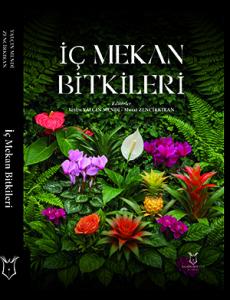
İç Mekanda Bitkisel Tasarım
Özet
İç mekanda bitkisel tasarım, peyzaj mimarlığı ve iç mekan tasarımı disiplinlerinin kesişiminde yer alan, estetik, ekolojik ve işlevsel boyutlarıyla bütüncül bir tasarım yaklaşımıdır. Modern kentleşme ve mimari pratiklerin insandoğa ilişkisini zayıflatması, bitkilerin yapısal çevreye entegrasyonunu giderek daha önemli hale getirmiştir. Bu çalışma, iç mekanda bitkisel tasarımın kuramsal temellerini, tasarım sürecindeki rolünü ve mekansal etkilerini literatür temelli bir yaklaşımla ele almaktadır. Bitkiler; hava kalitesini iyileştirme, psikolojik ve fizyolojik refahı destekleme, mekansal organizasyonu güçlendirme ve estetik değer yaratma gibi çok yönlü işlevleriyle değerlendirilmektedir. Tasarım sürecinde bitki seçimi; ekolojik uyum, ışık ve nem gereksinimleri, bakım koşulları ve mekanın kullanım amacı gibi kriterler doğrultusunda ele alınmaktadır. Renk, form, doku ve kompozisyon ilkeleri, iç mekan bitkisel düzenlemelerinin temel tasarım bileşenleri olarak açıklanmaktadır. Ayrıca biyofilik tasarım, fitotasarım ve biyomimikri gibi güncel kuramsal yaklaşımlar çerçevesinde, bitkisel tasarımın sürdürülebilir ve kullanıcı odaklı iç mekanların oluşturulmasındaki stratejik önemi vurgulanmaktadır.
Referanslar
Adams, D. (2016). The Color of Your Garden: Color Theory and Design. University of California Press.2.
Akhir, N. M., Amir, A. F., Abdullah, L., Halim, D. K. (2023). planting design expression on students perceiving campus landscape quality. International Journal of Sustainable Construction Engineering and Technology. https://doi.org/10.30880/ijscet.2023.14.03.023
Anonim, 2020. Indoor Landscaping: 30 Projects that Bring Life into Interiors. Archdaily. https://www.archdaily.com/935822/indoor-landscaping-30-projects-that-bring-life-into-interiors (Erişim Tarihi: 25.06.2025).
Anonim, 2024. Innovative Greenery: HSBC’s Flagship Space in NYC Innovative Greenery: HSBC’s Flagship Space in NYC | Ambius (Erişim Tarihi: 20.07.2025)
Anonim, 2024. The Art of Biomimicry in Architecture. Kaarwan. https://www.kaarwan.com/blog/architecture/the-art-of-biomimicry-in-architecture?id=1084 (Erişm Tarihi: 25.06.2025).
Anonim, 2024. Understanding Interior Landscaping: Enhancing Indoor Spaces. Understanding Interior Landscaping: Enhancing Indoor Spaces (Erişim Tarihi: 19.07.2025)
Anonim, 2025. Exploring Biophilic Design: Integrating Nature into Urban Spaces. Rethinking The Future. https://www.re-thinkingthefuture.com/architectural-community/a10973-exploring-biophilic-design-integrating-nature-into-urban-spaces/ (Erişim Tarihi: 25.06.2025).
Anonim, 2025. Renk skalası çemberi. https://tr.pinterest.com/pin/651825746068393092/ (Erişim Tarihi: 25.06.2025).
Armitage, A. M. (2011). Armitage's Garden Perennials: A Color Encyclopedia. Timber Press.
Balbekova, N., Kartashova, N. (2022). Landscapıng Interıors. Materials of the international youth scientific school-conference "Reproduction, monitoring and protection of natural, natural-anthropogenic and anthropogenic landscapes". https://doi.org/10.34220/rmpnnaal2021_148-152.
Bankar, M. S., Jain, S. S. (2017). Feasibility Study of Biomimicry Approach to Improve Indoor Air Quality in Green Building. International Journal of Engineering Research And. https://doi.org/10.17577/IJERTV6IS040621
Bozkurt, S., Ulus, A. (2014). Rekreasyonel amaçlı kullanılan alışveriş merkezlerinde iç mekan bitkilerinin organizasyonu ve kullanım parametrelerinin İstanbul (Avrupa Yakası) örneğinde incelenmesi. Journal of the Faculty of Forestry Istanbul University, 64(2), 24-40.
Calkins, M. (2010). Designing with Plants: Form, Texture, and Function. Garden Design Quarterly.
Chatakul, P., Janpathompong, S. (2022). Interior plants: Trends, species, and their benefits. Building and Environment. https://doi.org/10.1016/j.buildenv.2022.109325.
Chen, J. (2005). Overview of Interior Plants and Their Maintenance. University of Florida IFAS Extension.
Çolakkadıoğlu, D., Büyücek, G. (2023). The Effects of Plant Design on Interior Design. Journal of Interior Design and Academy. https://doi.org/10.53463/inda.20230198.
Diblik, R. E., Orum-Keller, C. L. (2007). Method for planting design.
El-Bannany, R. M., K.Hassan, D., Assem, A. M. (2022). Practices of Biophilic Patterns in Workplace Design. Engineering Research Journal - Faculty of Engineering (Shoubra). https://doi.org/10.21608/erjsh.2022.235277
Falk, J. H. (2014). The Role of Plants in Interior Environments: Environmental and Psychological Contributions. Journal of Environmental Horticulture, 32(1), 25–31.
Fatimah, D., Rifa, A. (2023). Vegetation Concept in Interior Space Design as Sick Building Syndrome Solution. Proceeding of The International Conference on Business, Economics, Social Sciences, and Humanities. https://doi.org/10.34010/icobest.v4i.384
Fujita, K., Akagi, S., Hase, H., Nakatogawa, T., & Takeuchi, M. (1993). Plant Layout Design System using a Hybrid Approach with a Constraint-Directed Search and a Mathematical Optimization Technique. Jsme International Journal Series C-Mechanical Systems Machine Elements and Manufacturing. https://doi.org/10.1299/JSMEC1993.36.562
Gray, T., Birrell, C. (2014). Are biophilic-designed site office buildings linked to health benefits and high performing occupants? International Journal of Environmental Research and Public Health. https://doi.org/10.3390/IJERPH111212204
Güngör, H., 1972. Temel Tasar (Birinci Baskı). Çeltüt Matbaacılık, İstanbul, s.88.
Hillenbrand-Nowicki, C., Bowker, J. M., Relf, P. D. (1993). Do plants affect human behavior in interior space? Hortscience. https://doi.org/10.21273/hortsci.28.5.565c
Hong, L. (2013). Indoor intensive and efficient planting system.
Kaufmann-Buhler, J. (2022). Designing for Maintenance: Plant Care Technology in the Office. Technology and Culture, 63, 1033 - 1056. https://doi.org/10.1353/tech.2022.0156.
Kucukali, U. F. (2024). Evaluation of Planting Design in Interiors in Terms of Basic Design Principles: The Example of Istanbul Zorlu Shopping Center. Architecture Image Studies (AIS), 5(1).
Liu, F., Yan, L., Meng, X., Zhang, C. (2022). A review on indoor green plants employed to improve indoor environment. Journal of Building Engineering. https://doi.org/10.1016/j.jobe.2022.104542
Loh, S., Santo, Y., Foth, M. (2023). Plant-human entanglements in buildings: designing for care infrastructuring with office occupants and pot plants. https://doi.org/10.3389/fcomp.2023.1233905
Mazalan, P., Vinarcikova, J., Hronský, M., Javoríková, M. (2022). Design process as a tool to improve health and wellbeing. Nucleation and Atmospheric Aerosols. https://doi.org/10.1063/5.0107535
Meng, Y. (2012). Planting and Interior Environment Design. Applied Mechanics and Materials. https://doi.org/10.4028/WWW.SCIENTIFIC.NET/AMM.209-211.284
Moran, S. (2017). Layout Within Buildings. https://doi.org/10.1016/B978-0-12-803355-5.00019-6
Moya, T. A., Dobbelsteen, A. van den, Ottelé, M., & Bluyssen, P. M. (2019). A review of green systems within the indoor environment. Indoor and Built Environment. https://doi.org/10.1177/1420326X18783042
Nandeha, N. N. (2024). From flowers to foliage: a study of plant aesthetics. Hortıculture The Global Country (pp. 1-7). Royal Book Publishing.1–7. https://doi.org/10.26524/223.1
Nazhar, R. D. (2022). Greenery Concepts in Cafe and Restaurant Interiors. https://doi.org/10.34010/icobest.v3i.183
Petrovska, Yu., Zubanova, V. (2023). Phytodesign in the interior of public catering establishments: domestic and international practices. https://doi.org/10.33042/2311-7257.2023.109.1.1
Planterra Lighting Guide, 2019. Planterra® Lighting Guide For Interior Landscape Design. planterra.com/wp-content/uploads/2019/04/PlanterraLightingGuide4.19.pdf (Erişim Tarihi: 19.07.2025)
Raghda, R. A. elaziz, El-keiy, T. M., Shalaby, E. A., Shehata, A. M. (2018). Overcoming indoor air pollutants by using wall gardens - carbon dioxide study case. https://doi.org/10.21608/ALEXJA.2018.82446
Roeser, D., Roeser, B. (2012). Plant growing system.
Sabiela, Y. H., Wibisono, A. (2024). The Effect of Houseplant Ratio in Residential Interior on Human Positive Emotions. Jurnal Desain Interior. https://doi.org/10.12962/j12345678.v9i1.20216
Seçkin, Ö.B., 2003. Peyzaj Uygulama Tekniği (Birinci Baskı). İstanbul Üniversitesi, Orman Fakültesi Yayınları, İstanbul, s.145.
Strashok, О. Y., Morozko, A. P. (2021). Phytodecoration of interiors of the Government House of Ukraine: analysis and proposals. Annals of Forest Science. https://doi.org/10.31548/FOREST2021.02.002
Sutherland, A. (2008). Planting for Texture: Creating Layers of Visual Interest. Horticultural Society Press.
Szczepańska-Rosiak, E., Sowa, J., Mastalerz, K., Heim, D. (2025). Useful daylight illuminance for ornamental plants in buildings – The method to design the green interior. Energy and Buildings. https://doi.org/10.1016/j.enbuild.2025.115315.
Wang, B., Liu, X., Chen, P. C. (2014). The Indoor Greening Design Practices. Applied Mechanics and Materials, 587–589, 476–479. https://doi.org/10.4028/www.scientific.net/amm.587-589.476
Wang, J. (2016, January). The application of plant landscape in interior design. In 2016 2nd International Conference on Education Technology, Management and Humanities Science (pp. 1-8). Atlantis Press.
Wang, W., Chi, J., Niu, S. (2023). Application of green plant elements in office space. SHS Web of Conferences. https://doi.org/10.1051/shsconf/202316702009.
Wolverton, B. C., Johnson, A., Bounds, K. (1989). Interior Landscape Plants for Indoor Air Pollution Abatement. NASA, Stennis Space Center.
Xiaodan, K. (n.d.) (2005). An Exploration on the Principle of Green Interior Design. https://doi.org/10.3969/j.issn.1671-4326.2004.02.011
Xiaoli, H. (n.d.) (2018). Application Research of Indoor Plant Wall in Interior Decoration Design. https://doi.org/10.23977/icamcs.2018.081
Xu, L. (2018, July). Analysis on indoor plant landscapes in interior design styles. In 4th International Conference on Arts, Design and Contemporary Education (ICADCE 2018) (pp. 530-533). Atlantis Press.
Xu, Q. (2023). Exploring the Potential of Plant-Driven Interaction Design. Highlights in Art and Design, 3(1), 93-96. https://doi.org/10.54097/hiaad.v3i1.9469
Xuanji, W. (2014). Indoor plant cultural method with condensed and transmitted light.
Yazgan, M., Uslu, A., Özyavuz, M. (2009). İç Mekan Bitkileri ve Tasarım (Birinci Baskı). Ankara Üniversitesi, Ziraat Fakültesi Yayınları, Ankara.
Yazgan, M., Uslu, A., Tanrivermiş, E. (2003). İç mekanda bitkisel tasarım. Saksı Süs Bitkileri Üreticiliği Derneği Yayınları, Ankara.
Yeo, L. B. (2020). Psychological And Physiological Benefits Of Plants In The Indoor Environment: A Mini And In-Depth Review. https://doi.org/10.11113/IJBES.V8.N1.597
Zeng, J., Li, C. (2017). The Application of Green Plants in the Interior Space. , 1032-1036. https://doi.org/10.2991/ICESAME-17.2017.225.
Zhong, W., Schröder, T., Bekkering, J. J. (2024). Implementing biophilic design in architecture through three-dimensional green spaces: Guidelines for building technologies, plant selection, and maintenance. Journal of Building Engineering. https://doi.org/10.1016/j.jobe.2024.109648