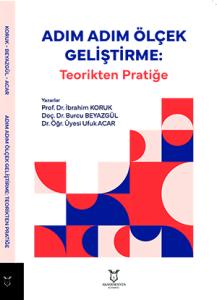
Adım Adım Ölçek Geliştirme: Teorikten Pratiğe
Özet
-
Referanslar
Akduman GG ve Cantürk G. (2010). Cinsel istismara uğrayan çocuklara karşı tutum ölçeği geçerlik ve güvenirlik çalışması (Üniversite öğrencileri örneklemi). Adli Tıp Dergisi, 24(2), 22-29.
Aksakoğlu G. (2013). Sağlıkta Araştırma ve Çözümleme. 3.Baskı, Meta Basım, İzmir.
Alavi M, Visentin D, Thapa D, Hunt G, Watson R, Cleary M. (2020). Chi-square for model fit in confirmatory factor analysis.. Journal of advanced nursing.
American Educational Research Association, American Psychological Association, & National Council on Measurement in Education. (2014). Standards for Educational and Psychological Testing. AERA.
American Psychiatric Association. https://www.psychiatry.org/patients-families/Peripartum-Depression/What-is-Peripartum-Depression 13.08.24.
Anastasi A ve Urbina S. (1997). Psychological Testing (7th ed.). Upper Saddle River, NJ: Prentice Hall.
Anastasi, A., & Urbina, S. (1997). Psychological Testing (7th ed.). Prentice Hall.
Aslam M ve Arif O. (2020). Multivariate Analysis under Indeterminacy: An Application to Chemical Content Data. Journal of Analytical Methods in Chemistry, 2020.
Asuero AG, Sayago A, González AG. (2006). The correlation coefficient: An overview. Critical reviews in analytical chemistry, 36(1), 41-59.
Aylar F ve Nagihan E. (2019). Derleme: Ölçek Geliştirme Çalışmalarında Doğrulayıcı Faktör Analizinin Kullanımı. The Journal of Social Sciences, 4(10), 389-412.
Ayre C, Scally AJ. (2014). Critical values for Lawshe’s content validity ratio: revisiting the original methods of calculation. Measurement and evaluation in counseling and development. 47(1):79-86.
Baker, M. J. (2000). Writing a Research Proposal. The Marketing Review, 1(1), 61–75.
Beaton, D. E., Bombardier, C., Guillemin, F., & Ferraz, M. B. (2000). Guidelines for the Process of Cross-Cultural Adaptation of Self-Report Measures. Spine, 25(24), 3186–3191.
Beck, A. T., Steer, R. A., & Brown, G. K. (1996). Manual for the Beck Depression Inventory-II. Psychological Corporation.
Beck, C. T. (2013). Routledge International Handbook of Qualitative Nursing Research. New York: Routledge.
Beyazgul B, Koruk F, Koruk I. (2024). Emzirme Döneminde Baskılayıcı Davranışlar Yaşama Durumuna Yönelik Ölçek Geliştirme Çalışması: Emzirme Baskısı Ölçeği. 14. Uluslararası İstanbul Bilimsel Çalışmalar Kongresi, İstanbul, Türkiye.
Beyazgul B, Koruk F, Koruk I. (2024). Development of a scale for attitude toward sexually transmitted infections based on the Health Belief Model. European Journal of Obstetrics & Gynecology and Reproductive Biology, 298, 42-48.
Beyazgül B, Karadağ D. (2024). Doğum Öncesi Bakım Hizmetlerinin Birinci Basamak Sağlık Hizmetleri İçerisinde Çok Boyutlu Değerlendirilmesine Yönelik Ölçek Geliştirilmesi. V. Uluslararası Farklı Boyutlarıyla Sağlık Konferansı, Çanakkale, Türkiye.
Binet, A., & Simon, T. (1905). Methods Nouvelles Pour Le Diagnostic du Niveau Intellectuel Des Anormaux [New Methods for the Diagnosis of the Intellectual Level of Subnormals]. L’Année Psychologique, 12(1), 191-244.
Boateng GO, Neilands TB, Frongillo EA, Melgar-Quiñonez HR, Young SL. (2018). Best Practices for Developing and Validating Scales for Health, Social, and Behavioral Research: A Primer. Front Public Health. 11;6:149.
Boateng GO, Neilands TB, Frongillo EA, Melgar-Quiñonez HR, Young S.L. (2018). Best Practices for Developing and Validating Scales for Health, Social, and Behavioral Research: A Primer, Frontiers in Public Health. 11;6:149.
Boateng, G. O., Neilands, T. B., Frongillo, E. A., Melgar-Quiñonez, H. R., & Young, S. L. (2018). Best Practices for Developing and Validating Scales in Health, Social and Behavioral Research: A Primer. Frontiers in Public Health, 6, 149.
Boccolini CS, Carvalho ML, Oliveira MI. (2015). Factors associated with exclusive breastfeeding in the first six months of life in Brazil: A systematic review. Rev Saude Publica. 49:91.
Bowen, G. A. (2009). Document Analysis as a Qualitative Research Method. Qualitative Research Journal, 9(2), 27–40.
Bryman, A. (2012). Social Research Methods (4th ed.). Oxford: Oxford University Press.
Bryson, J. M. (2011). Strategic Planning for Public and Nonprofit Organizations (4th ed.). San Francisco, CA: Jossey-Bass.
Bryson, J. M., Quick, K. S., Slotterback, C. S., & Crosby, B. C. (2013). Designing Public Participation Processes. Public Administration Review, 73(1), 23–34.
Bujang MA, Omar ED, Baharum NA. (2018). A Review on Sample Size Determination for Cronbach's Alpha Test: A Simple Guide for Researchers. Malays J Med Sci. 25(6):85-99.
Büyüköztürk, Ş. (2007). Sosyal Bilimler İçin Veri Analizi El Kitabı (7. baskı). Pegem A Yayıncılık.
Büyüköztürk, Ş. (2020). Sosyal Bilimler İçin Veri Analizi El Kitabı (27. baskı). Ankara: Pegem Akademi.
Callahan, J. L., & Martin, D. (2007). The Spectrum of School-Community Partnerships. Preventing School Failure: Alternative Education for Children and Youth, 51(4), 5–10.
Campbell, D. T., & Fiske, D. W. (1959). Convergent and Discriminant Validation by the Multitrait-Multimethod Matrix. Psychological Bulletin, 56(2), 81-105.
Carpenter S. (2018). Ten Steps in Scale Development and Reporting: A Guide for Researchers, Communication Methods and Measures.12(1):25-44.
Chakrabartty SN. (2013). Best split-half and maximum reliability. IOSR Journal of Research & Method in Education, 3(1), 1-8.
Charness, N., & Boot, W. R. (2009). Aging and Information Technology Use: Potential and Barriers. Current Directions in Psychological Science, 18(5), 253–258.
Cindoglu C, Beyazgul B, Tatligun M. (2024). Turkish Validity and Reliability of Comprehensive Diabetes Self-Management Scale. Medical Bulletin of Sisli Etfal Hospital, 58(1).
Cizek GJ ve Bunch MB. (2007). Standard Setting: A Guide to Establishing and Evaluating Performance Standards on Tests. Sage Publications.
Cohen, R. J., & Swerdlik, M. E. (2018). Psychological Testing and Assessment: An Introduction to Tests and Measurement (9th ed.). McGraw-Hill.
Costa MF. (2020). Health belief model for coronavirus infection risk determinants. Rev Saude Publica. 54:47.
Costello, A. B., & Osborn, J. W. (2005). Best practices in exploratory factor analysis: Four recommendations for getting the most from your analysis. Practical Assessment, Research, and Evaluation, 10(1), 7.
Cox JL ve Holden JM (1987). Detection of postnatal depression: Development of the 10-item Edinburgh Postnatal Depression Scale (EPDS). Br J Psychiatry, 150:782-786.
Creswell, J. W., & Plano Clark, V. L. (2018). Designing and Conducting Mixed Methods Research (3rd ed.). Thousand Oaks, CA: SAGE.
Crocker, L., & Algina, J. (2006). Introduction to Classical and Modern Test Theory. Mason, OH: Cengage Learning.
Cronbach, L. J. (1970). Essentials of Psychological Testing (3rd ed.). Harper & Row.
Çamlıca H ve Dişçi, R. (2008). Tanı testlerinde sınır değerlerinin belirlenmesi. Türk Onkoloji Dergisi, 23(1), 26-33.
Çelik AS, Pasinlioğlu T. (2015). Sıcak Basması İnanç Ölçeği’nin geçerlilik ve güvenilirlik çalışması. Sağlık Bilimleri ve Meslekleri Dergisi. 2(3):249-259.
Çelik Y. (2011). Nasıl? Biyoistatistik Bilimsel Araştırma SPSS.
Davis LL. (1992). Instrument review: Getting the most from a panel of experts. Applied Nursing Research. 5(4), 194-197.
Demir O ve Köse İA. (2014). Angoff, Nedelsky ve Ebel standart belirleme yöntemleri ile belirlenen kesme puanlarının karşılaştırılması. Mersin Üniversitesi Eğitim Fakültesi Dergisi.
Denzin, N. K., & Lincoln, Y. S. (Eds.). (2018). The SAGE Handbook of Qualitative Research (5th ed.). Thousand Oaks, CA: SAGE.
DeVellis RF (2022). Scale Development Theory and Applications. 3.Edition: Çeviri: Totan T, Nobel Akademik.
DeVellis RF. (2003). Scale development: theory and applications (applied social research methods). Social Research. 900:14929.
DeVellis RF. (2003). Scale development: theory and applications (applied social research methods). Social Research. 900:14929.
DeVellis RF. (2022). Scale Development Theory and Applications. 3.Edition: Çeviri: Totan T., Nobel Akademik.
DeVellis, R. F. (2016). Scale Development: Theory and Applications (4th ed.). SAGE.
DeVellis, R. F. (2017). Scale Development: Theory and Applications (4th ed.). Thousand Oaks, CA: SAGE.
Dişli B, ve Şahin NH. (2022). Menopoza özgü sıcak basması ölçeği: Geçerlik ve güvenirlik çalışması. İstanbul Gelişim Üniversitesi Sağlık Bilimleri Dergisi, (16), 48-62.
Dziuban C ve Shirkey E. (1974). On the Psychometric Assessment of Correlation Matrices. American Educational Research Journal, 11, 211 - 216.
Ekıcı E, Ikıısık H, Ankaralı H, Manav G, Colak M, Kozan Cıkırıkcı EH. (2021). The validity and reliability of the Turkish version of the Family Nutrition and Physical Activity screening tool. Marmara Medical Journal, 34(3), 319-326.
Emanuel, E. J., Wendler, D., & Grady, C. (2000). What Makes Clinical Research Ethical? JAMA, 283(20), 2701–2711.
Emond EJ ve Mason DW. (2002). A new rank correlation coefficient with application to the consensus ranking problem. Journal of Multi‐Criteria Decision Analysis, 11(1), 17-28.
Ercan K, Akıllı M, Sezek F. (2009). Lise öğrencilerinin çevreye karşı tutumlarının cinsiyet açısından incelenmesi. Mehmet Akif Ersoy Üniversitesi Eğitim Fakültesi Dergisi, (18), 43-54.
Erkorkmaz Ü, Etikan İ, Demir O, Özdamar K, Sanisoğlu SY. (2013). Doğrulayıcı faktör analizi ve uyum indeksleri. Turkiye Klinikleri Journal of Medical Sciences, 33(1), 210-223.
Erkuş A ve Selvi H. (2019). Ölçek uyarlama ve “norm” geliştirme. Pegem Akademi. Ankara.
Erkuş A. (2012). Değerlendirme, değerleme, norm, norm geliştirme, normalleştirme nedir ne değildir? İlköğretim Online, 11(2), 1-6.
Eroğlu N ve Sabuncu N. (2019). Diyabet Öz Yönetim Skalası’nın (DÖYS) Türk toplumuna uyarlanması: geçerlik ve güvenirlik çalışması. Hemşirelik Bilimi Dergisi, 1(3), 1-6.
Erol N, Sezgin N, Savaşır I. (1993).Gelişim Tarama Envanteri Geliştirilmesi ile İlgili Geçerlik Çalışmaları. Türk Psikiyatri Dergisi. 8(29): 16-22.
Erselcan T, Özen A, Yuksel D, Altun GD, Öztürk E, Balcı TA, Karayalcin B. (2009). Kemik mineral yoğunluğu ölçümü uygulama kılavuzu. Turk J Nucl Med, 18(1), 31-40.
Eskin M, Harlak H, Demirkıran F, Dereboy Ç. (2013). Algılanan Stres Ölçeğinin Türkçeye Uyarlanması: Güvenirlik ve Geçerlik Analizi. Yeni Symposium Journal Cilt 51, sayı 3.
Fawcett, J., & Garity, J. (2009). Evaluating Research for Evidence-Based Nursing Practice. Philadelphia, PA: F. A. Davis Company.
Foster RC. (2021). Kr20 and kr21 for some nondichotomous data (it’s not just cronbach’s alpha). Educational and Psychological Measurement, 81(6), 1172-1202.
Fowler Jr, F. J. (2014). Survey Research Methods (5th ed.). Thousand Oaks, CA: SAGE.
Freeman, R. E. (2010). Strategic Management: A Stakeholder Approach. Cambridge: Cambridge University Press.
Gaskin CJ, Happell B. (2014).On exploratory factor analysis: a review of recent evidence, an assessment of current practice, and recommendations for future use. Int J Nurs Stud. 51(3):511-21.
Goretzko D, Siemund K, Sterner P. (2023). Evaluating Model Fit of Measurement Models in Confirmatory Factor Analysis. Educational and Psychological Measurement.
Greenwood, M. (2007). Stakeholder Engagement: Beyond the Myth of Corporate Responsibility. Journal of Business Ethics, 74(4), 315–327.
Griffiths, M. D., Kuss, D. J., & Pontes, H. M. (2016). A Brief Overview of Internet Gaming Disorder and its Treatment. Australian Clinical Psychologist, 2(1), 20108.
Guba, E. G., & Lincoln, Y. S. (1994). Competing Paradigms in Qualitative Research. In N. K. Denzin & Y. S. Lincoln (Eds.), Handbook of Qualitative Research (pp. 105–117). Thousand Oaks, CA: SAGE.
Guthrie, G. (2010). Basic Research Methods: An Entry to Social Science Research. New Delhi: SAGE India.
Güvenir T, Özbek A, Baykara B, Arkar H, Şentürk B, İncekaş S. (2008). Güçler ve güçlükler anketi'nin (gga) Türkçe uyarlamasinin psikometrik özellikleri. Turkish Journal of Child and Adolescent Mental Health, 15(2), 65-74.
Howard, M. C. (2016). A Review of Exploratory Factor Analysis Decisions and Overview of Current Practices: What We Are Doing and How Can We Improve? International Journal of Human–Computer Interaction, 32(1), 51–62.
IBM Corp. (2021). IBM SPSS Amos for Windows, Version 26.0. Armonk, NY: IBM Corp.
IBM SPSS Statistics v.22.0 (IBM Corp.; Armonk, NY, USA).
Işık A ve Şimşek GM. (2019). Ruh Sağlığı Çalışanlarının Madde Kullanım Bozukluğu Tedavisine Yönelik Tutumları Ölçeğinin Geliştirilmesi. Kıbrıs Türk Psikiyatri ve Psikoloji Dergisi, 1(Özel Sayı 1), 24-26.
Jackson D, Gillaspy J, Purc-Stephenson R. (2009). Reporting practices in confirmatory factor analysis: an overview and some recommendations.. Psychological methods, 14 1, 6-23.
Jebb AT, Ng V, Tay L. (2021). A Review of Key Likert Scale Development Advances: 1995-2019. Front Psychol. 4; 12:637547.
Johnson, R. B., & Onwuegbuzie, A. J. (2004). Mixed Methods Research: A Research Paradigm Whose Time Has Come. Educational Researcher, 33(7), 14–26.
Jones K, Parker EJ, Steffens MA, Logan RM, Brennan D, Jamieson LM. (2016). Development and psychometric validation of social cognitive theory scales in an oral health context. Aust N Z J Public Health. 40(2):193-5.
Kandane-Rathnayake RK, Enticott JC, Phillips LE. (2013). Data distribution: normal or abnormal? What to do about it. Transfusion. 53(4):701-2.
Karabulut Demir E. (2007). Ebeveyn tutum ölçeği (ETÖ) (Master's thesis, Sosyal Bilimler Enstitüsü).
Karagöz Y, Bardakçı S. (2020). Bilimsel Araştırmalarda Kullanılan Ölçme Araçları ve Ölçek Geliştirme. Nobel Kitabevi, Ankara.
Karakoç FY ve Dönmez L. (2014). Ölçek geliştirme çalışmalarında temel ilkeler. Tıp Eğitimi Dünyası, 13(40), 39-49.
Karasar, N. (2018). Bilimsel Araştırma Yöntemi (32. baskı). Nobel Yayıncılık.
Karasar, N. (2021). Bilimsel Araştırma Yöntemi (35. baskı). Ankara: Nobel Yayıncılık.
Kartal M. ve Bardakçı S. (2018). SPSS ve AMOS Uygulamalı Örneklerle Güvenirlik ve Geçerlik Analizleri. Akademisyen Kitabevi. Ankara.
Kartal M. ve Bardakçı S. (2019). Tutum Ölçekleri. Akademisyen Kitabevi. Ankara.
Kılıç A ve Kilmen S. (2019). Angoff, Evet/Hayır ve Sınır Grup Yöntemlerine Göre Kesme Puanlarının Karşılaştırılması. Boğaziçi Üniversitesi Eğitim Dergisi, 36(2), 47-66.
Kılıç S. (2013). Klinik karar vermede ROC analizi. Journal of Mood Disorders, 3(3), 135-40.
Kline, R. B. (2016). Principles and Practice of Structural Equation Modeling (4th ed.). New York: The Guilford Press.
Kline, T. (2005). Psychological Testing: A Practical Approach. SAGE.
Koruk F. Turan Z, Beyazgül B, Barlas F, Özgen HN, Koruk İ (2023). Breastfeeding during pregnancy and tandem breastfeeding attitude scale: Instrument development and psychometric properties. 2.Uluslararası Kadın Sağlığı Hemşireliği Kongresi, Ankara, İstanbul.
Kuzan R, Beyazgül B, Karadağ D. (2024). A Study on the Development of a Health Literacy Assessment Scale. Harran Üniversitesi Tıp Fakültesi Dergisi, 21(3), 393-401.
Larsen R ve Warne R. (2010). Estimating confidence intervals for eigenvalues in exploratory factor analysis. Behavior Research Methods, 42, 871-876.
Lawshe CH. (1975). A quantitative approach to content validity. Personnel psychology. 28(4):563-75.
Ledesma R, Valero-Mora P, Macbeth G. (2015). The Scree Test and the Number of Factors: a Dynamic Graphics Approach. The Spanish Journal of Psychology, 18.
Likert, R. (1932). A Technique for the Measurement of Attitudes. Archives of Psychology, 22(140), 1-55.
Lin-qua Z. (2015). Application of Eigenvalue and Principal Components Based on Factor. Mathematics in Practice and Theory.
Lord, F. M., & Novick, M. R. (1968). Statistical Theories of Mental Test Scores. Addison-Wesley.
Macrosson W. (1999). Scree Plots, Data Structure, and Random Variance. Psychological Reports, 84, 533 - 540.
Maleki-Saghooni N, Barez MA, Karimi FZ (2020). Investigation of the relationship between social support and breastfeeding self-efficacy in primiparous breastfeeding mothers, The Journal of Maternal-Fetal & Neonatal Medicine, 33:18, 3097-3102.
Maxwell, J. A. (2013). Qualitative Research Design: An Interactive Approach (3rd ed.). Thousand Oaks, CA: SAGE.
McCluskey A ve Lalkhen AG. (2007). Statistics II: Central tendency and spread of data. Continuing Education in Anaesthesia, Critical Care & Pain, 7(4), 127-130.
Merriam, S. B., & Tisdell, E. J. (2016). Qualitative Research: A Guide to Design and Implementation (4th ed.). San Francisco, CA: Jossey-Bass.
Meydan CH ve Şeşen H (2015). Yapısal eşitlik modellemsi amos uygulamaları, 2.Baskı, Detay Yayıncılık, Ankara.
Mikhael EM, Hassali MA, Hussain SA, Shawky N. (2019). Development and validation of a comprehensive diabetes self-management scale. Diabetes Metab Syndr. 13(3): 1717-1721.
Miles, M. B., Huberman, A. M., & Saldaña, J. (2013). Qualitative Data Analysis: A Methods Sourcebook (3rd ed.). Thousand Oaks, CA: SAGE.
Morgado CMdC, Werneck GL, Hasselmann MH. (2013). Social network, social support and feeding habits of infants in their fourth month of life. Ciênc Saúde Coletiva. 18(2):367–376.
Nartgün Z. (2007). Aynı Puanlar Üzerinden Yapılan Mutlak Ve Bağıl Değerlendirme Uygulamalarının Notlarda Farklılık Oluşturup Oluşturmadığına İlişkin Bir İnceleme. Ege Eğitim Dergisi, 8(1), 19-40.
Netemeyer, R. G., Bearden, W. O., & Sharma, S. (2003). Scaling Procedures: Issues and Applications. Thousand Oaks, CA: SAGE.
Nkansah, B. (2018). On the Kaiser-Meier-Olkin’s Measure of Sampling Adequacy. Mathematical theory and modeling, 8, 52-76.
Nunnally, J. C., & Bernstein, I. H. (1994). Psychometric Theory (3rd ed.). McGraw-Hill.
Nunnally, J. C., & Bernstein, I. H. (1994). Psychometric Theory (3rd ed.). New York: McGraw-Hill.
Nutbeam, D. (1998). Health Promotion Glossary. Health Promotion International, 13(4), 349–364.
Nye C. (2022). Reviewer Resources: Confirmatory Factor Analysis. Organizational Research Methods, 26, 608- 628.
Ocak M. (2020). AMOS ile adım adım yapısal eşitlik modellemesi uygulamaları, Sonçağ Yayıncılık, Bursa.
Onbaşı Ö. (2022). e-Sağlıklı beslenme okuryazarlığı (e-SBO) ölçeğinin Türkçe’ye uyarlanması ve yetişkin bireylerde covid-19 pandemi öncesi ve sırasında e-SBO düzeyleri ile beslenmeye ilişkin parametreler arasındaki ilişkinin belirlenmesi.
Orb, A., Eisenhauer, L., & Wynaden, D. (2000). Ethics in Qualitative Research. Journal of Nursing Scholarship, 33(1), 93–96.
Orçan F. (2018). Açımlayıcı ve doğrulayıcı faktör analizi: İlk hangisi kullanılmalı. Eğitimde ve Psikolojide Ölçme ve Değerlendirme Dergisi, 9(4), 413-421.
Ozarkan HB. (2018). Açık uçlu testlerde standart belirleme sürecinde genişletilmiş Angoff ve karşıt gruplar yöntemlerinin karşılaştırılması (Master's thesis, Eğitim Bilimleri Enstitüsü).
Ömür S ve Selvi H. (2010). Angoff, Ebel ve Nedelsky yöntemleriyle belirlenen kesme puanlarının sınıflama tutarlılıklarının karşılaştırılması. Journal of Measurement and Evaluation in Education and Psychology, 1(2), 109-113.
Özçakar N, Ergönen AT, Kartal M, Baydur H. (2017). Adaptation, reliability, and validity study of the Hwalek-SengstockElder Abuse Screening Test (HS/EAST): a Turkish version. Turkish journal of medical sciences, 47(6), 1894-1902.
Özdamar K. (2016). Ölçek ve Test Geliştirme Yapısal Eşitlik Modellemesi. Ankara: Nisan Kitabevi Yayıncılık.
Özdemir Z. (2018). Sağlık bilimlerinde likert tipi tutum ölçeği geliştirme. Hacettepe Üniversitesi Hemşirelik Fakültesi Dergisi, 5(1), 60-68.
Patton, M. Q. (2015). Qualitative Research & Evaluation Methods (4th ed.). Thousand Oaks, CA: SAGE.
Piedmont R ve Hyland M. (1993). Inter-Item Correlation Frequency Distribution Analysis: A Method for Evaluating Scale Dimensionality. Educational and Psychological Measurement. 53 (2); 369-378.
Polit, D. F., & Beck, C. T. (2008). Nursing Research: Generating and Assessing Evidence for Nursing Practice (8th ed.). Philadelphia, PA: Wolters Kluwer.
Polit, D. F., & Beck, C. T. (2017). Nursing Research: Generating and Assessing Evidence for Nursing Practice (10th ed.). Philadelphia, PA: Wolters Kluwer.
Pronk T, Molenaar D, Wiers RW, Murre J. (2022). Methods to split cognitive task data for estimating split-half reliability: A comprehensive review and systematic assessment. Psychonomic Bulletin & Review, 29(1), 44-54.
Salamon, L. M. (Ed.). (2002). The Tools of Government: A Guide to the New Governance. New York: Oxford University Press.
Sandelowski, M. (2000). Focus on Research Methods: Whatever Happened to Qualitative Description? Research in Nursing & Health, 23(4), 334–340.
Sarı T ve Çakır G. (2016). Mutluluk korkusu ile öznel ve psikolojik iyi oluş arasındaki ilişkinin incelenmesi. Eğitim ve Öğretim Araştırmaları Dergisi, 5(25), 222-229.
Saupe JL. (1961). Some useful estimates of the Kuder-Richardson formula number 20 reliability coefficient. Educational and Psychological Measurement, 21(1), 63-71.
Skinner CS, Tiro J, Champion VL. (2015). Health Behavior and Health Education: Theory, Research and Practice. 5th ed. San Francisco: Jossey-Bass.
Stevens, S. S. (1946). On the Theory of Scales of Measurement. Science, 103(2684), 677-680. https://doi.org/10.1126/science.103.2684.677
Stone, D. (2012). Policy Paradox: The Art of Political Decision Making (3rd ed.). New York: W.W. Norton & Company.
Streiner, D. L., Norman, G. R., & Cairney, J. (2015). Health Measurement Scales: A Practical Guide to Their Development and Use (5th ed.). Oxford: Oxford University Press.
Sun J. (2005). Assessing Goodness of Fit in Confirmatory Factor Analysis. Measurement and Evaluation in Counseling and Development, 37, 240 - 256.
Şahin DB ve Gülleroğlu HD. (2013). Likert tipi ölçeklere madde seçmede kullanilan farkli madde analizi teknikleri ile oluşturulan ölçeklerin psikometrik özelliklerinin incelenmesi. Asya Öğretim Dergisi, 1(2), 18-28.
Şencan H. (2005). Sosyal ve davranışsal ölçünlerde güvenilirlik ve geçerlilik. Ankara: Seçkin Yayıncılık. p. 105–363.
Şeşen H. (2010). Adalet algısının tükenmişliğe etkisi: İş tatmininin aracı değişken rolünün yapısal eşitlik modeli ile testi. Savunma Bilimleri Dergisi, 9(2), 67-90.
Tabachnick, B. G., & Fidell, L. S. (2013). Using multivariate statistics (6th ed.). Pearson.
Tabachnick, B. G., & Fidell, L. S. (2019). Using Multivariate Statistics (7th ed.). Pearson.
Tabachnick, B. G., & Fidell, L. S. (2019). Using Multivariate Statistics (7th ed.). Boston: Pearson.
Tashakkori, A., & Teddlie, C. (Eds.). (2010). SAGE Handbook of Mixed Methods in Social & Behavioral Research (2nd ed.). Thousand Oaks, CA: SAGE.
Taşdemir F, Çokluk Ö. (2013). Angoff (1-0), Nedelsky ve Sınır Değerleri Saptama Yöntemleri ile Bir Testin Sınıflama Doğruluklarının İncelenmesi. Mediterranean Journal of Humanities mjh.akdeniz.edu.tr III/2, 241-261.
Taşdemir F. (2013). Angoff (1-0), Nedelsky ve sınır değerleri saptama yöntemleri ile bir testin sınıflama doğruluklarının incelenmesi. Yayımlanmamış Doktora Tezi. Ankara Üniversitesi, Ankara.
Tavakol M ve Dennick R. (2011). Making sense of Cronbach's alpha. International journal of medical education, 2, 53.
Taylor R. (1990). Interpretation of the correlation coefficient: a basic review. Journal of diagnostic medical sonography, 6(1), 35-39.
Teijlingen, E. R. V., & Hundley, V. (2001). The Importance of Pilot Studies. Social Research Update, (35). University of Surrey.
Tezbaşaran, A. A. (1997). Likert tipi ölçek geliştirme kılavuzu. Türk Psikologlar Derneği.
Uyumaz G ve Çokluk Ö. (2016). Likert Tipi Ölçeklerde Madde Düzeni ve Derecelendirme Farklılıklarının Psikometrik Özellikler ve Yanıtlayıcı Tutumları Açısından İncelenmesi. Journal of Theoretical Educational Science/Kuramsal Eğitimbilim Dergisi, 9(3).
WHO (World Health Organization). (2011). World Report on Disability. Cenevre: WHO Press.
WHO. (1994).Assessment of fracture risk and its application to screening for postmenopausal osteoporosis. Report of a WHO study group. Geneva, World Health Organization (WHO Technical Report Series, No. 843).
WHO. Abuse of older people. https://www.who.int/news-room/fact-sheets/detail/abuse-of-older-people 14.08.2024.
Yeşilyurt S ve Çapraz C. (2018). Ölçek geliştirme çalışmalarında kullanılan kapsam geçerliği için bir yol haritası. Erzincan Üniversitesi Eğitim Fakültesi Dergisi, 20(1), 251-264.
Yıkgeç A. (2005). A validity study of the Modified Checklist for Autism in Toddlers (M-CHAT) on a Turkish sample. Yayınlanmamış Yüksek Lisans Tezi, Boğaziçi Üniversitesi Sosyal Bilimler Enstitüsü, İstanbul.
Yıkgeç A. (2005). A validity study of the Modified Checklist for Autism in Toddlers (M-CHAT) on a Turkish sample. Yayınlanmamış Yüksek Lisans Tezi, Boğaziçi Üniversitesi Sosyal Bilimler Enstitüsü, İstanbul.
Zeyrek AŞ, Kurban NK, Arslan S. (2020). Bir başarı testi geliştirme çalışması: hemşirelik öğrencilerinin intramüsküler enjeksiyon becerilerini ölçme. Gümüşhane Üniversitesi Sağlık Bilimleri Dergisi, 9(2), 133-141.
Zimmerman DW. (1972). Test reliability and the Kuder-Richardson formulas: Derivation from probability theory. Educational and Psychological Measurement, 32(4), 939-954.
Yayınlanan
Lisans
LisansBu İnternet Sitesi içeriğinde yer alan tüm eserler (yazı, resim, görüntü, fotoğraf, video, müzik vb.) Akademisyen Kitabevine ait olup, 5846 sayılı Fikir ve Sanat Eserleri Kanunu ve 5237 sayılı Türk Ceca Kanunu kapsamında korunmaktadır. Bu hakları ihlal eden kişiler, 5846 sayılı Fikir ve Sanat eserleri Kanunu ve 5237 sayılı Türk Ceza Kanununda yer alan hukuki ve cezai yaptırımlara tabi olurlar. Yayınevi ilgili yasal yollara başvurma hakkına sahiptir.
