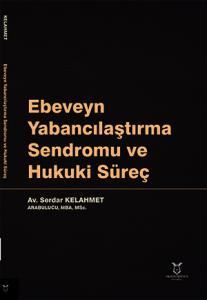
Ebeveyn Yabancılaştırma Sendromu ve Hukuki Süreç
Özet
Ebeveyn Yabancılaştırma sendromu tüm dünya için yeni bir kavramdır. Dünyada olduğu gibi ülkemizde de konuya taraf olanlar hukukçular ve bilirkişiler henüz yeterli bilgi ve donanıma sahip değillerdir. Bu duruma yabancı olan çocuk psikiyatrları ve profesyoneller, gerçek istismar veya kurgu istismarı tanımlamalarının yapıldığı incelemeleri değerlendirmemişlerse bu durumun birer parçası olunmakta ve mahkemeler uzadıkça da ebeveyn yabancılaştırma sendromu ile geride kalan ebeveyn imajı yok edilmektedir. Kurgu cinsel istismar davalarında belirgin özellikler adli psikiyatrinin konusu olup bu konuda henüz istenen düzeyde yaygın ve yeterli bilgi ve birikim oluşmamıştır.
Bu çalışma, uluslararası evliliklerden çocuk istismarı ve ebeveyn yabancılaştırma sendromuna oradan mahkeme salonlarına kadar geniş bir yelpazede önemli konulara odaklanarak aile, hukuk ve psikoloji alanları arasındaki karmaşıklıkları incelemektedir. Konuya ilişkin köşe taşları olan çocuk, uluslararası evliliklerin hukuki ve sosyal yönleri ile bu evliliklerde taraflardan birinin çocuğu kendi ülkesine kaçırması, çocuk ihmal ve istismarı, ebeveyn yabancılaştırma sendromu, çocuk hakları, hukuki düzenlemeler çalışmamız akışında teker teker incelenmiştir.
Ülkemizde yaşanmış 4 somut olgu değerlendirilmiştir. Bu olgulardaki uzman görüşleri, mahkeme kararları özellikle vakaların sonuçlarına hukuki sonuçlarına ilişkin paylaşımlar incelememiz kapsamındadır. Bununla birlikte sadece yerel mahkemelerin kararları değil, Bölge Adliye Mahkemeleri ve Yargıtay 2.Hukuk Dairesinin emsal kararları ışığında Türk Hukuk sistemindeki hukuki süreç irdelenmiştir.
Uluslararası Çocuk Kaçırmanın Hukuki Veçhelerine Dair Lahey Sözleşmesinin, uluslararası iş birliği içinde etkin uygulanması, hızlı karar alınması gerekmektedir. Çocukla çalışan profesyonellerin EYS konusunda bilgi ve farkındalıkların artması erken tanı ile çocuğun desteklenmesi önemlidir.
Parental Alienation Syndrome is a new concept for the whole world. In our country, as in the world, legal practitioners and experts who are involved in the issue do not yet have sufficient knowledge and equipment. If child psychiatrists and professionals, who are unfamiliar with this situation, have not evaluated the examinations in which the definitions of real abuse or fictional abuse are made, they become a part of this situation and as the courts are prolonged, the image of the parent left behind is destroyed by the parental alienation syndrome. The salient features of cases of fictional sexual abuse are the subject of forensic psychiatry and there is not yet the desired level of widespread and sufficient knowledge and accumulation in this field.
This study examines the complexities between the fields of family, law and psychology, focusing on a wide range of important issues, from international marriages, child abuse and parental alienation syndrome to the courtroom. The cornerstones of the subject, the child, the legal and social aspects of international marriages and the abduction of the child by one of the parties in these marriages, child neglect and abuse, parental alienation syndrome, children's rights, legal regulations are examined one by one in the course of our study.
4 concrete cases experienced in our country have been evaluated. In addition, the legal process in the Turkish legal system has been examined in the light of not only the decisions of the local courts but also the precedent decisions of the Regional Courts of Justice and 2nd Civil Chamber of the Supreme Court.
The Hague Convention on the Civil Aspects of International Child Abduction should be implemented effectively in international cooperation and decisions should be taken quickly. It is important to increase the knowledge and awareness of professionals working with children about Parental Alienation Syndrome and to support the child with early diagnosis.
Referanslar
TDK. (ty), Çocuk, Türk Dil Kurumu Sözlüğü. Retrieved from tdk.gov.tr.
Birleşmiş Milletler, Çocuk Haklarına Dair Sözleşme., Retrieved from unicef.org, 1995.
Y. Tıraşçı ve S. Gören, «Çocuk İstismarı ve İhmali,» Adli Tıp Bülteni, pp. 12(1), 31-42., 2007.
A. Butchart ve A. Harvey, Preventing Child Maltreatment: A Guide to Taking Action and Generating Evidence, Geneva: World Health Organization, 2006.
T. Cross ve L. Fung, «The Impact of Child Neglect,» Child Maltreatment, pp. 17(4), 338-347., 2012.
Y. Kepenekçi, Çocuk Hakları ve İhlalleri, Anı Yayıncılık, 2001.
S. Creighton, Child abuse trends in England and Wales 1988-1990, NSPCC, 1991.
R. Szur, The Neglected Child. In: M. E. Hertzig & E. A. Farber (Eds.), Annual Progress in Child Psychiatry and Child Development., Brunner/Mazel, 1991.
E. Turhan, T. İnandı ve C. Özer, «Türkiye’de çocuk ihmal ve istismarı konusunda bir değerlendirme,» Sağlık ve Toplum, pp. 16(1), 25-31., 2006.
A. Çamurdan, «Çocuk İhmali ve İstismarı,» Ankara Üniversitesi Tıp Fakültesi Mecmuası, pp. 61(3), 159-163., 2008.
H. Dubowitz, S. Feigelman, W. Lane ve J. Kim, «Pediatric Primary Care to Help Prevent Child Maltreatment: The Safe Environment for Every Kid (SEEK) Model,» Pediatrics, p. 138(1)., 2016.
D. Barnett, J. Manly ve D. Cicchetti, «Defining child maltreatment: The interface between policy and research. In D. Cicchetti & S. L. Toth (Eds.), Child abuse, child development, and social policy,» Norwood, NJ: Ablex., pp. (pp. 7-73), 1993.
E. Yilmaz, Düşünme Stilleri, Konya: Çizgi, 2016.
D. Wolfe ve P. Jaffe, «Emerging strategies in the prevention of domestic violence,» The Future of Children, pp. 9(3), 133-144., 1999.
T. Herrenkohl ve R. Herrenkohl, Examining the Overlap and Prediction of Multiple Forms of Child Maltreatment, Stress, and Crime. In R. C. Herrenkohl & T. I. Herrenkohl (Eds.), Exploring the Relationship Between Child Maltreatment and Delinquency (pp. 1-22), Transaction Publishers., 2007.
B. D. Perry, The Neurodevelopmental Impact of Violence in Childhood. In D. Schetky & E. P. Benedek (Eds.), Principles and Practice of Child and Adolescent Forensic Psychiatry (pp. 143-154)., American Psychiatric Publishing, 2001.
D. Daro, Current Trends in Child Abuse Reporting and Fatalities: The Results of the 1992 Annual Fifty State Survey. National Committee for Prevention of Child Abuse., 1993.
W. C. Gilbert R, B. K, F. D, W. E ve J. S, «Burden and consequences of child maltreatment in high-income countries,» The Lancet, pp. 373(9657), 68-81, 2009.
D. Glaser ve V. Prior, «Understanding Emotionally Harmful Behaviours.,» Child Abuse Review, pp. 22(4), 223-226., 2013.
M. Brassard, R. Germain ve S. Hart, Psychological maltreatment of children and youth., Pergamon Press, 1987.
J. Garbarino, E. Guttmann ve J. Seeley, The psychologically battered child: Strategies for identification, assessment, and intervention, Jossey-Bass, 1986.
M. Wright, E. Crawford ve D. D. Castillo, «Child neglect and its relation to emotional and behavioral difficulties: A systematic review of the neglect literature,» Trauma, Violence, & Abuse, pp. 10(3), 181-199., 2009.
D. Glaser, «Emotional abuse and neglect (psychological maltreatment): a conceptual framework,» Child Abuse & Neglect, pp. 26(6-7), 697-714., 2002.
K. O'Hagan, Identifying emotional and psychological abuse: A guide for child care professionals, Open University Press, 2006.
D. Fergusson, M. Lynskey ve L. Horwood, «Childhood Sexual Abuseand Psychiatric Disorder in Young Adulthood: II. Psychiatric Outcomes of Childhood Sexual Abuse,» Journal of the American Academy of Child & Adolescent Psychiatry, pp. 34(10), 1365-1374., 1996.
K. Kendall-Tackett, L. Williams ve D. Finkelhor, «Impact of sexual abuse on children: A review and synthesis of recent empirical studies.,» Psychological Bulletin, pp. 113(1), 164-180., 1993.
J. Conte, «Child sexual abuse: Awareness and backlash,» Children Today, pp. 16(4), 18-22., 1987.
L. Berliner ve D. Elliott, Sexual abuse of children. In J. Briere, L. Berliner, J. A. Bulkey, C. Jenny, & T. Reid (Eds.), The APSAC handbook on child maltreatment (pp. 51-71)., Thousand Oaks, CA: Sage Publications., 1996.
UNICEF, Birleşmiş Milletler Çocuk Haklarına Dair Sözleşme, Birleşmiş Milletler, 1989.
International Labour Organization (ILO), ILO Sözleşme No. 182: Çocuk İşgücünün En Kötü Biçimlerinin Ortadan Kaldırılması Sözleşmesi, 1999.
Council of Europe, Convention on the Protection of Children against Sexual Exploitation and Sexual Abuse, 2007.
P. Alston ve J. Gilmour, «Human Rightsand Development: TowardsMutualReinforcement,» Human RightsQuarterly, pp. 34(1), 197-225., 2012.
A. Çiçek, «Kültürlerarası Evliliklerde Kültürel Dinamikler,» Sosyoloji Dergisi, pp. 25(3), 145-162., 2017.
M. Kalmijn, «IntergroupandInterfaithMarriages in theNetherlands: AssessingtheImpact of IndividualandDyadicReligiousHomogamy on MaritalSatisfaction,» SocialForces, pp. 76(3), 1089-1118, 1998.
J. Ho, «Culture and the self: Implications for cognition, emotion, and motivation.,» Psychological Review, pp. 96(1), 224-253., 1990.
F. Hsu, «Psychosocial homeostasis and jen: Conceptual tools for advancing psychological anthropology.,» American Anthropologist, pp. 73(1), 23-44., 2001.
J. Waldman ve L. Rubalcava, Understanding intercultural marriages and relationships. In J. D. Nesselroade & H. L. Reese (Eds.) Life-span developmental psychology (pp. 227-245)., New York: Academic Press., 2005.
E. Carter ve M. McGoldrick, The expanded family life cycle: Individual, family, and social perspectives (3rd ed.), Boston: Allyn and Bacon., 1999.
J. Biever, M. Bobele ve M. North, «Therapy with intercultural couples: A postmodern approach,» In A. J. H. Kral (Ed.), A year in therapy, San Francisco: Jossey-Bass, pp. pp. 181-188, 1998.
C. Falicov, «Training to think culturally: A multidimensional comparative framework.,» Family Process, pp. 34(4), 373-388., 1995.
D. Chan ve E. Wethington, «Factors promoting marital resilience among interethnic couples,» Journal of Marriage and the Family, pp. 60(1), 71-87, 1998.
A. Touraine, Can We Live Together? Equality and Difference, Stanford University Press, 2005.
B. Parekh, Rethinking Multiculturalism: Cultural Diversity and Political Theory, London: Macmillan, 2002.
A. Kartarı, İletişim Çalışmaları, İstanbul: İletişim Yayınları, 2014.
G. Miller ve M. Steinberg, Between People: A New Analysis of Interpersonal Communication, Chicago: Science Research Associates, 1975.
B. Renalds, Culture and Communication: An Intercultural Communication Textbook, New York: Pearson Education, 2011.
T. Ülkücan, Kültürel Çeşitlilik ve Evlilik: Teorik ve Pratik Yaklaşımlar, 2015.
G. Seshadri ve C. Knudson-Martin, Cross-National Marriage Dynamics: Understanding Multicultural Relationships, 2013.
E. Maccoby ve J. Martin, Socialization in the context of the family: Parent-child interaction. In P. H. Mussen (Ed.), Handbook of Child Psychology: Vol. 4. Socialization, personality, and social development (4th ed., pp. 1-101, New York: Wiley, 1983.
R. Rohner ve P. Britner, «Worldwide mental health correlates of parental acceptance-rejection: Review of cross-cultural and intracultural evidence.,» Cross-Cultural Research, pp. 36(1), 16-47, 2002.
G. Hofstede, Culture's Consequences: International Differences in Work-Related Values., Sage Publications, 1980.
D. Putnick, M. Bornstein, J. Lansford, L. Chang, K. Deater-Deckard, L. D. Giunta ve S. Al-Hassan, «Agreement in mother and father acceptance-rejection, warmth, and hostility/rejection/neglect of children across nine countries,» Cross-Cultural Research, pp. 46(3), 191-223, 2012.
Ç. Kağıtçıbaşı, Family, Self, and Human Development Across Cultures: Theory and Applications., Lawrence Erlbaum Associates, 2007.
B. Soenens ve W. Beyers, «The cross-cultural significance of control and autonomy in parent–adolescent relationships,» Journal of Adolescence, pp. 35(2), 243-248, 2012.
G. Gao, G. Chen ve C. Li, «The impacts of cultural contexts on parenting practices and children’s social behaviors,» Journal of Cross-Cultural Psychology, pp. 46(8), 1103-1120, 2015.
Ç. Kağıtçıbaşı, Individualism and Collectivism, In J. W. Berry, M. H. Segall, & Ç. Kağıtçıbaşı (Eds.), Handbook of Cross-Cultural Psychology (Vol. 3, pp. 1-49). Allyn & Bacon, 1997.
K. Aunola, J. Nurmi, T. Onatsu-Arvilommi ve L. Pulkkinen, «The role of parenting styles in children’s problem behavior,» Child Development, pp. 70(6), 1144-1159., 1999.
L. W. Hoffman, The value of children to parents in the United States., In J. T. Fawcett (Ed.), The value of children: A cross-national study (pp. 205-235).: Eastern University Press, 1987.
V. Gecas ve F. Nye, «Parental behavior and dimensions of adolescent self-evaluation,» Sociometry, pp. 37(4), 466-482., 1974.
J. Smith ve A. Johnson, «Cultural Diversity in Interpersonal Relationships.,» Journal of Sociology, pp. 32(4), 234-256., 2015.
M. Garcia ve H. Wang, «Cross-Cultural Relationship Satisfaction: An Anthropological Perspective.,» Anthropology Today, pp. 15(2), 117-129., 2018.
J. Gottman ve N. Silver, The Seven Principles for Making Marriage Work, Crown Publishers imprint (Three Rivers Press), 1999.
D. Blanchflower ve A. Oswald, «Happinessandthe U-Shape: A LongitudinalStudy of Well-Beingacrossthe Life Course,» Social Science & Medicine, pp. 220, 231-238., 2019.
Hague Conference on Private International Law, Hague Convention on the Civil Aspects of International Child Abduction, 1980.
E. Pérez-Vera, Explanatory Report on the 1980 Hague Child Abduction Convention, Hague Conference on Private International Law, 1982.
P. Beaumont ve P. McEleavy, The Hague Convention on International Child Abduction, Oxford University Press., 1999.
A. Perez-Vega, «The Hague Convention on International Child Abduction: In Search of a New Analytical Framework,» Journal of International Law and Policy., 2017.
M. Weiner, International Child Abduction and the Escape from Domestic Violence., Fordham Law Review, 2000.
N. Taylor ve S. Wood, «International Child Abduction: TheInadequacies of the International Legal Framework.,» Child and Family Law Quarterly, pp. 31(2), 149-172., 2019.
K. Miller ve J. Clark, «Child Abductionandthe 'Habitual Residence' Requirement: Bringingthe Voices of Children into View.,» International Journal of Law, Policyand the Family, pp. 32(1), 39-60., 2018.
C. Johnston ve G. Thomas, «The Hague Abduction Convention: Practical Issues and Procedures forthe Family Lawyer.,» The Florida Bar Journal, pp. 90(6), 71-76., 2016.
D. Lykken, The Antisocial Personalities, Psychology Press, 2000.
G. Parker, «Parental 'maltreatment' and adult depression: risk factor versus form of depression?,» British Journal of Psychiatry, pp. 169(6), 703-711., 1996.
L. Walker, The Battered Woman Syndrome, Springer Publishing Company., 2009.
P. Neubauer, «The Medea complex: The psychoanalytic roots of the myth.,» Journal of the American Psychoanalytic Association, pp. 51(4), 1159-1179., 2003.
J. Paris, «Childhood trauma as an etiological factor in the personality disorders,» Journal of Personality Disorders, pp. 11(1), 34-49., 1997.
J. Coyne, «Depression and the response of others,» Journal of Abnormal Psychology, pp. 85(2), 186-193., 1976.
P. Keller, E. Cummings, P. Davies ve P. Mitchell, «Longitudinal relations between parental drinking problems, family functioning, and child adjustment,» Development and Psychopathology, pp. 15(4), 899-916., 2003.
S. Schmidt, «The role of maternal psychological state and stress in childhood development,» Journal of Child Psychology and Psychiatry, pp. 48(3-4), 343-362., 2007.
W. Jankowiak, Parenting and Child Development in Nontraditional Families., University of Michigan Press, 2001.
N. Chodorow, The Reproduction of Mothering: Psychoanalysis and the Sociology of Gender, University of California Press, 1978.
B. Egeland, «A history of abuse is a major risk factor for abusing the next generation,» Journal of Family Violence, pp. 8(3), 221-235., 1993.
J. Garbarino, The Human Ecology of Child Maltreatment: A Conceptual Model for Research, Academic Press., 1985.
J. Herman, Trauma and Recovery: The Aftermath of Violence--From Domestic Abuse to Political Terror, Basic Books., 1992.
D. Dutton, «Patriarchy and Wife Assault: The Ecological Fallacy.,» Violence and Victims, pp. 9(2), 125-140., 1994.
J. Belsky, «Etiology of child maltreatment: A developmental-ecological analysis.,» Psychological Bulletin, pp. 114(3), 413-434., 1993.
J. Garbarino, Lost Boys: Why Our Sons Turn Violent and How We Can Save Them, Free Press., 1999.
M. Johnson, «Domestic violence: It’s not about gender—or is it?,» Journal of Marriage and Family, pp. 67(5), 1126-1130., 2005.
R. Gardner, The Parental Alienation Syndrome and the Differentiation Between Fabricated and Genuine Child Sex Abuse., Creative Therapeutics, 1985.
W. Bernet ve A. Baker, «Parental Alienation, DSM-5, and ICD-11,» Springer, 2013.
J. Johnston ve J. Kelly, «Legal and Ethical Issues Involved in theUse of Child Custody Evaluations in Parental Alienation Cases.,» Journal of
Child Custody: Research, Issues, and Practices, pp. 2(4), 67-88., 2004.
J. Johnston ve J. Kelly, «Rejoinder to Gardner’s “Differentiating between Parental Alienation Syndrome and Bona Fide Abuse/Neglect”.,» Family Court Review, pp. 42(4), 622-628., 2004.
M. Johnson ve K. Clark, «Addressing Legal Uncertainties in International Child Abduction Cases,» Family Court Review, pp. 57(2), 253-267., 2019.
D. Darnall, Beyond Parental Alienation: Understanding and Reversing the Damage of Parental Alienation Syndrome., HarperCollins., 2011.
J. B. Amy, «Children's Alienation in Complex Divorce Cases,» Court Review, pp. 44(1), 44-51., 2007.
R. Warshak, «Family Bridges: Using Insights from Social Science to Reconnect Parents and Alienated Children.,» Family Court Review, pp. 53(1), 22-35., 2015.
S. Johnson ve J. Kelly, «Family Conflict and Its Impact on Children: A Review.,» Journal of Child Psychology and Psychiatry, pp. 60(5), 452-467., 2019.
J. Kelly ve S. Johnson, «Parental Alienation: The Impact of Family Conflict on Children.,» Family Court Review, pp. 57(3), 321-333., 2019.
L. Lowenstein, «The Psychological Impact of Parental Alienation on Children.,» Journal of Divorce & Remarriage, pp. 47(3-4), 55-66., 2007.
R. Johnson ve J. Kelly, «The Effects of Parental Communication on Child Development: Implications for Parental Alienation,» Family Court Review, pp. 42(3), 216-227., 2004.
J. Kelly ve J. Johnston, «The Alienated Child: A Reformulation of Parental Alienation Syndrome.,» Family Court Review, pp. 39(3), 249-266., 2001.
M. Saini, J. Johnston, B. Fidler ve N. Bala, Empirical studies of alienation. In Parental alienation: The handbook for mental health and legal professionals (pp. 193-230), Springer, 2016.
E. Ellis ve S. Boyan, Surviving parental alienation: A journey of hope and healing, Rowman & Littlefield., 2010.
R. Gardner, «Parental alienation syndrome vs. parental alienation: Which diagnosis should evaluators use in child-custody disputes?,» American Journal of Family Therapy, pp. 30(2), 93-115., 2002.
W. Bernet, Parental alienation, DSM-5, and ICD-11., Charles C Thomas Publisher., 2010.
A. Baker ve N. Ben-Ami, «To turn a child against a parent is to turn a child against himself.,» Journal of Divorce & Remarriage, pp. 52(7), 472-489., 2011.
J. Johnston, M. Walters ve N. Olesen, «Is it alienating parenting, role reversal or child abuse? A study of children’s rejection of a parent in child custody disputes,» Journal of Emotional Abuse, pp. 5(4), 191-218., 2005.
F. Torun, Ebeveyne Yabancılaşma Sendromu., İstanbul: Psikonet Yayınları, 2019.
F. Torun, «Parental alienation syndrome,» Anadolu Psikiyatri Derg., pp. 12: 167-168., 2011.
E. Erdoğan, «DUYGUSAL İSTİSMAR - EBEVEYNE YABANCILAŞMA SENDROMU: VELAYET SUİSTİMALLERİ,» Şiddetin Önlenmesi Çalıştayı ISSN: 2687-3672, pp. 45, 69-78., 2020.
B. Fidler, N. Bala ve M. Saini, Children who resist post-separation parental contact: A differential approach for legal and mental health professionals, Oxford University Press., 2013.
J. Johnston ve V. Roseby, In the name of the child: A developmental approach to understanding and helping children of conflicted and violent divorce, Free Press., 1997.
A. J. L. Baker, Adult Children of Parental Alienation Syndrome: Breaking the Ties That Bind (Norton Professional Book) - Hardcover, W.W. Norton & Company, 2006.
A. J. L. Baker, «TheLong-TermEffects of ParentalAlienation on AdultChildren: A QualitativeResearchStudy,» TheAmericanJournal of FamilyTherapy, pp. 33(4), 289-302., 2005.
«AdultRecall of Parental Alienation in a Community Sample: Prevalence and Associations with Psychological Maltreatment,» Journal of Divorce & Remarriage, pp. 51(1), 16-35., 2010.
A. J. L. Baker ve A. Buxton, «The Application Process of the Hague Convention on the Civil Aspects of International Child Abduction in England: An Empirical Study,» International Family Law, pp. 26(4), 249-263., 2020.
Birleşmiş Milletler Çocuk Haklarına Dair Sözleşme, Birleşmiş Milltler, 1989.
S. C. Stanley ve V. R. M. Brynne , Children Held Hostage: Dealing With Programmed and Brainwashed Children, Amer Bar Assn, 2003.
M. Coleman, L. Ganong ve M. Fine, «Reinvestigating Remarriage: AnotherDecade of Progress.,» Journal of Marriageand Family, pp. 62(4), 1288-1307., 2000.
Çocuk Kaçırmanın Hukuki Konulara Dair Sözleşme, Lahey Sözleşmesi, 1980.
H. Dubowitz, W. G. Lane ve E. S. Shea, «The Safe Environment for Every Kid (SEEK) Model: An Evidence-Based Child Maltreatment Prevention Program,» Frontiers in Public Health, pp. 4, 197., 2016.
M. Garcia ve L. Wang, «Intercultural Relationships: ExploringtheImpact of Cultural Differences on Relationship Satisfaction,» Anthropological Studies, pp. 29(4), 567-583., 2018.
R. A. Gardner , The Parental Alienation Syndrome: A Guide for Mental Health and Legal Professionals by Gardner, Richard A, Creative Therapeutics , 1992.
W. Gudykunst ve Y. Kim, Communicating With Strangers: An Approach to Intercultural Communication., McGraw-Hill: Boston, 2003.
İltica ve Göç Araştırmaları Merkezi, Uluslararası Evlilikler ve Göç: Hukuki Boyutlar ve Sorunlar., İstanbul: İltica ve Göç Araştırmaları Merkezi Yayınları., 2016.
R. H. Jones, «The Medea Complex: TheMyth of the Mother Who Kills Her Children.,» Journal of theAmerican Academy of Psychoanalysisand Dynamic Psychiatry, pp. 40(3), 473-491., 2012.
R. J. Kavoussi ve A. G. Armstead, «Exploring the Medea Complex: Child Murder by Mothers,» The American Journal of Forensic Medicine and Pathology, pp. 24(1), 25-28., 2003.
G. Matthews, «The Medea Complex: Observations on Parental Alienation.,» Journal of Child Custody: Research, Issues, and Practices, pp. 16(1), 42-61., 2019.
E. Smith ve J. Garcia, «Navigating the Cultural Contexts of International Child Abduction Cases: An Interdisciplinary Approach.,» Journal of Family Psychology, pp. 32(4), 446-451., 2018.
J. Smith ve K. Johnson, «Cross-CulturalRelationships in the Modern Society.,» Journal of Contemporary Sociology, pp. 43(2), 215-232., 2015.
A. Yıldırım ve Ö. Koçak, «Career Development and International Marriage: A Study on Dual-CareerCouples,» International Journal of Human Sciences, pp. 4(1), 1-15, 2007.
F. Göksü, «Kültürlerarası Evliliklerde Kimlik Problemi: Katalan-Türk Evlilikleri Üzerine Kalitatif Bir Çalışma,» İletişim Çalışmaları Dergisi,, pp. (35-45), 2015.
G. Hofstede, Culture's Consequences: Comparing Values, Behaviors, Institutions, and Organizations Across Nations, Sage Publications, 2001.
P. C. Earley ve C. B. Gibson, «Taking stock in our progress on individualism-collectivism: 100 years of solidarity and community,» Journal of Management, pp. 24(3), 265-304., 1998.
Ç. Kağıtçıbaşı, «Autonomous-relational self: A new synthesis,» European Psychologist, pp. 17(1), 59-66., 2012.
A. Khaleque ve R. P. Rohner, «Perceived parental acceptance-rejection and psychological adjustment: A meta-analysis of cross-cultural and intracultural studies,» Journal of Marriage and Family, pp. 64(1), 54-64, 2002.
R. P. Rohner ve P. A. Britner, «Worldwide mental health correlates of parental acceptance-rejection: Review of cross-cultural and intracultural evidence,» Cross-Cultural Research, pp. 36(1), 16-47, 2002.
R. P. Rohner ve S. M. & Pettengill, «Perceived parental acceptance-rejection and children's reported behavioral dispositions: A comparative and intracultural study of American youth,» Journal of Cross-Cultural Psychology, pp. 16(3), 367-388, 1985.
D. Rudy ve J. E. Grusec, «Correlates of authoritarian parenting in individualist and collectivist cultures and implications for understanding the transmission of values,» Journal of Cross-Cultural Psychology, pp. 32(2), 202-212, 2001.
H. C. Triandis, «Individualism-collectivism and personality,» Journal of Personality, pp. 69(6), 907-924, 2001.
F. A. Campbell, M. J. Goldstein, M. Schaefer ve C. T. & Ramey, «Parental beliefs and children's achievement: A prospective study,» Merrill-Palmer Quarterly, pp. 37(3), 453-475., 1991.
S. A. Miller ve G. E. Swanson, «A note on the derivation of the authoritarian family structure,» The Journal of Abnormal and Social Psychology, pp. 56(2), 206-208., 1958.
E. S. Schaefer ve M. Edgerton, «Parental modernity and child development,» Child Developmen, pp. 56(4), 869-875., 1985.
A. Sherman ve P. Harris, «The role of socioeconomic status in adult and child development: A view from anthropology,» Annual Review of Anthropology, pp. 41(1), 409-429., 2012.
A. B. Yalın, G. Güneş, F. C. Çetin ve B. Gökler, Çocuk İstismarı ve İhmali, Türk Tabipler Birliği Yayınları, 2002.
J. R. Johnston ve J. B. Kelly, «Legal and Psychological Management of Cases with Allegations of Abuseand Alienation.,» The American Journal of Family Therapy, pp. 32(5), 391-410., 2004.
C. Johnson ve A. Clark, «Legal Uncertainties and Disputes in Child Abduction Cases.,» Journal of International Law., 2019.
M. Freeman, International Child Abduction: The Effects, Family Law, 2006.
HMSO , «Çocuk istismarı konusunda DHSS bildirisi,» 1983.
S. Maidment, Aile Hukuku, 1984.
Yayınlanan
Lisans
LisansBu İnternet Sitesi içeriğinde yer alan tüm eserler (yazı, resim, görüntü, fotoğraf, video, müzik vb.) Akademisyen Kitabevine ait olup, 5846 sayılı Fikir ve Sanat Eserleri Kanunu ve 5237 sayılı Türk Ceca Kanunu kapsamında korunmaktadır. Bu hakları ihlal eden kişiler, 5846 sayılı Fikir ve Sanat eserleri Kanunu ve 5237 sayılı Türk Ceza Kanununda yer alan hukuki ve cezai yaptırımlara tabi olurlar. Yayınevi ilgili yasal yollara başvurma hakkına sahiptir.
