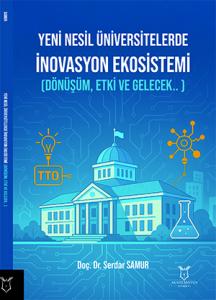
Yeni Nesil Üniversitelerde İnovasyon Ekosistemi (Dönüşüm, Etki ve Gelecek.. )
Özet
-
Referanslar
Aalto University Innovation Hub. (2023). Annual Impact and Ethics Report. Helsinki: Aalto Innovation.
Aalto University. (2022). Aalto University Strategy 2022–2030. Retrieved from https://www.aalto.fi
Aalto University. (2023). Startup Sauna Impact Report. Helsinki.
Altbach, P. G., & de Wit, H. (2018). The challenge to higher education internationalization. University World News.
Anderson, L. W. (2013). A taxonomy for learning, teaching, and assessing: A revision of Bloom's taxonomy of educational objectives. Longman.
Association of University Technology Managers [AUTM]. (2020). Sustaining Technology Transfer: Strategic Planning Guide. Retrieved from https://autm.net
Association of University Technology Managers [AUTM]. (2021). Technology Transfer Metrics Summary Report FY2020. Retrieved from https://autm.net
Benneworth, P., & Charles, D. (2005). University–industry links and regional development. Economic Development Quarterly, 19(3), 223–236.
Bercovitz, J., & Feldman, M. (2008). Academic entrepreneurs: Organizational change at the individual level. Organization Science, 19(1), 69–89. https://doi.org/10.1287/orsc.1070.0295
Bonney, R., et al. (2014). Citizen Science: Next Steps for Citizen Science. Science, 343(6178), 1436-1437. DOI:10.1126/science.1251554
Bonney, R., Phillips, T. B., Ballard, H. L., & Enck, J. W. (2016). Can citizen science enhance public understanding of science? Public Understanding of Science, 25(1), 2–16. https://doi.org/10.1177/0963662515607406
Bozeman, B. (2000). Technology transfer and public policy: a review of research and theory. Research Policy, 29(4–5), 627–655.
Bozeman, B. (2000). Technology transfer and public policy: A review of research and theory. Research Policy, 29(4–5), 627–655. https://doi.org/10.1016/S0048-7333(99)00093-1
Brennen, S., & Kreiss, D. (2016). Automation. In The International Encyclopedia of Communication Theory and Philosophy (pp. 1–5). Wiley.
Breque, M., De Nul, L., & Petridis, A. (2021). Industry 5.0: Towards a sustainable, human-centric and resilient European industry.European Commission, Directorate-General for Research and Innovation.
Bruneel, J., D’Este, P., & Salter, A. (2010). Investigating the factors that diminish the barriers to university–industry collaboration. Research Policy, 39(7), 858–868.**
Brynjolfsson, E., & McAfee, A. (2017). Machine, Platform, Crowd: Harnessing Our Digital Future. W.W. Norton & Company.
Business Finland. (2022). Funding Services for Research and Innovation. Helsinki: Business Finland.
Camilleri, A. F. (2021). Micro-credentials and the future of higher education. European Journal of Education, 56(3), 342–356.
Carayannis, E. G., & Campbell, D. F. J. (2012). Mode 3 knowledge production in quadruple helix innovation systems: 21st-century democracy, innovation, and entrepreneurship for development. Springer.
Carayannis, E. G., Morawska-Jancelewicz, J., & Salomaa, M. (2022). Smart innovation ecosystems in Industry 5.0: The role of digital platforms and living labs. Technological Forecasting and Social Change, 184, 121997. https://doi.org/10.1016/j.techfore.2022.121997
Chalmers University. (2023). Chalmers Ventures Strategic Plan 2023–2028. Gothenburg: Chalmers Innovation Office.
Chalmers Ventures. (2022). Annual Impact Report. Gothenburg: Chalmers University.
Chesbrough, H. (2003). Open Innovation: The New Imperative for Creating and Profiting from Technology. Boston: Harvard Business School Press.
Chesbrough, H. (2003). Open Innovation: The New Imperative for Creating and Profiting from Technology. Boston: Harvard Business School Press.
Chesbrough, H. (2020). Open Innovation Results: Going Beyond the Hype and Getting Down to Business. Oxford University Press.
Clark, B. R. (1998). Creating Entrepreneurial Universities: Organizational Pathways of Transformation. Pergamon Press.
Crossan, M. M., & Apaydin, M. (2010). A Multi‐Dimensional Framework of Organizational Innovation: A Systematic Review of the Literature. Journal of Management Studies, 47(6), 1154–1191. https://doi.org/10.1111/j.1467-6486.2009.00880.x
Debackere, K., & Veugelers, R. (2005). The role of academic technology transfer organizations. The Journal of Technology Transfer, 30(1–2), 73–86.
Delft University of Technology. (2022). Living Labs for Sustainable Urban Innovation. TU Delft.
Dell’Era, C., & Landoni, P. (2014). Living lab: A methodology between user-centred design and participatory design. Creativity and Innovation Management, 23(2), 137–154. https://doi.org/10.1111/caim.12061
Edquist, C. (2005). Systems of innovation: Perspectives and challenges. In J. Fagerberg, D. C. Mowery & R. R. Nelson (Eds.), The Oxford Handbook of Innovation (pp. 181–208). Oxford University Press.
EIT Manufacturing. (2023). European Innovation Community Annual Report. Brussels: EIT.
EIT. (2023). HEI Initiative: Innovation Capacity Building for Higher Education. European Institute of Innovation & Technology.
ETH Zurich. (2022). ETH Transfer Annual Review. Retrieved from https://ethz.ch/en/transfer
Etzkowitz, H. (2008). The Triple Helix: University–Industry–Government Innovation in Action. Routledge.
Etzkowitz, H., & Leydesdorff, L. (2000). The Dynamics of Innovation: From National Systems and “Mode 2” to a Triple Helix of University–Industry–Government Relations. Research Policy, 29(2), 109–123. https://doi.org/10.1016/S0048-7333(99)00055-4
Etzkowitz, H., & Zhou, C. (2017). The Triple Helix: University–Industry–Government Innovation and Entrepreneurship. Routledge.
EUA. (2020). The Role of Universities in Regional Innovation Ecosystems. European University Association.
EUA. (2022). University Digital Transformation Framework. Brussels: European University Association.
European Commission. (2019). Pathways to Impact: Maximising the Potential of EU R&I Programmes. Brussels.
European Commission. (2020). HEInnovate: Self-Assessment for Entrepreneurial Universities. Brussels.
European Commission. (2020). Horizon Europe Strategic Plan 2021–2024. Brussels.
European Commission. (2020). Indicators for societal impact of research: Towards a systemic framework. Brussels: Directorate-General for Research and Innovation.
European Commission. (2020). Smart Specialisation Strategy: Implementation and Challenges. Brussels.
European Commission. (2021). A European Approach to Micro-Credentials for Lifelong Learning and Employability. Brussels: Publications Office of the European Union.
European Commission. (2021). Horizon Europe Work Programme 2021–2022. Brussels.
European Commission. (2021). Industry 5.0 – Towards a sustainable, human-centric and resilient European industry. Brussels.
European Commission. (2021). Industry 5.0: Towards a sustainable, human-centric and resilient European industry. Brussels: Directorate-General for Research and Innovation.
European Commission. (2021). Industry 5.0: Towards a sustainable, human-centric and resilient European industry. https://ec.europa.eu/info/publications/industry-50_en
European Commission. (2021). Industry 5.0: Towards a Sustainable, Human-Centric and Resilient European Industry. Brussels: DG Research & Innovation.
European Commission. (2021). Industry 5.0: Towards a Sustainable, Human-Centric and Resilient European Industry. Brussels.
European Commission. (2021). Monitoring the Horizon Europe Performance Framework. Brussels.
European Commission. (2022). Deep Tech Entrepreneurship for the Green and Digital Transition. Brussels.
European University Association (EUA). (2020). The Role of Universities in Strengthening Research Capacities. Brussels. https://eua.eu/resources/publications
European University Association (EUA). (2021). Research Assessment in the Transition to Open Science. Brussels.
European University Association [EUA]. (2021). University Innovation Ecosystems and Institutional Sustainability. Brussels: EUA Publications.
Fayolle, A., & Redford, D. T. (2014). Handbook on the Entrepreneurial University. Edward Elgar Publishing.
Fecher, B., & Friesike, S. (2014). Open Science: One Term, Five Schools of Thought. In S. Bartling & S. Friesike (Eds.), Opening Science (pp. 17–47). Springer.
Fini, R., Grimaldi, R., Santoni, S., & Sobrero, M. (2018). Business incubators and ventures: An extended typology. Journal of Technology Transfer, 43(3), 505–529.
Fini, R., Grimaldi, R., Santoni, S., & Sobrero, M. (2018). Technology transfer offices as providers of entrepreneurship education. The Journal of Technology Transfer, 43(1), 48–76. https://doi.org/10.1007/s10961-017-9584-4
Floridi, L., Cowls, J., Beltrametti, M., Chatila, R., Chazerand, P., Dignum, V., & Vayena, E. (2018). AI4People – An ethical framework for a good AI society: Opportunities, risks, principles, and recommendations. Minds and Machines, 28(4), 689–707. https://doi.org/10.1007/s11023-018-9482-5
Fraunhofer Society. (2022). Annual Research Report 2022. Retrieved from https://www.fraunhofer.de
Fraunhofer Society. (2022). Digitalisation and AI in Technology Transfer Offices: Strategic Frameworks. Berlin: Fraunhofer Research.
Fraunhofer Society. (2022). Strategic Guidelines for Responsible Innovation. Berlin: Fraunhofer Research.
Fraunhofer-Gesellschaft. (2022). Annual Research Report. Retrieved from https://www.fraunhofer.de
Georghiou, L. (1998). Global cooperation in research. Research Policy, 27(6), 611–626.
Georghiou, L. (2008). Global cooperation in research. Research Policy, 37(9), 1464-1469. https://doi.org/10.1016/j.respol.2008.07.003
Gibbons, M. et al. (1994). The New Production of Knowledge: The Dynamics of Science and Research in Contemporary Societies.
Goddard, J., Kempton, L., & Vallance, P. (2016). The Civic University: The Policy and Leadership Challenges. Edward Elgar Publishing.
Grimaldi, R., & Grandi, A. (2005). Business incubators and new venture creation: An assessment of incubating models. Technovation, 25(2), 111–121.
Harsh, M., Boulton, G., Hodson, S., & Mons, B. (2020). Policy and practice: Open data in science. Data Science Journal, 19(1), 30.
Hazelkorn, E. (2015). Rankings and the Reshaping of Higher Education: The Battle for World-Class Excellence. Palgrave Macmillan.
Hodge, G., & Greve, C. (2007). Public–Private Partnerships: An International Performance Review. Public Administration Review, 67(3), 545–558.
https://doi.org/10.1016/j.respol.2010.03.006
https://doi.org/10.1016/S0048-7333(03)00087-8
https://doi.org/10.1561/0300000033
Ikeuchi, K., & Raymond, P. (2020). Digital credentialing: Implementation of blockchain-based certificate system. International Journal of Information Management, 54, 102134.
Innovate UK. (2022). Knowledge Transfer Network Impact Summary. London.
Isenberg, D. J. (2010). How to Start an Entrepreneurial Revolution. Harvard Business Review, 88(6), 40–50.
Isenberg, D. J. (2010). How to Start an Entrepreneurial Revolution. Harvard Business Review, 88(6), 40–50.
İTÜ ARI Teknokent. (2023). Girişimcilik Ekosistemi Raporu. İstanbul Teknik Üniversitesi Yayınları.
İTÜ UYG-AR. (2023). Araştırma Merkezi Faaliyet Raporu. İstanbul Teknik Üniversitesi Yayını.
Kaplan, R. S., & Norton, D. P. (2004). Strategy Maps: Converting Intangible Assets into Tangible Outcomes. Harvard Business Press.
KOSGEB. (2021). Teknoloji Odaklı Sanayi Hamlesi Raporu. Ankara.
KTH Innovation. (n.d.). About KTH Innovation. KTH Royal Institute of Technology. Retrieved from https://www.kth.se/en/om/innovation/kth-innovation-1.956839
KU Leuven – Flanders Make. (2022). Strategic Industry Collaboration Report. Retrieved from https://www.flandersmake.be
Lam, A. (2011). What motivates academic scientists to engage in research commercialization: "Gold," "ribbon" or "puzzle"? Research Policy, 40(10), 1354–1368. https://doi.org/10.1016/j.respol.2010.09.017
Laudel, G. (2006). The art of getting funded: How scientists adapt to their funding conditions. Science and Public Policy, 33(7), 489-504. https://doi.org/10.3152/147154306781778777
Link, A. N., & Scott, J. T. (2007). The economics of university research parks. Oxford Review of Economic Policy, 23(4), 661–674.
Lockett, A., & Wright, M. (2005). Resources, capabilities, risk capital and the creation of university spin-out companies. Research Policy, 34(7), 1043–1057.
Lundvall, B.-Å. (1992). National Systems of Innovation: Towards a Theory of Innovation and Interactive Learning. London: Pinter Publishers.
Markman, G. D., Gianiodis, P. T., Phan, P. H., & Balkin, D. B. (2005). Innovation speed: Transferring university technology to market. Research Policy, 34(7), 1058–1075.
Massachusetts Institute of Technology Technology Licensing Office [MIT TLO]. (2023). Annual Report 2023. Retrieved from https://tlo.mit.edu
Max Planck Innovation. (2023). Annual report 2022. https://www.max-planck-innovation.com/en/about-us/publications/
MIT Deshpande Center. (2022). Leadership in Responsible Innovation: Annual Review. Cambridge, MA: MIT.
MIT Media Lab. (2023). Open Projects and Platforms. Retrieved from https://www.media.mit.edu
MIT Sloan. (2023). Martin Trust Center Annual Impact Report. Cambridge, MA.
MIT Sloan. (2023). Martin Trust Center Annual Impact Report. Cambridge, MA: Massachusetts Institute of Technology.
Mian, S., Lamine, W., & Fayolle, A. (2016). Technology business incubation: An overview of the state of knowledge. Technovation, 50–51, 1–12.
Mora-Valentin, E. M., Montoro-Sanchez, A., & Guerras-Martin, L. A. (2004). Determining factors in the success of R&D cooperative agreements between firms and research organizations. Research Policy, 33(1), 17–40.
Morris, M. H., Kuratko, D. F., & Cornwall, J. R. (2013). Entrepreneurship Programs and the Modern University. Cheltenham: Edward Elgar Publishing.
Morris, M. H., Kuratko, D. F., & Cornwall, J. R. (2013). Entrepreneurship Programs and the Modern University. Edward Elgar Publishing.
Mowery, D. C., Nelson, R. R., Sampat, B. N., & Ziedonis, A. A. (2001). The growth of patenting and licensing by US universities: An assessment of the effects of the Bayh–Dole Act of 1980. Research Policy, 30(1), 99–119.
Mowery, D. C., Nelson, R. R., Sampat, B. N., & Ziedonis, A. A. (2001). The growth of patenting and licensing by US universities: An assessment of the effects of the Bayh–Dole Act of 1980. Research Policy, 30(1), 99–119. https://doi.org/10.1016/S0048-7333(99)00093-9
Mulgan, G. (2019). Social innovation: How societies find the power to change. Policy Press.
ODTÜ MEMS Research Center. (2022). Micro Systems Research Strategy Document. Orta Doğu Teknik Üniversitesi Yayını.
OECD (2021).The State of Higher Education: One Year into the COVID-19 Pandemic.OECD Publishing, Paris.
OECD. (2017). Getting Skills Right: Good Practice in Adapting to Changing Skill Needs. Paris: OECD Publishing.
OECD. (2020). Strategic approaches to institutional research infrastructures. Paris: OECD Publishing. https://doi.org/10.1787/4f3c4d79-en
OECD. (2020). Strategic foresight for better policies. Paris: OECD Publishing.
OECD. (2020). University-Industry Collaboration: New Evidence and Policy Options. OECD Publishing. https://doi.org/10.1787/9789264201274-en
OECD. (2021). Data governance in the public sector: A strategic framework. Paris: OECD Publishing.
OECD. (2021). Making Open Science a Reality. Paris: OECD Publishing.
OECD. (2021). Strengthening University-Based Entrepreneurship Support Systems. Paris: OECD Publishing.
OECD. (2022). Digitalising Public Research Institutions for Impact: Insights and Strategies. Paris: OECD Publishing.
OECD. (2022). Fostering Innovation in Industry–Academia Collaborations. Paris: OECD Publishing.
OECD. (2022). Framework for Evaluating University–Industry Collaboration Impact. Paris: OECD Publishing.
OECD. (2022). Innovation Governance for the Knowledge Economy. Paris: OECD Publishing.
OECD. (2022). International Research Collaborations and National Research Systems. Paris: OECD Publishing.
OECD. (2022). Policies for Entrepreneurial Higher Education Institutions. Paris: OECD Publishing.
OECD. (2023). Science, Technology and Innovation Outlook 2023. Paris: OECD Publishi
OECD. (2023). Science, Technology and Innovation Outlook 2023. Paris: OECD Publishing.
Open Badges Standard. (2021). IMS Global Learning Consortium. https://www.imsglobal.org/openbadges
Organisation for Economic Co-operation and Development [OECD]. (2021). OECD Reviews of National Research Centres: Framework and Indicators. Paris: OECD Publishing.
Organisation for Economic Co-operation and Development [OECD]. (2022). Public Research Institutions and National Innovation Systems. Paris: OECD Publishing.
Organisation for Economic Co-operation and Development [OECD]. (2022). The Future of Knowledge Transfer: New Models and Practices. Paris: OECD Publishing.
Oxford University Innovation. (2023). Annual revie. 2023 https://innovation.ox.ac.uk/about/annual-reviews/
Oxford University Innovation. (2023). Annual Report 2022–2023. Oxford.
Perkmann, M., & Walsh, K. (2007). University–industry relationships and open innovation: Towards a research agenda. International Journal of Management Reviews, 9(4), 259–280. https://doi.org/10.1111/j.1468-2370.2007.00225.x
Perkmann, M., Tartari, V., McKelvey, M., Autio, E., Broström, A., D’Este, P., … & Sobrero, M. (2013). Academic engagement and commercialisation: A review of the literature on university–industry relations. Research Policy, 42(2), 423–442.
Philpott, K., Dooley, L., O’Reilly, C., & Lupton, G. (2011). The entrepreneurial university: Examining the underlying academic tensions. Technovation, 31(4), 161-170. https://doi.org/10.1016/j.technovation.2010.12.003
Porter, M. E. (1998). Clusters and the new economics of competition. Harvard Business Review, 76(6), 77–90.
Reuters. (2021). Top 100 Most Innovative Universities. Thomson Reuters.
Rinaldi, C., Cavicchi, A., Spigarelli, F., Lacchè, L., & Rubens, A. (2023). University 5.0: The role of incubators in fostering human-centric innovation. The Journal of Technology Transfer, 48(3), 789-812. https://doi.org/10.1007/s10961-022-09987-1
Roberts, E. B., & Eesley, C. E. (2011). Entrepreneurial impact: The role of MIT. Foundations and Trends® in Entrepreneurship, 7(1–2), 1–149.**
Rothaermel, F. T., & Thursby, M. (2005). University-incubator firm knowledge flows: Assessing their impact on incubator firm performance. Research Policy, 34(3), 305–320.
Sabancı University & Brisa. (2022). Sürdürülebilirlikte Akademi–Sanayi İşbirliği Raporu. İstanbul.
Sabancı University. (2023). SUCool Program Evaluation Report. İstanbul.
Sabancı Üniversitesi SUNUM. (2023). Kurumsal Gelişim ve Paydaş Raporu. Sabancı Üniversitesi Yayını.
Sabancı Üniversitesi. (2022). Öğrenme Analitiği Uygulama Rehberi. İstanbul.
Salmi, J. (2009). The Challenge of Establishing World-Class Universities. Washington, DC: World Bank.
Shane, S. (2004). Academic Entrepreneurship: University Spinoffs and Wealth Creation. Edward Elgar Publishing.
Siegel, D. S., Waldman, D. A., & Link, A. N. (2003). Assessing the impact of organizational practices on the relative productivity of university technology transfer offices. Research Policy, 32(1), 27–48.
https://doi.org/10.1016/S0048-7333(01)00196-2
Siemens, G., & Long, P. (2011). Penetrating the fog: Analytics in learning and education. EDUCAUSE Review, 46(5), 30–40.
Stanford University OTL. (2022). Annual Technology Transfer and Innovation Report. Stanford, CA.
Stanford University. (2022). Digital Metrics and Impact Indicators in Technology Transfer. Stanford, CA.
SUCOOL. (2021). Sabancı University Start-up Acceleration Program Annual Review. Istanbul.
Technion University. (2022). Technion DRIVE Accelerator Program Overview. Haifa.
Tenopir, C., Allard, S., Douglass, K., Aydinoglu, A. U., Wu, L., Read, E., … & Frame, M. (2011). Data sharing by scientists: practices and perceptions. PLoS ONE, 6(6), e21101.
Times Higher Education. (2023). Impact Rankings Methodology. https://www.timeshighereducation.com
TNO (Netherlands Organization for Applied Scientific Research). (2022). Strategic Plan 2022–2026: Applied Research for a Resilient Society. Retrieved from https://www.tno.nl
Trippl, M., Sinozic, T., & Lawton Smith, H. (2015). The “third mission” of universities and the region: Towards a measurement framework. European Planning Studies, 23(9), 1722–1740. https://doi.org/10.1080/09654313.2015.1052782
TU Delft. (2022). Open Science Annual Progress Report. Delft: Delft University of Technology.
TU Delft. (2022). Open Science Strategy and Living Lab Guidelines. Delft University of Technology. Retrieved from https://www.tudelft.nl
TU Delft. (2023). Sustainability Annual Report. Delft University of Technology.
TÜBİTAK. (2022). Açık Bilim ve Açık Erişim Politika Önerileri Raporu. Ankara.
TÜBİTAK. (2022). Türkiye Teknoloji Geliştirme Bölgeleri Performans Endeksi 2022 Raporu. Ankara.
TÜBİTAK. (2023). 1513 Teknoloji Transfer Ofisleri Destekleme Programı Rehberi. Ankara.
TÜBİTAK. (2023). 1513 Teknoloji Transfer Ofisleri Performans Değerlendirme Rehberi. Türkiye Bilimsel ve Teknolojik Araştırma Kurumu.
TÜBİTAK. (2023). 1513 Teknoloji Transfer Ofisleri Performans Göstergeleri Raporu. Ankara: Türkiye Bilimsel ve Teknolojik Araştırma Kurumu.
TÜBİTAK. (2023). Girişimci ve Yenilikçi Üniversite Endeksi 2023 Raporu. Ankara.
TÜBİTAK. (2023). TÜBİTAK 1513 Teknoloji Transfer Ofisleri Destekleme Programı Raporu. Ankara.
TÜBİTAK. (2023).Endüstri 5.0 yol haritası: Üniversite-sanayi işbirliği politikaları. TÜBİTAK Yayınları.
UCL Business Ltd. (2021). Driving Innovation for Public Benefit: Annual Review 2021. University College London. Retrieved from https://www.uclb.com/annual-review-2021
UCL Business. (2023). Annual Integrity and Impact Report 2023. University College London.
U-Multirank. (2023). Methodology. https://www.umultirank.org
UNESCO (2022). Education for Sustainable Development: A roadmap (ESD for 2030). Paris: UNESCO. Erişim adresi: https://unesdoc.unesco.org/ark:/48223/pf0000374802
UNESCO. (2021). Higher Education and the 2030 Agenda for Sustainable Development. Paris: UNESCO.
UNESCO. (2021). Recommendation on Open Science. Paris: United Nations Educational, Scientific and Cultural Organization.
UNESCO. (2021). Transforming Higher Education for the Sustainable Future. Paris.
UNESCO. (2021). Transforming Higher Education for the Sustainable Future. Paris: UNESCO Publishing.
UNESCO. (2022). Citizen science for sustainable development: A UNESCO recommendation. Paris: UNESCO Publishing.
UNESCO. (2022). Education for sustainable development: A roadmap for implementing the Berlin Declaration on Education for Sustainable Development. UNESCO.
UNESCO. (2022). Reimagining our futures together: A new social contract for education. Paris: UNESCO Publishing.
UNESCO. (2022). Science for a sustainable future: Funding models and metrics. Paris: UNESCO Publishing.
United Nations. (2015). Transforming Our World: The 2030 Agenda for Sustainable Development. New York: United Nations.
University of Cape Town. (2022). Inclusive Innovation and Social Enterprise Models in Africa. Cape Town.
Von Schomberg, R. (2013). A vision of responsible research and innovation. In R. Owen, J. Bessant, & M. Heintz (Eds.), Responsible Innovation: Managing the Responsible Emergence of Science and Innovation in Society (pp. 51–74). Wiley.
Wächter, B. (2015). The internationalisation of European higher education institutions. European University Association. https://eua.eu/resources/publications/757:the-internationalisation-of-european-higher-education-institutions.html
Wilsdon, J., Allen, L., Belfiore, E., Campbell, P., Curry, S., Hill, S., … & Johnson, B. (2015). The Metric Tide: Report of the Independent Review of the Role of Metrics in Research Assessment and Management. HEFCE.
World Bank. (2019). Public-Private Partnerships in Education: Success Factors and Policy Options. Washington, DC.
World Bank. (2023). Innovation Metrics for Inclusive Development. Washington, DC.
World Bank. (2023). Innovation Metrics for Inclusive Development. Washington, DC: World Bank Group.
Wright, M., Clarysse, B., Mustar, P., & Lockett, A. (2008). Academic Entrepreneurship in Europe: Contributions to the Public and Private Sector. Edward Elgar Publishing.
WURI. (2023). World's Universities with Real Impact Rankings. https://www.wuri.world
Yıldız, H., & Kaya, F. (2021). Üniversite araştırma merkezlerinde performans değerlendirme ve finansal sürdürülebilirlik. Yükseköğretim ve Araştırma Dergisi, 9(1), 45–61. https://doi.org/10.2399/yod.21.009
YÖK. (2022). Üniversite İzleme ve Değerlendirme Raporu 2022. Ankara: Yükseköğretim Kurulu.
YÖK. (2023). Yükseköğretim 2023 Vizyon Belgesi. Ankara.
YÖK. (2023). Yükseköğretim 2023 Vizyon Belgesi. Ankara: Yükseköğretim Kurulu.
YÖKAK. (2022). Kurumsal Akreditasyon Programı Kriterleri. Ankara.
YÖKAK. (2022). Kurumsal Akreditasyon Programı Kriterleri. Ankara: Yükseköğretim Kalite Kurulu.
Yayınlanan
Lisans
LisansBu İnternet Sitesi içeriğinde yer alan tüm eserler (yazı, resim, görüntü, fotoğraf, video, müzik vb.) Akademisyen Kitabevine ait olup, 5846 sayılı Fikir ve Sanat Eserleri Kanunu ve 5237 sayılı Türk Ceca Kanunu kapsamında korunmaktadır. Bu hakları ihlal eden kişiler, 5846 sayılı Fikir ve Sanat eserleri Kanunu ve 5237 sayılı Türk Ceza Kanununda yer alan hukuki ve cezai yaptırımlara tabi olurlar. Yayınevi ilgili yasal yollara başvurma hakkına sahiptir.
