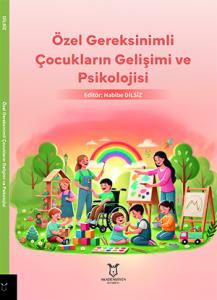
Özel Gereksinimli Çocuklarda Atlanan Önemli Bir Toplumsal Parametre: “Sosyal Yaşama Entegrasyon”
Referanslar
Abakay, O. (2022). Engelli bireylerde psikososyal desteğin önemi. Içinde ‘Engellilik araştirmaları yazıları essays on disability studies. 15.inci bölüm. https://cdn.istanbul.edu.tr/file/JTA6CLJ8T5/1C4CA97A68AD4B22B38E5F2EEC0D1E3D
Ainscow, M., & Messiou, K. (2018). Engaging with the views of students to promote inclusion in education. Journal of Educational Change, 19, 1-17. https://doi.org/10.1007/s10833-017-9312-1
Akhmetzyanova, A. I. (2014). The development of self-care skills of children with severe mental retardation in the context of Lekoteka. World Applied Sciences Journal, 29(6), 724-727.
Akoğlu, G., & Şipal, R. F. (2012). Düşük sosyoekonomik düzeydeki çocuklara yönelik erken müdahale yaklaşımları: Dünyadan ve Türkiye’den uygulamalar. Journal of Society & Social Work, 23(1).
Algan, Y., Bisin, A., Manning, A. & Verdier, T. (2012). Cultural integration of immigrants in europe: studies of policy reform. Oxford University Press.
Alkan-Ersoy, Ö. (2010). Özel gereksinimi olan çocukların aileleri ile yapılan çalışmalar. F. Temel (Ed.), *Aile eğitimi ve erken çocukluk eğitiminde aile katılım çalışmaları (ss. 406-435). Anı Yayıncılık.
Ar, Ö. F., Şen, M., & Melekoğlu, M. (2022). Erken çocuklukta özel eğitimde ailenin rolü. Trakya Eğitim Dergisi, 12(2), 637-646.
Aral, N; Gürsoy, F. (2012). Özel Eğitim Gerektiren Çocuklar ve Özel Eğitime Giriş. Morpa Yayıncılık.
Atbaşı, Z., & Özdemir, C. (2020). Türkiye’de özel eğitim hizmetlerinin sunumu. U. Sak & S. Toraman (Edt.), Türkiye’de özel eğitim hizmetleri (ss. 49-68). Avşar Ofset.
Aykaç, S.A., Karakaş, M. (2022). Entegrasyon, asimilasyon ve uyum kavramları arasından Türkiye’nin seçimi. İçtimaiyat Sosyal Bilimler Dergisi, Göç ve Mültecilik Özel Sayısı, 419-429
Bredekamp, S. (2015). Erken çocukluk eğitiminde etkili uygulamalar (Effective Practices in Early Childhood Education, 2nd Edition) (H. Z. İnan & T. İnan, Çev.). Ankara: Nobel Yayıncılık.
Buhrow, M., Hartshorne, T. & Bradley-Johnson, S. (1998). Parents and teachers ratings of the social skills of elementary-age students who are blind. Journal of Visual Impairment and Blindness, 92(7), 213– 227
Carta, J. J., McElhattan, T. E., & Guerrero, G. (2016). The application of response to intervention to young children with identified disabilities. B. Reichow, B. A. Boyd, E. E. Barton, & S. L. Odom (Eds.), Handbook of Early Childhood Special Education (pp. 163-178). Springer International Publishing.
Celeste, M. & Kobal Grum, D. (2010). Social integration of children with visual impairment: A developmental model. İlköğetim Online, 9(1), 11-22,
Council on Children with Disabilities (2021). Maltreatment of children with disabilities. pediatrics, 147(5), e2021050920. https://doi.org/10.1542/peds.2021-050920
Çitil, M., & Polatoğlu, Y. (2020). Türkiye’de eğitsel değerlendirme ve tanılama. U. Sak & S. Toraman (Edt.), Türkiye’de özel eğitim hizmetleri (ss. 77-107). Avşar Ofset.
Demirci, A., & Kartal, M. (2012). Çocukluk dönemine ait önemli bir sorun: Gelişme geriliği ve erken tanının önemi. The Journal of Turkish Family Physician, 3(4), 1-6.
Diken, İ. H., Cavkaytar, A., Batu, S., Bozkurt, F., & Kurtyılmaz, Y. (2008). The effectiveness of the First Step to Success early intervention program in Turkey: Results of the pilot study. Paper presented at the meeting of the 32nd Teacher Educators for Children with Behavioral Disorders (TECBD), Tempe, Arizona, USA.
Dong, X., Liang, H., Ding, X., & Zhang, Y. (2024). Enhancing children’s cognitive skills: An experimental study on virtual reality-based gamified educational practices. Education and Information Technologies, 29(6), 7569-7594.
Engelli Kadın ve Kız Çocuklarına Yönelik Şiddet Raporu (2021). İşitme Engelliler ve Aileleri Derneği Yayını. VİED Yayınları. Derleyen: İdil Seda Ak. https://etkiniz.eu/wp-content/uploads/2021/11/ETK%C4%B0N%C4%B0Z-ENGELL%C4%B0-KADIN-VE-KIZ-%C3%87OCUKLARINA-Y%C3%96NEL%C4%B0K-%C5%9E%C4%B0DDET-RAPORU.pdf
Esatbeyoğlu, F. & Güven-Karahan, B. (2014). Engelli bireylerin fiziksel aktiviteye katılımlarının önündeki engeller. Spor Bilimleri Dergisi. 25 (2), 43–55
Fahrutdinova, R., Yarmakeev I. & Fahrutdinov, R. (2016). Social adaptation of children with disabilities. The Turkish Online Journal of Design, Art and Communication - TOJDAC at from: http://tojdac.org/tojdac/VOLUME6-JLYSPCL_files/tojdac_v060JSE171.pdf
Faist, T. (2018). A Primer on social integration: participation and social cohesion in the global compacts (No. 161). Bielefeld: COMCAD Working Papers
Genç, Y. (2015). Engellilerin sosyal sorunları ve beklentileri. Sosyal Politika Çalışmaları Dergisi, 15(35/2 Ek), 65-92.
Goldstein, H., & Wetherby, B. (1984). Application of a functional perspective on receptive language development to early intervention. Remedial and Special Education, 5(2), 48-58
Greenspan, S. I., Wieder, S., & Simons, R. (1998). The child with special needs: Encouraging intellectual and emotional growth. Perseus Books.
Harvey, D. & Greenway, A.P. (1984). The self-concept of physically handicapped children and their non-handicapped siblings: an empirical investigation. J. Child Psychol. Psychiatry. 25: 273–284
Kaya, S., Ak, A. S., & Melekoğlu, M. A. (2022). Özel öğrenme güçlüğünde erken müdahale ve erken tanı: Müdahaleye tepki modeli. Milli Eğitim Dergisi, 51(236), 3679-3692.
Kizir, M. & Çiftçi-Tekinarslan, İ. (2016). İşitme yetersizliği olan bireylere sosyal beceri öğretimi: bir gözden geçirme. Curr Res Educ. 2(3): 149-164
Kopp, C., Baker, B., & Brown, K. (1992). Social skills and their correlates: Preschoolers with developmental delays. American Journal on Mental Retardation, 96, 357-366
Kurtoğlu, K. (2022). Göçmenlere yönelik entegrasyon politikalari: Avrupa Birliği ve Almanya örneği kapsamında Türkiye’nin uyum politikalarinin değerlendirilmesi. Yüksek lisans tezi. Kapadokya Üniversitesi. Nevşehir.
Luo, T. (2020). Difficulties and solutions for social integration of disabled children. Advances in Social Science, Education and Humanities Research, volume 466 Proceedings of the 2020 4th International Seminar on Education, Management and Social Sciences (ISEMSS 2020)
Matson, J. L., Cooper, C., Malone, C. J., Moskow, S. L. (2008). The relationship of self-injurious behavior and other maladaptive behaviors among individuals with severe and profound intellectual disability. Research in Developmental Disabilities, 29 (2), 141–148
Naugler, G. (1999). A comparison of friendship patterns of children with physical disabilities in integrated and segregated school setting. MAI. 1(3):1-22
Nicholas, J. & Geers, A. E. (2006). Effects of early auditory experience on the spoken language of deaf children at 3 years of age. Ear and Hearing, 27(3), 286
Özkubat, U. & Özdemir, S. (2012). Görme yetersizliğinden etkilenmiş ve normal gelişim gösteren çocukların sosyal becerilerinin karşılaştırılması. Ankara Üniversitesi Eğitim Bilimleri Fakültesi Özel Eğitim Dergisi. 13(1) 1-14
Philips, M., Flemming, N., Tsintzas, K. (2009). An exploratory study of physical activity and perceived barriers to exercise in ambulant people with neuromuscular disease compared with unaffected controls. Clinical Rehabilitation, 23, 746- 755.
Pınar, E. S. (2006). Dünyada ve Türkiye'de erken çocukluk özel eğitiminin gelişimi ve erken çocukluk özel eğitim uygulamaları. Ankara Üniversitesi Eğitim Bilimleri Fakültesi Özel Eğitim Dergisi, 7(2), 71-83.
Sazak, E., & Terzioğlu, I. (2018). Özel gereksinimli bireylerde sosyal becerilerin öğretimi. E. Sazak (Edt.), Özel eğitimde sosyal uyum becerilerin öğretimi (ss. 91-122). Pegem Akademi
Schneider, J. & Crul, M. (2010). Comparative integration context theory: participation and belonging in new diverse European cities. Ethnic and Racial Studies, 33(7), 1249-1268.
Schwinn, T. (2023). Social integration – levels and dimensions. Köln Z Soziol. (Suppl 1) 75:35–67
Severiens, S.E., & Schmidt, H.G. (2009) Academic and social integration and study progress in problem based learning, Higher Education, 58: 59-69
Silva Bampi, L.N., Guilhem, D. & Dornelles Alves, E. (2010). Social model: a new approach of the disability theme. Rev. Latino-Am. Enfermagem. 18(4): 816-823
Social Integration Research Report (2022). One bradford, many voices. Professor Uduak Archibong and Dr Colins Imoh Centre for Inclusion and Diversity University of Bradford. Centre for Inclusion and Diversity
Sosyal Entegrasyon Rehberi (2017). Meslekî eğitim yoluyla mültecilerin sosyal entegrasyonu projesi. İstanbul: Stratejik Reklam Organizasyon Eğitim Danışmanlık Prodüksiyon Yayın. European Union in the scope of Erasmus+ Program, 2014-2020.
Sullivan, P.M., Knutson, J.F. (2000). Maltreatment and disabilities: a population-based epidemiological study. Child Abuse & Neglect, 24(10), 1257–1273. https://doi.org/10.1016/ s0145-2134(00)00190-3
Tejano, L. D. (2023). Competency level of parents of children with special needs in providing assistance for acquiring self-care skills. Social Sciences, Humanities and Education Journal (SHE Journal), 4(3), 640-650.
The United Nations Committee on the Rights of Persons with Disabilities (2018). AT FROM: https://www.edf-feph.org/content/uploads/2021/05/The-United-Nations-CRPD-Committee-guide-for-DPO-for-upload.pdf
Türkiye Engelli ve Yaşlı İstatistik Bülteni (2023). Aile ve Sosyal Hizmetler Bakanlığı Raporu. At from: https://aile.gov.tr/media/135432/eyhgm_istatistik_bulteni_nisan_23.pdf
Twardowski, A. (2014). Barriers to social integration for people with disabilities, the polish experiences. Studia Edukacyjne Nr 30. 30: 119-128
Xhelili, H. (2014). The key to integration? A study of language as a policy strategy for social integration of immigrants in Sweden. Master of Science in Welfare Policies and Management Thesis supervisor: Ylva Stubbergaard Department of Political Science Lund University. Sweden.
Social Skills Interventions for Young Children with Disabilities A Synthesis of Group Design Studies
Vaughn, SD., Kim, A., Morris Sloan, C., Marie Tejero Hughes, Batya Elbaum, And Dheepa Sridhar
Yoshinaga-Itano, C. (2001). The social-emotional ramifications of universal newborn hearing screening, early identification and intervention of children who are deaf or hard of hearing. A Sound Foundation Through Early Amplification.
Walsh, R. T., Kosidoy, M., & Swanson, L. (2009). Promoting social-emotional development through creative drama for students with special needs. Canadian Journal of Community Mental Health, 10(1), 153-166.
World Health Organisation (2020). World Report on Disability.