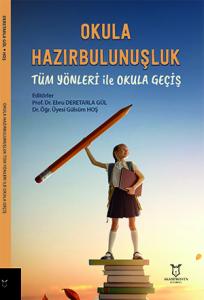
Okula Hazırbulunuşluk ve Çocuğun Gelişimsel Özellikleri
Özet
Okula hazırbulunuşluk, fiziksel, bilişsel, sosyal ve duygusal gelişim alanlarını kapsayan bütünsel bir yaklaşımla ele alınmalıdır. Erken çocukluk yılları, kritik bir dönem olarak çocukların okula hazırlık ile ilgili temel becerileri edinmesinde büyük önem taşır. Çocuğun ev ortamındaki deneyimleri ile okul öncesi ortamları, öğrenmeye hazır oluşunda etkili olup, destekleyici ve duygusal olarak sağlıklı bir çevre sunulduğunda, çocuğun gelişim ve öğrenme kapasitesi artar. Okula hazırlık, çocuğun bireysel olgunlaşma süreci kadar çevresel destekleri de gerektirir. Aile, okul ve çevrenin bu sürece uyumu, çocuğun okul başarısını ve sosyal uyumunu olumlu yönde etkiler. Gelişim ve öğrenme, fiziksel, sosyal, duygusal ve bilişsel alanların birbiriyle etkileşim içinde olduğu karmaşık bir süreçtir. Çocukların öğrenmeye yaklaşımları, dil becerileri, bilişsel kapasiteleri ve sosyal-duygusal yeterlilikleri bu süreçte önemli bir yer tutar. Çocukların bu alanlarda desteklenmesi, sadece akademik başarıyı değil, yaşam boyu süren gelişimlerini de olumlu yönde etkiler. Bu bölümde okula hazırbulunuşluk kavramı, erken çocukluk yıllarından itibaren çocuğun gelişimsel dönemleri ve gelişim alanları temele alınarak bütünsel açıdan ele alınmış ve erken yıllardaki olgunlaşma ve deneyimlerin okula hazırlıktaki katkısı anlamak ve çocuğun gelişimini desteklemek için okuyucuya bir bakış açısı sunmayı amaçlamaktadır.
Referanslar
Arnold, C., Bartlett, K., Gowani, S., & Merali, R. (2007). Is everybody ready? Readiness, transition and continuity: Reflections and moving forward (p. 5). Working Paper 41. Bernard van Leer Foundation: The Hague, The Netherlands This paper is based on a background paper prepared by the authors for UNESCO’s Education for All Global Monitoring Report 2007. Strong foundations: early childhood care and education. https://www.bibalex.org/Search4Dev/files/282616/114950.pdf
Berk, L. (2013). Child development. Pearson Higher Education AU.
Cappelloni, N. L. (2012). Kindergarten readiness. SAGE Publications. ProQuest Ebook Central, http://ebookcentral.proquest.com/lib/tamu/detail.action?docID=1104559.
Chall, J. (1983). Stages of Reading Development. New York: McGraw Hill.
Charles, C. (2010). Children’s Contact with The Outdoors and Nature: A Focus on Educators and Educational Settings. Journal of Environment and Behavior. 40(1), 111-143
Christensen, D., Taylor, C. L., Hancock, K. J., & Zubrick, S. R. (2022). School readiness is more than the child: a latent class analysis of child, family, school and community aspects of school readiness. Australian Journal of Social Issues, 57(1), 125-143.
Duncan, G. J., Dowsett, C. J., Claessens, A., Magnuson, K., Huston, A. C., Klebanov, P., ... & Japel, C. (2007). School readiness and later achievement. Developmental psychology, 43(6), 1428.
Epstein, A. S. (2014). social-emotional Learning in early childhood. https://image.highscope.org/wp-content/uploads/2018/08/16053956/ReSource2014spring_Soc-Emo.pdf
Fernandes, D. M. Z., & Lima, M. C. M. P. (2024). Child development: assessment of receptive and expressive language in preschoolers. Estudos de Psicologia (Campinas), 41, e210045. https://doi.org/10.1590/1982-0275202441e210045
Gabbard, C. (2021). Lifelong motor development. Lippincott Williams & Wilkins.
High, P. C., & Committee on Early Childhood, Adoption, and Dependent Care and Council on School Health. (2008). School readiness. Pediatrics, 121(4), e1008-e1015.
Horm, D., Norris, D., Perry, D., Chazan-Cohen, R., & Halle, T. (2016). Developmental Foundations of School Readiness for Infants and Toddlers: A Research to Practice Report. OPRE Report 2016-07. US Department of Health and Human Services.
Janus, M., & Duku, E. (2007). The School Entry Gap: Socio Economic, Family, and Health Factors Associated with Children’s School Readiness Toleran. Early Education and Development, 18(3), 375-403
Kagan, S. L. (1990). Readiness 2000: Rethinking rhetoric and responsibility. The Phi Delta Kappan, 72(4), 272-279.
Kagan, S. L., Moore, E., & Bredekamp, S. (1995). Reconsidering children's early development and learning: Toward common views and vocabulary 95, (3). National Education Goals Panel.
Kid Sense (2024). School Readiness. https://childdevelopment.com.au/areas-of-concern/school-readiness/
Kokkalia, G., Drigas, A. S., Economou, A., & Roussos, P. (2019). School Readiness From Kindergarten to Primary School. International Journal of Emerging Technologies in Learning (iJET), 14(11), 4–18. https://doi.org/10.3991/ijet.v14i11.10090
Lewit, E. M., & Baker, L. S. (1995). School readiness. The future of children, 128-139. https://www.jstor.org/stable/1602361
Miller, M. M., & Kehl, L. M. (2019). Comparing parents’ and teachers’ rank-ordered importance of early school readiness characteristics. Early Childhood Education Journal, 47, 445-453.
National Association for the Education of Young Children (2009). Developmentally appropriate practice in early childhood programs serving children from birth through age 8. A position statement of the National Association for the Education of Young Children.
http://www.naeyc.org/files/naeyc/file/positions/PSDAP.pdf
National Education Goals Panel (NEGP). (1991). The Goal 1Technical Planning Subgroup report on school readiness.Washington, DC: Author.
Osório, A., Meins, E., Martins, C., Martins, E. C., & Soares, I. (2012). Child and mother mental-state talk in shared pretense as predictors of children's social symbolic play abilities at age 3. Infant Behavior and Development, 35(4), 719-726.
Office of Head Start. (2015). Head Start Early Learning Outcomes Framework: Ages birth to 5. Washington, DC: Administration for Children and Families, U.S. Department of Health & Human Services. https://montessoriadvocacy.org/wp-content/uploads/2019/10/Head-Start-Early-Learning-Framework.pdf
Palmer, J. (2019). Social and emotional development in early learning settings. In National Conference of State Legislatures (Vol. 9). https://www.highspeedtraining.co.uk/hub/child-development-in-early-years/
Rudasill, K. M., Adelson, J. L., Callahan, C. M., Houlihan, D. V., & Keizer, B. M. (2013). Gifted Students’ Perceptions of Parenting Styles: Associations With Cognitive Ability, Sex, Race, and Age. Gifted Child Quarterly, 57(1), 15-24. https://doi.org/10.1177/0016986212460886
Seran, T. N., Haryono, H., & Anni, C. T. (2017). School readiness: Readiness children seen from the whole aspect of early childhood development. Journal of Primary Education, 6(3), 224-232.
Setiawati, F., Izzaty, R., & Triyanto, A. (2017). Exploring the construct of school readiness based on child development for kindergarten children. REID (Research and Evaluation in Education), 3(1), 42-49. https://journal.uny.ac.id/index.php/reid/article/view/13663
Stackhouse, J. (1997). Phonological awareness: Connecting speech and literacy problems. Perspectives in applied phonology, 157-196.
Şahin, I. T., Sak, R., & Tuncer, N. (2013). Comparison of Preschool and First Grade Teachers' Views about School Readiness. Educational Sciences: Theory and Practice, 13(3), 1708-1713. https://files.eric.ed.gov/fulltext/EJ1017735.pdf
Visser-Bochane, M. I., Reijneveld, S. A., Krijnen, W. P., van der Schans, C. P., & Luinge, M. R. (2020). Identifying milestones in language development for young children ages 1 to 6 years. Academic Pediatrics, 20(3), 421–429. https://doi.org/10.1016/j.acap.2019.07.003
Williams, P. G., Lerner, M. A., Sells, J., Alderman, S. L., Hashikawa, A., Mendelsohn, A., ... & Weiss-Harrison, A. (2019). School readiness. Pediatrics, 144(2). https://doi.org/10.1542/peds.2019-1766
Yangın, B. (2009). The relationship between readiness and reading and writing performances. Hacettepe Üniversitesi Eğitim Fakültesi Dergisi, 36(36), 316-326.