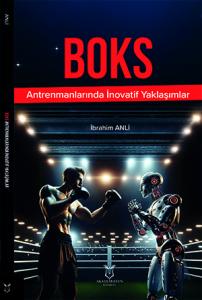
Boks Antrenmanlarında İnovatif Yaklaşımlar
Özet
-
Referanslar
Abeza G., O’Reilly N., Seguin B., Nzindukiyimana O. (2015). Social media scholarship in sport management research: A critical review. Journal of Sport Management, 29 (6), 601 -618. https://doi.org/10.1123/JSM.2014-0296
Adams, R., Jeanrenaud, S., Bessant, J., Overy, P. A., & Denyer, D. (2012). Innovating for Sustainability. A Systematic Review of the Body of Knowledge. NBS.
Ahmad, K. Z. B., Jasimuddin, S. M., Kee, W. L. (2018). Organizational Climate and Job Satisfaction: Do Employees’ Personalities Matter?”, Management Decision, Vol. 56 No. 2, pp. 421-440. https:// doi.org/10.1108/MD-10-2016-0713
Atalı, L.,& Sertbaş, K., (2013). A Research on Individual Innovativeness Levels of Football Referees Kocaeli Region Case. Turkish Journal of Sport and Exercise, 15(3), 18-21.
Ateş, O., Işık, A., Topçuoğlu, K. (2021). Spor Teknolojisi ve İnovasyon ile Kas Yaralanmaları Engellenebilir mi? Dönmez G., (Ed). Sporcularda Kas Yaralanmalarına Güncel Yaklaşım. 1. Baskı. Ankara: Türkiye Klinikleri; s.131- 5.
Babiak, K.,& Thibault, L. (2009). Challenges in Multiple Cross-Sector Partnerships. Nonprofit and Voluntary Sector Quarterly, 38(1), 117–143. https://doi.org/10.1177/0899764008316054
Backman, M., Klaesson, J., Öner, Ö. (2017). Innovation in The Hospitality Industry: Firm or Location? Tourism Economics, 23 (8), 1591-1614. https://doi.org/10.1177/1354816617715159
Baker, B. J., McDonald, H., Funk, D. C. (2006). The Uniqueness of Sport: Testing Against Marketing's Empirical Laws. Sport Management Review, 19(4), 378-390. https://doi.org/10.1016/j.smr.2016.02.002.
Balachandra, R.,& Friar, J. (1997). Factors for Success in R&D Projects and New Product Innovation: a contextual framework. IEEE Transactions on Engineering Management, 44, 276–287. https://doi.org/10.1109/17.618169
Ball, S. (2005). The Importance of Entrepreneurship to Hospitality, Leisure, Sport and Tourism, Hospitality, Leisure, Sport and Tourism Network, Vol. 1, No: 1, pp. 1-14.
Becker, S. W.,& Whisler, T. L. (1967). The Innovative Organization: A Selective View of Current Theory and Research. The Journal of Business, 40, 462-469. DOI: 10.1086/295011
Bigliardi, B. (2013). The Effect of Innovation on Financial Performance: A Research Study Involving SMEs. Innovation, 15 (2), 245-255. DOI: 10.5172/impp.2013.15.2.245
Birkinshaw, J.,& Goddard, J. (2009). What is Your Management Model? MIT Sloan Management Review, 50 (2), 81
Birkinshaw, J.,& Mol, M. (2006). How Management Innovation Happens. MIT Sloan Management, 47 (4).
Birkinshaw, J., Hamel, G., & Mol, M. J. (2008). Management Innovation. Academy of Management Review, 33 (4), 825– 845. https://doi.org/10.5465/amr.2008.34421969
Boks Eldivenlerinin Kısa Tarihi; https://www.boks.web.tr/boks-eldivenlerinin-kisa-tarihi/#:~:text=Farkl%C4%B1%20%C5%9Fekillerde%20olsa%20bile%20boks,eldivenlerindeki%20gibi%20dolgu%20maddesi%20bulunmazd%C4%B1 Erişim tarihi: 27 Haziran 2021).
Bradley, J. B., McDonald, H., & Funk, D. C. (2016). The Uniqueness of Sport: Testing Against Marketing's Empirical Laws. Sport Management Review, 19 (4), 378-390. DOI: 10.1016/j.smr.2016.02.002
Brentani, Ulrike. (1991). Success Factors in Developing New Business Services. European Journal of Marketing. 25, 33-59. 10.1108/03090569110138202.
Breuer, C.,& Wicker, P. (2011). Analyse zur Situation der Sportvereine in Deutschland Kurzfassung.
Breuer, C., & Wicker, P. (2009). Mädchen und Frauen im Sportverein. in C. Breuer (Ed.), Sportentwicklungsbericht 2007/2008. Analyse zur Situation der Sportvereine in Deutschland: Sportverlag Strauß S. 170-192).
Breuer, C., Hoekman, R., Nagel, S., Van der Werff, H. (Ed.) (2015). Sport Clubs in Europe, Springer International Publishing. New York, NY.
Cannarella, C.,& Piccioni, V. (2003). Innovation Transfer and Rural Smes. Journal of Central European Agriculture, 4(4), 371-388.
Caza, A. (2000). Context Receptivity: Innovation in an Amateur Sport Organization. Journal of Sport Management, 14(3), 227-242.
Chan, A., Go, F. M., & Pine, R. (1998). Service Innovation in Hong Kong: Attitudes and Practice, The Service Industries Journal, 18(2), 112-124. DOI: 10.1080 / 02642069800000021
Chelladurai, P. (2009). Managing Organizations for Sport and Physical Activity: A Systems Perspective. Scottsdale, AZ: Holcomb Hathaway.
Chen, Y. (2006). Marketing Innovation. Journal of Economics & Management Strategy, 15: 101-123. https://doi.org/10.1111/j.1530-9134.2006.00093.x
Chesbrough, H. W. (2003). Open Innovation: The New Imperative for Creating and Profiting fromTechnology. Boston, MA: Harvard Business Press.
Coda, R., Da Silva, D., & Custodio, I. (2015). Multidimensional Configurations of The Organizational Climate Construct. The International Journal of Human Resource Management, 26(14), 1827-1847. DOI: 10.1080/09585192.2014.962561
Cooper, R. G. (1979). Identifying Industrial New Product Success: Project NewProd. Industrial Marketing Management, 8(2), 124-135. https://doi.org/10.1016/0019-8501(79)90052-X
Cordero, R. (1990). The Measurement of Innovation Performance in the Firm: an Overview. Research policy, 19(2), 185-192.
Çengel, O. (2016). Spor Tüketicilerinin Bireysel Yenilikçilik ve Alışveriş Davranış Biçimleri Arasındaki İlişkinin İncelenmesi. Yüksek Lisans Tezi, Muğla Sıtkı Koçman Üniversitesi, Muğla.
Daft, R. L.,& Becker, S. W. (1978). The Innovative Organization: Innovation Adoption in School Organizations. New York: Elsevier.
Damanpour, F., Aravind, D. (2012). Organizational Structure and Innovation Revisited: from Organic to Ambidextrous Structure. Mumford M. (Ed.): Handbook of Organizational Creativity, pp.479–509, Elsevier, London. https://doi.org/10.1016/B978-0-12-374714-3.00019-7.
Damanpour, F., Walker, R. M., & Avellaneda, C. N. (2009). Combinative Effects of Innovation Types and Organizational Performance: A Longitudinal Study of Service Organizations. Journal of Management Studies, 46(4), 650-675. https://doi.org/10.1111/j.1467-6486.2008.00814.x
Demir, A. (2020). Spor Kulüplerinin Futbol Alt Yapı Performans Yönetimi Yaklaşımlarının İnovatif (yenilikçi) Açıdan İncelenmesi. Doktora Tezi. Kocaeli.
Demir, A., Sertbaş, K., & Sivrikaya, K. (2020a). Sporda İnovasyon Ölçeği’nin (SİÖ) Türkçeye Uyarlama Çalışması. Eurasian Research in Sport Science, 5(1), 16-25.
Demir, A., Sertbaş, K., Sivrikaya, K., & Bayazit, B. (2020b). The Effect of Innovative Approach on Performance Management in Soccer Clubs. International Journal of Applied Exercise Physiology (IJAEP), 9(10), 175-180.
Devecioğlu, S. (2008). Spor Kulüplerinde İnovasyon Yönetimi. Erişim: www. fesam. org. Erişim.
Devecioğlu, S.,& Altıngül, O. (2011). Spor teknolojilerinde inovasyon. Varol A, Varol Y, Çelik V, (Ed.). IATS, 11, 16-18.
Devecioğlu, S.,& Altıngül, O. (2011). Spor Teknolojilerinde İnovasyon. 6th International Advanced Technologies Symposium. (IATS’11), 16-18 May 2011, Elazığ, Turkey, (46-49).
Devecioğlu, S., Yıldırım, E., & Altıngül, O. (2011). Spor yönetiminde inovasyon yaklaşımı. Verimlilik Dergisi, 2011(1), 97-112.
Di Benedetto, C.A. (1999). Identifying the Key Success Factors in New Product Launch. Journal of Product Innovation Management, 16, 530-544. https://doi.org/10.1111/1540-5885.1660530
Doherty, A. (2013). Investing in Sport Management: The Value of Good Theory. Sport Management Review, 16(1), 5–11. https://doi.org/10.1016/j.smr.2011.12.006.
Doherty, A., Misener, K., & Cuskelly, G. (2014). Toward a Multidimensional Framework of Capacity in Community Sport Clubs. Nonprofit and Voluntary Sector Quarterl. 43(2), 124-142. https://doi.org/10.1177/0899764013509892
Drucker, P. F. (1985). The Discipline of the Innovator, Harvard Business Review, 63(3), 67-72.
Eren, E., (2004), Örgütsel Davranış ve Yönetim Psikolojisi, Beta Basım, İstanbul.
Ernst, H. (2002). Success Factors of New Product Development: A Review of the Empirical Literature. International Journal of Management Reviews, 4: 1-40. https://doi.org/10.1111/1468-2370.00075
Eskiler, E, Özmen, M, & Uzkurt, C. (2011). Bilgi Yönetimi Pazar Odaklılık ve Pazarlama Yeniliği İlişkisi: Mobilya Sektöründe Bir Araştırma. Eskişehir Osmangazi Üniversitesi İktisadi ve İdari Bilimler Dergisi, 6(1), 31-69. Retrieved from https://dergipark.org.tr/tr/pub/oguiibf/issue/56488/785425
Evangelista, R.,& Sirilli, G. (1995). Measuring innovation in services. Research evaluation, 5(3), 207-215.
Fagerberg, J., Mowery, D.C. & Nelson, R.R., (Ed.) (2005). The Oxford Handbook of Innovation. Oxford University Press, Oxford. DOI: 10.1093/oxfordhb/9780199286805.001.0001
Funk, D.C., Lock, D., Karg, A. & Pritchard, M., (2016). Sport Consumer Behavior Research: Improving Our Game. Journal of Sport Management, 30 (2), 113-116. DOI: 10.1123/jsm.2016-0028
Gallouj, F.,& Weinstein, O. (1997). Innovation in Services. Research policy, 26(4-5), 537-556.
Globe, S., Levy, G. W. & Schwartz, C. M. (1973) Key Factors and Events in the Innovation Process. Research Management, 16(4), 8-15. DOI: 10.1080/00345334.1973.11756189
Griffin, A. (1997), PDMA Research on New Product Development Practices: Updating Trends and Benchmarking Best Practices. Journal of Product Innovation Management, 14, 429-458. https://doi.org/10.1111/1540-5885.1460429
Guerrero, L.G.,& Gómez, A. J. (2004), La Gestión de los Servicios Deportivos Municipales: Vías Para La Excelencia, Indie, Barcelona.
Gupta, D. (2011). Functional Clothing-Definition and Classification. Indian Journal of Fibre and Textile Research. 36, 321-326.
Hamel, G. (2006). The Why, What and How of Management Innovation. Harvard Business Review, 84, 72–84.
Hipp, C.,& Grupp, H. (2005). Innovation in the Service Sector: The Demand for Service-Specific Innovation Measurement Concepts and Typologies. Research Policy, 34(4), 517-535.
Hjalager, A. M. (2010). A review of innovation research in tourism. Tourism Management, 31(1), 1-12.
Hoeber, L.,& Hoeber, O. (2012). Determinants of an Innovation Process: A Case Study of Technological Innovation in a Community Sport Organization. Journal of Sport Management. 26, 213-223. 10.1123/jsm.26.3.213.
Hoeber, L., Doherty, A., Hoeber, O., & Wolfe, R. (2015). The Nature of Innovation in Community Sport Organizations. European Sport Management Quarterly, 15(5), 518-534, DOI: 10.1080/16184742.2015.1085070
İmamoğlu, M., & İmamoğlu, O. (2018). Roma Zamanı ve Öncesinde Çıplak Yumruk ve Eldivenli Boks - Before and During Roman Time the Naked Punch and With Gloves Boxing. Journal of International Social Research, 11(59), 560-567.DOI:10.17719/jisr.2018.2662
Kanario, M.C. (2017). Influence Of Sports Innovation On Organizational Performance: A Case Of Football Kenya Federation. Published Master Dissertation, United States International University, Africa.
Karasar, N. (2012). Bilimsel Araştırma Yöntemi. 24. Baskı. Ankara: Nobel Yayın Dağıtım.
Kılıç, A.C. (2019). Stratejik İnovasyonun Organizsyon Başarısına Etkisi. Yayımlanmamış Yüksek Lisans Tezi. Kocaeli: Gebze Teknik Üniversitesi Sosyal Bilimler Enstitüsü.
Kimberly, J.R. (1981). Managerial Innovation. In: Nystrom, P.C. and Starbuck, W. H., (Ed.), Handbook of Organizational Design, Oxford University Press, New York, 1, 84-104.
Knight, K. E. (1967). A Descriptive Model of the Intra-Firm Innovation Process. The Journal of Business, 40(4), 478-496. Retrieved May 30, 2021, from http://www.jstor.org/stable/2351630
Lee, R. P., ve Ginn, G. O., & Naylor, G. (2009). The Impact of Network and Environmental Factors on Service Innovativeness. Journal of Service Marketing, 23(6), 397-406. http://dx.doi.org/0.1108/08876040910988183
Lertpachin, C., Wingwon, B., & Noithonglek, T. (2013). The Effect of Marketing Focus, Innovation and Learning Organization on the Building of Competitive Advantages: Empirical Evidence from ISO 9000 Certified Companies. Journal of Strategic Marketing, 21(4), 323 – 331. DOI:10.1080/0965254X.2013.790469
Linton, J.D. (2009). De-Babelizing the Language of Innovation. Technovation, 29, 729-737. https://doi.org/10.1016/j.technovation.2009.04.006
Lovelock, C. & Gummesson, E. (2004). Whither Services Marketing? In Search of a New Paradigma and Fresh Perspectives. Journal of Service Research, Vol. 7, 20–41. DOI: 10.1177 / 1094670504266131
Lüthje, C., Herstatt, C., & Hippel, E. V. (2005). User-Innovators and “Local” Information: The Case of Mountain Biking. Research Policy. 34(6), 951-965. 10.1016/j.respol.2005.05.005.
Malerba, F. & Brusoni, S. (Ed.) (2007) Perspectives on Innovation. Cambridge University Press, Cambridge. https://doi.org/10.1017/CBO9780511618390
Miles, I. (2005). Innovation in Services. In Fagerberg, J., Mowery, D., Nelson, R. (Ed.), The Oxford Handbook of Innovation, Oxford: Oxford University Press, 433-458. DOI: 10.1093 / oxfordhb / 9780199286805.003.0016
Mol, M. J. & Birkinshaw, J. (2009). The Sources of Management Innovation: When Firms Introduce New Management Practices. Journal of Business Research, 62(12), 1269-1280. https://EconPapers.repec.org/RePEc:eee:jbrese:v:62:y:2009:i:12:p:1269-1280.
Newell, S.,& Swan, J. (1995) The Diffusion of Innovations in Sport Organizations : An Evaluative Framework. Journal of Sport Management, 9 (3), 317-337.
Ngo, L. V. & O'Cass, A. (2013). Innovation and Business Success: The Mediating Role of Customer Participation. Journal of Business Research, Elsevier, 66(8), 1134-1142. https://ideas.repec.org/a/eee/jbrese/v66y2013i8p1134-1142.html
Nowy, T., Wicker, P., Feiler, S., & Breuer, C. (2015). Organizational Performance of Nonprofit and For-Profit Sport Organizations. European Sport Management Quarterly. 15(2), 155-175. 10.1080/16184742.2014.995691.
Oslo Kılavuzu. (2005). Yenilik Verilerinin Toplanması Ve Yorumlaması İçin İlkeler. Çev.: TÜBİTAK, Üçüncü Baskı, Ankara: TÜBİTAK Yayınları.
Peachey, J. W., Borland, J., Lobpries, J., & Cohen, A. (2015). Managing Impact: Leveraging Sacred Spaces and Community Celebration to Maximize Social Capital at a Sport-for-Development Event. Sport Management Review, Elsevier, 18(1), 86-98. https://ideas.repec.org/a/eee/spomar/v18y2015i1p86-98.html
Porter, M.E. & Ketels, C.H.M. (2003). UK Competitiveness: Moving to the Next Stage. DTI Economics Paper No 3, URN 03/899.
Rajapathirana, R. J. & Hui, Y. (2018). Relationship Between Innovation Capability, Innovation Type, and Firm Performance. Journal of Innovation & Knowledge, 3(1), 44-55. https://doi.org/10.1016/j.jik.2017.06.002
Ratten, V. (2010). E‐book Devices and M‐Commerce: What Might be The Impact on Organizational Learning? Development and Learning in Organizations, 24(6), 6-7. https://doi.org/10.1108/14777281011084685
Ratten, V. (2011). Sport-Based Entrepreneurship: Towards a New Theory of Entrepreneurship and Sport Management. International Entrepreneurship and Management Journal, 7, 57–69. https://doi.org/10.1007/s11365-010-0138-z
Ratten, V. (2016). Sport Innovation Management: Towards a Research Agenda. Innovation, Organization & Management, 18(3), 238-250.
Ratten, V.,& Ferreira, J.J. (Ed.). (2016). Sport Entrepreneurship and Innovation (1st ed.). Routledge. https://doi.org/10.4324/9781315393384
Reid Howie Associates. (2006). The Sustainability of Local Sports Clubs in Scotland. Edinburgh: Scottish Executive Education Department.
Rogers, E. M. (1995). Diffusion of innovations. New York: Free Press.
Rothwell, R. (1992). Successful Industrial Innovation: Critical Factors for the 1990s. R&D Management, 22(3): 221-239.
Rundh, B.,& Gottfridsson, P. (2015). Delivering Sports Events: The Arena Concept in Sports from a Network Perspective. Journal of Business & Industrial Marketing, 30(7).
Segredo Pérez, A. M. (2013). Clima Organizacional en la Gestión del Cambio Para el Desarrollo de la Organización. Revista Cubana de Salud Pública, 39(2), 385-393. Recuperado en 31 de mayo de 2021, de http://scielo.sld.cu/scielo.php?script=sci_arttext&pid=S086434662013000200017&lng=es&tlng=es.
Shah, S. (2000). Sources and Patterns of Innovation in a Consumer Products Field: Innovations in Sporting Equipment. WP-4105. Sloan School of Management, Massachusetts Institute of Technology Cambridge, MA
Smith, Aaron C.T. & Stewart, B. (2010). The Special Features of Sport: A Critical Revisit. Sport Management Review, 13(1), 1-13, https://EconPapers.repec.org/RePEc:eee:spomar:v:13:y:2010:i:1:p:1-13.
Tekin, Z.,& Karakuş, K. (2018). Gelenekselden Akıllı Üretime Spor Endüstrisi 4.0. Itobiad: Journal of the Human & Social Science Researches, 7(3) 2103-2117.
Tjønndal, A. (2017). Sport innovation: developing a typology. European Journal for Sport and Society, 14(4), 291-310.
TNS Opinion and Social. (2014). Sport and physical activity (Special Eurobarometer, 412/Wave EB80.2). Brussels: European Commission. DOI 10.2766/73002
Toivonen, M.,& Tuominen, T. (2006). Emergence of innovations in services: Theoretical discussion and two case studies. Paper presented at the International ProACT Conference, Tampere, Finland.
Tosun-tunç, G.,& Sevilmiş, A. (2019). Sporda İnovasyon: Bir Derleme Çalışması. Türk Spor Bilimleri Dergisi, 2(1), 39-46. Retrieved from https://dergipark.org.tr/tr/pub/tsbd/issue/44025/469737
Tufan, M., Özus, E. E., & Erden, F. (2016). Futbolcu Forma ve Eşofmanlarının Kullanıcıları Tarafından Değerlendirilmesi Üzerine Bir Araştırma. International Journal of Sport Culture and Science, 4(Special Issue 1), 249-259. Doi : 10.14486/IntJSCS553
Türkmen, M.,& Mutlutürk, N. (2014). Spor Malzemelerinde Nano-Teknoloji Kullanımı ve Performansa Katkısı. International Journal of Social Science Research, 3(1), 0-0. Retrieved from https://dergipark.org.tr/tr/pub/ijssresearch/issue/32887/365339
Twiss, B.,& Goodridge M. (1989). Managing Technology For Competitive Advantage: Integrating Technological And Organisational Development: From Strategy To Action. Trans-Atlantic Publications.
Urabe, K. (1988). Innovation and Management: International Comparison. Berlin, New York: Walter De Gruyter.
Walker, R. M. (2008). An Empirical Evaluation of Innovation Types and Organizational and Environmental Characteristics: Towards a Configuration Framework. Journal of Public Administration Research and Theory, 18(4), 591-615. https://doi.org/10.1093/jopart/mum026
Wan, D., Ong, C. H., & Lee, F. (2005). Determinants of Firm Innovation in Singapore. Technovation 25(3), 261-268. ScholarBank@NUS Repository. https://doi.org/10.1016/S0166-4972(03)00096-8
Weerawardena, J.,& Mort, G.S. (2012). Competitive Strategy in Socially Entrepreneurial Nonprofit Organizations: Innovation and Differentiation. Journal of Public Policy & Marketing, 31(1), 101 - 91. DOI:10.1509/jppm.11.034
Winand, M., Vos, S., Zintz, T., & Scheerder, J. (2013). Determinants of Service Innovation: a Typology of Sports Federations. International Journal of Sport Management and Marketing, 13, 55-73. DOI:10.1504/IJSMM.2013.055194
Zapf, W. (1994). Modernisierung, Wohlfahrtsentwicklung und Transformation. Berlin: Wissenschaftszentrum Berlin für Sozialforschung WZB.
(https://www.spordamarka.com/blog/icerik/boks-eldiveni-secimi-nasil-yapilmalidir Erişim tarihi: 27 Haziran 2021).
(https://www.aiba.org/licensees/ (www.teknoloji.com). Erişim tarihi: 27 Haziran 2021).
(http://www.cankayasporkursu.com/2017/08/kum-torbasi-nasil-secilmeli.html Erişim tarihi: 27 Haziran 2021).
(www.teknoloji.com. Erişim tarihi: 27 Haziran 2021).
(http://www.drsahinoglu.com/tr/spor-yapan-hastalarimiz-icin-disliklerin-mouthguard-onemi/ Erişim tarihi: 28 Haziran 2021).
Yayınlanan
Lisans
LisansBu İnternet Sitesi içeriğinde yer alan tüm eserler (yazı, resim, görüntü, fotoğraf, video, müzik vb.) Akademisyen Kitabevine ait olup, 5846 sayılı Fikir ve Sanat Eserleri Kanunu ve 5237 sayılı Türk Ceca Kanunu kapsamında korunmaktadır. Bu hakları ihlal eden kişiler, 5846 sayılı Fikir ve Sanat eserleri Kanunu ve 5237 sayılı Türk Ceza Kanununda yer alan hukuki ve cezai yaptırımlara tabi olurlar. Yayınevi ilgili yasal yollara başvurma hakkına sahiptir.
