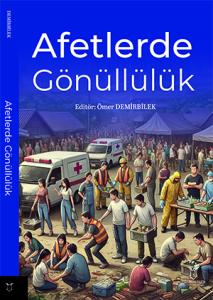
Afet Gönüllülüğüne Katılım ve Motivasyon
Özet
Gönüllüler gönüllülük çalışmalarını gerektiren durumlarda ilk müdahale edenler arasında yer almaktadır. Afetlerin giderek yaygınlaştığı günümüzde gönüllülerin özellikle gerçekleştirdikleri ilk müdahaleler ile profesyonel ekiplerin çalışmalarına katkı sundukları bilinmektedir. Ancak, ilgili alan yazında bir görüşe göre koordinasyon olmadan çalışan gönüllülerin afet alanında profesyonel ekiplerin çalışmalarını zora sokabilmektedir. Ancak, diğer görüşe göre afetlerde gönüllülerin çalışma esnekliği onların en önemli özelliğidir. Bu iki görüşe bir açılım sağlaması açısından, bu kitap bölümü gönüllülerin motivasyon süreçlerini İş Talepleri – Kaynakları teorisi bağlamında ele almayı amaçlamıştır. İş Talepleri ve Kaynakları teorisi genel olarak örgütsel psikoloji alanında uygulansa da gönüllüler ve bir örgüte bağlı çalışanlar arasında farklılıkların yanı sıra benzerlikler de mevcuttur. İş Talepleri ve Kaynakları teorisine göre her ne kadar gönüllüler afet alanında çeşitli iş talepleri (stres kaynakları) ile karşı karşıya kalsalar da katılım motivasyonlarını sürdürmeleri için tamponlayacak iş kaynaklarına (motivasyon kaynakları) ihtiyaç vardır. Ancak, sonraki çalışmalarda ele alınmasında fayda görülen bir konu da yüksek düzeyde motivasyon veya iş kaynağının gönüllülerin kuralların ihlali ve prosedürlerin uygulanmasında kestirme yolların kullanılıp kullanılmayacağıdır. Bu bağlamda afet gönüllüğüne katılım ve motivasyonunun olumlu ve olumsuz yönlerinden bahsedilmiştir.
Referanslar
Alfes, K., Shantz, A., & Bailey, C. (2016). Enhancing volunteer engagement to achieve desirable outcomes: What can non-profit employers do? VOLUNTAS: International Journal of Voluntary and Nonprofit Organizations, 27(2), 595-617. https://doi.org/10.1007/s11266-015-9601-3
Allen, J. A., & Mueller, S. L. (2013). The revolving door: A closer look at major factors in volunteers’ intention to quit. Journal of Community Psychology, 41(2), 139-155. https://doi.org/10.1002/jcop.21519
Bakker, A. B., & Demerouti, E. (2007). The job demands-resources model: State of the art. Journal of Managerial Psychology, 22(3), 309–328. https://doi.org/10.1108/02683940710733115
Bakker, A. B., & Demerouti, E. (2017). Job demands-resources theory: Taking stock and looking forward. Journal of Occupational Health Psychology, 22(3), 273–285. https://doi.org/10.1037/ocp0000056
Bakker, A. B., Demerouti, E., de Boer, E., & Schaufeli, W. B. (2003). Job demands and job resources as predictors of absence duration and frequency. Journal of Vocational Behavior, 62(2), 341–356. https://doi.org/10.1016/S0001-8791(02)00030-1
Barsky, L. E., Trainor, J. E., Torres, M. R., & Aguirre, B. E. (2007). Managing volunteers: FEMA’s Urban Search and Rescue programme and interactions with unaffiliated responders in disaster response. Disasters, 31(4), 495–507. https://doi.org/10.1111/j.1467-7717.2007.01021.x
Beher, K., Liebig, R., & Rauschenbach, T. (2000). Strukturwandel des Ehrenamts: Gemeinwohlorientiertung im Modernisierungsprozess. Weinheim: Juventa Verlag.
Boezeman, E. J., & Ellemers, N. (2007). Volunteering for charity: Pride, respect, and the commitment of volunteers. Journal of Applied Psychology, 92(3), 771-785. https://doi.org/10.1037/0021-9010.92.3.771
Booth, J. E., Park, K. W., & Glomb, T. M. (2009). Employer-supported volunteering benefits: Gift exchange among employers, employees, and volunteer organizations. Human Resource Management, 48(2), 227-249. https://doi.org/10.1002/hrm.20279
Bowman, W. (2009). The economic value of volunteers to nonprofit organizations. Nonprofit Management and Leadership, 19(4), 491–506. https://doi.org/10.1002/nml.232
Brudney, J. L. (2016). Designing and managing volunteer programs. In D. O. Renz & R. D. Herman (Eds.), The Jossey-Bass Handbook of Nonprofit Leadership and Management (pp. 688-733). Jossey-Bass.
Brudney, J. L., & Gazley, B. (2002). Testing the conventional wisdom regarding volunteer programs: A longitudinal analysis of the service corps of retired executives and the U.S. Small Business Administration. Nonprofit and Voluntary Sector Quarterly, 31(4), 525–548. https://doi.org/10.1177/089976402237321
Caligiuri, P., Mencin, A., & Jiang, K. (2013). Win–win–win: The influence of company sponsored volunteerism programs on employees, NGOs, and business units. Personnel Psychology, 66(4), 825-860. https://doi.org/10.1111/peps.12030
Caplan, R. D., Cobb, S., French, J. R. P., Van Harrison, R., & Pinneau, S. R. (1975). Job demands and worker health: Main effects and occupational differences. Washington, DC: U.S. Government Printing Office.
Chalofsky, N., & Krishna, V. (2009). Meaningfulness, commitment, and engagement: The intersection of a deeper level of intrinsic motivation. Advances in Developing Human Resources, 11(2), 189-203. https://doi.org/10.1177/1523422309333147
Cuskelly, G., & Boag, A. (2001). Organisational commitment as a predictor of committee member turnover among volunteer sport administrators: Results of a time-lagged study. Sport Management Review, 4(1), 65-86. https://doi.org/10.1016/S1441-3523(01)70070-0
Cuskelly, G., Taylor, T., Hoye, R., & Darcy, S. (2006). Volunteer management practices and volunteer retention: A human resource management approach. Sport Management Review, 9(2), 141-163. https://doi.org/10.1016/S1441-3523(06)70023-7
Demerouti, E., Bakker, A. B., Nachreiner, F., & Schaufeli, W. B. (2001). The job demands-resources model of burnout. Journal of Applied Psychology, 86(3), 499–512. https://doi.org/10.1037//0021-9010.86.3.499
Dynes, R. (1994). Community emergency planning: False assumptions and inappropriate analogies. International Journal of Mass Emergencies and Disasters, 12(2), 141–158.
Auf der Heide, E. (2003). Convergence behavior in disasters. Annals of Emergency Medicine, 41(4), 463–466. https://doi.org/10.1067/mem.2003.163
Smith, E., Morgans, A., Qureshi, K., Burkle, F., & Archer, F. (2009). Paramedics’ perceptions of risk and willingness to work during disasters. Australian Journal of Emergency Management, 24(3), 21–27. https://doi.org/10.3316/informit.785442194995235
Eriksson, K., & Danielsson, E. (2022). Framing volunteers identifying and integrating volunteers in crises response operations. International Journal of Disaster Risk Reduction, 74, 102912. https://doi.org/10.1016/j.ijdrr.2022.102912
Fernandes, V. J. (2018). Volunteer motivation, organizational commitment, and engagement: Knights of Columbus explanatory case study (Doctoral dissertation, University of Phoenix).
Fernandez, L. S., Barbera, J. A., & van Dorp, J. R. (2006). Spontaneous volunteer response to disasters: The benefits and consequences of good intentions. Journal of Emergency Management, 5(4), 57–68.
Grossman, J. B., & Furano, K. (2002). Making the most of volunteers. http://ppv.issuelab.org/resource/making_the_most_of_volunteers
Hager, M. A., & Brudney, J. L. (2021). Volunteer management capacity in America’s charities: Benchmarking a pre-pandemic field and assessing future directions. Arizona State University. https://www.volunteeralive.org/docs/Hager_Brudney_VMC2_2021_brief.pdf
Haivas, S., Hofmans, J., & Pepermans, R. (2013). Volunteer engagement and intention to quit from a self-determination theory perspective. Journal of Applied Social Psychology, 43(9), 1869-1880. https://doi.org/10.1111/jasp.12149
Harris, M., Shaw, D., Scully, J., Smith, C. M., & Hieke, G. (2017). The involvement/exclusion paradox of spontaneous volunteering: New lessons and theory from winter flood episodes in England. Nonprofit and Voluntary Sector Quarterly, 46(2), 352–371. https://doi.org/10.1177/0899764016654222
Hobfoll, S. E. (2002). Social and psychological resources and adaptation. Review of General Psychology, 6(4), 307–324. https://doi.org/10.1037/1089-2680.6.4.307
Whittaker, J., McLennan, B., & Handmer, J. (2015). A review of informal volunteerism in emergencies and disasters: Definition, opportunities and challenges. International Journal of Disaster Risk Reduction, 13, 358-368. https://doi.org/10.1016/j.ijdrr.2015.06.010
Kahn, R. L., & Byosiere, P. (1992). Stress in organizations. In M. D. Dunnette & L. M. Hough (Eds.), Handbook of Industrial and Organizational Psychology (pp. 571-650). Palo Alto, CA: Consulting Psychologists Press.
Kang, M. (2016). Moderating effects of identification on volunteer engagement. Journal of Communication Management, 20(2), 102-117. https://doi.org/10.1108/JCOM-08-2014-0051
Karasek, R. A. (1979). Job demands, job decision latitude and mental strain: Implications for job redesign. Administrative Science Quarterly, 24, 285–308.
Kvarnlöf, L., & Johansson, R. (2014). Boundary practices at incident sites: Making distinctions between emergency personnel and the public. International Journal of Emergency Services, 3(1), 65–7.
Liao-Troth, M. A. (2001). Attitude differences between paid workers and volunteers. Nonprofit Management and Leadership, 11(4), 423–442.
Miller, B. K., Adair, E. A., Nicols, K. M., & Smart, D. L. (2014). Hindering the help: Politics and engagement in volunteer service organizations. Journal of Managerial Issues, 26(4), 365-387, 324.
Netting, F. E., Nelson, W. H., Borders, K., & Huber, R. (2004). Volunteer and paid staff relationships: Implications for social work administration. Administration in Social Work, 28(3/4), 69–89.
Paret, K. E., Mayorga, M. E., & Lodree, E. J. (2021). Assigning spontaneous volunteers to relief efforts under uncertainty in task demand and volunteer availability. Omega, 99, 102228. https://doi.org/10.1016/j.omega.2020.102228
Post, S. G. (2005). Altruism, happiness, and health: It’s good to be good. International Journal of Behavioral Medicine, 12, 66-77.
Schaufeli, W. B., & Bakker, A. B. (2004). Job demands, job resources, and their relationship with burnout and engagement: A multi-sample study. Journal of Organizational Behavior, 25(3), 293-315. https://doi.org/10.1002/job.248
Schaufeli, W. B., Bakker, A. B., & van Rhenen, W. (2009). How changes in job demands and resources predict burnout, work engagement, and sickness absenteeism. Journal of Organizational Behavior, 30(7), 893-917. https://doi.org/10.1002/job.595
Siegrist, J. (1996). Adverse health effects of high effort–low reward conditions. Journal of Occupational Health Psychology, 1(1), 27-41.
Strandh, V. (2019). Crisis volunteerism is the new black?—Exploring the diversity of voluntary engagement in crisis management. Risk, Hazards & Crisis in Public Policy, 10(3), 311-331. https://doi.org/10.1002/rhc3.12164
Tidwell, M. V. (2005). A social identity model of prosocial behaviors within nonprofit organizations. Nonprofit Management and Leadership, 15(4), 449-467.
Wachtendorf, T. (2004). Improvising 9/11: Organizational improvisation following the World Trade Center disaster (Doctoral dissertation). University of Delaware.
Waugh, W., & Streib, G. (2006). Collaboration and leadership for effective emergency management. Public Administration Review, 66(S1), 131-140.
Wrześniewski, A., & Dutton, J. E. (2001). Crafting a job: Revisioning employees as active crafters of their work. Academy of Management Review, 26(2), 179-201. https://doi.org/10.5465/amr.2001.4378011