Uluslararası Alanda Afetlerde Gönüllülük ve Tarihçesi
Özet
Afete hazırlık hem bireysel olarak hem de topluluk içinde önemli düzeyde planlama ve hazırlık gerektirmektedir. Hiç kimse bir afetten tek başına kurtulamaz. Bir afete karşı toplum tepkisini harekete geçirmenin bu kadar önemli olmasının bir nedeni de budur. Bir afeti takip eden günler ve haftalarda, afetzedelerin büyük ölçüde yardıma ihtiyacı olduğu bilinmektedir. Afet sonrasında kamu kurumları ve Sivil Toplum Kuruluşları gıda, barınak, su, giysi, tıbbi malzeme ve diğer temel hizmetlerini bünyelerinde görevli personel veya gönüllüler ile sağlayarak afetzedelere yardımcı olmaktadırlar.
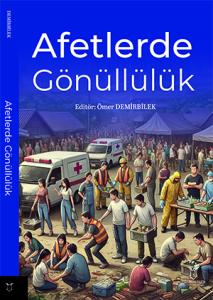
Gönüllülük, insan ilişkilerinin temel bir ifadesidir. İnsanların toplumlarına katılma ve başkaları için önemli olduklarını hissetme ihtiyacı ile ilgilidir. Gönüllülüğün tanınırlığı son zamanlarda, özellikle de Birleşmiş Milletler'in 2001 yılını Uluslararası Gönüllüler Yılı ilan etmesinden bu yana artmıştır. Afet gönüllülüğü, insanların bir yandan çok ihtiyaç duyulan bir toplum hizmeti sunarken diğer yandan da afete müdahale ve hazırlık konusunda kendi eğitimlerini kolaylaştırabilecekleri güçlü bir yoldur. Gönüllülük sadece bir afetin hemen sonrasında yardım etmek değil aynı zamanda bir afet meydana gelmeden çok önce planlamaya, farkındalık ve hazırlık oluşturmaya yardımcı olmaktır. Afet durumlarında ise gönüllüler genellikle; temiz su ve bozulmayan gıda dağıtımı, afette hasar gören ev ve işyerlerinin yıkılmasına yardımcı olma, devrilen ağaçları ve diğer enkazları temizleme, topluluk üyeleri ve ilk müdahale ekipleri için sıcak yemek hazırlama, giysi ve temizlik malzemeleri sağlama, engellilere veya imkânı olmayanlara ulaşım sağlama, yerlerinden edilen evcil hayvanları kurtarma ve barındırma vb. faaliyetleri sağlarlar. Bu faaliyetlerin eksiksiz bir şekilde yönetilmesi için gönüllülerin kamu ve özel sektör bünyesinde koordine edilmesi önem arz etmektedir. Aynı zamanda gönüllülerin etkin ve verimli bir şekilde yönetilmesi toplumlarla başlar ve toplumlarla biter. Günümüzde yaygın olarak kullanılan anahtar terimlerden biri olan "dirençlilik", toplumların afetleri önleme, afetlere hazırlanma, afetlerle başa çıkma ve afete müdahale edecek gönüllü bireyleri yetiştirtme becerilerini kapsamaktadır.
Referanslar
Akgüngör, A. Ç. (2010). Toplumbilim perspektifinden afeti düşünmek. LAÜ Sosyal Bilimler Dergisi, 1(1), 3-22.
Alexander, D. (2010). The voluntary sector in emergency response and civil protection: review and recommendations. International Journal of Emergency Management, 7(2), 151-166. https://doi.org/10.1504/IJEM.2010.033654
Australian Red Cross. (2010). Spontaneous Volunteer Management Resource Kit: Helping to Manage Spontaneous Volunteers in Emergencies. https://knowledge.aidr.org.au/media/4824/dfhcsia_spontaneous-volunteer-management-resource-kit.pdf
Australian Volunteers Program, (2024). History of international volunteering in Australia. https://www.dfat.gov.au/people-to-people/volunteers/about-the-program/history
Barraket, J., Keast, R., Newton, C. J., Walters, K., & James, E. (2013). Spontaneous volunteering during natural disasters.
Boztilki, M., & Barış, İ. (2024). A Research on The Experiences of Disaster Volunteers on 2023 Kahramanmaras Earthquakes. Amme Idaresi Dergisi, 57(2), 155-175.
Carson, E. D. (1999). Comment: On defining and measuring volunteering in the United States and abroad. Law and Contemporary Problems, 62(4), 67-71. https://doi.org/10.2307/1192267
Cnaan, R. A., Handy, F., & Wadsworth, M. (1996). Defining who is a volunteer: Conceptual and empirical considerations. Nonprofit and voluntary sector quarterly, 25(3), 364-383. https://doi.org/10.1177/089976409625300
Corley, W. G., Sr, P. F. M., Sozen, M. A., & Thornton, C. H. (1998). The Oklahoma City bombing: Summary and recommendations for multihazard mitigation. Journal of Performance of Constructed Facilities, 12(3), 100-112. https://doi.org/10.1061/(ASCE)0887-3828(1998)12:3(100)
CRED. (2021). Human Cost of Disasters: An overview of the last 20 years (200-2019). Center for Research on the Epidemiology of Disasters. https://www.undrr.org/publication/human-cost-disasters-overview-last-20-years-2000-2019
American Red Cros. (2013). Ready When the Time Comes. https://www.redcross.org/content/dam/redcross/local/Pacific_Islands/Red-Cross-WEB-RWTC-Brochure-22.pdf
Daddoust, L., Asgary, A., McBey, K. J., Elliott, S., & Normand, A. (2021). Spontaneous volunteer coordination during disasters and emergencies: Opportunities, challenges, and risks. International Journal of Disaster Risk Reduction, 65, 102546. https://doi.org/10.1016/j.ijdrr.2021.102546
Dekker, P., & Halman, L. (2003). Volunteering and values: An introduction. In The values of volunteering: Cross-cultural perspectives (pp. 1-17). Springer. https://doi.org/10.1007/978-1-4615-0145-9_1
Dollery, B., Kinoshita, Y., & Yamazaki, K. (2020). Humanitarian co-production in local government: the case of natural disaster volunteering in Japan. Local Government Studies, 46(6), 959-978. https://doi.org/10.1080/03003930.2019.1702531
Dynes, R. R. (1994). Situational altruism: Toward an explanation of pathologies in disaster assistance.
Dynes, R. R. (1998). Noah and disaster planning: the cultural significance of the flood story. https://doi.org/10.1111/j.0966-0879.2003.01104003.x
Fernandez, L. S., Barbera, J. A., & Van Dorp, J. R. (2006). Strategies for managing volunteers during incident response: A systems approach. Homeland Security Affairs, 2(3).
Fetene Tassew, S., Ayenew, T., Dires Nega, T., Bantie, B., & Getaneh Feleke, D. (2024). Knowledge levels of health professional working in Ethiopia toward disaster preparedness, systematic review and meta-analysis. International Journal of Africa Nursing Sciences, 20, 100649. https://doi.org/https://doi.org/10.1016/j.ijans.2023.100649
Haynes, K., Bird, D. K., & Whittaker, J. (2020). Working outside ‘the rules’: Opportunities and challenges of community participation in risk reduction. International Journal of Disaster Risk Reduction, 44, 101396.
Heide, E. A. (2003). Convergence behavior in disasters. Annals of emergency medicine, 41(4), 463-466. https://doi.org/10.1067/mem.2003.126
Hustinx, L., Cnaan, R. A., & Handy, F. (2010). Navigating theories of volunteering: A hybrid map for a complex phenomenon. Journal for the theory of social behaviour, 40(4), 410-434. http://hdl.handle.net/1854/LU-1100542
Köçer, M. S., & Aslan, R. (2023). Gönüllü arama kurtarma ekiplerinin orman yangınlarındaki tahliye deneyimleri: 2021 Akdeniz orman yangınları. Afet ve Risk Dergisi, 6(3), 829-851. https://doi.org/10.35341/afet.1236021
Larson, E. (2000). Isaac's storm: A man, a time, and the deadliest hurricane in history. Vintage.
Ma, Y., Zhu, W., Zhang, H., Zhao, P., Wang, Y., & Zhang, Q. (2021). The factors affecting volunteers’ willingness to participate in disaster preparedness. International journal of environmental research and public health, 18(8), 4141. https://doi.org/10.3390/ijerph18084141
McCullough, D. (2007). Johnstown Flood. Simon and Schuster.
McLennan, B., Whittaker, J., & Handmer, J. (2016). The changing landscape of disaster volunteering: opportunities, responses and gaps in Australia. Natural Hazards, 84, 2031-2048. https://doi.org/10.1007/s11069-016-2532-5
Orloff, L. (2011). Managing spontaneous community volunteers in disasters: a field manual. Crc Press.
Ross, J. C. (1976). An assembly of good fellows: Voluntary associations in history.
Sarvac. (2013). About SARVAC. Search and Rescue Volunteer Association of Canada. https://sarvac.ca/
Schneider, E., & Marshall, T. J. (2023). Volunteering in America: New U.S. Census Bureau, AmeriCorps Research. https://www.census.gov/library/stories/2023/01/volunteering-and-civic-life-in-america.html
Shaskolsky, L. (1967). Volunteerism in disaster situations.
Study on Volunteering in the European Union Country Report Finland. (2024). https://ec.europa.eu/citizenship/pdf/national_report_fi_en.pdf
Suzuki, I., & Kaneko, Y. (2013). Japan’s disaster governance: How was the 3.11 crisis managed? Springer Science & Business Media.
Türk Kızılay. (2023). Gönüllü, Görev ve Gönüllülük Süresi. https://www.kizilay.org.tr/Haber/HaberArsiviDetay/7404
Tasnuva, A., Hamidul Bari, Q., Reza Md. Towfiqul Islam, A., & Mahbub Hassan, K. (2024). Developing a disaster risk index for coastal communities in southwest Bangladesh: Shifting from data-driven models to holistic approaches. Ecological Indicators, 166, 112381. https://doi.org/https://doi.org/10.1016/j.ecolind.2024.112381
Twigg, J., & Mosel, I. (2017). Emergent groups and spontaneous volunteers in urban disaster response. Environment and Urbanization, 29(2), 443-458. https://doi.org/10.1177/0956247817721413
Value in the Vale. (2024). The Heart of Giving: A Journey Through the History of Volunteering in the UK. https://valueinthevale.com/the-heart-of-giving-a-journey-through-the-history-of-volunteering-in-the-uk/
United Nations Volunteers. (2022). 2022 State of the World’s Volunteerism Report. Building equal and inclusive societies. https://swvr2022.unv.org/
Waldman, S., Yumagulova, L., Mackwani, Z., Benson, C., & Stone, J. T. (2018). Canadian citizens volunteering in disasters: From emergence to networked governance. Journal of Contingencies and Crisis Management, 26(3), 394-402. https://doi.org/10.1111/1468-5973.12206
Whittaker, J., McLennan, B., & Handmer, J. (2015). A review of informal volunteerism in emergencies and disasters: Definition, opportunities and challenges. International Journal of Disaster Risk Reduction, 13, 358-368. https://doi.org/10.1016/j.ijdrr.2015.07.010
Wilson, J. (2000). Volunteering. Annual review of sociology, 26(1), 215-240. https://doi.org/10.1146/annurev.soc.26.1.215
Wilson, J. (2012). Volunteerism research: A review essay. Nonprofit and voluntary sector quarterly, 41(2), 176-212. https://doi.org/10.1177/0899764011434558
Wolensky, R. P. (1979). Toward a broader conceptualization of volunteerism in disaster. Journal of Voluntary Action Research, 8(3-4), 33-42. https://doi.org/10.1177/089976407900800306