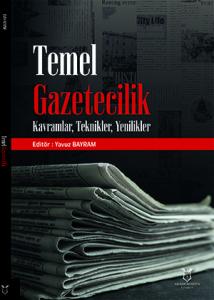
Sosyal Medya Gazeteciliği
Özet
Bilgi ve iletişim teknolojilerinin gelişmesi birçok alanda olduğu gibi gazetecilik alanında da birçok değişim ve dönüşüm oluşturmuştur. İnternet gazeteciliğiyle başlayan bu değişim ve dönüşümle birlikte gazetecilik pratikleri, sosyal medya ortamlarına taşınmıştır. Sosyal medya ortamlarının hem gazetecilere hem de birey/lere çeşitli alt yapısal özellikler sunarak yeni fırsatlar oluşturması bu ortamları hem gazeteciler hem de kullanıcılar karşısında önemli kılmıştır. Günümüzde artık hemen hemen bütün yerel ve ulusal gazetelerin hepsi sosyal medya ortamları üzerinden gazetecilik pratikleri gerçekleştirmektedir. Bu bağlamda araştırmada, sosyal medya ortamlarındaki (Facebook, YouTube, Twitter, Instagram, TikTok, WhatsApp, Telegram ve Metaverse) gazetecilik pratiklerinin incelenmesi amaçlanmıştır. Bu doğrultuda, sosyal medya gazeteciliği Facebook, YouTube, Twitter, Instagram, TikTok, WhatsApp, Telegram ve Metaverse olmak üzere toplam sekiz kategoride gazetecilik pratikleri açısından literatür taraması yapılarak incelenmiştir. Literatür taraması sonucunda; sosyal medya ortamlarının hem gazeteciler açısından haberin üretiminden dağıtıma kadar oluşturduğu hem de kullanıcılar açısından bu ortamların kullanıcılara sağladığı avantajlar ve dezavantajlar bütünlüklü bir bakış açısıyla sunulmuştur.
Referanslar
Adornato, A. (2017). Mobile and social media journalism a practical guide. California: SAGE Publications.
Barbosa, B., & Carvalho, C. (2022). Tweet And Retweet Journalısm Durıng The Pandemıc: Dissemination Of And Engagement With News On Twitter. Brazilian Journalism Research, 17, 736-763.
Belair-Gagnon, V., Agur, C., & Frisch, N. (2017). The changing physical and social environment of newsgathering: A case study of foreign correspondents using chat apps during unrest. Social Media+ Society, 3 (1), 2056305117701163.
Bossio, D. (2017). Big Data, Algorithms and the Metrics of Social Media News. Diana Bossio (Ed.). Journalism and Social Media: Practitioners, Organisations and Institutions içinde (ss. 89-109). Camden: Springer International Publishing.
Bruns, A., & Highfield, T. (2012). Blogs, Twitter, and breaking news: The produsage of citizen journalism. In R. A. Lind (Ed.). Produsing theory in a digital world: The intersection of audiences and production in contemporary theory (Vol. 30, pp. 15–32). New York: Peter Lang Publishing Inc.
Bulut, S. (2020). Egemen söylemin kıyısındakiler: alternatif bir platform olarak Youtube’da gazetecilik ve gazeteciler üzerine bir inceleme. Erciyes İletişim Dergisi, 7 (2), 727-748.
Burgess, J. ve Green, J. (2010). YouTube online video and participatory culture. Cambridge, UK: Polity Press.
Carlson, M., & Lewis, S. C. (2018). News and the networked self: Performativity, platforms, and journalistic epistemologies. In Z. Papacharissi (Ed.), A networked self and platforms, stories, connections (pp. 29–42). New York, NY: Routledge
Carpenter, J. P., Morrison, S. A., Craft, M., & Lee, M. (2020). How and why are educators using Instagram?. Teaching and teacher education, 96, 103149.
Chung, C. ve Austria K. (2010). Social Media Gratification and Attitude toward Social Media Marketing Messages: A Study of the Effect of Social Media Marketing Messages on Online Shopping Value. S. Yu, R. Lord ve B. Lin (Ed.), Proceedings of the Northeast Business & Economics Association içinde (s. 581-586). New Jersey: Montclair State University.
Coleman, B. (2011). Hello avatar dijital neslin yükselişi. (Çev: E. Bilge), İstanbul: Mediacat Yayınları.
Çetinkaya, A. (2019). Çevrimiçi gazetelerin Instagram üzerinden haber paylaşımı. Kritik İletişim Çalışmaları Dergisi, 1 (2), 1-28.
De la Peña, N., Weil, P., Llobera, J., Spanlang, B., Friedman, D., Sanchez-Vives, M. V., & Slater, M. (2010). Immersive journalism: Immersive virtual reality for the first-person experience of news. Presence, 19 (4), 291-301.
Edmonds, R., Guskin, E., Rosenstiel, T., & Mitchell, A. (2012). Newspapers: Building digital revenues proves painfully slow. Retrieved from http://stateofthe media.org/2012/newspapers-building-digital-reven ues-proves-painfully-slow
Erol, S. (2022). TikTok ve Gazetecilik İlişkisi Üzerine Ülkeler Arası Karşılaştırmalı Bir İçerik Analizi. Yeni Medya, 2022 (12), 302-325.
Hermida, A. (2012). Social journalism: Exploring how social media is shaping journalism. The Handbook Of Global Online Journalism, 12, 309-328.
Hermida, A., Fletcher, F., Korell, D. ve Logan, D. (2012). Share, like, recommend: Decoding the social media news consumer. Journalism Studies, 13 (5-6), 815-824.
Howe , J. (2009). Crowdsourcing: why the power of the crowd is driving the future of business. New York : Three Rivers .
Jansen, Bernard ve Mimi Zhang vd (2009). Twitter power: tweets as electronic word of mouth. Journal of The American Society For Information Science and Technology. 60 (11), 2169–2188.
Jones, M. (2006). Will news find a home on YouTube?. Nieman Reports, 60 (4), 52.
Kaplan, A. M. ve Haenlein, M. (2010). Users of the world, unite! the challenges and opportunities of social media. Business Horizons, 53 (1), 59-68.
Kermani, H. (2018). Telegramming News: How have Telegram channels transformed journalism in Iran?. Türkiye İletişim Araştırmaları Dergisi, (31), 168-187.
Klug, D., Qin, Y., Evans, M., & Kaufman, G. (2021). Trick and please. A mixed‐method study on user assump‐ tions about the TikTok algorithm. In 13th ACM Web Science Conference 2021 (WebSci’21) (pp. 84–92). ACM.
Lawrence, R. G., Molyneux, L., Coddington, M., & Holton, A. (2014). Tweeting conventions: Political journalists’ use of Twitter to cover the 2012 presidential campaign. Journalism Studies, 15, 789–806.
Lister, M., J. Dovey, S. Giddens, I. Grant ve K. Kelly (2009). New media: a critical Introduction. New York: Routledge
Martey, R.M. and Galley, J.S., (2007). The digital dollhouse: context and social norms in the sims online. Games and Culture, 2, 314-334.
Marwick, A., ve Boyd, D. (2011). To see and be seen: celebrity practice on twitter. Convergence: The International Journal of Research into New Media Technologies, 17 (2), 139-158.
Meese, J., & Hurcombe, E. (2021). Facebook, news media and platform dependency: The institutional impacts of news distribution on social platforms. New Media & Society, 23(8), 2367-2384.
Mellado, C., & Alfaro, A. (2020). Platforms, journalists, and their digital selves. Digital Journalism, 8 (10), 1258–1279.
Miller, K. (2012). Playing along: digital games, youtube, and virtual performance. New York: Oxford University Press.
Mystakidis, S. (2022). Metaverse. Encyclopedia, 2 (1), 486-497.
Neuberger, Christoph., Nuernbergk, Christian., Ve Langenohl, Susanne. (2019). “Journalism As Multichannel Communication: A Newsroom Survey On The Multiple Uses Of Social Media”, Journalism Studies, pp.1260- 1280.
Newman, N. (2018). Journalism, media, and technology trends and predictions 2018. Reuters Insitute Digital News Project 2018. https://reutersinstitute.politics.ox.ac.uk/sites/default/files/2018- 01/RISJ%20Trends%20and%20Predictions%202018%20NN.pdf (12 Mayıs 2018).
Oeldorf-Hirsch, A., & Sundar, S. S. (2015). Posting, commenting, and tagging: Effects of sharing news stories on Facebook. Computers in human behavior, 44, 240-249.
Özçağlayan, M. (1998). Yeni iletişim teknolojileri ve değişim. İstanbul: Alfa Yayınları.
Özmen, K. (2022). Gazeteciliğin değişimi ve YouTube’daki temsili. Medya ve Kültür, 2 (1), 10-27.
Rodriguez, S. E. (2017). How Facebook Has Transformed Journalism. (Yüksek Lisans Tezi). Liberty University.
Sarıkaya, B. F. (2023). Sarmal gazetecilik nedir, ı̇letişim süreçlerini nasıl etkiler?. TRT Akademi, 8(17), 448-471.
Seyidov, I., & Artan Özoran, B. (2020). Insta-worthiness of News in New Media Journalism: How to Understand News Values on Instagram. Türkiye İletişim Araştırmaları Dergisi, (36), 186-203.
Shengjie, J. (2021). Tiktok analysis. Journal of Frontiers of Society, Science and Technology, 1(1), 8-12.
Sine, R. (2017). Alternatif Medya ve Habercilik, Konya: Literatürk Yayınevi.
Şen, R. ve Akgül, S. K. (2023). WhatsApp dayanışma grupları ve iletişim uygulamaları: 6 şubat 2023 kahramanmaraş depremleri. Afet ve Risk Dergisi, 6(4), 1410-1428.
Telegram, (2023). https://telegram.org/faq. Erişim Tarihi: 10.03.2024.
Türkoğlu, H. S. (2023). Metaverse: meta medya kavramı üzerinden sürükleyici gazetecilik üzerine bir inceleme. Uluslararası Beşeri ve Sosyal Bilimler İnceleme Dergisi, 7(2), 77-86.
Vermeer, S., & van den Heijkant, L. (2023). Break a Story: Examining the Effects of Instagram Stories from News Accounts on Adolescents’ Political Learning. Journalism Studies, 1-24.
Vural, B. A. ve Bat, M. (2010). Yeni bir iletişim ortamı olarak sosyal medya: ege üniversitesi iletişim fakültesine yönelik bir araştırma. Journal of Yaşar University, 20 (5), 3348-3382.
WhatsApp, (2024). https://www.whatsapp.com/about Erişim Tarihi: 15.03.2024.
Yaşa, H. (2022). Çevre(cilik) hareketi olarak sosyal medyada sıfır atık hareketi. Selçuk Üniversitesi Sosyal Bilimler Enstitüsü Dergisi, (49), 212-230.
Yaşa, H. (2023). Kanaat önderliği bağlamında influencerlar ve içerikleri üzerine fenomenolojik bir araştırma. (Yayımlanmış doktora tezi). Anadolu Üniversitesi Sosyal Bilimler Enstitüsü, Eskişehir.
Yaşa, H. ve Batu, M. (2023). Influencerların metaverse deneyimini keşfetmek: YouTube örneği. Selçuk 9. Uluslararası Sosyal Bilimler Kongresi, ss. 1532-1548.
Yıldız, E., ve Özmen, Ş. Y. (2023). Sosyal medya platformlarıyla birlikte habercilik pratiklerinin dönüşümü. Düşünce ve Toplum Sosyal Bilimler Dergisi, 5 (1), 1-30.
Zinderen, A. (2021). YouTube ortamındaki haberciliği haritalandırmak: gazetecilerin YouTube haber kanalları üzerine tanımlayıcı bir çalışma. Atatürk Üniversitesi Sosyal Bilimler Enstitüsü Dergisi, 25 (3), 932-950.