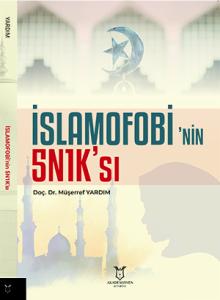
İSLAMOFOBİ’nin 5N1K’sı
Özet
-
Referanslar
(2015). Jaarrapport Meld Islamofobie, MELD İSLAMOFOBİE (https://www.meldislamofobie.org/app/uploads/2020/05/Meld_Islamofobie_jaarrapport_2015_definitief.pdf
Abdin Khalil, A. (2018). In and Out: Exploring Inclusion and Alienation within the Sport Experiences of Hijabi Athletes in Ontario. A thesis submitted in conformity with the requirements for the degree of Master of Science Graduate Department of Exercise Sciences University of Toronto.
Abdullah, A. (2015). Muslims in Pre- and Post-9/11 Contexts. International Journal of Comparative Literature & Translation Studies. doi:10.7575/aiac.ijclts.v.3n.3p.52
Abrahamian, E (2003). “The US Media, Huntington and September 11,” Third World Quarterly, v.24, no.3, pp.529-44
Abu-Lughod, L. (2006). The Muslim Woman: The Power of Images and the Danger of Pity. Available at: http://www.eurozine.com/articles/2006-09-01-abulughod-en.html
Adnani, R. (2021), Croire en l'existence d'un racisme envers l'İslam, “Croire à l’existence d’un racisme envers l’islam appelle à s’interroger sur l’avenir de la liberté de conscience”- L’islamophobie, un concept qui n’est pas scientifiquement fondé – Razika Adnani (razika-adnani.com)
Aḥmed, L. (1992). Women and gender in Islam: Historical roots of a modern debate. New Haven, CT: Yale University Press.
Allen, C. (2007). Islamophobia and its Consequences. In S. Amghar; A. Boubekeur & M.Emerson (eds.), European Islam: Challenges for Public Policy and Society (pp. 144-167).Brussels: Center for European Policy Studies
Allen, C. (2010). Islamophobia. Farnham: Ashgate.
Allen, C. & Nielsen, J. (2002). Summary Report on Islamophobia Summary Report on Islamophobia in the EU after 11 September 2001, EUMC.
Alam, S. (2020, November 2). Tens of thousands in Bangladesh protest against France. AP News. Retrieved August 5, 2021, from https://apnews.com/article/dhaka boycotts-bangladesh-emmanuel-macron-france ee5cf929c77844cc153af4a69c196094
Almond, I. (2013). Yeni Oryantalistler. İstanbul: Pinhan Yayıncılık.
Altun, F. (2022). A Critical Review of “Ottoman Modernization”, Adam Akademi Sosyal Bilimler Dergisi, Sayı 1 (2022), c. 12, s.107-130.
Alloula, M. (1986). The colonial harem. Minneapolis, MN: University of Minnesota Press.
Amara, M. (2008). An introduction to the study of sport in the Muslim world. In B. Houlihan (Ed.), Sport and society: A student Introduction (pp. 532–553). London, England: Sage.
Amara, M. (2013). Sport, Islam, and Muslims in Europe: In between or on the margin? Religions, 4(4), 644-656. doi:10.3390/rel4040644 100
Amara, M. and Henry, I. R, (2010) Sport. Muslim identities and cultures in the UK, an emerging policy issue: Case studies of Leicester and Birmingham. European Sport Management Quarterly 10, 419 443. doi: 10.1080/16184742.2010.502743.
Amara, M. & Henry, I. P., (2012) Deconstructing the Debate around Sport and the ‘Question’ of‘Muslim Minorities’ in the West'. In Farrar, M., Robinson, S., Vallie, Y. and Wetherly. P. (eds.), Islam in the West: Key Issues in Multiculturalism. London: Palgrave, pp. 138-153.
Amin, A. (2010) The remainders of race. Theory, Culture & Society 27(1): 1–23
Amiraux, V. (2014). L'Europe face à l'islam. Revue Projet, 342, 53-59. https://doi.org/10.3917/pro.342.0053
Arboit, G. & Blanchard, F. (2007). “Satanées caricatures. L’idéologisation médiatique d’un inimicus récalcitrant”, in Centre Thucydide, Annuaire français des relations internationales, Vol. 8, Bruxelles : Bruylant, 2007.
Al-Arian, L. (2012). TV's Most Islamophobic Show, http://www.salon.com/2012/12/15/tvs_most_islamophobic_show
Asal, H. (2014). Islamophobie: la fabrique d'un nouveau concept. État des lieux de la recherche. Sociologie, 5, 13-29. https://doi.org/10.3917/socio.051.0013
Aslan, A. (2019). The politics of Islamophobia in Turkey. In Bayraklı, E. & Hafez, F. (eds.), Islamophobia in Muslim Majority Societies (pp. 71-92). New York: Routledge.
Asmal, F. (2008). Islamophobia and the media: The portrayal of Islam since 9/11 and an analysis of the Danish cartoon controversy in South Africa [Doctoral dissertation]. University of Stellenbosch.
Atnashev, VR. (2016). Impact of Islamophobia and Human Rights: Violations to the Radicalization of Muslim Communities, Era M i d d l e E a s t (M E R P A), 2(1):91-107.
Audard, C. (2013). Pluralisme religieux et égalité: une critique de la laïcit. In Guérard de Latour, S. & Dilhac, M. (Eds.), Étant donné le pluralisme. Éditions de la Sorbonne. doi:10.4000/books.psorbonne.17309
Avcioglu, N. (2007). Identity-as-Form: The Mosque in the West, Cultural Analysis 6:91–112.
Avon, D. (2010). L’affaire des caricatures ». Chronologie et mise en perspective. In Avon, D. (Ed.), La caricature au risque des autorités politiques et religieuses. Presses universitaires de Rennes. doi :10.4000/books.pur.102906
AvrupanınSesi, Köln Dom Katedrali’nde 56 yıl önce bayram namazı kılınışının yıldönümü, Köln Dom Katedrali’nde 56 yıl önce bayram namazı kılınışının yıldönümü (avrupaninsesi.com)
Awan, I. (2014). Islamophobia and Twitter: A Typology of Online Hate Against Muslims on Social Media, Islamophobia and Twitter.pdf (bcu.ac.uk)
Aydemir, B. (2022). Islamophobic Tendencies and the Otherized Ottoman in Theater Plays from the Ottoman Empire to the Republic (1860-1950), Din Bilimleri Akademik Araştırma Dergisi, 22(2):1119-1151
Ayub, A. (2011). A closer look at FIFA's hijab ban: What it means for Muslim players and lessons learned. SAIS Review, 31(1), 43-50. doi:10.1353/sais.2011.0010
Bakir, M. (2016). Bakir. Laïcité et religion en Tunisie. Linguistique. Université de Strasbourg.
Basso, P. (2016). Le racisme européen. Paris: Syllepse.
Bayart J.-F. (2020). “Que le terme plaise ou non, il y a bien une islamophobie d’État en France”, Le Monde, 31 octobre.Fachosphère : l'islamophobie pollue les réseaux, Fachosphère : l'islamophobie pollue les réseaux | Témoignage | La ZEP
Beaugé, J. & Hajjat, A. (2014). Élites françaises et construction du « problème musulman ». Le cas du Haut Conseil à l'intégration (1989‑2012). Sociologie, 5, 31-59. https://doi.org/10.3917/socio.051.0031
Benhabib, D. (2018). “Le 29 janvier 2017 : un drame et son instrumentalisation”, Huffington Post Québec, 26 janvier. [En ligne]. https://quebec.huffingtonpost.ca/djemila-benhabib/le-29-janvier-2017-un-drame-et-son-instrumentalisation_a_23344871/. Page consultée le 19 mai 2018.
Benn, T. (1996). Muslim women and physical education in initial teacher training. Sport, Education and Society, 1(1), 5-21. doi:10.1080/1357332960010101
Benn, T. (2009). Muslim women in sport: A researcher’s journey to understanding embodied faith. International Council for Sports Science and Physical Education, Bulletin, 55, 48–56.
Benn, T. & Ahmed, A. (2006). Alternative visions: International sporting opportunities for Muslim women and implications for British youth sport. Youth & Policy, 92, 119–132
Benn, T. & Dagkas, S. & Jawad, H. (2011). Embodied faith: Islam, religious freedom and educational practices in physical education. Sport, Education and Society, 16(1), 17-34. doi:10.1080/13573322.2011.531959
Benn, T. & Pfister, G. (2013). Meeting needs of Muslim girls in school sport: Case studies exploring cultural and religious diversity. European Journal of Sport Science, 13(5), 567-574. doi:10.1080/17461391.2012.757808
Berchet, J-C. (1994). Chateaubriand et le despotisme oriental, Dix-huitième Siècle, n°26, Persée, Paris.
Betts, G.K. (1995). "Wanted Women, Woman's Wants: The Colonial Harem and Post-colonial Discourse." Canadian Review Of Comparative Literature (1995): 527-551
Beydoun, K. (2016) “Islamophobia: Toward a Legal Definition and Framework,” Columbia Law Review 116, (Nov. 1, 2016): 108.
Bhabha, H. (1994). The Location of Culture, Routledge, London.
BM (2014). Secretary-General’s remarks at the Event: “Celebrating Sport for Development and Peace, 28 April 2014, https://www.un.org/sg/en/content/sg/statement/2014-04-28/secretary-generals-remarks-event-celebrating-sport-development-and
Bock-Coté, M. (2018). Islamophobes? Non coupables!, Le Journal de Montréal, https://www.journaldemontreal.com/2018/01/11/islamophobes-non-coupables.
Bölsche, J. (2008). Die Lanzen der Eroberer, Spiegel Special, 2:72-79.
Boubeker, A. (2010). L'immigration (post)coloniale en héritage: un récit en marge de l'histoire de France. Achille Mbembe éd., Ruptures postcoloniales: Les nouveaux visages de la société française, 265-278.
Bourdieu, P. (1996). Sur la télévision, Raisons D’agir, Liber.
Bourdieu, P. (2005). Un problème peut cacher un autre, Foulard islamique en questions, sous la dir. Charlotte Nordmann, Paris, Amsterdam.
Bowen, J. (2021). What Does Europe Have Against Halal?, Boston Revieuw, 11 Haziran 2021.
Bozec. G. (2020). La construction de l’islam comme problème dans le champ scolaire. Lesenseignantes, entre prisme culturaliste et gestion pragmatique. Agora débats/jeunesses, 84(1):81.
Bradford, V. (1999) The veil and the visible. Western Journal of Communication 63(2): 115–139.
Bullock, K. (2002). Rethinking Muslim Women and the Veil: Challenging Historical and Modern Stereotypes, Herndon, VA: International Institute of Islamic Thought.
Bunzl, M. (2007). Anti-Semitism and Islamophobia: Hatreds Old and New in Europe. Chicago, IL: Prickly Paradigm Press
Burchett, J. (2021). L’Union européenne et la lutte contre la radicalisation terroriste : étude représentativedes défis juridiques de la lutte contre la radicalisation sous l’angle des interactions entre les ordresjuridiques européens, belge et français. Droit. Université Grenoble Alpes.
Butler, U. (2022). Islamophobia in the digital age: a study of anti-Muslim tweets, Islamic Council of Victoria.
Büttgen, P. et al. (eds.) (2009). Les Grecs, les Arabes et nous: Enquête sur l’islamophobie savante. Paris: Fayard.
Caron, J. (1997). Ernest Renan, Qu’est-ce qu’une Nation ? et autres écrits politiques. Présentation Raoul Girardet, 1996. Revue D’Histoire Du XIXe Siècle - 1848, 15(2), 100–101. https://www.persee.fr/doc/r1848_1265-1354_1997_num_15_2_2294_t1_0100_0000_
Carroll, B. & Hollinshead, G. (1993). Equal opportunities: race and gender in physical education: a case study. In J. Evans (Ed.) Equality, education and physical education,154-169.
Cesari, J. (2002). L'islam en Europe, Cahiers d’études sur la Méditerranée orientale et le monde turco-iranien, URL: http://journals.openedition.org/cemoti/720; DOI: https://doi.org/10.4000/cemoti.720
Cesari, J. (2013). Why the West Fears Islam: An Exploration of Muslims in Liberal Democracies (New York: Palgrave Macmillan
Chakraborti, N. & Zempi, I. (2012). The veil under attack: Gendered dimensions of Islamophobic victimization. International Review of Victimology, 18(3), 269-284. https://doi.org/10.1177/0269758012446983
Chaudhary, M. et al. (2021). Islamophobia In Western Media: A Study Of American Movies After 9/11, Journal of Peace, Development and Communication, 5(1):143-150, https://doi.org/10.36968/JPDC-V05-I01-13
Chekkat, K. (2021). L'islam et l'orientalisme, Independently.
Cheng, J. (2015). Islamophobia, Muslimophobia or racism? Parliamentary discourses on Islam and Muslims in debates on the minaret ban in Switzerland, Discourse & Society , 26(5): 562-58
Civila S. & Romero-Rodríguez LM. & Civila A. (2020). The Demonization of Islam through Social Media: A Case Study of #Stopislam in Instagram, 8(4):52. https://doi.org/10.3390/publications8040052
Consilium.Europa.eu, Mesures de l'UE pour prévenir la radicalisation.Fuchs, A .État d’urgence et démocratie, 1. État d’urgence et démocratie - Europe Écologie les Verts (eelv.fr)
Conte, D. (2009). Women: Strained stereotypes, Reset Dialogues on Civilizations. Dialogues on Civilizations. http://www.resetdoc.org/story/00000001456
Crusader Orientalism and the Rise of İslamophobia (2021). The Rise of Islamophobia - Paradigm Shift.
Daniel, N. (1997). Islam and the West: The Making of an Image. Oxford: Oneworld, 1997.
Dixon, F. (2019). Gendered Islamophobia: Muslim women slam Decathlon’s backtrack over sports hijab. Retrieved from www.alaraby.co.uk/english/ news/2019/2/27/women-slam-decathlons-backtrack-over-sports-hijab
Dubois V. (2009), L’action publique, Cohen A., Lacroix B. & Riutort Ph. (dir.), Nouveau manuel de science politique, Paris, La Découverte, 311-325.
Dunn, KK. & Klocker, N. & Salabay, T. (2007). Contemporary racism and Islamaphobia in Australia: Racializing religion. Ethnicities 7(4): 564–589
Elahi, F & Khan, O. (2017). Islamophobia : Still a Challenge for us all, Londres,
Elghobashy, S. (2009). Muslim Stereotypes in Hollywood: Are they really fading?, The Guide to Global Muslim Culture. http://www.elanthemag.com/index.php/site/blog_detail/muslimsstereotypes_in_hollywood_are_they_really_fading-nid503043165/
Emmer, P. & Lucassen, L. (2012). Migration from the Colonies to Western Europe since 1800, Migration from the Colonies to Western Europe since 1800 — EGO (ieg-ego.eu)
Facal, J. (2018). “Est-ce si dur à comprendre ?”, Le Journal de Montréal, 3 février. [En ligne]. https://www.journaldemontreal.com/2018/02/03/est-ce-si-dur-a-comprendre.
Eide, E. (2016). Lectures en contrepoint. Caricatures et contextes d’interprétations.. Communication & langages, 187, 31-45. https://doi.org/10.3917/comla.187.0031
ENAR, (2016). Forgotten Women: The Impact of Islamophobia on Muslim Women”, ENAR.
Encyclopedia of Crusades, Chanson de Roland - The Crusades (erenow.org)
European Court of Human Rights - HUDOC (2006). Ben El Mahiand Others- Denmark Decision.
Fanon, F. (1959). L’an V de la Révolution algérienne (Éditions La Découverte
FBI (2001). Crime in the United States - 2001, Federal Bureau of Investigation, http://www.fbi.gov/ucr/01cius.htm.
Fernandez, S. (2009). The crusade over the bodies of women. Patterns of Prejudice, 43(3-4), 269–286. https://doi.org/10.1080/00313220903109185
Frampton, M. (2018). The Muslim Brotherhood and the West: A History of Enmity and Engagement. Cambridge, Massachusetts: Belknap Press of Harvard University Press.
Fraser, N. (1990). "Rethinking the Public Sphere: A Contribution to a Critique of Actually Existing Democracy", Social Text 25/26: 56-80
Furseth, I. (2010). Power and migrant Muslim women. International Sociological Association. Gothenburg, Sweden
Gauthier, G. (2023). Islamophobie?, Communication http://journals.openedition.org/communication/11536
Geisser, V. (2021). İslamophobie: Un outrage au lexique républicain, Dieses.
Genevois, M. (2023). Des politiques İslamophobes en France, Master en Sciences Politiques, UCL.
Georgi-Findlay, B. (2020). “Inter/Multimedial Constructions of Islam in Post-9/11 TV Series: The West Wing and 24”, European journal of American studies. http://journals.openedition.org/ejas/16203
Gilbert, J-S. (2018), Islamophobie: à l’origine de la discorde, Huffington Post Québec, https://quebec.huffingtonpost.ca/jean-sebastien-gilbert/islamophobie-a-l-origine-de-la-discorde_a_23351236/
Gingras, Y. (2018). Quand les mots font des choses, Le Devoir. https://www.ledevoir.com/opinion/idees/518052/quand-les-mots-font-des-choses.
Goffman, E. (1974). Frame Analysis: An Essay on the Organization of Experience, Harper and Row
Göle, N. (2011). The Public Visibility of Islam and European Politics of Resentment: The Minarets Mosques Debate. Philosophy and Social Criticism, 37(4):383-392
Göle, N. (2013). Islam's disruptive visibility in the European public space. Political stakes and theoretical issues, Eurozine.
Gracieux, G. (2006). Les dessinateurs de presse et les caricatures du prophète Mahomet, Institut national de l’audiovisuel.
Grigoriadis, I. (2009) .Islam and democratization in Turkey: secularism and trust in a divided society, Democratization, 16: 1194-1213.
Grosfoguel, R (2012). The Multiple Faces of Islamophobia, Islamophobia Studies Journal , Vol. 1, No. 1 (Spring 2012), pp. 9-33
El Guindi, F. (1999). Veil: Modesty, Privacy and Resistance, Berg, Oxford.
Gusfield, J. (2009). La Culture des problèmes publics. L’alcool au volant : la production d’un ordre symbolique, Paris, Economica.
Habermas, J. (1998). L’intégration républicaine, Paris, Fayard.
Habermas, J. (2013). Religion in the public sphere », European Journal of Philosophy, 14 (1):1-25.
Habermas, J. & Rawls, J. (1997). Débat sur la justice politique, trad. C. Audard et R. Rochlitz, Paris, Cerf.
Hajjat, A. & Mohammed, M. (2016). Islamophobie, comment les élites françaises fabriquent le problème musulman. Paris, La Découverte.
Hall, S. (2000). The multi-cultural question. Un/Settled Multiculturalisms: Diaspora, Entanglement, Transruption. Edited by Barnor Hesse. London: Zed Books, 209–41
Halliday, F. (1999). ‘Islamophobia’ reconsidered. Ethnic and Racial Studies, 22: 892–902
Hamzeh, M. (2012). Pedagogies of deveiling: Muslim girls and the hijab discourse. Charlotte, NC: Information Age Press.
Hamzeh, M. & Oliver, K L. (2010). Gaining research access into the lives of Muslim girls: Researchers negotiating Muslimness, modesty, inshallah, and haram, International Journal of Qualitative Studies in Education, 23:165-180. doi:10.1080/09518390903120369
Hamzeh, M. & Oliver, K. L. (2012). Because I am Muslim, I cannot wear a swimsuit: Muslim girls negotiate participation opportunities for physical activity. Research Quarterly for Exercise and Sport, 83(2):330-339. doi:10.1080/02701367.2012.10599864
Hasal, H. (2014). Islamophobie: la fabrique d’un nouveau concept. État des lieux de la recherche, Sociologie, 5(1).
Hassan, I. & Azmi, M. N. L. (2021). Islamophobia in non-Western media: A content analysis of selected online newspapers. Newspaper Research Journal, 42(1): 29-47.
Helly, D. (2016). La Peur de l’Islam, https://doi.org/10.4000/sociologies.4900
Henri, G. (2012). Le rejet français de l'islam : Une souffrance républicaine.
Hofstra.edu, Women and the Islamic Veil:Deconstructing implications of orientalism, state, and feminism through an understanding of performativity, cultivation of piety and identity, and fashion (hofstra.edu).
Hourani, A. (1983). Arabic Thought in the Liberal Age: 1798-1939, Cambridge: Cambridge University Press.
Human Right Watch (2002). UNITED STATES (hrw.org)
Huth, C. (2010). Keeping the faith: An exploratory analysis of faith-based arbitration in Ontario. Masters Abstracts International, 48(1):1-120.
İslam, R. (2021). İslamophobia in Muslim Majority Societies: A Case Study of Bangladesh, Master Thesis.
Islamophobie dans le Monde Moderne (2008). Mohamed Mestiri, Ramon Grosfoguel y El Yamine Soum eds., París
Jacoby, T. (2023). Islam, violence and the ‘four dogmas of Orientalism’. Race & Class, 65(2):75-97.
Jamil. U. (2021). Multiculturalism and the Muslim Question. ReOrient. 6(2):219-225. DOI: 10.13169/reorient.6.2.0219
Jeunes et Médias (2022). Discrimination et haine en ligne, Discrimination et haine en ligne: Jeunes et media (jeunesetmedias.ch)ZepMédia
Jiwani, Y. (2010). Doubling discourses and the veiled other: Mediations of race and gender in Canadian media. S. Razack, M. Smith, & S. Thobani (Eds.), States of race: Critical race feminism for the 21st century, 59–86.
Kabbani, R. (1994). Imperial Fictions: Europe’s Myths of Orient, Pandora.
Kasirye, F. (2021). The Portrayal of Muslim Women in Western Media. A Content Analysis of the New York Times and The Guardian. Advance. Preprint. https://doi.org/10.31124/advance.14156915.v1
Kastolani, K. (2020). Understanding the delivery of Islamophobic hate speech via social media in Indonesia, Indonesian Journal of Islam and Muslim Societies, 10(2): 257-270.
Keegan, J. (2001). In this War of Civilisations, the West will Prevail, The Daily Telegraph 10/08/2001
Kepel, G. & Antoine, J. (2017). Terror in France: The Rise of Jihad in the West, Princeton Studies in. Muslim Politics.
Khosrokhavar, F. (2004). L'Islam dans les prisons, Archives de sciences sociales des religions, 128:53-158.
Kilpatrick, J. (2020). Quand un état d’urgence temporaire devient permanent. Le cas de la France, Transnational Institute.
Kimouche, F. (2022, May 10). La loi séparatisme d’Emmanuel Macron a institutionnalisé l’islamophobie d’État en France. Middle East Eye Édition Française. https://www.middleeasteye.net/fr/opinionfr/france-loi-separatisme-fermeture-mosqueesmacron-institutionnalise-islamophobie-etat-recul-libertes
Kiran, U. & Qamar, A. & Adnan, M. & Youssef, E. Y. (2021). Muslims depiction in Hollywood movies: A qualitative study. PalArch’s Journal of Archaeology of Egypt/Egyptology, 18(8):1126-1136
Kraft, S. (2002). Islamische Sakralarchitektur in Deutschland. Eine Untersuchung ausgewählter Moschee-Neubauten, Münster Lit.
Kumar, D. (2014) Mediating racism: The new McCarthyites and the matrix of Islamophobia. Middle East Journal of Culture and Communication 7: 9–26.
Kuppinger, P. (2004). Exclusive Greenery: New Gated Communities in Cairo. City and Society 16(2):35-61.
Kuppinger, P. (2010). Factories, Office Suites, Defunct and Marginal Spaces. Mosques in Stuttgart, Germany, M. Guggenheim, O. Söderström (dir.), Re‐shaping cities. How global mobility transforms architecture and urban form, Routledge, 83–99
Kuppinger, P. (2011). Vibrant mosques: Space, planning and informality in Germany. Built Environment, 37(1):78–91.
Kuppinger, P. (2014). Mosques and Minarets: Conflict, Participation, and Visibility in German Cities, Anthropological Quarterly , 87(3):793-818
Lagacé, P. (2018), C’est quoi l’islamophobie?, La Presse+, http://plus.lapresse.ca/screens/9d93db62-7425-4118-9572-d2a3323f2475__7C___0.html.
Lamchichi, A. (2000). Laïcité autoritaire en Tunisie et en Turquie, Confluences Méditerranée, 33:35-57.
Le Cour Grandmaison, O. (2019). Ennemis mortels, Représentations de l'islam et politiques musulmanes en France à l'époque coloniale, Paris, La Découverte.
Lefebvre, B. (2020), Interview. Thomas Deltombe et l’islam imaginaire des médias français, Interview. Thomas Deltombe et l'islam imaginaire des médias français (revolutionpermanente.fr)
Lemaire, F. (2023). Après avoir fait des vagues à la plage, le burkini refait surface à la piscine municipale, mais reste au vestiaire”, Revue du droit des religions, 15:187-201.
Liogier, R. (2012). Le Mythe de l'islamisation. Essai sur une obsession collective. Seuil.
Liu, W. J. & Bilewicz, M. (2020). Media of Contempt: Social Media Consumption Predicts Normative Acceptance of Anti-Muslim Hate Speech and Islamoprejudice, International Journal of Conflict and Violence (IJCV), 14:1–13. https://doi.org/10.4119/ijcv-3774
Lockman, Z. (2004). Contending Visions of the Middle East: The History and Politics of Orientalism. Cambridge; New York: Cambridge University Press.
Louati, Y. (2015). L’Exception Francaise. Islamophobia Studies Journal, 3(1):89-105.
Louati, Y. (2018). L'İslamophobie en France, Rapport Annuel, SETA:Analyse_40.pdf
Macdonald, M. (2006). Muslim women and the veil: Problems of image and voice in media representations. Feminist Media Studies 6(1): 7–23.
Malek, G. (2018). Le concept de despotisme oriental au sein de l’Europe des Lumières, Les clés du Moyen Orient.
Malik, M. (2009). Anti-Muslim prejudice in the West, past and present: An introduction. Patterns of Prejudice 43(3–4): 207–212.
Maréchal, B. & Dassetto, F. & Bocquet, C. (2014). Musulmans et non musulmans à Bruxelles, entretensions et ajustements réciproques, Fondation Roi Baudouin.
Margalit, A. (1996). La société décente, trad. F. Billard, Paris, La Découverte.
Maatouk, S. (2021). Orientalism – A Netflix Unlimited Series: A Multimodal Critical Discourse Analysis of the Orientalist Representations of Arab Identity on Netflix Film and Television (Dissertation). http://urn.kb.se/resolve?urn=urn:nbn:se:mau:diva43793
Mauger, G. (2016). Sur la radicalisation islamiste. Savoir/Agir, 37:91-99. https://doi.org/10.3917/sava.037.0091
Miller, J., & Sack, C. (2010). Terrorism and Anonymous Sources: the Toronto 18 Case. Canadian Journal of Media Studies , 8:1-24.
Modood, T. (1997). Difference, Cultural Racism and Anti-Racism, T. Modood and P. Werbner (eds) Debating Cultural Hybridity, London: Zed Books.
Modood, T. (2018). Islamophobia: A Form of Cultural Racism. Evidence Paper to the All-Party Parliamentary Group on British Muslims in response to the call for evidence on ‘Working Definition of Islamophobia. University of Bristol Research Centre for the Study of Ethnicity and Citizenship.
Modood, T. (2019) Essays on Secularism and Multiculturalism. London: Rowman & Littlefield International
Moosavi L. (2013). Islamophobia in the representations of Islam and Muslims by the British government between 2001 and 2007. İstanbul Üniversitesi Sosyoloji Dergisi, 3(27):333–368.
Meer, N. (2019). L’islamophobie, un racisme à l’égard des Musulmans européens, Hommes & migrations, URL: http://journals.openedition.org/hommesmigrations/8172
Meziti, K. (2013). Dictionnaire de l'İslamophbie, Bayard.
Miles, R. & Brown, M. (2003): Racism. Secon Edition. London, New York: Routledge.
Mingant, N. (2010). Le cinéma hollywoodien aujourd’hui: un diversité culturelle? Hollywood à la conquête du monde: Marchés, stratégies, influences. Paris: CNRS Éditions. doi :10.4000/books.editionscnrs.8049
Mirrlees, T. & Ibaid, T. (2021). The Virtual Killing of Muslims: Digital War Games, Islamophobia, and the Global War on Terror. Islamophobia Studies Journal, 6(1):33–51. https://doi.org/10.13169/islastudj.6.1.0033
Murray, D. (2017). The Strange Death of Europe: Immigration, Identity, Islam, London: Bloomsbury.
Mustafa, N. (2020). Muslim Women don’t need savingGendered Islamophobia in Europe, Transnational İnstitute.
Nadi, S. & Opratko, B. & Müller-Uri, F. (2014). L’islamophobie et les théories critiques du racisme.
Neaimi, S. (2006), Une fantasme philosophique: le despotisme oriental, dans Paul Dumont & Rémy Hildebrand (eds), L'Horloger du sérail, Institut français d’études anatoliennes.
Neptune, S. (2021). Discrimination against Muslims in the United States, Ballard Brief, Discrimination against Muslims in the United States - Ballard Brief (byu.edu)
Neveu, E. (2015). Sociologie politique des problèmes publics, U Collection, Armand Colin.
Noorlander, P. (2015). When satire incites hatred: Charlie Hebdo and the freedom of expression debate, Center for media pluralism and media freedom.
Ogan, C. & Willnat, L. & Pennington, R. et al. (2014). The rise of anti-Muslim prejudice: Media and Islamophobia in Europe and the United States. International Communication Gazette 76(1): 27–46.
Onfray, M. (2007). Atheist Manifesto: The Case Against Christianity, Judaism, and Islam, New York: Arcade.
Ouali, N. (2018). Islamophobia in Belgium. Islamophobia Studies Journal, Forthcoming, 2018
Öcal, M. & Kösedağ, S. (2023). 28 Şubat Sürecinde Türk Basınında Yer Alan İslamofobik İçerikler Üzerinde Bir İnceleme, Erciyes Akademi, 37(3):1182-1205
Özüdoğru Erdoğan, H. N. (2022). Anti-islam in digital games. Current Perspectives, Social Sciences, 26(1), 1 162-168.
Panagopoulos, C. (2006). Trends: Arab and Muslim Americans and Islam in the Aftermath of 9/1, The Public Opinion Quarterly, 70(4):608-624.
Papi, S. (2012). “Islam, laïcité et commensalité dans les cantines scolaires publiques”, Hommes & migrations, 1296:126-135.
Parekh, B. (2000). The Future of Multi-Ethnic Britain, London: Profile Books.
Pauwels, L. & Brion, F. & De Ruyver, B. et al., Comprendre et expliquer le rôle des nouveaux médias sociaux dans la formation de l’extrémisme violent. Une recherche qualitative et quantitative (RADIMED), Bruxelles: Politique scientifique fédérale.
Pellegrin, P. (1990). Aristote. Les Politiques: Traduction inédite, introduction, bibliographie, notes et index, Flammarion, Paris.
Picot, P. (2016). Quelques usages militants du concept de racisme institutionnel : le discours antiraciste postcolonial (France, 2005-2015), Migrations Société, 163(1):47-60.
Pujadas, D. & Salam, A. (1995). La Tentation du Jihad, JC Lattès.
Rane H. & Ewart J. & Martinkus J. (2014). Media-generated Muslims and Islamophobia. Media framing of the Muslim world. 29–46.
Rattansi, A. (2007). Racism. A very short introduction. Oxford: Oxford University Press
Rawls, J. (1999). The Law of Peoples and The Idea of Public Reason Revisited, Cambridge, Harvard University Press.
Rodinson, M. (2002). Europe and the Mystique of Islam, new ed., trans. Roger Veinus, London: Tauris.
Al-Saji A. (2010). The racialisation of Muslim veils: A philosophical analysis. Philosophy & Social Criticism 36(8): 875–902.
Sakib, N. S. (2021). Huge protest held ahead of Indian premier's Dhaka visit. Anadolu Agency (AA). https://www.aa.com.tr/en/asia-pacific/huge-protest-held-ahead-of-indian premiers-dhaka-visit/218168
Sayyid, S. (2008). Racism and İslamophbia, Dark Matter, http://www.darkmatter101.org/site/2008/03/26/racism-and-islamophobia/
Sealy T. (2021). Islamophobia: With or without Islam? Religions, 12(6):369. https://doi.org/10.3390/rel12060369
Schneider E. T. (2011). The reproduction of Islamophobia in German and Dutch newspaper discourse: An analysis from a critical discourse analytical perspective [Bachelor’s thesis]. University of Twente.
Schoeman, P. (2004). A clash of civilizations?, https://hdl.handle.net/10520/EJC28317
Seniguer, H. (2016). De quelques réflexions sur les sinuosités de la radicalisation. Histoire, monde et cultures religieuses, 39:13-31. https://doi.org/10.3917/hmc.039.0013
Benzine, R. (2016). La peur de l’islam, ferment d’un nouveau lien identitaire en France ?, Pascal Blanchard éd., Vers la guerre des identités: De la fracture coloniale à la révolution ultranationale, 101-109, https://doi.org/10.3917/dec.blanc.2016.02.0101
Soueif, A. (2001). The language of the veil, Veil: Veiling, Representation and Contemporary Art, David A. Bailey & Gilane Tawadros (eds.), Institute of International VisualArts, London, 109–119.
Steinberg, S. R. (2010). Islamophobia: The Viewed and the Viewers. Counterpoints, 346:79–97. http://www.jstor.org/stable/42980512
Taguieff, P-A. (1990). The new cultural racism in France. Telos, 83:109–122
Tarlo, E. (2007). Hijab in London: Metamorphosis, Resonance and Effects. Journal of Material Culture, 12(2):131-156. https://doi.org/10.1177/1359183507078121
Tassin, E. (ed.) (2003), Hannah Arendt: L'humaine condition politique, L'Harmattan, Paris.
Tavkhelidze, T. (2021). Historical Origins of European Islamophobia: The Nexus of Islamist Terrorism, Colonialism and the Holy Wars Reconsidered, 142–162, https://doi.org/10.37264/jcsi.v0i0.64
Taylor, Ch. (2002). Varieties of Religion Today, Harvard University Press,
Tevanian, P. (2012). Dévoilements. Du hijab à la burqa : les dessous d’une obsession française, Paris, Libertalia.
Tévanian, P. (2013), La haine de la religion, La Découverte, Paris.
The Institute for American Values, Sixty prominent US academics say war on terrorism is just, www.Gulf2000-14@Columbia.Edu
The Runnymede Trust, (1997). Islamophobia: A Challenge for us all, Londres,
Thompson P. M. (2013). Allen’s Islamophobia and the British news media: A critical evaluation of Islamophobia as a concept and its application to the written News media in Britain between 2001 and 2008 [Master’s thesis]. University of Wales.
Tiberj, V. (2014). L’islam et les Français: cadrages des élites, dynamiques et crispation de l’opinion, Migrations Société,155:165-180.
Touag, H. (2017). Un paradoxe belge, Hommes & migrations, 1316:49-56.
Trench, B. (2016) Charlie Hebdo, Islamophobia and Freedoms of the Press. Studies: An Irish Quarterly Review 105(418): 183-191.
Tyrer, D. & Sayyid, S. (2012). Governing ghosts: Race, incorporeality and difference in post-political times. Current Sociology 60(3): 353–367
Uddin, M. & Williams, A. & Alcock, K. (2022). Visibility as Muslim, Perceived Discrimination and Psychological Distress among Muslim Students in the UK, Journal of Muslim Mental Health, doi: https://doi.org/10.3998/jmmh.135
Van Nieuwkerk, K. (2004). Veils and wooden clogs don’t go together. Ethnos 69(2): 229–246.
Vidino, L. (2010). The New Muslim Brotherhood in the West. Columbia Studies in Terrorism and Irregular Warfare. New York: Columbia University Press.
Watson, H. (1994). Women and the veil: personal responses to global process, Islam,Globalization and Postmodernity, Akbar S. Ahmed & Hastings Donnan (eds.), Routledge, London, 141–159
Wazir, B. (2020). Exclusive: Islamophobic disinformation and hate speech has swamped social media during the coronavirus pandemic, CODASTORY.
Welzbacher, C. (2008). Euro Islam Architecture. New Mosques in the West, Amsterdam: SUN
Wickham, C. R. (2013). The Muslim Brotherhood: Evolution of an Islamist Movement. Princeton: Princeton University Press.
Wieviorka, M. (1997). Is it so difficult to be an anti-racist? In: Webster P and Modood T (eds) Debating Cultural Hybridity: Multi-cultural Identities and the Politics of Anti-racism. London: Zed Press, 139–153.
Yardim, M. (2023a). Macron'un Cezayir'deki katliamlar için özür dilemeyeceğiz sözleri sömürgeci tutumun göstergesi, AA.
Yardım, M (2023b). Fransa'da İslam ve Kolonyal Hafıza, Eğitim Yayınevi.
Yeğenoğlu, M. (1998). Colonial Fantasies: Towards a Feminist Reading of Orientalism. Cambridge, U.K.: Cambridge UP.
El Zahed, S. (2020). Internalized Islamophobia: The making of Islam in the Egyptian media. Islamophobia in Muslim majority societies, 137-160.
Zaki, Y. (2011). The Politics of Islamophobia. ERUSAM Analiz (2). www.erusam.com
Zebiri, K. (1997), Muslims and Christians Face to Face, Oxford: Oneworld.
Zebiri, K. (2008). The Redeployment of Orientalist Themes in Contemporary Islamophobia, Studies in Contemporary Islam, 10: 4-44.
Zebiri, K. (2008). British Muslim Converts: Choosing Alternative Lives, Oxford: Oneworld.
Zebiri, K. (2008). The redeployment of orientalist themes in contemporary Islamophobia. Studies in contemporary Islam, 10 (1-2), 4-44.
Yayınlanan
Lisans
LisansBu İnternet Sitesi içeriğinde yer alan tüm eserler (yazı, resim, görüntü, fotoğraf, video, müzik vb.) Akademisyen Kitabevine ait olup, 5846 sayılı Fikir ve Sanat Eserleri Kanunu ve 5237 sayılı Türk Ceca Kanunu kapsamında korunmaktadır. Bu hakları ihlal eden kişiler, 5846 sayılı Fikir ve Sanat eserleri Kanunu ve 5237 sayılı Türk Ceza Kanununda yer alan hukuki ve cezai yaptırımlara tabi olurlar. Yayınevi ilgili yasal yollara başvurma hakkına sahiptir.
