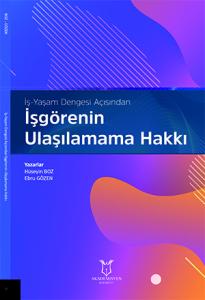
İş-Yaşam Dengesi Açısından İşgörenin Ulaşılamama Hakkı
Özet
Bu kitap, iş-yaşam dengesi açısından işgörenin ulaşılamama hakkını ele almaktadır. Günümüzde iş hayatındaki hızlı değişim ve gelişim, rekabeti artırmış ve çalışma saatlerinin ve temposunun artmasına neden olmuştur. İşgörenler, işleri, özel hayatları ve aileleri arasında bir denge kurmak zorunda kalmışlardır. İş-yaşam dengesinin önemi anlaşılmış ve bu konu son dönemde yoğun bir şekilde çalışılan bir konu haline gelmiştir. İş-yaşam dengesinin bozulmasında, teknolojik gelişmelerin etkisi büyüktür. Akıllı telefonlar, tabletler ve diğer akıllı cihazlar sayesinde işgörenler her an ulaşılabilir hale gelmişlerdir. Bu durum, işgörenlerin sürekli olarak göreve hazır olmaları gerektiği algısını oluşturmuştur. Bu kitap, işgörenin iş saatleri dışında ulaşılamama hakkının tartışılmasını ele almaktadır. İşgörenin ulaşılamama hakkı, Fransa'da ortaya çıkmış ve diğer ülkelerde de farklı yönleriyle ele alınmaya başlanmıştır. Bu kitap, işgörenin ulaşılamama hakkının sağlanmasına yönelik tartışmaları incelemektedir.
This book discusses the employee's right to be unreachable in terms of work-life balance. The rapid changes and developments in the workplace today have increased competition and led to longer working hours and a faster pace. Employees have had to find a balance between their work, personal lives, and families. The importance of work-life balance has been recognized, and this topic has become intensely studied in recent times. Technological advancements have played a significant role in disrupting work-life balance. With smartphones, tablets, and other smart devices, employees have become constantly accessible. This has created the perception that employees must always be ready for work. This book examines the discussion surrounding the employee's right to be unreachable outside of working hours. The concept of the employee's right to be unreachable originated in France and has been approached from different angles in other countries as well. This book explores the debates surrounding the establishment of the employee's right to be unreachable.
Referanslar
Adisa, T. A., Mordi, C., & Mordi, T. (2014). “The Challenges and Realities of Work-Family Balance among Nigerian Female Doctors and Nurses”. Economic Insights-Trens and Challenges, 3(3): 23-38.
Afota, M.-C., Savard, Y. P., Ollier-Malaterre, A. ve Leon, E. (2023). “Work-from-Home Adjustment in the US and Europe: The Role of Psychological Climate for Face Time and Perceived Availability Expectations”. The International Journal of Human Resource Management, 34(14): 2765-2796.
Agheniței, M. (2023). “Rights of Workers to Disconnect Globally”. International Journal of Legal and Social Order, 1: 1-10.
Akın, A., Ulukök, E. ve Arar, T. (2017). “İş-Yaşam Dengesi: Türkiye’de Yapılan Çalışmalara Yönelik Teorik Bir İnceleme”. AKÜ İİBF Dergisi, 19(1): 113-124.
Akın, O. (1981). “İş Hukukunda Çalışma Sürelerı̇”. İstanbul Üniversitesi Hukuk Fakültesi Mecmuası, 45: 775-795.
Allen, T.D., Cho, E. ve Meier, L.L. (2014). “Work-Family Boundary Dynamics”. Annual Review of Organizational Psychology and Organizational Behavior, 1: 99-121.
Altıntaş, B. ve Altıntaş, M. (2023). “Psikolojik Dayanıklılık ve İş Yaşam Dengesi İlişkisi Üzerine Bir Araştırma”. International Journal of Disciplines Economics & Administrative Sciences Studies, 9(49): 1095-1106.
Ampry-Samuel, A., Ayala, D. I., Maisel, A. N., Rosenthal, H. K. ve Levin, S. T. (2018). “The New York City Council”. https://legistar.council.nyc.gov/LegislationDetail.aspx?ID=3458217&GUID=8930D471-5788-4AF4-B960 54620B2535F7&Options=ID%7cText%7c&Search=disconnect, (Erişim Tarihi: 17.10.2023).
Ansari, S., Chimani, K., Baloch, R. A. ve Bukhari, S. F. H. (2015). Information and Knowledge Management, 5(10): 52-60.
Avogaro, M. (2018). “Right to Disconnect: French and Italian Proposals for a Global Issue”. Revista Brasileira de Previdência, 9(1): 97-115.
Aydın, U. ve Kutlu, M. (2020). “The Right to Disconnect: Lessons from Europe and Turkish Labour Law”. Kadir Has Üniversitesi Hukuk Fakültesi Dergisi, 8(2): 261-280.
Babayiğit, A. (2016). İş Yaşam Dengesinin Örgütsel Bağlılık ve İşten Ayrılma Niyeti Üzerindeki Etkisi. Yayımlanmamış Yüksek Lisans Tezi, Akdeniz Üniversitesi Sosyal Bilimler Enstitüsü, Antalya.
Baek, S.-U., Yoon, J.-H. ve Won, J.-U. (2023). “Association between Constant Connectivity to Work during Leisure Time and Insomnia: Does Work Engagement Matter?”. Social Psychiatry and Psychiatric Epidemiology.
Bano, S. ve Wajidi, A. (2021). “Role of Employee Behaviour and Job Stress on Work-Life Balance: A Case of HEIs of Pakistan”. Journal of Entrepreneurship Management and Innovation, 3(2): 177-201.
Baycık, G., Doğan, S., Dulay Yangın, D. ve Yay, O. (2021). “Covid-19 Pandemisinde Uzaktan Çalışma: Tespit ve Öneriler”. Çalışma ve Toplum, 3: 1683-1728.
Baylos Grau, A. (2019). “The Role of Collective Bargaining in the Law on the Protection of Personal Data and the Guarantee of Digital Rights in Spain”. Labour & Law Issues, 5(1): 1–14.
Bayramoğlu, G. (2018). “İş/Aile Sınırı Teorisi Bağlamında Kadın Akademisyenlerin İş/Yaşam Dengesinin Sağlanmasına Yönelik Bir Araştırma”, Elektronik Sosyal Bilimler Dergisi, 17(68): 1722-1744.
Becker, W. J., Belkin, L. Y., Conroy, S. A., ve Tuskey, S. (2018). "Killing me Softly: Electronic Communications Monitoring and Employee and Spouse Well-being". Academy of Management Proceedings, 1: 1-29.
Bell, M. (2021). “Responding to the ‘Rapidification’ of Working Life: The Right to Disconnect”. Studies: An Irish Quarterly Review, 110(440): 425-436.
Birinci, G. (2017). “İnsan Hakları Evrensel Bildirgesi’nin Kısa Tarihi I: Milletler Cemiyetin’den Birleşmiş Milletler’e”. Nevşehir Hacı Bektaş Veli Üniversitesi SBE Dergisi, 7(2): 50-81.
Borah, N. ve Bagla, N. (2017). “Work-Life Balance: Assessing Perceptions”. SCMS Journal of Indian Management, July-September, 112-119.
Borges, I. V. (2023). “R2D: The Right to Disconnect from Work”. içinde: Moura Vicente, D., de Vasconcelos Casimiro, S., Chen, C. (eds) The Legal Challenges of the Fourth Industrial Revolution. ICLCFIR 2022. Law, Governance and Technology Series, Springer, Cham, 57: 249–296.
Brescia University College. (2022). “Right to Disconnect Policy”. https://brescia.uwo.ca/about/docs/policies/right_to_disconnect_policy_june_1_2022.pdf, (Erişim Tarihi: 15.11.2023).
Brough, P., Timms, C., Chan, X.W., Hawkes, A. ve Rasmussen, L. (2020). Work-Life Balance: Definitions, Causes and Concequences in Handbook of Socioeconomic Determinants of Occupational Health, Handbook Series in Occupational Health Sciences, https://doi.org/10.1007/978-3-030-05031-3_20-1
Cervantes, F. (2019). “Disconnecting from Work: A New Reality”. https://www.lexology.com/library/detail.aspx?g=75352fed-40d0-4992-802e-51a18ecc4e5e, (Erişim Tarihi: 19.10.2023).
Chandra, V. (2012). Work-Life Balance: Eastern and Western Perspectives, The International Journal of Human Resource Management, 23(5), 1040-1056.
Chesalina, O. (2021). “The Legal Nature and the Place of the Right to Disconnect in European and in Russian Labour Law”. Russian Law Journal, 9(3): 36–59.
Chiuffo, F. M. (2019). "The ‘Right to Disconnect’ or ‘How to Pull the Plug on Work’". 4th Labour Law Research Network Conference, Pontificia Universidad Católica de Valparaiso, https://ssrn.com/abstract=3422283, (Erişim Tarihi: 22.11.2023).
Choi, B.-Y., Min, J.-Y., Ryoo, S.-W. ve Min, K.-B. (2022). “Use of Work-Related Communication Technology Outside Regular Working Hours and Work-Family Conflict (Work Interference with Family and Family Interference with Work): Results from the 6th Korean Working Conditions Survey”. Annals of Occupational and Environmental Medicine, 34:e44, 1-12.
Choudhary, N. ve Singh, N.K. (2016). “Work-Family Balance as per Life Stage and Total Experience: An Emprical Study Among Officers of Defence (Central Public Sector Enterprises) in Bangalore”, The IUP Journal of Organizational Behavior, 15(1): 49-65.
Chudnovskikh, M. V. (2019). “The Right to Disconnect in Digital Economics”. Advances in Economics, Business and Management Research, 105: 799-802.
Clark S.C. (2000). “Work/Family Border Theory: A New Theory of Work/Family Balance”. Human Relations, 53: 747–770.
Cominotto, C. (2021). “Telework, Smart Work, and the Right to Disconnect in Italy”, https://lineenetwork.org/telework-smart-work-and-the-right-to-disconnect-in-italy/, (Erişim Tarihi: 15.10.2023).
Cook, D., Rudnicka, A. ve Newbold, J. (2021). “Work-Life Balance in a Pandemic: A Public Health Issue We cannot Ignore”, https://theconversation.com/work-life-balance-in-a-pandemic-a-public-health-issue-we-cannot-ignore-155492 (Erişim Tarihi: 21.12.2023).
Cooks-Campbell, A. (2023). “How to have a Good Work-Life Balance”, https://www.betterup.com/blog/how-to-have-good-work-life-balance#what-does-work-life-balance-mean? (Erişim Tarihi: 28.11.2023).
Cowan, R., & Hoffman, M. F. (2007). “The Flexible Organizatiom: How Contemporary Employess Construct the Work/Life Border”. Qualitative Research Reports in Communication, 8(1): 37-44.
Cox, A.L., Bird, J., Mauthner, N., Dray, S., Peters, A. ve Collins, E. (2014). “Socio-Technical Practices and Work-Home Boundaries”. Workshop Summaries MobileHCI, Sept. 23-26, Toronto, ON, CA.
Çankaya, Y. (2019). İş İlişkisinde İşçinin Özel Yaşamının Gizliliği. Yayımlanmamış Yüksek Lisans Tezi. Atılım Üniversitesi Sosyal Bilimler Enstitüsü, Ankara.
Dagnino, E. (2018). “ The Right to Disconnect in the Prism of Work-Life Balance. The Role of Collective Bargaining: A Comparison between Italy and France”. içinde: Treu, T. ve Casale, G. (eds). Transformations of Work: Challenges for the National Systems of Labour Law and Social Security. XXII World Congress of the International Society for Labour and Social Security Law. s. 437-445.
Dagnino, E. (2020). “ ‘Working Anytime, Anywhere’ and Working Time Provisions. Insights from the Italian Regulation of Smart Working and the Right to Disconnect”. Journal of International and Comparative Labour Studies, 9(3): 1-25.
Daniel, S., ve Sonnentag, S. (2016). “Crossing The Borders: The Relationship Between Boundary Management, Work-Family Enrichment and Job Satisfaction”. The International Journal of Human Resource Management, 27(4): 407-426.
Davidavićiene, V., Rymaniak, J., ve Lis, K. (2023). “Remote Workplaces as a Determinant of Working Conditions in Education during COVID-19”. Economics and Sociology, 16(1): 123-138.
Davidson, S. (2021). “Ontario Passes New Rules That Will Change Work-Life Balance for Employees”. https://toronto.ctvnews.ca/ontario-passes-new-rules-that-will-change-work-life-balance-for-employees-1.5687603, (Erişim Tarihi: 18.10.2023).
Da Silva, L. M. M. ve Takeshita, L. M. A. (2022). “O teletrabalho e o direito à desconexão no home office em tempos de pandemia (Teleworking and the Right to Disconnect in Home Office in Pandemic Times)”. Revista de Direito Sanitario, 22(2): e0013, 1-14.
Del Contrasto, S. (2021). Remote Working: Agile Working in the Small and Medium Enterprises – A Qualitative Study. Yayımlanmamış Yüksek Lisans Tezi, Università degli studi di Modena e Reggio Emilia, Dipartimento di Studi Linguistici e Culturali, İtalya.
De Vega, A. (2017). “Bello: ‘Right to Disconnect’ After Office Hours Choice of Employees”. https://www.dole.gov.ph/news/bello-right-to-disconnect-after-office-hours-choice-of-employees/, (Erişim Tarihi: 24.11.2023).
Desrochers, S. ve Morgan, C. (2021). “Boundary Theory and Work-Family Border Theory Research: A Focus on Boundary Enactment”. Work and Family Encyclopedia, March 19, Work + Family Researchers Network.
Dima, L. ve Högback, A. (2020). “Labour and Social Justice Legislating a Right to Disconnect”. Friedrich Ebert Stiftung, https://library.fes.de/pdf-files/bueros/bukarest/17025.pdf, (Erişim Tarihi: 12.12.2023).
Dung, N. D., Yen, N. H., ve Ha, T. N. Q. (2022). ”The right to disconnect in Europe and some suggestions for Vietnam”. Science & Technology Development Journal – Economics - Law and Management, 6(2): 2823-2831.
Duxbury, L. ve Higgins, L. (2001). “Work-Life Balance in the New Millennium: Where Are We? Where Do We Need to Go?”. Work Network, Canadian Policy Resarch Networks, Inc., October.
Edwards, J. R., & Rothbard, N. P. (2000). “Mechanisms Linking Work and Family: Clarifiying the Relationship Between Work and Family Constructs”. Academy of Management Review, 25(1): 178-199.
Doğan, S., (2021). “Dijitalleşmenin Çalışma Yaşamına Etkisi: İşçinin Ulaşılamama Hakkı”, Ed. Kübra Doğan Yenisey, Seda Ergüneş Emrağ, İş Hukukunda Yeni Yaklaşımlar IV, Onikilevha, İstanbul, s. 109-144.
Dolobáč, M. ve Skolodová, K. (2022). “The Right to Disconnect in the Context of Employees’ Mental Health”. Przegląd Prawniczy Uniwersytetu im. Adam Mickiewicza (Adam Mickiewicz University Law Review), 14: 163-179.
Employment and Social Development Canada. (2019). “Disconnecting from Work-Related E-Communications Outside of Work Hours: Issue Paper”. https://www.canada.ca/en/employment-social development/corporate/portfolio/labour/programs/labour standards/reports/issue-paper-disconnecting-e-communications-outside-work hours.html, (Erişim Tarihi: 18.10.2023).
Erkanlı Başbüyük, E. (2023). “Uzaktan Çalışmanın Bir Türü Olarak Tele Çalışmada İşçinin Dinlenme Hakkı”. Marmara Üniversitesi Hukuk Fakültesi Hukuk Araştırmaları Dergisi, 29(1): 656-678.
Esen, B. (2021). “Covid-19 Pandemisi’nde Uzaktan Çalışma, ‘İrtibatı Kesme Hakkı’ ve İş Hukukunu Dijital Çağın Gerekliliklerine Göre Güncelleme İhtiyacı”. Lebib Yalkın Mevzuat Dergisi, 209: 55-66.
Esen, D. ve Bircan, Ö. (2022). “Ar-Ge Çalışanlarının Bakış Açısıyla Evden Çalışma”. Fenerbahçe Üniversitesi Sosyal Bilimler Dergisi, 2(1): 113-132.
Eurofound. (2020). “Right to Disconnect in the 27 EU Member States”, https://cooperante.uni.lodz.pl/wp-content/uploads/2020/08/wpef20019.pdf, (Erişim Tarihi: 23.10.2023).
Eurofound. (2021a). “Right to Disconnect”. European Observatory of Working Life, https://www.eurofound.europa.eu/observatories/eurwork/industrialrelations-dictionary/right-to-disconnect, (Erişim Tarihi: 23.10.2023).
Eurofound. (2021b). “Right to Disconnect: Exploring Company Practices”. https://www.eurofound.europa.eu/en/publications/2021/right-disconnect-exploring-company-practices, (Erişim Tarihi: 23.10.2023).
European Agency for Safety and Healty at Work. (2021). “Telework During the Covid-19 Pandemic: Risks and Prevention Strategies”, https://osha.europa.eu/en/publications/teleworking-during-covid-19-pandemic-risks-and-prevention-strategies, (Erişim Tarihi: 2.12.2023).
European Parliament. (2021). “European Parliament Resolution of 21 January 2021 with Recommendations to the Commission on the Right to Disconnect (2019/2181(INL)”, www.europarl.europa.eu/doceo/document/TA-9-2021-0021_EN.pdf, (Erişim Tarihi: 22.11.2023).
Fairbairn, J. (2019). “The Right to Disconnect: The Darker Side of Mis‐Managed Flexible Working Arrangements”. Employment Law Conference 2019
Faisal, A., Hameed, M. ve Aleemi, A.R. (2022). “Work-Life Balance and Job Performance: A Mediating and Moderating Model”. Market Forces College of Management Sciences, 17(1): 1-22.
Fedáková, D., ve Iśtoňová, L. (2017). “Slovak IT- Employees and New Ways of Working: Impact on Work-Family Borders and Work-Family Balance”. Ceskoslevenska Psychologie, 61(1): 68-85.
Fender, C. M. (2010). Electronic Tethering: Perpetual Wireless Connectivity to the Organization, Yayımlanmamış Doktora Tezi, Drexel University.
Fiata, E. (2023). “The Right to Disconnect, the EU Strategy and Gender Equality”. içinde: Paoloni, P., Lombardi, R. (eds) When the Crisis Becomes an Opportunity. SIDREA Series in Accounting and Business Administration. Springer, Cham, 217–226.
Figueroa, D. (2017). “Italy: Provisions on Self-Employed Workers and Flexible Work Schedules”. https://www.loc.gov/item/global-legal-monitor/2017-07-07/italy-provisions-on-self-employed-workers-and-flexible-work-schedules/, (Erişim Tarihi: 17.10.2023).
Franconi, A. ve Naumowicz, K. (2021). “Remote Work During COVID-19 Pandemic and the Right to Disconnect-Implications for Women´s Incorporation in the Digital World of Work”. Z Problematyki Prawa Pracy i Polityki Socjalnej, 2(19): 1-20.
Froger, M. C. ve Jordan, C. (2018). “Switching on to Switching off: Disconnecting Employees in Europe?”. https://s3.amazonaws.com/documents.lexology.com/7ed57203-63b9-48d6-b656-e0832cad1fe0.pdf, (Erişim Tarihi: 26.11.2023).
Gadeyne, N., Verbruggen, M., Delanoeije, J. ve De Cooman, R. (2018). “All Wired, All Tired? Work-Related ICT-Use Outside Work Hours and Work-To-Home Conflict: The Role of Integration Preference, Integration Norms and Work Demands”. Journal of Vocational Behavior, 107: 86-99.
Gallagher, E. (2020). After Hours Availability and the Right to Disconnect: An Exploratory Study into the Effect of After-Hours Availability and the Significance of Protective Legislation for the Right to Disconnect. Yayımlanmamış Yüksek Lisans Tezi, National Collage of Ireland, Ireland.
Gallagher Finn, T. (2022). Blurring the boundaries: An explorative study of Millennials, switching off, and the Right to Disconnect. Yayımlanmamış Yüksek Lisans Tezi, National Collage of Ireland, Ireland.
García González, G. (2020). “El Derecho a la Desconexión Digital de los Empleados Públicos: Alcance y Significado de un Derecho Emergente en el Contexto de la Crisis Sanitaria (Public Employees’ Right to Digital Disconnection: Scope and Significance of an Emerging Right in the Context of the Health Crisis)”. Revista Catalana de Dret Públic, Özel Sayı: 54-71.
Garg, S. (2020). “Right to Disconnect: A Way to Maintain Work-Life Balance”. Journal of Commerce and Business Studies, 7(1-2).
Gawełko-Bazan, K. (2023). “Prawo do bycia offline – uwagi na tle regulacji istniejących i projektowanych. Część I: rozwiązania w wybranych państwach europejskich (The Right to be Offline: Notes on the Background of the Existing and Proposed Regulations. Part I: Solutions in Selected European Countries)”. Kwartalnik Prawa Międzynarodowego, 3(3): 45-57.
Girdap, E. (2019). Kariyerizm ile İş-Yaşam Dengesi Arasındaki İlişki Üzerine Bir Araştırma. Yayımlanmamış Yüksek Lisans Tezi, Sakarya Üniversitesi İşletme Enstitüsü, Sakarya.
Ghislieri, C., Molino, M., Dolce, V., Sanseverino, D. ve Presutti, M. (2021). “Work-Family Conflict during the Covid-19 Pandemic: Teleworking of Administrative and Technical Staff in Healthcare. An Italian Study”. Medicina del Lavaro, 112(3): 229-240.
Golding, G. (2023). "The Right to Disconnect in Australia: Creating Space for a New Term Implied by Law". UNSW Law Journal, 46(2): 728-757.
Gözen, E. ve Boz, H. (2022). “İşgörenin Ulaşılamama Hakkı: Turizm Sektörü Bağlamında Bir Değerlendirme”. 22. Ulusal Turizm Kongresi, Burdur, s. 1233-1242.
Gözen, E. ve Boz, H. (2023). “İnsan Kaynakları Yöneticilerinin Bakış Açısından İşgörenin Ulaşılamama Hakkı: Turizm Sektörü Örneği”. 23. Ulusal Turizm Kongresi, Denizli, s. 1066-1089.
Guest, D.E. (2002). Perspectives on The Study of Work-Life Balance, Social Science Information, SAGE Publications, 41(2), 255-279.
Güzel, A. (2016). “İş Hukukunda ‘Yetki’ ve ‘Özgürlük’”. İstanbul Kültür Üniversitesi Hukuk Fakültesi Dergisi, 15(1-1): 93-126.
Hesselberth, P. (2018). “Discourses on Disconnectivity and The Right to Disconnect”. New Media & Society, 20(5): 1994-2010.
ILO (International Labour Organization), (2022). “Working Time and Work-Life Balance Around The World”. Geneva. https://www.ilo.org/global/publications/books/WCMS_864222/lang--en/index.htm (Erişim Tarihi: 05.12.2023).
IOE. (2021). “Portugal: A New Law on Remote Work Prohibits Contact with Employees after Working Hours”. https://ioewec.newsletter.ioe-emp.org/industrial-relations-and-labour-law-december-2021/news/article/portugal-a-new-law-on-remote-work-prohibits-contact-with-employees-after-working-hours, (Erişim Tarihi: 23.11.2023).
İİEnstitü. (2023). “İş ve Özel Hayat Dengesini Sağlamanın Yolları”, https://www.iienstitu.com/blog/is-ve-ozel-hayat-dengesini-saglamanin-yollari (Erişim Tarihi: 23.12.2023).
Ildiko, R. (2018). “Right to Disconnect – Jog a Kikapcsol(ód)áshoz”. Profuturo, 4: 50-66.
İrge, N.T. (2021). “İş-Yaşam Dengesini Etkileyen Risk Faktörleri”, Biga İktisadi ve İdari Bilimler Fakültesi Dergisi, 2(3), 322-333.
Jamal, M. ve Crawford, R. (1981). “Consequences of Extended Work Hours: A Comparison of Moonlighters, Overtimers, and Modal Employees”. Human Resource Management, 20(3): 18-23.
Jaworska, K. (2022). “The Right to Disconnect”. Studia z Zakresu Prawa Pracy i Polityki Społecznej (Studies on Labour Law and Social Policy), 29(1): 51–58.
Jochman, T. (2021). “Effects on Employees' Compensation Under the Right to Disconnect”. Marquette Benefifits and Social Welfare Law Review, 22(2): 209-224.
Jones, P. ve Bano, N. (2021). The Right to Disconnect, Autonomy Resarch Ltd., Hampshire.
Kaliannan, M., Perumal, K. ve Dorasamy, M. (2016). “Developing a Work-Life Balance Model Towards Improving Job Satisfaction among Medical Doctors across Different Generations”. The Journal of Developing Areas, Special Issue on Kuala Lumpur Conference Held in November, 50(5): 343-351.
Kalliath, T. ve Brough, P. (2008). “Work-Life Balance: A Review of The Meaning of The Balance Construct”. Journal of Management & Organization, 14: 323-327.
Karrassvidou, E. ve Glavelli, N. (2013). “Work-Family Balance Through Border Theory Lens: The Case of a Company ‘Driving in the Fast Lane’”. Equality, Diversity and Inclusion: An International Journa, 84-97.
Kasau, M.G. (2014). Work-Life Balance and Employee Performance in the Ministry of Finance and Economic Planning Kıtuı County Government, Kenya, Master of Business Administration of Kenyatta University, Kenya.
Kaya, P.P. (t.y.). Çalışanın Ulaşılamama Hakkı, https://www.turkiyehukuk.org/turkiyede-calisanlarin-ulasilamama-hakki-var-mi/ (E.T. 25.12.2023).
Kefer, F. (2022). “The Right to Disconnect: A Response to one of the Challanges Raised by the Digital Transition? European and Belgian Perspectives”. içinde: Ramalho, M.D.R.P,, Carvalho, C. ve Vicente, J. N. (eds). Trabalho Na Era Digial: Que Direito? Work in a Digital Era: Legal Challenges, Estudos Apodit 9, s. 429-447.
Kırık, H. (2023). İşçinin Ulaşılabilir Olmama Hakkı. Yayımlanmamış Yüksek Lisans Tezi. Kadir Has Üniversitesi Lisansüstü Eğitim Enstitüsü, İstanbul.
Kızıloğlu, E. (2020). “İş Yaşam Dengesi”. içinde: Mehmet S. (ed). Modern İşletmecilikte Yönetsel Konular, Eğitim Yayınevi, s. 243-256.
Kirby, S. (2018). “The Right to Unplug: New York City Council Proposes Bill Which Would Allow Employees to Disconnect from Work After Normal Work Hours”. Labor & Employment Law Blog. https://www.jdsupra.com/legalnews/the-right-to-unplug-newyork-city-19818/, (Erişim Tarihi: 18.10.2023).
Kivimäki, M., Jokela, M., Nyberg, S.T., Singh-Manoux, A., Fransson, E.I., Alfredsson, L., Bjorner, J.B., Borritz, M., Burr, H., Casini, A., Clays, E., De Bacquer, D., Dragano, N., Erbel, R., Geuskens, G.A., Hamer, M., Hooftman, W.E., Houtman, I.L., Jöckel, K-H., Kittel, F., Knutsson, A., Koskenvuo, M., Lunau, T., Madsen, I.E.H., Nielsen, M.L., Nordin, M., Oksanen, T., Pejtersen, J.H., Pentti, J., Rugulies, R., Salo, P., Shipley, M.J., Siegrist, J., Steptoe, A., Suominen, S.B., Theorell, T., Vahtera, J., Westerholm, P.J.M., Westerlund, H., O’Reilly, D., Kumari, M., Batty, G.D., Ferrie, J.E. ve Virtanen, M. (2015). The Lancet, October 31, 386(10005), 1739-1746, https://www.thelancet.com/journals/lancet/article/PIIS0140-6736(15)60295-1/fulltext (Erişim Tarihi: 28.11.2023).
Kolomoets, E., Guri Shoniya, G., Mekhmonov, S., Abdulnabi, S., Abdul Karim, N. ve Mohammad, T. A. (2023). “The Employee’s Right to Work Offline: A Comparative Analysis of Legal Frameworks in Different Countries”. RGSA – Revista de Gestão Social e Ambiental, 17(5): 1-9.
Kossek, E. E. ve Lautsch, B. A. (2012). “Work-Family Boundary Management Styles in Organizations: A Cross-Level Model”. Organizational Psychology Review, 2(2): 152-171.
Kratel, V. A. E. (2023). “To Disconnect or not to Disconnect. A Question Negotiated between Unequal Structures and DifferentScopes of Personal Agency”. Medien & Zeit, 38(1), 20–31.
Kreiner, G. E., Hollensbe, E. C. ve Sheep, M. L. (2006). “On the Edge of Identity: Boundary Dynamics at the Interface of Individual and Organizational Identities”. Human Relations, 59(10): 1315–1341.
Kreiner, G. E., Hollensbe, E. C. ve Sheep, M. L. (2009). “Work-Home Interface via Boundary Work Tactics”. Academy of Management Journal, 52(4): 704-730.
Kremp, P. R. (2022). “Employment and Employee Benefits in Germany: Overview”, http://uk.practicallaw.thomsonreuters.com/3-5033433?transitionType= Default&contextData=(sc.Default)&firstPage=true, (Erişim Tarihi: 29.11.2023).
Kubo, T., Izawa, S., Ikeda, H., Tsuchiya, M., Miki, K. ve Takahashi, M. (2021). “Work E-mail after Hours and off-Job Duration and their Association with Psychological Detachment, Actigraphic Sleep, and Saliva Cortisol: A 1-Month Observational Study for Information Technology Employees”. Journal of Occupational Health, 63:e12300, 1-11.
Kul Parlak, N. (2015). Refah Devletinin Yeniden Yapılanması ve AB Ülkelerinde İş-Yaşam Dengesi. Yayımlanmamış Doktora Tezi, İstanbul Üniversitesi Sosyal Bilimler Enstitüsü, İstanbul.
Kurumsal Çocuk Bakım Projesi I. Araştırma Raporu. (2021). Kurumsal Çocuk Bakım Hizmetleri Yoluyla Kayıtlı Kadın İstihdamının Desteklenmesi Projesi, İş Yaşam Dengesi Türkiye, Norveç ve Seçili AB Ülke Örnekleri, Ağustos, Ankara.
Lagutina, I. V. (2017). “‘Right to Disconnect’ and The Normal Duration of the Working Time: Correlation of Concepts”, ПРАВО ТА ІННОВАЦІЇ (Law and Innovations), 3(19): 64-67.
Lagutina, I. V. (2022). “’Right to Disconnect’ as one of the Employee’s Digital Labour Right”. Juris Europensis Scientia, 3(5): 28-32.
Laleta, S. (2023). “Pravo Radnika Na (Digitalno) Isključivanje: Izazovi I Moguća Rješenja”. Zbornik PFZ, 73(2-3): 195-232.
Lazar, I., Osoian, C. ve Ratiu, P. (2010). The Role of Work-Life Balance Practices in Order to Improve Organizational Performance, European Research Studies, 13(1), 201-214.
Legislative Assembly of Ontario. (2021). “Working for Workers Act, 2021”. https://www.ontario.ca/laws/statute/s21035, (Erişim Tarihi: 24.11.2023).
Lerouge, L. ve Pons, F. T. (2022). “Contribution to the Study on the ‘Right to Disconnect’ from Work. Are France and Spain Examples for Other Countries and EU Law?”. European Labour Law Journal, 13(3): 450–465.
Leyshon, J. (2023). 12 Ways to Support A Better Work-Life Balance for your Employees, https://www.sage.com/en-gb/blog/hr-support-better-work-life-balance-workplace/ (E.T. 28.12.2023).
Magnavita, N., Tripepi, G., Chiorri, C. (2021). “Telecommuting, Off-Time Work, and Intrusive Leadership in Workers ’Well-Being”. International Journal of Environmental Research and Public Health, 18: 1-10.
Manzella, P. ve Tiraboschi, M. (2021). The Prevention System and Insurance Coverage in the Context of the IV Industrial Revolution, ADAPT University Press.
Marcum, T., Cameron, E. A. ve Versweyveld, L. (2018). “Never off the Clock: The Legal Implication of Employees’ After Hours’ Work”. Labor Law Journal, 69(2): 73-82.
Marica, M. (2022). “Considerations on the Protection of Teleworkers, in Light of the Current European Regulations. Elements of Comparative Law”. Juridical Tribune, 12(4): 509-520.
Massoud, M.F., Younis, J. ve Abbas İbrahim, N. (2020). “Managing Stress through Work-Life Balance: A Study on Jinan Lebanon University Staff”. Research in Economics and Management, 5(4): 1-20.
McVicar, A. (2003). “Workplace Stress in Nursing: a Literature Review”. Journal of Advanced Nursing, 44(6): 633-642.
Mellner, C. (2013) “After-Hours Availability Expectations, Work-Related Smartphone Uses During Leisure, and Psychological Detachment: The Moderating Role of Boundary Control”. International Journal of Workplace Health Management, 9(2): 146–164.
Michel, A., Bosch, C. ve Rexroth, M. (2014). “Mindfulness as a Cognitive-Emotional Segmentation Strategy: An Intervention Promoting Work-Life Balance”. Journal of Occupational and Organizational Psychology, 87: 733-754.
Michael Page (2023). “İş Yaşam Dengesinde Birbirine Geçen Çizgiler – Her Zaman Erişilebilir Misin?”. https://www.michaelpage.com.tr/advice/kariyer-tavsiyeleri/i%C5%9F-ya%C5%9Fam-dengesi/i%C5%9F-ya%C5%9Fam-dengesinde-birbirine-ge%C3%A7en-%C3%A7izgiler-%E2%80%93-her-zaman (Erişim Tarihi: 24.12.2023).
Middleton, C. A. ve Cukier, W. (2006). “Is Mobile Email Functional or Dysfunctional? Two Perspectives on Mobile Email Usage”. European Journal of Information Systems, 15(3): 252-260.
Mitrus, L. (2019). “Potential Implications of the Matzak Judgment (Quality of Rest Time, Right to Disconnect)”. European Labour Law Journal, 10(4): 386-397.
Nam, T. (2014). “Technology Use and Work-Life Balance”. Applied Research Quality Life, 9: 1017–1040.
Nippert-Eng, C. (1996). “Calendars and Keys: The Classification of ‘Home’ and ‘Work’”, Sociological Forum, 11(3): 563-582.
Noor, N. (2002). “Work-Family Conflict, Locus of Control, and Women's Well-Being: Tests of Alternative”. The Journal of Social Psychology, 142(5): 645-662.
Noval, S. M. R. (2022). “Evolusı Hak Pekerja Di Era Digital: Prawacana Right to Disconnect Di Indonesia”. Jurnal Bina Mulia Hukum, 6(2): 234-253.
OECD Better Life Index. “Work Life Balance”. https://www.oecdbetterlifeindex.org/topics/work-life-balance/ (Erişim Tarihi: 15.12.2023).
Ogunde, F. (2023). “The Right to Disconnect from Work in Canada: Section 21.1.1 of Ontario’s Employment Standards Act In Context”. La Revue Du Barreau Canadien, 101: 546-572.
Özen Kapız, S. (2002). “İş-Aile Yaşamı Dengesi ve Dengeye Yönelik Yeni Bir Yaklaşım: Sınır Teorisi”, Dokuz Eylül Üniversitesi Sosyal Bilimler Enstitüsü Dergisi, 4(3): 139-153.
Özgün, K.A. ve Gönen Anaeli, A. (2021). “Turkey: An Employee’s Right to Disconnect in a Digital World”. https://www.mondaq.com/turkey/contract-of-employment/1088446/anemployees-right-to-disconnect-in-a-digital-world, (Erişim Tarihi: 07.12.2023).
Pansu, L. (2018). “Evaluation of ‘Right to Disconnect’ Legislation and Its Impact on Employee’s Productivity”. International Journal of Management and Applied Research, 5(3): 99-119.
Park, J.-R. ve Kwon, S.-D. (2019). “The Effect of Smart Working and Psychological Attachment from Work on Right to Disconnect: Focused on Moderating Effect of Open Communication and Gender”. Journal of Information Technology Applications & Management, 26(1): 77-93.
Park, J.-R. ve Kwon, S.-D. (2020). “A Study on the Effect of the Right to Disconnect on the Job Satisfaction”. Journal of Information Technology Applications & Management, 27(3): 55-68.
Parker, J. ve Danks, D. (2019). “How Technological Advances Can Reveal Rights”. In AAAI/ACM Conference on AI, Ethics, and Society (AIES ’19), January 27–28, 2019, Honolulu, HI, USA.
Perquy, D. (2018). “Workplace Stress: Do We Have the Right to be Disconnected from Work”. https://www.enhesa.com/resources/article/workplace-stress-do-we-have-the-right-to-be-disconnected-from-work/, (Erişim Tarihi: 19.10.2023).
Perry-Smith, J. E. ve Blum, T. C. (2000). “Work–Family Human Resource Bundles and Perceived Organizational Performance”. Academy of Management Journal, 43(6): 1107-1117.
Piper, D. L. A. (2017). “Italy: Self-Employment and Smart-Working - Italian Senate Approves Draft Law”. https://www.lexology.com/library/detail.aspx?g=4a329d38-5d69-4832-b699-38c8257f3647, (Erişim Tarihi: 19.11.2023).
Piszczek, M. M. (2017). “Boundary Control and Controlled Boundaries: Organizational Expectations for Technology Use at the Work-family Interface”. Journal of Organizational Behavior, 38: 592-611.
Piyarattanakunakorn, T. (2022). “Employees’ Right to Disconnection Outside Working Hours”. Yayımlanmamış Yüksek Lisans Tezi, Thammasat University, Tayland.
Pons, F. T. ve Fernandez, D. M. (2023). “Mental Health and the Right to Digital Disconnection at Work: A Panoramic Vision from the Spanish Experience and the Recent Approaches of the European Parliament”. Labor Law Journal, 79-90.
Ponzilacqua, M. H. P. ve Silva, L. G. (2022). “O direito à desconexão do trabalho francês: perspectivas de implementação no Direito brasileiro (The Right to Disconnect from Work: Perspectives for Implementation in Brazilian Legal System)”. Revista Direito e Práxis, 13(1): 196-221.
Pratt, K. ve Howard, L. (2023). “Worldwide Work-Life Balance Index 2023”. https://www.forbes.com/uk/advisor/business/work-life-balance-index/ (Erişim Tarihi: 20.12.2023).
Punia, V. ve Kamboj, M. (2013). “Quality of Work-life Balance Among Teachers in Higher Education Institutions”. Learning Community-An International Journal of Educational and Social Development, 4(3): 197-208.
Rau, B.L. ve Hyland, M. M. (2002). “Role Conflict and Flexible Work Arrangements: The Effects on Applicant Attraction”. Personnel Psychology, 55: 111-136.
Rene, N.N. (2020). Work Life Balance and Its Impact as a Strategic Human Resources Management Policy in Private Sector Organisations in Equatorial Guinea, https://papers.ssrn.com/sol3/papers.cfm?abstract_id=3698924 (E.T. 25.12.2023).
Rothbard, N. P., Philips, K. W. ve Dumas, T. L. (2005). “Managing Multiple Roles: Work-Family Policies and Individuals' Desires for Segmentation”. Organization Science, 16(3): 243-258.
Sakharkar, V. R. (2021). “Work from Home in the Corona Pandemic and Need of the Right to Disconnect Act”. Social Issues and Problems, 10(1): 15-18.
Samuel, H. (2018). “British Firm Ordered to Pay €60,000 by French Court for Breaching Employee’s ‘Right to Disconnect’ from Work”. https://www.telegraph.co.uk/news/2018/08/01/british-firm-ordered-pay 60000-french-courtbreaching-employees/, (Erişim Tarihi: 23.11.2023).
Sarva, A. (2017). “Why Germans Work Fewer Hours But Produce More: A Study In Culture”, https://www.huffpost.com/entry/why-germans-work-fewer-ho_b_6172262, (Erişim Tarihi: 29.11.2023).
Sayın, K.E. (2023). Çağın İmkânsızlığına Karşı Ulaşılamama Hakkı, https://www.okan.edu.tr/hukuk/sayfa/7964/cagin-imkansizligina-karsi-ulasilamama-hakki/ (E.T. 20.12.2023).
Schofield, H. (2016). “The Plan to Ban Work Emails Out of Hours”. https://www.bbc.com/news/magazine-36249647, (Erişim Tarihi: 17.11.2023).
Secunda, P. M. (2019a). “The Employee Right to Disconnect”. Notre Dame Journal of International & Comparative Law, 9(1): 1-39.
Secunda, P. M. (2019b). “Hybrid Federalism and the Employee Right to Disconnect”. Pepperdine Law Review, 46(4): 873-904.
Sevimli, K. A. (2016). İşçinin Özel Yaşamına Müdahalenin Sınırları. Legal Yayıncılık, İstanbul.
Shaari, S. C. ve Amirul, S. R. (2023). “Flexible Working Arrangements (FWAs) in Malaysia: The Missing Component of the Right to Disconnect”. 3rd Riau Annual Meeting on Law and Social Sciences (RAMLAS), IOP Conf. Series: Earth and Environmental Science, 1-10.
Siegl, L. V. (2023). ‘The Right to Disconnect’: An Intervention Study to Examine the Effect of Constant Connectivity through Work Emails on Work-Home Conflict, Recovery, Burnout and Performance. Yayımlanmamış Doktora Tezi, The University of Manchester.
Skrzypinski, C. (2021). “Ontario Government Grants Workers Right to Disconnect”. SHRM, https://www.shrm.org/resourcesandtools/hr-topics/global-hr/pages/ontario-grants-right-to-disconnect.aspx, (Erişim Tarihi: 24.11.2023).
Sole-Truyols, M. (2022). “Dret a la desconnexió o obligació empresarial de desconnexió remota? Reptes legislatius des de la perspectiva laboral (The right to disconnect or a corporate obligation of remote disconnection? Legislative challenges from a work perspective)”. Revista dels Estudis de Dret i Ciència Política, 36: 1-13.
Staufenberg, J. (2016). “France May Pass a Law on the ‘Right to Disconnect’ from Work Emails at Home”. https://www.independent.co.uk/news/world/europe/france-may-pass-a-law-onright- to-disconnect-from-work-emails-at-home-a6878571.html, (Erişim Tarihi: 17.11.2023).
Stawarz, K., Cox, A. L., Bird, J. ve Benedyk, R. (2013). “I’d Sit at Home and Do Work Emails: How Tablets Affect the Work-Life Balance of Office Workers., CHI'13 Extended Abstracts on Human Factors in Computing Systems, 1383-1388.
Stuart, K. (2014). “German Minister Calls for Anti-Stress Law Ban on Emails out of Office Hours”, The Guardian UK, https://www.theguardian.com/technology/2014/aug/29/germany-anti-stress-law-ban-on-emails-out-of-office-hours, (Erişim Tarihi: 29.11.2023).
TDK (Türk Dil Kurumu). (2023). “İş”, https://sozluk.gov.tr/ (Erişim Tarihi: 09.12.2023).
TDK (Türk Dil Kurumu). (2023). “Denge”, https://sozluk.gov.tr/ (Erişim Tarihi: 09.12.2023).
Todisco, L., Tomo, A., Canonico, P. ve Mangia, G. (2023). “The Bright and Dark Side of Smart Working in the Public Sector: Employees’ Experiences before and during COVID-19”. Management Decision, 61(13): 85-102.
Toffoletti, K. ve Starr, K. (2016). “Women Academics and Work-Life Balance: Gendered Discourses of Work and Care”. Gender, Work & Organization, 23(5): 489-504.
Top, D. (2023). “The Right to Disconnect of the Employee whoWorks Remotely”. European Journal of Social Law, 7-11.
Ugan Çatalkaya, D. (2016). “Kişisel Yaşamı Kapsamında İşçinin, İşverence ‘Ulaşılabilir Olmama’ Hakkı”. İstanbul Üniversitesi Hukuk Fakültesi Mecmuası, Prof. Dr. Fevzi Şahlanan’a Armağan Sayısı, 74: 737-755.
Ulucan, D. (2005). Esneklik İhtiyacı ve İş Hukukunun İşçiyi Koruma İşlevi, A. Can Tuncay’a Armağan, Legal Yayıncılık, 203-217.
Uluslararası Af Örgütü. (t.y.). Haklarımız İnsan Hakları Evrensel Beyannamesi, https://www.amnesty.org.tr/public/uploads/files/Human_Rights_Booklet_High_Print_2_PAge.pdf (E.T. 29.12.2023).
Urbane, M. (2022). “The Future of the Employee’s Right to Disconnect in the European Union and Latvia”. Human Factors, Business Management and Society, 56: 329–335.
Urbane, M. (2023). “Legal Preconditions for Sustainable Remote Work in EU in the Time of Emerging Technologies”. Human Interaction and Emerging Technologies (IHIET 2023), 111: 566–572.
Ünal, E. (2023). İşçinin Ulaşılamama Hakkı. Yayımlanmamış Yüksek Lisans Tezi. Dokuz Eylül Üniversitesi Sosyal Bilimler Enstitüsü, İzmir.
Vadkerti, Z. (2018). “Shutting Off: Could ‘Right to Disconnect’ Legislation Be Effective in Preventing Burnout?”. HR Professional, 36(13): 25–26.
Varela-Castro, W. H., Briceño-Santacruz, M. A. ve Castro-Solano, M. O. (2022). “The Right to Disconnect: Influence on Competitiveness, Productivity and Creativity”. Mercados y Negocios, 23(46): 5-30.
Vayre, E. ve Vonthron, A.-M. (2019). “Identifying Work-Related Internet’s Uses—at Work and Outside Usual Workplaces and Hours—and Their Relationships With Work–Home Interface, Work Engagement, and Problematic Internet Behavior”. Frontiers in Psychology, 10: 1-15.
Veloso, A. P., Marques da Costa, E. Abrantes, P. (2022). “Teletrabalho Em Tempo De Pandemia: Das Vantagens As Incertezas Nos Quotidianos Das Familias Residentes Na Area Metropolitana De Lisboa Norte, Portugal”. Finisterra, 57(121): 125-150.
Vernea, S.-A. (2023). “Rest Time and Digitization. The Right to Disconnect”. European Journal of Social Law, 73-81.
Von Bergen, C. W. ve Bressler, M. S. (2019). “Work, Non-Work Boundaries and the Right to Disconnect”. Journal of Applied Business and Economics, 21(2): 51-69.
Von Bergen, C. W., Bressler, M. S. ve Proctor, T. L. (2019). “On the Grid 24/7/365 and the Right to Disconnect”. Employee Relations Law Journal, 45(2): 1-18.
Wanigasinghe, N. (2019). “How Disconnected is Disconnection? A Critical Analysis of the Employee Right to Disconnect”. Proceedings of 12th International Research Conference, General Sir John Kothalawala Defence University, Sri Lanka, s. 762-769.
Wanigasinghe, N. (2020). “Can I Switch Off? I Can’t Breathe!”. University of Colombo Review (Series III), 1(1): 81 – 93.
Wisenburg Brin, D. (2019). “France and Spain: Right to Disconnect Spreads”. https://www.shrm.org/resourcesandtools/legal-and-compliance/employment-law/pages/global-france-spain-right-to-disconnect.aspx, (Erişim Tarihi: 24.11.2023).
WLBGuide. (2015). Work-Life Balance An Employer’s Guide, https://frelighsburg.ca/wp-content/uploads/2016/06/Work-life-balance-an-employers-guide.pdf (E.T. 15.12.2023).
Woolor, C. W., Solikhah, S., Fidhyallah, N.F. ve Lestari, D. P. (2020). “Effectiveness of E-training, E-leadership, and Work Life Balance on Employee Performance during Covid-19”. Journal of Asian Finance, Economics and Business, 7(10): 443–450.
World Economic Forum (2023). “Right to Disconnect: The Countries Passing Laws to Stop Employees Working out of Hours”. https://www.weforum.org/agenda/2023/02/belgiumright-to-disconnect-from-work, (Erişim Tarihi: 17.11.2023).
Yapağı, Ö. (2023). Kamu Görevlilerinin Özel ve Aile Hayatına Saygı Hakkı. Yayımlanmamış Yüksek Lisans Tezi. Ankara Üniversitesi Sosyal Bilimler Enstitüsü, Ankara.
Yavuz Aksakal, N. (2021). A Descriptive Study on Work-Life Balance of Turkish Employees in Various Sectors During Covid-19 Pandemic, Journal of Research in Business, 6(2), 493-509.
Yavuz, N. (2018). İş-Yaşam Dengesi ile İş Stresinin Esnek Çalışma Uygulamaları Bağlamında İncelenmesi, Yayımlanmamış Yüksek Lisans Tezi, İstanbul Üniversitesi Sosyal Bilimler Enstitüsü, İstanbul.
Yumuk Günay, G. ve Demiralay, T. (2016). “Serbest Muhasebeci ve Mali Müşavirlerin İş Stresi, Tükenmişlik Sendromu ve İş-Aile Yaşam Dengesi Arasındaki İlişkinin İncelenmesi”. Elektronik Sosyal Bilimler Dergisi, 15(58): 917-935.
Yayınlanan
Lisans
LisansBu İnternet Sitesi içeriğinde yer alan tüm eserler (yazı, resim, görüntü, fotoğraf, video, müzik vb.) Akademisyen Kitabevine ait olup, 5846 sayılı Fikir ve Sanat Eserleri Kanunu ve 5237 sayılı Türk Ceca Kanunu kapsamında korunmaktadır. Bu hakları ihlal eden kişiler, 5846 sayılı Fikir ve Sanat eserleri Kanunu ve 5237 sayılı Türk Ceza Kanununda yer alan hukuki ve cezai yaptırımlara tabi olurlar. Yayınevi ilgili yasal yollara başvurma hakkına sahiptir.
