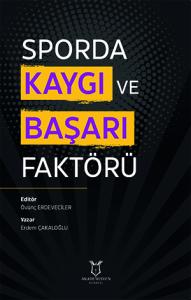
Sporda Kaygı ve Başarı Faktörü
Özet
Bu kitap, spor psikolojisi alanında önemli bir konu olan yarışma kaygısının ve başarı faktörünün incelenmesini amaçlamaktadır. Yarışma kaygısı, sporcuların performanslarını etkileyen bir faktördür ve bu kitapta bu konunun önemi ve etkileri üzerinde durulmaktadır. Kitap, spor psikolojisi alanında yapılan çalışmalara katkı sağlamayı hedeflemekte ve sporcularda yarışma kaygısı üzerine yapılacak çalışmalara yol gösterici olmayı amaçlamaktadır.Kitapta, yarışma kaygısı ve başarı faktörüne ilişkin temel kavramlar ele alınmaktadır. Uyarılmışlık ve stres gibi kavramlar, yarışma kaygısıyla ilişkili olan faktörlerdir ve bu kitapta detaylı bir şekilde incelenmektedir. Ayrıca, yarışma kaygısıyla başa çıkma stratejileri ve başarı faktörleri de kitapta ele alınan konular arasındadır.Bu kitap, spor psikolojisi alanında çalışan akademisyenler, antrenörler ve sporcular için önemli bir kaynak olmayı hedeflemektedir. Yarışma kaygısıyla başa çıkma ve başarı faktörlerini anlamak, sporcuların performanslarını artırmalarına yardımcı olabilir. Bu nedenle, bu kitap spor psikolojisi alanında çalışan herkes için faydalı bir kaynak olabilir.
This book aims to examine the competition anxiety and success factor, which are important topics in the field of sports psychology. Competition anxiety is a factor that affects athletes' performance, and this book focuses on the importance and effects of this issue. The book aims to contribute to the studies conducted in the field of sports psychology and to provide guidance for research on competition anxiety in athletes.The book discusses the fundamental concepts related to competition anxiety and success factor. Concepts such as arousal and stress are factors associated with competition anxiety and are examined in detail in this book. In addition, coping strategies for dealing with competition anxiety and success factors are also among the topics covered in the book.This book aims to be an important resource for academics, coaches, and athletes working in the field of sports psychology. Understanding how to cope with competition anxiety and success factors can help improve athletes' performance. Therefore, this book can be a valuable resource for anyone working in the field of sports psychology.
Referanslar
ALBANO A M, KENDALL P C (2002). Cognitive behavioural therapy for children and adolescents with anxiety disorders: Clinical research advances. International review of psychiatry, 14(2), 129-134.
AMY C S M, EDUCATION P (2005). Relationship Between Pre-Competition Anxieties And Situational Factors of University Badminton Players. Honours Project.
ANDERSON S A, HARALDSDOTTIR K, WATSON D (2021). Mindfulness in athletes. Current Sports Medicine Reports, 20(12), 655-660.
APTER M J (1984). Reversal theory and personality: A review. Journal of Research in Personality, 18(3), 265-288.
APTER M J, FONTANA D, MURGATROYD S. (2014). Reversal theory: Applications and development. Psychology Press.
ARAS D, SAMIL ONLU A, DURMUS T, CENGIZ C, GULER D, GULER Y, UGURLU A, ALDHAHI M I, GÜLÜ M (2023). A brief body scan mindfulness practice has no positive effect on the recovery of heart rate variability and cognitive tasks in female professional basketball players. Frontiers in psychology, 14, 1196066.
BACON S J (1974). Arousal and the range of cue utilization. Journal of Experimental Psychology, 102(1), 81.
BAHARLOUEI K, WANGWAD V (2023). The Effect of a Progressive Relaxation Training Period on Muscle Efficiency and Performance of Archery Athletes.
BARKER J B, SLATER M J, PUGH G, MELLALIEU S D, MCCARTHY P J, JONES M V, MORAN A (2020). The effectiveness of psychological skills training and behavioral interventions in sport using single-case designs: A meta regression analysis of the peer-reviewed studies. Psychology of sport and exercise, 51, 101746.
BARLOW D H. (2004). Anxiety and its disorders: The nature and treatment of anxiety and panic. Guilford press.
BEAUCHAMP M K, HARVEY R H, BEAUCHAMP P H (2012). An integrated biofeedback and psychological skills training program for Canada’s Olympic short-track speedskating team. Journal of clinical sport psychology, 6(1), 67-84.
BEILOCK S L, JELLISON W A, RYDELL R J, MCCONNELL A R, CARR T H (2006). On the causal mechanisms of stereotype threat: can skills that don't rely heavily on working memory still be threatened? Personality and Social Psychology Bulletin, 32(8), 1059-1071.
BERLYNE D E. (1967). Arousal and reinforcement. Nebraska symposium on motivation,
BIGGS A, BROUGH P, DRUMMOND S (2017). Lazarus and Folkman's psychological stress and coping theory. The handbook of stress and health: A guide to research and practice, 349-364.
BURTON D (1989). Winning isn’t everything: Examining the impact of performance goals on collegiate swimmers’ cognitions and performance. The Sport Psychologist, 3(2), 105-132.
BURTON D (1990). Multimodal stress management in sport: Current status and future directions.
BURTON D (1998). Measuring competitive state anxiety. Advances in sport and exercise psychology measurement, 129-148.
BURTON D, NAYLOR S (1997). Is anxiety really facilitative? Reaction to the myth that cognitive anxiety always impairs sport performance. Journal of Applied Sport Psychology, 9(2), 295-302.
CANNON W B (1929). Organization for physiological homeostasis. Physiological reviews, 9(3), 399-431.
CARSON H J, COLLINS D (2016). The fourth dimension: A motoric perspective on the anxiety–performance relationship. International Review of Sport and Exercise Psychology, 9(1), 1-21.
CATTELL R B, SCHEIER I H (1961). The meaning and measurement of neuroticism and anxiety.
CENGIZ C. (2023). Halkoyuncularda kaygı ve fiziksel benlik algısı (B. Taner, Ed. Vol. 1). Gazi Kitabevi.
CHAN E W M, HAMID M S A, NADZALAN A M, HAFIZ E (2020). Abdominal muscle activation: an EMG study of the Sahrmann five-level core stability test. Hong Kong Physiotherapy Journal, 40(02), 89-97.
CHANG M O, PERALTA A O, DE CORCHO O J P (2020). Training with cognitive behavioral techniques for the control of precompetitive anxiety. International Journal of Health and Medical Sciences, 3(1), 29-34.
CHENG W-N K, HARDY L (2016). Three-dimensional model of performance anxiety: Tests of the adaptive potential of the regulatory dimension of anxiety. Psychology of sport and exercise, 22, 255-263.
CHENG W-N K, HARDY L, MARKLAND D (2009). Toward a three-dimensional conceptualization of performance anxiety: Rationale and initial measurement development. Psychology of sport and exercise, 10(2), 271-278.
CHOW K, MERCADO E (2020). Performance anxiety and the plasticity of emotional responses. Cognition and Emotion, 34(7), 1309-1325.
CIGROVSKI V, RADMAN I, KONTER E, OČIĆ M, RUŽIĆ L (2018). Sport courage, worry and fear in relation to success of alpine ski learning. Sports, 6(3), 96.
COHN P J (1991). An exploratory study on peak performance in golf. The Sport Psychologist, 5(1), 1-14.
COOLEY E J (1987). Situational and trait determinants of competitive state anxiety. Perceptual and Motor Skills, 64(3), 767-773.
COOPER J J, JOHNSON M, RADCLIFFE J, FISHER J (2021). Optimal emotional profiles for peak performance in strength and conditioning. The Journal of Strength & Conditioning Research, 35(3), 833-840.
CORREIA M, ROSADO A (2019). Anxiety in athletes: Gender and type of sport differences. International Journal of Psychological Research, 12(1), 9-17.
CORREIA M E, ROSADO A (2018). Fear of failure and anxiety in sport. Análise Psicológica, 36(1), 75-86.
COX R H, MARTENS M P, RUSSELL W D (2003). Measuring anxiety in athletics: the revised competitive state anxiety inventory–2. Journal of Sport and Exercise Psychology, 25(4), 519-533.
CRAFT L L, MAGYAR T M, BECKER B J, FELTZ D L (2003). The relationship between the Competitive State Anxiety Inventory-2 and sport performance: A meta-analysis. Journal of Sport and Exercise Psychology, 25(1), 44-65.
CRASKE M G, CRAIG K D (1984). Musical performance anxiety: The three-systems model and self-efficacy theory. Behaviour research and therapy, 22(3), 267-280.
DAVIDSON R, SCHWARTZ G (1976). The psychobiology of relaxation and related states: A multi-process theory. Behavior control and modification of physiological activity, 399-442.
DIAS C, CRUZ J F, FONSECA A M (2009). Anxiety and coping strategies in sport contexts: A look at the psychometric properties of Portuguese instruments for their assessment. The Spanish Journal of Psychology, 12(1), 338-348.
DUFFY E (1962). Activation and behavior.
DUNN J G, GOTWALS J K, DUNN J C, LIZMORE M R (2022). Perceived parental pressure and perceived coach pressure in adolescent and adult sport. Psychology of sport and exercise, 59, 102100.
DUNN J G, NIELSEN A B (1993). A between-sport comparison of situational threat perceptions in ice hockey and soccer. Journal of Sport and Exercise Psychology, 15(4), 449-465.
EASTERBROOK J A (1959). The effect of emotion on cue utilization and the organization of behavior. Psychological review, 66(3), 183.
FADARE A S, LANGCO L, CANALIJA C, KABIRUN C A, ABELARDO-SABANDIJA B J (2022). Athletes' Confidence and Anxiety Management: A Review in Achieving Optimal Sport Performance. International Journal of Science and Management Studies, 5(4), 311-318.
FAZEY J, HARDY L. (1988). The inverted-U hypothesis: A catastrophe for sport psychology. British Association of Sports Sciences and the National Coaching Foundation.
FLETCHER D, HANTON S, MELLALIEU S D, NEIL R (2012). A conceptual framework of organizational stressors in sport performers. Scandinavian journal of medicine & science in sports, 22(4), 545-557.
FORD J L, ILDEFONSO K, JONES M L, ARVINEN-BARROW M (2017). Sport-related anxiety: current insights. Open access journal of sports medicine, 205-212.
GENTRY R N, ROESCH M R (2018). Neural activity in ventral medial prefrontal cortex is modulated more before approach than avoidance during reinforced and extinction trial blocks. Journal of Neuroscience, 38(19), 4584-4597.
GOESSL V C, CURTISS J E, HOFMANN S G (2017). The effect of heart rate variability biofeedback training on stress and anxiety: a meta-analysis. Psychological medicine, 47(15), 2578-2586.
GOULD D, GREENLEAF C, KRANE V (2002). Arousal-anxiety and sport behavior.
GOULD D, HORN T, SPREEMANN J (1983). Sources of stress in junior elite wrestlers. Journal of Sport and Exercise Psychology, 5(2), 159-171.
GOULD D, PETLICHKOFF L, SIMONS J, VEVERA M (1987). Relationship between Competitive State Anxiety Inventory-2 subscale scores and pistol shooting performance. Journal of Sport and Exercise Psychology, 9(1), 33-42.
GOULD D, WEINBERG R (1985). Sources of worry in successful and less successful intercollegiate wrestlers. Journal of Sport Behavior, 8(2), 115.
GROSSBARD J R, SMITH R E, SMOLL F L, CUMMING S P (2009). Competitive anxiety in young athletes: Differentiating somatic anxiety, worry, and concentration disruption. Anxiety, Stress, & Coping, 22(2), 153-166.
GRUBER J J, BEAUCHAMP D (1979). Relevancy of the competitive state anxiety inventory in a sport environment. Research Quarterly. American Alliance for Health, Physical Education, Recreation and Dance, 50(2), 207-214.
HACKFORT D, SPIELBERGER C D. (1989). Anxiety in sports: An international perspective. Taylor & Francis.
HAMILTON M (1959). The assessment of anxiety states by rating. British journal of medical psychology.
HANIN Y, SYRJÄ P (1995). Performance affect in junior ice hockey players: An application of the individual zones of optimal functioning model. The Sport Psychologist, 9(2), 169-187.
HANIN Y L (1986). State-trait anxiety research on sports in the USSR. Cross-cultural anxiety, 3, 45-64.
HANIN Y L (1995). Individual zones of optimal functioning (IZOF) model: An idiographic approach to performance anxiety. Sport psychology: An analysis of athlete behavior, 3, 103-119.
HANIN Y L (2000). Individual Zones of Optimal Functioning (IZOF) Model: Emotion-performance relationship in sport.
HANIN Y L (2007). Emotions and athletic performance: Individual zones of optimal functioning model.
HANTON S, MELLALIEU S D, HALL R (2004). Self-confidence and anxiety interpretation: A qualitative investigation. Psychology of sport and exercise, 5(4), 477-495.
HANTON S, NEIL R, MELLALIEU S D (2008). Recent developments in competitive anxiety direction and competition stress research. International Review of Sport and Exercise Psychology, 1(1), 45-57.
HARDY L (1992). Psychological stress, performance, and injury in sport. British medical bulletin, 48(3), 615-629.
HARDY L, PARFITT G (1991). A catastrophe model of anxiety and performance. British journal of psychology, 82(2), 163-178.
HARDY L, PARFITT G, PATES J (1994). Performance catastrophes in sport: A test of the hysteresis hypothesis. Journal of sports sciences, 12(4), 327-334.
HARRIS D, WILKINSON S, ELLMERS T (2023). From fear of falling to choking under pressure: a predictive processing perspective of disrupted motor control under anxiety. Neuroscience & Biobehavioral Reviews, 105115.
HATFIELD B D, LANDERS D M (1983). Psychophysiology–A new direction for sport psychology. Journal of Sport and Exercise Psychology, 5(3), 243-259.
HILL D M, HANTON S, MATTHEWS N, FLEMING S (2010). Choking in sport: A review. International Review of Sport and Exercise Psychology, 3(1), 24-39.
HODGSON D D, KING J A, DARICI O, DALTON B H, CLEWORTH T W, CLUFF T, PETERS R M (2023). Visual feedback-dependent modulation of arousal, postural control, and muscle stretch reflexes assessed in real and virtual environments. Frontiers in Human Neuroscience, 17, 1128548.
HULL C L (1943). Principles of behavior: an introduction to behavior theory.
ISSALILLAH F, AISYAH N (2022). The Elderly and the Determinants of Stress. Journal of Social Science Studies (JOS3), 2(1), 9-12.
IVANOVIĆ M, MILOSAVLJEVIĆ S, IVANOVIĆ U (2015). Perfectionism, anxiety in sport, and sport achievement in adolescence. Sport science, 8(1), 35-42.
JACOBSON E (1987). Progressive relaxation. The American Journal of Psychology, 100(3/4), 522-537.
JANELLE C M, FAWVER B J, BEATTY G F (2020). Emotion and sport performance. Handbook of sport psychology, 254-298.
JIMENEZ MORGAN S, MOLINA MORA J A (2017). Effect of heart rate variability biofeedback on sport performance, a systematic review. Applied psychophysiology and biofeedback, 42, 235-245.
JONES G (1995). More than just a game: Research developments and issues in competitive anxiety in sport. British journal of psychology, 86(4), 449-478.
JONES G, HANTON S (2001). Pre-competitive feeling states and directional anxiety interpretations. Journal of sports sciences, 19(6), 385-395.
KANNIYAN A (2015). Competitive state anxiety: impact of positive self talk training on junior level football players. Sport Mont Journal, 13(43-44-45), 42-49.
KENNY D. (2011). The psychology of music performance anxiety. OUP Oxford.
KENNY D T (2005). A systematic review of treatments for music performance anxiety. Anxiety, stress, and coping, 18(3), 183-208.
KERR G, LEITH L (1993). Stress management and athletic performance. The Sport Psychologist, 7(3), 221-231.
KERR J (1985). The experience of arousal: A new basis for studying arousal effects in sport. Journal of sports sciences, 3(3), 169-179.
KERR J. (2002). Counselling athletes: Applying reversal theory. Routledge.
KLAVORA P (1978). An attempt to derive inverted-U curves based on the relationship between anxiety and athletic performance. Psychology of motor behavior and sport, 1, 369-377.
KLEINE D (1990). Anxiety and sport performance: A meta-analysis. Anxiety research, 2(2), 113-131.
KORUÇ Z. (1998). CSAI-2’nin Türkçe uyarlaması V. Spor Bilimleri Kongresi, Ankara: Hacettepe Üniversitesi.
KRANE V (1992). Conceptual and methodological considerations in sport anxiety research: From the inverted-U hypothesis to catastrophe theory. Quest, 44(1), 72-87.
KRANE V, JOYCE D, RAFELD J (1994). Competitive anxiety, situation criticality and softball performance. The Sport Psychologist, 8(1), 58-72.
LANDERS D M (1980). The arousal-performance relationship revisited. Research Quarterly for exercise and sport, 51(1), 77-90.
LANG P J, DAVIS M, ÖHMAN A (2000). Fear and anxiety: animal models and human cognitive psychophysiology. Journal of affective disorders, 61(3), 137-159.
LAZARUS R S (2000). Toward better research on stress and coping.
LAZARUS R S. (2020). Psychological stress in the workplace. In Occupational stress (pp. 3-14). CRC Press.
LEE K, KANG S, KIM I (2017). Relationships among stress, burnout, athletic identity, and athlete satisfaction in students at Korea’s physical education high schools: Validating differences between pathways according to ego resilience. Psychological reports, 120(4), 585-608.
LIANG D, CHEN S, ZHANG W, XU K, LI Y, LI D, CHENG H, XIAO J, WAN L, LIU C (2021). Investigation of a progressive relaxation training intervention on precompetition anxiety and sports performance among collegiate student athletes. Frontiers in psychology, 11, 617541.
LIEBERT R M, MORRIS L W (1967). Cognitive and emotional components of test anxiety: A distinction and some initial data. Psychological reports, 20(3), 975-978.
LOWE R (1971). Emotional arousal and Little League performance. Unpublished doctoral dissertation, University of Illinois, Urbana.
MALMO R B (1959). Activation: a neuropsychological dimension. Psychological review, 66(6), 367.
MANGOLO E M, GUNTORO T S, PUTRA M F P (2021). The differences in Papuan elite athletes in the anxiety perspective. Journal Sport Area, 6(3), 296-303.
MANN B J, GRANA W A, INDELICATO P A, O'NEILL D F, GEORGE S Z (2007). A survey of sports medicine physicians regarding psychological issues in patient-athletes. The American journal of sports medicine, 35(12), 2140-2147.
MARCHANT D B, MORRIS T, ANDERSON M B (1998). Preceived importance of outcome as a contributing factor in competitive state anxiety. Journal of Sport Behavior, 21(1), 71.
MARTENS R (1971). Anxiety and motor behavior: A review. Journal of Motor Behavior, 3(2), 151-179.
MARTENS R, BURTON D, VEALEY R, SMITH D, BUMP L (1983). The development of the competitive state anxiety inventory-2. Champaign, IL: University of Urbana.
MARTENS R, BURTON D, VEALEY R S, BUMP L A, SMITH D E (1990). Development and validation of the competitive state anxiety inventory-2. Competitive anxiety in sport, 3(1), 117-190.
MARTENS R, LANDERS D M (1970). Motor performance under stress: a test of the inverted-U hypothesis. Journal of personality and social psychology, 16(1), 29.
MARTENS R, VEALEY R S, BURTON D (1990). Competitive anxiety in sport.
MASARIK A S, CONGER R D (2017). Stress and child development: A review of the Family Stress Model. Current opinion in psychology, 13, 85-90.
MATARAZZO J D, ULETT G A, SASLOW G (1955). Human maze performance as a function of increasing levels of anxiety. The Journal of General Psychology, 53(1), 79-95.
MAYNARD I W, COTTON P C (1993). An investigation of two stress-management techniques in a field setting. The Sport Psychologist, 7(4), 375-387.
MCGRATH J (1970). Social and Psychological factors in human stress. Urbana, Illinois: National Technical Information Service.
MEICHENBAUM D. (2013). Cognitive-behavior modification: An integrative approach. Springer Science & Business Media.
MELLALIEU S D, HANTON S, FLETCHER D. (2009). A competitive anxiety review: Recent directions in sport psychology research. Nova Science Publishers New York, NY, USA:.
MELLALIEU S D, HANTON S, JONES G (2003). Emotional labeling and competitive anxiety in preparation and competition. The Sport Psychologist, 17(2), 157-174.
MEYERS A W, SCHLESER R, OKWUMABUA T M (1982). A cognitive behavioral intervention for improving basketball performance. Research Quarterly for Exercise & Sport.
MORRIS L W, HARRIS E W, ROVINS D S (1981). Interactive effects of generalized and situational expectancies on the arousal of cognitive and emotional components of social anxiety. Journal of Research in Personality, 15(3), 302-311.
MURPHY S M (1988). The on-site provision of sport psychology services at the 1987 US Olympic Festival. The Sport Psychologist, 2(4), 337-350.
NICHOLLS A R (2016). Adaptation, stress, and coping in sport. Routledge international handbook of sport psychology, 119-127.
ONG N C, CHUA J H (2021). Effects of psychological interventions on competitive anxiety in sport: A meta-analysis. Psychology of sport and exercise, 52, 101836.
PALAZZOLO J (2020). Anxiety and performance. L'encephale, 46(2), 158-161.
PARK S-H, HWANG S, LEE S-M (2020). Pilot application of biofeedback training program for racket sports players. Annals of applied sport science, 8(4), 0-0.
PARNABAS V, PARNABAS J, PARNABAS A M (2015). The effect of cognitive anxiety on sport performances among football players. The International Journal of Indian Psychology, 2, 1-8.
PARNABAS V A, MAHAMOOD Y, PARNABAS J, ABDULLAH N M (2014). The relationship between relaxation techniques and sport performance. Universal Journal of Psychology, 2(3), 108-112.
PARTRIDGE J A, WIGGINS M S (2008). Coping styles for trait shame and anxiety intensity and direction in competitive athletes. Psychological reports, 103(3), 703-712.
PATEL D R, OMAR H, TERRY M (2010). Sport-related performance anxiety in young female athletes. Journal of pediatric and adolescent gynecology, 23(6), 325-335.
PELLIZZARI M, BERTOLLO M, ROBAZZA C (2011). Pre-and post-performance emotions in gymnastics competitions. International journal of sport psychology, 42(3), 278.
PLUHAR E, MCCRACKEN C, GRIFFITH K L, CHRISTINO M A, SUGIMOTO D, MEEHAN III W P (2019). Team sport athletes may be less likely to suffer anxiety or depression than individual sport athletes. Journal of sports science & medicine, 18(3), 490.
PRAPAVESSIS H, COX H, BROOKS L (1996). A test of Martens, Vealey and Burton's theory of competitive anxiety. Australian journal of science and medicine in sport, 28, 24-29.
PTÁČEK M, LUGO R G, STEPTOE K, SÜTTERLIN S (2023). Effectiveness of the mindfulness–acceptance–commitment approach: a meta-analysis. International Journal of Sport and Exercise Psychology, 1-19.
RAGLIN J S, TURNER P E (1993). Anxiety and performance in track and field athletes: A comparison of the inverted-U hypothesis with zone of optimal function theory. Personality and individual differences, 14(1), 163-171.
RAMIS LALOUX Y, VILADRICH SEGUÉS M C, SOUSA C D P D, JANNES C (2015). Exploring the factorial structure of the Sport Anxiety Scale-2: Invariance across language, gender, age and type of sport. Psicothema.
REISENZEIN R (1994). Pleasure-arousal theory and the intensity of emotions. Journal of personality and social psychology, 67(3), 525.
RITCHIE J, BASEVITCH I, RODENBERG R, TENENBAUM G (2017). Situation criticality and basketball officials’ stress levels. Journal of sports sciences, 35(21), 2080-2087.
ROBAZZA C, PELLIZZARI M, HANIN Y (2004). Emotion self-regulation and athletic performance: An application of the IZOF model. Psychology of sport and exercise, 5(4), 379-404.
ROWLAND D L, VAN LANKVELD J J (2019). Anxiety and performance in sex, sport, and stage: Identifying common ground. Frontiers in psychology, 10, 1615.
RUIZ M C, HANIN Y L (2014). Interactive effects of emotions on performance: An exploratory study in elite skeet shooters. Revista de psicología del deporte, 23(2), 0275-0284.
RUIZ M C, RAGLIN J S, HANIN Y L (2017). The individual zones of optimal functioning (IZOF) model (1978–2014): Historical overview of its development and use. International Journal of Sport and Exercise Psychology, 15(1), 41-63.
SATO W, KOCHIYAMA T (2022). Exploration of emotion dynamics sensing using trapezius EMG and fingertip temperature. Sensors, 22(17), 6553.
SCANLAN T K, LEWTHWAITE R (1986). Social psychological aspects of competition for male youth sport participants: IV. Predictors of enjoyment. Journal of sport psychology, 8(1).
SMITH R, SMOLL F, WIECHMAN S (1998). Measurement of trait anxiety in sport. Advances in sport and exercise psychology measurement, 105-127.
SMITH R E, SMOLL F L. (1990). Sport performance anxiety. In Handbook of social and evaluation anxiety (pp. 417-454). Springer.
SMITH R E, SMOLL F L, CUMMING S P, GROSSBARD J R (2006). Measurement of multidimensional sport performance anxiety in children and adults: The Sport Anxiety Scale-2. Journal of Sport and Exercise Psychology, 28(4), 479-501.
SMITH R E, SMOLL F L, SCHUTZ R W (1990). Measurement and correlates of sport-specific cognitive and somatic trait anxiety: The Sport Anxiety Scale. Anxiety research, 2(4), 263-280.
SMOLL F, SMITH R (1996). Competitive anxiety: Sources, consequences, and intervention strategies. Children and youth in sport: A biopsychosocial perspective, 359-380.
SPENCE J T, SPENCE K W (1966). The motivational components of manifest anxiety: Drive and drive stimuli. Anxiety and behavior, 291326.
SPIELBERGER C D, GONZALEZ-REIGOSA F, MARTINEZ-URRUTIA A, NATALICIO L F, NATALICIO D S (1971). The state-trait anxiety inventory. Revista Interamericana de Psicologia/Interamerican journal of psychology, 5(3 & 4).
SPIELBERGER C D, SARASON I G. (2013). Stress and emotion: Anxiety, anger, & curiosity. Taylor & Francis.
STEPHENS A, O’HERN S, YOUNG K, CHAMBERS R, HASSED C, KOPPEL S (2020). Self-reported mindfulness, cyclist anger and aggression. Accident Analysis & Prevention, 144, 105625.
STIEDE J T, TRENT E S, VIANA A G, GUZICK A G, STORCH E A, HERSHFIELD J (2023). Cognitive Behavioral Therapy for Children and Adolescents with Anxiety Disorders. Child and Adolescent Psychiatric Clinics, 32(3), 543-558.
SUT TXI M R, HASHIM H A, KRASILSHCHIKOV O. (2020). The Effects of Integrating Biofeedback Training into a 12-Week Periodized Training Program on Galvanic Skin Response and Anxiety Level Among Junior Archers. Enhancing Health and Sports Performance by Design: Proceedings of the 2019 Movement, Health & Exercise (MoHE) and International Sports Science Conference (ISSC),
SWAIN A, JONES G (1993). Intensity and frequency dimensions of competitive state anxiety. Journal of sports sciences, 11(6), 533-542.
TAMMINEN K A, BENNETT E V (2017). No emotion is an island: An overview of theoretical perspectives and narrative research on emotions in sport and physical activity. Qualitative Research in Sport, Exercise and Health, 9(2), 183-199.
TAMMINEN K A, PAGE-GOULD E, SCHELLENBERG B, PALMATEER T, THAI S, SABISTON C M, CROCKER P R (2019). A daily diary study of interpersonal emotion regulation, the social environment, and team performance among university athletes. Psychology of sport and exercise, 45, 101566.
TERRY P, COAKLEY L, KARAGEORGHIS C (1995). Effects of intervention upon precompetition state anxiety in elite junior tennis players: The relevance of the matching hypothesis. Perceptual and Motor Skills, 81(1), 287-296.
UYAR Y (2023). The relationship between social physique anxiety and self-confidence: a research on elite ice hockey players. Culture, 8(21), 896-912.
VALLANCE J K, DUNN J G, DUNN J L C (2006). Perfectionism, anger, and situation criticality in competitive youth ice hockey. Journal of Sport and Exercise Psychology, 28(3), 383-406.
VEALEY R S (1990). Advancements in competitive anxiety research: Use of the sport competition anxiety test and the competitive state anxiety inventory-2. Anxiety research, 2(4), 243-261.
WANG J-R, HSIEH S (2013). Neurofeedback training improves attention and working memory performance. Clinical Neurophysiology, 124(12), 2406-2420.
WEINBERG R S, GENUCHI M (1980). Relationship between competitive trait anxiety, state anxiety, and golf performance: A field study. Journal of Sport and Exercise Psychology, 2(2), 148-154.
WEINBERG R S, HUNT V V (1976). The interrelationships between anxiety, motor performance and electromyography. Journal of Motor Behavior, 8(3), 219-224.
WEINBERG R S, RAGAN J (1978). Motor performance under three levels of trait anxiety and stress. Journal of Motor Behavior, 10(3), 169-176.
WILLIAMON A. (2004). Musical excellence: Strategies and techniques to enhance performance. Oxford University Press.
WOODMAN T, HARDY L (2003). The relative impact of cognitive anxiety and self-confidence upon sport performance: A meta-analysis. Journal of sports sciences, 21(6), 443-457.
WOODMAN T, HARDY L, SINGER R, HAUSENBLAS H, JANELLE C. (2001). Stress and anxiety. In Handbook of sport psychology (pp. 290-318). John Wiley & Sons.
WOODS R, BUTLER B N. (2020). Social issues in sport. Human Kinetics Publishers.
WU T-Y, NIEN J-T, KUAN G, WU C-H, CHANG Y-C, CHEN H-C, CHANG Y-K (2021). The effects of mindfulness-based intervention on shooting performance and cognitive functions in archers. Frontiers in psychology, 12, 661961.
YEO K, FRYDENBERG E, NORTHAM E, DEANS J (2014). Coping with stress among preschool children and associations with anxiety level and controllability of situations. Australian Journal of Psychology, 66(2), 93-101.
YERKES R M, DODSON J D (1908). The relation of strength of stimulus to rapidity of habit-formation.
YOSHIE M, KUDO K, MURAKOSHI T, OHTSUKI T (2009). Music performance anxiety in skilled pianists: effects of social-evaluative performance situation on subjective, autonomic, and electromyographic reactions. Experimental Brain Research, 199, 117-126.
ZEEMAN E C (1976). Catastrophe theory. Scientific American, 234(4), 65-83.
Yayınlanan
Lisans
LisansBu İnternet Sitesi içeriğinde yer alan tüm eserler (yazı, resim, görüntü, fotoğraf, video, müzik vb.) Akademisyen Kitabevine ait olup, 5846 sayılı Fikir ve Sanat Eserleri Kanunu ve 5237 sayılı Türk Ceca Kanunu kapsamında korunmaktadır. Bu hakları ihlal eden kişiler, 5846 sayılı Fikir ve Sanat eserleri Kanunu ve 5237 sayılı Türk Ceza Kanununda yer alan hukuki ve cezai yaptırımlara tabi olurlar. Yayınevi ilgili yasal yollara başvurma hakkına sahiptir.
