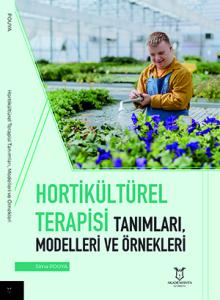
Hortikültürel Terapisi Tanımları, Modelleri ve Örnekleri
Özet
Bu kitap, hortikültürel terapinin tanımlarını, modellerini ve örneklerini ele almaktadır. Yazar, çocukluk dönemlerinde bahçe işleriyle uğraşarak bahçecilik deneyimlerini edindiğini belirtmektedir. Hortikültürel terapi konusuyla doktora tezinde tanışan yazar, bu alanda birçok bilimsel yayın ve konferans çalışması yapmıştır. Yazar, hortikültürel terapinin sadece bahçecilik işleriyle sınırlı olmadığını ve daha derin detayları kapsadığını vurgulamaktadır. Kitap, hortikültürel terapi konusunda bilgi ve beceri sahibi olmak isteyenler için rehber niteliğindedir.
This book discusses the definitions, models, and examples of horticultural therapy. The author mentions that they gained experience in gardening during their childhood. The author encountered horticultural therapy in their doctoral thesis and has conducted numerous scientific publications and conference studies in this field. The author emphasizes that horticultural therapy is not limited to gardening tasks alone and encompasses deeper details. The book serves as a guide for those who want to acquire knowledge and skills in horticultural therapy.
Referanslar
Ainsworth, M. D. S. (1978). The bowlby-ainsworth attachment theory. Behavioral and brain sciences, 1(3), 436-438.
Ainsworth, M. D. S. (1978). The bowlby-ainsworth attachment theory. Behavioral and brain sciences, 1(3), 436-438.
Allen, L. (1971). An adventure playground for handicapped children in London.International Journal of Early Childhood, 3(2), 70.
Baker, M. R., Waliczek, T. M., Zajicek, J. M. (2015). The Effect of School Gardening Activities on Visual-Motor Integration of Pre-School and Kindergarten Students. Journal of therapeutic horticulture, 25(2), 3-14.
Bowlby, J. (1979). The bowlby-ainsworth attachment theory. Behavioral and Brain Sciences, 2(4), 637-638.
Bowlby, J. (1982). Attachment and loss: retrospect and prospect. American journal of Orthopsychiatry, 52(4), 664.
Bronfenbrenner, U. (1979). The ecology of human development: Experiments by nature and design. Harvard university press.
Buber, M. 1971. I and Thou. Translated by Walter Kaufmann. New York: Touchstone Press.
Buettner, L., and S. L. Martin. 1995. Therapeutic Recreation in the Nursing Home. State College, PA: Venture Publishing.
Christie, M. A., Cole, F. (2017). The Impact of Green Exercise on Volunteers’ Mental Health and Wellbeing–Findings from a Community Project in a Woodland Setting. Journal of Therapeutic Horticulture, 27(1), 16-33.
Clopton, C. (1998). Horticultural therapy in a therapeutic farm community. Journal of Therapeutic Horticulture, 9, 9-13.
Coles, R. (1971). A domain of sorts. Harper’s Magazine, 116.
Csikszentmihalyi, M. 1990. Flow: The Psychology of Optimal Experience. New York: Harpe Row
Cutillo, A., Rathore, N., Reynolds, N., Hilliard, L., Haines, H., Whelan, K., & Madan-Swain,
A. (2015). A literature review of nature-based therapy and its application in cancer care. Journal of Therapeutic Horticulture, 25(1), 3-15.
D’Andrea, S. J., Batavia, M., & Sasson, N. (2007). Effect of Horticultural Therapy onPreventing the Decline of Mental Abilities of Patients with Alzheimer’s Type Dementia. Journal of Therapeutic Horticulture, 18.
Dorn, S., & Relf, D. (1995). Horticulture: Meeting the needs of special populations. HortTechnology, 5(2), 94-103.
Doutt, K. M., Airhart, D. L., & Willis, T. W. (1989). Horticultural therapy activities for exceptional children. Journal of Therapeutic Horticulture, 10-14.
Fleming, L. L., Dutrizac, G. J. (2010). Botanical Gardens: Fertile Soil for the Practice of Horticultural Therapy. Journal of therapeutic horticulture, 20.
Flick, K. M. (2012). The application of a horticultural therapy program for preschool children with autism spectrum disorder. Journal of Therapeutic Horticulture, 22(1), 38-45.
Foster, D. (2002). Social and Therapeutic Horticulture in the United Kingdom. Journal of Therapeutic Horticulture, 40-43.
Gerlach-Spriggs, N., & Healy, V. J. (2019). Rehabilitation and Gardens. SiteLINES: A Journal of Place, 15(1), 15-19.
Gray, S. (1999). Therapeutic garden design in residential care for older adults including those with dementia and physical frailties. Journal of Therapeutic Horticulture, 10, 40-49.
Hall, L., Robertson, W., & Turner, M. A. (1992). Clinical reasoning process for service provision in the public school. The American Journal of Occupational Therapy, 46(10), 927-936.
Hettler, B. 1976. “Six Dimensions of Wellness Model.” National Wellness Institute, Inc. Accessed September 3, 2017. http://www.nationalwellness.org/?page=six_ dimensions.
Hewson, M. (2001). Horticultural therapy and post traumatic stress recovery. Journal of Therapeutic Horticulture, 44-47.
Hewson, M.L. (1998). Horticulture as therapy: A practical guide to using horticulture as a therapeutic tool . Guelph, Ontario, Canada: Greemoore Printing Company
Hilbers, J., & Satharasinghe, A. (2013). Gardens and therapeutic horticulture in an acute healthcare setting: opportunities provided by the Blooming Backyard project at Prince of Wales Hospital, Sydney. Journal of Therapeutic Horticulture, 23(1), 35-48.
Holland, J. L. 1997. Making Vocational Choices: A Theory of Careers. Englewood Cliffs, NJ:
Prentice Hall. “Issues.” United Nations Division for Social Policy and Development: Disability. Accessed April 2, 2018. https://www.un.org/development/desa/ disabilities/issues.html.
Huxmann, N. J. 2016. “The Garden as Setting for Horticultural Therapy.” Acta Horticulturae, 1121: 39–45.
Jarrott, S. E., Kwack, H. R., & Relf, D. (2002). An observational assessment of a dementia-specific horticultural therapy program. HortTechnology, 12(3), 403-410.
Jung, C. G. (2014). The archetypes and the collective unconscious. Routledge.
Kaplan, R., & Kaplan, S. (1990). Restorative experience: The healing power of nearby nature. In R. Hester, & M. Francis (Eds.), The meanings of gardens: Idea, place, and action (pp.238-243). Cambridge, MA: MIT Press.
Kaplan, R., & Kaplan, S. (1996). The experience of nature: A psychological perspective (2nd ed.). New York: Cambridge University Press.
Kasar, J., and N. Clark. 2000. Developing Professional Behaviors. Thorofare, NJ: Slack Incorporated.
Katcher, B. L., and A. Snyder. 2010. An Insider’s Guide to Building a Successful Consulting Practice. New York: AMACOM.
Kellert, S. R. (2014). This feeling of connection to nature enlarges our understanding of community.... We emerge as stewards of nature motivated by an expanded appreciation of our personal and collective self-interest. Welcome to Subirdia: Sharing Our Neighborhoods with Wrens, Robins, Woodpeckers, and Other Wildlife, 51.
Kohut, H. 1984. How Does Analysis Cure? Chicago, IL: University of Chicago Press.
Kojima, H., & Kunimi, M. (2013). The effect of horticultural activity on the cognitive performance of healthy elderly individuals.Journal of Therapeutic Horticulture, 23(2), 5-18.
Lewis, C. A. (1990). Gardening as healing process. In R. Hester, & M. Francis, (Eds.), The meanings of gardens: Idea, place, and action (pp. 244-251). Cambridge, MA: MIT Press.
Lewis, C. A. (1995). Green nature, human nature. Urbana, IL: University of Illinois Press.
Lewis, C. A., (1973). People-plant interaction: A new horticultural perspective. American Horticulturist, 52 (2), 18-24.
Lewis, C. A., (1979). Healing in the urban environment: A person/plant perspective.
Journal of the American Planning Association, 45, 330-338.
Lindheim, R., Glaser, H. H., & Coffin, C. (1972). Changing hospital environments for children. Harvard University Press.
Lopez, B. (1986). Arctic Dreams: Imagination and Desire in a Northern Landscape. London: Picador.
Louv, R. (2005). Nature deficit. Orion, 70, 71.
Marcus, C. C. (2007). Healing gardens in hospitals. Interdisciplinary design and research e-Journal, 1(1), 1-27.
Mattson, R. H., Merkle, J., Parrett, L., & Waliczek, T. (1993). Proposed horticultural therapy standards of practice. Journal of Therapeutic Horticulture, 41-48.
Mehl-Madrona, L. 2007. Narrative Medicine: The Use of History and Story in the Healing Process. Rochester, VT: Bear & Company.
Melwood Horticultural Training Center. 1980. The Melwood Manual: A Planning and Operations Manual for Horticultural Training and Work Co-op Programs. Accessed May 10. 2018. https://eric. ed.gov/?q=Melwood+Manual&id=ED200793.
Miavitz, E. M. (1998). Grief Gardening: A Horticultural Therapy Program for the Bereaved. Journal of Therapeutic Horticulture, 9, 17-20.
Moore, T. 1992. Care of the Soul: A Guide for Cultivating Depth and Sacredness in Everyday Life. New York: Harper Collins.
Murrey, G. J., Wedel, A., Dirks, J. (2001). A horticultural therapy program for brain injury patients with neurobehavioral disorders. Journal of Therapeutic Horticulture, 4-8.
Olds, G. R., Sanson, A. J., & Daniel, T. M. (1987). Characterization of Mycobacterium tuberculosis antigen 5 epitopes by using a panel of 19 monoclonal antibodies.Journal of clinical microbiology, 25(3), 471-475.
Park, S.-A., C. Song, J.-Y. Choi, K.-C. Son, and Y. Miyazaki. 2016. “Foliage Plants Cause Physiological and Psychological Relaxation as Evidenced by Measurements of Prefrontal Cortex Activity and Profile of Mood States.” HortScience 51: 1308–1312.
Parsons, F. 1909. Choosing a Vocation. Boston, MA: Houghton Mifflin
Pouya, S., Demirel, Ö. (2015). What is a healing garden?. Akdeniz University Journal of the Faculty of Agriculture, 28(1), 5-10.
Pouya, S., Demirel, Ö. (2016). Ortopedik Engelli Çocukların Iyileştirilmelerine Yönelik Planlama Yaklaşımı: ODTÜ Eymir Gölü Örneği (Ankara), Karadeniz Teknik Üniversitesi.
Fen Bil. Ens., Peyzaj Mimarlığı Ana Bilim Dalı. Fen Bilimleri Enstitüsü, Peyzaj Mimalrığı Bölümü, Doktora tezi, 139s.
Pouya, S., & Demirel, Ö. (2017). Hospital rooftop garden. Sanat ve Tasarım Dergisi, 7(1), 150-167.
Pouya, S. (2018). The importance of horticulture therapy and gardening for older adults in nursing home. Sanat ve Tasarım Dergisi, 8(2), 146-166.
Pouya S., (2023). Zihinsel Engelli Çocuklara Bireysel Bahçe Terapisinin Uygulanmasi ve Gelişimlerinin Değerlendirilmesi, Akademia Doğa ve İnsan Bilimleri Dergisi, 9(1).
Predny, M., & Relf, P. D. (2000). Perspectives on Intergenerational Horticultural Therapy. Journal of Therapeutic Horticulture, 26-31.
Relf, D. (1992). Human issues in horticulture. HortTechnology, 2(2), 159-171.
Relf, D. 2012. “Advancing Horticultural Therapy through Research and Publishing,” Acta Horticulturae 954: 13–20.
Rice, J. S., & Lremy, L. (1998). Impact of horticultural therapy on psychosocial functioning among urban jail inmates. Journal of Offender Rehabilitation, 26(3-4), 169-191.
Rogers, C. R. (1951). Perceptual reorganization in client-centered therapy.
Sackett, D. L., W. M. C. Rosenberg, J. A. Muir-Gray, R. Brian Haynes, and W. Scott Richarson. 1996. “Evidence-Based Medicine: What It Is and What It Isn’t.” British Medical Journal 312: 71–72.
Sacks, O. 1995. An Anthropologist on Mars. New York: Vintage Books.
Salomon, L. (2002). Application of a client-centered horticultural therapy approach in a behavioral setting. Journal of Therapeutic Horticulture, 44-51.
Seligman, M. 2002. Authentic Happiness: Using the New Positive Psychology to Realize Your Potential for Lasting Fulfillment. New York: The Free Press.
Sempik, J., J. Aldridge, and S. Becker. 2003. Social and Therapeutic Horticulture: Evidence and Messages from Research. Leicestershire, Thrive and CCFR.
Shukor, S. F. A., Stigsdotter, U. K., & Nilsson, K. (2012). A review of design recommendations for outdoor areas at healthcare facilities. Journal of Therapeutic Horticulture, 22(2), 32-47.
Siegel, D. J. 2007. The Mindful Brain: Reflection and Attunement in the Cultivation of Well-Being. New York: Norton. Siegel, D. J. 2010. The Mindful Therapist: A Clinician’s Guide to Mindsight and Neural Integration. New York: Norton.
Şirin-Ayva, A. B., Canel, A. N. (2019). Psikolojik Danışma Sürecinde Yeni Bir Model: Macera Terapisi.
Sneed, C. 1992. Growing Season: The Movie. Directed by Nicholas Wellington. Olney, PA: Bullfrog Films.
Soga, M., K. J. Gaston, and Y. Yamaura. 2017. “Gardening Is Beneficial for Health: A Meta-Analysis.” Preventive Medicine Reports 5: 92–99
Spriggs, N.G., Kaufman, R. E., & Warner, S. B., Jr. (1998). Restorative gardens: The healing landscape. New Haven, CT: Yale University Press.
Starling, L. A. 2016. “Horticultural Therapy with Special Populations” In Urban Horticulture, ed. T. M. Waliczek, and J. M. Zajicek. Boca Raton, FL: CRC Press, Taylor & Francis Group, p. 7
Stewart, S. (2003). Horticultural therapy for patients with eating disorders at the Homewood Health Centre, Guelph, Ontario. Journal of Therapeutic Horticulture, 32-37.
Thorp, L., and C. Townsend. 2001. Agriculture education in an elementary school: An ethnographic study of a school garden. Paper presented at the 28th Annual National Agricultural Education Research Conference, New Orleans, LA. Accessed
September 9, 2017. http://www.aaaeonline. org/Resources/Documents/National/ ResearchProceedings, National2001.pdf.
Tweddle, A. (2007). Youth leaving care: How do they fare?. New directions for youth development, (113), 15-31.
Ulrich, R. S. (1984). View through a window may influence recovery from surgery. Science, 224, 420-421.
Ulrich, R. S. (1991). Stress recovery during exposure to natural and urban environments. Journal of Environmental Psychology, 11, 210-230.
Ulrich, R. S. (1991). Stress recovery during exposure to natural and urban environments. Journal of Environmental Psychology, 11, 210-230.
Ulrich, R. S. (1992). How design impacts wellness. Healthcare Forum Journal, September/ October, 20-25.
URL 1. https://www.oggusto.com/kunye/gozde-ozugur
URL 2. https://www.bilincdisiyayinlari.com/post/chiron-efsanesi
URL 3. https://www.nytimes.com/2019/10/04/nyregion/garden-rikers-island.html
URL 4. https://ncbg.unc.edu/2016/03/04/horticultural-therapy-at-ncbg/
URL 5. https://www.transplantingtraditions.org/
URL 6. https://www.nytimes.com/2019/03/25/style/plants-hospital-horticulture-therapy.html
URL 7. https://news.climate.columbia.edu/2019/01/10/community-gardens-east- harlem/
Walters, M. (1938). The literary and rhetorical background of Francis Bacon as an English man of letters. University of London, Royal Holloway College (United Kingdom).
Warner, S. B., Jr. (1995). The human side: A brief history of healing gardens in health care settings. Journal of Health Care Design, 7, September.
Wilfong, C. (2010). The Meditative Gardener: Cultivating Mindfulness of Body, Feelings, and Mind. Heart Path Press.
Wilson, E. O. (1986). Biophilia. Harvard university press.
Wilson, E. O. (1995). The biophilia hypothesis. Island Press.
Wilson, J. F., & Christensen, K. M. (2011). The relationship between gardening and depression among individuals with disabilities. Journal of Therapeutic Horticulture, 21(2), 28-41.
Winterbottom, D., and A. Wagenfeld. 2015. Therapeutic Gardens: Design for Healing Spaces. Portland, OR: Timber Press.
Witvliet, C. V., T. E. Ludwig, and K. L. Vander Laan. 2001. “Granting Forgiveness or Harboring Grudges: Implications for Emotion, Physiology, and Health.” Psychological Science, 12: 117–123.
Yayınlanan
Lisans
LisansBu İnternet Sitesi içeriğinde yer alan tüm eserler (yazı, resim, görüntü, fotoğraf, video, müzik vb.) Akademisyen Kitabevine ait olup, 5846 sayılı Fikir ve Sanat Eserleri Kanunu ve 5237 sayılı Türk Ceca Kanunu kapsamında korunmaktadır. Bu hakları ihlal eden kişiler, 5846 sayılı Fikir ve Sanat eserleri Kanunu ve 5237 sayılı Türk Ceza Kanununda yer alan hukuki ve cezai yaptırımlara tabi olurlar. Yayınevi ilgili yasal yollara başvurma hakkına sahiptir.
