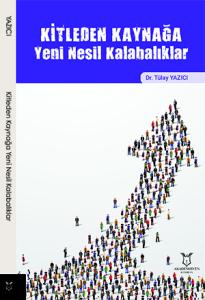
Kitleden Kaynağa Yeni Nesil Kalabalıklar
Özet
Bu kitap, kitle kaynak kullanımının günümüzdeki önemini ve yeni nesil süreçlerdeki varlığını ele almaktadır. Kitle kaynak, bir görevi gerçekleştirmek veya bir sorunu çözmek için kalabalığın fikir ve yaratıcılık temelli iş gücünden yararlanma eylemidir. Geleneksel iş yapma biçimlerinin değiştiği dijitalleşen dünyada, kitle kaynak kullanımı önem kazanmaktadır. Teknoloji ve dijitalleşme, kitlelerin yaratıcı kaynaklara dönüşmesini sağlamakta ve işleri kolaylaştırmaktadır. Kitle kaynak, markaların süreçlerinde, kamusal alanlarda, bilimsel çalışmalarda ve fikir ve yaratıcılığın yer aldığı diğer alanlarda uygulanmaktadır. Bu kitap, kitlelerin kaynağa dönüşümünü ve yeni nesil süreçlerdeki varlıklarını ele alarak, kitle kaynak kullanımının önemini vurgulamaktadır.
This book discusses the importance of crowd sourcing and its presence in the processes of the new generation. Crowd sourcing is the action of utilizing the ideas and creativity-based workforce of the crowd to accomplish a task or solve a problem. In the digitalized world where traditional ways of doing business are changing, the use of crowd sourcing is gaining significance. Technology and digitalization enable the transformation of crowds into creative resources and facilitate tasks. Crowd sourcing is applied in brands' processes, public spaces, scientific research, and other areas involving ideas and creativity. This book emphasizes the importance of crowd sourcing by addressing the transformation of crowds into resources and their presence in the processes of the new generation.
Referanslar
Acar, O. (2019). Motivations and solution appropriateness in crowdsourcing challenges for ınnovation. Research Policy, 48(8), 103716.
Adla A, Zarate P, Soubie J-L (2011) A proposal of toolkit for GDSS facilitators. Group Decis Negot, 20(1):57–77. doi: https://doi.org/10.1007/s10726-010-9204-8)
Afuah, A. & Tucci, C. (2012). Crowdsourcing as a solution to distant search. Academy of Management Review, 37(3), 355–375.
Azadegan A, Kolfschoten G (2014) An assessment framework for practicing facilitator. Group Decis Negot, 23(5):1013–1045. doi: https://doi.org/10.1007/s10726-012-9332-4)
Beat, C. (2020). AI-Labeling crowdsourcing platforms. https://medium.com/swlh/ai-labeling-crowdsourcing-platforms-630adbc79c40
Bostrom, R. P, Anson, R. & Clawson, V. K. (1993). Group facilitation and group support systems. Group support systems: New perspectives, (8), pp.146–168
Brabham, D. (2008). Crowdsourcing as a model for problem-solving. Convergence: The International Journal of Research into New Media Technologies, 14(1), 75-90.
Brandtzaeg, P.B. & Følstad, A. (2017). Why people use chatbots. International Conference on Internet Science, pp. 377-392.
Carpenter, J. (2011). May the best analyst win. Science, 331(6018), 698–699.
Cullina, E., Conboy, K. & Morgan, L. (2015). Measuring the crowd: a preliminary taxonomy of crowdsourcing metrics. in Proceedings of the 11th International Symposium on Open Collaboration. doi: https:// doi.org/10.1145/2788993.2789841.
Dilmegani, C. (2023). AI crowdsourcing: Benefits, use cases & top vendors in 2023. https://research.aimultiple.com/crowdsource-ai/
Derrick, D. C., Read, A., Nguyen, C., Callens, A. & de Vreede, G. J. (2013). Automated group facilitation for gathering wide audience end-user requirements. Proceedings of the 46th Hawaii International Conference on System Sciences (HICSS 2013), pp. 195–204 (doi: https://doi.org/10.1109/HICSS.2013.109
Dissanayake, I., Nerur, S. & Zhang, J. (2019). Team formation and performance in online crowdsourcing competitions: the role of homophily and diversity in solver characteristics. Proceedings of the 40th International Conference on Information Systems (ICIS 2019), Association for Information Systems
Dubey, R., Gunasekaran, A., Bryde, D. J., Dwivedi, Y. K. & Papadopoulos, T. (2020). Blockchain technology for enhancing swift-trust, collaboration and resilience within a humanitarian supply chain setting. International Journal of Production Research, Vol. 58 No. 11, pp. 3381-3398.
Estellés-Arolas, E. González-Ladrón-de-Guevara, F. (2012). Towards an integrated crowdsourcing definition. Journal Inform Science, 38:2. doi: https://doi.org/10.1177/0165551512437638)
Füller, J., Hutter, K. Kröger, N. (2021). Crowdsourcing as a service – from pilot projects to sustainable innovation routines. Int Journal Project Manage 39:2. doi: https://doi.org/10.1016/j.ijproman.2021.01.005)
Gassmann, O., Frankenberger, K. Csik, M. (2015). The business model navigator: 55 models that will revolutionise your business. FT Publishing International. ISBN-10 9781292065816
Gimpel, H., Graf-Seyfried, V., Laubacher, R. Meindl, O. (2023). Towards artificial ıntelligence augmenting facilitation: AI affordances in macro-task crowdsourcing. Group Decision and Negotiation; 32:75–124. https://doi.org/10.1007/s10726-022-09801-1
Goldfarb, A., Taska, B., & Teodoridis, F. (2021). Could machine learning be a general purpose technology? A comparison of emerging technologies using data from online job postings. SSRN: http://dx.doi.org/10.2139/ssrn.3468822.
Griffith, T. L., Sawyer, J. E. & Poole, M. S. (2019). Systems savvy: Practical intelligence for transformation of sociotechnical systems. Group Decis Negot, 28(3):475–499. doi: https://doi.org/10.1007/ s10726-019-09619-4
Hershkovitz, S. (2018a). When humans meet AI: The next generation of crowdsourcing. https://crowdsourcingweek.com/blog/when-humans-meet-ai-next-generation-crowdsourcing/
Hershkovitz, S. (2018b). A thousand eyes are better than two. https://crowdsourcingweek.com/blog/thousand-eyes-better-than-two/
Hershkovitz, S. (2019). A perfect match: Artificial ıntelligence and crowdsourcing. https://bold-awards.com/artificial-intelligence-and-crowdsourcing-perfect-match/
Introne, J., Laubacher, R., Olson, G. Malone, T. (2013). Solving wicked social problems with socio-computational systems. KI - Künstliche Intelligenz, 27(1):45–52. doi: https://doi.org/10.1007/ s13218-012-0231-2)
Ito, T., Hadfi, R. & Suzuki, S. (2021) An agent that facilitates crowd discussion. Group Decis Negot. doi: https://doi.org/10.1007/s10726-021-09765-8)
Ivanov, E. (2018). Crowdsourcing 2.0. https://innovationobserver.com/ 2018/02/15/crowdsourcing-2-0/
Kiruthika, U., Somasundaram, T. S. Raja, S. K. S. (2020). Lifecycle model of a negotiation agent: A survey of automated negotiation techniques. Group Decis Negot, 29(6):1239–1262. doi: https://doi. org/10.1007/s10726-020-09704-z)
Manyika, J., Lund, S., Bughin, J., Woetzel, J. R., Stamenov, K. Dhingra, D. (2016). Digital globalization: The new era of global flows. McKinsey Global Institute San Francisco
Kaplan, A., & Haenlein, M. (2019). Siri, Siri, in my hand: Who’s the fairest in the land? On the interpretations, illustrations, and implications of artificial intelligence. Bus Horiz, 62(1):15–25. doi: https://doi. org/10.1016/j.bushor.2018.08.004)
Ludvik, E. (2020). BOLD // Crowd 2.0 powered by AI and machine learning. https://crowdsourcingweek.com/blog/bold-crowd-2-0-powered-by-ai-and-machine-learning/
Makridakis, S., Spiliotis, E., Assimakopoulos, V. (2020). The M4 Competition: 100,000 Time Series and 61 Forecasting methods. International Journal of Forecasting, 36(1), 54–74
Mao, K., Capra, L., Harman, M., Jia, Y. (2017). A Survey of the use of crowdsourcing in software engineering. Journal of Systems and Software, 126, 57–84.
McBride, J. (2020). Why your next freelance writing gig should be writing chatbot dialogues. https://medium.com/escape-motivation/why-your-next-freelancewriting-gig-should-be-writing-chatbot-dialogues-d69ac22aefad.
ML Contests (2021). Winning at competitive ML in 2021: An analysis of over 100 ML contest winners. ML Contests Blog, 13 April.
Naudé, W., Bray, A. & Lee, C. (2021). Crowdsourcing artificial İntelligence in Africa: Findings from a machine learning Contest. IZA – Institute of Labor Economics. ISSN: 2365-9793.
Ndung’u, N. Sign´e, L. (2020). The fourth ındustrial revolution and digitization will transform Africa into a global powerhouse. In Coulibay, B.S. and Golubski, C. (eds). Foresight Africa : Top priorities for the continent 2020-2030. Washington DC: The Brookings Institution. Chapter 5, pp. 60-73
Olaleye, E. (2021). How to win any ML contest. Towards Data Science.
Open Assembly Quarterly (OAQ) Report 2018 (2019). Co-creating the future of work state of crowdsourcing report. https://openassembly.com/reports/oaq-report- fall-2018/
Piller, F. & Walcher, D. (2006). Tookits for ıdea competitions: A novel method to ıntegrate users in new product development. R/&D Management, 36(3), 307–318.
Qiao, L., Tang, F. & Liu, J. (2018). Feedback based high-quality task assignment in collaborative crowdsourcing. IEEE 32nd International Conference on Advanced Information Networking and Applications, pp. 1139–1146 (doi: https://doi.org/10.1109/AINA.2018.00163)
Reffell, C. (2023). Training AI and deep learning with crowdsourcing. https://crowdsourcingweek.com/blog/crowdsourcing-ai-training/
Rhyn, M., Leicht, N., Blohm, I. & Leimeister, J. M. (2020). Opening the black box: How to design ıntelligent decision support systems for crowdsourcing. Proceedings of the 15th International Conference on Wirtschaftsinformatik (WI 2020), pp. 50–65
Robert, L. P. (2019). Crowdsourcing controls: A review and research agenda for crowdsourcing controls used for macro-tasks. Macrotask Crowdsourcing, V.-J. Khan, K. Papangelis, I. Lykourentzou and P. Markopoulos (eds.), pp. 45–126 (doi: https://doi.org/10.1007/978-3-030-12334-5_3)
Seeber, I., Bittner, E., Briggs, R. O., de Vreede, T., de Vreede, G. J., Elkins, A., Maier, R., Merz, A. B., Oeste-Reiß, S., Randrup, N., Schwabe, G. & Söllner, M. (2020). Machines as teammates: A research agenda on AI in team collaboration. 57:103174. https://doi.org/10.1016/j.im.2019.103174). 2
Schmitz, H. & Lykourentzou, I. (2018). Online sequencing of non-decomposable macrotasks in expert crowdsourcing. ACM Trans Social Comput, 1(1):1–33. doi: https://doi.org/10.1145/3140459)
Shafiei Gol, E., Stein, M. K. Avital, M. (2019). Crowdwork platform governance toward organizational value creation. Journal Strategy Inf Syst, 28(2):175–195. doi: https://doi.org/10.1016/j.jsis.2019.01.001)
Schneider, S. (2018). Crowdsourcing in the age of artificial intelligence: How the crowd will train machines. https://venturebeat.com/ai/crowdsourcing-in-the-age-of-artificial-intelligence-how-the-crowd-will-train-machines/
Taieb, S. Hyndman, R. (2014). A gradient boosting approach to the kaggle load forecasting competition. International Journal of Forecasting, 30, 382–394.
Trajtenberg, M. (2018). AI as the Next GPT: A political-economy perspective. NBER Working Paper no. 24245. National Bureau for Economic Research.
Wang, A., Pruksachatkun, Y., Nangia, N., Singh, A., Michael, J., Hill, F., Levy, O. & Bowman, S. (2019). Superglue: A stickier benchmark for general-purpose language understanding systems. Advances in neural information processing systems.
Vinuesa, R., Azizpour, H., Leite, I., Balaam, M., Dignum, V., Domisch, S., Fell¨ander, A., Langhans, S., Tegmark, M., & Nerini, F. F. (2020). The role of artificial ıntelligence in achieving the sustainable development goals. Nature Communications, 11(233).
Yazıcı, T. (2022). Kitle kaynak ve yapay zekâ. Afyon Kocatepe Üniversitesi Sosyal Bilimler Dergisi / Cilt: 24, Sayı: 4, 1301-1313. Kitle Kaynak ve Yapay Zeka.pdf
Yu, Z., Xu, Z., Black, A.W. Rudnicky, A. (2016). Chatbot evaluation and database expansion via crowdsourcing. Proceedings of the Chatbot Workshop of LREC, Vol. 63, p. 102.
Zhao, Y. & Zhu, Q. (2014). Evaluation on crowdsourcing research: Current status and future direction. Information System Frontiers, 16, 417–434.
Zolas, N., Kroff, Z., Brynjolfsson, E., McElheran, K., Beede, D. N., Buffington, C., Goldschlag, N., Foste, L., Dinlersoz, E. (2020). Advanced technologies adoption and use by U.S. Firms: evidence from the annual business survey. NBER Working Paper No. 28290, National Bureau of Economic Research.
Yayınlanan
Lisans
LisansBu İnternet Sitesi içeriğinde yer alan tüm eserler (yazı, resim, görüntü, fotoğraf, video, müzik vb.) Akademisyen Kitabevine ait olup, 5846 sayılı Fikir ve Sanat Eserleri Kanunu ve 5237 sayılı Türk Ceca Kanunu kapsamında korunmaktadır. Bu hakları ihlal eden kişiler, 5846 sayılı Fikir ve Sanat eserleri Kanunu ve 5237 sayılı Türk Ceza Kanununda yer alan hukuki ve cezai yaptırımlara tabi olurlar. Yayınevi ilgili yasal yollara başvurma hakkına sahiptir.
