Çalışan Dayanıklılığı; Örgütsel Adalet ve Örgütsel Güvenin Önemi
Özet
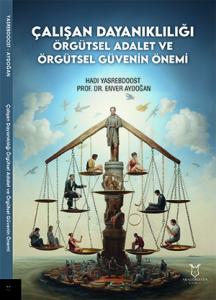
Bu kitap, Hadi Yasrebdoost'un \"Örgütsel Adalet ve Örgütsel Güvenin Çalışan Dayanıklılığı Üzerine Etki\" adlı doktora tezinden üretilmiştir. Kitap, çalışan dayanıklılığı, örgütsel adalet ve örgütsel güvenin önemini ele almaktadır. Çalışan dayanıklılığı kavramı, dayanıklılığın tarihi gelişimi, bir kişisel özellik ve kişisel beceri olarak dayanıklılık gibi konuları içermektedir. Örgütsel adalet ve örgütsel güvenin çalışan dayanıklılığı üzerindeki etkileri de incelenmektedir. Kitap, akademisyenler ve araştırmacılar için faydalı bir kaynak olabilir.
This book is based on Hadi Yasrebdoost's doctoral thesis titled \"The Impact of Organizational Justice and Organizational Trust on Employee Resilience\". The book discusses the importance of employee resilience, organizational justice, and organizational trust. The concept of employee resilience includes the historical development of resilience, as well as topics such as resilience as a personal characteristic and skill. The effects of organizational justice and organizational trust on employee resilience are also examined. The book can be a valuable resource for academics and researchers.
Referanslar
Adams, J. S. (1965). “Inequity in Social Exchange”. In L. Berkowitz (Ed.), Advances in Experimental Social Psychology (Vol.2, pp. 267–299). New York, NY: Academic Press.
Adger, W. N. (2000). “Social and ecological resilience: Are hey related?” Study of Human Geography, 24, 347–64.
Afifi, T. O. and MacMillan, H. L. (2011). “Resilience following child maltreatment: A review of protective factors”. The Canadian Journal of Psychiatry, 56(5), 266–272.
Afridi, A. A. and Baloch, Q. B. (2018). “The effect of organizational justice on job satisfaction: A comparative study of public and private universities of khyber pakhtunkhwa”. Abasyn Journal of Social Sciences, 11(1), 237-253.
Agnihotri, R., Trainor, K.J., Krush, M.T. and Krishnakumar, S. (2014). “Satisfied and productive boundary spanners: A model of resiliency and customer expectations”. Journal of Services Research, 14, 57–74.
Ajala, E. M. and Bolarinwa, K. O. (2015). “Organisational justice and psychological well- being of employees in the local government service of Osun State, Nigeria”. African Research Review, 9(4), 55-72.
Akbar Saifi, I. and Shahzad, K. (2017). “The mediating role of job satisfaction in the relationship between organizational justice and organizational citizenship behavior”. Pakistan Journal of Commerce and Social Sciences, 11(1), 126-146.
Aked, J., Marks, N., Cordon, C. and Thompson, S. (2017). “Five Ways to Wellbeing: A report presented to the Foresight Project on communicating the evidence base for improving people’s well-being. Nef: the new economics foundation 2008”. Psychological Bulletin, 138(4), 655-691.
Aksoy, M. (2009). İşletmelerde Örgütsel Güven Anlayışının Algılanması ve Demografik Değişkenler Açısından Analizi. (Unpublished Master Thesis). Gazi Üniversitesi Sosyal Bilimler Enstitüsü, Ankara.
Alberts, D. S. and Hayes, R. E. (2005). Power to The Edge: Command and Control in The İnformation Age. Washington, DC: Command and Control Research Program.
Allison, P. D. (1999). Multiple regression: A primer. Thousand Oaks [USA] : Pine Forge Press.
Al-Naser, F. and Sandman, M. (2000). “Evaluating resiliency patterns using the ER89: a case study from Kuwait”. Social Behavior and Personality, 28(5), 505–514.
Altuntaş, S. and Baykal, Ü. (2010). “Reliability and validity of organizational trust scale in nursing”. Florence Nightingale Journal of Nursing, 18(1), 10-18.
Ambrose, M. L. and Schminke, M. (2009). “The role of overall justice judg-ments in organizational justice research: A test of mediation”. Journal of Applied Psychology, 94(2), 491–500.
Arrington, E. G. and Wilson, M. N. (2000). “A re-examination of risk and resilience during adolescence: Incorporating culture and diversity”. Journal of Child and Family Studies, 9, 221 -230.
Aryee, S., Budhwar, P. S. and Chen, Z. X. (2002). “Trust as a mediator of the relationship between organizational justice and work outcomes”. Journal of Organizational Behavior, 23(3), 267–285.
Ashford, S. J., Lee, C. and Bobko, P. (1989). “Content, cause, and consequences of job insecurity: A theory-based measure and substantive test”. Academy of Management Journal, 32(4), 803-829.
Atkinson, S. and Butcher, D. (2003), “Trust in managerial relationships”. Journal of Managerial Psychology, 18(4), 282-304.
Avey, J. B., Luthans, F. and Jensen, S.M. (2009). “Psychological capital: A positive resource for combating employee stress and turnover”. Human Resource Management, 48, 677–693.
Awang, Z. (2012). A Handbook on SEM Structural Equation Modelling: SEM Using AMOS Graphic (5th ed.). Kota Baru: Universiti Teknologi Mara Kelantan.
Awang, Z., Afthanorhan, A., Mamat, M. and Aimran, N. (2017). “Modeling structural model for higher order constructs (HOC) using marketing model”. World Applied Sciences Journal, 35(8), 1434-1444.
Baird, A. and Amand Real, S. T. (1995). “Trust within the organization; Building trust monograph”. Public Service Commission of Canada, 2.
Bakker, A. B., Demerouti, E., de Boer, E. and Schaufeli, W. B. (2003). “Job demands and job resources as predictors of absence duration and frequency”. Journal of Vocational Behavior, 62, 341–356.
Balcı, A. (2015). Sosyal Bilimlerde Araştırma Yöntem Teknik ve İlkeler (11. Baskı). Ankara: Pegem Akademi Yayınları.
Barber, B. (1983). The logic and limits of trust. New Brunswick, NJ: Rutgers University Press.
Bardoel, E. A., Pettit, T. M., De Cieri, H. and McMillan, L. (2014). “Employee resilience: an emerging challenge for HRM”. Asia Pacific Journal of Management, 52(3), 279- 297.
Barimani, A. and Salimi Khorshidi, A. (2018). “The relationship between organizational trust and job satisfaction in employees of the agricultural bank branches”. Journal of Industrial Strategic Management, 3(2), 25-36.
Bateman, T. S. and Organ, D. W. (1983). “Job satisfaction and the good soldier: The relationship between affect and employee ‘citizenship’”. Academy of Management Journal, 26(4), 587-595.
Bayram, N. (2010). Yapısal Eşitlik Modellemesine Giriş AMOS Uygulamaları. Ankara: Ezgi Kitabevi.
Beardslee, W. and Podorefsky, D. (1988). “Resilient Adolescents whose parents have serious affective and other psychiatric disorders: Importance of selfunderstanding and relationships”. American Journal of Psychiatry, 145(11), 63-69.
Belsky, J., Youngblade, L., Rovine, M., Volling, B. (1991). “Patterns of marital change and parent–child interaction”. Journal of Marriage and the Family, 53, 487-498.
Beugré, C. D. (1998). Managing Fairness in Organizations. London: Greenwood Publishing Group, Incorporated, Quorum Books Westport, Connecticut.
Beugré, C. D. (2002). “Understanding organizational justice and its impact on managing employees: an african perspective”. Journal of Human Resource Management,13(7), 1091-1104.
Bies, R. J. and Moag, J. F. (1986). “Interactional Justice: Communication Criteria of Fairness”. In R. J. Lewicki, B. H. Sheppard, & M. H. Bazerman (Eds.), Research on Negotiations in Organizations (Vol. 1, pp. 43–55). Greenwich, CT: JAI Press.
Bies, R. J., Shapiro, D. L. and Cummings, L. L. (1988). “Causal accounts and managing organizational conflict: Is it enough to say it's not my fault?” Communication Research, 15(4), 381-399.
Bigbee, J. L. (1985). “Hardiness: A new perspective in health promotion”. Nurse Practitioner, 10, 51-56.
Block, J. and Kremen, A. M. (1996). “IQ and ego resiliency: Conceptual and empirical connections and separateness”. Journal of Personality and Social Psychology, 70, 349–361.
Blum, R., McNeely, C. and Nonnemaker, J. (2001). “Vulnerability, risk, and protection”.
Journal of Adolescent Health, 31S, 29– 39.
Bolton, K. W., Praetorius, R. T., Smith-Osborne, A. (2016). “Resilience protective factors in an older adult population: A qualitative ınterpretive meta-synthesis”. Social Work Research, 40(3), 171–182.
Bonanno, G. A. (2004). “Loss, trauma, and human resilience: Have we underestimated the human capacity to thrive after extremely aversive events?” American Psychologist, 59, 20–28.
Bonanno, G. A., Mancini, A. D., Horton, J. L., Powell, T. M., Leardmann, C. A., Boyko, E.
J. and Smith, T. C. (2012). “Trajectories of trauma symptoms and resilience in deployed US military service members: Prospective cohort study”. The British Journal of Psychiatry, 200(4), 317–323.
Bouteyre, E., Maurel, M. and Bernaud, J. L. (2007). “Daily hassles and depressive symptoms among first year psychology students in France: The role of coping and social support”. Stress and Health: Journal of the International Society for the Investigation of Stress, 23(2), 93–99.
Bowling, N. A., Eschleman, K. J. and Wang, Q. (2010). “A meta‐analytic examination of the relationship between job satisfaction and subjective well‐being”. Journal of Occupational and Organizational Psychology, 83(4), 915-934.
Boyaci, A., Karacabey, M. F. and Bozkus, K. (2018). “The role of organizational trust in the effect of leadership of school administrators on job satisfaction of teachers”. Educational Administration: Theory & Practice, 24(3), 437-482.
Bradley, B., Davis, T. A., Wingo, A. P., Mercer, K. B. and Ressler, K. J. (2013). “Family environment and adult resilience: contributions of positive parenting and the oxytocin receptor gene”. European Journal of Psychotraumatology, 4(1), 122–129.
Brandan, M. M., Goddard, N. A., Kabir, B., Lofton, S. S., Ruiz, J. and Hau, J. M. (2013). “Resilience and retirement coping self-efficacy and collective self-efficacy: implementing positive psychology during times of economic hardship for late-career individuals”, Career Planning and Adult Development Journal, 20(4), 25-36.
Brann, P. and Foddy, M. (1987). Trust and the consumption of a deteriorating common resource. Journal of Conflict Resolution, 31(4), 615-630.
Brislin, R. W. (1970). “Back-translation for cross-cultural research”. Journal of CrossCultural Psychology, 1(3), 185-216.
Brockner, J. and Siegel, P. (1996). Understanding the İnteraction Between Procedural and Distributive Justice: the Role of Trust R.M. Kramer, T.R. Tyler (Eds.), Trust in Organizations: frontiers of Theory and Research, Thousand Oaks, CA: SAGE.
Bromiley, P. ve Cummings, L.L. (1996). The Organizational Trust Inventory (OTI): Development and Validation. In R. Kramer ve T. Tyler (Eds.), Trust in Organizations (p. 302-330). Thousand Oaks, CA: Sage.
Brooks, R. B. (1994). “Children at risk: Fostering resilience and hope”. American Journal of Orthopsychiatry, 64, 545–553.
Byrne, B. M. (2010). Structural Equation Modeling With AMOS: Basic Concepts, Applications, And Programming (2nd ed.). London: Routledge.
Cannas, M., Sergi, B. S., Sironi, E. and Mentel, U. (2019). “Job satisfaction and subjective well-being in Europe”. Economics and Sociology, 12, 183-196.
Carlson, D. J. (2001). Development and Validation of a College Resilience Questionnaire.
Yayınlanmamış Doktora Tezi, University of Nebraska, Nebraska.
Carmeli, A., Yitzhak-Halevy, M. and Weisberg, J. (2009). “The relationship between emotional intelligence and psychological wellbeing”. Journal of Managerial Psychology, 24, 66–78.
Chathoth, P. K., Mak, B., Jauhari, V. and Manaktola, K. (2007). “Employees' perceptions of organizational trust and service climate: A structural model combining their effects on employee satisfaction”. Journal of Hospitality & Tourism Research, 31(3), 338-357.
Chathoth, P. K., Mak, B., Sim, J., Jauhari, V. and Manaktola, K. (2011). “Assessing dimensions of organizational trust across cultures: A comparative analysis of US and Indian full service hotels”. International Journal of Hospitality Management, 30(2), 233-242.
Chen, S. Y., Wu, W. C., Chang, C. S., Lin, C. T., Kung, J. Y., Weng, H. C., Lin, Y. T. and Lee, S. I. (2015). “Organizational justice, trust, and identification and their effects on organizational commitment in hospital nursing staff”. BMC Health Services Research, 15(1), 1-17.
Choi, S. (2011). “Organizational justice and employee work attitudes: The federal case”. The American Review of Public Administration, 41, 185–204.
Chua, Y. P. (2009). Research methods and statistics: Advanced research statistics- regression tests, factor analysis and SEM analysis (Book 5). Malaysia: McGraw Hill Education.
Coetzee, M. (2005). The Fairness of Affirmative Action: An Organizational Justice Perspective. PhD dissertation, Faculty of Economic and Management Sciences, University of Pretoria.
Cohen Charash, Y. and Spector, P. E. (2001). “The role of justice in organizations: A meta- analysis”. Organizational Behavior and Human Decision Processes, 86, 278–321.
Cohen, R. L., Lind, E. A. and Tyler, T. R., (1989). “The Social Psychology of Procedural Justice”. Contemporary Sociology, 18, 758.
Colquitt, J. A. (2001). “On the dimensionality of organizational justice: A construct validation of a measure”. Journal of Applied Psychology, 86(3), 386-400.
Colquitt, J. A., Conlon, D. E., Wesson, M. J., Porter, C. O. and Ng, K. Y. (2001). “Justice at the millennium: a meta-analytic review of 25 years of organizational justice research”. Journal of Applied Psychology, 86(3), 425-445.
Colquitt, J. A., Scott, B. A., Rodell, J. B., Long, D. M., Zapata, C. P., Conlon, D. E. and Wesson, M. J. (2013). “Justice at the millennium, a decade later: A meta-analytic test of social exchange and affect-based perspectives”. Journal of Applied Psychology, 98(2), 199–236.
Connor, K. M. and Davidson, J. R. T. (2003). “Development of a new resilience scale: The connor-davidson resilience scale (CD-RISC)”. Depression Anxiety, 18, 76–82.
Cook, J. and Wall, T. (1980). “New Work attitude measures of trust, organizational commitment and personal need non-fulfillment”. Journal of Occupational Psychology, 53(1), 39-52.
Cooke, F. L., Cooper, B., Bartram, T., Wang, J. and Mei, H. (2016). “Mapping the relationships between high-performance work systems, employee resilience and engagement: A study of the banking industry in China”. The International Journal of Human Resource Management, 30(8), 1239-1260.
Cooper, C. L., Flint-Taylor, J. and Pearn, M. (2013). Building Resilience for Success: A Resource for Managers and Organizations. New York, NY: Palgrave Macmillan.
Cortina, J. M. (1993). “What is coefficient alpha? An examination of theory and applications”. Journal of Applied Psychology, 78(1), 98.
Costigan, R. D., Ilter, S. S. and Berman, J. J. (1998). “A multi‐ dimensional study of trust in organisations”. Journal of Managerial, 10, 303–317.
Cropanzano, R. (1993). Justice in The Workplace: Approaching Fairness in Human Resource Management. New Jersey: Lawrence Erlbaum Associates.
Cropanzano, R. and Greenberg, J. (1997). “Progress in Organizational Justice: Tunneling Through The Maze”. In C. Cooper and I. Robertson (Eds.), International Review Of İndustrial and Organizational Psychology (pp. 317-372). New York: Wiley.
Crosby, F. (1984). “Relative Deprivation in Organizational Settings”. In BM Staw and LL Cummings (Eds.), Research in Organizational Behavior. 5th edition. New York: McGraw-Hill.
Culbert, S. A., and McDonough, J. J. (1986). The politics of trust and organızatıon empowerment. Public Administration Quarterly, 10(2), 171–188.
Cummings, E. M., Goeke-Morey, M. C. and Papp, L. M. (2004). “Everyday marital conflict and child aggression”. Journal of Abnormal Child Psychology, 32, 191–202.
Curtis, W. J., Cicchetti, D. (2003). “Moving research on resilience into the 21st century: Theoretical and methodological considerations in examining the biological contributors to resilience”. Development and Psychopathology, 15(03), 773–810
Çıtır, I. Ö. and Kavi, E. (2010). “Algılanan örgütsel güven ile iş güvencesi arasındaki ilişkiye yönelik bir araştırma”. Yönetim Bilimleri Dergisi, 8(4), 229-244.
Çolakoğlu, N., Dikili, E. and Aslan, M. (2021). “Örgütsel adaletin örgütsel bağlılığa etkisi: Özel bir işletmenin satış personeli üzerinde bir araştırma”. Journal of Life Economics, 8(1), 101-109,
D’Angelo, B. and Wierzbicki, M. (2003). “Relations of daily hassles with both anxious and depressed mood in students”. Psychological Reports, 92(2), 416–418.
Davey, M., Eaker, D. G. and Walters, L. H. (2003). “Resilience processes in adolescents: personality profiles, self-worth, and coping”. Journal of Adolescence Research, 18, 347–362.
Davis, T. (2001). “Gone but not forgotten: declarative and nondeclarative memory processes and their contribution to resilience”. Bulletin of the Menninger Clinic, 65, 451–470.
Deluga, R. J. (1994). “Supervision Trust Building, Leader-Member Exchange and Organizational Citizenship Behaviour”. Journal of Occupational and Organizational Psychology, 67(4):315-327.
Demircan, N. and Ceylan, A. (2003). “Örgütsel güven kavramı: Nedenleri ve sonuçları”. Yönetim ve Ekonomi: Celal Bayar Üniversitesi İktisadi ve İdari Bilimler Fakültesi Dergisi, 10(2), 139-150.
Demirkiran, M., Taskaya, S. and Dinc, M. (2016). “A study on the relationship between organizational justice and organizational citizenship behavior in hospitals”. International Journal of Business and Economics Research, 7, 547-554.
Deutsch, M. (1975). “Equity, equality, and need: what determines which value will be used as the basis of distributive justice”, Journal of Social, 31, 137-150.
Di Stefano, G., Venza, G., Cascio, G. and Gaudiino, M. (2018). The role of organizational trust and organizational support on employees' well-being. La Medicina del Lavoro, 109(6), 459-470.
Digman, J. M. (1990). “Personality structure: Emergence of the five-factor model”. Annual Review of Psychology, 41(1), 417-440.
Dirks, K. T. and Ferrin, D. L. (2001). “The role of trust in organizational settings”.
Organization Science, 12(4), 450-467.
Donaldson, L. (2001). The Contingency Theory of Organizations. Thousand Oaks, CA: Sage Publications.
Dunn, L. B., Iglewicz, A. and Moutier, C. (2008). “A conceptual model of medical student well-being: Promoting resilience and preventing burnout”. Academic Psychiatry, 32(1), 44–53.
Durdağ, F. M. ve Naktiyok, A. (2011). “Psikolojik taciz algısının örgütsel güven üzerindeki rolü”. Kafkas Üniversitesi İİBF Dergisi, 1(2), 5-37.
Duyar, V. D., Örnekli, Y. and Gündüz, M. (2020). “The effect of organizational justice on employee well-being”. Uluslararası Akademik Yönetim Bilimleri Dergisi, 6(8), 28-48.
Dyrbye, L. N., Power, D. V., Massie, F., Eacker, A., Harper, W., Thomas, M. R. and Shanafelt, T. D. (2010). “Factors associated with resilience to and recovery from burnout: A prospective, multi-institutional study of US medical students”. Medical Education, 44, 1016–1026.
Ellonen, R., Blomqvist, K. and Puumalainen, K. (2008). “The role of trust in organisational innovativeness”. European Journal of Innova-tion Management, 11(2), 160-181.
Erdal, N. (2018). Sağlık Çalışanlarında Örgütsel Güven ve Örgütsel Vatandaşlığın İş Tatmini Üzerindeki Etkilerinin İncelenmesi: Bir Üniversite Hastanesi Örneği. Doktora Tezi, Beykent Üniversitesi Lisansüstü Eğitim Enstitüsü, 22.
Erdem, F. and Ozen, J. (2003). “Cognitive and affective dimensions of trust in developing team performance”. Team Performance Management, 9(5/6), 131-135.
Ergün Başak, B. (2012). Düşük Gelirli Ailelerden Gelen Üniversite Öğrencilerinin Öz Duyarlık, Sosyal Bağlılık, İyimserlik ve Psikolojik Sağlamlık Düzeyleri Arasındaki İlişkiler. Yayınlanmamış Doktora Tezi, Anadolu Üniversitesi, Eğitim Bilimleri Enstitüsü, Eskişehir.
Evans, M. and Wensley, A. (2001). “Predicting the ınfluence of network structure on trust in knowledge communities: Addressing the ınterconnectedness of four network principles and trust”. The Electronic Journal of Knowledge Management, 7, 41-54.
Fabrigar, L. R., Wegener, D. T., MacCallum, R. C. and Strahan, E. J. (1999). “Evaluating the use of exploratory factor analysis in psychological research”. Psychological Methods, 4, 272-299
Fergusson, D. M. and Lynskey, M. T. (1996). “Adolescent resiliency to family adversity”.
Journal of Child Psychology, 37, 281-292.
Ferres, N., Connell, J. and Travaglione, A. (2004). “Co‐worker trust as a social catalyst for constructive employee attitudes”. Journal of Managerial Psychology, 19(6), 608–622
Fletcher, D. and Sarkar, M. (2013). “Psychological resilience: A review and critique of definitions, concepts and theory”. European Psychologist, 18(1), 12-23.
Folger, R. (1984). The Sense of İnjustice: Social Psychological Perspectives. New York: Plenum Press.
Folger, R. and Cropanzano, R. (1998). Organizational Justice and Human Resource Management. Thousand Oaks, California: SAGE.
Fossion, P., Leys, C., Kempenaers, C., Braun, S., Verbanck, P. and Linkowski, P. (2014). “Disentangling sense of coherence and resilience in case of multiple traumas”. Journal of Affective Disorders, 160, 21–26.
Fossion, P., Leys, C., Kempenaers, C., Braun, S., Verbanck, P. and Linkowski, P. (2013). “Depression, anxiety and loss of resilience after multiple traumas: an illustration of a mediated moderation model of sensitization in a group of children who survived the Nazi Holocaust”. Journal of Affective Disorders, 151(3), 973–979.
Fossion, P., Leys, C., Vandeleur, C., Kempenaers, C., Braun, S., Verbanck, P. and Linkowski, P. (2015). “Transgenerational transmission of trauma in families of Holocaust survivors: The consequences of extreme family functioning on resilience, sense of coherence, anxiety and depression”. Journal of Affective Disorders, 171, 48– 53.
Fox, S., Spector, P. E. and Miles, D. (2001). “Counterproductive work behavior (cwb) in response to job stressors and organizational justice: some mediator and moderator tests for autonomy and emotions”. Journal of Vocational Behavior, 59, 291–309.
Fraser, M. (1997). Risk and Resilience in Childhood. Washington, DC: NASW Press.
Fredrickson, B. L., Tugade, M. M., Waugh, C. E. and Larkin, G. R. (2003). “What good are positive emotions in crisis? A prospective study of resilience and emotions following the terrorist attacks on the United States on September 11th, 2001”. Journal of Personality and Social Psychology, 84(2), 365.
Freiberg, A. (2010). The Tools of Regulation. Leichhardt, NsW: The Federation Press. Friborg, O., Barlaug, D., Martinussen, M., Rosenvinge, J. H. and Hjemdal, O. (2005).
“Resilience in relation to personality and intelligence”. International Journal of Methods in Psychiatric Research, 14(1), 29–42.
Frost, S. E. (Ed.). (1972). Masterworks of Philosophy (Vol. 1, pp. 135- 140). Boston: McGraw-Hill.
Fulk, J., Brief, A. P. and Barr, S. H. (1985). “Trust-in-supervisor and perceived fairness and accuracy of performance evaluations”. Journal of Business Research, 13(4), 301–313.
Fuller. A. (1998). From Surviving to Thriving: Promoting Mental Health in Young People.
Camberwell: The Australian Council for Educational Researche.
Gainey, T. W. and Klaas, B. S. (2003). “The outsourcing of training and development: Factors impacting client satisfaction”. Journal of Management, 29(2), 207-229.
Garmezy, N. (1970). “Process and reactive schizophrenia: Some conceptions and issues”. Schizophrenia Bulletin, 2, 30–74.
Garmezy, N. (1991). “Resiliency and vulnerability to adverse developmental outcomes associated with poverty”. American Behavioral Scientist, 34, 416–430.
Garmezy, N. (1993). “Children in poverty: Resilience despite risk”. Psychiatry, 56, 127– 136.
Garmezy, N. (1996). “Reflections and Commentary on Risk, Resiliency, and Development”. In R. J. Haggerty, L. R. Sherrod, N. Garmezy and M. Rutter (Eds.), Stress. Risk and Resiliency in Children and Adolescents (pp. 1-18). New York: Cambridge University Press.
Garmezy, N., Masten, A. S. and Tellegen, A. (1984). “The study of stress and competence in children: A building block for developmental psychopathology”. Child Development, 55, 97–111.
Garmezy. N. (1985). “Stress-resistant children: The search for protective factors”. Recent Research in Developmental Psychopathology, 4, 213-233.
Gill, M. J. and Sypher, B. D. (2009). “Workplace incivility and organizational trust”. Destructive Organizational Communication: Processes, Consequences, and Constructive Ways Of Organizing, 53-73.
Gillespie, N. and Dietz, G. (2009). “Trust repair after an organization-level failure”. Academy of Management Review, 34, 127-145.
Gilson, L., Palmer, N. and Schneider, H. (2005). “Trust and health worker performance: exploring a conceptual framework using South African evidence”. Social Science & Medicine, 61(7), 1418-1429.
Goldberg, L. R. (1993). “The structure of phenotypic personality traits”. American Psychologist, 48, 26-34.
Greenberg, J. (1987). “A taxonomy of organizational justice theories”. The Academy of Management Review, 12(1), 9–22.
Greenberg, J. (1990). “Organizational justice: yesterday, today, and tomorrow”. Journal of Management, 16(2), 399-432.
Greenberg, J. (1993) “The Social Side of Fairness: Interpersonal and Informational Classes of Organizational Justice”. In: Cropanzano, R., (Ed.), Justice in the Workplace: Approaching Fairness in Human Resource Management, Hillsdale: Lawrence Erlbaum Associates, 79-103.
Greenberg, J. (2004). “Stress fairness to fare no stress: Managing workplace stress by promoting organizational justice”. Organizational Dynamics, 33(4), 352–365.
Greenberg, M. A., Wortman, C. B. and Stone, A. A. (1996). “Emotional expression and physical health: Revising traumatic memories or fostering self-regulation?” Journal of Personality and Social Psychology, 71(3), 588–602.
Grey, C. and Garsten, C. (2001). “Trust, control and post-bureaucracy”. Organization Studies, 22(2), 229-250.
Griffeth, R. W., Hom, P. W. and Gaertner, S. (2000). “A meta-analysis of antecedents and correlates of employee turnover: Update, moderator tests, and research implications for the next millennium”. Journal of Management, 26, 463–488.
Griffith, J. and West, C. (2013). “Master resilience training and its relationship to individual well-being and stress buffering among army national guard soldiers”. Journal of Behavioral Health Services & Research, 40, 140–155.
Groysberg, B. and Abrahams, R. (2006).” Lift outs: How to acquire a high functioning team”. Harvard Business Review, 84(12), 133–140.
Gulati, R. and Nickerson, J. (2008). “Interorganizational trust, governance choice, and exchange performance”. Organization Science, 19, 688-708.
Güçer, E. and Şerif, A. D. (2014). “Organizational trust and job satisfaction: A study on hotels”. Business Management Dynamics, 4(1), 12-28.
Güloğlu, B. ve Karaırmak, Ö. (2010). “Üniversite öğrencilerinde yalnızlığın yordayıcısı olarak benlik saygısı ve psikolojik sağlamlık”. Ege Eğitim Dergisi, 11(2) , 73-88.
Hair, J., Black, W., Babin, B., and Anderson, R. (2010). Multivariate Data Analysis (7th ed.). Upper Saddle River, NJ, USA: Prentice-Hall, Inc.
Hall, C. M., Prayag, G. and Amore, A. (2018). Tourism and Resilience: İndividual, Organisational and Destination Perspectives. Bristol: Channel View Publications.
Harland, L., Harrison, W., Jones, J.R. and Reiter-Palmon, R. (2005). “Leadership behaviors and subordinate resilience”. Journal of Leadership and Organizational Studies, 11(2), 2-14.
Hassan, M. and Semercioz, F. (2010). “Trust in personal and impersonal forms its antecedents and consequences: A conceptual analysis within organizational context”. International Journal of Management & Information Systems, 14(2), 67-84.
Heller, S. S., Larrieu, J. A., D’Imperio, R., and Boris, N. W. (1999). “Research on resilience to child maltreatment: Empirical considerations”. Child Abuse and Neglect, 23(4), 321– 338.
Herman, D. R. (2016). “CFA First Order and CFA Second Order (Measurement Model) of the Special Education Teachers’ Readiness on the Implementation of Sexuality and Health Education for Students with Learning Disabilities in Special Education (Integration Program) in Sabah, Mala”. International Journal of Current Research, 8(10), 165- 172.
Hess, C. R. (2002). “Resilience among African American adolescent mothers: predictors of positive parenting in early infancy”. Journal of Pediatric Psychology, 27, 619–629.
Hildon, Z., Smith, G., Netuveli, G. and Blane, D. (2008), “Understanding adversity and resilience at older ages”. Sociology of Health and Illness, 30(5), 726-740.
Hodges, H., Keeley, A. and Troyan, P. (2008). “Professional resilience in baccalaureate prepared acute care nurses: First steps”. Nursing Education Perspectives, 29(2), 80– 89.
Holt, P., Fine, M. J. and Tollefson, N. (1987). “Mediating stress: Survival of the hardy”. Psychology in the Schools, 24(1), 51-58.
Homans, G. (1961). Social Behavior: Its Elementary Forms. London: Routledge and Kegan Paul.
Hosseini, S. Y. and Abareshi, A. (2012). Structural Equation Modeling (First Edition). Tehran (In persian): Sociologists Publication.
Hu, L. T. and Bentler, P. M. (1999). “Cutoff criteria for fit indexes in covariance structure analysis: Conventional criteria versus new alternatives”. Structural Equation Modeling: A Multidisciplinary Journal, 6(1), 1-55.
Hubbell, A. P. and Chory‐Assad, R. M. (2005). “Motivating factors: Perceptions of justice and their relationship with managerial and organizational trust”. Communication Studies, 56(1), 47-70.
Hubbell, A. P. and Chory‐Assad, R. M. (2005). “Motivating factors: Perceptions of justice and their relationship with managerial and organizational trust”. Communication Studies, 56(1), 47-70.
Huong, L., Zheng, C. and Fujimoto, Y. (2016). Inclusion, organisational justice and employee well-being. International Journal of Manpower, 37(6), 945-964.
Iftikhar, U. (2016). The Dynamics of Organizational Justice: Analyzing the Role of Trust and Job Embeddedness in Augmenting Organizational Effectiveness (Doctoral dissertation, National Defence University (NDU) Islamabad.
Ingoldsby, E. M., Shaw, D. S. and Garcia, M. M. (2001). “Intrafamily conflict in relation to boys’ adjustment at school”. Development and Psychopathology, 13, 35–52.
Ivancevich, J. M. and Matteson, M. T. (2002). Organizational Behavior and Management
(6th edition). New York: McGraw-Hill.
İçerli, L. (2010). “Örgütsel adalet: Kuramsal bir yaklaşım”. Girişimcilik ve Kalkınma Dergisi, 5(1), 67-92.
İnternet: A Dictionary of Environment and Conservation. (2007). Oxford Reference Online. Oxford: Oxford University Press. URL: http:www.oxfordreference.com Son Erişim Tarihi: 14.11.2009.
İnternet: Merriam Webster. (2015). Dictionary. URL: http://www.merriam- webster.com/dictionary/trust.
İnternet: The Oxford Dictionary of English, Revised Edition. (2005). Oxford: Oxford University; URL: http://www.oxfordreference.com, Son Erişim Tarihi: 14.10.2009.
İnternet: The Oxford Dictionary of Law Enforcement. (2007). Oxford: Oxford University Press. URL: http://www.oxfordreference.com, Son Erişim Tarihi: 14.10.2009.
İnternet: The Oxford Dictionary of Sports Science and Medicine (2007). Oxford: Oxford University Press. URL: http://www.oxfordreference.com, Son Erişim Tarihi: 14.10.2009.
İyigün, N. Ö. (2012). “Örgütsel adalet: Kuramsal bir yaklaşım”. İstanbul Ticaret Üniversitesi Sosyal Bilimler Dergisi, 11(21), 49-64.
Jehanzeb, K. and Mohanty, J. (2019). “The mediating role of organizational commitment between organizational justice and organizational citizenship behavior: power distance as moderator”, Personnel Review, 49(2), 445-468.
Johnson-George, C. and Swap, W. (1982). “Measurement of specific interpersonal trust: Construction and validation of a scale to assess trust in a specific other”. Journal of Personality and Social Psychology, 43, 1306-1317.
Jones, G. R. and George, J. M. (1998). The experience and evolution of trust: Implications for cooperation and teamwork. Academy of Management Review, 23(3), 531-546.
Jones, W. H. and Burdett, M. P. (1994). “Betrayal in Relationships.” In A. L. Weber and J.
H. Harvey (Eds.), Perspectives on Close Relationships: 243-262. Boston: Allyn and Bacon.
Jongsik Yu, Aejoo Lee, Heesup Han & Hye-Ran Kim (2020) Organizational Justice and Performance of Hotel enterprises: Impact of Job Embeddedness, Journal of Quality Assurance in Hospitality & Tourism, 21:3, 337-360,
Kakkar, S. (2019). “Leader-member exchange and employee resilience: the mediating role of regulatory focus”. Management Research Review, 42(9), 1062-1075.
Kalisch, R., Muller, M. B. and Tuscher, O. (2015). “A conceptual framework for the neurobiological study of resilience”. Behavioral and Brain Sciences, 38, 92.
Kalkan, F. (2015). İlköğretim Okullarında Mesleki Öğrenme Topluluğu ile Bürokratik Yapı ve Örgütsel Güven Arasındaki İlişki. Doktora Tezi, Gazi Üniversitesi Eğitim Bilimleri Enstitüsü, Ankara.
Kanner, A. D., Coyne, J. C., Schaefer, C. and Lazarus, R. S. (1981). “Comparison of two modes of stress measurement: Daily hassles and uplifts versus major life events”. Journal of Behavioral Medicine, 4(1), 1-39.
Kašpárková, L., Vaculík, M., Procházka, J. and Schaufeli, W. B. (2018). “Why resilient workers perform better: The roles of job satisfaction and work engagement”. Journal of Workplace Behavioral Health, 33(1), 43-62.
Kenny, D. A. and Kashy, D. A. (1992). “Analysis of multitraitmultimethod matrix by confirmatory factor analysis”. Psychological Bulletin, 112, 165-172.
Kenny, D. A. and McCoach, D. B. (2003). “Effect of the number of variables on measures of fit in structural equation modeling”. Structural Equation Modeling, 10(3), 333-51.
King, D. D., Newman, A. and Luthans, F. (2016). “Not if, but when we need resilience in the workplace”. Journal of Organizational Behavior, 37(5), 782-786.
King, G. A. and Rothstein, M. G. (2010). Resilience and Leadership: The Self-Management Of Failure. UK: Edward Elgar Publishing, 361-394.
Kitano, M. K. and Lewis, R. B. (2005). “Sutherland”. Roeper Review, 27, 200–5.
Kline, R. B. (2011). Methodology in The Social Sciences, Principles and Practice of Structural Equation Modeling (3rd ed.). New York: Guilford Press.
Kobasa, S. C. (1979). “Stressful life events, personality, and health: An inquiry into hardiness”. Journal of Personality and Social Psychology, 37(1), 1–11.
Koç, H. ve Yazıcıoğlu, İ. (2011). “Relationship between trust in director and work satisfaction, Comparison of state and private sectors”. Journal of Doğuş University, 12(1), 46-57.
Korsgaard, M. A., Pitariu, A. H., Jeong, S. S., Cooper, C. L. and Barling, J. (2008). “Trust in Management: An Interpersonal Perspective”. In The SAGE handbook of organizational behavior (pp. 89-105). London: SAGE, 89–105.
Kossek, E. E. and Perrigino, M. B. (2016). “Resilience: A review using a grounded integrated occupational approach”. The Academy of Management Annals, 10, 729– 797.
Kramer, R. M. (1999). “Trust and distrust in organizations: Emerging perspectives, enduring questions”. Annual Review of Psychology, 50(1), 569-598.
Kuntz, J. R., Malinen, S. and Näswall, K. (2017). “Employee resilience: Directions for resilience development”. Consulting Psychology Journal: Practice and Research, 69(3), 223.
Kuntz, J., Connell, P., Connell, P., Näswall, K. and Näswall, K. (2017), “Workplace resources and employee resilience: the role of regulatory profiles”. Career Development International, 22(4), 419-435.
Kuntz, J., Näswall, K. and Malinen, S. (2016). “Resilient employees in resilient organizations: Flourishing beyond adversity”. Industrial and Organizational Psychology: Perspectives on Science and Practice, 9, 456–462.
Kuriyan, R., Kitner, K. and Watkins, J. (2010). “ICTs, development and trust: an overview”. Information Technology and People, 23(3), 216-221.
Lange, G., Farran, D. and Boyles,C. (1999, April). Cognitive Ability, Motivation ve Self- Regulation Skills as Predictors of Academic Competence in Young at Risk Children. Paper presented at the annual meeting of the Society of Research in Child Development, Albuquerque, NM.
Larson, M. and Luthans, F. (2006). “Potential added value of psychological capital in predicting work attitudes”. Journal of Leadership and Organizational Studies, 13(1), 45–62.
Lau, D. C. and Liden, R. C. (2008). “Antecedents of coworker trust: Leaders’ blessings”. Journal of Applied Psychology, 93, 1130–1138.
Lee, J. and See, K. (2004). “Trust in automation: designing for appropriate reliance”, The Journal of the Human Factors and Ergonomics Society, 46, 50-80.
Lee, J. E. C., Sudom, K. A. and McCreary, D. R. (2011). “Higher-order model of resilience in the Canadian Forces”. Canadian Journal of Behavioural Science, 43(3), 222-234.
Lengnick-Hall, C. A. and Beck, T. E. (2011). “Developing a capacity for organizational resilience through strategic human resource management”. Human Resource Management Review, 21(3), 243- 255.
Lerner, M. J. (1982). “The Justice Motive in Human Relations and The Economic Model of Man: A Radical Analysis of Facts and Fictions”. In V Derlega and J Grezlak (Eds.), Cooperation and Helping Behavior: Theories and Research. New York: Academic Press.
Leventhal, G. S. (1976). “Fairness in Social Relationships”. In J. Thibaut, J. T. Spence and
R. C. Carson (Eds.), Contemporary Topics in Social Psychology (pp. 211–239). Morristown, NJ: General Learning Press.
Leventhal, G. S. (1980). “What Should be Done with Equity Theory?” In K. J. Gergen, M.
S. Greenberg and R. H. Willis (Eds.), Social Exchange: Advances in Theory and Research (pp. 27–55). New York, NY: Plenum.
Leventhal, G.S. (1976), “The Distribution of Rewards and Resources in Groups and Organizations”, in Berkowitz, L. and Walster, W. (Eds), Advances in Experimental Social Psychology (Vol. 9). New York, NY: Academic Press, 91-131.
Leys, C., Arnal, C., Wollast, R., Rolin, H., Kotsou, I. and Fossion, P. (2020). “Perspectives on resilience: Personality trait or skill?” European Journal of Trauma & Dissociation, 4(2), 1-6.
Leys, C., Kotsou, I., Goemanne, M. and Fossion, P. (2017). “The influence of family dynamics on eating disorders and their consequence on resilience: a mediation model”. The American Journal of Family Therapy, 45(2), 123–132.
Libres, A. C. and Michelle T. M. (2014). “Empowerment and organizational trust: ıts ımpact on job satisfaction and turnover ıntention”. Liceo Journal of Higher Education Research, 10(1), 191.
Lilly, J. D. (2017). “What happened to civility? Understanding rude behavior through the lens of organizational justice”. Bus. Horizons, 60, 707–714.
Lind, E. A. and Tyler, T. R. (1988). The Social Psychology of Proceduraljustice. New York: Springer.
Longstaff, P. H. (2005). Security, Resilience, and Communication in Unpredictable Environments Such as Terrorism, Natural Disasters, and Complex Technology. Cambridge, MA: Harvard University.
Loprinzi, C. E., Prasad, K., Schroeder, D. R. and Sood, A. (2011). “Stress management and resilience training (smart) program to decrease stress and enhance resilience among breast cancer survivors: a pilot randomized clinical trial”. Clinical Breast Cancer, 11(6), 364–368.
Luthans, F. (2002). “Positive organizational behavior: Developing and managing psychological strengths”. Academy of Management Perspectives, 16(1), 57-72.
Luthans, F. (2002). “The need for and meaning of positive organizational behavior”. Journal of Organizational Behavior, 23(6), 695-706.
Luthans, F. (2012). “Psychological capital: Implications for HRD, retrospective analysis, and future directions”. Human Resource Development Quarterly, 23(1), 1-8.
Luthans, F. and Avolio, B. J. (2003). “Authentic Leadership Development”. In, K.S. Cameron, J.E. Dutton & R.E. Quinn (Eds.), Positive Organizational Scholarship: Foundations of a New Discipline. (pp. 241-258). San Francisco: CA: Berrett- Koehler.
Luthans, F. and Church, A. H. (2002). “Positive organizational behavior: Developing and managing psychological strengths”. Academy of Management Executive, 16(1), 57-75.
Luthans, F., Avey, J. B., Avolio, B. J. and Peterson, S. J. (2010). “The development and resulting performance impact of positive psychological capital”. Human Resource Development Quarterly, 21(1), 41-67.
Luthans, F., Avey, J. B., Avolio, B. J., Norman, S. M. and Combs, G. M. (2006). “Psychological capital development: Toward a micro-intervention”. Journal of Organizational Behavior, 27, 387–393.
Luthans, F., Vogelgesang, G. R. and Lester, P. B. (2006). “Developing the psychological capital of resiliency”. Human Resource Development Review, 5(1), 25-44.
Luthar, S. S. (1991). “Vulnerability and resilience: A study of high‐risk adolescents”. Child Development, 62(3), 600-616.
Luthar, S. S. and Zigler, E. (1992). “Intelligence and social competence among high-risk adolescents”. Development and Psychopathology, 4(2), 287-299.
Luthar, S. S., Cicchetti, D. and Becker, B. (2000). “The construct of resilience: A critical evaluation and guidelines for future work”. Child Development, 71(3), 543-562.
Luthar, S. S., Doernberger, C. H. and Zigler, E. (1993). “Resilience is not a unidimensional construct: Insights from a prospective study of inner-city adolescents”. Development and Psychopathology, 5(4), 703-717.
Lynch, S. M. (2007). Introduction to Applied Bayesian Statistics and Estimation for Social Scientists. Philadelphia: Springer Science & Business Media.
MacFarlane, L. C. (1998). An Educational Psychological Perspective of the Personal Attributes which serve to Anchor Resilience. Unpublished Masters Thesis, Universıty of South Africa.
MacKenzie, S. B., Podsakoff, P. M. and Jarvis, C. B. (2005). “The problem of measurement model misspecification in behavioral and organizational research and some recommended solutions”. Journal of Applied Psychology, 90(4), 710-730.
Maddi, S. R. (2002). “The Story of Hardiness: 20 Years of Theorizing, Research and Practice”. Consulting Psychology Journal: Practice and Research, 54(3), 175-185.
Maguire, S. and Phillips, N. (2008). “Citibankers' at Citigroup: a study of the loss of institutional trust after a merger”. Journal of Management Studies, 45(2), 372–401.
Malik, P. and Garg, P. (2017). “The relationship between learning culture, inquiry and dialogue, knowledge sharing structure and affective commitment to change”. Journal of Organizational Change Management, 30(4), 610-631.
Malik, P. and Garg, P. (2020). “Learning organization and work engagement: The mediating role of employee resilience”. The International Journal of Human Resource Management, 31(8), 1071-1094.
Mason, S., O’Keeffe, C., Carter, A. and Stride, C. (2016). “A longitudinal study of well- being, confidence and competence in junior doctors and the impact of emergency medicine placements”. Emergency Medicine Journal, 33(2), 91-98.
Masten, A. S. (1994). “Resilience in İndividual Development: Successful Adaptation Despite Risk and Adversity”. M. C. Wang and E. W. Gordon (Eds.), Educational Resilience in İnner-City America: Challenges and Prospects (pp. 3-25). Hillsdale, NJ, US: Lawrence Erlbaum Associates, Inc., 3–25.
Masten, A. S. and Coatsworth, J. D. (1998). “The development of competence in favorable Resilience in Children 55 environments: Lessons from research on successful children”. American Psychologist, 53, 205-220.
Masten, A. S. and Powell, J. L. (2003). “A Resilience Framework for Research, Policy, and Practice”. In S. S. Luthar (Ed.), Resilience and Vulnerability: Adaptation in The Context of Childhood Adversities (pp. 1-25). New York, NY, US: Cambridge University Press.
Masten, A. S., Best, K. M. and Garmezy, N. (1990). “Resilience and development: Contributions from the study of children who overcome adversity”. Development and Psychopathology, 2(4), 425-444.
Masten, A. S., Burt, K. B., Roisman, G. I., Obradović, J., Long, J. D. and Tellegen, A. (2004). “Resources and resilience in the transition to adulthood: Continuity and change”. Development and Psychopathology, 16(4), 1071-1094.
Masten, A. S., Hubbard, J. J., Gest, S. D., Tellegen, A., Garmezy, N., and Ramirez, M. (1999). “Competence in the context of adversity: Pathways to resilience and maladaptation from childhood to late adolescence”. Development and Psychopathology, 11, 143–169.
Masterson, S. S., Lewis, K., Goldman, B. M. and Taylor, M. S. (2000). “Integrating justice and social exchange: The differing effects of fair procedures and treatment on work relationships”. Academy of Management Journal, 43(4), 738-748.
Mauno, S., Ruokolainen, M. and Kinnunen, U. (2013), “Does aging make employees more resilient to job stress? Age as a moderator in the job stressor–well-being relationship in three Finnish occupational samples”, Aging and Mental Health, 17(4), 411-422.
Mayer, R. C. and Davis, J. H. (1999). “The effect of the performance appraisal system on trust for management: A field quasi-experiment”. Journal of Applied Psychology, 84(1), 123.
Mayer, R. C., Davis, J. H. and Schoorman, F. D. (1995). “An integrative model of organizational trust”. The Academy of Management Review, 20(3), 709-734.
McAllister, D. J. (1995). Affect and cognition based trust as foundations for interpersonal cooperation in organizations”. Academy of Management Journal, 38(1), 24-59.
McAllister, D. J. (1997). “The second face of trust: Reflections on the dark side of interpersonal trust in organizations”. Research on Negotiation in Organizations, 6, 87- 112.
Mcbain, R. (2007). “The practice of engagement: Research into current employee engagement practice”. Strategic HR Review, 6(6), 6–19.
McCauley, D.P. and Kuhnert, K.W. (1992) “A theoretical review and empirical ınvestigation of employee trust in management”. Public Administration Quarterly, 16, 265-284.
McGrath, C. and Zell, D. (2009). “Profiles of Trust: Exploring the Support Networks of Top Managers”. Sloan Management Review, 50(2), 75-80.
McIntosh, C. (2006). “Rethinking fit assessment in structural equation modelling: A commentary and elaboration on Barrett (2007)”. Personality and Individual Differences, 42(5), 859-67.
McKnight, D. H., Choudhury, V. and Kacmar, C. (2002). “Developing and validating trust measures for e-commerce: An integrative typology”. Information Systems Research, 13(3), 334-359.
McKnight, D. H., Cummings, L. L. and Chervany, N. L. (1998). “Initial trust formation in new organizational relationships”. Academy of Management Review, 23(3), 473–490.
McLarnon, M. J. W. and Rothstein, M. G. (2013). “Development and initial validation of the workplace resilience ınventory”. Journal of Personnel Psychology, 12(2), 63-73.
Meng, H. , Luo, Y. , Huang, L., Wen, J., Ma, J., and Xi, J. (2019). “On the relationships of resilience with organisational commitment and burnout: A social exchange perspective”. The International Journal of Human Resource Management, 30(15), 2231–2250.
Mete, E. S. and Sökmen, A. (2019). “The mediating role of organizational commitment in the organizational justice’s effect on job satisfaction and turnover intention: A research on academic staff”. Gazi İktisat ve İşletme Dergisi, 5(3), 193-205.
Mishra, A. K. (1996). “Organizational Responses to Crisis: The Centrality of Trust”. In R.
M. Kramer and T. Tyler (Eds.), Trust in Organizations (pp. 261-287). Newbury Park, CA: Sage.
Moenkemeyer, G., Hoegl, M. and Weiss, M. (2012). “Innovator resilience potential: A process perspective ofindividual resilience as influenced by innovation project termination”. Human Relations, 65(5), 627-655.
Morawczynski, O. and Miscione, G. (2008), “Kuriyan”, in Avgerou, C., Smith, M.L. and van den Besselaar, P. (Eds), Social Dimensions of Information and Communication Technologies Policy, New York, NY: Springer.
Morreale, S. P. and Shockley-Zalabak, P. S. (2015). “Organizational trust in cultures with a history of distrust: A qualitative study of Polish and Russian leaders’ perspectives and experiences”. Journal of Intercultural Communication Research, 44(1), 27-43.
Morrison, E. W. (1994). “Role definitions and organizational citizenship behavior: the importance of the employee’s perspective”. Academy of Management Journal, 37(6), 1543-1568.
Moss, G. E. (1973). Illness, Immunity, and Social Interaction. New York: Wiley.
Myers, D. G. (2000). “The funds, friends, and faith of happy people”. American Psychologist Journal, 55, 56–67.
Naami, A., Qanavati, S. and Hashemi, S. (2021). “The effect of organizational trust and workplace spirituality on organizational citizenship behavior and psychological wellbeing: Mediating role of organization based self-esteem”. International Journal of Psychology, 14(1), 253-278.
Näswall, K., Kuntz, J. Hodliffe, M. and Malinen, S. (2015). Employee Resilience Scale (EmpRes): Technical Report. Resilient Organisations Research Report, 4.
Näswall, K., Malinen, S., Kuntz, J. and Hodliffe, M. (2019). “Employee resilience: Development and validation of a measure”. Journal of Managerial Psychology, 34(5), 353-367.
National Tertiary Education Union and Bessant v Royal Melbourne Institute of Technology. (2013). Federal Court of Australia 451. retrieved september 13, 2016 from LexisNexis database.
Neubert, M. J. and Cady, S. H. (2001). “Program commitment: A multi-study longitudinal field investigation of its impact and antecdents”. Personnel Psychology, 54, 421–448.
Nguyen, Q., Kuntz, J.R., Näswall, K. and Malinen, S. (2016), “Employee resilience and leadership styles: the moderating role of proactive personality and optimism”, New Zealand Journal of Psychology (Online), 45(2), 13-21.
Nilakant, V., Walker, B., Kuntz, J., de Vries, H. P., Malinen, S., Näswall, K. and van Heugten, K. (2016). “Dynamics of Organisational Response to a Disaster: A Study of Organisations İmpacted by Earthquakes”. In Business and Post-disaster Management (pp. 35-47). Şehir: Routledge.
Norris, F. H. (2002). “60,000 disaster victims speak: an empirical review 1981– 2001”.
Psychiatry, 65, 207-239.
Nyhan, R. C. (2000). “Changing the paradigm: Trust and its role in public sector organizations”. The American Review of Public Administration. 30(1), 87-109.
Nyhan, R. C. and Marlowe Jr, H. A. (1997). “Development and psychometric properties of the organizational trust inventory”. Evaluation Review, 21(5), 614-635.
O’Connell, M. E., Boat, T. and Warner, K. E.. (2009). Preventing Mental, Emotional, and Behavioral Disorders Among Young People: Progress And Possibilities. Washington, DC: The National Academies Press.
Okello, D. R. and Gilson, L. (2015). “Exploring the influence of trust relationships on motivation in the health sector: a systematic review”. Human Resources for Health, 13, 16.
Oliveira, Á. F., Gomide, S. and Poli, B. V. S.( 2020). “Antecedents Of Well-Being At Work: Trust And People Management Policies”. Ram. Revista de Administração Mackenzie [online], 21(1).
Ollier Malaterre, A. (2010). “Contributions of work-life and resilience initiatives to the individual/organization relationship”. Human Relations, 63, 41–62.
Omarov, A. (2009). Örgütsel Güven ve İş Doyumu: Özel Bir Sektörde Uygulama. (Yayımlanmamış Yüksek Lisans Tezi). Dokuz Eylül Üniversitesi Sosyal Bilimler Enstitüsü, İzmir.
Ong, A. D., Bergeman, C. S., Bisconti, T. L. and Wallace, K. A. (2006). “Psychological resilience, positive emotions, and successful adaptation to stress in later life”. Journal of Personality and Social Psychology, 91(4), 730-749.
Organ, D. W. (1990). “The motivational basis of organizational citizenship behavior”.
Research in Organizational Behavior, 12, 43–72.
Oshio, A., Taku, K., Hirano, M. and Saeed, G. (2018). “Resilience and Big Five personality traits: A meta-analysis”. Personality and Individual Differences, 127, 54-60.
Ouchi, W. G. (1981). Theory Z: How American business can meet the Japanese challenge.
Reading, MA: Addison-Wesley.
Ozmen, Y. S. (2018). “How employees define organizational trust: analyzing employee trust in organization”. Journal of Global Responsibility, 9(1), 21-40.
Özen, J. (2002). “Adalet Kuramlarının Gelişimi ve Örgütsel Adalet Türleri”, Hukuk Felsefesi ve Sosyolojisi Arşivi, 5, 107-117.
Paine, K. D. (2003). “Guidelines for measuring trust in organizations”. The İnstitute for Public Relations, 2003, 9-10.
Parker, R. and Kohlmeyer, J. M. (2005). “Organizational justice and turnover in public accounting firms: A research note”. Organizations and Society, 30(4), 357–369.
Parr, G., Montgomery, M. and DeBell, C. (1998). “Flow theory as a model for enhancing student resilience”. Professional School Counseline, 1(5). 26-31.
Paton, D. (2006). Measuring and Monitoring Resilience in Auckland (GNS Science Report 2007/18). Wellington, New Zealand: GNS Science.
Paul, H., Bamel, U. K. and Garg, P. (2016). “Employee Resilience and OCB: Mediating Effects of Organizational Commitment”. Vikalpa, 41(4), 308–324.
Pawlby, S. J., Mills, A. and Quinton, D. (1997). “Vulnerable adolescent girls: Opposite‐sex relationships”. Journal of Child Psychology and Psychiatry, 38(8), 909-920.
Pawlby, S. J., Mills, A., Taylor, A. and Quinton, D. (1997). “Adolescent friendships mediating childhood adversity and adult outcome”. Journal of Adolescence, 20(6), 633-644.
Peng, J., Zhang, G., Chen, R. and Tan, Y. (2011). “Impacts of essential elements of management on IT application maturity-A perspective from firms in China”. Decision Support Systems, 51(1), 88-98.
Pillutla, M. and Murnighan, J. K. (1999). On Fairness and Justice in Bargaining and in Allocation Decisions and Procedures. Unpublished manuscript.
Pipe, T. B., Buchda, V. L., Launder, S., Hudak, B., Hulvey, L., Karns, K. E. and Pendergast,
D. (2012). “Building personal and professional resources of resilience and agility in the healthcare workplace”. Stress & Health, 28(1), 11-22.
Podsakoff, P. M., MacKenzie, S. B., Lee, J. Y., and Podsakoff, N. P. (2003). “Common method biases in behavioral research: A critical review of the literature and recommended remedies”. Journal of Applied Psychology, 88(5), 879–903.
Pollard, J. A., Hawkins, J. D. and Arthur, M. W. (1999). “Risk and protection: Are both necessary to understand diverse behavioural outcomes in adolescence”. Social Work Research, 23(3), 145-58.
Pollock, S. E. (1989). “The hardiness characteristic: A motivating factor in adaptation”.
Advanced Nursing Science, 11, 53-62.
Poon, J. M., Rahid, M. R. and Othman, A. S. (2006). “Trust-in-supervisor: Antecedents and effect on affective organizational commitment”. Asian Academy of Management Journal, 11(2), 35-50.
Prayag, G. (2018). “Symbiotic relationship or not? Understanding resilience and crisis management in tourism”. Tourism Management Perspectives, 25, 133–135.
Radke Yarrow, M. and Brown, E. (1993). “Resilience and vulnerability in children of multiple-risk families”. Development and Psychopathology, 5, 581-592.
Rajalekshmi, K. (2008). “E‐ governance services through telecenters: the role of human intermediary and issues of trust”. Information Technologies and International Development, 4, 19-35.
Rak, C. R. and Patterson, L. E. (1996). “Promoting Resilience in at risk children”. Journal of Counseling and Development, 74, 368-373.
Ratnasingam, P., Pavlou, P.A., and Tan, Y.H., (2002). The Importance of Technology Trust for B2B Electronic Commerce. 15th Bled Electronic Commerce Conference eReality: Constructing the eEconomy, Bled, Slovenia, June 17-19 (2002),
Rego, A., Sousa, F., Marques, C., e. and Cunha, M.P. (2012). “Authentic leadership promoting employees’ psychological capital and creativity”. Journal of Business Research, 65(3), 429-437.
Reivich, K. J., Seligman, M. E. and McBride, S. (2011). “Master resilience training in the US Army”. American Psychologist, 66(1), 25.
Rezaeian, A. (2008). Principles of Management. Tehran: Organization of Codification and Study of the Books of Departments of Humanities.
Richardson, G. E. and Waite, P. J. (2001). “Mental health promotion through resilience and resiliency education”. International Journal of Emergency Mental Health, 4(1), 65– 75.
Richardson, G. E. and Waite, P. J. (2001). “Mental health promotion through resilience and resiliency education”. International Journal of Emergency Mental Health, 4(1), 65– 75.
Richardson, H. A., Simmering, M. J. and Sturman, M. C. (2009). “A Tale of Three Perspectives: Examining Post Hoc Statistical Techniques for Detection and Correction of Common Method Variance”. Organizational Research Methods, 12(4), 762–800.
Riolli, L., Savicki, V. and Cepani, A. (2002). “Resilience in the face of catastrophe: optimism, personality and coping in the Kosovo crisis”. Journal of Applied Social Psychology, 32, 1604–1627.
Robertson, I. and Cooper, C. (2011). Well-Being: Productivity and Happiness at Work.
Basingstoke, England: Palgrave Macmillan.
Robinson, S. L. (1996). “Trust and breach of the psychological contract”. Administrative Science Quarterly, 41, 574-599.
Robson, M. J., Katsikeas, C. S. and Bello, D. C. (2008). “Drivers and performance outcomes of trust in international strategic alliances: The role of organizational complexity”. Organization Science, 19(4), 647-665.
Ross, E. and Deverell, A. (2004). Psychosocial Approaches to Health, Illness and Disability.
Pretoria: Van Schaik Publishers.
Rosseni D. (2014). Construction & Modeling of Teaching Systems. Malaysia: Penerbit National University Publications.
Rotter, J. (1967). “A New Scale for the Measurement of Interpersonal Trust”. Journal of Personality, 35, 651-665.
Rouse, K. (2001). “Resilient students’ goals and motivation”. Journal of Adolescence, 24(4), 461–472.
Rutter, M. (1985). “Resilience in the face of adversity: protective factors and resistance to psychiatric disorder”. The British Journal of Psychiatry, 147, 598–611.
Rutter, M. (1987). “Psychosocial resilience and protective mechanisms”. American Journal of Orthopsychiatry, 57(3), 316-331.
Rutter, M. (1990). “Psychosocial Resilience and Protective Mechanisms”. In J. Rolf, A. S. Masten, D. Cicchetti, K. H. Nuechterlein, and S. Weintraub (Eds.), Risk and Protective Factors in the Development of Psychopathology (pp. 181-214). New York: Cambridge University Press.
Rutter, M. (1993). “Resilience: some conceptual considerations”. Journal of Adolescent Health, 14, 598–611.
Rutter, M. (1999). “Resilience concepts and findings: Implications for family therapy”.
Journal of Family Therapy, 21, 119–144.
Rutter, M. (2006). “Implications of resilience concepts for scientific understanding”.
Annuals of New York Academy of Sciences, 1094, 1-12.
Ryan, A. (1993). Justice. Oxford, England: Oxford University Press.
Sackett, P. R. and DeVore, C. J. (2001). “Counterproductive Behaviors at Work”. In N. Anderson, D. Ones, H. K. Sinangil, and C. Viswesvaran (Eds.), Handbook of Industrial, Work, and Organizational Psychology (pp. 145–164). London: Sage.
Sakarya, D. and Güneş, C. (2013). “Van depremi sonrasında travma sonrası stres bozukluğu belirtilerinin psikolojik dayanıklılık ile ilişkisi”. Kriz Dergisi, 21(1-2-3), 25-32.
Salminen, H., von Bonsdorff, M.B and von Bonsdorff, M. (2019). “Investigating the links between resilience, perceived HRM practices, and retirement intentions”. Evidence- based HRM, 7(1), 75-92.
Sapienza, J. and Masten, A. (2011). “Understanding and promoting resilience in children and youth”. Current Opinion in Psychiatry, 24(4), 267-273.
Schivinski, B. (2013). “Implementing second-order CFA model for the factorial validity of brand equity”. PhD Interdisciplinary Journal, 3, 53-59.
Schoorman, F. D., Mayer, F. C. and Davis, J. H. (2007). “An integrative model of organizational trust: Past, present, and future”. Academy of Management Review, 32, 344-354.
Schumacker, R. E. and Lomax, R. G. (2010). A Beginner's Guide to Structural Equation Modeling (Third_Edition). New York: Taylor and Francis Group, LLC.
Scott III, C. L., (1980). “Interpersonal trust: A comparison of attitudinal and situational factors”. Human Relations, 33, 805-812.
Searle, R., Den Hartog, D. N., Weibel, A., Gillespie, N., Six, F., Hatzakis, T. and Skinner,
D. (2011). “Trust in the employer: The role of high-involvement work practices and procedural justice in European organizations”. The International Journal of Human Resource Management, 22, 1069-1092.
Searle, R., Weibel, A. and Den Hartog, D. N. (2011). “Employee trust in organizational contexts”. International Review of Industrial and Organizational Psychology, 26, 143- 191.
Seery, M. D., Leo, R. J., Lupien, S. P., Kondrak, C. L. and Almonte, J. L. (2013). “An upside to adversity? Moderate cumulative lifetime adversity is associated with resilient responses in the face of controlled stressors”. Psychological Science, 24(7), 1181- 1189.
Seligman, M. E. and Csikszentmihalyi, M. (2000). “Positive psychology: An introduction”.
American Psychologist, 55, 5–14.
Seligman, M. E. P. and Csikszentmihalyi, M. (2014). “Positive Psychology: An Introduction”. In Flow and the Foundations of Positive Psychology (pp. 279-298). Dordrecht: Springer.
Semercioğlu, M. S. (2012). Özel ve Kamu Hastanelerinde Çalışan Tıbbi Sekreterlerin İş Doyumu ve Örgütsel Güven Düzeylerinin Karşılaştırılmasına Yönelik Bir Alan Çalışması. Yayımlanmamış Yüksek Lisans Tezi, Gazi Üniversitesi Eğitim Bilimleri Enstitüsü, Ankara.
Seo, M. G., Taylor, M. S., Hill, N. S., Zhang, X., Tesluk, P. E. and Lorinkova, N. M. (2012). “The role of affect and leadership during organizational change”. Personnel Psychology, 65, 121–165.
Sevinç, Y. S. (2013). İlköğretim Okulu Yöneticilerinin İletişim Yeterliliklerine İlişkin Öğretmen Görüşleri İle Öğretmenlerin Örgütsel Güven Düzeyleri Arasındaki İlişki: Uşak İli Örneği. (Yayınlanmamış Yüksek Lisans Tezi). Uşak Üniversitesi Sosyal Bilimler Enstitüsü, Uşak.
Shapiro, S. P. (1987). “The social control of impersonal trust”. American Journal of Sociology, 93, 623-658.
Sharma, P. K. and Kumra, R. (2020). “Relationship between workplace spirituality, organizational justice and mental health: mediation role of employee engagement”. Journal of Advances in Management Research, 17(5), 627-650.
Shaw, R. B. (1997). Trust in Balance: Building Successful Organizations on Results, Integrity and Concern. San Francisco: Jossey-Boss Publishers.
Sheppard, B. H., Lewicki, R. J. and Minton, J. W. (1992). Organizational Justice: The Search for Fairness in The Workplace. New York: Lexington Books.
Shin, J., Taylor, M. S. and Seo, M. G. (2012). “Resources for change: The relationships of organizational inducements and psychological resilience to employees’ attitudes and behaviors toward organizational change”. Academy of Management Journal, 55, 727– 748.
Shockley-Zalabak, P., Ellis, K., ve Winograd, G. (2000). “Organizational trust: What it means, why it matters”. Organization Development Journal, 35-48.
Shockley-Zalabak, P., Morreale, S. P. and Hackman, M. Z. (2010). Building The High Trust Organization: Strategies for Supporting Five Key Dimensions of Trust. San Francisco, CA: Jossey-Bass.
Sırma, Furkan., (2021), Örgütsel Adalet ve Duygusal Emek Arasındaki İlişkiyi Belirlemeye Yönelik Bir Araştırma. Pamukkale Üniversitesi Sosyal Bilimler Enstitüsü Yüksek Lisans Tezi.
Sigal, J. J. and Weinfeld, M. (2001). “Do children cope better than adults with potentially traumatic stress? A 40-year follow-up of Holocaust survivors”. Psychiatry: Interpersonal & Biological Processes, 64(1), 69-80.
Silk, J. S., Vanderbilt-Adriance, E., Shaw, D. S., Forbes, E. E., Whalen, D. J., Ryan, N. D. and Dahl, R. E. (2007). “Resilience among children and adolescents at risk for depression: Mediation and moderation across social and neurobiological contexts”. Development and Psychopathology, 19(3), 841-865.
Simonton, D. K. (2000). “Creativity: Cognitive, personal, developmental, and social aspects”. American Psychologist, 55(1), 151-158.
Sironi, E. (2019). “Job satisfaction as a determinant of employees’ optimal well-being in an instrumental variable approach”. Qual Quant, 53, 1721–1742.
Skinner, D., Dietz, G. and Weibel, A. (2014). “The dark side of trust: When trust becomes a “poisoned chalice””. Organization, 21, 206-224.
Smith, B. W., Dalen, J., Wiggins, K., Tooley, E., Christopher, P. and Bernard, J. (2008). “The brief resilience scale: assessing the ability to bounce back”. International Journal of Behavioral Medicine, 15(3), 194-200.
Sommer, S. A., Howell, J. M. and Hadley, C. N. (2016), “Keeping positive and building strength: the role of affect and team leadership in developing resilience during ”, Group and Organization Management, 41(2), 172-202.
Spooner, C., Hall, W. and Lynskey, M. (2001). Structural Determinants of Youth Drug Use.
Woden, ACT: Australian National Council on Drugs.
Srivastava, U. (2015). “Multiple dimensions of organizational justice and work-related outcomes among health-care professionals”. American Journal of Industrial and Business Management, 5, 666-685.
Staudinger, U. M., Marsiske, M. and Baltes, P. B. (1995). Resilience and Reserve Capacity in Later Adulthood: Potentials and Limits Of Development Across the Lifespan (Vol 2). New York: Wiley.
Stokes, P., Smith, S., Wall, T. and Moore, N. (2019). “Resilience and the (micro-)dynamics of organizational ambidexterity: implications for strategic HRM”, International Journal of Human Resource Management, 30(8), 1287-1322.
Süzen, B. (2015). 1999 Marmara Depremini Yaşamış Bireylerin Psikolojik Dayanıklılıklarının Çeşitli Değişkenler Açısından İncelenmesi. Yüksek Lisans Tezi, Haliç Üniversitesi Sosyal Bilimler Enstitüsü, İstanbul.
Tabachnick, B. G. and Fidell, L. S. (2013). Using Multivariate Statistics (Sixth Ed.) Boston: Pearson,
Tan, H. H. and Lim, A. K. H. (2009). “Trust in coworkers and trust in organizations”. The Journal of Psychology, 143, 45–66.
Tan, H. H. and Tan, C. S. (2000). “Toward the differentiation of trust in supervisor and trust in organization”. Genetic, Social, and General Psychology Monographs, 126(2), 241.
Tartasky, D. S. (1993). “Hardiness: Conceptual and methodological issues”. Image, 25, 225- 229.
Taşpınar, Y. ve Eryeşil, K. (2021). “Örgütsel güvenin psikolojik iyi oluş ve işyeri yalnızlığı üzerindeki etkisine ilişkin bir alan araştırması: konya ilinde bir yerel yönetim örneği”. Akademik Araştırmalar ve Çalışmalar Dergisi, 13(24) , 250-265.
Tekingündüz, S., Top, M., Tengilimoğlu, D. and Karabulut, E. (2017). “Effect of organisational trust, job satisfaction, individual variables on the organisational commitment in healthcare services”. Total Quality Management & Business Excellence, 28(5-6), 522-541.
Thibaut, J. and Walker, L. (1975). Procedural Justice: A Psychological Analysis. Hillsdale, NJ: Erlbaum.
Thibaut, J. and Walker, L. (1978). “A theory of procedure”. California Law Review, 66, 541- 666.
Thiessen, I. (1993). “The impact of divorce on children”. Early Child Development and Care, 96(1), 19-26.
Tonkin, K., Malinen, S., Näswall, K. and Kuntz, J. C. (2018). “Building employee resilience through wellbeing in organizations”. Human Resource Development Quarterly, 29(2), 107-124.
Topaloğlu, I. G. (2010). İş Görenlerin Adalet ve Etik Algıları Açısından Örgütsel Güven ile Örgütsel Bağlılık İlişkisi. Yüksek Lisans Tezi, Atılım Üniversitesi, Sosyal Bilimler Enstitüsü, Ankara.
Trifoglio, V. (2018). Connections Between Resilience, Work-Related Factors and Perceived Organizational Practices - Focus on Older Finnish Nurses. Master’s Thesis, University of Tampere School of Management, Management and Organizations, 37- 38.
Tusaie, K. and Dyer, J. (2004). “Resilience: A historical review of the construct”. Holistic Nursing Practice, 18(1), 3-8.
Tusaie-Mumford, K. (2001). Psychosocial Resilience in Rural Adolescents: Optimism, Perceived Social Support, and Gender Differences [dissertation]. Pittsburgh, Pa: University of Pittsburgh.
Tümlü, G. Ü. and Recepoğlu, E. (2013). “Üniversite akademik personelinin psikolojik dayanıklılık ve yaşam doyumu arasındaki ilişki”. Yükseköğretim ve Bilim Dergisi, 3(3), 205-213.
Tyler, T. R. (2010).Why People Cooperate: The Role of Social Motivations. Princeton, NJ: Princeton University Press.
Tziner, A., Felea, M. and Vasiliu, C (2015). “Relating ethical climate, organizational justice perceptions, and leader-member exchange (LMX) in Romanian organizations”. Journal of Work and Organization Psycology, 31(1), 21-57.
U.S. Department of Health and Human Services, Substance Abuse and Mental Health Services Administration. (2009). Risk and Protective Factors for Mental, Emotional, and Behavioral Disorders Across The Life Cycle.
Urman, M. L., Funk, J. B. and Elliott, R. (2001). “Children’s experiences of traumatic events: The negotiation of normalcy and difference”. Clinical Child Psychology and Psychiatry, 6(3), 403-424.
Vanhala, M. (2019). “Trust as an organizational knowledge sharing enabler – validation of the impersonal trust scale”. VINE Journal of Information and Knowledge Management Systems, 50, 349-368.
Vanhala, M., Heilmann, P. and Salminen, H. (2016). “Organizational trust dimensions as antecedents of organizational commitment”. Knowledge and Process Management, 23(1), 46-61.
Vera, M., Rodríguez-Sánchez, A. and Salanova, M. (2017), “May the force be with you: looking for resources that build team resilience”. Journal of Workplace Behavioral Health, 32(2), 119-138.
Verburg, R. M., Nienaber, A. M., Searle, R. H., Weibel, A., Den Hartog, D. N. and Rupp,
D. E. (2018). “The role of organizational control systems in employees’ organizational trust and performance outcomes”, Group and Organization Management, 43(2), 179- 206.
Vineburgh, J. H. (2010). A Study of Organizational Trust and Related Variables Among Faculty Members at HBCUs. (Doctoral dissertation). University of Iowa, pp.18.
Wagnild, G. M. and Young, H. M. (1993). “Development and psychometric evaluation of the resilience scale”. Journal of Nursing Measurement, 1(2), 165-178.
Waite, P. J. and Richardson, G. E. (2004). “Determining the efficacy of resiliency training in the work site”. Journal of Allied Health, 33, 178–183.
Wang, J., Cooke, F.L. and Huang, W. (2014). “How resilient is the (future) workforce in China? A study of the banking sector and implications for human resource development”. Asia Pacific Journal of Human Resources, 52, 132–154.
Wang, X., Liao, J., Xia, D., and Chang, T. (2010). “The impact of organizational justice on work performance: mediating effects of organizational commitment and leader- member Exchange”. International Journal of Manpower, 31, 660–677.
Weissberg, R. P., Caplan, M. and Sivo, P. J. (1989). “A New Conceptual Framework for Establishing School-Based Social Competence Promotion Programs”. In L. A. Bond and B. E. Compas (Eds.), Primary Prevention and Promotion in The Schools (pp. 255- 96). Newbury Park, CA: SAGE.
Wemer, E. E. (1988). “High Risk children in young adulthood: A Longitudinal Study form birth to 32 years”. American Journal of Orthopsvchiatric, 59(1), 72-81.
Wemer, E. E. (1993). “Risk, resilience, and recovery: Perspectives for the Kauai longitudinal study”. Development and Psychopathology, 5, 503-515
Werner, E. and Smith, R. (1992). Overcoming The Odds: High Risk Children from Birth to Adulthood. Ithaca, NY: Cornell University Press.
Werner, E. E. (1995). “Resilience in development”. Current Directions in Psychological Science, 4, 81-85.
Whitener, E. M., Brodt, S. E., Korsgaard, M. A. and Werner, J. M. (1998). “Managers as initiators of trust: An exchange relationship framework for understanding managerial trustworthy behavior”. Academy of Management Review, 23(3), 513-530.
Williams, M. (2001). “In whom we trust: group membership as an effective context for trust development”. Academy of Management Review, 26(3), 377–396.
Windle, G. (2011). “What is resilience? A review and concept analysis”. Reviews in Clinical Gerontology, 21(2), 152-169.
Wolin, J. and Wolin, S. (1993). Bound and Determined: Growing Up Resilient in a Troubled Family. New York: Villard Press.
Wu, S. I. and Li, P. C. (2011). “The relationships between CRM, RQ, and CLV based on different hotel preferences”. International Journal of Hospitality Management, 30(2), 262-271.
Yıldırım, F. (2007). “İş doyumu ile örgütsel adalet ilişkisi”. Ankara Üniversitesi SBF Dergisi, 62(01), 253-278.
Yilmaz, K. (2008). “The relationship between organizational trust and organizational commitment in turkish primary schools”. Journal of Applied Sciences, 8, 2293-2299.
Youssef, C. M. and Luthans, F. (2007). “Positive organizational behavior in the workplace: the impact of hope, optimism, and resilience”. Journal of Management, 33(5), 774- 800.
Yu, J., Lee, A. and Han, H. (2017). “Relationships among organizational justice, job embeddedness, self-efficacy, organization citizenship behavior and turnover intention in a hotel organization”. Korean Journal of Hospitality and Tourism, 26(1), 89–106.
Yu, J., Lee, A., Han, H. and Kim, H. R. (2019). “Organizational justice and performance of hotel enterprises: Impact of job embeddedness”. Journal of Quality Assurance in Hospitality & Tourism, 21(3), 337-360.
Yu, J., Lee, A., Han, H., and Kim, H. R. (2020). Organizational justice and performance of hotel enterprises: Impact of job embeddedness. Journal of Quality Assurance in Hospitality & Tourism, 21(3), 337-360.
Yücel, P. Z. (2006). Organizational Trust and Job Satisfaction Connection and a Study. Unpublished Master’s Thesis Istanbul University and Institute of Social Sciences, Istanbul.
Zahra, S. A., Yavuz, R. I. and Ucbasaran, D. (2006). “How much do you trust me? The dark side of relational trust in new business creation in established companies”. Entrepreneurship Theory and Practice, 30(4), 541-559.
Zand, D. E. (1972), “Trust and managerial problem solving”. Administrative Science Quarterly, 17, 229-239.
Zhang, L., Nie, T. and Luo, Y. (2009). “Matching organizational justice with employment modes”. Journal of Technology Management in China, 4(2), 180-187.
Zhang, X., Bian, L., Bai, X., Kong, D., Liu, L., Chen, Q. and Li, N. (2020). “The influence of job satisfaction, resilience and work engagement on turnover intention among village doctors in China: a cross-sectional study”. BMC Health Services Research, 20, 283.
Zhu, Y., Zhang, S. and Shen, Y. (2019). “Humble leadership and employee resilience: exploring the mediating mechanism of work-related promotion focus and perceived insider identity”. Frontiers in Psychology, 10, 673.
Zucker, L. G. (1986). Production of Trust: Institutional Sources of Economic Structure, 1840–1920. Greenwich, CT: Jai Press.
Zuckerman, M. (1999). Vulnerability to Psychopathology. Washington, DC: American Psychological Association
Bagherzadeh, K. M., and Yasrebdoost, H. (2015). A model for evaluating of suppliers based on fuzzy AHP method at piece making firms (case study). In LISS 2013 (pp. 1375- 1379). Springer, Heidelberg, New York Dordrecht London.
Faryabi, M., Moradi, R. M., Yasrebdoost, H., and Moghadam, S. S. (2013). The effect of marketing intelligence on customers’ Loyalty. Vidyabharati International Interdisciplinary Research Journal, 2(2), 34-45.
Faryabi, M., Yasrebdoost, H., Moghadam, S. S., and Fars, S. R. (2012). The Effect of Brand Perceived Value on Customer’s Repurchase Intention. European Journal of Scientific Research, 91(4), 491-498.
Faryabi, M., Yasrebdoost, H., Moghadam, S. S., and Koldeh, A. J. (2012). Explanation and development of a model for creating marketing intelligence (CMI). American Journal of Scientific Research, (81), 124-132.
Iranzadeh, S. Yasrebdoost, H. (2013),identification and ranking of costumers loyalty indexes,1thNational conference of industry and national production, Tabriz, Iran.
Iranzadeh, S. Yasrebdoost, H., and Moghadam, S. S. Surveying the effect of spirituality in the workplace on organizational justice in bonab sahand powerplant. Europian journal of management, (submitted) (ISI, Master Journal List, Zoological Record index)
Parıltı, N., Etemedejazi, S.M., and Yasrebdoost, H. (2020). The effect of the involvement factors on the effectıveness of sponsorshıp activitıes case study of hamrah-e-avval; The sponsor of traktorsazı club of Tabriz. The Journal of Business, Economic and Management Research.
Parilti, N., and Yasrebdoost, H. (2016). Accepting the Internet by consumers as a distribution channel (In terms of online channel usage). Journal of Organısatıonal Studıes and Innovatıon, 3(1), 51-62
Taghizadeh, H., Moghadam, S. S., Yasrebdoost, H., and Razmi, A. (2013). Evaluation of the relation of business ethics and job satisfaction. Research Journal of Recent Sciences, 2(8), 56-62.
Yasrebdoost, H. The affect of corporate social responsibility on relation quality with customers. Asian journal of business and management (submitted)
Yasrebdoost, H.Taghizadeh, H. (2013),the relationship between business ethics and customer satisfaction,2thcongress of human capital management, Tabriz, Iran.
Yayınlanan
Lisans
LisansBu İnternet Sitesi içeriğinde yer alan tüm eserler (yazı, resim, görüntü, fotoğraf, video, müzik vb.) Akademisyen Kitabevine ait olup, 5846 sayılı Fikir ve Sanat Eserleri Kanunu ve 5237 sayılı Türk Ceca Kanunu kapsamında korunmaktadır. Bu hakları ihlal eden kişiler, 5846 sayılı Fikir ve Sanat eserleri Kanunu ve 5237 sayılı Türk Ceza Kanununda yer alan hukuki ve cezai yaptırımlara tabi olurlar. Yayınevi ilgili yasal yollara başvurma hakkına sahiptir.
