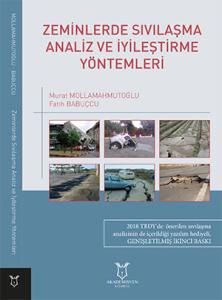
Zeminlerde Sıvılaşma Analiz ve İyileştirme Yöntemleri
Özet
\"Zeminlerde Sıvılaşma Analiz ve İyileştirme Yöntemleri\" adlı kitap, zemin mekaniği konusunda önemli bir kaynak olarak öne çıkmaktadır. Kitap, Prof. Dr. Murat MOLLAMAHMUTOĞLU ve İnş. Y. Müh. Fatih BABUÇCU tarafından kaleme alınmıştır. Bu kitap, zeminlerin sıvılaşma riski ve bu riskin nasıl analiz edileceği konularını ele almaktadır. Ayrıca, zeminlerin iyileştirilmesi için kullanılan yöntemleri de detaylı bir şekilde açıklamaktadır. Kitap, depremlerin yerel zeminlere olan etkisini de ele alarak, zemin mekaniği ile deprem mühendisliği arasındaki ilişkiyi vurgulamaktadır. Pratik bir yaklaşımla hazırlanan bu kitap, zemin mekaniği konusunda bilgi sahibi olmak isteyen mühendisler ve araştırmacılar için önemli bir kaynak niteliği taşımaktadır.
\"The book titled 'Liquefaction Analysis and Improvement Methods in Soils' stands out as an important resource in the field of soil mechanics. The book is written by Prof. Dr. Murat MOLLAMAHMUTOĞLU and Eng. M.Sc. Fatih BABUÇCU. This book addresses the liquefaction risk of soils and how this risk can be analyzed. Additionally, it provides detailed explanations of the methods used for soil improvement. The book also emphasizes the relationship between soil mechanics and earthquake engineering by discussing the impact of earthquakes on local soils. This practical approach makes the book a valuable resource for engineers and researchers who want to acquire knowledge in the field of soil mechanics.\"
Referanslar
Mollamahmutoğlu, M., Kayabali, K., Beyaz T., and Kolay, E. (2003) “Liquefaction-related building damage in Adapazari during the Turkey earthquake of August 17, 1999” Engineering Geology, 67, 297-307
Kramer, S.L. (1996) “Geotechnical Earthquake Engineering”, 653 pages, Prentice-Hall Civil Engineering and Engineering Mechanics Series.
Yılmaz, Y., and Mollamahmutoğlu, M. (2009). “Characterization of Liquefaction Susceptibility of Sands by Means of Extreme Void Ratios and/or Void Ratio Range’’ Journal of Geotechnical and Geoenvironmental Engineering 135(12): 1986-1990
Yılmaz, Y., Mollamahmutoğlu, M., Özaydın, V., Kayabalı, K. (2008). “Experimental investigation of the effect of grading characteristics on the liquefaction resistance of various graded sands.” Engineering Geology 100(3-4):91-100.
Boulanger, R.W., and Idriss, I. M. (2006). “Liquefaction susceptibility criteria for silts and clays’’, Journal of Geotechnical and Geoenvironmental Engineering, ASCE, 132(11),1413-426.
Seed, R.B., Cetin, K.O, Moss, R.E.S., Kammerer, A.M., Wu, J., Pestana, J.M., Riemer, M.F., Sancio, R.B., Bray, J.D., Kayen, R.E., Faris. A. (2003). “Recent advances in soil liquefaction engineering: A unified and consistent framework.” EERC-2003–06, Earthquake Engineering Research Institute, Berkeley, Calif,
Day, R.W. (2002). Çevirenler Mollamahmutoğlu, M. ve Kayabalı K. (2004). “Geoteknik Deprem Mühendisliği El Kitabı” Gazi Kitabevi, Fersa Matbaası, McGraw-Hill El Kitapları
Division of Mines and Geology (1997). “Guidelines for Evaluating and Mitigating Seismic Hazards in California”, Special Publication 117. Department of Conservation, Division of Mines and Geology, California.
Ishihara, K. (1985). "Stability of Natural Deposits During Earthquakes." Proceedings of the Eleventh International Conference on Soil Mechanics and Foundation Engineering, vol. l. San Francisco, pp. 321-376.
Ishihara, K. (1993). "Liquefaction and Flow Failure During Earthquakes." Geotechnique, vol. 43, no. 3, London, England, pp. 351-415.
Ishihara, K., Sodekawa, M., and Tanaka, Y. (1978). "Effects of Overconsolidation on Liquefaction Characteristics of Sands Containing Fines." Dynamic Geotechnical Testing, ASTM Special Technical Publication 654, ASTM, Philadelphia, pp. 246-264.
Handbook on liquefaction Remediation on Reclaimed Land (1997). Port and Harbour Research Institute, Ministry of Transport, Japan, Rotterdam, P.241.
Poulos, S. J., Castro, G., and France, J. W. (1985). "Liquefaction Evaluation Procedure." Journal of Geotechnical Engineering, ASCE, vol. 111, no. 6, pp. 772-792.
Seed, R. B. (1991). Liquefaction Manual. Course Notes for CE 275: Geotechnical Earthquake Engineering, College of Engineering, University of California, Berkeley.
Seed, H.B. and Idriss I.M. (1971). “Simplified procedure for evaluating soil liquefaction potential.” Journal of the Soil Mechanics and Foundation Divisions, ASCE, Vol.107, No.SM9, pp.1249-1274.
Seed, H. B., and Idriss, I. M. (1982). “Ground Motions and Soil Liquefaction During Earthquakes”. Earthquake Engineering Research Institute, University of California, Berkeley.
Seed, H. B., Mori, K., and Chan, C. K. (1975). "Influence of Seismic History on the Liquefaction Characteristics of Sands." Report EERC 75-25. Earthquake Engineering Research Center, University of California, Berkeley.
Seed, H. B., Idriss, I. M., and Arango, I. (1983). "Evaluation of Liquefaction Potential Using Field Performance Data." Journal of Geotechnical Engineering, ASCE, vol. 109, no. 3, pp. 458-482.
Yeats, R. S., Sieh, K., and Allen, C. R. (1997). The Geology of Earthquakes. Oxford University Press, New York.
Yoshimi, Y., Tokimatsu, K., and Hasaka, Y. (1989). “Evaluation of liquefaction resistance of clean sands based on high-quality undisturbed samples”. Soils and Foundations, vol. 29, no.1, pp. 93-104.
Youd, T. L., and Gilstrap, S. D. (1999). "Liquefaction and Deformation of Silty and Fine-Grained Soils." Earthquake Geotechnical Engineering, 2nd 3rd., Balkema, Rotterdam, pp. 1013-1020.
Idriss, I. M., and Boulanger, R. W. (2008). ‘’Soil liquefaction during earthquakes.’’ Monograph MNO-12, Earthquake Engineering Research Institute, Oakland, CA, 261 pp.
Kayen, R.E., Mitchell, J.K., Seed, R.B., Lodge, A., Nishio, S., and Coutinho, R. (1992). “Evaluation of SPT-, CPT-, and shear wave-based methods for liquefaction potential assessment using Loma Prieta data”, Proceedings, 4th US - Japan Workshop on Earthquake Resistant Design of Lifeline Facilities and Countermeasures for Soil Liquefaction, Vol. 1, pp. 177-204
Kovacs, W. D., and Salomone., L. A. (1982). “SPT hammer energy measurement”, Journal of the Geotechnical Engineering Division, ASCE, Vol. 108, No. GT4, pp. 599-620.
Kramer, S. L. (1996). Geotechnical Earthquake Engineering, 653 pages, Prentice-Hall Civil Engineering and Engineering Mechanics Series.
Liao, S.S.C. and Whitman, R.V. (1986a). “Overburden correction factors for SPT in sand”, Journal of Geotechnical Engineering, ASCE, Vol.112, No. 3, pp. 373-377.
Meyerhof, G.G. (1957). Discussion: Proceedings, 4th International Conference on Soil Mechanics and Foundation Engineering, Vol.3, pp.110.
Palacios, A. (1977). “The theory and measurement of energy transfer during SPT test sampling”, Ph. D. Dissertation, University of Florida.
Robertson, P. K., Woeller, D. J., and Finn, W. D. (1992). “Seismic cone penetration test for evaluating liquefaction potential under cyclic loading,” Canadian Geotechnical Journal,Ottawa Vol. 29, pp. 686-695.
Robertson, P.K., and Wride, C.E. (1998). “Evaluating cyclic liquefaction potential using the cone penetration test”, Canadian Geotechnical Journal, Ottawa, Vol. 35, No. 3, pp. 442-459.
Schmertmann, J. H. (1976). “Predicting the qc / N ratio-interpreting the dynamics of the standard penetration test”, University of Florida Report to the Department of Transportation, Florida.
Schmertmann, J. H. (1977). “Use the SPT to measure dynamic properties?- Yes, But....!”, Proceedings, American Society For Testing and Materials Symposium on Dynamic Field and Laboratory Testing of Soil and Rock, Denver.
Seed, H.B. and Idriss, I.M. (1971). “Simplified procedure for evaluating soil liquefaction potential”, Journal of the Soil Mechanics and Foundations Division, ASCE, Vol., 107, No. SM9, pp. 1249-1274.
Seed, H.B. and Idriss, I.M. (1982). “Ground Motions and Soil Liquefaction During Earthquakes”, Earthquake Engineering Research Institute, Berkeley, California, 134 pp.
Seed, H.B., Tokimatsu, K., Harder, L.F. and Chung, R.M. (1985). “Influence of SPT procedures in soil liquefaction resistance evaluations”, Journal of Geotechnical Engineering, Vol. 111, No.12, pp.1425-1445.
Skempton, A.K. (1986). “Standard penetration test procedures and the effects in sands of overburden pressure“, relative density, particle size, aging, and overconsolidation., Geotechnique, London, Vol. 36, No. 3, pp. 425-447.
Stokoe, K.H., II, Lee, S.H.H., and Knox, D. P. (1985). “Shear moduli measurements under true triaxial stresses,” Advances in the art of testing under cyclic conditions, ASCE, New York, pp. 166-185.
Sykora, D. W. (1987). “Creation of a data base os seismic shear wave velocities for correlation analysis,” Geotech. Lab. Misc. Paper GL-87-26, U.S. Army Engineering Waterways Experiment Station, Vicksburg, Miss.
Tokimatsu, K., and Yoshimi, Y. (1983). “Emprical correlation of soil liquefaction based on SPT-N value and fines content”, Soils and Foundations, Vol. 23, No. 4, pp. 56-74.
Whitman, R.V. (1971). “Resistance of soil to liquefaction and settlement”, Soils and Foundations, Vol. 11, No. 4, pp. 59-68.
Youd, T.L. et al. (2001). “Liquefaction Resistance of Soils: Summary Report From The 1996 NCEER and 1998 NCEER/NSF Workshops on Evaluation of Liquefaction Resistance of Soils”, Journal of Geotechnical and Geoenvironmental Engineering, ASCE, Vol.127, No. 10, pp. 817-832.
Boulanger, R. W., and Idriss, I. M., and (2014). "CPT and SPT-based liquefaction triggering procedures." Report UCD/CGM-14/01, Department of Civil and Environmental Engineering, University of California, Davis, CA, 134 pp.
Idriss, I. M., and Boulanger, R. W. (2008). ‘’Soil liquefaction during earthquakes.’’ Monograph MNO-12, Earthquake Engineering Research Institute, Oakland, CA, 261 pp.
Cetin, K. O., Seed, R. B., Der Kiureghian, A., Tokimatsu, K., Harder, L. F., Kayen, R. E., and Moss, R. E. S. (2004). Standard penetration test-based probabilistic and deterministic assessment of seismic soil liquefaction potential, J. Geotechnical and Geoenvironmental Eng., ASCE 130(12), 1314–340.
Vaid, Y. P., Stedman, J. D. &Sivathayalan, S. (2001). Confining stress and static shear effects in cyclic liquefaction. Can. Geotech. J. 38, No. 3, 580–591.
Andrus, R. D., and Stokoe, K. H. (2000). "Liquefaction Resistance of Soils from Shear Wave Velocity." Journal of Geotechnical and Geoenvironmental Engineering, vol. 126, no. 11, pp. 1015-1025.
Andrus R D, Stokoe K H, Juang C H. (2004) "Guide for Shear-Wave-Based Liquefaction Potential Evaluation", Eartquake Spectra.
Day, R.W. (2002). Çevirenler Mollamahmutoğlu, M. ve Kayabalı K. (2004). “Geoteknik Deprem Mühendisliği El Kitabı” Gazi Kitabevi, Fersa Matbaası, McGraw-Hill El Kitapları
De Alba, P., Seed, H.B., and Chan, C.K. (1976). “Sand liquefaction in large-scale simple shear tests” Journal of Geotechnical Engineering Division, ASCE, Vol. 102, No.GT9, pp.909-927.
Gilstrap, S.D. and Youd, T.L. (1998). “CPT based liquefaction resistance analyses using case histories.” Technical Report CEG-90-01, Department of Civil and Environmental Engineering, Birmingham Young University, Provo, Utah.
Hynes, ME and Olsen, RS. (1999). ‘’Influence of confining stress on liquefaction resistance’’ In: Proc. Int. Workshop on Phys. and Mech. of Soil Liquefaction, Balkema, Rotterdam, p. 145-52.
Idriss, I. M., (1990). ‘’Response of soft soil sites during earthquakes’’ Proceedings, H. Bolton Seed Memorial Symposium, Vol.2, BiTech Publishers, Ltd, Vancouver, B.C. Canada, p. 273 – 290.
Idriss, I.M. (1995). Seed Memorial Lecture, University of California at Berkeley (I.M. Idriss, personal communication to T.L. Youd, 1997)
Iwasaki, T., et al. (1978b). “A practical method for assessing soil liquefaction potential based on case studies at various sites in Japan” Proc. 2nd International Conference on Microzonation, San Francisco, Vol.2, pp. 885-896.
Iwasaki, T., Tokida, K., Tatsuoka, F. (1981) “Soil liquefaction potential evaluation with use of the simplified procedure” Proceedings, International Conference of Recent Advances in Geotechnical Earthquake Engineering and Soil Dynamics, Vol. 1, pp. 209-214.
Kramer, S. L. (1996). Geotechnical Earthquake Engineering. Prentice-Hall Civil Engineering and Engineering Mechanics.
Liao, S.S.C. and Whitman, R.V. (1986), “Overburden correction factors for SPT in sand.” Journal of Geotechnical Engineering, ASCE, Vol.112, No.3, pp.373-377.
Meyerhof, G.G., (1957) Discussion: Proceedings 4th International Conference on Soil Mechanics and Foundation Engineering, Vol.3, pp.110.
Robertson, P.K. (1990). “Soil classification using CPT” Canadian Geotechnical Journal, Ottawa, Vol. 27. No. 1, pp. 151-158.
Robertson, P. K., Woeller, D. J., and Finn, W. D. L. (1992). "Seismic Cone Penetration Test for Evaluating Liquefaction Potential Under Cyclic Loading." Canadian Geotechnical Journal, Ottawa, vol. 29, pp. 686-695.
Robertson, P.K. and Fear, C.E. (1995). “Liquefaction of sands and its evaluation” Proceedings, 1st Conference on Earthquake Geotechnical Engineering
Robertson, P.K. and Wride, C.E. (1998). “Evaluating cyclic liquefaction potential using the cone penetration test.” Can. Geotechnical Journal. Ottowa, Vol.35, No.3, pp.442-459.
Seed, H. B. (1979a). "Soil Liquefaction and Cyclic Mobility Evaluation for Level Ground During Earthquakes." Journal of the Geotechnical Engineering Division, ASCE, vol. 105, no. GT2, pp. 201-255.
Seed, H. B., and Idriss, I. M. (1982). “Ground Motions and Soil Liquefaction During Earthquakes.” Earthquake Engineering Research Institute, University of California, Berkeley.
Seed, H.B. and Idriss I.M. (1971). “Simplified procedure for evaluating soil liquefaction potential.” Journal of the Soil Mechanics and Foundation Divisions, ASCE, Vol.107, No.SM9, pp.1249-1274.
Seed, H.B., Tokimatsu, K., Harder, L.F., and Chung, R.M. (1985). “The influence of SPT procedures in soil liquefaction resistance evaluations” Journal of Geotechnical Engineering, ASCE, Vol.111, No.12, pp.1425-1445.
Seed, R.B., (1996) “Recent advances in evaluation and mitigation of liquefaction hazards” Ground Stabilization and Seismic Mitigation, Theory and Practice, Portland, Oregon.
Seed, H.B. and De Alba, P. (1986). “Use of SPT and CPT tests for evaluating the liquefaction resistance of soils” Proceedings, Insitu ’86, ASCE
Suzuki, Y., Koyamada, K., and Tokimatsu, K. (1997) “Prediction of liquefaction resistance based on CPT tip resistance and sleeve friction” Proceedings XIV International Conference of Soil Mechanics and Foundation Engineering, Hamburg, Germany, pp. 603-606.
Sykora, D. W. (1987). "Creation of a Data Base of Seismic Shear Wave Velocities for Correlation Analysis." Geotechnical Laboratory Miscellaneous Paper GL-87-26. U.S. Army Engineer Waterways Experiment Station, Vicksburg, MS.
Tokimatsu, K. and Yoshimi, Y. (1983). “Empirical correlation for soil liquefaction based on SPT-N values and fines content.” Soils and Foundations, Vol.23, No.4, pp.56-74.
Woods, R. D., ed. (1994). Geophysical Characterization of Sites. Balkema, Rotterdam, The Netherlands.
Youd, T.L. et al. (2001). “Liquefaction Resistance of Soils: Summary Report From The 1996 NCEER and 1998 NCEER/NSF Workshops on Evaluation of Liquefaction Resistance of Soils” Journal of Geotechnical and Geoenvironmental Engineering, ASCE, Vol.127, No.10, pp.817-832.
Mollamahmutoğlu, M. and Avcı, E. (2018),’’ Dynamic compaction experience in alluvial soils of Carsamba (Turkey), Maejo international journal of science and technology 12(3):206-220.
Yasuda, S. (2007). Remediation Methods Against Liquefaction which can be Applied to Existing Structures. Earthquake Geotechnical Engineering, pp. 385–406.
American Society of Civil Engineers: Committee on Deep Foundations, Practical Guidelines for the selection, Design and Installation of Piles, American Society of Civil Engineers, 1984.
Boulanger, DP, Hashish, Y and Schmidt, B, [1997]. ‘’Drainage Capacity of Stone Columns or Gravel Drains for Mitigating Liquefaction’’, 2 nd Geotechnical Earthquake Engineering and Soil Dynamics Conference, Seattle, Vol. I, 678-690.
Broms, B. (1991), “Deep compaction of granular soil”, in H.Y. Fang, ed., Foundation Engineering Handbook, 2nd ed., Van Nostrand Reinhold, New York, pp. 814-832.
Brown, R.E. (1977), “Vibroflotation compaction of cohesionless soils”, Journal of the Geotechnical Engineering Division, ASCE, 103,No.GT-12, pp. 1437-1451.
Brown, D.R. and Warner, J. (1973), Compaction Grouting, Journal of the Soil Mechanics and Foundations Division, ASCE, 99, No. SM-8, paper 9908, pp.589-601.
Brown, R.E. and Glenn, A.J.(1976), “Vibroflotation and terra-probe comparison”, Journal of the Geotechnical Engineering Division, ASCE; 102, No. GT-10, pp.1059-1072.
Dobson, T. and Slocamble, B. (1982). “Deep Densification of Granular Fills”, The 2nd Geotechnical Conference and Exhibit on Design Construction, Las Vegas, April, pp. 26-28.
Ivanov, P.L. (1967). “Compaction of Non-Cohesive Soils by Explosions” Izdatel ‘Stvo Literatury Po Stroitel ‘Stvu, Leningrad. Published for the U.S. Dept. of the Interior Bureau of Reclamation and National Science Foundation, Washington, D.C. by the Indian National Scientific Documentation Centre, New Delhi, TT 70-57221, 1972, 211 pp.
Karol, R.H. (1983), Chemical Grouting, 327 pages, M.Dekker
Kramer, S.L. (1996) Geotechnical Earthquake Engineering, 653 pages, Prentice-Hall Civil Engineering and Engineering Mechanics Series.
Kishida, H. (1967) “Ultimate bearing capacity of piles driven into loose sand”, Soils and Foundation,7, No.3, pp. 20-29.
Leonards, G.A., Cutter, W.A., and Holtz, R.D. (1980) “Dynamic compaction of granular soils”, Journal of the Geotechnical Engineering Division, ASCE, Vol.106, No. GT-1, pp. 35-44
Massarsch, K. R. (1985) “Deep compaction of sand using vibratory probes”, Proceedings of the Third International Geotechnical Seminar, Soil Improvement methods, Singapore, pp. 9-17.
Mayne, P.W., Jones, J.S., and Dumas, J.C. (1984) “Ground response to dynamic compaction”, Journal of Geotechnical Engineering, 110, No.6, pp. 757-774
Mitchell, J.K. (1981). “Soil Improvement-State-of-the Art Report”, Proceedings of the Tenth International Conference on Soil Mechanics &Foundation Engineering, Stockholm.
Mitchell J.K., Baxter C.D.P., Munson T.C. (1995). “Performance of Improved Ground During Earthquakes”, Soil Improvement for Earthquake Hazard Mitigation, ASCE, 145 pp., Geotechnical Special Publication No. 49
Seed, HB, and Booker, JR [1977]. “Stabilization of Potentially Liquefiable Sand Deposits Using Gravel Drains,” J. Geotechnical Engrg. Div., ASCE, 103(GT7), 757-768.
Mollamahmutoğlu, M. (1995), “A review of some of the properties of Geoseal MQ-5 and silicate-Hardener 600B grouts, Ground Engineering’’, London, pp. 44–48.
Avcı, E., and Mollamahmutoğlu, M. (2018). ‘’Syneresis dependent shear strength parameters of sodium silicate grouted sands’’ Quarterly Journal of Engineering Geology and Hydrogeology, 52 (1), pp. 99-109.
Mollamahmutoğlu, M., Avcı, E., Tomaç, S. K., and Köse, D.A. (2017). ‘’Performance of Novel Chemical Grout in Treating Sands’’ ASCE Journal of Materials in Civil Engineering, Volume 29, Issue 10, 04017164.
Mollamahmutoğlu, M. (2003) Treatment of Medium to Coarse Grained Sands by Fine-Grained Portland Cement as an Alternative Grouting Material to Silicate-ester Grouts, ASTM, Volume 25, Number 1, pp.1 – 6.
Mollamahmutoğlu, M., and Avcı, E. (2015). ‘’ Effectiveness of Microfine Portland Cement Grouting on the Strength and Permeability of Medium to Fine Sands’’ Periodica Polytechnica Civil Engineering, Vol. 59, No 3, pp. 319-326.
Mollamahmutoğlu, M., and Avcı, E. (2015). ‘’ Ultrafine Portland cement grouting performance with or without additives’’ KSCE Journal of Civil Engineering, Volume 19, Issue 7, pp 2041–2050
Peck, R.B., Hanson, W.E., and Thornbur (n, T.H. (1974) Foundation Engineering, 2nd ed., Wiley, New York
Robinsky, E.I. and Morrison, D.E. (1964) “Sand displacement and compaction around model friction piles”, Canadian Geotechnical Journal,1,No.2, p.81.
Saito, A. (1977) “Characteristics of penetration resistance of a reclaimed sandy deposit and their change through vibratory compaction”, Soils and Foundation, (17), 4, pp. 32-43
Salley, J. R., Foreman, B., Baker, W. H., and Henry, J.F. (1987) “Compaction grouting test programme Pinopolis West Dam”, Soil Improvement-A Ten Year Update, ASCE, Geotechnical Special Publication, No. 12, pp.245-269.
Stilley, A.N. (1982) “Compaction Grouting for Foundation Stabilization”, Proceedings, ASCE Specialty Conference on Grouting in Geotechnical Engineering, New Orleans, Louisiana, pp. 923-937.
Solymar, Z. V. and Reed, D.J. (1986) “A comparison of foundation compaction techniques”, Canadian Geotechnical Jouvcırnal, 23, No.3, pp. 271-280.
Thorburn, S. (1975) “Building structures supported by stabilized ground”, Geotechnique, (25), 1, pp. 83-94.
Vesic, A.S. (1977) “Design of Pile Foundations”, Transportation Research Board, NRC, Washington, D.C., pp. 44-47.
Youd, T. L., and Gilstrap, S. D. (1999) "Liquefaction and Deformation of Silty and Fine-Grained Soils." Earthquake Geotechnical Engineering, 2d 3d., Balkema, Rotterdam, pp. 1013-1020.
Andrus, R, D,, Stokoe, K, H,, &Hsein Juang, C, (2004), Guide for shear-wave-based liquefaction potential evaluation, Earthquake Spectra, 20(2), 285-308,
Babuçcu, F, (2002),”Zeminlerde sıvılaşma potansiyelinin ve sıvılaşma sonucu oturmanın SPT ve CPT verilerine dayalı analiz yöntemleri üzerine bilgisayar yazılımı’’ Yüksek Lisans Tezi, G,Ü, Fen Bilimleri Enstitüsü, Boulanger, R, W, (2003), Relating Kα to relative state parameter index, Journal of geotechnical and geoenvironmental engineering, 129(8), 770-773,
Boulanger, R, W,, &Idriss, I, M, (2014), CPT and SPT based liquefaction triggering procedures, Report No, UCD/CGM,-14,1,
Jamiolkowski, M,, LO PRESTI, D, C,, Garizio, G, (2001), Correlation between relative density and cone resistance for silica sands (pp, 55-63), Institute fur Grundbau und Bodenmechanik; TUW,
Mayne, P, W, (2007), NCHRP synthesis 368, Cone Penetration Testing, A synthesis of highway practice, Washington, D,C,: Transportation research board,
Seed, H, B,, &Idriss, I, M, (1971), Simplified procedure for evaluating soil liquefaction potential,Journal of Soil Mechanics &Foundations Div,
Robertson, P, K, (2009), Performance based earthquake design using the CPT, Proc, IS-Tokyo, 3-20,
Türkiye Bina Deprem Yönetmeliği (T,C, Resmi Gazete, 18 Mart 2018, sayı: 30364)
Yoshimine, M,, Nishizaki, H,, Amano, K,, &Hosono, Y, (2006), Flow deformation of liquefied sand under constant shear load and its application to analysis of flow slide of infinite slope, Soil Dynamics and Earthquake Engineering, 26(2-4), 253-264,
Yi, F,, 2009b, Procedure to Evaluate Seismic Settlement in Dry Sand Based on Shear Wave Velocity, Manuscript submitted to The 9th U,S, National and 10th Canadian Conference on Earthquake Engineering (9USN/10CCEE), Toronto, Canada, July 25-29, 2010,
Blake, T. F. (2000b). EQSEARCH Computer Program, Version 3.00. Computer Program for Estimation of Peak Acceleration from California Earthquake Catalogs. Thousand Oaks, CA.
Day R. (2002) “Geotechnical Earthquake Engineering”, 653 pages, Prentice-Hall Civil Engineering and Engineering Mechanics Series.
Division of Mines and Geology (1997). “Guidelines for Evaluating and Mitigating Seismic Hazards in California”, Special Publication 117. Department of Conservation, Division of Mines and Geology, California.
Uniform Building Code (1997). International Conference of Building Officials, three volumes, Whittier, CA.
Yayınlanan
Lisans
LisansBu İnternet Sitesi içeriğinde yer alan tüm eserler (yazı, resim, görüntü, fotoğraf, video, müzik vb.) Akademisyen Kitabevine ait olup, 5846 sayılı Fikir ve Sanat Eserleri Kanunu ve 5237 sayılı Türk Ceca Kanunu kapsamında korunmaktadır. Bu hakları ihlal eden kişiler, 5846 sayılı Fikir ve Sanat eserleri Kanunu ve 5237 sayılı Türk Ceza Kanununda yer alan hukuki ve cezai yaptırımlara tabi olurlar. Yayınevi ilgili yasal yollara başvurma hakkına sahiptir.
