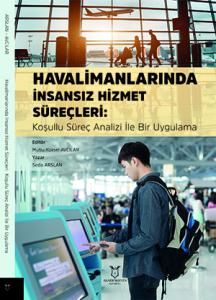
Havalimanlarında İnsansız Hizmet Süreçleri: Koşullu Süreç Analizi ile Bir Uygulama
Özet
Bu kitap, havalimanlarında insansız hizmet süreçlerinin koşullu süreç analizi ile incelenmesini konu almaktadır. Havacılık sektöründe teknoloji temelli hizmet inovasyonları uzun süredir kullanılmaktadır ve bu inovasyonlar artık seyahat sürecinin tamamında kullanılabilmektedir. Hızlı seyahat teknolojileri, havalimanlarında uçuş öncesi ve sonrası işlemlerin hızlı ve teması azaltarak gerçekleştirilmesini sağlamaktadır. Ancak bu teknolojileri kullanma niyeti düşük olan yolcu sayısı bir sorun olarak görülmektedir. Bu kitap, yolcuların teknolojik yatkınlık düzeyinin, algılanan kullanım kolaylığı, algılanan fayda ve tutum gibi faktörler üzerindeki etkisini ve hizmet personeli ile etkileşim düzeyinin bu ilişkilerdeki düzenleyici rolünü incelemektedir. Araştırma sonuçları, havacılık endüstrisi paydaşlarına, hızlı seyahat teknolojilerinin kullanım niyetini artırmak için yapılması gerekenleri sunmaktadır.
This book examines the conditional process analysis of unmanned service processes in airports. Technology-based service innovations have been used in the aviation industry for a long time and these innovations can now be used throughout the travel process. Fast travel technologies enable pre-flight and post-flight processes to be carried out quickly and with reduced contact in airports. However, the low intention to use these technologies by passengers is seen as a problem. This book examines the impact of passengers' technological inclination level on factors such as perceived ease of use, perceived benefits, and attitude, as well as the regulatory role of interaction level with service personnel in these relationships. The research results provide aviation industry stakeholders with insights on what needs to be done to increase the intention to use fast travel technologies.
Referanslar
Abbas, M., Shahid Nawaz, M., Ahmad, J., & Ashraf, M. (2017). The effect of innovation and consumer related factors on consumer resistance to innovation. Cogent Business, & Management, 4(1), 1312058.
Acar, Y. (2020). Yeni koronavirüs (Covid-19) salgını ve turizm faaliyetlerine etkisi. Güncel Turizm Araştırmaları Dergisi, 4(1), 7-21.
ACI (2021). Airports council international. Erişim tarihi 12 Eylül 2021, https://aci.aero/
Adiyarta, K., Napitupulu, D., Nurdianto, H., Rahim, R., & Ahmar, A. (2018, May). User acceptance of E-Government Services Based on TRAM model. In IOP Conference Series: Materials Science and Engineering (Vol. 352, No. 1, p. 012057). IOP Publishing.
Ahadzadeh, A. S., Sharif, S. P., Ong, F. S., & Khong, K. W. (2015). Integrating health belief model and technology acceptance model: An investigation of health-related internet use. Journal of Medical Internet Research, 17(2), e3564.
Ajzen I. (1985). From intentions to actions: A theory of planned behavior. J. Kuhl and J. Beckmann (Eds), In Action control SSSP Springer series in social psychology (pp. 11-39). Berlin: Springer.
Ajzen, I. (1991). The theory of planned behavior. Organizational Behavior and Human Decision Processes, 50, 179-211.
Aksöz, M. (2016). Examining the adoption of intention of internet of things in healthcare technology products with innovation diffusion theory and technology acceptance model. Master Thesis, Bahçeşehir University, Istanbul
Alam, I., & Perry, C. (2002). A customer‐oriented new service development process. Journal of Services Marketing, 16(6), 515-534.
Alam, M., Parveen, R., Khan, I. R., & Hamdard, J. (2020). Role of information technology in Covid-19 prevention. International Journal of Business Education and Management Studies, 5(1), 65-78.
Al-Emran, M. (2021). Evaluating the use of smartwatches for learning purposes through the integration of the technology acceptance model and task-technology fit. International Journal of Human–Computer Interaction, 1-9. https://doi.org/10.1080/10447318.2021.1921481
Alkevli, A. (2020). Tüketicilerin işbirlikçi tüketime yönelik niyetini etkileyen faktörler: Kuşaklararası bir çalışma. Doktora Tezi, Osmaniye Korkut Ata Üniversitesi, Osmaniye.
Alkış, M.C. (2016). Havacılık endüstrisinde self servis uygulamaları, IATA “Hızlı Seyahat Programı” kapsamında 3. Havalimanı için öneriler. Yüksek lisans tezi, Beykent Üniversitesi, İstanbul.
Al-Maatouk, Q., Othman, M. S., Aldraiweesh, A., Alturki, U., Al-Rahmi, W. M., & Aljeraiwi, A. A. (2020). Task-technology fit and technology acceptance model application to structure and evaluate the adoption of social media in academia. IEEE Access, 8, 78427-78440.
Amaro, S., & Duarte, P. (2015). An integrative model of consumers' intentions to purchase travel online. Tourism management, 46, 64-79.
Anninou, I., Stavraki, G., & Yu, Y. (2018). Cultural differences on perceived crowding, shopping stress and excitement in superstores. In Proceedings of the 51th Academy of Marketing Conference (pp. 1-13).
Arpaci, I., & Basol, G. (2020). The impact of preservice teachers’ cognitive and technological perceptions on their continuous intention to use flipped classroom. Education and Information Technologies, 25(5), 3503-3514.
Arslantürk, Z., & Arslantürk, E.H. (2013). Uygulamalı sosyal araştırma: Kavramlar, teknikler, metotlar, bilgisayar uygulamaları (3. Baskı). İstanbul: Çamlıca Yayınları.
Atalık, Ö., Akan, Ş., & Bakır, M. (2019). Havacılık 4.0: Havayolu ve havaalanı endüstrisinde güncel Endüstri 4.0 uygulamaları. Proceedings of II. International Conference on Emprical Economics and Social Science (ICEESS’ 19), 894-906.
Atcha, M. H. (2020). Airport passenger technology readiness and self-service bag drop technology adoption at South African Airports. Doctoral dissertation, University of the Witwatersrand, Johannesburg, South Africa.
Avcılar, M. Y. (2010). Tüketici temelli perakendeci değerinin ölçümü: Adana ilinde bir araştırma. Doktora Tezi, Niğde Üniversitesi, Niğde.
Aydın, B., & Doğan, M. (2020). Yeni koronavirüs (COVID-19) pandemisinin turistik tüketici davranışları ve Türkiye turizmi üzerindeki etkilerinin değerlendirilmesi. Pazarlama Teorisi ve Uygulamaları Dergisi, 6(1), 93-115.
Bae, S. Y., & Chang, P. J. (2021). The effect of coronavirus disease-19 (COVID-19) risk perception on behavioural intention towards ‘untact’tourism in South Korea during the first wave of the pandemic (March 2020). Current Issues in Tourism, 24(7), 1017-1035.
Bagozzi, R. P. (1981). Evaluating structural equation models with unobservable variables and measurement error: a comment. Journal of Marketing Research, XVIII (August 1981), 375-81.
Bagozzi, R. P., Yi, Y., & Nassen, K. D. (1998). Representation of measurement error in marketing variables: Review of approaches and extension to three-facet designs. Journal of Econometrics, 89(1-2), 393-421.
Baron, R. M., & Kenny, D. A. (1986). The moderator–mediator variable distinction in social psychological research: Conceptual, strategic, and statistical considerations. Journal of personality and social psychology, 51(6), 1173-1182.
Barrett, M., Davidson, E., Prabhu, J., & Vargo, S. L. (2015). Service innovation in the digital age: key contributions and future directions. MIS Quarterly, 39(1), 135–154.
Başgöze, P. (2010). Teknoloji kabul modelinin teknolojik yatkınlık ve marka kredibilitesi değişkenleri eklenerek genişletilmesi: Satın alma eğilimine uyarlanması. Doktora Tezi, Hacettepe Üniversitesi, Ankara.
Baum, T., & Hai, N. T. T. (2020). Hospitality, tourism, human rights and the impact of COVID-19. International Journal of Contemporary Hospitality Management, 32(7), 2397-2407.
Beatson, A., Lee, N., & Coote, L. V. (2007). Self-service technology and the service encounter. The Service Industries Journal, 27(1), 75-89.
Bekar, A. (2020). Ürün konumlandırmada Covid-19’un ihracat ve pazarlama stratejisine etkisi: Pandemi süreci ve sonrası mobilya sektörü. Uluslararası Sosyal Bilimler Akademi Dergisi, (4), 852-873.
Belanche, D., Casaló, L. V., & Flavián, C. (2020). Customer’s acceptance of humanoid robots in services: The moderating role of risk aversion. In Marketing and Smart Technologies (pp. 449-458). Springer, Singapore.
Belanche, D., Casaló, L. V., Flavián, C., & Schepers, J. (2020a). Service robot implementation: A theoretical framework and research agenda. The Service Industries Journal, 40(3-4), 203-225.
Belge, S., & Mutlu, H. M. (2020). Tüketicilerin giyilebilir teknolojileri benimsenmesine yönelik davranışsal niyet ve kullanımları üzerine bir araştırma. Uygulamalı Sosyal Bilimler Dergisi, 4(1), 14-35.
Belk, R. W. (1974). An exploratory assessment of situational effects in buyer behavior. Journal of Marketing Research, 11(2), 156-163.
Berkhout, A. J., Hartmann, D., van der Duin, P., & Ortt, R. (2006). Innovating the innovation process. International Journal of Technology Management, 34(3-4), 390-404.
Bhat, D. A. R., & Sharma, V. (2021). Dimensionality and consequences of service innovation: An empirical study of hospitality industry. Cogent Business, & Management, 8(1), 1924931.
Bilici, F., & Özdemir, E. (2020). Tüketicilerin artırılmış gerçeklik teknolojilerini kullanma niyeti üzerinde teknolojik hazır bulunuşluluğun rolü. International Social Mentality and Researcher Thinkers Journal, 6(37), 2046-2060.
Bish, A., & Michie, S. (2010). Demographic and attitudinal determinants of protective behaviours during a pandemic: A review. British journal of health psychology, 15(4), 797-824.
Bitner, M. J., Zeithaml, V. A., & Gremler, D. D. (2010). Technology’s impact on the gaps model of service quality. P. P. Maglio, C. A. Kieliszewski and J. C. Spohrer (Eds.), in Service science: Research and innovations in the service economy (p. 197-218). London: Springer.
Blut, M., & Wang, C. (2020). Technology readiness: A meta-analysis of conceptualizations of the construct and its impact on technology usage. Journal of the Academy of Marketing Science, 48(4), 649-669.
Bobbitt, L. M., & Dabholkar, P. A. (2001). Integrating attitudinal theories to understand and predict use of technology-based self-service: The internet as an illustration. International Journal of Service Industry management, 12(5), 423-450.
Bogicevic, V., Bujisic, M., Bilgihan, A., Yang, W., & Cobanoglu, C. (2017). The impact of traveler-focused airport technology on traveler satisfaction. Technological Forecasting and Social Change, 123, 351-361.
Bollen, K.A. (1989). Structural Equations with Latent Variables. New York, USA: John Wiley, & Sons Inc.
Bowonder, B., Dambal, A., Kumar, S., & Shirodkar, A. (2010). Innovation strategies for creating competitive advantage. Research-technology Management, 53(3), 19-32.
Brown, T. A., & Moore, M. T. (2014). Confirmatory factor analysis. In Running Head (pp. 1–39). Boston.
Burgelman, R. A., Christensen, C. M., & Wheelwright, S. C. (2009). Strategic Management of Technology and Innovations (5th ed.). Chicago: McGraw Hill.
Busagara, T., Mori, N., Mossberg, L., Jani, D., & Andersson, T. (2020). Customer information sharing and new service development: Is there a link? The Bottom Line, 33(2), 133-147.
Büyüköztürk, Ş. (2010). Sosyal bilimler için veri analizi el kitabı: İstatistik, araştırma deseni, SPSS uygulamaları ve yorum (12. baskı). Ankara: Pegem Akademi.
Carico, C.C., Sheppard, J., & Thomas, C. B. (2021). Community pharmacists and communication in the time of COVID-19: Applying the health belief model. Research in Social and Administrative Pharmacy, 17(1), 1984-1987.
Cassidy, K., Baron, S., & Lu, X. (2015). How customers ‘learn’to work for retailers. Journal of Marketing Management, 31(17-18), 1747-1772.
Castillo-Manzano, J. I., & López-Valpuesta, L. (2013). Check-in services and passenger behaviour: Self service technologies in airport systems. Computers in Human Behavior, 29(6), 2431-2437.
Castka, P., Searcy, C., & Fischer, S. (2020). Technology-enhanced auditing in voluntary sustainability standards: The impact of COVID-19. Sustainability, 12(11), 4740.
Cebeci, U., Ertug, A., & Turkcan, H. (2020). Exploring the determinants of intention to use self-checkout systems in super market chain and its application. Management Science Letters, 10(5), 1027-1036.
Celik, H., & Kocaman, R. (2017). Roles of self-monitoring, fashion involvement and technology readiness in an individual’s propensity to use mobile shopping. Journal of Systems and Information Technology, 19(3/4), 166-182.
Chai, L., Li, J., Tangpong, C., & Clauss, T. (2020). The interplays of coopetition, conflicts, trust, and efficiency process innovation in vertical B2B relationships. Industrial Marketing Management, 85, 269-280.
Champion, V.L.,, & Skinner, C.S. (2018). The health belief model. K. Glanz, B.K. Rimer, & K. Viswanath (Eds.), In Health behavior and health education: theory, research, and practice (4th Edition), (s. 45-65), San Francisco: Jossey-Bass.
Chang, H. L., & Yang, C. H. (2008). Do airline self-service check-in kiosks meet the needs of passengers? Tourism Management, 29(5), 980-993.
Chen, F. C. Y. (2007). Passenger use intentions for electronic tickets on international flights. Journal of Air Transport Management, 13(2), 110-115.
Chen, M. F., & Lin, N. P. (2018). Incorporation of health consciousness into the technology readiness and acceptance model to predict app download and usage intentions. Internet Research, 28(2), 351-373.
Chen, Q., Lu, Y., Gong, Y., & Tang, Q. (2019). Why do users resist service organization’s brand mobile apps? The force of barriers versus cross-channel synergy. International Journal of Information Management, 47, 274-282.
Chen, S. C., & Li, S. H. (2010). Consumer adoption of e-service: Integrating technology readiness with the theory of planned behavior. African Journal of Business Management, 4(16), 3556-3563.
Chen, Y., Yu, J., Yang, S., & Wei, J. (2018). Consumer’s intention to use self-service parcel delivery service in online retailing: An empirical study. Internet research, 28(2), 500-519.
Choi, J. H. (2021). Changes in airport operating procedures and implications for airport strategies post-COVID-19. Journal of Air Transport Management, 94, 102065.
Chung, N., Han, H., & Joun, Y. (2015). Tourists’ intention to visit a destination: The role of augmented reality (AR) application for a heritage site. Computers in Human Behavior, 50, 588-599.
Churchill Jr, G. A. (1979). A paradigm for developing better measures of marketing constructs. Journal of marketing research, 16(1), 64-73.
Claudy, M. C., Garcia, R.,, & O’Driscoll, A. (2015). Consumer resistance to innovation - A behavioral reasoning perspective. Journal of the Academy of Marketing Science, 43(4), 528-544.
Cochran, W. G. (1977). Sampling techniques (Third edition). United States of America: John Wiley, & Sons Inc.
Collier, J. E., Moore, R. S., Horky, A., & Moore, M. L. (2015). Why the little things matter: Exploring situational influences on customers' self-service technology decisions. Journal of Business Research, 68(3), 703-710.
Csuka, S. I., Martos, T., Kapornaky, M., Sallay, V., & Lewis, C. A. (2019). Attitudes toward technologies of the near future: The role of technology readiness in a Hungarian adult sample. International Journal of Innovation and Technology Management, 16(06), 1950046.
Cualheta, L. P., Caetano, M., & Almeida, C. F. (2020). New service development process applied on air transport industry. Revista Gestão, & Tecnologia, 20(2), 146-167.
Curran, J. M., & Meuter, M. L. (2005). Self-service technology adoption: Comparing three technologies. Journal of Services Marketing, 19(2), 103–113
Çabuk, S., Demirci Orel, F., & İplik, E. (2008). Kalabalık ve zaman baskısı altındaki tüketicilerin alışverişten duydukları tatmin düzeyini belirlemeye yönelik bir çalışma. Öneri Dergisi, 8(29), 1-12.
Çalışkan, S. (2017). Antecedents of consumer intention to use personal health Technologies: Revisiting the technology acceptance model. Doktora tezi, Boğaziçi Üniversitesi, İstanbul.
Çelik, H. (2011). Influence of social norms, perceived playfulness and online shopping anxiety on customers' adoption of online retail shopping: An empirical study in the Turkish context. International Journal of Retail & Distribution Management, 39(6), 390-413.
Çiftçi, N. (2020). Sağlık inanç modeline dayalı eğitim programının üniversite öğrencilerinin fiziksel aktivite inanç ve davranışlarına etkisi. Doktora tezi, Marmara Üniversitesi, İstanbul.
Çokluk, Ö., Şekercioğlu, G., & Büyüköztürk, Ş. (2016). Sosyal bilimler için çok değişkenli istatistik – SPSS ve Lisrel uygulamaları (4. baskı). Ankara: Pegem Akademi.
Dabholkar, P. A. (2000). Technology in service delivery: Implications for self-service and service support. T. A. Swartz ve D. Iacobucci (Ed.), In Handbook of services marketing and management, (s. 103-110). California: Sage Publications.
Dabholkar, P. A., & Bagozzi, R. P. (2002). An attitudinal model of technology-based self-service: moderating effects of consumer traits and situational factors. Journal of the Academy of Marketing Science, 30(3), 184-201.
Damanpour, F., & Schneider, M. (2008). Characteristics of innovation and innovation adoption in public organizations: Assessing the role of managers. Journal of Public Administration Research and Theory, 19(3), 495-522.
Damanpour, F., Sanchez‐Henriquez, F., & Chiu, H. H. (2018). Internal and external sources and the adoption of innovations in organizations. British Journal of Management, 29(4), 712-730.
D'Ambra, J., Wilson, C. S., & Akter, S. (2013). Application of the task‐technology fit model to structure and evaluate the adoption of E‐books by Academics. Journal of the American Society for Information Science and Technology, 64(1), 48-64.
Das, S. S., & Tiwari, A. K. (2021). Understanding international and domestic travel intention of Indian travellers during COVID-19 using a Bayesian approach. Tourism Recreation Research, 46(2), 228-244.
D'Attoma, I., & Ieva, M. (2020). Determinants of technological innovation success and failure: Does marketing innovation matter? Industrial Marketing Management, 91, 64-81.
Davis, F. D. (1985). A technology acceptance model for empirically testing new end-user information systems: Theory and results. Doctoral dissertation, Massachusetts Institute of Technology, Cambridge, MA.
Davis, F. D. (1989). Perceived usefulness, perceived ease of use, and user acceptance of information technology. MIS Quarterly, 13(3), 319-340.
Davis, F. D., Bagozzi, R. P., & Warshaw, P. R. (1989). User acceptance of computer technology: A comparison of two theoretical models. Management Science, 35(8), 982-1003.
De Jong, J. P., Bruins, A., Dolfsma, W., & Meijaard, J. (2003). Innovation in service firms explored: What, how and why. EJM Business and Research, Literature review, Zoetermeer.
De Vos, J. (2020). The effect of COVID-19 and subsequent social distancing on travel behavior. Transportation Research Interdisciplinary Perspectives, 5, 100121.
Dedeoğlu, A. Ö. (2018). Yeni ürün ve hizmet sunma (Philip Kotler - Kevin Lane Keller). İ. Kırcova (Eds.), Pazarlama Yönetimi: Kotler - Keller içinde (pp. 429 - 459). İstanbul: Beta Yayınevi.
Değerli, A., Aytekin, Ç., & Değerli, B. (2015). Analyzing information technology status and networked readiness index in context of diffusion of innovations theory. Procedia-Social and Behavioral Sciences, 195, 1553-1562.
Delgosha, M. S., & Hajiheydari, N. (2021). How human users engage with consumer robots? A dual model of psychological ownership and trust to explain post-adoption behaviours. Computers in Human Behavior, 117, 106660.
Demoulin, N. T., & Djelassi, S. (2016). An integrated model of self-service technology (SST) usage in a retail context. International Journal of Retail, & Distribution Management, 44(5), 540-559.
den Hertog, P., & Bilderbeek, R. (1999). Conceptualising service innovation and service innovation patterns. Research Programme on Innovation in Services (SIID) for the Ministry of Economic Affairs, Dialogic, Utrecht.
Devlet Hava Meydanları İşletmesi Genel Müdürlüğü (DHMİ) (2021). İstatistikler. Erişim tarihi 9 Ağustos 2021, www.dhmi.gov.tr
Dishaw, M. T., & Strong, D. M. (1999). Extending the technology acceptance model with task–technology fit constructs. Information, & Management, 36(1), 9-21.
Dodel, M., & Mesch, G. (2017). Cyber-victimization preventive behavior: A health belief model approach. Computers in Human behavior, 68, 359-367.
Doganis, R. (2002). Flying off course: The economics of international airlines. Third edition. London: Routledge Taylor, & Francis Group.
Doganis, R. (2006). The airline business, (2th ed.). Oxon: Routledge.
Drljača, M., Štimac, I., Bračić, M., & Petar, S. (2020). The role and influence of industry 4.0. in airport operations in the context of covid-19. Sustainability, 12(24), 10614.
Dryhurst, S., Schneider, C. R., Kerr, J., Freeman, A. L., Recchia, G., Van Der Bles, A. M., Spiegelhalter, D. , & van der Linden, S. (2020). Risk perceptions of COVID-19 around the world. Journal of Risk Research, 23(7-8), 994-1006.
Dube, K., Nhamo, G., & Chikodzi, D. (2021). COVID-19 pandemic and prospects for recovery of the global aviation industry. Journal of Air Transport Management, 92, 102022.
Dou, K., Yu, P., Deng, N., Liu, F., Guan, Y., Li, Z., ... & Duan, H. (2017). Patients’ acceptance of smartphone health technology for chronic disease management: a theoretical model and empirical test. JMIR mHealth and uHealth, 5(12), e7886.
Durst, S., Mention, A. L., & Poutanen, P. (2015). Service innovation and its impact: What do we know about? Investigaciones europeas de dirección y economía de la empresa, 21(2), 65-72.
Dursun, Ö. O. (2017). İnovasyon üzerine kavramsal bir inceleme. International Journal of Management and Administration, 1(1), 12-17.
Edvardsson, B., Frow, P., Jaakkola, E., Keiningham, T. L., Koskela-Huotari, K., Mele, C., & Tombs, A. (2018). Examining how context change foster service innovation. Journal of Service Management, 29(5), 932-955.
El Alfy, S., Gómez, J. M., & Ivanov, D. (2017). Exploring instructors’ technology readiness, attitudes and behavioral intentions towards e-learning technologies in Egypt and United Arab Emirates. Education and Information Technologies, 22(5), 2605-2627.
Elçi, Ş. (2006). İnovasyon: Kalkınma ve rekabetin anahtarı. İstanbul: İnomer.
Elliott, K. M., Hall, M. C., & Meng, J. G. (2013). Consumers' intention to use self-scanning technology: The role of technology readiness and perceptions toward self-service technology. Academy of Marketing Studies Journal, 17(1), 129.
English, F. W., & Ehrich, L. C. (2015). Innovatus interregnum: Waiting for a paradigm shift. The International Journal of Educational Management, 29(7), 851-862.
Erkorkmaz, Ü., Etikan, İ., Demir, O., Özdamar, K., & Sanisoğlu, S. Y. (2013). Doğrulayıcı faktör analizi ve uyum indeksleri. Turkiye Klinikleri Journal of Medical Sciences, 33(1), 210-223.
Eser, Z., Korkmaz, S., & Öztürk, S. A. (2011). Pazarlama: Kavramlar – ilkeler – kararlar (2. baskı). Ankara: Siyasal Kitapevi.
Fagerberg, J. (2004). Innovation: A guide to the literature. Georgia Institute of Technology. Erişim tarihi 9 Ağustos 2021, https://smartech.gatech.edu/handle/1853/43180
Fan, A., Wu, L., Miao, L., & Mattila, A. S. (2020). When does technology anthropomorphism help alleviate customer dissatisfaction after a service failure?–The moderating role of consumer technology self-efficacy and interdependent self-construal. Journal of Hospitality Marketing, & Management, 29(3), 269-290.
Feng, W., Tu, R., Lu, T., & Zhou, Z. (2019). Understanding forced adoption of self-service technology: The impacts of users’ psychological reactance. Behaviour, & Information Technology, 38(8), 820-832.
Fennell, D. A. (2021). Technology and the sustainable tourist in the new age of disruption. Journal of Sustainable Tourism, 29(5), 767-773.
Fernandes, T., & Oliveira, E. (2021). Understanding consumers’ acceptance of automated technologies in service encounters: Drivers of digital voice assistants adoption. Journal of Business Research, 122, 180-191.
Fernando, E., Surjandy, S., Meyliana, M., Wijadja, H. A., Hidayat, D., Kusumaningtyas, A. W., & Heryatno, R. (2020). Factors ınfluencing the ıntention to use technology services to implement self-service technology case study: Situation pandemic Covid-19. Advances in Science, Technology and Engineering Systems Journal, 5(5), 342-347.
Ferreira, J. B., da Rocha, A., & da Silva, J. F. (2014). Impacts of technology readiness on emotions and cognition in Brazil. Journal of Business Research, 67(5), 865-873.
Field, A. (2009). Discovering statistics using SPSS (Third edition). London: Sage.
Fishbein, M., & Ajzen, I. (1975). Belief, attitude, intention and behavior: An introduction to theory and research. MA: Addison-Wesley.
Fornell, C., & Larcker, D. F. (1981). Evaluating structural equation models with unobservable variables and measurement error. Journal of marketing research, 18(1), 39-50.
Future Airport (2021). IATA’s Fast Travel programme: Smoother travelling with facial recognition. Erişim tarihi 13 Ağustos 2021, https://www.futureairport.com/contractors/future-airport/iatas-fast-travel-programme-smoother-travelling-with-facial-recognition/
Galanakis, K. (2006). Innovation process. Make sense using systems thinking. Technovation, 26(11), 1222-1232.
Garrow, L., & Lurkin, V. (2021). How COVID-19 is impacting and reshaping the airline industry. Journal of Revenue and Pricing Management, 20(1), 3-9.
Gefen, D. (2003). Assessing unidimensionality through LISREL: An explanation and an example. Communications of the Association for Information Systems, 12(1), 23-47.
Gegez, A. E. (2010). Pazarlama araştırmaları (3. Baskı). İstanbul: Beta Basım. .
Gelbrich, K., & Sattler, B. (2014). Anxiety, crowding, and time pressure in public self-service technology acceptance. Journal of Services Marketing, 28(1), 82–94.
Gelderman, C. J., Ghijsen, P. W. T., & van Diemen, R. (2011). Choosing self-service technologies or interpersonal services - The impact of situational factors and technology-related attitudes. Journal of Retailing and Consumer Services, 18(5), 414-421.
Gerbing, D. W., & Anderson, J. C. (1988). An updated paradigm for scale development incorporating unidimensionality and its assessment. Journal of marketing research, 25(2), 186-192.
Gerede, E. (2015). Havayolu işletmeciliğine ilişkin temel kavramlar. E. Gerede (Ed.), Havayolu taşımacılığı ve ekonomik düzenlemeler: Teori ve Türkiye uygulaması içinde (s. 1-46). Ankara: Sivil Havacılık Genel Müdürlüğü Yayınları.
Gilbert, J. T. (1994). Choosing an innovation strategy: Theory and practice. Business Horizons, 37(6), 16-23.
Glanz, K., Rimer, B.K., & Viswanath, K. (2018a). The scope of health behavior and health education. K. Glanz, B.K. Rimer, & K. Viswanath (Eds.), In Health behavior and health education: Theory, research, and practice (4th Edition) (s. 3-22), San Francisco: Jossey-Bass.
Glanz, K., Rimer, B.K., & Viswanath, K. (2018b). Theory, research, and practice in health behavior and health education. K. Glanz, B.K. Rimer, & K. Viswanath (Eds.), In Health behavior and health education: Theory, research, and practice (4th Edition) içinde (s. 23-40), San Francisco: Jossey-Bass.
Godoe, P., & Johansen, T. (2012). Understanding adoption of new technologies: Technology readiness and technology acceptance as an integrated concept. Journal of European psychology students, 3(1), 38-52.
Google (2021). COVID-19. Erişim tarihi 9 Ağustos 2021, https://news.google.com/covid19/map?hl=tr&gl=TR&ceid=TR%3Atr
Gordyushova, K. O., Rogavichene, L. I., Budrina, E. V., & Lebedeva, A. S. (2020, April). Biometric technologies: Application possibilities at airport for passenger processing. In III International Scientific and Practical Conference Digital Economy and Finances (Vol. 137), (pp. 49-52).
Gözüm, S., & Çapık, C. (2014). Sağlık davranışlarının geliştirilmesinde bir rehber: Sağlık inanç modeli. Dokuz Eylül Üniversitesi Hemşirelik Fakültesi Elektronik Dergisi, 7(3), 230-237.
Gu, Q., Jiang, W., & Wang, G. G. (2016). Effects of external and internal sources on innovation performance in Chinese high-tech SMEs: A resource-based perspective. Journal of Engineering and Technology Management, 40, 76-86.
Guan, J. C., Yam, R. C. M., Tang, E. P., & Lau, A. K. (2009). Innovation strategy and performance during economic transition: Evidences in Beijing, China. Research Policy, 38(5), 802-812.
Guan, X., Xie, L., Shen, W. G., & Huan, T. C. (2021). Are you a tech-savvy person? Exploring factors influencing customers using self-service technology. Technology in Society, 65, 101564.
Gursoy, D., Chi, O. H., Lu, L., & Nunkoo, R. (2019). Consumers acceptance of artificially intelligent (AI) device use in service delivery. International Journal of Information Management, 49, 157-169.
Gürbüz, S. (2021a). AMOS ile yapısal eşitlik modellemesi: Temel ilkeler ve uygulamalı analizler (2. Baskı). Ankara: Seçkin Yayıncılık.
Gürbüz, S. (2021b). Sosyal bilimlerde aracı ve düzenleyici etki analizleri (2. Baskı). Ankra: Seçkin Yayıncılık.
Güreş, N., & Arslan, S. (2021). Birleştirilmiş teknoloji kabul ve kullanım teorisi. M.İ. Yağcı ve S. Çabuk (Ed.), Pazarlama teorileri 2 içinde (s. 353-386). İstanbul: MediaCat.
Habibi, S. (2008). Intention to adopt technology-based self-service: the case of airport self check-in service for Iran aviation industry. Master’s thesis, Lulea University of Technology, Iran.
Hair, J.F., Anderson, R.E., Tatham, R.L., & Black, W.C. (1992). Multivariate data analysis with readings (Third edition). New York: Macmillan Publishing Company.
Hair, J.F., Black, W.C., Babin, B.J.,, & Anderson, R.E. (2019). Multivariate data analysis (Eighth edition). Hampshire: Cengage Learning EMEA.
Halpern, N., Mwesiumo, D., Budd, T., Suau-Sanchez, P., & Bråthen, S. (2021). Segmentation of passenger preferences for using digital technologies at airports in Norway. Journal of Air Transport Management, 91, 102005.
Hayes, A. F. (2022). Introduction to mediation, moderation, and conditional process analysis: A regression-based approach (Third edition). New York: The Guilford Press.
Heidenreich, S., & Kraemer, T. (2016). Innovations—doomed to fail? Investigating strategies to overcome passive innovation resistance. Journal of Product Innovation Management, 33(3), 277-297.
Hew, J. J., Lee, V. H., Ooi, K. B., & Wei, J. (2015). What catalyses mobile apps usage intention: an empirical analysis. Industrial Management, & Data Systems, 115(7), 1269-1291.
Hong, S. C. (2020). Digital bible and innovation resistance. Journal of Media and Religion, 19(1), 24-34.
Hotle, S., Murray-Tuite, P., & Singh, K. (2020). Influenza risk perception and travel-related health protection behavior in the US: Insights for the aftermath of the COVID-19 outbreak. Transportation Research Interdisciplinary Perspectives, 5, 100127.
Hou, Y., Zhang, K., & Li, G. (2021). Service robots or human staff: How social crowding shapes tourist preferences. Tourism Management, 83, 104242.
Hoyle, R. H., & Panter, A. T. (1995). Writing about structural equation models. R. H. Hoyle (Ed.), in Structural equation modeling: Concepts, issues, and applications (p. 158-176). London: Sage Publications Inc.
Hui, M. K., & Bateson, J. E. (1991). Perceived control and the effects of crowding and consumer choice on the service experience. Journal of Consumer Research, 18(2), 174-184.
Hussain, I., Mu, S., Mohiuddin, M., Danish, R. Q., & Sair, S. A. (2020). Effects of sustainable brand equity and marketing innovation on market performance in hospitality industry: mediating effects of sustainable competitive advantage. Sustainability, 12(7), 2939.
International Air Transportation Association - IATA (2015). Fast travel program strategy (v7). Erişim tarihi 9 Ağustos 2021, www.iata.org
International Air Transportation Association - IATA (2016). Passenger processing: The benefits of fast travel. The International Airport Review. https://www.internationalairportreview.com/article/23211/passenger-processing-benefits-fast-travel/
International Air Transportation Association - IATA (2018). OneID concept paper. https://www.iata.org/contentassets/1f2b0bce4db4466b91450c478928cf83/oneid-concept-paper.pdf
International Air Transportation Association - IATA (2019). IATA global passenger survey 2019 highlights. Erişim tarihi 9 Ağustos 2021, https://www.iata.org/en/publications/gps-download/
International Air Transportation Association - IATA (2021a). COVID passenger survey. Erişim tarihi 17 Aralık 2021, https://www.iata.org/en/publications/store/covid-passenger-survey/
International Air Transportation Association - IATA (2021b). International air transportation association. Erişim tarihi 17 Aralık 2021, https://www.iata.org/en/about/mission/
International Air Transportation Association - IATA (2021c). Fast travel. Erişim tarihi 01 Şubat 2022, https://www.iata.org/en/programs/passenger/fast-travel/
Iglesias-Pradas, S., Hernández-García, Á., & Fernández-Cardador, P. (2015). Social factors' influences on corporate wiki acceptance and use. Journal of Business Research, 68(7), 1481-1487.
International Civil Aviation Organization - ICAO (2021). Coronavirus econ. Erişim tarihi 17 Aralık 2021, https://www.icao.int/sustainability/Documents/COVID-19/ICAO%20COVID%202021%2009%2014%20Economic%20Impact%20TH%20Toru.pdf
Irigoyen-Camacho, M. E., Velazquez-Alva, M. C., Zepeda-Zepeda, M. A., Cabrer-Rosales, M. F., Lazarevich, I.,, & Castaño-Seiquer, A. (2020). Effect of income level and perception of susceptibility and severity of COVID-19 on stay-at-home preventive behavior in a group of older adults in Mexico City. International Journal of Environmental Research and Public Health, 17(20), 7418.
Ishizaki, T., Imanaka, Y., Hirose, M., Hayashida, K., Kizu, M., Inoue, A., & Sugie, S. (2004). Estimation of the impact of providing outpatients with information about SARS infection control on their intention of outpatient visit. Health Policy, 69(3), 293-303.
Israel, G. D. (1992). Determining sample size (Fact sheet PEOD-6). Gainesville, FL: University of Florida, 1-5.
Ivanov, S., Webster, C., & Seyyedi, P. (2018). Consumers' attitudes towards the introduction of robots in accommodation establishments. Tourism: An International Interdisciplinary Journal, 66(3), 302-317.
Javaid, M., Haleem, A., Vaishya, R., Bahl, S., Suman, R., & Vaish, A. (2020). Industry 4.0 technologies and their applications in fighting COVID-19 pandemic. Diabetes, & Metabolic Syndrome: Clinical Research, & Reviews, 14(4), 419-422.
Jeon, H. M., Ali, F., & Lee, S. W. (2019). Determinants of consumers’ intentions to use smartphones apps for flight ticket bookings. The Service Industries Journal, 39(5-6), 385-402.
Jeon, H. M., Sung, H. J., & Kim, H. Y. (2020). Customers’ acceptance intention of self-service technology of restaurant industry: expanding UTAUT with perceived risk and innovativeness. Service Business, 14(4), 533-551.
Johannessen, J. A., Olsen, B., & Lumpkin, G. T. (2001). Innovation as newness: What is new, how new, and new to whom? European Journal of Innovation Management, 4(1), 20-31.
Joo, J. H. (2015). Understanding Korean college students' social commerce behavior through an integrated model of technology readiness, technology acceptance model, and theory of planned behavior. Journal of digital Convergence, 13(7), 99-107.
Jőreskog, K. G., & Lawley, D. N. (1967). New methods in maximum likelihood factor analysis. ETS Research Bulletin Series, 1967(2), i-24.
Kahn, K. B. (2018). Understanding innovation. Business Horizons, 61(3), 453-460.
Kamel, M., El-Domiaty, A., & Ramzy, K. (2020). Passengers, readiness for the use of a new smart check-in technology in airports. International Journal of Latest Technology in Engineering, Management, & Applied Science (IJLTEMAS), IX(III), 69-81.
Karagöz, Y. (2021). SPSS – AMOS – META uygulamalı nicel – nitel – karma bilimsel araştırma yöntemleri ve yayın etiği (3. baskı). Ankara: Nobel Yayınevi.
Karahoca, A., Karahoca, D., & Aksöz, M. (2018). Examining intention to adopt to internet of things in healthcare technology products. Kybernetes, 47(4), 742-770.
Karlsson, C., & Tavassoli, S. (2016). Innovation strategies of firms: What strategies and why? The Journal of Technology Transfer, 41(6), 1483-1506.
Kartal, C. (2020). İnovasyonun müşteriler açısından önemi ve müşteriler ile işbirliğine dayalı inovasyon süreci. D. Zeren ve O. Yılmaz (Ed.), İnovasyon ve pazarlama içinde (s. 37-56). Ankara: Gazi Kitapevi.
Kaushik, A. K., & Rahman, Z. (2017). An empirical investigation of tourist’s choice of service delivery options: SSTs vs service employees. International Journal of Contemporary Hospitality Management, 29(7), 1892-1913.
Keikhosrokiani, P., Mustaffa, N., Zakaria, N., & Abdullah, R. (2020). Assessment of a medical information system: The mediating role of use and user satisfaction on the success of human interaction with the mobile healthcare system (iHeart). Cognition, Technology, & Work, 22(2), 281-305.
Keiningham, T., Aksoy, L., Bruce, H. L., Cadet, F., Clennell, N., Hodgkinson, I. R., & Kearney, T. (2020). Customer experience driven business model innovation. Journal of Business Research, 116, 431-440.
Khairat, G. M. (2014). Obstacles to the adoption of self-service technology at Cairo international airport. Journal of Association of Arab Universities for Tourism and Hospitality, 11(1), 85-100.
Kılıç, S. (2012). Örnek büyüklüğü, güç kavramları ve örnek büyüklüğü hesaplaması. Journal of Mood Disorders, 2(3), 140-142.
Kılıç, S. (2016). İnovasyon ve inovasyon yönetimi (2. baskı). Ankara: Seçkin Yayıncılık.
Kılıç, S., & Karaosmanoğlu, E. (2019). Self-servis teknolojilerinin marka deneyimine ve müşteri memnuniyetine etkileri. Galatasaray Üniversitesi İletişim Dergisi, (31), 277-296.
Kim, C., Costello, F. J.,, & Lee, K. C. (2019). Integrating qualitative comparative analysis and support vector machine methods to reduce passengers’ resistance to biometric e-gates for sustainable airport operations. Sustainability, 11(19), 5349.
Kim, C., Lee, K. C., & Costello, F. J. (2020). The intention of passengers towards repeat use of biometric security for sustainable airport management. Sustainability, 12(11), 4528.
Kim, J. H., & Park, J. W. (2019). The effect of airport self-service characteristics on passengers’ perceived value, satisfaction, and behavioral intention: based on the SOR model. Sustainability, 11(19), 5352.
Kim, J., & Park, H. A. (2012). Development of a health information technology acceptance model using consumers’ health behavior intention. Journal of Medical Internet Research, 14(5), e133.
Kinard, B. R., Capella, M. L., & Kinard, J. L. (2009). The impact of social presence on technology based self-service use: The role of familiarity. Services Marketing Quarterly, 30(3), 303-314.
Klopping, I. M.,, & McKinney, E. (2004). Extending the technology acceptance model and the task-technology fit model to consumer e-commerce. Information Technology, Learning, & Performance Journal, 22(1), 35-48.
Kobarg, S., Stumpf-Wollersheim, J., & Welpe, I. M. (2019). More is not always better: Effects of collaboration breadth and depth on radical and incremental innovation performance at the project level. Research Policy, 48(1), 1-10.
Kokkinou, A., & Cranage, D. A. (2013). Using self-service technology to reduce customer waiting times. International Journal of Hospitality Management, 33, 435-445.
Korucuk, S., Memiş, S., & Ergün, M. (2020). Kobi'lerde inovasyon stratejilerinin önceliklendirilmesine yönelik bir uygulama: Giresun ili örneği. Karadeniz Teknik Üniversitesi İletişim Araştırmaları Dergisi, 10(1), 156-168.
Kotsemir, M., & Meissner, D. (2013). Conceptualizing the innovation process–trends and outlook. Higher School of Economics research paper no. WP BPR, 10.
Kour, P., Jasrotia, A., & Gupta, S. (2020). Understanding the impact of airport service quality on passengers’ revisit intentions amidst covid-19 pandemic. Enlightening tourism. A Pathmaking Journal, 10(2), 358-386.
Köse, B. (2012). Tüketici yenilikçiliği ve yeniliklerin benimsenmesi: Bir yenilik olarak mobil internet. Doktora tezi, Afyon Kocatepe Üniversitesi, Afyonkarahisar.
Kraljic, A., & Pestek, A. (2016). An application of UTAUT2 model in exploring the impact of quality of technology on mobile Internet. Economic Review: Journal of Economics and Business, 14(2), 66-76.
Ku, E. C., & Chen, C. D. (2013). Fitting facilities to self-service technology usage: evidence from kiosks in Taiwan airport. Journal of Air Transport Management, 32, 87-94.
Kuczmarski, T. D. (2003). What is innovation? And why aren’t companies doing more of it? Journal of Consumer Marketing, 20(6), 536-541.
Kumar, A., Gupta, P. K., & Srivastava, A. (2020). A review of modern technologies for tackling COVID-19 pandemic. Diabetes, & Metabolic Syndrome: Clinical Research, & Reviews, 14(4), 569-573.
Kurt, İ., Komşuoğlu Yılmaz, N., & Karakadılar, İ. S. (2013). Features of innovative applications in the service industry and exploration of their effect on firm efficiency. Procedia-Social and Behavioral Sciences, 99, 572-581.
Kurtuluş, K. (2004). Pazarlama araştırmaları (Genişletilmiş 7. Basım). İstanbul: Literatür
Yayınevi.
Lai, Y. L., & Lee, J. (2020). Integration of technology readiness index (TRI) ınto the technology acceptance model (tam) for explaining behavior in adoption of BIM. Asian Education Studies, 5(2), 10-17.
Lakshmiprabha, S., & Mahalakshmi, K. (2020). Role of digital technologies and applications against COVID-19 in India. Gedrag, & Organisatie Review, 33(2), 1751-1759.
Lawson, B., & Samson, D. (2001). Developing innovation capability in organisations: A dynamic capabilities approach. International Journal of Innovation Management, 5(03), 377-400.
Le, N. T., Rao Hill, S., & Troshani, I. (2020). Perceived control and perceived risk in self-service technology recovery. Journal of Computer Information Systems, 1-10.
Leary, M. R., & Atherton, S. C. (1986). Self-efficacy, social anxiety, and inhibition in interpersonal encounters. Journal of Social and Clinical Psychology, 4(3), 256-267.
Lee, H. J., Cho, H. J., Xu, W., & Fairhurst, A. (2010). The influence of consumer traits and demographics on intention to use retail self‐service checkouts. Marketing Intelligence, & Planning, 28(1), 46-58.
Lee, S. M., Lee, D., & Schniederjans, M. J. (2011). Supply chain innovation and organizational performance in the healthcare industry. International Journal of Operations, & Production Management, 31(11), 1193-1214.
Lee, W., Castellanos, C., & Choi, H. S. C. (2012). The effect of technology readiness on customers' attitudes toward self-service technology and its adoption; the empirical study of US airline self-service check-in kiosks. Journal of Travel, & Tourism Marketing, 29(8), 731-743.
Legenvre, H., & Gualandris, J. (2018). Innovation sourcing excellence: Three purchasing capabilities for success. Business Horizons, 61(1), 95-106.
Leng, H. K., & Wee, K. N. L. (2017). An examination of users and non-users of self-checkout counters. The International Review of Retail, Distribution and Consumer Research, 27(1), 94-108.
Leung, L., & Chen, C. (2019). E-health/m-health adoption and lifestyle improvements: Exploring the roles of technology readiness, the expectation-confirmation model, and health-related information activities. Telecommunications Policy, 43(6), 563-575.
Li, L., Liu, B., & Mu, H. (2020). Innovation community and content providers' new service development performance in technology-based service ecosystem. Industrial Management, & Data Systems, 120(10), 1835-1862.
Lian, J. W. (2021). Why is self-service technology (SST) unpopular? Extending the IS success model. Library Hi Tech, 39 (4), 1154-1173.
Lian, J. W., Chen, C. T., Shen, L. F., & Chen, H. M. (2020). Understanding user acceptance of blockchain-based smart locker. The Electronic Library, 38(2), 353-366.
Liang, T. P., Ling, Y. L., Yeh, Y. H., & Lin, B. (2013). Contextual factors and continuance intention of mobile services. International Journal of Mobile Communications, 11(4), 313-329.
Lien, C. H., Hsu, M. K., Shang, J. Z., & Wang, S. W. (2021). Self-service technology adoption by air passengers: A case study of fast air travel services in Taiwan. The Service Industries Journal, 41(9-10), 671-695.
Liljander, V., Gillberg, F., Gummerus, J., & Van Riel, A. (2006). Technology readiness and the evaluation and adoption of self-service technologies. Journal of Retailing and Consumer Services, 13(3), 177-191.
Lin, C. H., Shih, H. Y., & Sher, P. J. (2007). Integrating technology readiness into technology acceptance: The TRAM model. Psychology, & Marketing, 24(7), 641-657.
Lin, J. S. C., & Hsieh, P. L. (2011). Assessing the self-service technology encounters: Development and validation of SSTQUAL scale. Journal of Retailing, 87(2), 194-206.
Lin, J. S. C.,, & Chang, H. C. (2011). The role of technology readiness in self‐service technology acceptance. Managing Service Quality: An International Journal, 21(4), 424-444.
Lin, Z., & Filieri, R. (2015). Airline passengers’ continuance intention towards online check-in services: The role of personal innovativeness and subjective knowledge. Transportation Research Part E: Logistics and Transportation Review, 81, 158-168.
Lissitsa, S., & Kol, O. (2021). Four generational cohorts and hedonic m-shopping: association between personality traits and purchase intention. Electronic Commerce Research, 21(2), 545-570.
Liu, C., Hung, K., Wang, D., & Wang, S. (2020). Determinants of self-service technology adoption and implementation in hotels: The case of China. Journal of Hospitality Marketing, & Management, 29(6), 636-661.
Lu, J. L., Chou, H. Y., & Ling, P. C. (2009). Investigating passengers’ intentions to use technology-based self check-in services. Transportation Research Part E: Logistics and Transportation Review, 45(2), 345-356.
Luo, J. M., & Lam, C. F. (2020). Travel anxiety, risk attitude and travel intentions towards “travel bubble” destinations in Hong Kong: Effect of the fear of COVID-19. International journal of environmental research and public health, 17(21), 7859.
Machleit, K. A., Eroglu, S. A., & Mantel, S. P. (2000). Perceived retail crowding and shopping satisfaction: what modifies this relationship? Journal of Consumer Psychology, 9(1), 29-42.
Masran, N. H., & Adis, A. A. A. (2019). The influence of self-service technology on consumers’ privacy and security’s threats in the airline industry. Malaysian Journal of Business and Economics (MJBE), 1(Special Edition), 129-146.
Mehrolia, S., Alagarsamy, S., & Solaikutty, V. M. (2021). Customers response to online food delivery services during COVID‐19 outbreak using binary logistic regression. International Journal of Consumer Studies, 45(3), 396-408.
Melzner, J., Heinze, J., & Fritsch, T. (2014). Mobile health applications in workplace health promotion: An integrated conceptual adoption framework. Procedia Technology, 16, 1374-1382.
Meuter, M. L., Bitner, M. J., Ostrom, A. L., & Brown, S. W. (2005). Choosing among alternative service delivery modes: An investigation of customer trial of self-service technologies. Journal of Marketing, 69(2), 61-83.
Meydan, C. H., & Şeşen, H. (2015). Yapısal eşitlik modellemesi: AMOS uygulamaları (2 baskı). Ankara: Detay Yayıncılık.
Mikalef, P., & Krogstie, J. (2020). Examining the interplay between big data analytics and contextual factors in driving process innovation capabilities. European Journal of Information Systems, 29(3), 260-287.
Miles, I. (1993). Services in the new industrial economy. Futures, 25(6), 653-672.
Miles, I. (2006). Innovation in services. J. Fagerberg, & D. C. Mowery (Eds.), The Oxford handbook of innovation içinde. Oxford Handbooks Online. https://10.1093/oxfordhb/9780199286805.003.0016.
Momani, A. M., & Jamous, M. (2017). The evolution of technology acceptance theories. International Journal of Contemporary Computer Research (IJCCR), 1(1), 51-58.
Montaño, D. E., & Kasprzyk, D. (2018). Theory of reasoned action, theory of planned behavior, and the integrated behavioral model. K. Glanz, B. K. Rimer ve K. Viswanath (Ed.), In Health behavior and health education: Theory, research, and practice (s. 67-96). San Francisco: Jossey-Bass.
Moon, H. G., Lho, H. L., & Han, H. (2021). Self-check-in kiosk quality and airline non-contact service maximization: How to win air traveler satisfaction and loyalty in the post-pandemic world?. Journal of Travel, & Tourism Marketing, 38(4), 383-398.
Morosan, C. (2016). An empirical examination of US travelers’ intentions to use biometric e-gates in airports. Journal of Air Transport Management, 55, 120-128.
Mudie, P., & Pirrie, A. (2011). Services marketing management. Routledge.
Muruganantham, A., & Joseph, B. (2020). Smart airline baggage tracking and theft prevention with blockchain technology. Test Engineering and Management, 83(3), 3436-3440.
Mustafa, E. (2019). Service innovation. Routlegde: New York.
Nakip, M. (2008). Pazarlama araştırmalarına giriş (SPSS Destekli) (3. baskı). Ankara: Seçkin Yayıncılık.
Nakip, M.,, & Yaraş, E. (2016). SPSS uygulamalı pazarlama araştırmalarına giriş (5. Baskı). Ankara: Seçkin Yayıncılık.
Nanni, A., & Ulqinaku, A. (2020). Mortality threats and technology effects on tourism. Annals of Tourism Research, May, 102942.
Nijssen, E. J., Hillebrand, B., Vermeulen, P. A., & Kemp, R. G. (2006). Exploring product and service innovation similarities and differences. International Journal of Research in Marketing, 23(3), 241-251.
Nunnally, J. C. (1975). Psychometric theory— 25 years ago and now. Educational Researcher, 4(10), 7–21.
O’Leary, D. E. (2020). Evolving information systems and technology research issues for COVID-19 and other pandemics. Journal of Organizational Computing and Electronic Commerce, 30(1), 1-8.
OECD. (2005). Oslo Manual. Guidelines for Collecting and Interpreting Innovation Data. OECD Publication. http://www.sourceoecd.org/scienceIT/9264013083
Oesterle, S., Trübenbach, B., & Buck, C. (2019, February 24-27). Intent and the use of wearables in the workplace–a model development. 14th International Conference on Wirtschaftsinformatik, Siegen, Germany.
Oğuztürk, B. S. (2003). Yenilik kavramı ve teorik temelleri. Süleyman Demirel Üniversitesi İktisadi ve İdari Bilimler Fakültesi Dergisi, 8(2), 253-273.
Okazaki, S., Navarro-Bailón, M. Á., & Molina-Castillo, F. J. (2012). Privacy concerns in quick response code mobile promotion: The role of social anxiety and situational involvement. International Journal of Electronic Commerce, 16(4), 91-120.
Ozdemir, S., & Trott, P. (2009). Exploring the adoption of a service innovation: A study of Internet banking adopters and non-adopters. Journal of Financial Services Marketing, 13(4), 284-299.
Ozturk, B. N., & Akinci, S. (2019). Reklam içeriğinin satın alma niyetine etkisi: davranışa yönelik tutumun aracı ve çevresel endişenin düzenleyici rolü. Business and Economics Research Journal, 10(1), 277-296.
Ozturk, E., & Ozen, O. (2021). How management innovation affects product and process innovation in Turkey: The moderating role of industry and firm size. European Management Review, 18(3), 293-310.
Özbekler, T. M. (2019). Perakende sektöründe hizmet inovasyonu: algılanan değer, müşteri memnuniyeti ve davranışsal niyet açısından bir çalışma. Girişimcilik ve İnovasyon Yönetimi Dergisi, 8(2), 97-125.
Öztürk, S. A. (2017). Hizmet pazarlaması: Kuram, uygulama ve örnekler, (16. Baskı). Bursa: Ekin Basım Yayın Dağıtım.
Paluch, S., & Wirtz, J. (2020). Artificial intelligence and robots in the service encounter. Journal of Service Management Research, 4(1), 3-8.
Pamuk, N. S. (2019). Endüstri 4.0 sürecinin teknoloji kabul modeli ve teknolojik yatkınlık endeksi çerçevesinde davranışsal açıdan incelenmesi. Yüksek lisans tezi, Hacettepe Üniversitesi, Ankara.
Pantano, E. (2017). Innovation-driven marketing. In Marketing at the Confluence between Entertainment and Analytics, P. Rossi (Ed.) (pp. 369-379). France: Springer, Cham.
Parady, G., Taniguchi, A., & Takami, K. (2020). Travel behavior changes during the COVID-19 pandemic in Japan: Analyzing the effects of risk perception and social influence on going-out self-restriction. Transportation Research Interdisciplinary Perspectives, 7, 100181.
Parasuraman, A. (2000). Technology Readiness Index (TRI) a multiple-item scale to measure readiness to embrace new technologies. Journal of service research, 2(4), 307-320.
Parasuraman, A., & Colby, C. L. (2014). An updated and streamlined technology readiness index: TRI 2.0. Journal of service research, 18(1), 59-74.
Park, E., & del Pobil, A. P. (2013). Users' attitudes toward service robots in South Korea. Industrial Robot: An International Journal, 40(1), 77-87.
Park, H. Y. (2020). A study on the customer attitudes toward the airport IT service: Focusing on handling process and acceptance intention. The Journal of Distribution Science, 18(1), 27-34.
Park, J. S., Ha, S., & Jeong, S. W. (2021). Consumer acceptance of self-service technologies in fashion retail stores. Journal of Fashion Marketing and Management: An International Journal, 25(2), 371-388.
Park, I. J., Kim, J., Kim, S. S., Lee, J. C., & Giroux, M. (2021). Impact of the COVID-19 pandemic on travelers’ preference for crowded versus non-crowded options. Tourism Management, 87, 104398.
Parthasarthy, R., & Hammond, J. (2002). Product innovation input and outcome: moderating effects of the innovation process. Journal of Engineering and Technology Management, 19(1), 75-91.
Patsiotis, A. G., Hughes, T., & Webber, D. J. (2013). An examination of consumers' resistance to computer-based technologies. Journal of Services Marketing, 27(4), 294-311.
Peng, L., Zhang, W., Wang, X., & Liang, S. (2019). Moderating effects of time pressure on the relationship between perceived value and purchase intention in social E-commerce sales promotion: Considering the impact of product involvement. Information, & Management, 56(2), 317-328.
Persaud, A., Wang, S., & Schillo, S. R. (2021). Assessing industry differences in marketing innovation using multi-level modeling. Journal of Business, & Industrial Marketing, 36(8), 1371-1388.
Pires, P. J., da Costa Filho, B. A, & da Cunha, J. C. (2011). Technology readiness index (TRI) factors as differentiating elements between users and non users of internet banking, and as antecedents of the technology acceptance model (TAM). In International Conference on ENTERprise Information Systems (pp. 215-229). Berlin: Springer.
Podsakoff, P. M., & Organ, D. W. (1986). Self-reports in organizational research: Problems and prospects. Journal of management, 12(4), 531-544.
Podsakoff, P. M., MacKenzie, S. B., Lee, J. Y., & Podsakoff, N. P. (2003). Common method biases in behavioral research: A critical review of the literature and recommended remedies. Journal of Applied Psychology, 88(5), 879-903.
Preacher, K. J., & Hayes, A. F. (2008). Asymptotic and resampling strategies for assessing and comparing indirect effects in multiple mediator models. Behavior research methods, 40(3), 879-891.
Preacher, K. J., Rucker, D. D., & Hayes, A. F. (2007). Addressing moderated mediation hypotheses: Theory, methods, and prescriptions. Multivariate behavioral research, 42(1), 185-227.
Priilaid, D., Ballantyne, R., & Packer, J. (2020). A “blue ocean” strategy for developing visitor wine experiences: Unlocking value in the Cape region tourism market. Journal of Hospitality and Tourism Management, 43, 91-99.
Purchase, S., & Volery, T. (2020). Marketing innovation: a systematic review. Journal of Marketing Management, 36(9-10), 763-793.
Puriwat, W., & Tripopsakul, S. (2021). Understanding food delivery mobile application technology adoption: A UTAUT model ıntegrating perceived fear of COVID-19. Emerging Science Journal, 5, 94-104.
Putra, I. D. G. R. D. (2019). The evolution of technology acceptance model (TAM) and recent progress on technology acceptance research in ELT: State of the art article. Yavana Bhasha: Journal of English Language Education, 1(2), 25-37.
Raamkumar, A. S., Tan, S. G., & Wee, H. L. (2020). Measuring the outreach efforts of public health authorities and the public response on Facebook during the COVID-19 pandemic in early 2020: Cross-country comparison. Journal of Medical Internet Research, 22(5), e19334.
Radnejad, A. B., Osiyevskyy, O., & Vredenburg, H. (2020). Barriers to radical process innovation: A case of environmental technology in the oil industry. Journal of Strategy and Management, 13(4), 453-476.
Rahman, F. B. A., Hanafiah, M. H. M., Salehuddin, M., Zahari, M., & Jipiu, L. B. (2021). Systematic literature review on the evolution of technology acceptance and usage model used in consumer behavioural study. International Journal of Academic Research in Business and Social Sciences, 11(13), 272–298.
Rahman, N. A. A., Rosshahdan, A. M., Mohammad, M. F., Majid, Z. A., & Mokhtar, A. Z. (2021). Biometric technology application in the aviation industry: Preliminary findings from passenger perspective. Turkish Journal of Computer and Mathematics Education (TURCOMAT), 12(11), 2279-2288.
Richardson, H. A., Simmering, M. J., & Sturman, M. C. (2009). A tale of three perspectives: Examining post hoc statistical techniques for detection and correction of common method variance. Organizational Research Methods, 12(4), 762-800.
Rosenstock, I. M. (1974). Historical origins of the health belief model. Health Education Monographs, 2(4), 328-335.
Rosenstock, I. M., Strecher, V. J., & Becker, M. H. (1988). Social learning theory and the health belief model. Health Education Quarterly, 15(2), 175-183.
Rothaermel, F., & Hess, A. (2010). Innovation strategies combined. MIT Sloan Management Review, 51(3), 13-15.
Ruangkanjanases, A., & Tantrakul, S. (2015). Predicting customers’ intention for using self-service checkout at hypermarket stores: A comparative study of male and female customers in Thailand. Advanced Science Letters, 21(6), 1815-1821.
Sağlık Bakanlığı (2020). COVID-19. Erişim tarihi 9 Ağustos 2021, https://covid19.saglik.gov.tr/TR-66300/covid-19-nedir-.html
Sağlık Bakanlığı (2021a). COVID-19. Erişim tarihi 9 Ağustos 2021, https://covid19.saglik.gov.tr/TR-66436/b.html
Sağlık Bakanlığı (2021b). COVID-19. Erişim tarihi 9 Ağustos 2021, https://covid19.saglik.gov.tr/TR-66439/c.html
Salerno, M. S., de Vasconcelos Gomes, L. A., da Silva, D. O., Bagno, R. B., & Freitas, S. L. T. U. (2015). Innovation processes: Which process for which project? Technovation, 35, 59-70.
Samy, H. (2017). Studying traveler’s use of self check-in technologies in smart airports. Journal of Association of Arab Universities for Tourism and Hospitality, 14(1), 79-90.
Sarı, B. (2020). Bilişim yeteneklerinin inovasyona etkisi. O. Yılmaz, S.S. Aktuğ ve S. Erat (Ed.), İnovasyonun kökenleri içinde (s. 87-114). Ankara: Gazi Kitapevi.
Saulat, A. (2020). Three technology strategies airlines can adopt to emerge stronger from the covid-19 downturn. Erişim tarihi 21 Nisan 2021, https://www.mindtree.com/insights/blog/three-technology-strategies-airlines-can-adopt-emerge-stronger-covid-19-downturn
Saunders, M., Lewis, P., & Thornhill, A. (2009). Research methods for business students (Fifth edition). Essex: Prentice Hall.
Savas, S. (2017). Perceived risk and consumer adoption of service innovations. Doctoral dissertation, Florida Atlantic University, Florida.
Schumacker, R.E., & Lomax, R.G. (2004). Beginner’s guide to structural equation modeling. New Jersey, USA: Lawrence Erlbaum Associates.
Seçer, İ. (2017). SPSS ve Lisrel ile pratik veri analizi – Analiz ve raporlaştırma (3. Baskı). Ankara: Anı Yayıncılık.
Seo, O. M., Kim, K. W., & Jeon, J. D. (2021). Passengers' perception and their acceptance of technology-based self service at check-ın counter in airport after COVID-19 pandemic-including mediating effect of innovation. Journal of the Korean Society for Aviation and Aeronautics, 29(2), 25-35.
Serrano, F., & Kazda, A. (2020). The future of airport post COVID-19. Journal of Air Transport Management, 89, 101900.
Shahid Iqbal, M., Ul Hassan, M., & Habibah, U. (2018). Impact of self-service technology (SST) service quality on customer loyalty and behavioral intention: The mediating role of customer satisfaction. Cogent Business, & Management, 5, 1423770.
Shahnazi, H., Ahmadi-Livani, M., Pahlavanzadeh, B., Rajabi, A., Hamrah, M. S., & Charkazi, A. (2020). Assessing preventive health behaviors from COVID-19 based on the health belief model (HBM) among people in Golestan province: a cross-sectional study in Northern Iran. Research Square. https://doi.org/10.21203/rs.3.rs-24871/v1
Sharma, R., & Mishra, R. (2014). A review of evolution of theories and models of technology adoption. Indore Management Journal, 6(2), 17-29.
Shaw, S. (2007). Airline marketing and management. Hampshire: Ashgate.
Shin, S., & Lee, W. J. (2014). The effects of technology readiness and technology acceptance on NFC mobile payment services in Korea. Journal of Applied Business Research (JABR), 30(6), 1615-1626.
Simiyu, S. C., & Kohsuwan, P. (2019). Understanding consumers’ mobile banking adoption through the integrated technology readiness and acceptance model (TRAM) perspective. Human Behavior, Development and Society, 20(4), 29-40.
Simon, F., & Usunier, J. C. (2007). Cognitive, demographic, and situational determinants of service customer preference for personnel-in-contact over self-service technology. International Journal of Research in Marketing, 24(2), 163-173.
Singh, A. (2018). Evaluating Passengers' Perceived Service Quality Towards Self-Service Luggage Check-In Technologies at Airports Using SSTQUAL Scale. Doctoral dissertation, Arizona State University, Arizona.
Singh, N., Sinha, N., & Liébana-Cabanillas, F. J. (2020). Determining factors in the adoption and recommendation of mobile wallet services in India: Analysis of the effect of innovativeness, stress to use and social influence. International Journal of Information Management, 50, 191-205.
Singh, S., Akbani, I., & Dhir, S. (2020). Service innovation implementation: a systematic review and research agenda. The Service Industries Journal, 40(7-8), 491-517.
Śledzik, K. (2013). Schumpeter’s view on innovation and entrepreneurship. S. Hittmar (Ed.), In Management Trends in Theory and Practice (pp. 89-95). Zilina: Faculty of Management Science and Informatics, University of Zilina, & Institute of Management by University of Zilina.
Société Internationale de Télécommunications Aéronautiques - SITA (2020). A new normal: The changing face of air transport post-covid-19. Erişim tarihi 9 Ağustos 2021, https://www.sita.aero/resources/White-papers/the-changing-face-of-air-transport-post-covid-19/
Société Internationale de Télécommunications Aéronautiques - SITA (2021a). SITA’s Air Transport IT Insights reveals a sharper focus on safety, automation, and efficiency. Erişim tarihi 9 Ağustos 2021, https://www.sita.aero/pressroom/news-releases/covid-19-has-sharply-changed-the-it-spending-priorities-for-airports-and-airlines-in-2020/
Société Internationale de Télécommunications Aéronautiques - SITA (2021b). 2020 Air Transport IT Insight. Erişim tarihi 9 Ağustos 2021, https://www.sita.aero/globalassets/docs/surveys--reports/2020-air-transport-it-insights.pdf
Spohrer, J. C., & Maglio, P. P. (2010). Toward a science of service systems: Value and symbols. P. P. Maglio, C. A. Kieliszewski and J. C. Spohrer (Eds.), In Service science: Research and innovations in the service economy (p. 157-194). London: Springer.
Sreelakshmi, C. C., & Prathap, S. K. (2020). Continuance adoption of mobile-based payments in Covid-19 context: an integrated framework of health belief model and expectation confirmation model. International Journal of Pervasive Computing and Communications, 16(4), 351-369.
Stock, R. M., & Merkle, M. (2017, March). A service Robot Acceptance Model: User acceptance of humanoid robots during service encounters. In 2017 IEEE International Conference on Pervasive Computing and Communications Workshops (PerCom Workshops) (pp. 339-344). IEEE.
Stock, T., Obenaus, M., Slaymaker, A., & Seliger, G. (2017). A model for the development of sustainable innovations for the early phase of the innovation process. Procedia Manufacturing, 8, 215-222.
Strombeck, S. D., & Wakefield, K. L. (2008). Situational influences on service quality evaluations. Journal of Services Marketing, 22(5), 409–419.
Sun, Y., Wang, N., Guo, X., & Peng, Z. (2013). Understanding the acceptance of mobile health services: A comparison and integration of alternative models. Journal of electronic commerce research, 14(2), 183-200.
Sürme, M. (2020). Turizm ve Kovid-19. Ankara: İKSAD Yayınevi.
Sürücü, L., Şeşen, H.,, & Maşlakçı, A. (2021). SPSS, AMOS ve PROCESS Macro ile ilişkisel, aracı / düzenleyici ve yapısal eşitlik modellemesi. Ankara: Detay Yayıncılık.
Süt, E., & Çetin, A. K. (2018). İnovasyon göstergesi olarak inovasyon endeksleri. Uluslararası Turizm, Ekonomi ve İşletme Bilimleri Dergisi (IJTEBS), 2(2), 299-309.
Şahbaz, A., & Tanyeri, M. (2017). Küçük ve orta büyüklükteki işletmelerde inovasyona yönelik tutumlar ve inovasyon engelleri: Çanakkale ilinde KOBİ’ler üzerine bir araştırma. Çanakkale Onsekiz Mart Üniversitesi Uluslararası Sosyal Bilimler Dergisi, 3(2), 233-263.
Şahin, F., & Alkaya, A. (2017). Tüketicilerin çevrimiçi şikâyet kanallarını kullanımına yönelik davranışlarının: Teknoloji kabul modeli ve planlı davranış teorisi bütünleşik modeli bakış açısı ile incelenmesi. PESA Uluslararası Sosyal Araştırmalar Dergisi, 3(4), 87-103.
Şekercioğlu, G. (2015). Yapısal eşitlik modellemesi (Barbara G. Tabachnick – Linda S. Fidell). M. Baloğlu (Eds.), Çok Değişkenli İstatistiklerin Kullanımı içinde (pp. 681-785). İstanbul: Beta Yayınevi.
Taber, K. S. (2018). The use of Cronbach’s alpha when developing and reporting research instruments in science education. Research in Science Education, 48(6), 1273-1296.
Tang, D., & Chen, L. (2011, May). A review of the evolution of research on information Technology Acceptance Model. In 2011 International Conference on Business Management and Electronic Information (Vol. 2, pp. 588-591). IEEE.
Taufik, N., & Hanafiah, M. H. (2019). Airport passengers' adoption behaviour towards self-check-in Kiosk Services: the roles of perceived ease of use, perceived usefulness and need for human interaction. Heliyon, 5(12), e02960.
Tekin, Z., Avados, Y., & Gümüş, S. (2016). Uluslararası pazarlarda inovasyon stratejileri: Türkiye ve dünyadan beyaz eşya sektörü inovasyon örnekleri. Journal of International Social Research, 9(46), 850-856.
Thakur, R., & Srivastava, M. (2013). Customer usage intention of mobile commerce in India: an empirical study. Journal of Indian Business Research, 5(1), 52-72.
Thamaraiselvan, N., Arul, S. T., & Kasilingam, D. (2019). Understanding the intention to use self service technologies in the airline industry. International Journal of Services, Economics and Management, 10(2), 89-109.
Thepchalerm, T., & Ho, P. (2021). Impacts of COVID-19 on airline business: An overview. GATR Journal of Business and Economics Review, 6(1), 81-91.
Thompson, R. L., Higgins, C. A., & Howell, J. M. (1991). Personal computing: Toward a conceptual model of utilization. MIS Quarterly, 15(1), 125-143.
Totan, T., & Baloğlu, M. (2015). Temel bileşenler ve faktör analizi (Barbara G. Tabachnick – Linda S. Fidell). M. Baloğlu (Eds.), Çok Değişkenli İstatistiklerin Kullanımı içinde (pp. 612-680). İstanbul: Beta Yayınevi.
Tsou, H. T., & Chen, L. J. (2019). The influence of service innovation capability for self-service technology investment. Canadian Journal of Administrative Sciences/Revue Canadienne des Sciences de l'Administration, 36(4), 544-558.
Tuchen, S., Arora, M., & Blessing, L. (2020). Airport user experience unpacked: Conceptualizing its potential in the face of COVID-19. Journal of Air Transport Management, 89, 101919.
Türk Hava Yolları (2021). https://www.turkishairlines.com/tr-ru/bilgi-edin/check-in-ne-anlama-geliyor/
Türkiye Bilimsel ve Teknolojik Araştırma Kurumu – TÜBİTAK (2021). COVID-19. Erişim tarihi 9 Ağustos 2021, https://covid19.tubitak.gov.tr
Türkiye İstatistik Kurumu – TUİK (2022). Dönemsel gayrisafi yurt içi hasıla, I. çeyrek: Ocak - Mart, 2022. Erişim tarihi 4 Temmuz 2022, https://data.tuik.gov.tr/Bulten/Index?p=Donemsel-Gayrisafi-Yurt-Ici-Hasila-I.-Ceyrek:-Ocak---Mart,-2022-45549
Türkiye Odalar ve Borsalar Birliği – TOBB (2022). 2021 Ekonomik rapor. Erişim tarihi 4 Temmuz 2022, https://tobb.org.tr/Documents/yayinlar/2022/78ER.pdf
Vanduhe, V. Z., Nat, M., & Hasan, H. F. (2020). Continuance intentions to use gamification for training in higher education: Integrating the technology acceptance model (TAM), Social motivation, and task technology fit (TTF). IEEE Access, 8, 21473-21484.
Venkatesh, V., & Bala, H. (2008). Technology acceptance model 3 and a research agenda on interventions. Decision Sciences, 39(2), 273-315.
Venkatesh, V., & Davis, F. D. (2000). A theoretical extension of the technology acceptance model: Four longitudinal field studies. Management Science, 46(2), 186-204.
Venkatesh, V., Morris, M. G., Davis, G. B., & Davis, F. D. (2003). User acceptance of information technology: Toward a unified view, MIS Quarterly, 27(3), 425-478.
Walczuch, R., Lemmink, J., & Streukens, S. (2007). The effect of service employees’ technology readiness on technology acceptance. Information & Management, 44(2), 206-215.
Walker, R. H., & Johnson, L. W. (2006). Why consumers use and do not use technology‐enabled services. Journal of Services Marketing, 20(2), 125-135.
Walrave, M., Waeterloos, C., & Ponnet, K. (2020). Adoption of a contact tracing app for containing COVID-19: a health belief model approach. JMIR Public Health and Surveillance, 6(3), e20572.
Wang, C., Harris, J., & Patterson, P. G. (2012). Customer choice of self‐service technology: the roles of situational influences and past experience. Journal of Service Management, 23(1), 54-78.
Wang, D., Yao, J., & Martin, B. A. (2021). The effects of crowdedness and safety measures on restaurant patronage choices and perceptions in the COVID-19 pandemic. International Journal of Hospitality Management, 95, 102910.
Wang, W., Zhang, S., Su, Y., & Deng, X. (2019). An empirical analysis of the factors affecting the adoption and diffusion of GBTS in the construction market. Sustainability, 11(6), 1795.
Wang, H., Li, Y., Hutch, M., Naidech, A., & Luo, Y. (2021). Using tweets to understand how covid-19–related health beliefs are affected in the age of social media: Twitter data analysis study. Journal of Medical Internet Research, 23(2), e26302.
Wang, X., Liu, Y., & Liu, H. (2020). Examining users’ adoption of precision medicine: The moderating role of medical technical knowledge. International Journal of Environmental Research and Public Health, 17(3), 1113.
Wang, X., Wong, Y. D., Chen, T., & Yuen, K. F. (2021). Adoption of shopper-facing technologies under social distancing: A conceptualisation and an interplay between task-technology fit and technology trust. Computers in Human Behavior, 106900.
Wang, Y., Hong, A., Li, X., & Gao, J. (2020). Marketing innovations during a global crisis: A study of China firms’ response to COVID-19. Journal of Business Research, 116, 214-220.
Wang, Y., Wu, A. M., & Lau, J. T. (2016). The health belief model and number of peers with internet addiction as inter-related factors of Internet addiction among secondary school students in Hong Kong. BMC Public Health, 16(1), 1-13.
Warnock-Smith, D., Graham, A., O'Connell, J. F., & Efthymiou, M. (2021). Impact of COVID-19 on air transport passenger markets: Examining evidence from the Chinese market. Journal of Air Transport Management, 94, 102085.
Wells, A. T., & Wensveen, J. G. (2004). Air transportation: A management perspective (Fifth Edition). Belmont: Thomson Brooks / Cole.
Wei, J., Vinnikova, A., Lu, L., & Xu, J. (2021). Understanding and predicting the adoption of fitness mobile apps: evidence from China. Health communication, 36(8), 950-961.
Wong, L. P., Alias, H., Wong, P. F., Lee, H. Y., & AbuBakar, S. (2020). The use of the health belief model to assess predictors of intent to receive the COVID-19 vaccine and willingness to pay. Human vaccines, & immunotherapeutics, 16(9), 2204-2214.
Woon, I., Tan, G. W., & Low, R. (2005). A protection motivation theory approach to home wireless security. ICIS 2005 Proceedings (pp. 367-380). https://aisel.aisnet.org/icis2005/31
World Trade Organization – WTO (2022). Barometer indicates continued services trade recovery despite Ukraine conflict. Erişim tarihi 5 Temmuz 2022, https://www.wto.org/english/news_e/news22_e/wtoi_23jun22_e.htm
Wu, D. (2020). Empirical study of knowledge withholding in cyberspace: Integrating protection motivation theory and theory of reasoned behavior. Computers in Human Behavior, 105, 106229.
Xia, L., Deng, S., & Liu, Y. (2017). Seeking health information online: The moderating effects of problematic situations on user intention. Journal of Data and Information Science, 2(2), 76-95.
Yam, R. C., Lo, W., Tang, E. P., & Lau, A. K. (2011). Analysis of sources of innovation, technological innovation capabilities, and performance: An empirical study of Hong Kong manufacturing industries. Research Policy, 40(3), 391-402.
Yang T.M., & Zheng MC. (2021). Usability of the self-check-in kiosk in airports based on users’ behavior mapping. T.Z. Ahram and C.S. Falcão (Eds.), In Advances in usability, user experience, wearable and assistive technology AHFE 2021 (pp. 994-1001). Springer, Cham. https://doi.org/10.1007/978-3-030-80091-8_118
Yang, C., & Santonino III, M.D. (2016). A Kano analysis on the adoption of self-service bag drops at Singapure Changi Airport. International Journal of Aviation Management, 3(2-3), 150-171.
Yang, H. S., & Park, J. W. (2019). A study of the acceptance and resistance of airline mobile application services: With an emphasis on user characteristics. International Journal of Mobile Communications, 17(1), 24-43.
Yapraklı, Ş. T., Hoş, B., & Ünalan, M. (2018). Alışveriş merkezinin algılanan ortamı ile insan ve mekan kalabalığının memnuniyet üzerindeki etkisi. IV. Uluslararası Mesleki ve Teknik Bilimler Kongresi, Türkiye, 1667-1679.
Yaşa Özeltürkay, E. (2020). Ürün inovasyonu. D. Zeren ve O. Yılmaz (Ed.), İnovasyon ve pazarlama içinde (s. 57-71). Ankara: Gazi Kitapevi.
Yau, H. K., & Tang, H. Y. H. (2018). Analyzing customer satisfaction in self-service technology adopted in airports. Journal of Marketing Analytics, 6(1), 6-18.
Yıldırır, S. C. (2015). Havayolu taşımacılığında rekabet unsurlarının değişkenliği ve hizmet inovasyonu ile müşteri memnuniyetinin artırılması: Yeni bir “Mil+Süre Puanı” uygulaması. İşletme Araştırmaları Dergisi, 7(1), 340-359.
Yılmaz, H. (2003). Yenilik (İnovasyon), yeni ekonomi ve rekabet. Uzmanlık tezi, Rekabet Kurumu, Ankara. www.rekabet.gov.tr/Dosya/uzmanlik-tezleri/44-pdf
Yılmaz, A. (2020). Tutundurma karması uygulamalarında inovasyon. D. Zeren ve O. Yılmaz (Eds.), İnovasyon ve pazarlama içinde (s. 119-133). Ankara: Gazi Kitapevi.
Yoganathan, V., Osburg, V. S., Kunz, W. H.,, & Toporowski, W. (2021). Check-in at the Robo-desk: Effects of automated social presence on social cognition and service implications. Tourism Management, 85, 104309.
Yoon, C., & Choi, B. (2020). Role of situational dependence in the use of self-service technology. Sustainability, 12(11), 4653.
Zamorano, M. M., Fernández-Laso, M. C., & de Esteban Curiel, J. (2020). Smart airports: Acceptance of technology by passengers. Cuadernos de Turismo, 45, 567-570.
Zeng, Z., Chen, P. J., & Lew, A. A. (2020). From high-touch to high-tech: COVID-19 drives robotics adoption. Tourism Geographies, 22(3), 724-734.
Zeren, D. (2010). Mobil hizmet inovasyonlarının kabulü: Türkiye örneği. Doktora tezi, Çukurova Üniversitesi, Adana.
Zeren, D. (2014). Teknoloji kabul modeli. M.İ. Yağcı, & S. Çabuk (Ed.), Pazarlama teorileri içinde (s. 171-186). İstanbul: MediaCat.
Zhang, Y., Liu, C., Luo, S., Xie, Y., Liu, F., Li, X., & Zhou, Z. (2019). Factors influencing patients’ intentions to use diabetes management apps based on an extended unified theory of acceptance and use of technology model: web-based survey. Journal of medical Internet research, 21(8), e15023.
Zhang, L., Yang, H., Wang, K., Bian, L., & Zhang, X. (2021). The impact of COVID-19 on airline passenger travel behavior: An exploratory analysis on the Chinese aviation market. Journal of Air Transport Management, 95, 102084.
Zhao, Y., Ni, Q., & Zhou, R. (2018). What factors influence the mobile health service adoption? A meta-analysis and the moderating role of age. International Journal of Information Management, 43, 342-350.
Zhu, T., & Wang, L. (2020, March). Feasibility study of a new security verification process based on face recognition technology at airport. In Journal of Physics: Conference Series (Vol. 1510, No. 1, p. 012025). IOP Publishing.
Žižlavský, O. (2013). Past, present and future of the innovation process. International Journal of Engineering Business Management. https://doi.org/10.5772/56920
Yayınlanan
Lisans
LisansBu İnternet Sitesi içeriğinde yer alan tüm eserler (yazı, resim, görüntü, fotoğraf, video, müzik vb.) Akademisyen Kitabevine ait olup, 5846 sayılı Fikir ve Sanat Eserleri Kanunu ve 5237 sayılı Türk Ceca Kanunu kapsamında korunmaktadır. Bu hakları ihlal eden kişiler, 5846 sayılı Fikir ve Sanat eserleri Kanunu ve 5237 sayılı Türk Ceza Kanununda yer alan hukuki ve cezai yaptırımlara tabi olurlar. Yayınevi ilgili yasal yollara başvurma hakkına sahiptir.
