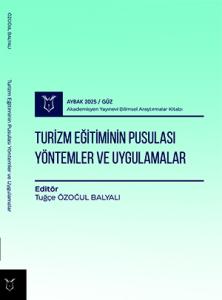
Turizm Eğitiminde Müfredat Tasarımı ve Öğretim Yöntemlerinin Entegrasyonu
Özet
Turizm eğitimi, günümüzde hızla değişen sektör dinamiklerine ve küresel ihtiyaçlara uyum sağlamak amacıyla sürekli olarak evrilmektedir. Bu evrim dönemsel olarak değişmekte ve birtakım yeni konuların müfredatlara entegrasyonu sağlanmaktadır. Ülkelerin turizm eğitim politikaları hem ulusal hem de uluslararası ölçekte güncel ihtiyaçlara cevap verebilir hale gelmeli, esnek ve modüler yapıların geliştirilmesi gerekmektedir. Eğitim kurumları, müfredatlarını sadece teorik bilgi aktarma üzerine değil, aynı zamanda uygulamalı becerilerin kazandırılmasına da odaklanarak tasarlamalıdır. Staj programları, öğrencilerin edindikleri teorik bilgileri gerçek çalışma ortamlarında test etmelerine ve profesyonel becerilerini geliştirmelerine olanak tanıyarak, eğitim sürecinin önemli bir parçasını oluşturmaktadır. Ayrıca, sektör profesyonellerinin eğitim süreçlerine dahil edilmesi, güncel uygulamaların müfredata daha etkin bir şekilde aktarılmasını ve öğrencilerin sektör beklentilerini daha iyi anlamalarını sağlamakta önemli bir rol oynamaktadır. Eğitimdeki dijitalleşme süreci, e-öğrenme platformları, artırılmış gerçeklik (AR) ve sanal gerçeklik (VR) uygulamaları gibi yenilikçi teknolojilerin entegrasyonunu zorunlu kılmaktadır. Bu tür teknolojiler, öğrencilere destinasyonları interaktif bir şekilde deneyimleme, müşteri senaryolarını simüle etme ve kriz durumlarını gerçekçi bir biçimde canlandırma fırsatları sunarak, klasik öğrenme yöntemlerine ilave olarak güçlü alternatifler oluşturmaktadır. Sonuç olarak, turizm eğitiminin kalitesini artırmak ve mezunların sektöre uyumunu sağlamak için müfredatın sürekli olarak güncellenmesi, akademi ile sektör arasındaki iş birliklerinin güçlendirilmesi ve dijital teknolojilerin etkin entegrasyonu büyük önem taşımaktadır. Bu kitap bölümü turizm eğitiminde müfredat tasarımı ve öğretim yöntemlerinin entegrasyonunu kapsamlı bir şekilde incelemeyi, sürecin eğitim kalitesine katkılarını ortaya koymayı ve karşılaşılan pedagojik ile yapısal zorluklara ilişkin çözüm önerilerini sunmayı amaçlamaktadır.
Referanslar
Airey, D. (2008). Tourism education: Life begins at 40. Tourism Recreation Research, 33(1), 119–130. https://doi.org/10.7202/1070894ar
Airey, D., & Tribe, J. (2005). Issues for the future of tourism education: International perspectives. Journal of Teaching in Travel & Tourism, 5(1-2), 1–16. https://doi.org/10.1016/B978-0-08-044667-7.50038-0
Barron, P., & Henderson, S. (2000). Tourism and hospitality students’ part-time employment: Patterns, benefits and recognition. Journal of Hospitality & Tourism Education, 12(3), 46–53. https://doi.org/ 10.3794/johlste.62.150
Biggs, J., & Tang, C. (2011). Teaching for quality learning at university. McGraw-Hill Education.
Christou, E. (1999). Hospitality management education in Greece: An exploratory study. Tourism Management, 20(6), 683–691. https://doi.org/10.1016/S0261-5177(99)00039-4
Cooper, C., & Shepherd, R. (1997). The integration of experiential learning into tourism higher education. In M. Oppermann (Ed.), Tourism education.
Dewey, J. (1938). Experience and education. Macmillan.
Dredge, D., Airey, D., & Gross, M. J. (2012). The Routledge handbook of tourism and hospitality education. Routledge. https://doi.org/10.4324/9780203763308
Garrison, D. R., & Vaughan, N. D. (2008). Blended learning in higher education: Framework, principles, and guidelines. Jossey-Bass.
Gössling, S., & Hall, C. M. (2022). The sustainable chef. Routledge.
Guttentag, D. A. (2010). Virtual reality: Applications and implications for tourism. Tourism Management, 31(5), 637–651. https://doi.org/10.1016/j.tourman.2009.07.003
Hall, C. M. (2008). Tourism planning: Policies, processes and relationships. Pearson Education.
Hmelo-Silver, C. E. (2004). Problem-based learning: What and how do students learn? Educational Psychology Review, 16(3), 235–266. https://doi.org/10.1023/B:EDPR.0000034022.16470.f3
Huang, Y. C., Backman, K. F., Backman, S. J., & Moore, D. (2016). Exploring user acceptance of 3D virtual worlds in travel and tourism marketing. Tourism Management, 36, 490–501. https://doi.org/10.1016/j.tourman.2012.09.009
Inui, Y., Wheeler, D., & Lankford, S. (2006). Rethinking tourism education: What should schools teach? Journal of Hospitality, Leisure, Sport & Tourism Education, 5(2), 25–35. https://doi.org/1010.3794/JOHLSTE.52.122
Kolb, D. A. (1984). Experiential learning: Experience as the source of learning and development. Prentice Hall.
Okumus, F., & Wong, K. F. (2004). A critical review and evaluation of teaching methods of strategic management in tourism and hospitality schools. International Journal of Hospitality Management, 23(5), 599–622. https://doi.org/10.1080/10963758.2004.10696790
Piaget, J. (1973). To understand is to invent: The future of education. Grossman.
Ritchie, B. W. (2003). Managing educational tourism. Channel View Publications.
Ruhanen, L. (2005). Bridging the divide between theory and practice: Experiential learning approaches for tourism and hospitality management education. Journal of Teaching in Travel & Tourism, 5(4), 33–51. https://doi.org/10.1300/J172v05n04_03
Sharpley, R. (2009). Tourism development and the environment: Beyond sustainability? Earthscan.
Sigala, M. (2020). Tourism and COVID-19: Impacts and implications for advancing and resetting industry and research. Journal of Business Research, 117, 312–321. https://doi.org/10.1016/j.jbusres.2020.06.015
Smith, V. L. (1989). Hosts and guests: The anthropology of tourism (2nd ed.). University of Pennsylvania Press.
Taba, H. (1962). Curriculum development: Theory and practice. Harcourt, Brace & World.
Tribe, J. (2002). The philosophic practitioner. Annals of Tourism Research, 29(2), 338–357. https://doi.org/10.1016/S0160-7383(01)00038-X
TURAK. (2025). Türkiye’de turizm eğitiminin kalitesi için çalışıyoruz (25.08.2025 tarihinde https://turak.org/hakkinda/ adresinden ulaşılmıştır.)
Tussyadiah, I., Wang, D., & Jia, C. H. (2018). Virtual reality and attitudes toward tourism destinations. Tourism Management, 66, 140–154. https://doi.org/10.1007/978-3-319-51168-9_17
TYÇ. (2021). Yükseköğretim Mezuniyet Belgelerinde Türkiye Yeterlilikler Çerçevesi Logosunun Kullanımına ilişkin Usul ve Esaslar (02.09.2025 tarihinde https://www.tyc.gov.tr/uploads/dosyalar/16884657081674e9f0225ff23240fed62f6b151844.pdf adresinden ulaşılmıştır.)
Tyler, R. W. (1949). Basic principles of curriculum and instruction. University of Chicago Press.
United Nations, 2025. The Sustainable Development Goals in Türkiye (25 Ağustos 2025 https://turkiye.un.org/en/sdgs adresinden ulaşılmıştır.)
UNWTO, 2020. International Tourism Highlights, 2020 Edition. (25 Ağustos 2025 tarihinde https://www.e-unwto.org/doi/book/10.18111/9789284422456 adresinden erişilmiştir.)
Vygotsky, L. S. (1978). Mind in society: The development of higher psychological processes. Harvard University Press. https://doi.org/10.2307/j.ctvjf9vz4
Zagonari, F. (2009). Balancing tourism education and training. International Journal of Hospitality Management, 28(1), 2–9. https://doi.org/10.1016/j.ijhm.2008.03.006
Zehrer, A. (2007). Service experience and service design: Concepts and application in tourism SMEs. Managing Service Quality: An International Journal, 17(3), 332–341. https://doi.org/10.1108/09604520910955339