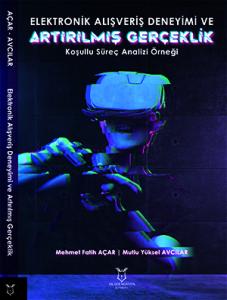
Elektronik Alışveriş Deneyimi ve Artırılmış Gerçeklik: Koşullu Süreç Analizi Örneği
Özet
Bu kitap, \"Elektronik Alışveriş Deneyimi ve Artırılmış Gerçeklik: Koşullu Süreç Analizi Örneği\" başlıklı bir araştırmadan türetilmiştir. Araştırma, artırılmış gerçeklik teknolojisi tabanlı sanal deneme uygulamalarının perakendecilikte kullanımının incelenmesini amaçlamaktadır. Kitap, tüketicilerin mobil artırılmış gerçeklik alışveriş uygulaması aracılığıyla yaptıkları makyaj ürünü alışverişlerinde, uygulamadan algıladıkları artırılmış gerçeklik özelliklerinin ve performans riskinin satın alma karar süreçlerinde nasıl etkili olduğunu odaklanmaktadır. Bu çalışma, artırılmış gerçeklik alışveriş uygulaması geliştiricilerine ve dijital ve fiziksel perakende yöneticilerine faydalı olabilecek bilgiler sunmayı hedeflemektedir. Kitap, araştırmanın amacını, yöntemini, kavramsal çerçevesini ve bulgularını içermektedir.
This book is derived from a research titled \"Electronic Shopping Experience and Augmented Reality: A Conditional Process Analysis Example\". The research aims to examine the use of augmented reality technology-based virtual try-on applications in retail. The book focuses on how the perceived augmented reality features and performance risk from the application influence the purchasing decision process of consumers in their makeup product shopping through a mobile augmented reality shopping application. This study aims to provide useful information for augmented reality shopping application developers and digital and physical retail managers. The book includes the purpose, methodology, conceptual framework, and findings of the research.
Referanslar
Abrar, K. (2018). Impact of augmented reality on consumer purchase intention with the mediating role of customer brand engagement: Moderating role of interactivity in online shopping, Bahria University Journal of Management & Technology,1(2), 64-80.
Acquisti, A., Gross, R. & Stutzman, F. (2014). Face recognition and privacy in the age of augmented Reality. Journal of Privacy and Condentiality, 6(2), 1-20.
Ahn, T., Ryu, S. & Han, I. (2004). The impact of the online and offline features on the user acceptance of Internet shopping malls. Electronic Commerce Research and Applications, 3(4), 405-420.
Alcaniz, M., Bigne, E. & Guixeres, J. (2019). Virtual reality in marketing: a framework, review, and research agenda. Frontiers in psychology, 10, 1-15.
Algharabat, R. S. (2014). Conceptualising and modelling virtual product experience for online retailers. International Journal of Internet Marketing and Advertising, 8(4), 300-319.
Alimamy, S. (2018), The effect of co-creation through exposure to augmented reality on customer perceived risk, perceived trust and purchase intent. Unpublished doctoral thesis, University of Otago, New Zealand.
Alpar. R. (2010). Uygulamalı istatistik ve geçerlik-güvenirlik. Ankara: Detay
Alsop, T. (2021, November 29). Global mobile augmented reality (AR) users 2019-2024. https://www.statista.com/statistics/1098630/global-mobile-augmented-reality-ar-users/#statisticContainer.
Andersen, A. D., & Schreck, L. (2018). Enhancing consumers' purchase intention by augmented reality: The relationship between augmented reality and Swedish millennials’ online purchase intention of shopping goods. Unpublished master thesis. Dalarna University, Sweden.
Aniket, P. (2015). Augmented reality. International Journal of Research in Advance Engineering (IJRAE), 1(1), 1-10.
Arakji, R. Y. & Lang, K. R. (2008). Avatar business value analysis: A method for the evaluation of business value creation in virtual commerce. Journal of Economic Commerce Research. 9(3), 207-218.
Atılgan, K. Ö. (2014). Gerekçeli Eylem Teorisi. Kitap içinde Bölüm, M.İ. Yağcı ve S. Çabuk (Eds.), Pazarlama Teorileri, 297-310. İstanbul: MediaCat.
Avcılar M. Y. & Açar M. F. (2021). Sahiplik etkisi teorisi. M. İ. Yağcı & S. Çabuk (Ed.), Pazarlama Teorileri 2 içinde, 387-429. İstanbul: Mediacat.
Avcılar, M. Y. & Yenilmez, G. (2019). Çok kanallı perakendecilik uygulamalarının algılanan deneyimsel değer ve akış deneyimi açısından karşılaştırılması. Osmaniye Korkut Ata Üniversitesi İktisadi ve İdari Bilimler Fakültesi Dergisi, 3 (1), 114-137.
Avcılar, M. Y. (2010). Tüketici temelli perakendeci değerinin ölçümü: Adana ilinde bir araştırma. Doktora tezi, Niğde Üniversitesi, Niğde.
Avcılar, M. Y., Demirgüneş, B. K. & Açar, M. F. (2019) Artırılmış gerçeklik uygulamalarının kullanıcı deneyimi, tatmin ve satın alma niyeti üzerindeki etkilerinin incelenmesi. Pazarlama ve Pazarlama Araştırmaları Dergisi, 24, 235-271.
Avcılar, M. Y., Güreş, N., Bozkurt, S., Açar, M. F. (2021). Çevrimiçi alışveriş bağlamında tüketiciler tarafından algılanan gizlilik endişesinin kişisel bilgi koruma davranışına etkisi. Çukurova Üniversitesi Sosyal Bilimler Enstitüsü Dergisi, 30(3), 181-197.
Azuma, R. T. (1997). A survey of augmented reality. Presence 6(4), 355-385.
Azuma, R. T. (2019). The road to ubiquitous consumer augmented reality systems. Human Behavior and Emerging Technologies, 1(1), 26-32.
Azuma, R., Baillot, Y., Behringer, R., Feiner, S., Julier, S. & MacIntyre, B. (2001). Recent advances in augmented reality. IEEE Computer Graphics and Applications, 21(6), 34-47.
Babin, B. J., Darden, W. R. & Griffin, M. (1994). Work and/or fun: measuring hedonic and utilitarian shopping value. Journal of Consumer Research, 20(4), 644-656.
Baek, T. H., Yoo, C. Y. & Yoon, S. (2018). Augment yourself through virtual mirror: the impact of self-viewing and narcissism on consumer responses. International Journal of Advertising, 37(3), 421-439.
Baharuddin, N. A. & Rambli, D. R. A. (2017). A conceptual model of AR based experiential marketing. In International Conference on E-Commerce (ICOEC 2017), (pp. 119-125).
Balas, O. (2019). Uzamsal Artırılmış Gerçeklik tekniklerinin sergileme tasarımında kullanımı. Yayınlanmamış yüksek lisans tezi. Hacettepe Üniversitesi, Ankara.
Ballantine, P. W. (2005). Effects of interactivity and product information on consumer satisfaction in an online retail setting. International Journal of Retail & Distribution Management. 33(6), 461-471.
Baratali, E., Rahim, M. H. B. A., Parhizkar, B. & Gebril, Z. M. (2016). Effective of Augmented Reality (AR) in marketing communication; a case study on brand interactive advertising. International Journal of Management and Applied Science (IJMAS), 2(4), 133-137.
Bashir, A. (2017, November 2). Is it safe to use makeup testers in cosmetics stores?. https://theconversation.com/is-it-safe-to-use-makeup-testers-in-cosmetics-stores-86635
Batra, R. & Keller, K. L. (2016). Integrating marketing communications: New findings, new lessons, and new ideas. Journal of Marketing, 80(6), 122-145.
Beck, N. & Rygl, D. (2015). Categorization of multiple channel retailing in Multi-, Cross-, and Omni‐Channel Retailing for retailers and retailing. Journal of Retailing and Consumer Services, 27, 170-178.
Bederson, B. B. (1995). Audio augmented reality: a prototype automated tour guide. In Conference Companion on Human Factors in Computing Systems (pp. 210-211). New York: ACM.
Bennett, E. & Stevens, B. (2006). The effect that the visual and haptic problems associated with touching a projection augmented model have on object-presence. Presence, 15(4), 419-437.
Berman, B. (2019). Flatlined: Combatting the death of retail stores. Business Horizons, 62(1), 75-82.
Berryman, D. R. (2012). Augmented reality: a review. Medical Reference Services Quarterly, 31(2), 212-218.
Bezjian-Avery, A., Calder, B. & Iacobucci, D. (1998). New media interactive advertising vs. traditional advertising. Journal of Advertising Research, 38, 23-32.
Bhattacherjee, A. (2012). Social science research: Principles, methods, and practices. Textbooks Collection.
Bilici, F. (2015). Pazarlamada artırılmış gerçeklik ve karekod teknolojileri: Tüketicilerin artırılmış gerçeklik teknoloji algılamaları üzerine bir alan araştırması. Yayınlanmamış yüksek lisans tezi. Uludağ Üniversitesi, Bursa.
Billinghurst, M., Kato, H. & Poupyrev, I. (2001). The magicbook-moving seamlessly between reality and virtuality. IEEE Computer Graphics and Applications, 21(3), 6-8.
Bimber, O. & Raskar, R. (2006). Modern approaches to augmented reality. In ACM SIGGRAPH 2006 Courses (pp. 1-86). Boston, U.S.A.
Biocca, F. (1997). The cyborg's dilemma: Progressive embodiment in virtual environments. Journal of Computer-Mediated Communication, 3(2), 1-29.
Boldu, R., Jain, S., Cortes, J. P. F., Zhang, H. & Nanayakkara, S. (2019). M-Hair: Extended Reality by Stimulating the Body Hair. In SIGGRAPH Asia 2019 XR (pp. 27-28). New York: ACM.
Bollen, K. A. (1989), Structural equations with latent variables. New York: John Wiley & Sons Inc.
Bonetti, F., Warnaby, G. & Quinn, L. (2018). Augmented reality and virtual reality in physical and online retailing: A review, synthesis and research agenda. In T. Jung & M. C. T. Dieck (eds) Augmented Reality and Virtual Reality, (pp. 119-132). Cham: Springer.
Bonnin, G. (2020). The roles of perceived risk, attractiveness of the online store and familiarity with AR in the influence of AR on patronage intention. Journal of Retailing and Consumer Services, 52, 101938.
Borst, C. W. & Volz, R. A. (2005). Evaluation of a haptic mixed reality system for interactions with a virtual control panel. Presence, 14(6), 677-696.
Brody, A. B., & Gottsman, E. J. (1999). Pocket BargainFinder: A handheld device for augmented commerce. In International Symposium on Handheld and Ubiquitous Computing (pp. 44-51). Berlin: Springer.
Brown, L. (2017). The next generation classroom: Transforming aviation training with augmented reality. Paper presented at National Training Aircraft Symposium (NTAS), Embry-Riddle Aeronautical University, 14 August.
Bruner, G. C. (1998). Standardization & justification: Do Aad scales measure up?. Journal of Current Issues & Research in Advertising, 20(1), 1-18.
Brynjolfsson, E., Hu, Y. J. & Rahman, M. S. (2013). Competing in the age of omnichannel retailing. Cambridge: MIT.
Bulearca, M. & Tamarjan, D. (2010). Augmented reality: A sustainable marketing tool. Global Business and Management Research: An International Journal, 2(2), 237-252.
Burns, A. C. & Bush, R. F. (2015). Pazarlama araştırması. Çeviri Editörü: Fatma Demirci Orel, Ankara: Nobel Yayınları.
Caboni, F. & Hagberg, J. (2019). Augmented reality in retailing: a review of features, applications and value. International Journal of Retail & Distribution Management, 47(11), 1125-1140.
Çadırcı, T. O., & Güngör, A. S. (2018). Çevrimiçi Satın Almalarda Tüketicinin Risk Algısı: İki Boyutlu Ürün Görüntüleme ve Artırılmış Gerçeklik (Üç Boyutlu Ürün Görüntüleme) Uygulamalarına İlişkin Bir Karşılaştırma. Kocaeli Üniversitesi Sosyal Bilimler Dergisi, (36), 53-76.
Çakır, F. S. (2020). Kısmi en küçük kareler yapısal eşitlik modellemesi. Ankara: Gazi Kitabevi.
Cakmakci, O. & Rolland, J. (2006). Head-worn displays: a review. Journal of Display Technology, 2(3), 199-216.
Can, A. (2013). Spss ile bilimsel araştırma sürecinde nicel veri analizi. Ankara: Pegem Akademi.
Carmigniani J. & Furht B. (2011) Augmented Reality: An Overview. In B. Furth (eds) Handbook of augmented reality. (pp. 3-46). New York: Springer.
Carmigniani, J., Furht, B., Anisetti, M., Ceravolo, P., Damiani, E. & Ivkovic, M. (2011). Augmented reality technologies, systems and applications. Multimedia Tools and Applications, 51(1), 341-377.
Carrozzi, A., Chylinski, M., Heller, J., Hilken, T., Keeling, D. I. & de Ruyter, K. (2019). What's mine is a hologram? How shared augmented reality augments psychological ownership. Journal of Interactive Marketing, 48, 71-88.
Carvalho, E. & Marcos, A. (2018, October). Virtual tutor: a case of study in University Aberta. In The 2018 International Conference on Digital Science (pp. 465-471). Cham: Springer.
Castro, J. C., Quisimalin, M., Córdova, V. H., Quevedo, W. X., Gallardo, C., Santana, J., & Andaluz, V. H. (2018). Virtual reality on e-Tourism. In IT Convergence and Security 2017 (pp. 86-97). Singapore: Springer.
Çelik, H. E. & Yılmaz, V. (2013). Lisrel 9.1 ile yapısal eşitlik modellemesi: Temel kavramlar, uygulamalar, programlama. Ankara: Anı.
Chacon, B. (2019, October 4). How to Shop on Instagram with Augmented Reality. https://later.com/blog/instagram-augmented-reality-shopping/
Chandra, S. & Kumar, K. N. (2018). Exploring factors influencing organizational adoption of augmented reality in e-commerce: empirical analysis using technology-organization-environment model. Journal of Electronic Commerce Research, 19(3). 237-265.
Chang, H. J., Eckman, M. & Yan, R. N. (2011). Application of the Stimulus-Organism-Response model to the retail environment: The role of hedonic motivation in impulse buying behavior. The International Review of Retail, Distribution and Consumer Research, 21(3), 233-249.
Chehimi, F., Coulton, P., & Edwards, R. (2007). Augmented reality 3d interactive advertisements on smartphones. In International Conference on the Management of Mobile Business (ICMB 2007). IEEE.
Civelek, M. E. (2018). Yapısal eşitlik modellemesi metodolojisi. İstanbul: Beta.
Coelho, C., Tichon, J. G., Hine, T. J., Wallis, G. M. & Riva, G. (2006). Media presence and inner presence: the sense of presence in virtual reality technologies. In G Riva, M. T. Anguera, B. K. Wiederhold & F. Montovani (Eds.) From communication to presence: Cognition, emotions and culture towards the ultimate communicative experience (pp. 25-45). Amsterdam: IOS Press.
Conrad, E., Misenar, S. & Feldman, J. (2016). Domain 8: Software Development Security (Understanding, Applying, and Enforcing Software Security). In CISSP Study Guide, 3rd ed. (pp. 429-477), Boston: Syngress.
Costanza, E., Inverso, S. A., Pavlov, E., Allen, R. & Maes, P. (2006). Eye-q: Eyeglass peripheral display for subtle intimate notifications. In Proceedings of the 8th Conference on Human-Computer Interaction with Mobile Devices and Services (pp. 211-218). New York: ACM.
Cunningham, L. F., Gerlach, J. H., Harper, M. D. & Young, C. E. (2005). Perceived risk and the consumer buying process: internet airline reservations. International Journal of Service Industry Management. 16(4), 357-372.
Cuomo, M. T., Tortora, D. & Metallo, G. (2014). In store augmented reality: retailing strategies for smart communities. Mondo Digitale, 49, 1-12.
Cuomo, M. T., Tortora, D., Festa, G., Ceruti, F. & Metallo, G. (2020). Managing omni-customer brand experience via augmented reality: A qualitative investigation in the Italian fashion retailing system. Qualitative Market Research: An International Journal. 1352-2752.
Cutolo, F., Fontana, U., Carbone, M., D'Amato, R. & Ferrari, V. (2017). Hybrid video/optical see-through HMD. In 2017 IEEE International Symposium on Mixed and Augmented Reality (ISMAR-Adjunct) (pp. 52-57). IEEE.
Dacko, S. G. (2017). Enabling smart retail settings via mobile augmented reality shopping apps. Technological Forecasting and Social Change, 124, 243-256.
Dadwal, S. S. & Hassan, A. (2015). The augmented reality marketing: A merger of marketing and technology in tourism. In Mobile Computing and Wireless Networks: Concepts, Methodologies, Tools, and Applications (pp. 78-96). U.S.A: IGI Global.
Daugherty, T., Li, H. & Biocca, F. (2008). Consumer learning and the effects of virtual experience relative to indirect and direct product experience. Psychology & Marketing, 25(7), 568-586.
Day, R. H. (1990). The Bourdon illusion in haptic space. Perception & Psychophysics, 47(4), 400-404.
Demangeot, C. & Broderick, A. J. (2016). Engaging customers during a website visit: a model of website customer engagement. International Journal of Retail & Distribution Management. 44(8), 814-839.
Demir, S. Ö. (2015). Omurilik yaralanmalı hastalarda robot yardımlı yürüme eğitimi. Türkiye Fiziksel Tıp ve Rehabilitasyon Dergisi, 1, 37-44.
Designhubz (2020, October, 20). 19 Augmented Reality Statistics to Watch For in 2020 (Based on Up-to-Date Data). https://designhubz.com/augmented-reality-in-retail-statistics-and-trends/
Dholakia, R. R., Zhao, M., Dholakia, N. & Fortin, D. R. (2000). Interactivity and revisits to websites: A theoretical framework (Working paper). Research Institute for Telecommunications and Information Marketing. http://ritim. cba. uri. edu/wp.
Dou, X., & Li, H. (2008). Creative use of QR codes in consumer communication. International Journal of Mobile Marketing, 3(2), 61-67.
Dunn, W. W. (1989) Chapter 7: Validity, Physical & Occupational Therapy In Pediatrics, 9(1), 149-168.
Erra, U. & Colonnese, V. (2015). Experiences in the development of an augmented reality dressing room. In International Conference on Augmented and Virtual Reality (pp. 467-474). Cham: Springer.
Eyüboğlu, E. (2011). Augmented reality as an exciting online experience: is it really beneficial for brands?. International Journal of Social Sciences and Humanity Studies, 3(1), 113-123.
Fan, X., Chai, Z., Deng, N., & Dong, X. (2020). Adoption of augmented reality in online retailing and consumers’ product attitude: A cognitive perspective. Journal of Retailing and Consumer Services, 53, 101986.
Faust, F., Roepke, G., Catecati, T., Araujo, F., Ferreira, M. G. G. & Albertazzi, D. (2012). Use of augmented reality in the usability evaluation of products. Work, 41(1), 1164-1167.
Featherman, M. S. & Pavlou, P. A. (2003). Predicting e-services adoption: a perceived risk facets perspective. International Journal of Human-Computer Studies, 59(4), 451-474.
Feldman, A., Tapia, E. M., Sadi, S., Maes, P. & Schmandt, C. (2005). ReachMedia: On-the-move interaction with everyday objects. In Ninth IEEE International Symposium on Wearable Computers (ISWC'05) (pp. 52-59). IEEE.
Feng, Y., & Xie, Q. (2019). Demystifying novelty effects: An analysis of consumer responses to YouTube videos featuring augmented reality out-of-home advertising campaigns. Journal of Current Issues & Research in Advertising, 40(1), 36-53.
Ferrari, V., Viglialoro, R. M., Nicoli, P., Cutolo, F., Condino, S., Carbone, M., Siesto, M. & Ferrari, M. (2016). Augmented reality visualization of deformable tubular structures for surgical simulation. The International Journal of Medical Robotics and Computer Assisted Surgery, 12(2), 231-240.
Fiore, A. M., Jin, H. J. & Kim, J. (2005). For fun and profit: Hedonic value from image interactivity and responses toward an online store. Psychology & Marketing, 22(8), 669-694.
Flavian, C., Ibáñez-Sánchez, S. & Orús, C. (2019). The impact of virtual, augmented and mixed reality technologies on the customer experience. Journal of Business Research, 100, 547-560.
Fornell, C. & Larcker, D. F. (1981). Evaluating structural equation models with unobservable variables and measurement error. Journal of Marketing Research, 18(1), 39-50.
Fragoso, V., Gauglitz, S., Zamora, S., Kleban, J. & Turk, M. (2011). TranslatAR: A mobile augmented reality translator. In 2011 IEEE workshop on applications of computer vision (WACV) (pp. 497-502), Kona: IEEE.
Freedman, L. (2020, March 11). Taking the pulse: Retailers and the coronavirus. https://www.digitalcommerce360.com/2020/03/11/taking-the-pulse-retailers-and-the-coronavirus/
Gallon, V. (2018, March 20). Beauty Tech: Augmented reality applications take center stage in brands’ multi-channel strategies. https://www.premiumbeautynews.com/en/beauty-tech-augmented-reality,13120
Gamgam, H. & Altunkaynak, B. (2021). Regresyon analizi. Ankara: Seçkin Yayıncılık.
Gao, S., Krogstie, J., Chen, Z. & Zhou, W. (2014). Lifestyles and mobile services adoption in China. International Journal of E-Business Research (IJEBR), 10(3), 36-53.
Gerbing, D. W. & Anderson, J. C. (1988). An updated paradigm for scale development incorporating unidimensionality and its assessment. Journal of Marketing Research, 25(2), 186-192.
Gervautz, M. & Schmalstieg, D. (2012). Anywhere interfaces using handheld augmented reality. Computer, 45(7), 26-31.
Goh, E. S., Sunar, M. S. & Ismail, A. W. (2019). 3D object manipulation techniques in handheld mobile augmented reality interface: A review. IEEE Access, 7, 40581-40601.
Gold, L. N. (1993). Virtual reality now a research reality. Marketing Research, 5(4), 50.
Grewal, D., Motyka, S. & Levy, M. (2018). The evolution and future of retailing and retailing education. Journal of Marketing Education, 40(1), 85-93.
Grewal, D., Noble, S. M., Roggeveen, A. L. & Nordfalt, J. (2020). The future of in-store technology. Journal of the Academy of Marketing Science, 48(1), 96-113.
Griffith, D. A. & Gray, C. C. (2002). The fallacy of the level playing field: The effect of brand familiarity and web site vividness on online consumer response. Journal of Marketing Channels, 9(3-4), 87-102.
Grundey, D. (2008). Experiential marketing vs. traditional marketing: Creating rational and emotional liaisons with consumers. The Romanian Economic Journal, 29(3), 133-151.
Grzegorczyk, T., Sliwinski, R. & Kaczmarek, J. (2019). Attractiveness of augmented reality to consumers. Technology Analysis & Strategic Management, 31(11), 1257-1269.
Gudigantala, N. & Bicen, P. (2016). An examination of antecedents of conversion rates of e-commerce retailers. Management Research Review. 39(1), 82-114.
Gürbüz, S. & Şahin, F. (2018). Sosyal bilimlerde araştırma yöntemleri. Ankara: Seçkin Yayıncılık.
Gürbüz, S. (2021). Sosyal bilimlerde aracı, düzenleyici ve durumsal etki analizleri. Ankara: Seçkin Yayıncılık.
Ha, L. & James, E. L. (1998). Interactivity reexamined: A baseline analysis of early business web sites. Journal of Broadcasting & Electronic Media, 42(4), 457-474.
Hair, J. F, Black, W. C., Babin, B. J. & Anderson, R. E. (2014). Multivariate data analysis. USA: Peaarson.
Haque, R., Islam, M. M., Salma, S., Al Jubair, M. A. & Weng, N. G. (2020). Extracting Relevant Information Using Handheld Augmented Reality. In Proceedings of the International Conference on Computing Advancements (pp. 1-6), New York: ACM.
Haumer, F., Kolo, C., & Reiners, S. (2020). The impact of augmented reality experiential marketing on brand equity and buying intention. Journal of Brand Strategy, 8(4), 368-387.
Hayes, A. F. (2018). Introduction to mediation, moderation, and conditional process analysis. A regression-based approach. New York: Guilford publications.
Heimo, O. I., Kimppa, K. K., Helle, S., Korkalainen, T. & Lehtonen, T. (2014). Augmented reality-Towards an ethical fantasy?. In 2014 IEEE international symposium on ethics in science, technology and engineering (pp. 1-7). IEEE.
Heinzel, A., Azhar, S. & Nadeem, A. (2017). Uses of augmented reality technology during construction phase. Paper presented at The Ninth International Conference on Construction in the 21st Century (CITC-9), Dubai, United Arab Emirates, March 5th-7th.
Heller, J., Chylinski, M., de Ruyter, K., Mahr, D. & Keeling, D. I. (2019a). Touching the untouchable: exploring multi-sensory augmented reality in the context of online retailing. Journal of Retailing, 95(4), 219-234.
Heller, J., Chylinski, M., de Ruyter, K., Mahr, D. & Keeling, D. I. (2019b). Let me imagine that for you: Transforming the retail frontline through augmenting customer mental imagery ability. Journal of Retailing, 95(2), 94-114.
Heutger, M. & Kückelhaus, M. (2014). Augmented reality in logistics: Changing the way see logistics - DHL perspectives. Germany: DHL Customer Solutions & Innovation.
Hilken, T., de Ruyter, K., Chylinski, M., Mahr, D. & Keeling, D. I. (2017). Augmenting the eye of the beholder: exploring the strategic potential of augmented reality to enhance online service experiences. Journal of the Academy of Marketing Science, 45(6), 884-905.
Hilken, T., Heller, J., Chylinski, M., Keeling, D. I., Mahr, D., & de Ruyter, K. (2018). Making omnichannel an augmented reality: the current and future state of the art. Journal of Research in Interactive Marketing. 12(4), 509-523.
Hofman-Kohlmeyer, M. (2017). Characterization of new business opportunities in virtual commerce. World Scientific News, 78, 175-184.
Hopp, T. & Gangadharbatla, H. (2016). Novelty effects in augmented reality advertising environments: the influence of exposure time and self-efficacy. Journal of Current Issues & Research in Advertising, 37(2), 113-130.
Huang, T. L. & Liao, S. L. (2017). Creating e-shopping multisensory flow experience through augmented-reality interactive technology. Internet Research, 27(2), 449.475.
Huang, T. L. & Liu, F. H. (2014). Formation of augmented-reality interactive technology's persuasive effects from the perspective of experiential value. Internet Research, 24(1), 82-109.
Huang, T. L. (2019). Psychological mechanisms of brand love and information technology identity in virtual retail environments. Journal of Retailing and Consumer Services, 47, 251-264.
Huang, T. L., Mathews, S. & Chou, C. Y. (2019). Enhancing online rapport experience via augmented reality. Journal of Services Marketing. 33(7), 851-865.
Hwangbo, H., Kim, Y. S. & Cha, K. J. (2017). Use of the smart store for persuasive marketing and immersive customer experiences: A case study of Korean apparel enterprise. Mobile Information Systems, 2017, 1-17.
Ihde D. (1990). Technology and the lifeworld: From garden to earth. Technology and Culture, 32(4), 1135-1137.
İnan, H. (2015). Beklenti teorisi. M. İ. Yağcı & S. Çabuk (Ed.), Pazarlama Teorileri içinde. 283-295. İstanbul: Mediacat.
Javornik, A. (2014). Classifications of augmented reality uses in marketing. In 2014 IEEE International Symposium on Mixed and Augmented Reality-Media, Art, Social Science, Humanities and Design (ISMAR-MASH'D) (pp. 67-68). IEEE.
Javornik, A. (2016a). Augmented reality: Research agenda for studying the impact of its media characteristics on consumer behaviour. Journal of Retailing and Consumer Services, 30, 252-261.
Javornik, A. (2016b). ‘It’s an illusion, but it looks real!’ Consumer affective, cognitive and behavioural responses to augmented reality applications. Journal of Marketing Management, 32(9-10), 987-1011.
Jeon, S. & Choi, S. (2009). Haptic augmented reality: Taxonomy and an example of stiffness modulation. Presence, 18(5), 387-408.
Jessen, A., Hilken, T., Chylinski, M., Mahr, D., Heller, J., Keeling, D. I. & de Ruyter, K. (2020). The playground effect: How augmented reality drives creative customer engagement. Journal of Business Research, 116, 85-98.
Jimeno-Morenilla, A., Sánchez-Romero, J. L., Mora-Mora, H. & Coll-Miralles, R. (2016). Using virtual reality for industrial design learning: a methodological proposal. Behaviour & Information Technology, 35(11), 897-906.
Jin, O & Yazdanifard, R. (2015). The review of the effectivity of the augmented reality experiential marketing tool in customer engagement. Global Journal of Management and Business Research. 15(8), 13-17.
Kahneman, D. & Tversky, A. (1979). Prospect theory: An analysis of decision under risk. Econometrica, 47(2), 263-292.
Kahneman, D., Knetsch, J. L. & Thaler, R. H. (1991). The endowment effect, loss aversion, and status quo bias. Journal of Economic Perspectives, 5(1), 193-206.
Kajimoto, H., Kawakami, N., Tachi, S. & Inami, M. (2004). SmartTouch: Electric skin to touch the untouchable. IEEE Computer Graphics and Applications, 24(1), 36-43.
Kanade, T., Narayanan, P. J. & Rander, P. W. (1995). Virtualized reality: Concepts and early results. In Proceedings IEEE Workshop on Representation of Visual Scenes, (pp. 69-76), IEEE.
Kang, H. J., Shin, J. H., & Ponto, K. (2020). How 3D virtual reality stores can shape consumer purchase decisions: The roles of informativeness and playfulness. Journal of Interactive Marketing, 49, 70-85.
Kang, J. Y. M. (2014). Augmented reality and motion capture apparel e-shopping values and usage intention. International Journal of Clothing Science and Technology. 26(6), 486-499.
Kavran, A. K., Loncaric, D. & Dlacic, J. (2016). Augmented reality experiential marketing in tourism. Paper presented 5th. International Scientific Symposium, Osijek, Crotia, June.
Kim, J. & Forsythe, S. (2008). Adoption of virtual try-on technology for online apparel shopping. Journal of Interactive Marketing, 22(2), 45-59.
Kim, R. Y. (2020). The impact of COVID-19 on consumers: Preparing for digital sales. IEEE Engineering Management Review, 48(3), 212-218.
Kizza, J. M. (2013). Ethical and social issues in the information age. New York: Springer.
Kowalczuk, P., Siepmann, C. & Adler, J. (2021). Cognitive, affective, and behavioral consumer responses to augmented reality in e-commerce: A comparative study. Journal of Business Research, 124, 357-373.
Krevelen, D. W. F.V & Poelman, R. (2010). A survey of augmented reality technologies, applications and limitations. The International Journal of Virtual Reality, 9(2), 1-20.
Lam, H. K., Yeung, A. C., Lo, C. K., & Cheng, T. C. E. (2019). Should firms invest in social commerce? An integrative perspective. Information & Management, 56(8), 103164.
Laroche, M., McDougall, G. H., Bergeron, J. & Yang, Z. (2004). Exploring how intangibility affects perceived risk. Journal of Service Research, 6(4), 373-389.
Lazaris, C. & Vrechopoulos, A. (2014). From multichannel to “omnichannel” retailing: review of the literature and calls for research. In 2nd International Conference on Contemporary Marketing Issues,(ICCMI) (pp. 1-6).
Lebeck, K. (2019). Security and privacy for emerging augmented reality technologies. Unpublished doctoral thesis. University of Washington, Washington.
Lee, B. C. Y. (2007). Consumer attitude toward virtual stores and its correlates. Journal of Retailing and Consumer Services, 14(3), 182-191.
Lee, K. M. (2004). Presence, explicated. Communication Theory, 14(1), 27-50.
Lee, T. (2005). The impact of perceptions of interactivity on customer trust and transaction intentions in mobile commerce. Journal of Electronic Commerce Research, 6(3), 165.
Leinfuss, E. (1996). Virtual worlds, real applications. InfoWorld, 18(48), 57-59.
Levy, M. & Weitz, B. A. (2012). Retailing Management. New York: McGraw Hill.
Li, G., Jiang, Z., Han, X., Shang, X., Tian, W., Kang, X. & Fang, M. (2020). A moderated mediation model of perceived stress, negative emotions and mindfulness on fertility quality of life in women with recurrent pregnancy loss. Quality of Life Research, 29(7), 1775-1787.
Li, H., Daugherty, T. & Biocca, F. (2002). Impact of 3-D advertising on product knowledge, brand attitude, and purchase intention: The mediating role of presence. Journal of Advertising, 31(3), 43-57.
Li, H., Daugherty, T. & Biocca, F. (2003). The role of virtual experience in consumer learning. Journal of Consumer Psychology, 13(4), 395-407.
Li, H., Daugherty, T., & Biocca, F. (2001). Characteristics of virtual experience in electronic commerce: A protocol analysis. Journal of Interactive Marketing, 15(3), 13-30.
Li, M., Dong, Z. Y. & Chen, X. (2012). Factors influencing consumption experience of mobile commerce: A study from experiential view. Internet Research.22(2), 120-141.
Li, X. & Chen, D. (2010). Augmented reality in e-commerce with markerless tracking. In 2010 2nd IEEE International Conference on Information Management and Engineering (pp. 609-613). IEEE.
Liang, T. P. & Turban, E. (2011). Introduction to the special issue social commerce: a research framework for social commerce. International Journal of Electronic Commerce, 16(2), 5-14.
Liu, H., Lobschat, L. & Verhoef, P. C. (2018). Multichannel retailing: A review and research agenda. Foundations and Trends® in Marketing, 12(1), 1-79.
Liu, T. Y., Tan, T. H., & Chu, Y. L. (2008). QR code and augmented reality-supported mobile English learning system. In Workshop of Mobile Multmedia Processing (pp. 37-52). Berlin: Springer.
Liu, Y. (2003). Developing a scale to measure the interactivity of websites. Journal of Advertising Research, 43(2), 207-216.
Lopez-Nicolas, C. & Molina-Castillo, F. J. (2008). Customer Knowledge Management and E-commerce: The role of customer perceived risk. International Journal of Information Management, 28(2), 102-113.
Lu, W., McFarlane, D., Giannikas, V. & Zhang, Q. (2016). An algorithm for dynamic order-picking in warehouse operations. European Journal of Operational Research, 248(1), 107-122.
Lu, Y. & Smith, S. (2007). Augmented reality e-commerce assistant system: trying while shopping. In International Conference on Human-Computer Interaction (pp. 643-652). Berlin: Springer.
Lucia-Palacios, L., Pérez-López R., & Polo-Redondo, Y. (2016). Cognitive, affective and behavioural responses in mall experience: A qualitative approach. International Journal of Retail & Distribution Management.44(1), 4-21.
Lutz, K. A., & Lutz, R. J. (1978). Imagery-eliciting strategies: Review and implications of research. ACR North American Advances, 5, 611-620.
Mago, Z. (2017). New trends of marketing communication based on digital games. European Journal of Science and Theology, 13(6), 171-182.
Manganari, E. E., Siomkos, G. J. & Vrechopoulos, A. P. (2009). Store atmosphere in web retailing. European Journal of Marketing. 43(9/10), 1140-1153.
Mann, S. (2002, August 6). Mediated reality with implementations for everyday life. Presence Connect, http://wearcam.org/presence_connect/
Martarahayu, S., Hermawan, A. & Winarno, A. (2019). Decision Factors for Purchasing Local Cosmetic Products. European Journal of Business and Management, 11(21), 104-111.
Martínez-Navarro, J., Bigné, E., Guixeres, J., Alcañiz, M. & Torrecilla, C. (2019). The influence of virtual reality in e-commerce. Journal of Business Research, 100, 475-482.
Mathwick, C., Malhotra, N. & Rigdon, E. (2001). Experiential value: conceptualization, measurement and application in the catalog and Internet shopping environment. Journal of Retailing, 77(1), 39-56.
Mauroner, O., Le, L. & Best, S. (2016). Augmented reality in advertising and brand communication: an experimental study. International Journal of Information and Communication Engineering, 10(2), 422-425.
McLean, G. & Wilson, A. (2019). Shopping in the digital world: Examining customer engagement through augmented reality mobile applications. Computers in Human Behavior, 101, 210-224.
McMillan, S. J. & Hwang, J. S. (2002). Measures of perceived interactivity: An exploration of the role of direction of communication, user control, and time in shaping perceptions of interactivity. Journal of Advertising, 31(3), 29-42.
McMillan, S. J. (2005). The researchers and the concept: Moving beyond a blind examination of interactivity. Journal of Interactive Advertising, 5(2), 1-4.
McMillan, S. J. (2006). Exploring models of Interactivity from multiple research traditions: Users, documents and systems. In L. A. Lievrouw & S. Livingstone (Eds.), The handbook of new media (pp. 205-229). London: Sage publications.
Mehrabian, A. & Russell, J. A. (1974). An approach to environmental psychology. The MIT Press.
Memon, M. A., Cheah, J. H., Ramayah, T., Ting, H., Chuah, F., & Cham, T. H. (2019). Moderation analysis: issues and guidelines. Journal of Applied Structural Equation Modeling, 3(1), 1-11.
Milgram, P. & Kishino, F. (1994). A taxonomy of mixed reality visual displays. IEICE Transactions on Information and Systems, 77(12), 1-15.
Milnes, (2016). ‘VR isn’t scalable’: Bursting the in-store digital tech bubble. https://digiday.com/marketing/retailtech2016-vr-isnt-scalable-bursting-the-in-store-digital-tech-bubble/
Misra, P., Baranwal, S. & Jha, M. (2017). Brick and mortar store vs. online shopping experience: a study. International Journal of Information Technology and Management, 16(2), 133-146.
Mitchell, V. W. & Harris, G. (2005). The importance of consumers' perceived risk in retail strategy. European Journal of Marketing. 39(7/8), 821-837.
Moorhouse, N., Dieck, M., & Jung, T. (2018). Technological innovations transforming the consumer retail experience: A review of literature. In T. Jung & M. C. T. Dieck (eds) Augmented Reality and Virtual Reality, (pp. 133-143). Cham: Springer.
Mordorintelligence (2021). Virtual retinal display market - growth, trends, Covid-19 impact, and forecasts (2022 - 2027). https://www.mordorintelligence.com/industry-reports/virtual-retinal-display-market#
Mummalaneni, V. (2005). An empirical investigation of web site characteristics, consumer emotional states and on-line shopping behaviors. Journal of Business Research, 58(4), 526-532.
Murthy, D. N. P., Solem, O. & Roren, T. (2004). Product warranty logistics: Issues and challenges. European Journal of Operational Research, 156(1), 110-126.
Nakamura, H., & Miyashita, H. (2011). Augmented gustation using electricity. In Proceedings of the 2nd augmented human international conference (pp. 1-2). New York: ACM.
Nakip, M. (2013). Pazarlamada Araştırma Teknikleri. Ankara: Seçkin Yayıncılık.
Namkung, Y., & Jang, S. C. S. (2010). Effects of perceived service fairness on emotions, and behavioral intentions in restaurants. European Journal of Marketing. 44(9/10), 1233-1259.
Narumi, T., Nishizaka, S., Kajinami, T., Tanikawa, T. & Hirose, M. (2011). Augmented reality flavors: gustatory display based on edible marker and cross-modal interaction. In Proceedings of the SIGCHI Conference on Human Factors in Computing Systems (pp. 93-102). New York: ACM.
Nascimento, T. H., Nunes, F. A. A. D. M., Vieira, M. A., Felix, J. P., Mombach, J. G., De Campos, L. M. C., Rogrigues, W. G., De Miranda, W. F. & Da Costa, R. M. (2019). Using smartwatches as an interactive movie controller: A case study with the Bandersnatch movie. In 2019 IEEE 43rd Annual Computer Software and Applications Conference (COMPSAC) (pp. 263-268). Milwaukee: IEEE.
Nepomuceno, M. V., Laroche, M., Richard, M. O. & Eggert, A. (2012). Relationship between intangibility and perceived risk: moderating effect of privacy, system security and general security concerns. Journal of Consumer Marketing. 29(3), 176-189.
Ng, C. S. P. (2013). Intention to purchase on social commerce websites across cultures: A cross-regional study. Information & Management, 50(8), 609-620.
Nikhashemi, S. R., Knight, H. H., Nusair, K. & Liat, C. B. (2021). Augmented reality in smart retailing: A (n) (A) Symmetric Approach to continuous intention to use retail brands’ mobile AR apps. Journal of Retailing and Consumer Services, 60, 102464.
Oh, H., Yoon, S. Y. & Shyu, C. R. (2008). How can virtual reality reshape furniture retailing?. Clothing and Textiles Research Journal, 26(2), 143-163.
Pachoulakis, I. & Kapetanakis, K. (2012). Augmented reality platforms for virtual fitting rooms. The International Journal of Multimedia & Its Applications, 4(4), 35.
Pantano, E. & Priporas, C. V. (2016). The effect of mobile retailing on consumers' purchasing experiences: A dynamic perspective. Computers in Human Behavior, 61, 548-555.
Pantano, E. (2014). Innovation drivers in retail industry. International Journal of Information Management, 34(3), 344-350.
Pantano, E., & Viassone, M. (2014). Demand pull and technology push perspective in technology-based innovations for the points of sale: The retailers evaluation. Journal of Retailing and Consumer Services, 21(1), 43-47.
Pantano, E., Rese, A. & Baier, D. (2017). Enhancing the online decision-making process by using augmented reality: A two country comparison of youth markets. Journal of Retailing and Consumer Services, 38, 81-95.
Park, J. & Lee, W. (2004). Augmented E-commerce: Making augmented reality usable in everyday E-commerce with laser projection tracking. In International Workshop on Multimedia Interactive Protocols and Systems (pp. 242-251). Berlin: Springer.
Park, M. & Yoo, J. (2020). Effects of perceived interactivity of augmented reality on consumer responses: A mental imagery perspective. Journal of Retailing and Consumer Services, 52, 1-9.
Paul, I. (2017, February 22). Samsung’s Monitorless concept swaps your PC display for augmented sunglasses. https://www.pcworld.com/article/412129/samsungs-monitorless-concept-swaps-your-pc-display-for-augmented-sunglasses.html
Perez, M. E. M, Martínez, L. V. & Neira-Piñeiro, M. R. (2016). Minors trapped in the magical world of augmented reality, advergaming and social networks. Prisma Social, 1, 1-28.
Peter, J. P. (1979). Reliability: A review of psychometric basics and recent marketing practices. Journal of Marketing Research, 16(1), 6-17.
Piotrowicz, W. & Cuthbertson, R. (2014). Introduction to the special issue information technology in retail: Toward omnichannel retailing. International Journal of Electronic Commerce, 18(4), 5-16.
Piumsomboon, T., Altimira, D., Kim, H., Clark, A., Lee, G. & Billinghurst, M. (2014). Grasp-Shell vs gesture-speech: A comparison of direct and indirect natural interaction techniques in augmented reality. In 2014 IEEE International Symposium on Mixed and Augmented Reality (ISMAR) (pp. 73-82). IEEE.
Pleyers, G. & Poncin, I. (2020). Non-immersive virtual reality technologies in real estate: How customer experience drives attitudes toward properties and the service provider. Journal of Retailing and Consumer Services, 57, 102175.
Plotkina, D. & Saurel, H. (2019). Me or just like me? The role of virtual try-on and physical appearance in apparel M-retailing. Journal of Retailing and Consumer Services, 51, 362-377.
Podsakoff, P. M., MacKenzie, S. B., Lee, J. Y. & Podsakoff, N. P. (2003). Common method biases in behavioral research: a critical review of the literature and recommended remedies. Journal of Applied Psychology, 88(5), 879-903.
Porter, M. E. & Heppelman, J. E. (2019). Why every organization needs an augmented reality Strategy. In J. C. Williams & S. Lebsock (Eds.) HBR’S 10 Must Reads: The Definitive Management Ideas of the Year from Harvard Business Review (pp. 85-108). Boston: Harvard Business School Publishing Corporation.
Porter, M. E. & Heppelmann, J. E. (2015). How smart, connected products are transforming companies. Harvard business review, 93(10), 1-19.
Poushneh, A. & Vasquez-Parraga, A. Z. (2017). Discernible impact of augmented reality on retail customer's experience, satisfaction and willingness to buy. Journal of Retailing and Consumer Services, 34, 229-234.
Poushneh, A. (2018). Augmented reality in retail: A trade-off between user's control of access to personal information and augmentation quality. Journal of Retailing and Consumer Services, 41, 169-176.
Poushneh, A. (2019). Consumers and augmented reality in shopping and services: drivers and consequences. Unpublished doctoral thesis. The University of Texas Rio Grande Valley, U.S.A.
Pravas, S. (2020, June 14). Virtual Retinal Display. https://www.engineersgarage.com/virtual-retinal-display/
Preacher, K. J., Rucker, D. D., & Hayes, A. F. (2007). Addressing moderated mediation hypotheses: Theory, methods, and prescriptions. Multivariate Behavioral Research, 42(1), 185-227.
Purcărea, T. (2020). Retailers under pressure of faster adaptation to the new marketing environment. Rom. Distrib. Comm. Mag, 11, 35-45.
Qin, H., Peak, D. A. & Prybutok, V. (2021). A virtual market in your pocket: How does mobile augmented reality (MAR) influence consumer decision making?. Journal of Retailing and Consumer Services, 58, 102337.
Rabbi, I. & Ullah, S. (2013). A survey on augmented reality challenges and tracking. Acta Graphica, 24(1-2), 29-46.
Raska, K. & Richter, T. (2017). Influence of augmented reality on purchase intention: The IKEA case. Unpublished master thesis. Jönköping University, Sweden.
Rauschnabel, P. A., Felix, R. & Hinsch, C. (2019). Augmented reality marketing: How mobile AR-apps can improve brands through inspiration. Journal of Retailing and Consumer Services, 49, 43-53.
Rauschnabel, P. A., Rossmann, A. & Dieck, M. C. (2017). An adoption framework for mobile augmented reality games: The case of Pokémon Go. Computers in Human Behavior, 76, 276-286.
Redström, J., Skog, T. & Hallnäs, L. (2000). Informative art: using amplified artworks as information displays. In Proceedings of DARE 2000 on Designing Augmented Reality Environments (pp. 103-114). New York: ACM.
Reisinger, Y. & Turner, L. (1999). Structural equation modeling with Lisrel: application in tourism. Tourism Management, 20(1), 71-88.
Reitmayr, G. & Drummond, T. W. (2006). Going out: robust model-based tracking for outdoor augmented reality. In 2006 IEEE/ACM International Symposium on Mixed and Augmented Reality (pp. 109-118). CA: IEEE.
Rese, A., Baier, D., Geyer-Schulz, A. & Schreiber, S. (2017). How augmented reality apps are accepted by consumers: A comparative analysis using scales and opinions. Technological Forecasting and Social Change, 124, 306-319.
Richardson, H. A., Simmering, M. J. & Sturman, M. C. (2009). A tale of three perspectives: Examining post hoc statistical techniques for detection and correction of common method variance. Organizational Research Methods, 12(4), 762-800.
Rigby, D. (2011). The future of shopping. Harvard Business Review, 89(12), 65-76.
Roggeveen, A. L. & Sethuraman, R. (2020). How the COVID-19 pandemic may change the world of retailing. Journal of Retailing, 96(2), 169-171.
Romano, B., Sands, S. & Pallant, J. I. (2021). Augmented reality and the customer journey: An exploratory study. Australasian Marketing Journal, 29(4), 354-363.
Roxo, M. T. & Quelhas Brito, P. (2020). “I see myself, therefore I purchase”: factors influencing consumer attitudes towards m-commerce AR apps. In Augmented Reality and Virtual Reality (pp. 51-63). Cham: Springer.
Roy, A. & Tai, S. T. (2003). Store environment and shopping behavior: the role of imagery elaboration and shopping orientation. Journal of International Consumer Marketing, 15(3), 71-99.
Roy, S. K., Balaji, M. S., Sadeque, S., Nguyen, B. & Melewar, T. C. (2017). Constituents and consequences of smart customer experience in retailing. Technological Forecasting and Social Change, 124, 257-270.
Saarijärvi, H., Mitronen, L. & Yrjölä, M. (2014). From selling to supporting–Leveraging mobile services in the context of food retailing. Journal of Retailing and Consumer Services, 21(1), 26-36.
Santoso, M. & Gook, L. B. (2012). ARkanoid: Development of 3D game and handheld augmented reality. International Journal Of Computational Engineering Research, 2(4), 1053-1059.
Santulli, M. (2019). The influence of augmented reality on consumers’ online purchase intention: the Sephora Virtual Artist case. Unpublished doctoral thesis. Bocconi University, Italy.
Schmitt, B. (1999). Experiential marketing. Journal of Marketing Management, 15(1-3), 53-67.
Schnabel, M. A., Wang, X., Seichter, H. & Kvan, T. (2007). From virtuality to reality and back. Conference: International Association of Societies of Design Research (IASDR), Hong Kong, 1-15.
Scholz, J. & Smith, A. N. (2016). Augmented reality: Designing immersive experiences that maximize consumer engagement. Business Horizons, 59(2), 149-161.
Schumacker, R. E., & Lomax, R. G. (2004). A beginner's guide to structural equation modeling. New Jersey: Lawrence Erlbaum Associates.
Schwartz, A. M. (2011). Augmenting purchase intent: An empirical study on the effects of utilizing augmented reality in online shopping. Unpublished master thesis, University of California Riverside, U.S.A.
Schwerdtfeger, B. (2010). Pick-by-vision: Bringing hmd-based augmented reality into the warehouse. Unpublished doctoral thesis. Technische Universität München, Munich.
Shin, D. H. (2017). The role of affordance in the experience of virtual reality learning: Technological and affective affordances in virtual reality. Telematics and Informatics, 34(8), 1826-1836.
Shuhaiber, J. H. (2004). Augmented reality in surgery. Archives of Surgery, 139(2), 170-174.
Siltanen, S. (2012). Theory and applications of marker-based augmented reality. VTT Technical Research Centre of Finland: Espoo.
Siltanen, S. (2017). Diminished reality for augmented reality interior design. The Visual Computer, 33(2), 193-208.
Slater, M. & Wilbur, S. (1997). A framework for immersive virtual environments (FIVE): Speculations on the role of presence in virtual environments. Presence: Teleoperators & Virtual Environments, 6(6), 603-616.
Smilansky S. (2009). Experiential marketing: A practical guide to interactive brand experiences. London: Kogan Page.
Smink, A. R., Frowijn, S., van Reijmersdal, E. A., van Noort, G. & Neijens, P. C. (2019). Try online before you buy: How does shopping with augmented reality affect brand responses and personal data disclosure. Electronic Commerce Research and Applications, 35, 100854.
Smink, A. R., van Reijmersdal, E. A., van Noort, G. & Neijens, P. C. (2020). Shopping in augmented reality: The effects of spatial presence, personalization and intrusiveness on app and brand responses. Journal of Business Research, 118, 474-485.
Sokhanych, A. (2021, August 6). Augmented reality in retail. https://thinkmobiles.com/blog/augmented-reality-retail/
Sorce, S., Augello, A., Santangelo, A., Gentile, A., Genco, A., Gaglio, S. ve Pilato, G. (2010). Interacting with augmented environments. IEEE Pervasive Computing, 9(2), 56-58.
Souiden, N., Ladhari, R. & Chiadmi, N. E. (2019). New trends in retailing and services. Journal of Retailing and Consumer Services, 50, 286-288.
Spacey (2016, December 22). Augmented reality vs. augmented virtuality. https://simplicable.com/new/augmented-reality-vs-augmented-virtuality
Spangenberg, E. R., Crowley, A. E. & Henderson, P. W. (1996). Improving the store environment: Do olfactory cues affect evaluations and behaviors?. Journal of Marketing, 60(2), 67-80.
Srinivasan, S. R. & Srivastava, R. K. (2010). Creating the futuristic retail experience through experiential marketing: Is it possible? An exploratory study. Journal of Retail & Leisure Property, 9(3), 193-199.
Standing, C. (2000). Internet commerce development. London: Artech House.
Statista (2021, February). Number of mobile augmented reality (AR) active users worldwide from 2019 to 2024. https://www.statista.com/statistics/1098630/global-mobile-augmented-reality-ar-users/#statisticContainer
Stefanelli, A. & Pazè, F. (2018). The Impact of Mobile Augmented Reality Applications on the Customer Experience. Unpublished master thesis. Copenhagen Business School, Denmark.
Steuer, J. (1992). Defining virtual reality: Dimensions determining telepresence. Journal of Communication, 42(4), 73-93.
Stoltz, M. H., Giannikas, V., McFarlane, D., Strachan, J., Um, J. & Srinivasan, R. (2017). Augmented reality in warehouse operations: opportunities and barriers. IFAC-PapersOnLine, 50(1), 12979-12984.
Stone, R. N. & Grønhaug, K. (1993). Perceived risk: Further considerations for the marketing discipline. European Journal of Marketing, 27(3), 39-50.
Stoyanova, J. (2014). Interactive user experience-Effects of augmented reality on consumer psychology and behavior. Unpublished doctoral thesis, Universidade do Porto, Portugal.
Sukaviriya, N., Podlaseck, M., Kjeldsen, R., Levas, A., Pingali, G. & Pinhanez, C. (2003). Augmenting a retail environment using steerable interactive displays. In CHI'03 Extended Abstracts on Human Factors in Computing Systems (pp. 978-979).
Tabachnick, B. G. & Fidell, L. S. (2015). Çok değişkenli istatistiklerin kullanımı [Using multivariate statistics]. Çeviri Editörü: M. Baloğlu. Ankara: Nobel Yayınları.
Templeman, R., Rahman, Z., Crandall, D. & Kapadia, A. (2012). PlaceRaider: Virtual theft in physical spaces with smartphones. arXiv preprint arXiv, 1-21.
Thomas, L. (2020, May 11). Here’s how you’ll be safely shopping for clothes as stores begin to reopen. https://www.cnbc.com/2020/05/11/coronavirus-how-to-safely-shop-for-clothes-as-stores-reopen.html
Thompson, P. B. (2001). Social acceptance of nanotechnology. In M. C. Roco & W.S. Bainbridge (Eds.) Societal implications of nanoscience and nanotechnology (pp. 251-256). Virginia: NSET.
Tsai, W. H. S., Tian, S. C., Chuan, C. H. & Li, C. (2020). Inspection or play? A study of how augmented reality technology can be utilized in advertising. Journal of Interactive Advertising, 20(3), 1-14.
Turgut, T. & Yücel, S. (2020). Beliren ve genç yetişkinlerde koşulsuz kendini kabul ve ilişki bağımlılığı arasındaki ilişkide olumsuz değerlendirilme korkusunun aracı rolünün incelenmesi. Humanistic Perspective, 2(3), 316-334.
Turner, B. (2019, July 22). The continuing battle of fitting room theft in a world of increasing privacy concerns. https://losspreventionmedia.com/the-continuing-battle-of-fitting-room-theft-in-a-world-of-increasing-privacy-concerns/
Tussyadiah, I. (2013). Expectation of travel experiences with wearable computing devices. In Information and communication technologies in tourism 2014 (pp. 539-552). Dublin, Ireland.
Ullman, J. B. (2015). Yapısal eşitlik modellemesi. Çev. Ed. M. Baloğlu. B. Tabachnick ve L. Fidell (Ed.), Çok değişkenli İstatistiklerin Kullanımı içinde, 681-785. Ankara: Nobel Yayınları.
Ulriksen, V. D. (2019). Mirror, mirror on the wall: a study of AR-powered magic mirror technology and its influence on consumer experiences and attitudes. Unpublished master thesis. Norwegian School of Economics, Norway.
Välkkynen, P., Boyer, A., Urhemaa, T., & Nieminen, R. (2011). Mobile augmented reality for retail environments. In Proceedings of Workshop on Mobile Interaction in Retail Environments in Conjunction with MobileHCI.
Varadarajan, R., Srinivasan, R., Vadakkepatt, G. G., Yadav, M. S., Pavlou, P. A., Krishnamurthy, S., & Krause, T. (2010). Interactive technologies and retailing strategy: A review, conceptual framework and future research directions. Journal of Interactive Marketing, 24(2), 96-110.
Vasile, C. (2019, October 4). Instagram enables augmented reality shopping through its mobile app. https://www.phonearena.com/news/Instagram-update-augmented-reality-shopping_id119430
Vaughan-Nichols, S. J. (2009). Augmented reality: No longer a novelty?. Computer, 42(12), 19-22.
Verhoef, P. C., Kannan, P. K. & Inman, J. J. (2015). From multi-channel retailing to omni-channel retailing: introduction to the special issue on multi-channel retailing. Journal of Retailing, 91(2), 174-181.
Vinerean, S. & Opreana, A. (2019). Social media marketing efforts of luxury brands on Instagram. Expert Journal of Marketing, 7(2), 144-152.
Vrechopoulos, A. P., O’keefe, R. M., Doukidis, G. I. & Siomkos, G. J. (2004). Virtual store layout: an experimental comparison in the context of grocery retail. Journal of Retailing, 80(1), 13-22.
Vrechopoulos, A., Apostolou, K. & Koutsiouris, V. (2009). Virtual reality retailing on the web: emerging consumer behavioural patterns. The International Review of Retail, Distribution and Consumer Research, 19(5), 469-482.
Wagner, D. (2007). Handheld augmented reality. Unpublished doctoral thesis, Graz University of Technology, Graz.
Wang, Y., Ko, E. & Wang, H. (2021). Augmented reality (AR) app use in the beauty product industry and consumer purchase intention. Asia Pacific Journal of Marketing and Logistics. 1355-5855.
Watson, A., Alexander, B. & Salavati, L. (2018). The impact of experiential augmented reality applications on fashion purchase intention. International Journal of Retail & Distribution Management, 48(5), 1-19.
Whang, J. B., Song, J. H., Choi, B. & Lee, J. H. (2021). The effect of Augmented Reality on purchase intention of beauty products: The roles of consumers’ control. Journal of Business Research, 133, 275-284.
Witmer, B. G. & Singer, M. J. (1998). Measuring presence in virtual environments: A presence questionnaire. Presence, 7(3), 225-240.
Wu, G. (2005). The mediating role of perceived interactivity in the effect of actual interactivity on attitude toward the website. Journal of Interactive Advertising, 5(2), 29-39.
Xu, L., Zhang, L., Cui, N. & Yang, Z. (2020). How and when AR technology affects product attitude. Asia Pacific Journal of Marketing and Logistics. 32(6), 1226-1241.
Yaghmaie, F. (2003). Content validity and its estimation. Journal of Medical Education. 3(1), 25-27.
Yamada, W., Manabe, H., Ikeda, D., & Rekimoto, J. (2019). VARiable HMD: Optical see-through HMD for AR and VR. In The Adjunct Publication of the 32nd Annual ACM Symposium on User Interface Software and Technology (pp. 131-133). New York: ACM.
Yaoyuneyong, G. S., Pollitte, W. A., Foster, J. K. & Flynn, L. R. (2018). Virtual dressing room media, buying intention and mediation. Journal of Research in Interactive Marketing. 1281), 125-144.
Yaoyuneyong, G., Foster, J., Johnson, E. & Johnson, D. (2016). Augmented reality marketing: Consumer preferences and attitudes toward hypermedia print ads. Journal of Interactive Advertising, 16(1), 16-30.
Yıldız. E. (2020). SmartPls ile yapısal eşitlik modellemesi: Reflektifve formatif yapılar. Ankara: Seçkin Yayıncılık.
Yim, M. Y. C. & Park, S. Y. (2019). “I am not satisfied with my body, so I like augmented reality (AR)” Consumer responses to AR-based product presentations. Journal of Business Research, (100), 581-589.
Yim, M. Y. C., Chu, S. C. & Sauer, P. L. (2017). Is augmented reality technology an effective tool for e-commerce? An interactivity and vividness perspective. Journal of Interactive Marketing, 39, 89-103.
Yoo, J., & Kim, M. (2014). The effects of online product presentation on consumer responses: A mental imagery perspective. Journal of Business Research, 67(11), 2464-2472.
Yrjölä, M., Spence, M. T. & Saarijärvi, H. (2018). Omni-channel retailing: propositions, examples and solutions. The International Review of Retail, Distribution and Consumer Research, 28(3), 259-276.
Yuan, Y. H. E., & Wu, C. K. (2008). Relationships among experiential marketing, experiential value, and customer satisfaction. Journal of Hospitality & Tourism Research, 32(3), 387-410.
Yussof, F. M., Salleh, S. M. & Ahmad, A. L. (2019). Augmented reality: a systematic literature review and prospects for future research in marketing and advertising communication. Intelligent and Interactive Computing, 459-473.
Zhang, T., Wang, W. Y. C., Cao, L. & Wang, Y. (2019). The role of virtual try-on technology in online purchase decision from consumers’ aspect. Internet Research, 29(3), 529-551.
Zhao, A. L., Hanmer‐Lloyd, S., Ward, P. & Goode, M. M. (2008). Perceived risk and Chinese consumers' internet banking services adoption. International Journal of Bank Marketing. 26(7), 505-525.
Zhao, L. & Lu, Y. (2012). Enhancing perceived interactivity through network externalities: An empirical study on micro-blogging service satisfaction and continuance intention. Decision Support Systems, 53(4), 825-834.
Zhou, F., Duh, H. B. L. & Billinghurst, M. (2008). Trends in augmented reality tracking, interaction and display: A review of ten years of ISMAR. In 7th IEEE/ACM International Symposium on Mixed and Augmented Reality (pp. 193-202). Cambridge: IEEE.
Zhu, B., Kowatthanakul, S. & Satanasavapak, P. (2020). Generation Y consumer online repurchase intention in Bangkok: Based on Stimulus-Organism-Response (SOR) model. International Journal of Retail & Distribution Management. 48(1), 53-69.
Yayınlanan
Lisans
LisansBu İnternet Sitesi içeriğinde yer alan tüm eserler (yazı, resim, görüntü, fotoğraf, video, müzik vb.) Akademisyen Kitabevine ait olup, 5846 sayılı Fikir ve Sanat Eserleri Kanunu ve 5237 sayılı Türk Ceca Kanunu kapsamında korunmaktadır. Bu hakları ihlal eden kişiler, 5846 sayılı Fikir ve Sanat eserleri Kanunu ve 5237 sayılı Türk Ceza Kanununda yer alan hukuki ve cezai yaptırımlara tabi olurlar. Yayınevi ilgili yasal yollara başvurma hakkına sahiptir.
