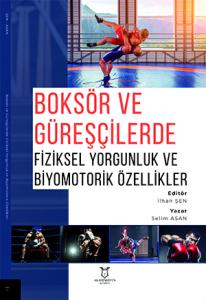
Boksör ve Güreşçilerde Fiziksel Yorgunluk ve Biyomotorik Özellikler
Özet
Bu kitap, boksörler ve güreşçilerin fiziksel yorgunluk ve biyomotorik özellikleri üzerine odaklanmaktadır. Editör Prof. Dr. İlhan Şen ve yazar Dr. Selim Asan tarafından hazırlanan bu kitap, Akademisyen Kitabevi A.Ş. tarafından basılmıştır.Kitap, boks ve güreş sporuyla ilgilenen sporcuların fiziksel yorgunluk durumunu ve biyomotorik özelliklerini incelemektedir. Bu çalışma, Atatürk Üniversitesi Sporcu Performans Ölçüm Değerlendirme ve Rehabilitasyon Merkezi tarafından desteklenmiştir. Çalışmaya 24 gönüllü erkek sporcu katılmış ve denge, reaksiyon süresi, çeviklik, anaerobik güç ve kan laktat düzeyleri gibi ölçümler alınmıştır. Ayrıca, sporcuların yorgunluğunu oluşturmak için Wingate anaerobik güç testi yapılmış ve farklı zaman aralıklarında ölçümler tekrarlanmıştır.Bu kitap, boks ve güreş gibi sıklet sporlarında müsabık sporcuların seçiminde önemli bir katkı sağlamaktadır. Ayrıca, sporcuların yorgunluktan kaynaklanan kayıplarını belirlemeye yardımcı olmaktadır. Mücadele sporları, anaerobik ve aerobik antrenman, anaerobik ve aerobik güç ve kapasite, laktat metabolizması, antrenmanın temel motorik özellikleri gibi konular da kitapta ele alınmaktadır.Bu kitap, boks ve güreş sporuyla ilgilenen sporcular, antrenörler ve spor bilimciler için önemli bir kaynak olacaktır.
This book focuses on the physical fatigue and biomotor characteristics of boxers and wrestlers. Edited by Prof. Dr. İlhan Şen and written by Dr. Selim Asan, this book is published by Akademisyen Kitabevi A.Ş. The book examines the physical fatigue status and biomotor characteristics of athletes interested in boxing and wrestling. This study is supported by Atatürk University Athlete Performance Measurement Evaluation and Rehabilitation Center. 24 male athletes volunteered for the study and measurements such as balance, reaction time, agility, anaerobic power, and blood lactate levels were taken. In addition, the Wingate anaerobic power test was conducted to induce fatigue in athletes and measurements were repeated at different time intervals.This book provides an important contribution to the selection of competitive athletes in weight sports such as boxing and wrestling. It also helps determine the losses caused by fatigue in athletes. Topics such as combat sports, anaerobic and aerobic training, anaerobic and aerobic power and capacity, lactate metabolism, and the fundamental motor characteristics of training are also addressed in the book.This book will be a valuable resource for athletes, coaches, and sports scientists interested in boxing and wrestling.
Referanslar
Açıkada, C., & Ergen, E. (1990). Science and sports. Büro Tek Ofset Matbaacılık, Ankara.
Adlerton, A. K., Moritz, U., & Moe‐Nilssen, R. (2003). Forceplate and accelerometer measures for evaluating the effect of muscle fatigue on postural control during one‐legged stance. Physiotherapy research international, 8(4), 187-199.
Akbulut T. (2019). Farklı egzersiz uygulamalarının irisin, ısı şok protein 70 ve bazı biyokimyasal parametrelere etkisinin incelenmesi (Tez No. 551147) [Doktora tezi, Fırat Üniversitesi-Elazığ]. Yükseköğretim Kurulu Ulusal Tez Merkezi.
Akcan, F. (2018). Farklı şiddetlerde uygulanan aerobik ve anaerobik egzersizlerin sporcu ve sedanterlerde serum irisin seviyesine akut etkisinin incelenmesi (Tez No. 524188 ) [Doktora Tezi, Gaziantep Üniversitesi-Gaziantep]. Yükseköğretim Kurulu Ulusal Tez Merkezi.
Akgün, N. (1994). Egzersiz Fizyolojisi. (2. Baskı), Ege Üniversitesi Basımevi, İzmir.
Akkuş, H., & Inal, A. N. (1999). Gençlerde Egzersizin Vücut Üzerine Etkisi. Selçuk Üniversitesi Beden Eğitimi ve Spor Bilimleri Dergisi, (1). 7, 20-45
Aksu, S. (1994). Denge eğitiminin etkilerinin postüral stres testi ile değerlendirilmesi (Tez No. 37887 ) [Yüksek Lisans Tezi, Hacettepe Üniversitesi-Ankara]. Yükseköğretim Kurulu Ulusal Tez Merkezi.
Alpkaya, U., & Çoknaz, H. (2002). Reaksiyon süresini etkileyen faktörler. Spor Araştırmaları Dergisi, 6 (1), 109-121
Arabacı, R., Topçu, H., & Vardar, T. (2019). The relationship between some physical fitness characteristics and body composition of elite wrestlers. International Journal of Physical Education, Fitness and Sports, 8(1), 25–32.
Arseven, R. (1986). Eskrim Tarihi ve Modern Eskrim. Türkiye Eskrim Federasyonu Ankara.
Aslan A, Güvenç A, Hazır T, & Açıkada C. (2011). Genç Futbolcularda yüksek şiddette yüklenme sonrasında toparlanma dinamikleri. Hacettepe Journal of Sport Sciences, 22(3), 93-103.
Aslankeser Z. (2010). Anaerobik antrenmanların santral-periferik yorgunluk ve toparlanma süreçlerine etkileri (Tez No. 267694 ) [Doktora Tezi, Çukurova Üniversitesi-Adana]. Yükseköğretim Kurulu Ulusal Tez Merkezi.
Astrand, P. O., Rodahl, K., Dahl, H. A., & Stromme, B. S. (1986). Evaluation of physical performance on the basis of tests. Textbook of work physiology: physiological bases of exercise, 4, 273-98
Atçeken D.H. (2017). Kadın boksörlerde müsabaka periyodu antrenmanlarının laktat, kalp atım hızı ve yorgunluk indeksi üzerine etkileri (Tez No. 478985 ) [Yüksek Lisans Tezi, Selçuk Üniversites-Konya]. Yükseköğretim Kurulu Ulusal Tez Merkezi.
Audiffren, M., Tomporowski, P. D., & Zagrodnik, J. (2008). Acute aerobic exercise and information processing: energizing motor processes during a choice reaction time task. Acta Psychologica, 129(3), 410-419.
Aydın R. (2020). Elit güreşçilerde dinamik-statik denge ve proprioseptif duyuyu etkileyen bazı faktörlerin belirlenmesi ve ilişkilendirilmesi (Tez No. 650624 ) [Doktora Tezi, Ankara Üniversitesi-Ankara]. Yükseköğretim Kurulu Ulusal Tez Merkezi.
Aydos, L., Taş, M., Akyüz, M., & Uzun, A. (2009). Investigation of the relationshıp between strength and some anthropometrıc parameters ın young elıte wrestlers. Beden Eğitimi ve Spor Bilimleri Dergisi, 11(4).
Balcı, A., Tortu, E., Kabak, B., Akınoğlu, B., Hasanoğlu, A., & Kocahan, T. (2020). Investigation of The Body Composition And Maximal Oxygen Consumption Capacity Of Elite Boxing And Wrestling Athletes. Türk Spor ve Egzersiz Dergisi, 22(3), 452-457.
Baltacı, G., Harput, G., Haksever, B., Ulusoy, B., & Ozer, H. (2013). Comparison between Nintendo Wii Fit and conventional rehabilitation on functional performance outcomes after hamstring anterior cruciate ligament reconstruction: prospective, randomized, controlled, double-blind clinical trial. Knee surgery, sports traumatology, arthroscopy, 21(4), 880-887.
Barabas, A., Bretz, K., & Kaske, R. J. (1996). Stabilometry of the flamingo balance test. In ISBS-Conference Proceedings Archive.
Başar, S., Duzgun, I., Guzel, N. A., Cicioğlu, I., & Çelik, B. (2014). Differences in strength, flexibility and stability in freestyle and Greco-Roman wrestlers. Journal of back and musculoskeletal rehabilitation, 27(3), 321-330.
Baykuş S. (1989). The analysis of physiological characteristics of 17-20 years old the turkish national free style and greco-romen espoir teams wrestlers [Unpublished Master Thesis]. Middle East Technical University.
Beneke, R., Hutler, M., Von Duvillard, S. P., Sellens, M., & Leithauser, R. M. (2003). Effect of test interruptions on blood lactate during constant workload testing. Medicine and science in sports and exercise, 35(9), 1626-1630.
Bhat, R., & Moiz, J. A. (2013). Comparison of dynamic balance in collegiate field hockey and football players using star excursion balance test. Asian journal of sports medicine, 4(3), 221.
Binboğa, E., Pehlivan, M., & Çelebi, G. (2007). Farklı frekanslardaki ve şiddetlerdeki işitsel uyaranların insanda basit reaksiyon zamanına etkileri. Ege Tıp Dergisi, 46(2), 67-72.
Bompa, T. O. (1994). Theory and methodology of training: the key to athletic performance. Kendall hunt publishing company.
Bompa, T. O. (1999). Periodization Training: Theory and Methodology-4th: Human Kinetics publishers. s57-60.
Bompa, T. O. (2007). Training Theory and Method-Periodization. Sports Bookstore, 3rd Edition, Ankara.
Boyas, S., & Guével, A. (2011). Neuromuscular fatigue in healthy muscle: underlying factors and adaptation mechanisms. Annals of physical and rehabilitation medicine, 54(2), 88-108.
Chaabène, H., Tabben, M., Mkaouer, B., Franchini, E., Negra, Y., Hammami, M., & Hachana, Y. (2015). Amateur boxing: physical and physiological attributes. Sports medicine, 45(3), 337-352.
Chaouachi, A., Brughelli, M., Chamari, K., Levin, G. T., Abdelkrim, N. B., Laurencelle, L., & Castagna, C. (2009). Lower limb maximal dynamic strength and agility determinants in elite basketball players. The Journal of Strength & Conditioning Research, 23(5), 1570-1577.
Chelladurai, P. (1976). Manifestations of agility. Journal of the Canadian Association of Health, Physical Education and Recreation, 42(3), 36-41.
Chen, Y. C., Hung, T. H., Tseng, T. C., Hsieh, C. C., Chen, F. C., & Stoffregen, T. A. (2012). Pre-bout standing body sway differs between adult boxers who do and do not report post-bout motion sickness. Plos one, 7(10), e46136.
Cicioğlu İ., Kürkçü R., Eroğlu H., & Yüksek, S. (2007). 15-17 yaş grubu güreşçilerin fiziksel ve fizyolojik özelliklerinin sezonsal değişimi. Spor Metre Beden Eğitimi ve Spor Bilimleri Dergisi, 5(4), 151- 156.
Cüceloğlu D. (1993) İnsan ve Davranışı. (ss.236) Remzi Kitabevi,
Çamçakal, A., Pepe, H., & Altın, M. (2014). Aerobic and anaerobic power profile of elıte turkısh greco-roman wrestlers. Beden Egitimi ve Spor Bilimleri Dergisi, 8(3).
Çankaya, S., Gökmen, B., Musa, Ç. O. N., & Taşmektepligil, M. (2014). Denge geliştirici özel antrenman uygulamalarının 11 yaş genç erkeklerin reaksiyon zamanları ve vücut kitle indeksi üzerine etkisi. Spor ve Performans Araştırmaları Dergisi, 5(2), 59-67.
Çetin, N., Bayramoglu, M., Aytar, A., Surenkok, O., & Yemisci, O. U. (2008). Effects of lower-extremity and trunk muscle fatigue on balance. The Open Sports Medicine Journal, 2(1).
Davis, B., Bull, R., Roscoe, J., Roscoe, D., & Saiz, M. (2000). Physical education and the study of sport.
Dawes, J. (Ed.). (2019). Developing agility and quickness. Human Kinetics Publishers.
Deane, R. S., Chow, J. W., Tillman, M. D., & Fournier, K. A. (2005). Effects of hip flexor training on sprint, shuttle run, and vertical jump performance. The Journal of Strength & Conditioning Research, 19(3), 615-621.
Demirel, N., Özbay, S., Kaya, F., & Bayram, M. (2015). Elit güreşçilerde uygulanan aerobik ve anaerobik antrenman programının vücut kompozisyonu üzerine etkileri. International Journal of Social Sciences and Education Research, 3(2), 675-682.
Demirhan, B. (2013), Güreşçilerde buz masajının toparlanmaya ilişkin bazı biyokimyasal parametrelere etkisi (Tez No 359453.) [Doktora tezi, Gazi Üniversitesi-Ankara]. Yükseköğretim Kurulu Ulusal Tez Merkezi.
Demiriz M. (2013) Farklı dinlenme aralıklarında yapılan anaerobik interval antrenmanın, aerobik kapasite, anaerobik eşik ve kan parametrelerine etkilerinin karşılaştırılması (Tez No. 331443) [Yüksek lisans tezi, Balıkesir Üniversitesi-Balıkesir]. Yükseköğretim Kurulu Ulusal Tez Merkezi.
Demirkan, E., Koz, M., Kutlu, M., & Favre, M. (2015). Comparison of physical and physiological profiles in elite and amateur young wrestlers. The Journal of Strength & Conditioning Research, 29(7), 1876-1883.
Demirkan, E., Kutlu, M., Koz, M., Özal, M., & Favre, M. (2014). Physical fitness differences between freestyle and Greco-Roman junior wrestlers. Journal of human kinetics, 41(1), 245-251.
Deniz, N. A., Ertat, A., Akgün, N., & Yapıcıoğlu, Ş. (1987). Boks sporunda oditif ve vizüel stimuluse karşı reaksiyon zamanının ölçülmesi. Spor Hekimliği Dergisi, 22, 139-148.
Doğan, E. (2013). Futbol ve güreş dalındaki sporcuların leptin düzeylerinin solunum ve aerobik kapasite parametreleri açısından incelenmesi. (Tez No. 339519) [Doktora tezi, 19 Mayıs Üniversitesi-Samsun].Yükseköğretim Kurulu Ulusal
Duchateau, J., & Hainaut, K. (1993). Behaviour of short and long latency reflexes in fatigued human muscles. The Journal of Physiology, 471(1), 787-799.
Duvan, A. (2009). Elit eskrimcilerde yorgunluğun reaksiyon zamanı üzerine etkisi (Tez No. 260800) [Doktora tezi, Gazi Üniversitesi-Ankara]. Yükseköğretim Kurulu Ulusal Tez Merkezi.
Dünya Mücadele Sporları Federasyonu İnternet Sitesi. www.dmsf.org.tr.
Era, P., Jokela, J., & Heikkinen, E. (1986). Reaction and movement times in men of different ages: a population study. Perceptual and Motor Skills, 63(1), 111-130.
Ergen E, Çağırıcı U. (1987) Okçularda reaksiyon hızı ve el – göz koordinasyonu değerlendirmeleri. Spor Hekimliği Dergisi, (2):3.
Erkmen, N., Taşkin, H., Sanioğlu, A., Kaplan, T., & Baştürk, D. (2010). Relationships between balance and functional performance in football players. Journal of Human Kinetics, 26(2010), 21-29.
Gauchard, G. C., Gangloff, P., Vouriot, A., Mallie, J. P., & Perrin, P. P. (2002). Effects of exercise-induced fatigue with and without hydration on static postural control in adult human subjects. International Journal of Neuroscience, 112(10), 1191-1206.
Ghosh, A. K. (2010). Heart rate, oxygen consumption and blood lactate responses during specific training in amateur boxing. International Journal of Applied Sports Sciences, 22(1), 1-12.
Gierczuk, D. (2008). Level of selected indicators of coordınatıon motor abılıtıes (cma) ın greco-roman and freestyle wrestlers aged 13-14. Polish Journal of Sport & Tourism, 15(4).
Gonçalves, D. F. F., Ricci, N. A., & Coimbra, A. M. V. (2009). Functional balance among community-dwelling older adults: a comparison of their history of falls. Brazilian Journal of Physical Therapy, 13(4), 316-323.
Gökdemir K. (2000). Güreş Antrenmanının bilimsel temelleri, Poyraz Ofset Matbaası, Ankara.
Gökmen, B. (2013). Denge geliştirici özel antrenman uygulamalarının 11 yaş erkek öğrencilerin statik ve dinamik denge performanslarına etkisi (Tez No. 339529) [Yüksek lisans tezi, 19 Mayıs Üniversitesi-Samsun]. Yükseköğretim Kurulu Ulusal Tez Merkezi.
Gölünük, S. (2010). Sedanter, sporcularda bacak tercihi, izokinetik diz kuvvetinin denge performansına etkisi [Doktora tezi, 19 Mayıs Üniversitesi-Samsun]. http://libra.omu.edu.tr/tezler/76638.pdf
Grindstaff, T. L., & Potach, D. H. (2006). Prevention of common wrestling injuries. Strength and Conditioning Journal, 28(4), 20.
Guidetti, L., Musulin, A., & Baldari, C. (2002). Physiological factors in middleweight boxing performance. Journal of sports medicine and physical fitness, 42(3), 309-314.
Guizani, S. M., Bouzaouach, I., Tenenbaum, G., & Kheder, A. B. (2006). Simple and choice reaction times under varying levels of physical load in high skilled fencers. Journal of Sports Medicine and physical fitness, 46(2), 344.
Gündüz N. (1993) Antrenman Bilgisi, Kanyılmaz Matbaası, İzmir. s264-265.
Güney, M., Şıktar, E.,Tamer,K. & Cicioğlu, İ. (2017). Spor fizyolojisi ve performans ölçüm testleri. (Geliştirilmiş 4.baskı. ss. 601.). Gazi kitapevi. Ankara.
Haksever, B. (2018). Sağlıklı bireylerde fonksiyonel hareketli denge sistemi ile denge tahtası eğitiminin denge ve fonksiyonel düzey üzerine etkilerinin karşılaştırılması (Tez No. 489772) [Doktora tezi, Hacettepe Üniversitesi-Ankara]. Yükseköğretim Kurulu Ulusal Tez Merkezi.
Hanon, C., Savarino, J., & Thomas, C. (2015). Blood lactate and acid-base balance of world-class amateur boxers after three 3-minute rounds in international competition. The Journal of Strength & Conditioning Research, 29(4), 942-946.
Hazar F. (2005). Badmintonda çevikliğin performansa etkisi ve geliştirilmesine yönelik antrenman uygulamaları (Tez No. 164055) [Doktora tezi, Marmara Üniversitesi-İstanbul]. Yükseköğretim Kurulu Ulusal Tez Merkezi.
Hazar, F., & Taşmektepligil, Y. (2008). Puberte öncesi dönemde denge ve esnekliğin çeviklik üzerine etkilerinin incelenmesi. Spormetre Beden Eğitimi ve Spor Bilimleri Dergisi.5(1), 9-12.
Hazır, T., Mahir, Ö. F., & Açıkada, C. (2010). Genç futbolcularda çeviklik ile vücut kompozisyonu ve anaerobik güç arasındaki ilişki. Spor Bilimleri Dergisi, 21(4), 146-153.
Hiemstra, L. A., Lo, I. K., & Fowler, P. J. (2001). Effect of fatigue on knee proprioception: implications for dynamic stabilization. Journal of Orthopaedic & Sports Physical Therapy, 31(10), 598-605.
Horak, F. B., & Shupert, C. L. (1994). Role of the vestibular system in postural control. Vestibular rehabilitation, 2, 98-113.
Horswill, C. A. (1992). Applied physiology of amateur wrestling. Sports Medicine, 14(2), 114-143.
Horswill, C. A., Scott, J. R., & Galea, P. (1989). Comparison of maximum aerobic power, maximum anaerobic power, and skinfold thickness of elite and nonelite junior wrestlers. International Journal of Sports Medicine, 10(03), 165-168.
Hrysomallis, C. (2011). Balance ability and athletic performance. Sports medicine, 41(3), 221-232.
Hsu, C. L., Best, J. R., Davis, J. C., Nagamatsu, L. S., Wang, S., Boyd, L. A., & Liu-Ambrose, T. (2018). Aerobic exercise promotes executive functions and impacts functional neural activity among older adults with vascular cognitive impairment. British journal of sports medicine, 52(3), 184-191.
Hukkanen, E., & Häkkinen, K. (2017). Effects of sparring load on reaction speed and punch force during the precompetition and competition periods in boxing. The Journal of Strength & Conditioning Research, 31(6), 1563-1568.
Hunnicut, M. (2005) The development of boxing strategies, stlyles and techniques during the gloved era to present. . İBRO Journal, 85.
Hübner-Wozniak, E., Kosmol, A., Lutoslawska, G., & Bem, E. Z. (2004). Anaerobic performance of arms and legs in male and female free style wrestlers. Journal of science and medicine in sport, 7(4), 473-480.
Iri, R., Aktug, Z. B., Koc, M., Sahin, I., & Murathan, F. (2016). The effect of fatigue in elite young female wrestlers upon balance performance and reaction. An International Journal of Medical Sciences,4(27).
Işık, Ö., Gökdemir, K., Bastık, C., Yıldırım, İ., & Doğan, İ. (2013). A study on elıte wrestlers: weıght loss and depressıon. Journal of Physical Education & Sports Science/Beden Eğitimi ve Spor Bilimleri Dergisi, 7(3).
Ivoilov, A. V., Smirnov, Y. G., Chikalov, V. V., & Garkavenko, A. G. (1981). Effects of progressive fatigue on shooting accuracy. The theory and practice of physical training culture, 7, 12-14.
Jain, A., Bansal, R., Kumar, A., & Singh, K. D. (2015). A comparative study of visual and auditory reaction times on the basis of gender and physical activity levels of medical first year students. International Journal of Applied and Basic Medical Research, 5(2), 124.
Jarvis, S., Sullivan, L. O., Davies, B., Wiltshire, H., & Baker, J. S. (2009). Interrelationships between measured running intensities and agility performance in subelite rugby union players. Research in Sports Medicine, 17(4), 217-230.
Jay, D., Mark, R. (2012). Developing agility and quickness. National Strength & Conditioning Association.
Jelena. Z. P.G., Barak, O. F., & Grujic, N. G. (2009). Maximal anaerobic power test in athletes of different sport disciplines. The Journal of Strength & Conditioning Research, 23(3), 751-755.
Johnson, B. L., & Nelson, J. K. (1969). Practical measurements for evaluation in physical education. Minniapolis:(ss.486) Burgess Publishing Company.
Juel, C. (1998). Muscle pH regulation: role of training. Acta Physiologica Scandinavica, 162(3), 359-366.
Kafkas, A., & Çoksevim, B. (2014). İzokinetik egzersiz programlarının sporcuların üst ve alt ekstremite kas gurupları üzerine etkisi. İnönü Üniversitesi Beden Eğitimi ve Spor Bilimleri Dergisi, 1(3), 10-21.
Kara, M., & Gökbel, H. (1994). Anaerobik eşik ve önemi. Spor Hekimliği Dergisi, 29, 161, 175.
Karataş, M. (2016). Yorgunluk baskısı altında tabanca atış performansının ölçülmesi: polis mekik koşusu testi (Tez No. 443862) [Doktora tezi, Kırıkkale Üniversitesi-Kırıkkale]. Yükseköğretim Kurulu Ulusal Tez Merkezi.
Karatosun H. (2010). Antrenmanın Fizyolojik Temelleri. (3.Baskı) Altındağ Matbaası, Isparta.
Kaya, M., & Şenel, Ö. (1999). Maksimal egzersiz sonrası uygulanan lokal spor masajının kan laktat düzeyi kan basıncı ve kalp atım sayısı üzerindeki etkileri. Gazi Beden Eğitimi ve Spor Bilimleri Dergisi, 4(2), ss.17-22.
Kenney, D. (1999). Police and Policing: Contemporary issues. Green wood Publishing Group.
Kent-Braun, J. A. (1999). Central and peripheral contributions to muscle fatigue in humans during sustained maximal effort. European journal of applied physiology and occupational physiology, 80(1), 57-63.
Khanna, G. L., & Manna, I. (2006). Study of physiological profile of Indian boxers. Journal of sports science & medicine, 5(CSSI), 90-98
Kirby, R. (1971). A simple test of agility. Coach and athlete, 25(6), 30-31.
Köseoğlu, A. & Kin, A. (2008). Supramaksimal bir bacak egzersizi sonrası farklı sürelerde uygulanan bacak masajının toparlanmaya etkisi. 10.Uluslararası Spor Bilimleri Kongresi Özet Kitabı (ss. 49). Abant İzzet Baysal Üniversitesi.
Kutlu, M., & Cicioğlu, H. İ. (1995). Türkiye greko-romen ve serbest yıldız milli takım güreşçilerinin seçilmiş fizyolojik özelliklerinin analizi. Hacettepe Üniversitesi Spor Bilimleri Dergisi, 6(4), 9-17.
Kürkçü, R., & Özdağ, S. (2005). Antrenman bilimi ışığında güreş. Saray Kağıtçılık ve Matbaacılık (ss.12-18), Ankara.
Lamb, D. R., & Williams, M. H. (1992). Ergogenics: Enhancement of Performance in Exercise and Sport. Medicine & Science in Sports & Exercise, 24(4), 499.
Langan-Evans, C., Close, G. L., & Morton, J. P. (2011). Making weight in combat sports. Strength & Conditioning Journal, 33(6), 25-39.
Lenetsky, S., Harris, N.,Brughelli, M. (2013) Assessment and Contributors of Punching Forces in Combat Sports Athletes. Strength and Conditioning Journal, 35 (2), 1-7.
Lepers, R., Bigard, A. X., Diard, J. P., Gouteyron, J. F., & Guezennec, C. Y. (1997). Posture control after prolonged exercise. European journal of applied physiology and occupational physiology, 76(1), 55-61.
Letafatkar, A., & Milaei, M. (2012). Being in context and simıilarıiy in fatiguing protocols to maın aspects of wrestlıng don't alter the balance. Sport Scientific & Practical Aspects, 9(2).
Lin, Y. H., Tang, Y. W., Chen, T. R., & Wang, C. Y. (2012). A reliability study for standing functional reach test using modified and traditional rulers. Perceptual and motor skills, 115(2), 512-520.
Little, T. & Williams, A.G. (2005). Specificity of acceleration, maximum speed, and agility in professional soccer players. J Strength Cond Res, 19 (1), 76–8
Lyon, R. J., Tong, J. E., Leigh, G., & Clare, G. (1975). The influence of alcohol and tobacco on the components of choice reaction time. Journal of Studies on Alcohol, 36(5), 587-596.
Mann, J. B., Ivey, P. A., Mayhew, J. L., Schumacher, R. M., & Brechue, W. F. (2016). Relationship between agility tests and short sprints: Reliability and smallest worthwhile difference in National Collegiate Athletic Association Division-I football players. The Journal of Strength & Conditioning Research, 30(4), 893-900.
Maud, P. J., & Foster, C. (2006). Physiological assessment of human fitness. Human Kinetics.
Maughan, R., & Gleeson, M. (2004). Middle distance events. The Biochemical Basis of Sports Performance (ss. 91-114).
McKeon, P. O., Ingersoll, C. D., Kerrigan, D. C., Saliba, E., Bennett, B. C., & Hertel, J. (2008). Balance training improves function and postural control in those with chronic ankle instability. Medicine & science in sports & exercise, 40(10), 1810-1819.
Michell, T. B., Ross, S. E., Blackburn, J. T., Hirth, C. J., & Guskiewicz, K. M. (2006). Functional balance training, with or without exercise sandals, for subjects with stable or unstable ankles. Journal of Athletic Training, 41(4), 393.
Miller, J. M., Hilbert, S. C., & Brown, L. E. (2001). Speed, quickness, and agility training for senior tennis players. Strength & Conditioning Journal, 23(5), 62.
Miller, M. G., Herniman, J. J., Ricard, M. D., Cheatham, C. C., & Michael, T. J. (2006). The effects of a 6-week plyometric training program on agility. Journal of sports science & medicine, 5(3), 459.
Morán-Navarro, R., Valverde-Conesa, A., López-Gullón, J. M., la Cruz-Sánchez, D., & Pallarés, J. G. (2015). Can balance skills predict Olympic wrestling performance. Journal of Sport & Health Research, 7(1).
Moreno-Segura, N., Igual-Camacho, C., Ballester-Gil, Y., Blasco-Igual, M. C., & Blasco, J. M. (2018). The Effects of the pilates training method on balance and falls of older adults: a systematic review and meta-analysis of randomized controlled trials. Journal of Aging & Physical Activity, 26(2).
Muratlı, S. (2007). Children and sports in terms of training science “antrenman bilimi yaklaşımıyla çocuk ve spor”. Nobel Publication and Distribution (2nd Edition), Ankara.
Musabaşoğlu, S. (2008). Elit düzeydeki alp disiplini kayakçıların reaksiyon zamanlarının araştırılması (Tez No. 248550) [Yüksek lisans tezi, Atatürk Üniversitesi-Erzurum]. Yükseköğretim Kurulu Ulusal Tez Merkezi.
Nardone, A., Tarantola, J., Giordano, A., & Schieppati, M. (1997). Fatigue effects on body balance. Electroencephalography and Clinical Neurophysiology/Electromyography and Motor Control, 105(4), 309-320.
Nas, K. (2010). Futbolcularda sürat ve çabukluk arasındaki ilişkinin incelenmesi (Tez No. 267119) [Yüksek lisans tezi, Selçuk Üniversitesi-Konya]. Yükseköğretim Kurulu Ulusal Tez Merkezi.
Ozan, M. (2013). Sporcularda kol ve bacak wingate testleri ile anaerobik gücün değerlendirilmesi (Tez No. 333996) [Yüksek lisans tezi, Selçuk Üniversitesi-Konya]. Yükseköğretim Kurulu Ulusal Tez Merkezi.
Özbay, S., & Ulupınar, S. (2020). Strength-power tests are more effective when performed after exhaustive exercise in discrimination between top-elite and elite wrestlers. Journal of strength and conditioning research,1-7.
Özbay, S., Ulupınar, S., & Özkara, A. B. (2018). Sporda Çeviklik Performansı.Ulusal Spor Bilimleri Dergisi, 2(2), 97-112.
Özdil, G. (2016). Boksörlerde kuvvet antrenmanlarının maksimal kuvvet ve anaerobik güce etkisi (Tez No. 440495) [Yüksek lisans tezi, Selçuk Üniversitesi-Konya]. Yükseköğretim Kurulu Ulusal Tez Merkezi.
Özer, K. (2001). Fiziksel uygunluk.(1.Baskı ss.87-89), Nobel Yayın Dağıtım.
Özer, Ö. (2019). Investigation of the effect of acute muscular fatigue on static and dynamic balance performances in elite wrestlers. Journal of Education and Learning, 8(5), 179-184.
Özkan A, Köklü Y, & Ersöz G. ( 2010), Wingate Anaerobik Güç Testi, Uluslararası insan Bilimleri Dergisi, 7(1).
Özkan, A., Köklü, Y., & Ersöz, G. (2010). Anaerobik performans ve ölçüm yöntemleri. Gazi Kitapevi (ss.119-127), Ankara.
Özkan, A., Köklü, Y., Alemdaroğlu, U., & Eyüboğlu, E. (2009). Develop mental Periods, Physical Fitness and Physical Activity of 6-12 Age Group Children, Ankara University Press, Ankara.
Pala, R. (2011). Investigation of some physical and oxidative stress parameters of boxing national team the during preparation to the european championship camps (Tez No. 281357) [Doktora tezi Fırat Üniversitesi, Elazığ-Türkiye]. Yükseköğretim Kurulu Ulusal Tez Merkezi.
Panjan A, Sarabon N. (2012). Review of methods for the evaluation of human body balance. Sport science review,19(5-6): 131-63
Paul, D. J., Gabbett, T. J., & Nassis, G. P. (2016). Agility in team sports: Testing, training and factors affecting performance. Sports Medicine, 46(3), 421-442.
Perrin, P., Deviterne, D., Hugel, F., & Perrot, C. (2002). Judo, better than dance, develops sensorimotor adaptabilities involved in balance control. Gait & posture, 15(2), 187-194.
Pfile, K. R., Gribble, P. A., Buskirk, G. E., Meserth, S. M., & Pietrosimone, B. G. (2016). Sustained improvements in dynamic balance and landing mechanics after a 6-week neuromuscular training program in college women’s basketball players. Journal of sport rehabilitation, 25(3), 233-240.
Plisky, P. J., Gorman, P. P., Butler, R. J., Kiesel, K. B., Underwood, F. B., & Elkins, B. (2009). The reliability of an instrumented device for measuring components of the star excursion balance test. North American journal of sports physical therapy, 4(2), 92.
Plowman, S. A., & Smith, D. L. (2013). Exercise physiology for health fitness and performance. Lippincott Williams & Wilkins.
Polat, G. (2009). 9–12 yaş grubu çocuklarda 12 haftalık temel badminton eğitimi antrenmanlarının motorik fonksiyonları ve reaksiyon zamanları üzerine etkileri (Tez No. 242810) [Yüksek lisans tezi, Çukurova Üniversitesi-Çukurova]. Yükseköğretim Kurulu Ulusal Tez Merkezi.
Popadic Gacesa JZ., Barak, O. F., & Grujic, N. G. (2009). Maximal anaerobic power test in athletes of different sport disciplines. The Journal of Strength & Conditioning Research, 23(3), 751-755.
Pyne, D. B., & Martin, D. T. (2011). Fatigue-Insights from individual and team sports. In Regulation of fatigue in exercise (ss. 177-186). Nova Publishers.
Raya, M. A., Gailey, R. S., Gaunaurd, I. A., Jayne, D. M., Campbell, S. M., Gagne, E., & Tucker, C. (2013). Comparison of three agility tests with male servicemembers: edgren side step test, t-test, and ıllinois agility test. Journal of Rehabilitation Research & Development, 50(7).951-960.
Reddy, S., Eckner, J. T., & Kutcher, J. S. (2014). Effect of acute exercise on clinically measured reaction time in collegiate athletes. Medicine and science in sports and exercise, 46(3), 429.
Renklikurt, T. (1973). Antrenman ve fizyolojik özellikleri (1. Baskı). İstanbul Matbaası. İstanbul.
Ribeiro, F., & Oliveira, J. (2007). Aging effects on joint proprioception: the role of physical activity in proprioception preservation. European Review of Aging and Physical Activity, 4(2), 71-76.
Rugelj, D. (2010). The effect of functional balance training in frail nursing home residents. Archives of gerontology and geriatrics, 50(2), 192-197.
Sahlin, K. (1992). Metabolic factors in fatigue. Sports Medicine, 13(2), 99-107.
Samar, E. (2013). Dayanıklılık artırıcı antrenman yapan boksörlere quercetin verilmesinin antioksidan kapasite ve egzersiz performansı üzerine etkileri (Tez No. 411984) [Yüksek lisans tezi, Kafkas Üniversitesi-Kars]. Yükseköğretim Kurulu Ulusal Tez Merkezi.
Savaş, S. & Uğraş, A. (2004). Sekiz haftalık sezon öncesi antrenman programının üniversiteli erkek boks, tekwando ve karate sporcularının fiziksel ve fizyolojik özellikleri üzerine olan etkileri. Gazi Üniversitesi Gazi Eğitim Fakültesi Dergisi, 24(3).
Savranbaşı, R. (2011). Elit erkek serbest güreşçilerde kan laktat düzeyi, kalp atım hızı ve teknik performans arasındaki ilişkinin incelenmesi. Spor Hekimliği Dergisi, 46(3), 087-096.
Sayın, M. (2011). Hareket ve beceri öğretimi.Spor Yayınevi.
Schmidt, R. A., & Lee, T. (1988). Motor Control and Learning, 5E. Human kinetics (ss.56-60).
Sekulic, D., Spasic, M., Mirkov, D., Cavar, M., & Sattler, T. (2013). Gender-specific influences of balance, speed, and power on agility performance. The Journal of Strength & Conditioning Research, 27(3), 802-811.
Selçuk, M. S. (2014). Bayan boksörlerde 6 haftalık direnç lastiği uygulamasının maksimal kuvvet ve anaerobik güce etkisi (Tez No. 359771) [Yüksek lisans tezi, Selçuk Üniversitesi-Konya]. Yükseköğretim Kurulu Ulusal Tez Merkezi.
Sevim, Y. (2002). Antrenman Bilgisi, (6. Baskı), Nobel Yayınevi, Ankara.
Sevim, Y. (2009). Üst düzey futbol takımlarında antrenman planlaması, programlaması ve uygulama örnekleri. 3. Ulusal futbol ve bilim kongresinde sunulan bildiri, Marmara Üniversitesi
Shephard, R. J. (1984). Sleep, biorhythms and human performance. Sports Medicine, 1(1), 11-37.
Sheppard, J. M., & Young, W. B. (2006). Agility literature review: Classifications, training and testing. Journal of sports sciences, 24(9), 919-932.
Simonek, J., Horička, P., & Hianik, J. (2016). Differences in pre-planned agility and reactive agility performance in sport games. Acta Gymnica, 46(2), 68-73.
Smith, M. S. (2006). Physiological profile of senior and junior England international amateur boxers. Journal of sports science & medicine, 5(CSSI), 74.
Soslu, R., Güler, M., Özer, Ö., Devrilmez, M., Cincioğlu, G., Doğan, A. A., & Esen, H. T. (2018). Boksörlerde akut yorgunluğun statik dengeye etkisi. Sportive, Journal of Sport, Education and Recreation 1(1), 19-30.
Soykurt, M. (2017). Boksörlerde esneklik ve dengenin direkt yumruk kinematiği ile ilişkisi (Tez No. 478913) [Yüksek lisans tezi, Hacettepe Üniversitesi-Ankara]. Yükseköğretim Kurulu Ulusal Tez Merkezi.
Sönmez G.T,. (2002). Egzersiz ve spor fizyolojisi. Ata Ofset Matbaacılık (ss.163-167). Bolu.
Sönmez, V., & Alacapınar, F. G. (2014). Örneklendirilmiş bilimsel araştırma yöntemleri. Anı Yayıncılık.
Stewart, P. F., Turner, A. N., & Miller, S. C. (2014). Reliability, factorial validity, and interrelationships of five commonly used change of direction speed tests. Scandinavian journal of medicine & science in sports, 24(3), 500-506.
Sucan, S., Yılmaz, A., Can, Y.,& Süer, C. (2005). Aktif futbol oyuncularının çeşitli denge parametrelerinin değerlendirilmesi. Sağlık Bilimleri Dergisi, 14(1), 36-43.
Swaddling, J. (2000). Antik olimpiyat oyunları (Çeviren Gürün, B.) (1.Baskı) Homer Kitapevi. İstanbul
Şenel, Ö., Duvan, A., & Toros, T. (2010). Maksimal yüklenme yoğunluğunun elit türk eskrimcilerin görsel reaksiyon zamanları üzerine etkisi. Beden Eğitimi ve Spor Bilimleri Dergisi, 4(3), 146-151.
Tamer, K. (2000). Sporda fiziksel-fizyolojik performansın ölçülmesi ve değerlendirilmesi. Bağırgan Yayınevi.Ankara
Tatlıcı, A. (2017). Elit boksörlerde akut besinsel nitrat takviyesinin anaerobik güç üzerine etkisi (Tez No. 478968) [Yüksek lisans tezi, Selçuk Üniversitesi-Konya]. Yükseköğretim Kurulu Ulusal Tez Merkezi.
Thompson, G. (2001). The throws & take-downs of greco-romen wrestling. Great Britain:Summersdale Publishers.
Tsorbatzoudis, H., Barkoukis, V., Danis, A., & Grouios, G. (1998). Physical exertion in simple reaction time and continuous attention of sport participants. Perceptual and motor skills, 86(2), 571-576.
Turner, A., Walker, S., & Stembridge, M. (2011). A testing battery for the assessment of the fitness in score players. National Strength and Conditioning Journal, 33: 29-39.
Türkeri C. (2007) İki Ayrı Karate Tekniğinin Antropometrik ve Biyomekanik Açıdan İncelenmesi (Tez No. 288442) [Doktora tezi, Çukurova Üniversitesi-Çukuova]. Yükseköğretim Kurulu Ulusal Tez Merkezi.
Uçan, İ. (2020). Selection of agility tests according to sports branches in terms of basic motor characteristics. African Educational Research Journal. Special Issue, 8(3)22-29
Ün, N. (2003). Zihinsel özürlü çocuklarda fiziksel uygunluk eğitiminin reaksiyon zamanı üzerine etkisi (Tez No. 132174) [Doktora tezi, Hacettepe Üniversitesi-Ankara]. Yükseköğretim Kurulu Ulusal Tez Merkezi.
Ünlü, G., & Tatlıcı, A. (2018). Elit güreşçilerde proprioseptif nöromuskuler fasilitasyon (pnf) uygulamalarının dinamik denge performansına akut etkileri. Sportif Bakış: Spor ve Eğitim Bilimleri Dergisi, 57-63.
Üstündağ, B., Kocahan, T., Tortu, E., Karaman, G., & Deliceoğlu, G. (2017). Farklı branşlardaki erkek milli takım sporcularının anaerobik güç ve kapasitelerinin incelenmesi. Gaziantep Üniversitesi Spor Bilimleri Dergisi, 2(2), 57-65.
Vardar, S. A., Tezel, S., Öztürk, L., & Kaya, O. (2007). The relationship between body composition and anaerobic performance of elite young wrestlers. Journal of sports science & medicine, 6(CSSI-2), 34.
Welford, A. (1980). Choice reaction time: Basic concepts. Reaction times, 73-128.
Williams, G. N., & Allen, E. J. (2010). Rehabilitation of syndesmotic (high) ankle sprains. Sports Health, 2(6), 460-470.
Wilmore, J. H., & Costill, D. L. (1999). Physiology of Sport and Exercise. (2 nd ss. 310-41) Champaign. Human Kinetics.
Yarar H. (2015). Mücadele sporcularında kısa süreli vücut ağırlığı kaybının dayanıklılık performansına etkisinin incelenmesi (Tez No. 447359) [Doktora tezi, Bolu Abant İzzet Baysal Üniverisitesi-Bolu]. Yükseköğretim Kurulu Ulusal Tez Merkezi.
Yoon, J. (2002). Physiological profiles of elite senior wrestlers. Sports Medicine, 32(4), 225-233.
Young, W. B., James, R., & Montgomery, I. (2002). Is muscle power related to running speed with changes of direction?. Journal of sports medicine and physical fitness, 42(3), 282-288.
Young, W., & Farrow, D. (2006). A review of agility: Practical applications for strength and conditioning. Strength and conditioning journal, 28(5), 24.
Zemková, E. (2016). Differential contribution of reaction time and movement velocity to the agility performance reflects sport-specific demands. Human movement, 17(2), 94-101.
Zemková, E., Kyselovičová, O., & Hamar, D. (2010). Postural sway response to rebound jumps of different duration. Hum Mov, 11(2), 153-156.
Zenbilci N. (1995). Sinir sistemi hastalıkları. İstanbul Üniversitesi Basımevi, İstanbul.
Ziyagil M.A. (1991). Güreşcilerin antropometrik özellikleri, biyomotor yetenekleri ve başarıları arasındaki ilişkilerin araştırılması (Tez No.19033) [Doktora tezi, Marmara Üniversitesi-İstanbul].Yükseköğretim Kurulu Ulusal Tez Merkezi.
Ziytak Y.Ş. (2011) Mücadele sporlarında üst ekstremite reaksiyon süratinin incelenmesi (Tez No. 301452) [Yüksek lisans tezi, Ege Üniversitesi-İzmir]. Yükseköğretim Kurulu Ulusal Tez Merkezi.
Zorba E., Ziyagil M. A., & Erdemli D. (1999). Türk rus boks milli takımlarının bazı fizyolojik kapasite ve antropometrik yapılarının karşılaştırılması. Gazi Beden Eğitimi ve Spor Bilimleri Dergisi, 4(1), 17-28.
Zorba, E. (1999). Herkes için spor ve fiziksel uygunluk. Başbakanlık Gençlik ve Spor Genel Müdürlüğü.
Zorba, E., Özkan, A., Akyüz, M., Harmancı, H., Taş, M., & Şenel, Ö. (2010). Güreşçilerde bacak hacmi, bacak kütlesi, anaerobik performans ve bacak kuvveti arasındaki ilişki. Uluslararası İnsan Bilimleri Dergisi, 7(1), 83-96.
Yayınlanan
Lisans
LisansBu İnternet Sitesi içeriğinde yer alan tüm eserler (yazı, resim, görüntü, fotoğraf, video, müzik vb.) Akademisyen Kitabevine ait olup, 5846 sayılı Fikir ve Sanat Eserleri Kanunu ve 5237 sayılı Türk Ceca Kanunu kapsamında korunmaktadır. Bu hakları ihlal eden kişiler, 5846 sayılı Fikir ve Sanat eserleri Kanunu ve 5237 sayılı Türk Ceza Kanununda yer alan hukuki ve cezai yaptırımlara tabi olurlar. Yayınevi ilgili yasal yollara başvurma hakkına sahiptir.
