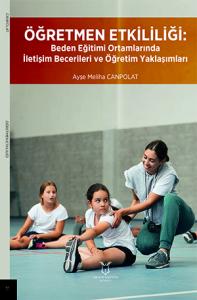
Öğretmen Etkililiği: Beden Eğitimi Ortamlarında İletişim Becerileri ve Öğretim Yaklaşımları
Özet
Bu kitap, beden eğitimi ortamlarında iletişim becerileri ve öğretim yaklaşımları konusunda öğretmen etkililiğini ele almaktadır. Yazar Ayşe Meliha Canpolat tarafından kaleme alınan kitap, Akademisyen Kitabevi A.Ş. tarafından yayımlanmıştır. Kitapta, beden eğitimi öğretmenlerinin iletişim becerileri ve öğretim yaklaşımlarının modern eğitimdeki etkililiği incelenmektedir. Kitap, Prof. Dr. Birol Doğan'ın danışmanlığında yürütülen Ayşe Meliha Canpolat'ın doktora tezinden üretilmiştir. Kitapta, öğretmenlerin iletişim becerileri ve öğretim yaklaşımlarının önemi vurgulanmakta ve beden eğitimi ortamlarında etkili iletişim stratejileri sunulmaktadır. Kitap, beden eğitimi öğretmenlerinin profesyonel gelişimine katkı sağlamayı hedeflemektedir.
This book addresses the effectiveness of teacher communication skills and teaching approaches in physical education settings. The book, written by Ayşe Meliha Canpolat, was published by Akademisyen Kitabevi A.Ş. It examines the effectiveness of physical education teachers' communication skills and teaching approaches in modern education. The book is based on Ayşe Meliha Canpolat's doctoral thesis, supervised by Prof. Dr. Birol Doğan. The importance of teachers' communication skills and teaching approaches is emphasized in the book, and effective communication strategies in physical education settings are presented. The book aims to contribute to the professional development of physical education teachers.
Referanslar
Ahmed, A. K. (2013). Teacher-centered versus learner -centered teaching style. The Journal of Global Business Management. 9(1), 22-34.
Aküzüm, C. & Gültekin, S. Ö. (2017). Sınıf öğretmenlerinin iletişim becerileri ile sınıf yönetimi becerileri arasındaki ilişkinin incelenmesi. Elektronik Eğitim Bilimleri Dergisi. 6(12), 89-107.
Ashton, P. T., & Webb, R. B. (1986). Making a Difference: Teachers’ Sense of Efficacy and Student Achievement. New York: Longman.
Bilgin, İ., & Bahar,M. (2008). Investigation of the relationship between teaching and learning styles of primary school teachers. Gazi Eğitim Fakültesi Dergisi, 28, (1), 19-38.
Black, K. A. (2000). Gender differences in adolescents’ behavior during conflict resolution tasks with best friends. Adolescence, 35(139), 499-512.
Boddy, N., Watson, K., & Aubusson, P. (2003). A trial of the five Es: a referent model for constructivist teaching and learning. Research in Science Teaching, 33(1), 27–42.
Brown, T. J., Castor, T., Byrnes-Loinette, K., Bowman, J., & McBride, M. C. (2016). The LOCs and the shift to student-centered learning. Communication Education, 65(4), 493-495. https://doi.org/10.1080/03634523.2016.1202998.
Burka, J. B., & Yuen, L. M. (2008). Procrastination: Why You Do It, What to Do about It Now. Cambridge, MA: Da Capo Press.
Canpolat, A.M. (2009). Approaches to teaching inventory: evaluation of psychometric properties and examining in academic staff, teachers, and teacher candidates in the field of physical education and sport. Performance. 3-4, (15), 59-66.
Canpolat A. M., & Doğan, B. (2011). Evaluation of psychometric properties of teacher efficacy scale in academic staff, teachers and teacher candidates in the field of physical education and sports. Turkiye Klinikleri J Sports Sci, 3(1), 21-28.
Chacón, C.T. (2005). Teachers’ perceived efficacy among English as a foreign language teachers in middle schools in Venezuela. Teaching and Teacher Education. 21(3), 257-272. https://doi:10.1016/j.tate.2005.01.001.
Cheung, H.Y. (2006) The measurement of teacher efficacy: Hong Kong primary in‐service teachers. Journal of Education for Teaching, 32:4, 435-451. https://doi:10.1080/02607470600982134.
Cuban, L. (2007). Hugging the middle teaching in an era of testing and accountability, 1980–2005. Education Policy Analysis Archives, 15(1), 1-29.
Çağlar, İ. & Kılıç, S. (2008). Genel İletişim, 16. Ankara 1. Baskı.
Çam, S. (1999). İletişim becerileri eğitimi programının öğretmen adaylarının ego durumlarına ve problem çözme becerisine etkisi. Türk PDR Dergisi, 12, 16-27.
Çapar, D.& Tomul, E. (2022). Öğretmenlerin Sınıfta Kullandıkları Beden Dilleri ve Kullanış Amaçları. E-Uluslararası Eğitim Araştırmaları Dergisi 13(5), 41-59.
Çetinkanat, A.C. (1997). “Öğretmenlerin İletişim Becerileri”, 3. Ulusal Sınıf Öğretmenliği Sempozyumu, 23-24 Ekim, 17-26, Çukurova Üniversitesi, Adana.
Çiftçi, S., Sünbül, A. M., & Köksal, O. (2013). An assessment of elementary school teachers’ approaches and practices regarding the constructivist program based on the views of educational inspectors. Constructivist program based on the views of educational inspectors. Mersin University Journal of the Faculty of Education, 9, (1), 281-295.
Çoban, B., Ünveren, A. (2007). Beden Eğitimi ve Oyun Öğretimi. Oğuzhan Zirek (Editör). Ankara: Nobel Yayın Dağıtım.
Demirel Ö. (1998). Genel Öğretim Yöntemleri, Kardeş Yayın Evi, Ankara.
Dökmen, Ü. (2008) İletişim çatışmaları ve empati. Remzi kitap evi.
Emaliana, I. (2017). Teacher-centered or student-centered learning approach to promote learning? Journal Sosial Humaniora, 10(2), 59-70.
Erişti, S. D. B. (2016). Yeni Medya ve Görsel İletişim Tasarımı. Ankara: Pegem Akademi Yayınları, 1. Baskı.
Eroğlu, C., & Ünlü, H. (2015). Self-efficacy: Its effects on physical education teacher candidates’ attitudes toward the teaching profession. Educational Sciences: Theory&Practice. 15(1), 201-212.
Gibson, S., & Dembo M. H. (1984). Teacher Efficacy: A construct validation. Journal of Educational Psychology.76: 569-582. http://dx.doi.org/10.1037/0022-0663.76.4.569.
Güleç, S., & Şentürk Leylek, B. (2018). Communication skills of classroom teachers according to various variables. Universal Journal of Educational Research 6(5): 857-862. http://doi:10.13189/ujer.2018.060507.
Gülüm, V., & Bilir, P. (2011). Opinious of physical education teachers, physical education curricula programs related to the condition of applicability. SPORMETRE Beden Eğitimi ve Spor Bilimleri Dergisi, IX (2), 57-64.
Güngör, N. (2011) İletişime Giriş, Siyasal Kitapevi. Ankara.
Grasha, A. F. (2002) The Dynamics of One-on-One teaching, college teaching, 50:4, 139-146. http://doi:10.1080/87567550209595895.
Guskey, T.R. (1988). Teacher efficacy, self-concept, and attitudes toward the implementation of instructional innovation. Teaching and Teacher Education, 4(1), 63–69.
Hall, J. & Saunders, P. (1997). Adopting a student-centred approach to management of learning. C. Bell, M. Bowden ve A. Trott (Ed.), Implementing flexible learning. London: Kogan Page.
Isikoglu, N., Basturk, R., & Karaca, F. (2009). Assessing in-service teachers’ instructional beliefs about student-centered education: A Turkish perspective. Teaching and Teacher Education, 25, 350–356.
Karakaya, Y. E., Devecioğlu, S., Çoban, B., & Karademir, T. (2011). Evaluation of the guide book of physical education classes in the direction of physical education teachers. Erzincan University journal of Education, 13 (1), 123- 142.
Kayabaşı, Y., & Akcengiz, S. A. (2014). Examining different aspects of communication talents of candidate teachers which are reading in Gazi education faculty. The Journal of the Industrial Arts Education faculty of Gazi University, 33, 86-104.
Kazempour, M. (2009). Impact of inquiry-based professional development on core conceptions and teaching practices: a case study. Science Education, 18(2), 56–68.
Kirazoğlu, Z. (2000). Ünitelere göre hazırlanmış Oyunlar. Bursa: Ezgi Kitabevi.
Kleinsasser, R. (2014). Teacher efficacy in teaching and teacher education. Teaching and Teacher Education. 44, 168-179. https://doi.org/10.1016/j.tate.2014.07.007.
Korkut, F. (2005) Communication skills Training Program for Adults. Hacettepe University journal of Education. 28, 143-149.
Korkut Owen, F., & Bugay, A. (2014). Developing a communication skills scale: validity and reliability studies. Mersin University Journal of the Faculty of Education. 10 (2), 51- 64.
Kozikoğlu, İ. & Özcanlı N. (2020). Öğretmenlerin 21. yüzyıl öğreten becerileri ile mesleğe adanmışlıkları arasındaki ilişki, Cumhuriyet Uluslararası Eğitim Dergisi, 9(1), 270-290.
Künüçen, H.& Olguntürk, K. (2014). Görsel iletişim öğelerinin yeni bir medya dili olarak sinemada yeniden tasarımı, İstanbul International Conference on Communication, Media, Tecnology and Design, 24-26 April pp.334-337
Lindblom-Ylänne, S., Trigwell, K., Nevgi, A., & Ashwin, P. (2006). How approaches to teaching are affected by discipline and teaching context. Studies in Higher Education, 31(3), 285–298.
Mackay, J., & Parkinson, J. (2010). Gender, self-efficacy and achievement among South African Technology teacher trainees, Gender and Education. 22(1), 87–103.
Martin, N.K. Sass, D.A., & Schmitt, T.A. (2012). Teacher efficacy in student engagement, instructional management, student stressors, and burnout: a theoretical model using in-class variables to predict teachers' intent-to-leave. Teaching and Teacher Education: An International Journal of Research and Studies. 28(4), 546-559.
Mascolo, M. F. (2009). Beyond student-centered and teacher-centered pedagogy: teaching and learning as guided participation. Pedagogy and the Human Sciences, 1 (1), 3-27
MEB.(2023). Öğretmenlik Mesleği. https://mevzuat.sitesi.web.tr/milli-egitim-temel-kanunu/madde/43/ adresinden 07.03.2023 tarihinde erişilmiştir.
Milli, M. S., & Yağcı, U. (2017). Research on communication skills of pre-service teachers. Abant İzzet Baysal University Journal of Faculty Education, 17 (1), 286-298.
Minor, L.C., Onwuegbuzie, A.J., Witcher, A.E., & James, T.L. (2002). Preservice teachers' educational beliefs and their perceptions of characteristics of effective teachers. The Journal of Educational Research, 96:2, 116-127.https://doi:10.1080/00220670209598798.
Moore, K. D., (2004) Öğretim Becerileri, Çeviren, Nizamettin Kaya, 111-114.
Neumann, R., Parry, S., & Becher, T. (2002). Teaching and learning in their disciplinary context: A conceptual analysis. Studies in Higher Education, 4, 405-417.
Odanga, S.J.O., Raburu, P.A., & Aloka P.J.O. (2015). Influence of gender on teachers’ self-efficacy in secondary schools of Kisumu county, Kenya. Academic Journal of Interdisciplinary Studies, 4(3), 189-197. https://doi:10.5901/ajis.2015.v4n3p189.
Qhobela, M. (2012). Using argumentation as a strategy of promoting talking science in a physics classroom: What are some of the challenges? US-China Education Review, B 2, 163–172.
Özdemir, N., & Özkan, G. (2018). The investigation of the relationship between physical education and sports teacher candidates’ communication skills and their teacher self-efficacy perceptions. Journal of History School (JOHS), 11(33), 1139-1156. http://dx.doi.org/10.14225/Joh1231.
Peat J, Barton B. (2005). Medical statistics: A guide to data analysis and critical appraisal. Blackwell Publishing.
Reed,V.A., McLeod, K., & McAllister, L. (1999). Importance of selected communication skills for talking with peers and teachers. Language, Speech, and Hearing Services in Schools. 30(1), 32-49. https://doi.org/10.1044/0161-1461.3001.32.
Sabuncuoğlu Z. & Tüz, M. (2003) Örgütsel İletişim, Furkan Ofset, 84, Bursa, 4. Baskı.
Samuelowıcz, K., & Bain, J. D. (2001). Revisiting academics’ beliefs about teaching and learning. Higher Education. 41: 299–325.
Saraç, L., & Muştu, E. (2013). Öğretmen adaylarının beden eğitimi öğretim stillerini kullanım düzeyleri ile stillere ilişkin değer algılarının incelenmesi. Pamukkale Journal of Sport Sciences. 4(2), 112-124.
Serin, H. (2018). A comparison of teacher-centered and student-centered approaches in educational settings, International Journal of Social Sciences & Educational Studies, 5(1), 164-167.
Silverman, S. K., & Davis, H. A. (2009). Teacher Efficacy. In E. Anderman, & L. Anderman (Eds.), Psychology of Classroom Learning: An Encyclopedia (PCL) (Vol. 2, 915-920). New York: Macmillan Reference.
Sönmez, V. (2000). Öğretmenlik Mesleğine Giriş. Anı yayıncılık, Eylül, Ankara.
Sridhar, Y.N., & Badiei, H.R. (2008). Teacher efficacy beliefs: a comparison of teachers in India and Iran. Journal of the Indian Academy of Applied Psychology. 34, 81-89.
Stes, A., Gijbels, D., & Van Petegem, P. (2008). Student-focused approaches to teaching in relation to context and teacher characteristics. Higher Education, 55, 3: 255–67.
Stronge, J. H. (2007). Qualities of effective teacher. Alexandria, Virginia: Association for Supervision and Curriculum Development.
Summers, J. J., Davis, H. A., & Hoy, A. W. (2017). The effects of teachers’ efficacy beliefs on students’ perceptions of teacher relationship quality. Learning and Individual Differences. 53,17-25. http://dx.doi.org/10.1016/j.lindif.2016.10.004.
Şirin, E., Yıldız, F., Mülazımoğlu, Ö., & Erdoğdu, M. (2008). The teacher opinions about initiated application new primary physical education lesson program in 2006-2007 academic year. Journal of Physical Education Sports Science. 2 (2), 98-110.
Şirinkan, A. (2007). Ortaöğretimde öğrencilerinin beden eğitimi ve spor öğretmeni ile olan iletişimleri hakkındaki görüşleri (Erzurum ili örneği), Atatürk Üniversitesi, Beden Eğitimi ve Spor Bilimleri Dergisi, 3 (9), 46-52.
Taimalu, M., Kikas, E., Hinn, M. & Niilo, A. (2010). Teachers’ self-efficacy, teaching practices, and teaching approaches: Adaptation of scales and examining relations. In J. Mikk, M. Veisson & P. Luik (Eds.), Teacher’s personality and professionalism. Estonian Studies in Education (Vol. 2, pp. 123–141). Frankfurt am Main: Peter Lang.
Tamim, S. R., & Grant, M. M. (2013). Definitions and uses case study of teachers implementing project-based learning. Interdisciplinary Journal of Problem-Based Learning, 7(2), 72–101. https://doi.org/10.7771/1541-5015.1323.
Taş, A. M. (2018). Examination of the relationship between the democratic attitude of prospective teachers and their communication skills. Universal Journal of Educational Research. 6(5), 1060-1068.
Tatar, N., & Ceylan, N. (2018). Development of pre-service science teachers' constructivist-oriented teaching practices. Elementary Education Online. 17(1), 207-222. https://doi:10.17051/ilkonline.2018.413758.
Tengilimoğlu, D., & Tutar, H., (2003) Çağdaş Büro yönetimi, Gazi Kitabevi, 167, Ankara, 1. Baskı.
Titsworth, S., Quinlan, M.M., & Mazer, J.P. (2010). Emotion in teaching and learning: Development and validation of the classroom emotions scale. Communication Education. 59, 431– 452. https://doi:10.1080/03634521003746156.
Tozoğlu, E., & Bayraktar, G. (2014). Effects of sports on communication skills: a research on teacher candidates. Research on Humanities and Social Sciences,2(1), 68-74.
Trigwell, K., & Prosser, M. (1996). Congruence between intention and strategy in science teachers’ approach to teaching. Higher Education, 32, 77–87.
Trigwell, K., Prosser, M. & Waterhouse, F. (1999) Relations between teachers’ approaches to teaching and students’ approach to learning. Higher Education. 37, 73–83.
Tschannen-Moran, M., & Woolfolk Hoy, A. (2001). Teacher efficacy: capturing an elusive construct. Teaching and Teacher Education. 17, 783–805.
Tuncel S.D. (2011). Comparison of teacher behaviors within classroom in terms of physical education and other branch teachers. The Journal of Physical Education and Sport Sciences. 11 (2), 65-69.
Woolfolk, A. E., & Hoy, W. K. (1990). Prospective teachers' sense of efficacy and beliefs about control. Journal of Educational Psychology, 82(1), 81-91.
Wright, G. B. (2011). Student-centered learning in higher education. International .
Yetim, A. A. ve Cengiz, R. (Ed.). Sporda Etkili İletişim (ss. 123-178). Ankara: Spor Yayınevi.
Yılmaz E & Yılmaz G. (2017) Davranış Bilimleri. İletişim Bölümü Editör. Mehmet Zencirkıran , Ezgi Maatbaası 2. Baskı Dore Yayınları. Bursa.
Yüksel, A. H. (2014). Etkili İletişim Teknikleri, sekizinci bölüm. Anadolu Üniversitesi yayınları. Eskişehir.
Zhang, Q., & Sapp, D. A. (2013) Psychological reactance and resistance intention in the classroom: effects of perceived request politeness and legitimacy, relationship distance, and teacher credibility. Communication Education. 62:1, 1-25, https://doi:10.1080/03634523.2012.727008.
Yayınlanan
Lisans
LisansBu İnternet Sitesi içeriğinde yer alan tüm eserler (yazı, resim, görüntü, fotoğraf, video, müzik vb.) Akademisyen Kitabevine ait olup, 5846 sayılı Fikir ve Sanat Eserleri Kanunu ve 5237 sayılı Türk Ceca Kanunu kapsamında korunmaktadır. Bu hakları ihlal eden kişiler, 5846 sayılı Fikir ve Sanat eserleri Kanunu ve 5237 sayılı Türk Ceza Kanununda yer alan hukuki ve cezai yaptırımlara tabi olurlar. Yayınevi ilgili yasal yollara başvurma hakkına sahiptir.
