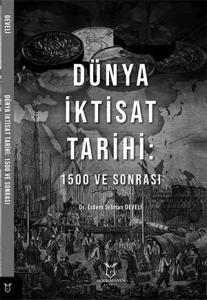
Dünya İktisat Tarihi: 1500 ve Sonrası
Özet
Dr. Erdem Selman Develi tarafından kaleme alınan ve editörlüğünü Prof. Dr. Muammer Tekeoğlu'nun üstlendiği Dünya İktisat Tarihi: 1500 ve Sonrası başlıklı eser, 1500 yılından günümüze küresel ekonomide yaşanan köklü dönüşümleri ve güç kaymalarını kapsamlı bir şekilde incelemektedir. 1500'lerde dünya ekonomisinin merkezi Asya, en güçlü ekonomileri ise Çin ve Hindistan konumundayken; Merkantilizm anlayışı, Coğrafi Keşifler ve Sanayi Devrimi süreçleriyle birlikte ekonomik üstünlük kademeli olarak Avrupa'ya ve Birleşik Krallık'a geçmiştir. İngiltere'den teknoloji ve zanaatkârların yurt dışına kaçmasıyla sanayileşme Kıta Avrupası ile ABD'ye yayılmış; ABD, 1. ve 2. Dünya Savaşları'nın ardından küresel ekonominin ana aktörü haline gelmiştir. Çalışma; Merkantilizm, Rönesans, Reform ve Aydınlanma hareketlerinin entelektüel ve iktisadi etkilerini, Latin Amerika'daki yabancı sermaye ve demiryolu yatırımlarını, Büyük Petro sonrası Rusya'nın modernleşmesini, Çin ile Hindistan'ın yaşadığı güç kaybını ve Asya'nın 21. yüzyıldaki yeniden yükselişini ele almaktadır. Ayrıca 20. ve 21. yüzyıl teknolojik hamleleri ile Türkiye'nin enerji, savunma sanayisi, yerli otomobil, sanayi üretimi ve teknoloji yatırımları doğrultusunda bölgesel ve küresel ölçekte güçlü bir ekonomi olma stratejileri ve önerileri sunulmaktadır.
Authored by Dr. Erdem Selman Develi and edited by Prof. Dr. Muammer Tekeoğlu, the work titled World Economic History: 1500 and After comprehensively examines the deep transformations and shifts in power within the global economy from 1500 to the present day. While the center of the world economy was Asia and its strongest economies were China and India in the 1500s, economic dominance gradually shifted to Europe and the United Kingdom through Mercantilism, the Geographical Discoveries, and the Industrial Revolution. With technology and skilled artisans escaping from Britain, industrialization spread to Continental Europe and the United States, allowing the US to become the primary actor in the global economy following World Wars I and II. The study addresses the intellectual and economic impacts of Mercantilism, the Renaissance, the Reformation, and the Enlightenment; foreign capital and railway investments in Latin America; Russia's modernization post-Peter the Great; the decline of China and India; and the resurgence of Asia in the 21st century. Additionally, it evaluates 20th and 21st-century technological strides alongside Turkey's strategies and recommendations to become a strong regional and global economic power through investments in energy, defense, local automobiles, industrial production, and technology.
Referanslar
Abbott, E. (1908). History of the employment of women in the American cotton mills. Journal of Political Economy, Vol.16, No.9, 602-621.
Abelshauser, W. (1998). Germany: Guns, butter, and economic miracles. In Mark Harrison (Ed.), The economics of World War II: Six great powers in international comparison (pp. 122-176). Cambridge: Cambridge University Press.
Acemoğlu, D. ve Robinson, J.A. (2012). Why nations fail: The origins of power, prosperity, and poverty. London: Profile Books.
Acton, L. (2005). Lectures on modern history. New York: The Macmillan Company.
Aiken, C. S. (1973). The evolution of cotton ginning in the Southeastern United States. Geographical Review, Vol.63, No.2, 196-224.
Alganer, Y. ve Çetin, M.Ö. (2007). Avrupa’da birlik ve bütünleşme hareketleri-1. Marmara Üniversitesi İİBF Dergisi, Cilt XXIII, Sayı 2, 285-309.
Allen, G. C. (1981). A short economic history of modern Japan (4th ed.). London: The Macmillan Press Ltd.
Allen, R. C. (2001). The great divergence in European wages and prices from the Middle Ages to the First World War. Explorations in Economic History, Vol 38, 411-447.
Ames, E. (1947). A century of Russian railroad construction: 1837-1936. The American Slavic and East European Review, Vol:6, No:3/4, 57-74.
Armstrong, C. ve Chmielewski, L.M. (2013). The Atlantic experience: Peoples, places, ideas. New York: Palgrave Macmillan.
Arruda, J. B. A. (1991). Colonies as mercantile investments: The Luso-Brazilian Empire, 1500-1808. In James D. Tracy (Ed.), The Political Economy of Merchant Empires: State Power and World Trade 1350-1750 (pp. 360-420). Cambridge: Cambridge University Press.
Aspromourgos, T. (1988). The life of William Petty in relation to his economics: A tercentenary interpretation. History of Political Economy, Vol.20, No.3, 337-356.
Attman, A. (1981). The Russian market in world trade, 1500-1860. Scandinavian Economic History Review, 29:3, 177-202.
Aytekin, E. (2022). Çin, uzay istasyonuna yeni taykonot ekibini yolladı. https://www.aa.com.tr/tr/bilim-teknoloji/cin-uzay-istasyonuna-yeni-taykonot-ekibini-yolladi/2605912 Erişim Tarihi: 05.08.2022
Baba, M. ve Tatemoto, M. (1998). Foreign trade and economic growth in Japan: 1858-1937. In Michael Smitka (Ed.), Japan’s economic sscent: International trade, growth, and postwar reconstruction (2-22). New York: Garland Publishing.
Baban, C. (1983). İsa Öncesinden Günümüze Kadar Çin Tarihi. İstanbul.
Bairoch, P. (1982). International industrialization levels from 1750 to 1980. The Journal of European Economic History, Vol.11, 269-333.
Barisitz, S. (2017). Central Asia and the Silk Road: Economic rise and decline over several millennia. Springer International Publishing.
Barrett, W. (1990). World bullion flows, 1450-1800. In James D. Tracy (Ed.), The rise of merchant empires: Long distance trade in the early modern world, 1350-1750 (224-254). Cambridge: Cambridge University Press.
Bartels, M. (2020). NASA to pay Russia $90 million for a Soyuz seat on a crew launch this fall. https://www.space.com/nasa-pays-russia-90-million-for-soyuz-seat.html, Erişim Tarihi: 13.06.2020.
Bates, R. H., Coatsworth, J.H. ve Williamson, J. G. (2006). Lost decades: Lessons from post-independence Latin America for today’s Africa. NBER Workind Paper, No:12610.
Baumer, F. L. V. (1970). Main currents of Western thought: Readings in Western European intellectual history from the Middle Ages to the present (3rd ed.). New York: Alfred A. Knopf.
Beaud, M. (2016). Kapitalizmin tarihi: 1500-2010 (F. Başkaya, Çev.). 2. Baskı. İstanbul: Yordam Kitap. (Orijinal baskı, 2010).
Beck, R. B., Black, L., Krieger, L. S., Naylor, P. C. ve Shabaka, D. I. (2009). World history: Patterns of interaction. USA: McDougal Littell.
Becker, S. O. ve Woessmann, L. (2009). Was Weber wrong? A human capital theory of Protestant economic history. The Quarterly Journal of Economics, Vol 124, Issue 2, 531-596.
Becker, S. O., Pfaff, S. ve Rubin, J. (2016). Causes and consequences of the Protestant Reformation. Warwick Economics Research Paper Series.
Bejczy, I. (2001). Erasmus and the Middle Ages: The historical consciousness of a Christian humanist. Leiden: Koninklijke Brill NV.
Bertola, L. (2008). Globalization in Latin America before 1940. In V.Bulmer-Thomas, John H. Coatsworth & Roberto C. Conde (Eds.), The Cambridge economic history of Latin America, Vol 2, (pp. 11-56). New York: Cambridge University Press.
Bertola, L. ve Ocampo, J. A. (2012). The economic development of Latin America since indpendence. Oxford: Oxford University Press.
Beveridge, H. (1862). A comprehensive history of India, Vol.1. New Delhi: Associated Publishing House.
Blackburn, R. (1997). The making of new world slavery: From the baroque to the modern, 1492-1800. New York: Verso.
Blaug, M. (1991a). The early mercantilist: Thomas Mun, Edward Misselden, Gerard de Malynes. Edward Elgar Publication.
Blaug, M. (1991b). The later mercantilist: Josiah Child and John Locke. Edward Elgar Publication.
Bonwick, C. (2000). The American Revolution 1763-1791. In David Parker (Ed.), Revolutions and the Revolutionary Tradition in the West 1560-1991 (pp. 68-87). London: Routledge.
Boxer, C. R. (1969). The Portuguese seaborne empire, 1415-1825. London: Hutchinson & Co Ltd.
Brandt, L., Ma, D. ve Rawski, T. (2016). Industrialization in China. IZA Discussion Paper Series, No:10096.
Braudel, F. (1975). The Mediterranean and the Mediterranean world in the age of Philip II. Cilt 1. London: Fontana/Collins.
Braudel, F. (1983). Civilization and capitalism 15th – 18th century, Vol.2: The wheels of commerce. London: Book Club Associates.
Braudel, F. (1984). Civilization and capitalism 15th-18th Century. Vol 3: The perspective of the world. London: William Collins Sons & Co Ltd.
Brewer, J. (1989). The sinews of power: War, money and the English state, 1688-1783. London: Unwin Hyman Limited.
Broadberry S. ve Gupta, B. (2005). Cotton textiles and the great divergence: Lancashire, India and shifting competitive advantage, 1600-1850. Paper presented at the The Rise, Organization, and Institutional Framework of Factor Markets. Utrecht, 23-25 June 2005.
Broadberry, S. ve Harrison, M. (2005). The economics of World War I: An overview. In Stephen Broadberry & Mark Harrison (Eds.), The economics of World War I (pp. 3-40). Cambridge: Cambridge University Press.
Broadberry, S. ve Howlett, P. (1998). The United Kingdom: ‘Victor at all costs.’ In Mark Harrison (Ed.), The economics of World War II: Six great powers in international comparison (pp. 43-80). Cambridge: Cambridge University Press.
Broadberry, S. ve Howlett, P. (2005). The United Kingdom during World War I: Business as Usual? In Stephen Broadberry & Mark Harrison (Eds.), The economics of World War I (pp. 206-234). Cambridge: Cambridge University Press.
Brotton, J. (2006). The Renaissance: A very short introduction. Oxford: Oxford University Press.
Bulliet, R. W., Crossley, P. K., Headrick, D. R., Hirsch, S. W., Johnson, L. L. ve Northrup, D. (2014). The earth and its people, a global history. Vol. 2: Since 1500. Stamford: Cengage Learning.
Bulmer-Thomas, V. (2003). The economic history of Latin America since independence (2nd ed.). New York: Cambridge University Press.
Burke, P. (2000). A social history of knowledge. Cambridge: Polity Press.
Bushkovitch, P. (2004). Peter the Great: The struggle for power, 1671-1725. Cambridge: Cambridge University Press.
Butterfield, H. (1959). The origins of modern science: 1300-1800. New York: The Macmillan Company.
Cain, P. J. ve Hopkins, A.G. (2016). British imperialism (3rd ed.). New York: Routledge.
Calvert, P. (2005). Vasco da Gama: So strong a spirit. New York: Benchmark Books.
Cameron, R. (1993). A concise economic history of the world: From paleolithic times to the present (2nd ed.). New York: Oxford University Press.
Cannan, E. (1964). A Review of Economic Theory. (2nd ed.). New York: A. M. Kelley.
Cantoni, D. (2015). The economic effects of the Protestant Reformation: Testing the Weber hypothesis in the German lands. Journal of the European Economic Association, Vol 13, Issue 4, 561-598.
Cantoni, D., Dittmar, J. ve Yuchtman, N. (2017). The Religious Roots of the Secular West: The Protestant Reformation and the Allocation of Resources in Europe. https://voxeu.org/article/protestant-reformation-and-allocation-resources-europe, Erişim tarihi: 06.12.2018.
Cardoso, J. L. (2015). Liberalism and enlightened political economy. The European Journal of the History of Economic Thought, Vol.22, Issue.6, 934-948.
Carus-Wilson, E. M. (1941). An Industrial Revolution of the thirteenth century. The Economic History Review, Vol.11, No.1, 39-60.
Catel, P. (2017). Exploring the New York colony. Minnesota: Capstone Press.
CBO. (2022). Budget and Economic Data. https://www.cbo.gov/data/budget-economic-data#3 Erişim Tarihi: 10.08.2022.
CENSUS. (1922). Fourteenth census of the United States, Vol XI: Mines and Quarries 1919. U.S. Bureau of the Census. Washington: Government Printing Office. https://babel.hathitrust.org/cgi/pt?id=mdp.39015066239743;view=1up;seq=9, Erişim tarihi: 29.05.2019.
Chandra, A. M. (2007). India condensed: 5000 years of history and culture. Singapore: Marshall Cavendish Editions.
Chapman, S. D. (1972). The cotton industry in the Industrial Revolution. London: Palgrave Macmillan.
Chaudhuri, K. N. (1963). The East India Company and the export of treasure in the early seventeenth century. Economic History Review, Vol.16, No.1, 23-38.
Chaudhuri, K. N. (1978). The trading world of Asia and the English East India Company, 1660-1760. Cambridge: Cambridge University Press.
Chavez, T. E. (2002). Spain and the independenc of the United States. University of New Mexico Press.
Chiasson, P. (2013). The island of seven cities: Where the Chinese settled when they discovered America. St. Martin’s Press.
Chouhan, O. P. (1985). The Dutch East India Company and the economy of Bengal, 1630-1720. New Jersey: Princeton University Press.
Cioran, Z. (2014). Theories of monetary policy: From the mercantilist pragmatism to the modern monetary theories. The USV Annals of Economic and Public Administration, 14(1-9), 92-101.
Clapham, J. H. (1910). The transference of the worsted industry from Norfolk to the west riding. The Economic Journal, Vol.20, No.78, 195-210.
Clark, G. (1987). Why isn’t whole world developed? Lessons from the cotton mills. The Journal of Economic History, Vol.47, No.1, 141-173.
Clark, G. (2007). A farewell to alms: A brief economic history of the world. Princeton: Princeton University Press.
Coakley, R. W. ve Conn, S. (2010). The war of the American Revolution. Washington: Bicentennial Publication.
Copeland, M. T. (1912). The cotton manufacturing industry of the United States. Cambridge: Harvard University.
Cortesao, A. (1944). The suma oriental of Tomѐ Pires. London: Hakluyt Society.
Corwin, E. S. (1915). The French objective in the American Revolution. The American Historical Review, Vol.21, No.1, 33-61.
Craig, J. R. ve Rimstidt, J.D. (1998). Gold production history of the United States. Ore Geology Reviews, Vol.13, 407-464.
Crawcour, E. S. (2008). Industrialization and technological change, 1885-1920. In Peter Duus (Ed.), The Cambridge history of Japan, Volume 6: The twentieth century pp. (385-450). Cambridge: Cambridge University Press.
Cross, H. E. (1983). South American bullion production and export, 1550-1750. In John F. Richards (Ed.), Precious metals in the tater Medieval and early modern worlds (pp. 397-423). Kuzey Karolina: Carolina Academic Press.
Curtin, P. D. (1984). Cross-cultural trade in world history. Cambridge: Cambridge University Press.
Cwik, P. F. (2011). The new neo-mercantilism: Currency manipulation as a form of protectionism. Economic Affairs, Vol.31, Issue.3, 7-11.
Davenport, F. G. (1917). European treaties bearing on the history of United States and its dependencies to 1648. Washington: Carnegie Institution of Washington.
Davis, R. (1962). English foreign trade, 1700-1774. The Economic History Review. Vol.15, No.2, 285-303.
Deane, P. (1979). The first Industrial Revolution (2nd ed.). Cambridge: Cambridge University Press.
Diamond, J. (1999). Guns, germs and steel: The fates of human societies. New York: W.W.Norton & Company.
Dimont, M. I. (1962). Jews, god, and history. New York: Penguin Group.
Dittmar, J. ve Seabold, S. (2016). Media, markets, and radical ideas: Evidence from the Prostestant Reformation. LSE Working Paper.
Easton, M., Saldais, M., Smith, R. ve Dumovic, V. (2016). Oxford big ideas humanities 8. Oxford: Oxford University Press.
Eğilmez, M. (2012). Satınalma gücü paritesi nedir? http://www.mahfiegilmez.com/2012/05/satnalma-gucu-paritesi-nedir.html. Erişim tarihi: 14.06.2020.
Elliott, J. H. (1970). The Old World and the New: 1492-1650. Cambridge: Cambridge University Press.
Ellison, M. ve Scott, A. (2017). Managing the UK national debt 1694-2017. Centre for Macroeconomics Working Paper 2017-27.
Elvin, M. (1973). The pattern of the chinese past. California: Stanford University Press.
ENERJİ. (2022). Boru Hatları ve Projeleri. https://enerji.gov.tr/bilgi-merkezi-boru-hatlari Erişim Tarihi: 09.08.2022.
EPDK. (2022a). Petrol Piyasası 2021 Yılı Sektör Raporu. Ankara: T.C. Enerji Piyasası Düzenleme Kurumu Strateji Geliştirme Dairesi Başkanlığı.
EPDK. (2022b). Doğal Gaz Piyasası 2021 Yılı Sektör Raporu. Ankara: T.C. Enerji Piyasası Düzenleme Kurumu Strateji Geliştirme Dairesi Başkanlığı.
Escosura, L. P. (2005). Colonial independence and economic backwardness in Latin America. GEHN Working Paper Series, Working Paper No: 10/05.
Escosura, L. P. (2008). The economic censequences of independence in Latin America. In V.Bulmer-Thomas, John H. Coatsworth & Roberto C. Conde (Eds.), The Cambridge economic history of Latin America, Vol 1, (pp. 463-504). New York: Cambridge University Press.
EUROSTAT. (2022a). Government finance statistics. https://ec.europa.eu/eurostat/ Erişim Tarihi: 10.08.2022.
EUROSTAT. (2022b). From where do we import energy? https://ec.europa.eu/eurostat/ Erişim Tarihi: 11.08.2022.
Evans, G. R. (1993). Philosophy and theology in the Middle Ages. London: Routledge.
Fairbank, J. K. ve Goldman, M. (2006). China: A new history (2nd ed.). London: Harvard University Press.
Falkus, M. E. (1972). The industrialisation of Russia 1700-1914. London: The Macmillan Press Ltd.
FAO. (2022). Crops and livestock products. https://www.fao.org/faostat/en/#data Erişim Tarihi: 11.08.2022.
Faust, C. M. (1961). Russian expansion to the east through eighteenth century. The Journal of Economic History, Vol.21, No.4, 469-482.
Feis, H. (1961). Europe: The world’s banker, 1870-1914. New York: Augustus M. Kelley.
Ferguson, N. (2015a). Uygarlık: Batı ve ötekiler (N. Elhüseyni, Çev.). 2. Baskı. İstanbul: Yapı Kredi Yayınları. (Orijinal baskı, 2011).
Ferguson, N. (2015b). Hazin savaş, 1914-1918 (N. Elhuseyni, Çev.). İstanbul: Yapı Kredi Yayınları. (Orijinal baskı, 1999).
Fırat, O. Z. ve Fırat, S. Ü. (2017). Endüstri 4.0 yolculuğunda trendler ve robotlar. İstanbul Üniversitesi İşletme Fakültesi Dergisi, Cilt:46, Sayı:2, 211-223.
Findlay, R. ve O’Rourke, K. H. (2007). Power and plenty: Trade, war, and the world economy in the second millennium. New Jersey: Princeton University Press.
Fischer, H. D. (1996). The pulitzer prize archive. Vol 9: General nonfiction awards 1962-1993. Paris: K.G. Saur.
Fischer, S., Sahay, R. ve Vegh, C. A. (2002). Modern hyper and high inflations. Jornal of Economic Literature, Vol.40, No.3, 837-880.
Flyyn, D. O. ve Giraldez, A. (1995). Born with a silver spoon: The origin of the world trade in 1571. Journal of World History, Vol.6, No.2, 201-221.
Flyyn, D. O. ve Giraldez, A. (1996). Silk for silver: Manila-Macao trade in the 17th Century. Philippine Studies, Vol.44, No.1, 52-68.
Folly, M. H. (2004). The palgrave concise historical atlas of the Second World War. New York: Palgrave Macmillan.
Frank, A. G. (1978). World accumulation, 1492-1789. New York: Algora Publishing.
Frank, A. G. (1998). Reorient: Global economy in the Asian age. London: University of California Press Ltd.
Freedman, P. (2005). Spices and Late-Medieval European ideas of scarcity and value. Speculum, Vol.80, No.4, 1209-1227.
Frieden, J. A. (2011). The modern capitalist world economy: A historical overview. In Dennis Mueller (Ed.), Oxford Handbook of Capitalism (pp. 15-37). New York: Oxford University Press.
Fruin, W. M. (1997). Knowledge works: Managing intellectual capital at Toshiba. New York: Oxford University Press.
Furtado, C. (1976). Economic development of Latin America (2nd ed.). New York: Cambridge University Press.
Galbraith, J. K. (2013). Büyük kriz 1929 (E. N. Akbaş, Çev.). 2. Baskı. İstanbul: Pegasus Yayınları. (Orijinal baskı, 1955).
GAO. (2022). Financial Audit: Bureau of the Fiscal Service’s FY 2020 and FY 2019 Schedules of Federal Debt. https://www.gao.gov/products/gao-21-124 Erişim Tarihi: 10.08.2022.
Gatrell, P. (2005). Poor Russia, poor show: Mobilising a backward economy. In Stephen Broadberry & Mark Harrison (Eds.), The economics of World War I (pp. 235-275). Cambridge: Cambridge University Press.
Gerschenkron, A. (1947). The rate of industrial growth in Russia, since 1885. The Journal of Economic History, Vol:7, Issue:S1, 144-174.
Glamann, K. (1981). Dutch-Asiatic trade, 1620-1740. Den Haag: Martinus Nijhoff.
Glete, J. (2010). Swedish naval administration, 1521-1721: Resource flows and organisational capabilities. Leiden: Brill.
Glick, R. ve Taylor, A. M. (2005). Collateral damage: Trade disruption and the economic impact of war. Federal Reserve Bank of San Francisco Working Paper Series.
Goldberg, R. A. (2003). America in the twenties. New York: Syracuse University Press.
Gomes, L. (1987). Foreign trade and the national economy: Mercantilist and classical perspectives. London: Macmillan Press Ltd.
Gregory, P. R. (1982). Russian national income, 1885-1913. Cambridge: Cambridge University Press.
Grellier, J. J. (1810). The history of the national debt, from the revolution in 1688 to the beginning of the year 1800. London: John Richardson, Royal Exchange, and J. Johnson & Co.
Grilli, E. (2005). Political economy and economic development in Latin America in the second half of the 20th century. Journal of Policy Modeling, Vol:27, Issue:1, 1-31.
Gunderson, C. (2004). The Boston Tea Party. Minnesota: ABDO Publishing Company.
Gunn, G. C. (2018). World trade systems of the East and West: Nagasaki and the Asian bullion trade networks. Leiden: Koninklijke Brill NV.
Guy, J. (2001). Tamil merchant guilds and the Quanzhou trade. In Angela Schottenhammer (Ed.), The emporium of the world maritime Quanzhou, 1000-1400 (pp. 283-308). Leiden: Brill.
Gür, A. (2018). İngiliz Zehiri, Çin İpeğine Karşı (1839-1860). Tarih Dergi, Sayı: 54.
Habib, I. (1982a). Agrarian economy. In Tapan Raychaudhuri & Irfan Habib (Eds.), The Cambridge economic history of India: 1200-1750, Vol.1 (pp. 48-75). Cambridge: Cambridge University Press.
Habib, I. (1982b). Non-agricultural production and urban economy. In Tapan Raychaudhuri & Irfan Habib (Eds.), The Cambridge Economic History of India: 1200-1750, Vol.1 (pp. 76-92). Cambridge: Cambridge University Press.
Halsey, F. M. (1916). Railway expansion in Latin America. New York: The Moody Magazine and Book Company.
Hamen, S. (2014). History of America: America enters the Industrial Revolution. Minnesota: Rourke Educational Media.
Hamilton, E. J. (1944). Monetary problems in Spain and Spanish America 1751-1800. The Journal of Economic History, Vol.4, No.1, 21-48.
Hançerlioğlu, O. (1995). Düşünce tarihi. İstanbul: Remzi Kitabevi.
Hara, A. (1998). Japan: Guns before rice. In Mark Harrison (Ed.), The economics of World War II: Six great powers in international comparison (pp. 224-267). Cambridge: Cambridge University Press.
Harari, Y. N. (2015). Hayvanlardan tanrılara sapiens (E. Genç, Çev.). 9. Baskı. İstanbul: Kolektif Yayınları. (Orijinal baskı, 2012).
Hardach, G. (1977). The First World War, 1914-1918. Berkeley: University of California Press.
Haring, C. H. (1915). American gold and silver production in the first half of the sixteenth century. The Quarterly Journal of Economics, Vol.29, No.3, 433-479.
Harreld, D. J. (2016). An economic history of the world since 1400. Virginia: The Great Courses.
Harrison, M. (1998a). The economic of World War II: An overview. In Mark Harrison (Ed.), The economics of World War II: Six great powers in international comparison (pp. 1-42). Cambridge: Cambridge University Press.
Harrison, M. (1998b). The Soviet Union: The defeated victor. In Mark Harrison (Ed.), The economics of World War II: Six great powers in international comparison (pp. 268-301). Cambridge: Cambridge University Press.
Hautcoeur, P. C. (2005). Was the rreat war a watershed? The economics of World War I in France. In Stephen Broadberry & Mark Harrison (Eds.), The Economics of World War I (pp. 169-205). Cambridge: Cambridge University Press.
Heaton, H. (2005). Avrupa İktisat Tarihi. Ankara: Paragraf Yayınevi.
Heckscher, E. F. (1935). Mercantilism. Vol 1. London: Routledge.
Heilbroner, R. L. (1999). The Worldly philosophers: The lives, times, and ideas of the great economic thinkers (7th ed.). New York: Touchstone.
Herr, R. (1969). The eighteenth-century revolution in Spain. New Jersey: Princeton University Press.
Herranz-Loncan, A. (2011). The contribution of railways to economic growth in Latin America before 1914: A growth accounting approach. MPRA Paper 33578.
Hill, C. (1998). Protestanlık ve kapitalizmin ortaya çıkışı. In David S. Landes (Ed.), Kapitalizmin doğuşu (pp. 31-44). İstanbul: İnsan Yayınları.
Hill, M. R. (2006). Russian iron production in the eighteenth century. Icon, Vol.12, 118-167.
Hillstrom, K. ve Hillstrom, L. C. (2005). Industrial Revolution in America: Iron and steel. California: ABC-CLIO Inc.
Hochberg, H. (1953). The empirical philisophy of Roger and Francis Bacon. Philosophy of Science, Vol.20, No.4, 313-326.
Hofman, A. A. (2000). The economic development of Latin America in the twentieth century. Cheltenham: Edward Elgar Publishing Limited.
Hogendorn, J. ve Johnson, M. (1986). The shell money of the slave trade. Cambridge: Cambridge University Press.
Holm, M. (2017). The Marshall Plan: A new deal for Europe. New York: Routledge.
Holslag, J. (2006). China’s new mercantilism in Central Africa. African and Asian Studies, 5(2), 133-169.
Holslag, J. (2011). China and the coups: Coping with political instability in Africa. African Affairs, 110(440), 367-386.
Honda, G. (1997). Differential Structure, Differential Health: Industrialization in Japan, 1868-1940. In Richard H. Steckel & Roderick Floud (Eds.), Health and Welfare During Industrialization (pp. 251-284). University of Chicago Press.
Hont, I. (2005). Jealousy of trade: International competition and the nation-state in historical perspective. Cambridge: Harvard University Press.
Howe, C. (1999). The origins of Japanese trade supremacy: Development and technology in Asia from 1540 to the Pasific War. London: C. Hurst & Company.
Hsu, I. C. Y. (2000). The Rise of Modern China (6th ed.). New York: Oxford University Press.
http://www.cnsa.gov.cn/ Erişim tarihi: 09.07.2021
https://www.howmanypeopleareinspacerightnow.com/ Erişim Tarihi: 01.08.2021
https://tradingeconomics.com/ Erişim tarihi: 10.07.2021
Hughes, J. (1986). The vital few: The entrepreneur and American economic progress (Expanded ed.). New York: Oxford University Press.
IFR. (2019a). Executive summary: World robotic 2019 industrial robots.
IFR. (2019b). World robotics presentation. IFR press conference, 18 Eylül 2019, Shanghai.
IFR. (2020a). Executive summary: World robotic 2020 industrial robots.
IFR. (2020b). IFR press conference, 24 Eylül 2020, Frankfurt.
Ike, N. (1955). The pattern of railway development in Japan. The Far Eastern Quarterly, Vol.14, No.2, 217-229.
ILO. (2021). ILO Gözlem: COVID-19 ve Çalışma Yaşamı. 7. Baskı. 25 Ocak 2021.
IMF. (2022a). Currency Composition of Official Foreign Exchange Reserves (COFER). https://data.imf.org/?sk=e6a5f467-c14b-4aa8-9f6d-5a09ec4e62a4 Erişim Tarihi: 08.08.2022.
IMF. (2022b). World Economic Outlook. https://www.imf.org/en/Publications/WEO Erişim Tarihi: 09.08.2022.
Imperial Institute. (1925). The mineral industry of the British Empire and foreign countries: Statistical summary, 1913-1922. London: His Majesty’s Stationery Office.
Inkster, I. (2001). The Japanese industrial economy: Later development and cultural causation. London: Routledge.
İbn Battuta. (2000). Seyahatname (A. S. Aykut, Çev.). 2. Cilt. İstanbul: Yapı Kredi Yayınları.
İnce, F. (2020). ABD’nin Ay Koalisyonu: “Artemis Accords”. https://tasam.org/tr-TR/Icerik/57708/abdnin_ay_koalisyonu_artemis_accords Erişim Tarihi: 05.08.2022.
Jacobs, H. E. ve Spaeth, A. (1915). Works of Martin Luther: With introductions and notes. Vol 1. Philadelphia: A. J. Holman Company.
Jacques, M. (2009). When China rules the world: The rise of the middle kingdom and the end of the Western World. London: Penguin Books.
James, D. H. (2011). The rise and fall of the Japanese Empire. Oxon: Routledge.
Ji, Z. (2003). A history of modern Shanghai Banking: The rise and decline of China’s finance capitalism. New York: M. E. Sharpe.
Johnson, E. A. J. (1937). Predecessors of Adam Smith: The growth of British economic thought. New York: Prentice-Hall Inc.
Johnson, H. B. (1987). Portuguese settlement, 1500-1580. In Leslie Bethell (Ed.), Colonial Brazil (pp. 1-38). Cambridge: Cambridge University Press.
Jolly, E. (2012). Tracing your British Indian ancestors. South Yorkshire: Pen & Sword Books Ltd.
Jones, H. (2009). A history of American foreign relations to 1913. Maryland: Rowman & Littlefield Publishers, INC.
Kalıpcı, M. (2018). Economic effects of the Opium Wars for Imperial China: The downfall of an empire. AİBÜ Sosyal Bilimler Enstitüsü Dergisi, Cilt 18, Sayı 3, 291-304.
Kang, D. C. (2010). East Asia Before the West: Five Centuries of Trade and Tribute. New York: Columbia University Press.
Kant, I. (1784). What’s Enlightenment? Toplumbilim Aydınlanma Özel Sayısı, Yıl:2000, Sayı:11. (N. Bozkurt Çev.). İstanbul: Bağlam Yayıncılık.
Kellenbenz, H. (1976). The rise of the European economy: An economic history of the Continental Europe from the fifteenth to the eighteenth Century. New York: Holmes & Meier Publishers.
Kennedy, P. (1976). The rise and fall of British naval mastery. London: Penguin Books Ltd.
Kennedy, P. (1988). The rise and fall of great powers: Economic change and military conflict from 1500 to 2000. London: Unwin Hyman Limited.
Kenwood, A. G. ve Lougheed, A. L. (1971). The growth of the international economy, 1820-1960. New York: State University of New York Press.
Keynes, J. M. (1919). The economic consequences of the peace.
Keynes, J. M. (1964). The general theory of employment, interest and money. Florida: HBJ Book.
Khan, B. Z. (1995). Property rights and patent litigation in early nineteenth-century America. The Journal of Economic History, Vol.55, No.1, 58-97.
Kılıç, S. ve Alkan, R. M. (2018). Dördüncü Sanayi Devrimi, Endütri 4.0: Dünya ve Türkiye değerlendirmeleri. Girişimcilik İnovasyon ve Pazarlama Araştırmaları Dergisi, 2(3), 29-49.
Kishtainy, N. (2017). Ekonominin kısa tarihi (A. Yılmaz, Çev.). 3. Baskı. İstanbul: Alfa Yayınları. (Orijinal baskı, 2017).
Koizumi, K. (2002). In search of ‘Wakon’: The cultural dynamics of the rise of manufacturing technology in postwar Japan. Technology and Culture, Vol.43, No.1, 29-49.
Kordon, A. K. (2010). Applying computational intelligence: How to create value. Heidelberg: Springer.
KPMG. (2020). Enerji: Sektörel bakış.
Kshetry, G. (2008). Foreigners in Japan: A historical perspective. Indiana: Xlibris Corporation.
Küçükkalay, A. M. (2014). Dünya iktisat tarihi. İstanbul: Beta Yayınları.
Kümin, B. (2018). The European world: 1500-1800 (3rd ed.). New York: Routledge.
Landes, D. S. (1969). The unbound prometheus: Technological change and industrial development in Western Europe from 1750 to the present. Cambridge: Cambridge University Press.
Laperche, B. ve Uzunidis, D. (2009). The new mercantilism and the crisis of global capitalism: Elements for discussion. Paper presented at the 13th Conference of the Research Network Macroeconomics and Macroeconomic Policies. Berlin, 30-31 October 2009.
Le Doudic, K. (2015). ‘Exotic’ goods? Far-Eastern commodities fort he French market in India in the eighteenth century. In Maxine Berg (Ed.), Goods from the east, 1600-1800 (pp. 216-228). New York: Palgrave Macmillan.
League of Nations. (1927). International statistical yearbook 1926. Geneva: Publications of the League of Nations.
Lebergott, S. (1966). Labor force and employment, 1800-1960. In Dorothy S. Brady (Ed.), Output, employment, and productivity in the United States after 1800 (pp. 117-204). Cambridge: NBER Books.
Lee, K. E. ve Khor, A. (2019). China’s long march of modernisation. Xlibris Publishing.
Lenman, B. P. (1998). Colonial wars and imperial instability, 1688-1793. In Peter J. Marshall (Ed.), The Oxford history of the British Empire, Vol.2 (pp. 151-168). New York: Oxford University Press.
Lewis, C. (1938). America’s stake in international investments. Washington: The Brookings Institution.
Lieberman, V. (2009). Strange parallels: Southeast Asia in global context, c.800-1830. Vol 2. Cambridge: Cambridge University Press.
Lieven, D. (2006). The cambridge history of Russia. Vol 2: Imperial Russia, 1689-1917. Cambridge: Cambridge University Press.
Luraghi, R. (2000). Sömürgecilik Tarihi (H. İnal, Çev.). İstanbul: E Yayınları. (Orijinal baskı, 1964).
Luscombe, D. E. (1970). The school of Peter Abelard: The influence of Abelard’s thought in the early Scholastic Period. Cambridge: Cambridge University Press.
Mack, E. (2020). US Space Force: What you need to know. https://www.cnet.com/news/us-space-force-what-you-need-to-know/, Erişim tarihi: 08.06.2020.
MacRae, D. G. (1974). Max Weber. Viking Press.
Maddison, A. (2001). The world economy: A millennial perspective. Paris: OECD.
Maddison, A. (2006a). The world economy. Vol 1: A millennial perspective. OECD.
Maddison, A. (2006b). The world economy. Vol 2: Historical statistics. OECD.
Maddison, A. (2007a). Contours of the world economy, 1-2030 AD. Oxford: Oxford University Press.
Maddison, A. (2007b). Chinese economic performance in the long run (2nd ed.). OECD.
Madsen, J. B. (2001). Trade barriers and the collapse of world trade during the Great Depression. Southern Economic Journal, Vol.67, No.4, 848-868.
Magnusson, L. (1994). Mercantilism: The shaping of an economic language. London: Routledge.
Magnusson, L. (2009). Mercantilism. In Jarrod Wiener & Robert A. Schrire (Eds.), International relations, Vol.2 (pp. 25-36). Oxford: Eolss Publishers.
Magnusson, L. (2015). The political economy of Mercantilism. New York: Routledge.
Malsberger, J. W. ve Marshall, J. N. (2009). The American economic history reader. New York: Routledge.
Malthus, T. R. (1998). An essay on the principle of population. (Orijinal baskı, 1798).
Mancall, M. (1964). The Kiakhta trade. In Charles D. Cowan (Ed.), The economic development of China and Japan (pp. 19-48). London: George Allen and Unwin Ltd.
Mantoux, P. (1964). The Industrial Revolution in the eighteenth century. London: Jonathan Cape Ltd.
Matsui, Y. (2018). Japanese-Dutch relations in the Tokugawa period. J-STAGE, Vol.72, 139-154.
Mavor, J. (1925). An economic history of Russia. Vol 1. (2nd ed.). London: J. M. Dent & Sons Limited.
May, O. L. ve Lege, K. E. (1999). Development of the world cotton industry. In C. W. Smith & J. T. Cothren (Eds.), Cotton: Origin, history, technology, and production (pp. 65-98). New York: John Wiley & Sons.
McEvedy, C. ve Jones, R. (1979). Atlas of world population history. Great Britain: Penguin Books Ltd. and Allen Lane.
McKay, J. P. (1970). Pioneers for profit: Foreign entrepreneurship and Russian industrialization, 1885-1913. Chicago: The University of Chicago Press.
McLean, R. (2010). The Enlightenment. University of Warwick: The Higher Education Academy.
McNeese, T. (2009). The Erie Canal. New York: Chelsea House Publishers.
Meilink-Roelofsz, M. A. P. (1962). Asian trade and European influence: In the Indonesian Archipelago between 1500 and about 1630. The Hague: Martinus Nijhoff.
Merrill, C. W. (1930). Summarized data of silver production. Washington: United States Government Printing Office.
Mitchell, B. R. (1993). International historical statistics: The Americas 1750-1988 (2nd ed.). New York: Stockton Press.
Miyamoto, M. (1989). The products and market strategies of the Osaka cotton spinning company: 1883-1914. Japanese Yearbook on Business History, Vol.5, 117-159.
Moeller, B. (1979). Stadt und buch: Bemerkungen zur struktur der Reformatorischen bewegung in Deutschland. In Wolfgang J. Mommsen (Ed.), Stadtbürgertum und adel in der Reformation: Studien zur sozialgeschicte der Reformation in England und Deutschland (pp. 25-39). Stuttgart: Klett Cotta.
Mokyr, J. (1998). The Second Industrial Revolution, 1870-1914. https://cpb-us-e1.wpmucdn.com/sites.northwestern.edu/dist/3/1222/files/2016/06/The-Second-Industrial-Revolution-1870-1914-Aug-1998-1ubah7s.pdf, Erişim tarihi: 30.05.2019.
Mokyr, J. (2002). The gifts of Athena: Historical origins of the knowledge economy. New Jersey: Princeton University Press.
Mokyr, J. (2005a). Long-term economic growth and the history of technology. In Philippe Aghion & Steven N. Durlauf (Eds.), Handbook of economic growth, Vol.1B (pp. 1113-1180). Amsterdam: Elsevier.
Mokyr, J. (2005b). The intellectual origin of modern economic growth. Journal of Economic History, Vol.65, Issue.2, 285-351.
Mokyr, J. (2007). The European Enlightenment, the Industrial Revolution, and modern economic growth. Max Weber Lecture Series. MWP – LS 2007/07.
Montaigne, M. (1993). Essays. London: Penguin Books. (Orijinal baskı, 1580).
Morey, A. (2015). A timeline history of the declaration of independence. Minneapolis: Lerner Publishing Group.
Morris, I. (2014). Dünyaya neden Batı hükmediyor (şimdilik) (G. Ç. Güven, Çev.). 3. Baskı. İstanbul: Alfa Yayınları. (Orijinal baskı, 2010).
Moss, W. G. (2005). A history of Russia Vol 1: To 1917 (2nd ed.). London: Anthem Press.
Moya, J. C. (1998). Cousins and strangers: Spanish immigrants in Buenos Aires, 1850-1930. London: University of California Press.
Nagase-Reimer, K. (2016). Copper in the early modern Sino-Japanese trade. Leiden: Koninklijke Brill.
Nagle, J. (2018). The Erie Canal. New York: Britannica Educational Publishing.
NASA. (2022). FY 2022 Budget Request. www.nasa.gov Erişim Tarihi: 04.08.2022
Naske, C. M. ve Slotnick, H. E. (1987). Alaska: A history of the 49th state (2nd ed.). Norman: University of Oklahoma Press.
Naske, C. M. ve Slotnick, H. E. (2011). Alaska: A history (3rd ed.). Norman: University of Oklahoma Press.
Nef, J. U. (1934). The progress of technology and the growth of large-scale industry in Great Britain, 1540-1640. The Economic History Review, Vol.5, No.1, 3-24.
Nef, J. U. (1943). The Industrial Revolution reconsidered. The Journal of Economic History, Vol.3, No.1, 1-31.
Nester, W. R. (1993). American power, the new world order and the Japanese challenge. Hampshire: The Macmillan Press Ltd.
Newitt, M. (2005). A history of Portuguese overseas expansion, 1400-1668. New York: Routledge.
Newitt, M. (2010). The Portuguese in West Africa, 1415-1670. Cambridge: Cambridge University Press.
North, D. C. (1961). The economic growth of the United States 1790 to 1860. New Jersey: Prentice-Hall Inc.
Numanoğlu, Ö. (2020). Bir uzay serüveni: Hindistan. https://www.atlasdergisi.com/kesfet/bilim-haberleri/hindistanin-uzaya-arac-yollamasi.html, Erişim tarihi: 09.06.2020.
O’Hara, K. (2010). The Enlightenment. Oxford: Oneworld Publications.
O’Rourke, K. H. ve Williamson, J. G. (2009). Did Vasco da Gama matter for European markets? The Economic History Review, Vol.62, Issue.3, 655-684.
OECD. (2018). GDP long-term forecast (indicator). doi: 10.1787/d927bc18-en. https://data.oecd.org/gdp/gdp-long-term-forecast.htm Erişim tarihi: 08.08.2022.
OECD. (2022). Gross domestic spending on R&D (indicator). doi: 10.1787/d8b068b4-en. https://data.oecd.org/rd/gross-domestic-spending-on-r-d.htm Erişim tarihi: 02.08.2022.
Ohno, K. (2006). The economic development of Japan. Tokyo: GRIPS Development Forum.
Ohno, K. (2013). Learning to industrialize: From given growth to policiy-aided value creation. New York: Routledge.
Osler, M. J. (2000). The canonical imperative: Rethinking the Scientific Revolution. In Margaret J. Osler (Ed.), Rethinking the scientific revolution (pp. 3-24). Cambridge: Cambridge University Press.
Öz, S. (2009). Kriz ve korumacılık: Tarih tekerrür edecek mi? TÜSİAD-Koç University Economic Research Forum, Working Paper: No. 0904. İstanbul.
Özcan, A. (2015). Sömürgecilik tarihi (Afrika-Asya). 2. Baskı. Eskişehir: Anadolu Üniversitesi Yayınları.
Özsoylu, A. F. (2017). Endüstri 4.0. Çukurova Üniversitesi İİBF Dergisi, Cilt.21, Sayı.1, 41-64.
Pagden, A. (2013). The enlightenment and why in still matters. Oxford: Oxford University Press.
Parthasarathi, P. (2011). Why Europe grew rich and Asia did not: Global economic divergence, 1600-1850. New York: Cambridge University Press.
Parthesius, R. (2010). Dutch ships in tropical waters: The development of the Dutch East India Company (VOC) shipping network in Asia 1595-1660. Amsterdam: Amsterdam University Press.
Pearson, M. N. (1996). An expanding world, Volume 11: Spice in the Indian Ocean World. New York: Routledge.
Peck, F. M. ve Earl, H. H. (1877). Fall River and its industries. New York: Atlantic Publishing and Engraving Company.
Persson, K. G. (2010). An economic history of Europe: Knowledge, institutions, and growth, 600 to the present. Cambridge: Cambridge University Press.
Petersen, C. C. (2019). A short history of Roscosmos and the Soviet space program. https://www.thoughtco.com/soviet-space-program-history-4140631, Erişim tarihi: 09.06.2020.
Peukert, H. (2012). Mercantilism. In Jürgen G. Backhaus (Ed.), Handbook of the history of economic thought (pp. 93-121). New York: Springer.
Phillips, E. J. (1995). The founding of Russia’s navy: Peter the Great and the Azov Fleet, 1688-1714. Connecticut: Greenwood Press.
Phillips, M. (2012). The long story of the U.S. debt, from 1790 to 2011, in 1 little chart. https://www.theatlantic.com/business/archive/2012/11/the-long-story-of-us-debt-from-1790-to-2011-in-1-little-chart/265185/ Erişim tarihi: 09.05.2019.
Pollard, S. (1981). Peaceful conquest: The industrialization of Europe 1760-1970. New York: Oxford University Press.
Pomeranz, K. (2008). The great divergence: China, Europe, and the making of the modern world economy. Princeton: Princeton University Press.
Prakash, O. (1998). The new Cambridge history of India: European commercial enterprise in pre-colonial India. Cambridge: Cambridge University Press.
Prange, S. R. (2009). Like Banners on the Sea: Muslim Trade Networks and Islamization in Malabar and Maritime Southeast Asia. In R. Michael Feener & Terenjit Sevea (Eds.), Islamic connections: Muslim societies in South and Southeast Asia (pp. 25-47). Singapore: ISEAS Publishing.
Printy, M. (2009). Enlightenment and the creation of German Catholicism. New York: Cambridge University Press.
Rienert, S. A. ve Rienert, E. S. (2003). An early national innovation system: The case of Antonio Serra’s 1613 Breve Trattato. Istituzioni e Sviluppo Economico, 1(3), 87-124.
Rippy, J. F. (1958). Latin America: A modern history. The University of Michigan Press.
Ritschl, A. (2005). The pity of peace: Germany’s economy at war, 1914-1918 and beyond. In Stephen Broadberry & Mark Harrison (Eds.), The economics of World War I (pp. 41-76). Cambridge: Cambridge University Press.
Rockoff, H. (1998). The United States: From Ploughshares to Swords. In Mark Harrison (Ed.), The economics of World War II: Six great powers in international comparison (pp. 81-121). Cambridge: Cambridge University Press.
Rockoff, H. (2005). Until It’s Over, Over There: The US Economy in World War I. In Stephen Broadberry & Mark Harrison (Eds.), The Economics of World War I (pp. 310-343). Cambridge: Cambridge University Press.
Romano, M. J. (2010). European history (2nd ed.). New Jersey: Wiley Publishing.
Rosenberg, M. (2017). Strategy and geopolitics: Understanding global complexity in a turbulent world. UK: Emerald Publishing Limited.
Rosenbloom, J. L. (2002). Path dependence and the origins of cotton textile manufacturing in New England. NBER Working Paper Series.
Rostow, W. W. (1959). The stages of economic growth. The Economic History Review, New Series, Vol.12, No.1, 1-16.
Rostow, W. W. (1960). The stages of economic growth. New York: Cambridge University Press.
Rostow, W. W. (1970). Sanayi Devrimi nasıl başladı. İ.Ü. İktisat Fakültesi Dergisi, C:30, Sayı:1-4, 255-278.
Rostow, W. W. (1978). The world economy: History & prospect. London: The Macmillan Press Ltd.
Rostow, W. W. (1991). The world economy: History & prospect. London: Macmillan Press.
Roy, T. (1932). How British rule changed India’s economy: The paradox of the Raj. Cham: Palgrave Macmillan.
Rubin, J. (2014). Printing and Protestants: An empirical test of the role of printing in the Reformation. The Review of Economics and Statistics, 96(2), 270-286.
Russell, B. (1945). A history of Western philosophy. New York: Simon & Schuster.
Sahni, B. P. (2013). A legal analysis of the British East India Company. Acta Juridica Hungarica, Vol.54, No.4, 317-330.
Salter, J. A. (1921). Allied shipping control: An experiment in international administration. Oxford: At the Clarendon Press.
Samuelsson, K. (1957). Religion and economic action: A critique of Max Weber. Toronto: University of Toronto Press.
SBB. (2022). Orta Vadeli Mali Plan (2021-2023). http://www.sbb.gov.tr/butce-orta-vadeli-mali-planlar/, Erişim tarihi: 09.08.2022.
Schafer, D. P. (2008). Revolution or Renaissance: Making the transition from an economic age to a cultural age. Ottowa: University of Ottowa Press.
Schaltegger, C. A. ve Torgler, B. (2009). Was Weber wrong? A human capital theory of Protestant economic history: A comment on Becker and Woessmann. School of Economics and Finance Discussion Papers and Working Papers Series 248.
Schmidt, K. J. (1995). An atlas and survey of South Asian history. New York: Routledge.
Schumpeter, J. A. (1939). Business cycles: A theoretical, historical, and statistical analysis of the capitalist process. Vol.1. New York: McGraw-Hill Book Company.
Schumpeter, J. A. (1972). History of economic enalysis. London: George Allen & Unwin Ltd.
Schwartz, S. B. (1985). Sugar plantations in the formation of Brazilian society. Cambridge: Cambridge University Press.
Schwartz, S. B. (1987). Plantations and Peripheries, 1580-1750. In Leslie Bethell (Ed.), Colonial Brazil (pp. 67-144). Cambridge: Cambridge University Press.
Schwarz, G. (2016). Archaeology of the early 19th-century American steamboat Phoenix. The International Journal of Nautical Archaeology, Vol.45, Issue.1, 119-140.
Sheremeta, R. M. ve Smith, V. L. (2017). The impact of the economic development of Western Europe. (pp. 1-21). MPRA Paper No: 87220.
Sheridan, R. B. (1968). The wealth of Jamaica in the eighteenth century: A rejoinder. The Economic History Review, Vol.21, No.1, 46-61.
Shimada, R. (2006). The Golden Age of Japanese Copper: The Intra-Asian Copper Trade of the Dutch East India Company. In John Latham & Heita Kawakatsu (Eds.), Intra-Asian trade and the world market (pp. 24-36). New York: Routledge.
Siegler, M. V. (2017). An economic history of the United States. London: Palgrave.
Smith, A. (1977). An inquiry into the nature and causes of the wealth of nations. Edwin Cannan (Ed.). Chicago: The University of Chicago Press. (Orijinal baskı, 1776).
Smith, D. V. (1994). Russia’s naval future. Strategic Research Department: Research Report 1-94.
Snooks, G. D. (1994). New perspectives on the Industrial Revolution. In Graeme D. Snooks (Ed.), Was the Industrial Revolution necessary? (pp. 1-26). London: Routledge.
Sobocinski, C. H. (2003). The travails of Madagascar: Rennefort’s relation du premier voyage de la compagnie des Indes orientales. In Glenn J. Ames & Ronald S. Love (Eds.), Distant lands and diverse cultures: The French experience in Asia, 1600-1700 (pp. 97-110). Westport: Praeger Publishers.
Spence, J. D. (1990). The search for modern China. New York: W. W. Norton & Company.
Sperling, J. (1962). The international payments mechanism in the seventeenth and eighteenth centuries. The Economic History Review, 14(3), 446-468.
Spielvogel, J. J. (2006). World history: Modern times. Ohio: The McGraw-Hill Companies.
Spielvogel, J. J. (2009). Western civilization (7th ed.). California: Thomson Wadsworth.
Spitz, L. W. (2003). The Protestant Reformation, 1517-1559. St. Louis: Concordia Publishing House.
SSB. (2022). Türk Savunma Sanayiinin 2021 Yılı Performansı. https://www.ssb.gov.tr/WebSite/contentlist.aspx?PageID=48&LangID=1 Erişim Tarihi: 09.08.2022
Steele, I. K. (1998). The anointed, the appointed, and the elected: Governance of the British Empire, 1689-1784. In Peter J. Marshall (Ed.), The Oxford history of the British Empire, Vol.2 (pp. 151-168). New York: Oxford University Press.
STM. (2015). Robotik, otomasyon ve yapak zekâ: Sektör değerlendirme raporu. Thinktech: STM Future Technology Institute.
Stone, I. (1977). British direct and portfolio investment in Latin America before 1914. The Journal of Economic History, Vol.37, No.3, 690-722.
Sullo, P. ve Wyatt, J. (2014). War reparations. Max Planck Encyclopedia of Public International Law.
Sutherland, K. (2004). The new economics of the Enlightenment. In Martin Fitzpatrick, Peter Jones, Christa Knellwolf & Ian McCalman (Eds.), The enlightenment world (pp. 473-485). New York: Routledge.
Sylla, R. (1998). U.S. securities markets and the banking system, 1790-1840. Federal Reserve Bank of St. Louis. Review May/June, Vol.80, No.3, 83-98.
Taussig, F. W. (1900). The iron industry in the United States. The Quarterly Journal of Economics, Vol.14, No.2, 143-170.
Tawney, R. H. (1938). Religion and the rise of capitalism. London: Pelican Books.
Tawney, R. H. (1941). The rise of the gentry, 1558-1640. The Economic History Review, Vol.11, No.1, 1-38.
Taylor, A. M. (2003). Foreign capital in Latin America in the nineteenth and twentieth centuries. NBER Working Paper Series, No: 9580.
Taylor, A. M. ve Williamson, J. G. (1991). Capital flows to the New World as an intergenerational transfer. NBER Working Paper Series, No: 32.
Taylor, S. A. (2009). A comparative study of America’s entries into World War I and World War II. Electronic Theses and Dissertations, Paper 1860.
TCMB. (2022). Uluslararası Rezervler ve Döviz Likiditesi Tablosu. https://evds2.tcmb.gov.tr/index.php?/evds/serieMarket/collapse_18/5092/DataGroup/turkish/bie_ulusdovlkd/ Erişim Tarihi: 09.08.2022.
TePaske, J. J. (2010). A new world of gold and silver. Leiden: Brill.
Todorov, T. (2010). In defence of Enlightenment. London: Atlantic Books.
Tompkins, D. A. (1904). The cotton industry. Publication of the American Economic Association, 3rd Series, Vol.5, No.1, 144-153.
Torun, İ. (2002). Kapitalizmin zorunlu şartı “Protestan Ahlâk”. C.Ü. İktisadi ve İdari Bilimler Dergisi, Cilt 3, Sayı 2, 89-98.
Townsend, J. (1817). A dissertation on the poor laws. London: Ridgways.
Toynbee, A. (1894). Lectures on the Industrial Revolution of the 18th century in England (4th ed.). London: Longmans, Green and Co.
Trevor-Roper, H. (1967). The crisis of the seventeenth century: Religion, the reformation, and social change. Indianapolis: Liberty Fund.
TRT. (2022). Türkiye’nin gururu Fatih’ten 540 milyar metreküplük doğal gaz keşfi. https://www.trthaber.com/haber/ekonomi/turkiyenin-gururu-fatihten-540-milyar-metrekupluk-dogal-gaz-kesfi-586266.html Erişim Tarihi: 09.08.2022.
Türkdoğan, O. (1981). Endüstri sosyolojisi, Türkiye’nin endüstrileşmesi: Dün-bugün-yarın. Ankara: Töre Devlet Yayınevi.
Twomey, M. J. (1983). Employment in nineteenth century Indian textiles. Explorations in Economic History, Vol.20, 37-57.
UCS. (2022). Satellite Database. https://www.ucsusa.org/resources/satellite-database, Erişim tarihi: 03.08.2022.
Ulusoy, M. (2019). ABD’nin Çin’i Kur Manipülatörü İlan Etmesi ve Bu Durumun Olası Etkileri, https://www.sde.org.tr, Erişim tarihi: 02.06.2020.
UNCTAD. (2020a). Exploring space technologies for sustainable development and the benefits of international research collaboration in this context.
UNCTAD. (2020b). World investment report 2020: International production beyond the pandemic. New York: United Nations Publications.
UNOOSA. (2018). European global navigation satellite system and copernicus: Supporting the sustainable development goals. Vienna: United Nations.
USC. (1956). Congressional record: Proceedings and debates of the 84th congress, second session. Vol.102, Part.1. Washington: United States Government Printing Office.
USDT. (2019). Macroeconomics and foreign exchange policies of major trading partners of the United States.
Usher, A. P. (1929). A history of mechanical inventions. New York: McGraw-Hill Book Company.
USTC. (1938). Iron and steel. Washington: Government Printing Office.
Ünal, F. (2012). Karadeniz’e çıkan ilk Rus savaş gemisi “Krepost” ve Ukraintsev’in İstanbul Elçiliği (1699-1700). Uluslararası Sosyal Araştırmalar Dergisi, Cilt:5, Sayı:20, 221-245.
Vermander, B. (2010). Scholasticism, dialogue and universalism. Journal of Philosophy and Culture, Vol.37, Issue.11, 23-40.
Viner, J. (1948). Power versus plenty as objectives of foreign policy in the seventeenth and eighteenth centuries. World Politics, Vol.1, No.1, 1-29.
Vogt, J. L. (1973). The early Sao Tome-Principe slave trade with Mina, 1500-1540. The International Journal of African Historical Studies, Vol.6, No.3, 453-467.
Von Glahn, R. (1996). Myth and reality of China’s seventeenth-century monetary crisis. The Journal of Economic History, Vol.56, No.2, 429-454.
Von Glahn, R. (2016). The economic history of China: From antiquity to the nineteenth century. Cambridge: Cambridge University Press.
Wadsworth, A. P. ve Mann, J. D. L. (1931). The cotton trade and industrial Lancashire. Manchester: Manchester University Press.
Wai-Ming, N. (2004). Overseas China in the Japan-Southeast Asia maritime trade during the Tokugawa period (1603-1868). In Wang Gungwu & Ng Chin-Keong (Eds.), Maritime China in transition 1750-1850 (pp. 213-226). Wiesbaden: Harrassowitz Verlag.
Wake, C. H. H. (1979). The changing pattern of Europe’s pepper and spice imports, ca 1400-1700. The Journal of European Economic History, Vol. 8(2), 361-403.
Wallace, P. G. (2020). The long European reformation: Religion, political conflict, and the search for conformity, 1350-1750 (3rd ed.). London: Red Globe Press.
Wallerstein, I. (1980). The modern world system 2: Mercantilism and the consolidation of the European world economy, 1600-1750. New York: Academic Press.
Wallerstein, I. (2011). The modern world system 3: The second era of great expansion of the capitalist world-economy, 1730-1840. California: University of California Press.
Walton, G. M. ve Rockoff, H. (2010). History of the American economy (11th ed.). Ohio: South-Western, Cengage Learning.
Wang, Y. (2012). Management of the Grand Canal and it’s bid as a world cultural heritage site. Frontiers of Architectural Research, Vol.1, 34-39.
Weber, M. (2001). The Protestant ethic and the spirit of capitalism. New York: Routledge.
Wen, Y. (2016). The making of an economic superpower: Unlocking China’s secret of rapid industrialization. Singapore: World Scientific Publishing.
Whaley, J. (2012). German and the Holy Roman Empire. Vol 2: The Peace of Westphalia to the dissolution of the Reich 1648-1806. New York: Oxford University Press.
WIPO. (2021). World intellectual property indicators 2021. Cenevre: World Intellectual Property Organization.
Wilkins, M. (1989). The history of foreign investment in the United States to 1914. Harvard University Press.
Wilks, I. (1982a). Wangara, Akan and Portuguese in the fifteenth and sixteenth centuries-1. The Journal of African History, Vol.23, No 3, 333-349.
Wilks, I. (1982b). Wangara, Akan and Portuguese in the fifteenth and sixteenth centuries-2. The Journal of African History, Vol.23, No 4, 463-472.
Williams, E. (1994). Capitalism and slavery. Chapel Hill: The University of North Carolina Press.
Wittner, D. G. (2008). Technology and the culture of progress in Meiji Japan. New York: Routledge.
World Book. (2004). About America: The constitution of the United States of America. The World Book Encyclopedia.
World Bank. (2022a). GDP (current US$). https://data.worldbank.org/indicator/NY.GDP.MKTP.CD Erişim Tarihi: 06.08.2022
World Bank. (2022b). GDP per capita (current US$). https://data.worldbank.org/indicator/NY.GDP.PCAP.CD Erişim Tarihi: 08.08.2022.
World Bank. (2022c). Total reserves (includes gold, current US$). https://data.worldbank.org/indicator/FI.RES.TOTL.CD Erişim Tarihi: 09.08.2022.
Wright, Q. (1942). A study of war. Vol.1. Chicago: The University of Chicago Press.
WTO. (2021). World Trade Statistical Review 2020. World Trade Organization.
WTO. (2022). World Trade Statistical Review 2021. World Trade Organization.
Wu, C. Y. (1939). An outline of international price theories. London: George Routledge & Sons Ltd.
Yamashita, N. (2015). A short introduction to the history of Dutch studies in Japan. Journal of Center for Language Studies Nagasaki University, No.3, 57-77.
Young, C. (2009). Religion and economic growth in Western Europe: 1500-2000. Paper presented at the National Meeting of the American Sociological Association. San Francisco, 08-11 August 2009.
Zamagni, V. (1998). Italy: How to lose the war and win the peace. In Mark Harrison (Ed.), The economics of World War II: Six great powers in international comparison (pp. 177-223). Cambridge: Cambridge University Press.
Yayınlanan
Lisans
LisansBu İnternet Sitesi içeriğinde yer alan tüm eserler (yazı, resim, görüntü, fotoğraf, video, müzik vb.) Akademisyen Kitabevine ait olup, 5846 sayılı Fikir ve Sanat Eserleri Kanunu ve 5237 sayılı Türk Ceca Kanunu kapsamında korunmaktadır. Bu hakları ihlal eden kişiler, 5846 sayılı Fikir ve Sanat eserleri Kanunu ve 5237 sayılı Türk Ceza Kanununda yer alan hukuki ve cezai yaptırımlara tabi olurlar. Yayınevi ilgili yasal yollara başvurma hakkına sahiptir.
