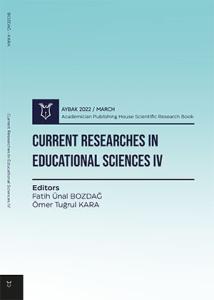
Teachers’ Perceived Strengths and The Strengths Perceived By Other Teachers in The Same Teaching Environment .
Özet
This study authored by Duygu İşpınar Akçayoğlu investigates language teachers' self-perceived strengths alongside the strengths identified by their colleagues within the same educational environment. Utilizing a qualitative research design, the researcher collected data from twenty-five English Language instructors working at a School of Foreign Languages within a state university in southern Turkey using open-ended questionnaires, analyzing the text inductively via content analysis. The findings indicate that instructors' top self-perceived strengths are highly focused on personal traits, including being empathetic, helpful, maintaining good communication, establishing positive rapport with students, and adjusting lessons to student levels and needs. Conversely, the strengths attributed to them by peers were higher in number and more diverse, prominently highlighting excellent communicative relationships, being well-organized, being highly experienced in English teaching, patience, and operating as life-long learners. Importantly, the results demonstrate strong consistency between self-reported strengths and peer evaluations, signaling robust overall teacher self-efficacy. This alignment emphasizes the vital role of social components and collegiate support in reinforcing self-efficacy. Ultimately, the study suggests that cultivating teachers' self-efficacy through targeted interventions optimizes the educational environment, reduces burnout, and enhances institutional instructional quality.
Referanslar
Alderman, M. K. (1999). Motivation for Achievement: Possibilities for teaching and learning. Mahwah, NJ: Erlbaum
Bandura, A. (1977). Self-efficacy: Toward a unifying theory of behavioral change. Psychological Bulletin, 84, 191–215.
Bandura, A. (1986). Social foundations of thought and action. New Jersey: PrenticeHall.
Bandura, A. (1989). Regulation of cognitive processes through perceived self-efficacy. Developmental Psychology, 25, 729-735.
Bandura, A. (2001). Social cognitive theory: An agentic perspective. Annual Review of Psychology, 52(1), 1-26.
Bandura, A. (2006). Social cognitive theory. In S. Rogelberg (Ed.). Encyclopedia of Industrial/Organizational Psychology. Beverly Hills: Sage Publications.
Bembenutty, H. (2007). Teachers' self-efficacy and self-regulation. Academic Exchange Quarterly, 11, 155–161.
Black, P., Harrison, C., Lee, C., Marshall, B., & Wiliam, D. (2004). Working inside the black box: Assessment for learning in the classroom. Phi Delta Kappan, 86 (1), 8– 21.
Briones, E., Tabernero, C., & Arenas, A. (2010). Job satisfaction of secondary school teachers: Effect of demographic and psycho-social factors. Revista de Psicología del Trabajo y de las Organizaciones, 26(2), 115-122.
Brouwers, A., & Tomic, W. (2000). A longitudinal study of teacher burnout and perceived self-efficacy in classroom management. Teaching and Teacher Education, 16, 239 –253. https://doi.org/10.1016/S0742- 051X(99)00057-8
Caprara, G. V., Barbaranelli, C., Steca, P., & Malone, P. S. (2006). Teachers’ self-efficacy
beliefs as determinants of job satisfaction and students’ academic achievement: A study at the school level. Journal of School Psychology, 44(6), 473-490.
Cooper, B. (2004). Empathy, interaction and caring: Teachers’ roles in a constrained environment. Pastoral Care in Education, 4, 12–21.
Ghasemboland, F., & Hashim, F. B. (2013). Teachers’ self-efficacy beliefs and their English language proficiency: A study of nonnative EFL teachers in selected language centers. Procedia-Social and Behavioral Sciences, 103, 890-899.
Gibson, S., & Dembo, M. H. (1984). Teacher efficacy: A construct validation. Journal of Educational Psychology, 76(4), 569–582.
Klassen, R. M., & Chiu, M. M. (2010). Effects on teachers' self-efficacy and job satisfaction: Teacher gender, years of experience, and job stress. Journal of Educational Psychology, 102(3), 741.
Mizrak, P. (2019). An exploratory study on the relationship between teacher burnout and teacher self-efficacy among English language teachers (Master's thesis). Bolu Abant Izzet Baysal University.
Midgley, C., Feldlaufer, H., & Eccles, J., (1989). Change in teacher efficacy and student self- and task-related beliefs in mathematics during the transition to junior high school. Journal of Educational Psychology, 81, 247-258.
Muijs, R.D., & Reynolds, D. (2001). Effective teaching: Evidence and practice. London: Paul Chapman.
Mulholland, J., & Wallace, J. (2001). Teacher induction and elementary science teaching: Enhancing self-efficacy. Teaching and Teacher Education, 17(2), 243-261.
Ozkan, H., Dalli, M., Bingol, E., Metin, S. C., & Yarali, D. (2014). Examining the relationship between the communication skills and self-efficacy levels of physical education teacher candidates. Procedia-Social and Behavioral Sciences, 152, 440-445.
Poulou, M. (2007). Personal teaching efficacy and its sources: Student teachers' perceptions. Educational Psychology, 27(2), 191-218.
Schunk, D. H., Pajares, F. (2010). Self-efficacy beliefs. In Sana Järvelä (Ed.) Social and Emotional Aspects of Learning (2011, 668-672). Oxford: Elsevier: Academic Press.
Solar Şekerci, A. (2011). Self-efficacy levels of prep-school teachers and its predictors (Unpublished Master’s Thesis). Middle East Technical University.
Tschannen-Moran, M., Hoy, A. W., & Hoy, W. K. (1998). Teacher efficacy: Its meaning and measure. Review of Educational Research, 68(2), 202-248.
Vorkapić, S. T. (2015). How much personality is important in educational context? In M. Orel (Ed.), International Conference EDUvision 2015: “Modern Approaches to Teaching Coming Generation” (pp. 75–83). EDUvision, Stanislav Jurjevčič, Ljubljana, Slovenija.
Windschitl, M. (2002). Framing constructivism in practice as the negotiation of dilemmas: An analysis of the conceptual, pedagogical, cultural, and political challenges facing teachers. Review of Educational Research, 72, 131–175.
Woolfolk, A., & Hoy, W. K. (1990). Prospective teachers' sense of efficacy and beliefs about control. Journal of Educational Psychology, 82, 81-91.