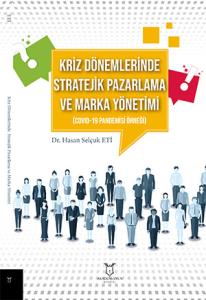
Kriz Dönemlerinde Stratejik Pazarlama ve Marka Yönetimi: COVID-19 Pandemisi Örneği
Özet
Dr. Hasan Selçuk ETİ tarafından kaleme alınan "Kriz Dönemlerinde Stratejik Pazarlama ve Marka Yönetimi (COVID-19 Pandemisi Örneği)" başlıklı bu eser, küresel rekabet ortamında stratejik pazarlama ile marka yönetiminin kesişim noktalarını ve kriz anlarında işletmelerin sürdürülebilirliğini sağlayan yöntemleri son derece kapsamlı bir şekilde incelemektedir. Kitapta; marka penetrasyonu, marka genişlemesi, uluslararasılaşma, şemsiye marka, aile markası ve kurumsal markalaşma stratejileri gibi temel kavramlar teorik çerçevede ele alınırken, kriz durumlarının marka değerine ve pazarlama metriklerine olan doğrudan etkileri detaylandırılmaktadır. COVID-19 pandemisini somut bir örnek olay olarak merkezine alan çalışma; firmaların değişen tüketici davranışlarına ve pazar koşullarına uyum sağlama süreçlerini, marka mesajı ile iç organizasyon kültürünün bütünleştirilmesini, çalışan deneyiminin yönetilmesini ve paylaşılan değer yaratımının stratejik önemini vurgulamaktadır. Ayrıca kriz dönemlerinde doğru reklam tercihlerinden içerik ve sosyal medya pazarlamasına, izinli e-posta pazarlamasından e-ticaret ve bütünleşik dijital pazarlama kanallarına kadar geniş bir yelpazedeki yeni nesil pazarlama araçlarının rolü açıklanmaktadır. Empati, şeffaflık, müşteri odaklılık ve dijital esnekliği ön plana çıkaran bu eser, akademisyenler, pazarlama profesyonelleri, araştırmacılar ve karar verici yöneticiler için rehber niteliğinde nitelikli bir başvuru kaynağı sunmaktadır.
Written by Dr. Hasan Selçuk ETİ, "Strategic Marketing and Brand Management in Times of Crisis (Case of COVID-19 Pandemic)" comprehensively examines the intersection of strategic marketing and brand management in a globally competitive environment, alongside the methods that ensure business sustainability during crises. While discussing fundamental concepts such as brand penetration, brand extension, internationalization, umbrella brand, family brand, and corporate branding strategies within a theoretical framework, the book details the direct impacts of crisis situations on brand equity and marketing metrics. Centering on the COVID-19 pandemic as a concrete case study, the work emphasizes companies' adaptation processes to changing consumer behavior and market conditions, the integration of brand messaging with internal organizational culture, the management of employee experience, and the strategic importance of creating shared value. Furthermore, it elucidates the role of next-generation marketing tools during crisis periods, ranging from proper advertising choices to content and social media marketing, permission-based email marketing, and e-commerce alongside integrated digital marketing channels. Highlighting empathy, transparency, customer-centricity, and digital flexibility, this work serves as a qualified reference guide for academics, marketing professionals, researchers, and decision-making executives.
Referanslar
Aaker, D. A. ve Moorman, C. (2017). Strategic market management. 11th Edition, New York: Wiley.
Alavinasab, S.M., Soltani, M. ve Alimohammadi, J. (2017). "The Effect of Brand Extension Strategy on Brand Image to Customers", British Journal of Economics, Management & Trade, 17(4), ss.1-9.
Bansal, H. S. ve Taylor, S. F. (2015). "Beyond service quality and customer satisfaction: investigating additional antecedents of service provider switching intentions",Proceedings of the 1999 Academy of Marketing Science (AMS) Annual Conference Springer.
Baudrillard, J. (2017). Simulacra and Simulation. Michigan: University of Michigan Press.
Baumöl, U., Hollebeek, L. ve Jung, R. (2016). "Dynamics of customer interaction on social media platforms". Electronic Markets, 26(3), ss.199– 202.
Bern, T. (2020). "State of Social Media Report: The Impact of COVID-19". Socialbakers, [Çevrimiçi]: socialbakers.com/blog/covid-19-is-changing-behavior-on-social-media-for-both-brands-and-users (10.09.2021).
Bose, U. (2012). "An ethical framework in information systems decision making using normative theories of business ethics". Ethics and Information Technology, 14(1), ss.17–26.
Bu, Y., Parkinson, J. ve Thaichon, P. (2020). "Digital content marketing as a catalyst for e-WOM in food tourism". Australasian Marketing Journal, ss.1–12.
Buchwald, E. (2020). "Airbnb will give laid-off employees 14 weeks base pay and health insurance, but millions of other laid-off workers are not so lucky", Marketwatch.
Bundy, J., Pfarrer, M.D., Short, C.E. ve Coombs, W.T. (2017). "Crises and crisis management: integration, interpretation, and research development", J. Manag. 43 (6), 1661–1692.
Business Roundtable, (2019). "Our Commitment", [Çevrimiçi]: https://opportunity.businessroundtable.org/ourcommitment/ (30.09.3021).
Chien, M. P., Sharifpour, M., Ritchie, B. W. ve Watson, B. (2017). "Travelers’ health risk perceptions and protective behavior: A psychological approach". Journal of Travel Research, 56, ss.744–759.
Cleeren, K., Van Heerde, H. ve Dekimpe, M. G. (2013). "Rising from the ashes : How brands and categories can overcome product-harm crises". Journal of Marketing, 77(2), ss.58-77.
Coombs, W. T. (2007). "Protecting organization reputations during a crisis: The development and application of situational crisis communication theory". Corporate Reputation Review, 10, ss.163–176.
De Neys, W. (2017). Dual Process Theory 2.0. Routledge, London.
Eagleton, T. (2002). The Idea of Culture, Oxford: Blackwell Publishing.
Edeling, A. ve Fischer, M. (2016). "Marketing’s impact on frm value: Generalizations from a meta-analysis". Journal of Marketing Research, 53(4), ss.515–534.
Eren Erdoğmuş, I., Akgün, I. ve Arda, E. (2018)." Drivers of successful luxury fashion brand extensions: cases of complement and transfer extensions". Journal of Fashion Marketing and Management, 22, ss.476-493.
Ettinger, A., Grabner-Krauter, S. ve Terlutter, R. (2018). "Online CSR communication in the hotel industry: evidence from small hotels". Int. J. Hosp. Manag. 68, ss.94–104.
Evans, J.S.B.T. ve Stanovich, K.E. (2013). "Dual-process theories of higher cognition: advancing the debate". Perspect. Psychol. Sci. 8 (3), ss. 223–241.
Farida, S.N. ve Azizah, N. (2019). "Optimization of Corporate Branding Strategy in Higher Education as the Marketing Sustainability", ERN: Other Organizations & Markets: Policies & Processes (Topic).
Fırat, F. A. ve Venkatesh, A. (1993). "Postmodernity: The age of marketing". International Journal of Research in Marketing, 10 (3), ss.227-249.
Fox, A. (2020). "Frozen Food Company Dr. Praeger’s Buying Food for Grocery Stores Employees Amid the Coronavirus", Video.
Gretry, A., Horvath, C., Belei, N. ve van Riel, A.C. (2017). “Don’t pretend to be my friend!” when informal brand communication style backfires on social media. J. Bus. Res. 74 (4), ss.77–89.
Groh, M. (2014). "Strategic management in times of crisis", American Journal of Economics and Business Administration, 6 (2), ss.49-57.
Harbar, Z., Selezneva, O.N., Litvinov, O., Kaptalan, S. ve Gonchar, V. (2020). "Strategic Marketing Management Of Innovative Activities In Ensuring Enterprise Economic Security". REICE, 8(15), ss.300-313.
Hardeman, G., Font, X. ve Nawijn, J. (2017). "The power of persuasive communication to influence sustainable holiday choices: appealing to self-benefits and norms". Tour. Manag. 59, ss. 484–493.
Hardy, Q. (2020). "COVID-19 and Our Surprising Digital Transformation", Forbes. 2020. [Çevrimiçi]: https://www.forbes.com/sites/ googlecloud/2020/03/11/beyond-spreadsheets/#401e43c76c7f (05.09.2021).
Heilweil, R. (2020). "Coronavirus scammers are flooding social media with fake cures and tests", Vox.
Hollebeek, L. D. ve Macky, K. (2019). "Digital Content Marketing's Role in Fostering Consumer Engagement, Trust, and Value : Framework, Fundamental Propositions, and Implications". Journal of Interactive Marketing, 45, ss.27–41.
Hsieh, T. (2010). "Delivering Happiness: A Path to Profits, Passion, and Purpose", Grand Central Publishing.
Jobber, D. (2004). Principles and Practice of Marketing, 4th edn, McGraw-Hill, London.
Kalaignanam, K., Kushwaha, T. ve Eilert, M. (2013). "The impact of product recalls on future product reliability and future accidents: Evidence from the automobile industry". Journal of Marketing, 77(2), ss.41-57.
Kapferer, J.M. ve Valette-Florence, P. (2018). "The impact of brand penetration and awareness on luxury brand desirability". Journal of Business Research, 83, ss.38-50.
Kapferer, J.N. (2012). The New Strategic Brand Management : Advanced Insights and Strategic Thinking, Kogan Page Ltd, UK.
Keller, K.J.(1993)."Conceptualizing, Measuring, and Managing Customer-Based Brand Equity," Journal of Marketing, 57 (1), ss.1-22.
Kelly, J. (2020). "Uber Lays Off 3,500 Employees Over A Zoom Call—The Way In Which A Company Downsizes Its Staff Says A Lot About The Organization", Forbes.
Kim, K., Kim, J. ve Reid, L. N. (2017). "Experiencing motivational conflict on social media in a crisis situation: The case of the Chickfil-A same-sex marriage controversy". Computers in Human Behavior, 71, ss.32-41.
Kim, R.Y. (2020). "The impact of COVID-19 on consumers: Preparing for digital sales". IEEE Eng. Manag. Rev., 48, ss. 212–218.
Kirsch, P. M. (2012). "The influence of social contagion and technology on epidemic non-suicidal self-injury". Library Events at Digital Scholarship@UNLV. 1-15. [Çevrimiçi]: https://digitalscholarship.unlv.edu/ award/8 (08.09.2021).
Koerber, D. ve Zabara, N. (2016). "Preventing damage: The psychology of crisis communication buffers in organized sports". Public Relations Review, 43(1), ss.193-200.
Kotler, P. (2017). Pazarlama 4.0.: Gelenekselden Dijitale Geçiş, Optimist Yayın Dağıtım.
Kotler, P. ve Keller, K. L. (2015). Marketing Management: Global Edition, Pearson Education.
Lawrance, E. (2020). "Mary Barra: How GM shifted to high gear during coronavirus pandemic", Detroit Free Press.
Lee, N. R. ve Kotler, P. (2016). Social Marketing. London: Sage Publications.
Liu, D., Juanchich, M., Sirota, M. ve Orbell, S. (2020)."Differences between decisions made using verbal or numerical quantifiers". Thinking & Reasoning, 27(1), ss.69–96.
Lude, M. ve Prügl, R. (2018). "Why the family business brand matters: Brand authenticity and the family firm trust inference". Journal of Business Research, 89, ss.121-134.
Mahase, E. (2020). "Long covid could be four different syndromes, review suggests". BMJ 371:m3981. doi: 10.1136/bmj.m3981.
Mamula, T. (2012). "Role of marketing metrics in strategic brand management". Marketing Science, 43, ss.49-61.
Medvedeva, M. ve Starodubtseva, E.B. (2020). "The Russian exported goods under the umbrella brand: Expectations and reality". National Interests: Priorities and Security, 16, ss.1636-1655.
Melewar, T.C. ve Skinner, H. (2020). "Territorial brand management: Beer, authenticity, and sense of place". Journal of Business Research, 116, ss.680-689.
Milichovsky, F. ve Simberova, I. (2015). "Marketing effectiveness: Metrics for effective strategic marketing". The Engineering Economics, 26, ss.211-219.
Morgan, J. (2017). "Why the Millions We Spend on Employee Engagement Buy Us So Little", HBR.
Morhart, F., Malär, L., Guèvremont, A., Girardin, F. ve Grohmann, B. (2015). "Brand authenticity: An integrative framework and measurement scale". Journal of Consumer Psychology, 25(2), ss.200–218.
Morning Consult, (2020). "WEATHER NG THE STORM: Brand Management in the Covid-19 Era".
Nooyi, I.K. ve Govindarajan, V. (2020). "Becoming a Better Corporate Citizen", HBR.
Novixoxo, J.D., Jamal-Deen, A., Anning, L. ve Darko, S. (2018). "THE EFFECT OF BRANDING ON THE MARKETING PERFORMANCE OF COMPANIES IN THE MOBILE PHONE INDUSTRY", International Journal of Developing and Emerging Economies, 6(2), ss.39-60.
Palmer, An. (2020). "TECH As coronavirus kills another Amazon worker, the company’s response is adding to employees’ fears", CNBC.
Pecujlija, M. ve Cosic, D. (2019). Crisis Management: Introducing Companies Organizational Reactivity and Flexibility. Nova.
Pecujlija, M., Jaksic, K., Drobnjak, S., Cosic, I., Kesetovic, Z. ve Seslija, D. (2017). "Serbian Companies reactivityand flexibilityand their crisis managementefficiency and effectiveness". Journal for East European Management Studies, 22, 2, 257-270.
Porter, M. (1998). What is strategy? in Segal-Horn (ed.), The Strategy Reader,Blackwell in association with The Open University.
Prentice, C., Han, X. Y., Hua, L. L. ve Hu, L. (2019). "The influence of identity-driven customer engagement on purchase intention". Journal of Retailing and Consumer Services, 47, ss.339–347.
Reimers, V., Chao, C-W. ve Gorman, S. (2016). "Permission email marketing and its influence on online shopping". Asia Pacific Journal of Marketing and Logistics, 28(2), ss.308-322.
Ritchie, B. W. (2004). "Chaos, crises and disasters: A strategic approach to crisis management in the tourism industry". Tourism Management, 25, ss.669–683.
Schiavone, F. ve Simoni, M. (2019). "Strategic marketing approaches for the diffusion of innovation in highly regulated industrial markets: the value of market access". Journal of Business & Industrial Marketing, 34(7), ss.1606–1618.
Sheng, J. (2019). "Being Active in Online Communications: Firm Responsiveness and Customer Engagement Behaviour". Journal of Interactive Marketing, 46, ss.40–51.
Shujie, Y. (2017). "Driving factors for successful brand extensions in Chinese market: The case of Chinese brand Xiaomi Tech",Graduate School of Management, St. Petersburg State University.
Sotirios, V. ve Nikolaos, G. (2016). "Measurement of Strategic Management Effectiveness in Tourism Enterprises". BESSH-2016, 146(3), ss.41-45.
Steenkamp, J. B. E. M. ve Fang, E. (2013). "The impact of economic contractions on the efectiveness of R&D and advertising: Evidence from US companies spanning three decades". Marketing Science, 30(4), ss.628–645.
Steimer, S. (2020). "How marketers are working during the pandemic". Marketing News, Spring. [Çevrimiçi]: https://www.ama.org/marketing-news/how-marketers-are-working-during-the-pandemic/ (03.09.2021).
Taiminen, K. ve Ranaweera, C. (2019). "Fostering brand engagement and value-laden trusted B2B relationships through digital content marketing: The role of the brand's helpfulness". European Journal of Marketing, 53(9), ss.1759–1781.
Tanusondjaja, A., Nenycz-Thiel, M., Dawes, J. ve Kennedy, R. (2018). "Portfolios: Patterns in brand penetration, market share, and hero product variants". Journal of Retailing and Consumer Services, 41, ss.211-217.
Tiku, N. (2020). "Airbnb creates a new listing: Its laid-off workers", Washington Post.
Trimble C. S. ve Rifon, N. J. (2006). "Consumer perceptions of compatibility in cause-related marketing messages". International Journal of Nonproft and Voluntary sector Marketing, 11(1), ss.29–47.
Van Heerde, H. J., Gijsenberg, M. J., Dekimpe, M. G. ve Steenkamp, J. B. E. M. (2013). "Price and advertising over the business cycle". Journal of Marketing Research, 50(2), ss.177–193.
Wang, C. Y., Wu, L. W., Lin, C. Y. ve Chen, R. J. (2017). "Purchase intention toward the extension and parent brand: The Role of Brand Commitment". Journal of Economics & Management, 13(1), ss.83–103.
Welch, J. (2015). "Three Ways to Take Your Company’s Pulse".
Wheelen, T.L. ve Hunger, J.D. (2012).Strategic Management and Business Policy TOWARD GLOBAL SUSTAINABILITY, Pearson.
Williams, R. (2015). Keywords: A Vocabulary of Culture and Society. New York: Oxford University Press.
Woodroof, P. J., Deitz, G. D., Howie, K. M. ve Evans, R. D. (2019). "The efect of cause-related marketing on frm value: A look at fortune’s most admired all-stars". Journal of the Academy of Marketing Science, 47(5), ss.899–918.
Yalkın, Ç. (2017). "A Brand Culture Approach to Managing Nation Brands", European Management Review. https://doi.org/10.1111/emre.12129.
Yin, S. ve Jing, R. (2014). "A Schematic View of Crisis Threat Assessment", Journal of Contingencies and Crisis Management 22(2),ss. 97–107.
Yu, S., Liu, M.J. ve Ye, D. (2019). "Place Umbrella Branding and the Provision of Quality: A Case Study of the “ZhejiangMade” Brand." China Branding, ss.1-13.
Zhao, Y. (2016). "THE IMPACTS OF BRAND MANAGEMENT PRACTICES ON BRAND PERFORMANCE AND FIRM VALUE", Michigan State University.
Yayınlanan
Lisans
LisansBu İnternet Sitesi içeriğinde yer alan tüm eserler (yazı, resim, görüntü, fotoğraf, video, müzik vb.) Akademisyen Kitabevine ait olup, 5846 sayılı Fikir ve Sanat Eserleri Kanunu ve 5237 sayılı Türk Ceca Kanunu kapsamında korunmaktadır. Bu hakları ihlal eden kişiler, 5846 sayılı Fikir ve Sanat eserleri Kanunu ve 5237 sayılı Türk Ceza Kanununda yer alan hukuki ve cezai yaptırımlara tabi olurlar. Yayınevi ilgili yasal yollara başvurma hakkına sahiptir.
