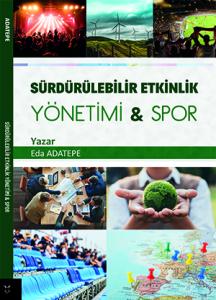
Sürdürülebilir Etkinlik Yönetimi & Spor
Özet
Bu kitap, sürdürülebilir etkinlik yönetimi ve spor alanında yapılan bir araştırmayı konu almaktadır. Yazar, Kocaeli Büyükşehir Belediye Kağıtspor Kulübü'nün sürdürülebilir etkinlik farkındalığını ölçmeyi, mevcut durumunu analiz etmeyi ve sürdürülebilirlik stratejisi oluşturmayı amaçlamaktadır. Kitap, sürdürülebilirlik kavramının önemini vurgulamakta ve sporun bu kavramdan ayrı düşünülemeyeceğini belirtmektedir. Yerel yönetimlere de büyük sorumluluk düştüğü vurgulanmaktadır. Kitap, sürdürülebilirlik yol haritasının oluşturulması ve mevcut durumun iyileştirilmesi için Birleşmiş Milletler 2030 Sürdürülebilir Kalkınma Amaçlarına odaklanmaktadır. Yazar, doktora tezinden yola çıkarak bu konuda bilgi ve deneyimlerini paylaşmaktadır. Kitap, spor ve rekreasyon alanında sürdürülebilirlik konusunda bir kaynak olarak okuyuculara sunulmaktadır.
This book focuses on a research conducted in the field of sustainable event management and sports. The author aims to measure the awareness of sustainable event practices, analyze the current situation, and develop a sustainability strategy for Kocaeli Metropolitan Municipality Kağıtspor Club. The book emphasizes the importance of the concept of sustainability and highlights that sports cannot be separated from this concept. It also emphasizes the significant responsibility of local governments. The book focuses on the United Nations' 2030 Sustainable Development Goals for creating a roadmap for sustainability and improving the current situation. The author shares their knowledge and experiences on this topic based on their doctoral thesis. The book is presented to readers as a resource on sustainability in the field of sports and recreation.
Referanslar
Adams, W. M. (2006). The future of sustainability: Re-thinking environment and development in the twenty-first century. Report of the IUCN Renowned Thinkers Meeting, 29–31.
Adatepe, E. & Kolayiş, H. (2022). Sürdürülebilir etkinlik farkındalık ölçeğinin geliştirilmesi: Geçerlilik ve güvenilirlik çalışması. CBÜ Beden Eğitimi ve Spor Bilimleri Dergisi, 17 (1) , 13-28. doi: 10.33459/cbubesbd.1070114
Adatepe, E. & Solakumur, A. (2022). ISO 20121 sürdürülebilir etkinlik yönetim sistemi perspektifinden sporda organizasyonel sürdürülebilirlik. Ersoy, A.Y. ve Saygılı, M (Ed.), Sürdürülebilirlik Güncel Araştırmalar (s.313-336). Ankara: Gazi Kitabevi
Akgül, U. (2010). Sürdürülebilir kalkınma: Uygulamalı antropolojinin eylem alanı. Ankara Üniversitesi Dil ve Tarih Coğrafya Fakültesi Antropoloji Dergisi, 2010: 24; 133- 164.
Akşar, T. (2013). Olimpiyat düzenlemek akıl karı mı? Ülkeler neden olimpiyat düzenlerler? Futbol Ekonomisi (1 Eylül 2013). Retrieved from http://www.futbolekonomi.com/index.php/videolar/ 2730-olimpiyat-duezenlemek-akl-kar-m-uelkeler-neden-olimpiyat-duezenlerler.html
Allen, J., O'toole, W., Harris, R. ve McDonnell, I. (2002).
Festival and special event management. 2nd press, John Wiley Sons Inc,
Singapur.
Alshuwaikhat, H. M., Abubakar, I., 2007. towards a sustainable urban environmental management approach (SUEMA): Incorporating environmental management with strategic environmental assessment (SEA), Journal of Environmental Planning and Management, 50(2): 257-270.
Arcodia, C. & Barker, T. (2003). The employability prospects of graduates in event management: Using data from job advertisements. (Master’s thesis). University of Queensland. Austrália.
Argan, M. (2002). Eğlence Pazarlaması. Detay Yayıncılık, Ankara.
Argan, M. (2004). Spor ve turizm pazarlamasının kesişim noktası olarak spor
turizmine kuramsal bir bakış. Anatolia: Turizm Araştırmaları Dergisi,
Sayı 15, No:2, ss. 164, 457.
Aull Davies, C. (1999). Reflexive ethnography a guide to researching selves and others. London, New York: Routledge.
Ayas, A. S. & Aydın, U. C. (2016). Sporda kurumsal sürdürülebilirlik ve ERP sistemi (Fenerbahçe Spor Kulübü örneği) . Spormetre Beden Eğitimi ve Spor Bilimleri Dergisi, 14 (2) , 153-162. https://doi.org/10.1501/Sporm_0000000292
Aydemir, M. (2007). İşletmelerin iş görenlere karşı sosyal sorumlulukları ve SA8000 standardı,” kurumsal sosyal sorumluluk. 4. Baskı, İstanbul, İgiad Yayınları.
Aydınoğlu, Y. (2019). Turizm işletmelerinde hizmet mekânlarının kalitesinin yürürlükteki yasal çerçeve açısından değerlendirilmesi. Yüksek Lisans Tezi. Gazi Üniversitesi, Fen Bilimleri Enstitüsü, Ankara.
Baade, R. A. & Matheson, V. A. (2016). Going for the gold: The economics of the olympics. Journal of Economic Perspectives, 30(2). http://dx.doi.org/10.1257/jep.30.2.201
Badea, L.; Șerban-Oprescu, G.L.; Dedu, S.; Piroșcă, G.I. (2020). The impact of education for sustainable development on Romanian economics and business students’ behavior. Sustainability 2020, 12, 8169. https://doi.org/10.3390/su12198169
Balcı, A. (2005). Sosyal bilimlerde araştırma. (5. Baskı) Ankara: PegemA Yayıncılık
Balcı, V. & Koçak, F. (2014). Spor ve rekreasyon alanlarının tasarımında ve kullanımında çevresel sürdürülebilirlik. Spor ve Performans Araştırmaları Dergisi, 5 (2) , 46-58. Retrieved from https://dergipark.org.tr/tr/pub/omuspd/issue/20458/217867
Balcı, V. , Gök, Y. & Akoğlu, H. E. (2018). Türkiye’nin ulusal gençlik ve spor politikalarının, sürdürülebilirliğin sosyal boyutuyla incelenmesi. Spor Bilimleri Araştırmaları Dergisi, 3 (1) , 9-22. https://doi.org/10.25307/jssr.399823.
Bakos, A. (2014). Environmental sustainability of sporting events in local communities: Assessing the ecological footprint of the 2013 International Children’s Games. (Master’s thesis). University of Windsor, Ontario, Kanada.
Bardocz-Bencsik, M. & Doczi, T. (2019). Mapping sport for development and peace as Bourdieu’s field physical culture and sport. Studies and Research, 2019, 81, 1-12 https://doi.org/10.2478/pcssr-2019-0001
Baş, T. & Akturan, U. (2017). Fenomenoloji. İçinde sosyal bilimlerde bilgisayar destekli nitel araştırma yöntemleri, T. Baş ve U. Akturan (Ed.), 3. Baskı, Ankara: Seçkin Yayıncılık.
Bayram, N.(2015). Sosyal bilimlerde SPSS ile veri analizi, 5.Baskı, Bursa: Ezgi Kitabevi
Bektaş, H. (2003). Türkiye’de ISO 14001 uygulanması açısından sektörün değerlendirilmesi, Çevre ve Mühendis Türk Mühendis ve Mimar Odaları Birliği Çevre Mühendisleri Odası Yayın Organı, 25, 39-41.
Bergen, T. (2020). Tackling sustainability in sporting events. Retrieved from https://inhabitat.com/tackling-sustainability-in-sporting-events/
Beutler, I. (2008). Sport serving development and peace: Achieving the goals of the United Nations through sport. Sport in Society, 11(4), 359–369.
Bilgili, M. Y. (2017). Ekonomik, ekolojik ve sosyal boyutlarıyla sürdürülebilir kalkınma. Uluslararası Sosyal Araştırmalar Dergisi, Vol.10, pp.559-569
BMİÇK (1972). United Nations Conference on the Human Environment: Report of the 2nd Committee. Retrieved from https://digitallibrary.un.org/record/761867
BMUV (2016). Sport Events – Catalysts for Sustainable Development. Position paper Sustainable Sport Events. Retrieved from https://www.bmuv.de/en/download/sustainable-sport-events
Bowdin, G.A.J., Allen, J., O’Toole, W., Harris, R., McDonnell, I. (2012). Events management. 3rd edition. Routledge. London.
Bogdan, R.C. & Biklen, S.K. (1992). Qualitative research for education: An
introduction to theory and methods. Boston: Allyn and Bacon.
Bokhari, A. (2017). Universities' social responsibility (USR) and sustainable development: A conceptual framework. SSRG International Journal of Economics and Management Studies, Vol. 4, No. 12, 2017, p. 13. https://doi.org/10.14445/23939125/IJEMS-V4I12P102
Bormane, S., Šķiltere, D., & Batraga, A. (2017). Sustainability – economic, environmental and public ıssues. Marketing Possibilities. Regional Formation and Development Studies, 23(3), 21-35. https://doi.org/10.15181/rfds.v23i3.1582
Bowdin, G., O'Toole, W., Allen, J., Harris, R., McDonnell, I. (2006). Events management. Routledge, London, UK. 2nd Edition.
Bozkurt, Ö. & Göral, M. (2013). Modern liderlik tarzlarının yenilik stratejilerine etkisini belirlemeye yönelik bir çalışma. Anadolu Üniversitesi Sosyal Bilimler Dergisi, 14(4), 1-14.
Brady, Kristjan O. (2005). The sustainability effect: Rethinking corporate reputation in the 21st century. New York, Palgrave Macmillan.
BSI (2007). British Standards launches new standard for managing a more sustainable event. Press Release.12 November 2007. https://www.bsigroup.com/en-GB/about-bsi/media-centre/press-releases/2007/11/BSI-British-Standards-launches-new-standard-for-managing-a-more-sustainable-event/
BSI (2009). Positive Impact Case Study, Understanding BS 8901, Educational Workshop. Retrieved from https://organisethis.co.uk/assets/uploads/page_content/image/13837B65-90F1-16EF-E2AA14FB7CC75257.pdf.
Bull, R. (2012). LOCOG launches new global sustainability standard. Event. https://www.campaignlive.com/article/locog-launches-new-global-sustainability-standard/1137328. Retrieved from 3 Aralık 2021.
Büyüköztürk, Ş., Kılıç, Çakmak, E., Akgün, Ö., E., Karadeniz, Ş., Demirel, F. (2012). Bilimsel araştırma yöntemleri.11. Baskı. Pegem Akademi, Ankara.
Campelli, M. (2019). Manure powers Helsinki International Horse Show. The Sustainability Report .The Insıde Track On Sport Sustaınabılıty. https://sustainabilityreport.com/2019/10/28/manure-powers-helsinki-international-horse-show/
Campillo-Sánchez, J., Segarra-Vicens, E., Morales-Baños, V., Díaz-Suárez, A. (2021). Sport and Sustainable Development Goals in Spain. Sustainability 2021, 13, 3505. https://doi.org/10.3390/su13063505
Caniato, F., Caridi, M., Crippa, L., ve Moretto, A. (2012). environmental sustainability in fashion supply chains: An exploratory case based research, International journal Of Production Economics, 135(2) , 659-670.
Castka, P.& Balzarova, M. A. (2008). ISO 26000 and supply chains-On the diffusion of the social responsibility standard. International Journal of Production Economics 111(2):274-286
Chappelet, J-L. (2008). Olympic Environmental concerns as a legacy of the winter games. The International Journal of the History of Sport, 25(14), 1884–1902.
https://doi.org/10.1080/09523360802438991
Chernushenko, D. (1994). Greening our games: running sports events and facilities that won’t cost the earth. Ottawa: Centurion Publishing & Marketing
Chernushenko, D,. Van der Kamp, A., Stubb, D. (2001). Sustainable sport management: running and environmentally socially and economically responsible organization. Green & Gold Inc., Ontorio, Canada.
Creswell, J. W. (2003). Research design: Qualitative, quantitative, and mixed methods approaches (2nd ed.). Thousand Oaks, CA: Sage
Creswell, J. W. & Plano-Clark, V. L. (2015). Karma yöntem araştırmalarının tasarımı ve yürütülmesi. Y. Dede ve S. B. Demir (Çev. Edt.). Ankara: Anı Yayıncılık.
Creswell, J.W. (2012). Research design: Qualitative, quantitative and mixed methods
approache. California: Sage Publication.
Creswell, J.W. (2017). Karma yöntem araştırmalarına giriş. (M. Sözbilir, çev. ed.). Ankara: Pegem Akademi.
Çaha, Ö. (1999). Spora Yaslanarak Bir Nefes Almak. Düşünen Siyaset, Yıl 1, Sayı 2, Mart, Ankara.
Çankaya, Y. S. & Sezen, B. (2015). Ekolojik yenilik ile sürdürülebilirlik performansı arasındaki ilişkide çevresel belirsizliğin moderatör etkisi. Uluslararası Yönetim İktisat ve İşletme Dergisi, 11(24), s: 111-134.
Çetin, A. (2019). Mega spor etkinliklerinde spor mirası konseptinin gerekliliği. Journal of Health and Sport Sciences, 2 (2) , 66-73. Retrieved from https://dergipark.org.tr/tr/pub/jhss/issue/50709/660413
De Muth, J. (2006). Basic statistics and pharmaceutical statistical applications. Second Edition. CRC Press.2nd edition.
DeMarrais, K. (2004). Qualitative interview studies: Learning through experience. In K. deMarrais, & S. D. Lapan, Foundations for research (pp. 51─68). Mahwah: Lawrrence Erlbaum.
Demirel, M. (2009). Rekreasyonel etkinliklere katılım ve çevresel duyarlılık. Gazi Üniversitesi Eğitim Bilimleri Enstitüsü Beden Eğitimi Ve Spor Öğretmenliği Anabilim Dalı Doktora Tezi. Ankara.
Deshpandé, R., Farley, John U. & Frederick E. Webster Jr. (1993). corporate culture, customer orientation and ınnovativeness in Japanese firms: A quadrad analysis. Journal of Marketing, 57 (1): 23-37.
Dienes, E. (2012). Perspectives of the United Nations on sport as a tool for promoting peace. In K. Gilbert & W. Bennett (Eds.), Sport, Peace & Development (pp. 39–51). Champaign, IL: Common Ground Publishing LLC.
Dietrich, S, R. (2009). Going Green! Part 2: Sustainability in Athletic Training and Therapy. International Journal of Athletic Therapy and Training. Sep2009, Vol. 14 Issue 5, p40-43. 4p. https://doi.org/10.1123/att.14.5.44
Dresner, S. (2002) The principles of sustainability. Earthscan Publications, London.
Duarte, S. & Cruz‐Machado, V. (2013). Modelling lean and green: a review from business models, International Journal of Lean Six Sigma, 4 (3), https://doi.org/10.1108/IJLSS-05-2013-0030.
Durmuş, A. G. (1999). Futbol kulüplerinin stratejik yönetimi Beşiktaş örneği, Ankara: Bağırgan Yayınevi.
Eckerstein, A. (2002). Evaluation of event marketing (Master’s thesis). International Management, No: 25, Göteborg University.
Ekmekçi, Y., Dağlı, A., Ekmekçi, R. & İrmiş, A. (2013). Küreselleşme ve spor endüstrisi, Pamukkale Journal of Sport Sciences, 4/ 1.
Emrealp, S. (2005). Yerel gündem 21 uygulamalarına yönelik kolaylaştırıcı bilgiler elkitabı. IULA-EMME (UCLG-MEWA) Yayını. İkinci Baskı. İstanbul.
Er, B. & Güzel, P. (2019). Mega spor etkinlikleri ve sürdürülebilirlik. CBÜ Beden Eğitimi ve Spor Bilimleri Dergisi, 14 (2) , 199-221. DOI: 10.33459/cbubesbd.556623
Ergin, D. (1991). Örnekleme. M. Ü. Atatürk Eğitim Fakültesi Eğitim Bilimleri Dergisi, sayı 3 sayfa 111-124
Ersoy, F. (2019). “Fenomenoloji”, İçinde Eğitimde Nitel Araştırma Desenleri. Saban, A. ve Ersoy, A. (Ed.), , 3. Baskı, Anı Yayıncılık: Ankara.
Ertuğrul, İ. (2006). Toplam kalite kontrol, 2.Baskı, Ekin Kitabevi, Bursa.
Frost, R. (2012). New ISO 20121 standard for sustainable events management. https://www.iso.org/news/2012/06/Ref1598.html.
Foulke Jr, E. G. (2019). What you need to know about ISO 45001. Risk Management, 66(5): 12-13.
Fuss, F.K., Subic, A. & Mehta, R. (2010). Increased importance of sustainability development when awarding sporting events, Sports Technology, 3:2, 65-65, https://doi.org/10.1080/19346182.2010.545630
Getz, D. (2000). Developing a research agenda for the event management field. Events beyond, 10-21.
Getz, D. (2007). Event studies: Theory, research and policy for planned
events, Elsevier Butterworth- Heinemann, Oxford.
Getz, D. (2008). Event tourism: Definition, evolution, and research. Tourism Management, 29 (3): 403–428. https://doi.org/10.1016/j.tourman.2007.07.017
Getz, D. (2012). Event studies: theory, research and policy for planned events, 2nd Edition, Routledge, London.
Gibson, H., Kaplanidou, K., & Kang, S.J. (2012). Small-scale event sport tourism: A case study in sustainable tourism. Sport Management Review, 15, p. 160-170.
Göçer, A. (2016). Yaşam boyu öğrenmenin önemli bir aşaması: Yetişkin okuryazarlığı ve yararları (Kayseri örneği-Türkiye). Eğitim ve Bilim Dergisi, 41(183), ss.205.
Goodland, R. (2002). Sustainability: Human, Social, Economic and Environmental, Ted Munn (Ed.), Encyclopedia of Global Environmental Change, içinde (1-3), John Wiley&Sons Ltd.
Greene, J. C., Caracelli, V. J., & Graham, W. F. (1989). Toward a conceptual framework for mixed-method evaluation designs. Educational evaluation and policy analysis, 11(3), 255-274. https://doi.org/10.3102%2F01623737011003255
GRI (2013). Global Reporting Inıtiative Guideline G4 Sürdürülebilirlik Raporlaması Kılavuzu “Raporlama İlkeleri ve Bildirimler” https://www.globalreporting.org/resourcelibrary/Turkish-G4-Part-One.pdf
Grootaert, C. & Van Bastelaer, T., editors,(2002). The Role of social capital in development: An empirical assessment. Cambridge University Press.
Güldoğan, M. (2018). Mega etkinlikler için yönetim ve örgüt modeli önerisi: Eskişehir 2013 Türk dünyası kültür başkentliği etkinliği alan araştırması. Doktora Tezi. Dumlupınar Üniversitesi, Sosyal Bilimler Enstitüsü. Kütahya.
Gürbüz, S. & Şahin, F. (2014). Sosyal bilimlerde araştırma yöntemleri. 4. Baskı, Ankara: Seçkin Yayıncılık.
Gürgen, Nedim E. (2018). SA 8000 ve ISO 26000 İş etiği standartlarının Türkiye’de uygulanabilirliği. Hacettepe Üniversitesi Sosyal Bilimler Enstitüsü. Yüksek Lisans Tezi, Ankara.
Güzel, P. & Ark. (2009). Sürdürülebilir kalkınmanın çevre boyutunda Uluslararası Olimpiyat Komitesi (IOC) uygulamaları ve olimpiyat organizasyonları kapsamında incelenmesi. Hacettepe Üniversitesi Spor Bilimleri Dergisi, 2009:20(2); 59-69.
Hahn, R. (2013). ISO 26000 and the standardization of strategic management. Processes for Sustainability and Corporate Social Responsibility,442–455. https://doi.org/10.1002/bse.1751
Hall, J. K., Daneke, G. A. & Lenox, M. J. (2010). Sustainable development and entrepreneurship: Past contributions and future directions. Journal of Business Venturing, 25(5), 439-448. https://doi.org/10.1016/j.jbusvent.2010.01.002
Harris, J. M. (2000). Basic Principles of Sustainable Development, Global Development and Environment Institute Working Paper 00-04, Tufts University, USA.
Hart, S.L. (2005) Capitalism at the Crossroads. Johnson Graduate School of Management, Cornell University. Wharton School Publishing.
Hiscox, Michael J. , Schwartz, C. & Toffel, Michael W. (2008). Evaluating the Impact of SA 8000 Certification. Harvard Business School Technology & Operations Mgt. Unit Research Paper No. 08-097, Available at SSRN: https://ssrn.com/abstract=1135676 veya http://dx.doi.org/10.2139/ssrn.1135676
Holstein, A. J. & Gubrium, F. J. (2004). The active interview. Qualitative Research Theory, Method and Practice (ed. David Silverman). Los Angeles, London, New Delhi: Sage Publications. http://dx.doi.org/10.4135/9781412973588.n3
Horst, P. & Messari-Becker, L. (2021) Kommunale sporthallen in Deutschland – Bestandssituation und perspektiven. Bauphysik 43,
H. 1, S. 12–17. https://doi.org/10.1002/bapi.202000025
Hugaerts, I., Scheerder, J., Helsen, K., Corthouts, J., Thibaut, E.
& Könecke, T. (2021). Sustainability in participatory sports events: The development of a research instrument and empirical insights. Sustainability 2021, 13, 6034. https:// doi.org/10.3390/su13116034
Irak, M., Çapan, D. ve Soylu, C. (2015). Üstbilişsel süreçlerde yaşa bağlı değişiklikler. Türk Psikoloji Dergisi, 30(75), 64-75.
IOC (2008). IOC Spor, çevre ve sürdürülebilir gelişim rehberi. Front Cover. Uluslararası Olimpiyat Komitesi.
IOC (2012). Sustainability through Sport: Implementing the Olympic Movement’s Agenda 21. https://stillmed.olympic.org/Documents/Commissions_PDFfiles/SportAndEnvironment/Sustainability_Through_Sport.pdf
IOC (2018). Sustainability Essentials v7. A series of practical guides for the Olympic Movement. https://olympics.com/ioc/sustainability/essentials
IOC (2021) All you need to know about Tokyo 2020 sustainability. https://olympics.com/ioc/news/all-you-need-to-know-about-tokyo-2020-sustainability.
ISO (2011). Practical overview of the linkages between ISO 26000:2010, Guidance on social responsibility, and OECD Guidelines for Multinational Enterprises. https://www.iso.org/files/live/sites/isoorg/files/store/en/PUB100418.pdf
ISO (2012). Sustainable events with ISO 20121 pdf. ISO Central Secretariat. https://www.iso.org/files/live/sites/isoorg/files/store/en/PUB100302.pdf
ISO (2020). Discovering ISO 26000 - Guidance on social responsibility. https://www.iso.org/files/live/sites/isoorg/files/store/en/PUB100258.pdf
ISO 26000 (2010). Internatıonal Standard ISO 26000-Guidance on social responsibility. First edition. https://documentation.lastradainternational.org/lsidocs/3078-ISO%2026000_2010.pdf
ISO 31000 (2018). Risk management — Principles and guidelines. https://governance.ie/uploads/files/Internal%20Control/ISO310002018.pdf
IUCN, UNEP & WWF (1991). Caring for the Earth: A Strategy for Sustainable Living, David A. Munro & Martin W. Holdgate Eds., Switzerland, Earthscan. Retrieved from https://portals.iucn.org/library/efiles/documents/cfe-003.pdf
İsçan, S. (2019). Metro İstanbul enerji yönetim sisteminin oluşturulması,
modellenmesi ve değerlendirilmesi (Yüksek Lisans tezi). Yalova Üniversitesi, Fen Bilimleri Enstitüsü, Yalova.
Jago, Leo K. & Shaw, Richard N. (1998). Special events: a conceptual and
definitional framework. Festival Management ve Event Tourism, 5(1), https://doi.org/10.3727/106527098792186775
Jasper, M. A. (1994). Issues in phenomenology for researchers of nursing. Journal of Advanced Nursing, 309-314. https://doi.org/10.1111/j.1365-2648.1994.tb01085.x
Jitpakdee, R. & Thapa, G.B. (2012). Sustainability analysis of ecotourism on Yao
Noi Island, Thailand. Asia Pacific Journal of Tourism Research, 17 (3), ss.301-325. https://doi.org/10.1080/10941665.2011.628328
Johnson, R. B. & Onwuegbuzie, A. J. (2004). Mixed methods research: A research paradigm whose time has come. Educational Researcher, 33(7), 14-26. doi:10.3102/0013189X033007014
Johnson, R. B., Onwuegbuzie, A. J., & Turner, L. A. (2007). Toward a definition of mixed methods research. Journal of mixed methods research, 1(2), 112-133. doi: 10.1177/1558689806298224
Karaman, A. (2018). Ürün bilinirliği ve tercihini belirlemede ürün uzmanlarının rolü: Nitel bir araştırma. İşletme Araştırmaları Dergisi, 10(2), ss.651. https://doi.org/10.20491/isarder.2018.449
Karasar, N. (2012). Bilimsel Araştırma Yöntemi. 24. Baskı. Nobel Yayınevi, 396 s,
Ankara
Kates, Robert W., Parris, Thomas M. & Leiserowitz, Anthony A. (2005). What is Sustainable Development? Goals, Indicators, Values and Practice. Environment: Science and Policy for Sustainable Development, Vol. 47, No. 3, s. 11. https://doi.org/10.1080/00139157.2005.10524444
KBB Kağıtspor (2022a). http://www.kbbkspor.com/kurumsal/kulubumuz-hakkinda
KBB Kağıtspor (2022b). http://www.kbbkspor.com/kurumsal/sporcu-beceri-koordinasyon-egitim-merkezi-sbkm
Kim, H. & Grix, J. (2021). Implementing a sustainability legacy strategy: A case study of PyeongChang 2018 Winter Olympic Games. Sustainability 13, no. 9: 5141. https://doi.org/10.3390/su13095141
Kim, H. (2020). Sustainability of the PyeongChang 2018 WinterOlympics. Doctoral thesis (PhD), Manchester Metropolitan University. https://e-space.mmu.ac.uk/626132/
Kızılboğa, R. (2014). Risk yönetimi ve ülke uygulamalarında yönetim modelleri. Akademik Araştırmalar ve Çalışmalar Dergisi (AKAD) , 4 (7) .
Koçak, F. (2013). Sporda sürdürülebilirliğin değerlendirilmesi. Doktora Tezi. Ankara Üniversitesi, Sağlık Bilimleri Enstitüsü, Ankara.
Kohli, Ajay K. & Jaworski, Bernard J. (1990). Market orientation: the construct, research propositions and managerial ımplications. Journal of Marketing, 54: 1-18. https://doi.org/10.1177%2F002224299005400201
Korul, V. (2003). Havaalanı Çevre Yönetim Sistemi, Anadolu Üniversitesi Sosyal Bilimler Dergisi, 3 (1), s: 99-120.
Kozatek, A., Uzhvenko, K., Duchnova, L., Radchenko, L., Krol, I., Ulan, A., D’omina, A., Borysova, O., Denysova, L., Shi, S. (2020). Sustainable development and olympic movement. Journal of Physical Education and Sport ® (JPES), Vol 20 (Supplement issue 1), Art 57 pp 403 – 407. doi:10.7752/jpes.2020.s1057
Kömürcü, S. , Sarıbaş, Ö. & Güler, M. E. (2017). Yavaş şehirlerde yaşayan Z kuşağının çevre ve sürdürülebilir kalkınma algıları: Seferihisar Örneği. Uluslararası Türk Dünyası Turizm Araştırmaları Dergisi, 1 (2) , 107-119. Retrieved from https://dergipark.org.tr/tr/pub/tdtad/issue/30336/327419
KTH Royal Institute of Technology, (2018). Economic sustainability, https://www.kth.se/en/om/miljohallbar-utveckling/utbildning-miljo-hallbar-utveckling/verktygslada/sustainable-development/ekonomiskhallbarhet 1.431976,
Kudinova, Y.V., Loginova, O.A., Zhukova, O.V. (2021). Relationship Between Economy and Sports in Society. In: Ashmarina, S.I., Horák, J., Vrbka, J., Šuleř, P. (eds) Economic Systems in the New Era: Stable Systems in an Unstable World. IES 2020. Lecture Notes in Networks and Systems, vol 160. Springer, Cham. https://doi.org/10.1007/978-3-030-60929-0_23
Küçüksüleymanoğlu, R. (2007). İlköğretim örgütlerinde stratejik planlama süreci: bir örnek olay incelemesi. Eğitimde Politika Analizleri ve Stratejik Araştırmalar Dergisi, 2(1), 6-33.
Küp, H. F. (2011). Stratejik planlama süreci ve küçük ve orta ölçekli işletmelerde yaşanan sorunların stratejik planlama ile çözülmesi. (Yüksek Lisans Tezi). İstanbul Teknik Üniversitesi, Fen Bilimleri Enstitüsü, İstanbul. http://hdl.handle.net/11527/5762
Landis, J. R. & Koch, G. G. (1977). The measurement of observer agreement for categorical data. Biometrics, 33(1), 159–174. https://doi.org/10.2307/2529310.
Lathrop, K. & Centner, T.(1998). Eco-Labeling and ISO 14000: An Analysis of US Regulatory Systems and Issues Concerning Adoption of Type II Standards. Environmental Management 22, 163–172. https://doi.org/10.1007/s002679900093
Leipziger, D. (2009), SA8000 the First decade: Implementation, influence and impact, Greenleaf Publishing, Sheffield.
Littig, B. & Griebler, E. (2005). Social sustainability: A catchword between political pragmatism and social theory, International Journal for Sustainable Development, 8(1/2), 65-79.
Liu, J-Y., Fujimor, S., Takahashi, K., Hasegawa, T., Wu, W., Geng, Y., Takakura, J. & Masui, T. (2021). The importance of socioeconomic conditions in mitigating climate change impacts and achieving Sustainable Development Goals. Environmental Research Letters, Volume 16, Number 1
Levermore, R. (2008). Sport: a new engine of development?. Progress in Development Studies 8, 2 (2008) pp. 183–90. https://doi.org/10.1177%2F146499340700800204
Mallen, C. & Adams, J.L. (2008). Sport recreation and sport turism event management theoretical and practical dimensions. Butterworrth and Heinemann.
Manzenreiter, W. & Horne J. (2005). Hosting Major International Sports Events: Comparing Asia and Europe // IIAS Newsletter. – N 39
Marshall, C. & Rossman, G.B. (1999). Designing qualitative research. 3rd edition. Tousand Oaks: Sage
Maudlin, L. (2010). Event organizers getting ready for the sustainable event standard. Tourism Review Online Magazine. 8 / 2010
McKenzie, S. (2004). Social Sustainability: Towards Some Definitions, Hawke Research Institute, Working Paper Series, 27, 1-31.
Meadows, D. H., Dennis, L. M., Randers, J., & Behrens III, W. W. (1972). Limits to Growth; A Report for the Club of Rome's Project on the Predicament of Mankind. New York: Universe Books. http://www.donellameadows.org/wp-content/userfiles/Limits-to-Growth-digital-scan-version.pdf
Mertens, D. M. (2019) Eğitim ve psikolojide araştırma ve değerlendirme. (Seçer, İ. & Ulaş, S., Çev Ed..) Anı Yayıncılık.
Moldan, B., Janousková, S. & Hak, T. (2012). How to understand and measure environmental sustainability: Indicators and targets, Ecological Indicators, Vol:17, 4-13. https://doi.org/10.1016/j.ecolind.2011.04.033
Morelli, J. (2011). Environmental Sustainability: A Definition for Environmental Professionals, Journal of Environmental Sustainability, Vol: 1(1), Article 2, 1-10. doi: 10.14448/jes.01.0002
Mueckenberger U, J. S. (2010). Transnational norm-building networks and the legitimacy of corporate social responsibility standards. Journal of Business Ethics, 223–239. https://link.springer.com/article/10.1007/s10551-010-0506-1
Munoz-Torres, M. Jesus., Fernandez-Izquierdo, M. Angeles., Rosariobalaguer-Franchn, M. (2004). The social responsibility performance of ethical and solidarity funds: An approach to the case of Spain. Business Ethics: A European Review, Vol. 13, 2004, 200-218.
Narver, John C. & Slater, Stanley F. (1990). The effect of a market orientation on business profitability. Journal of Marketing, 58 (3): 20-38. https://doi.org/10.1177%2F002224299005400403
Nemli, E. (2001). Çevreye duyarlı yönetim anlayışı. İstanbul Üniversitesi Siyasal
Bilgiler Fakültesi Dergisi, No: 23-24, http://www.sbf.istanbul.edu.tr/dergi/sayi23- 24/17.htm
Nemli, E. (2004). Sürdürülebilir kalkınma: Şirketlerin çevresel ve sosyal yaklaşımları, İstanbul, Filiz Kitabevi.
Nielsen, M.L. (2021). Environmental sustainability among sport clubs in Lund’s municipality (Master’s thesis). Malmö University Faculty for Education and Society. https://www.diva-portal.org/smash/get/diva2:1567492/FULLTEXT02
Nooney, G.J., Woodrum, E. H.T., Clifford, B.W. (2003). Environmental worldwiev and behavior, cosequences of dimensionality ın a survey of North Caralonians. Environment and Behavior. 35(6): 763-783
Önce, S., Onay, A. & Yeşilçelebi, G. (2015). Corporate sustainability reporting and situation in Turkey. Journal of Economics, Finance&Accounting-JEFA. 2(2): 230-251.
Özbalkan, E.(2003). ISO 9000:2000 Kalite Güvence Sistemi ve ISO 9000:1994 Kalite Güvence Sistemi Uygulaması, Endüstri Mühendisliği Bölümü 2002–2003 Öğretim Yılı, Bahar Yarı Yılı (Yıl İçi Projesi), İstanbul, http://www.belgeler.com/blg/9o0/so-kalite-gvence-sistemi-ve-so-kalite-gvencesistemi-uygulamasi
Öztürk, M. & Öztürk, A. (2019). BMİDÇS'den Paris Anlaşması'na: Birleşmiş Milletler'in iklim değişikliğiyle mücadele çabaları. Ömer Halisdemir Üniversitesi İktisadi ve İdari Bilimler Fakültesi Dergisi, 12(4), 527-541. https://doi.org/10.25287/ohuiibf.494667
Patton, M. Q. (2014). Nitel araştırma ve değerlendirme yöntemleri (3. baskıdan çeviri)
Çev. Ed. M. Bütün ve S. B. Demir). Ankara: Pegem Akademi.
Pedro, F., Caetano, J., Christiani, K., & Raquilha, L. (2012). Gestão de eventos. Escolar Editora. Lisboa.
Pektaş, N. (2013). ISO 9001 Kalite Yönetim Sisteminde Süreç Yönetiminin İncelenmesi; BTK İçin Etkin Süreç Yönetimi Model Önerisi. İdari Uzmanlık Tezi. Bilgi Teknolojileri ve İletişim Kurumu, Ankara.
Pelham F. (2011). Sustainable event management: the journey to ISO 20121, in Sustainability and Sport, eds Savery J., Gilbert K. (Champaign, IL: Common Ground; ), 43–51.
Pentifallo, C. & VanWynsberghe, R. (2012). Blame it on Rio: Isomorphism, environmental protection and sustainability in the Olympic Movement. International Journal of Sport Policy, 4(3), 427–446. https://doi.org/10.1080/19406940.2012.694115
Pepe, K. (2017). Sporda çevresel sürdürülebilirlik. Kesit Akademi Dergisi. Yıl: 3, Sayı: 10, Aralık 2017, s. 161-172
Perera, O. (2008). How material is ISO 26000 Social Responsibility to Small and Medium - sized Enterprises (SMEs)?. International Institute for Sustainable Development ( IISD).
Plano Clark, V. L., & Ivankova, N. V. (2016). Mixed methods research: A guide to the field. Sage.
Poister, T. H. (2003). Measuring performance in public and nonprofit organizations, San Francisco, California: Jossey-Bass Publishers.
Polatcan, M. ve Kılınç, A.Ç. (2018). Fenomenoloji ve Araştırmalarda Fenomenolojik Yöntem. (Ed. Beycioğlu, K., Özer, N. ve Kondakçı, Y.), İçinde Eğitim Yönetiminde Araştırma, 1. Baskı, Pegem Akademi: Ankara.
Potteiger, K. (2017). Athletic trainers' attitudes and perceptions of environmental sustainability. Journal of Athletic Training, 52 (12): 1109–1120. https://doi.org/10.4085/1062-6050-52.12.19
Prasad, V. K. & Naidu, G. M. (1994). Perspectives and preparedness regarding ISO-9000 international quality standards. Journal of International Marketing, 2,2.81-98.
Raj, R. & Musgrave, J. (2009). Event management sustainability. Wallingford, Oxfordshire, UK: CABI International.
Reddy, T. & Thomson, R. (2015). Environmental, Social and Economic Sustainability: Implications for Actuarial Science, Actuaries Institute 2015 ASTIN, AFIR/ERM and IACA Colloquia, 23-27 August Sydney: Australia.
Roberts, P., & Priest, H. (2006). Reliability and validity in research. Nursing standard, 20 (44), 41-46. doi: 10.7748/ns2006.07.20.44.41.c6560.
Rofner, A. (2009). Critical success factors of ınternational sport events from the
perspective of project management, Yüksek Lisans Tezi, Umea University
School of Business. Retrieved from https://www.diva-portal.org/smash/get/diva2:235168/FULLTEXT01.pdf
S ve D. Sport & Development (2017). A call for action following the closure of the United Nations Office on Sport for Development and Peace (UNOSDP). https://www.sportanddev.org/en/article/news/call-action-following-closure-united-nations-office-sport-development-and-peace-unosdp.
SAAS (2018).Social Accountability Accreditation Services. https://sa-intl.org/resources/sa8000-certified-organizations/
SAI (2020). Social Accountability 8000.Social Accountability International. https://sa-intl.org/programs/sa8000/.
Sakr, D. A., Sherif, A., El-Haggar, S. M. (2010). Environmental management systems awareness: An investigation of top 50 contractors in Egypt, Journal of Cleaner Production 18. https://doi.org/10.1016/j.jclepro.2009.09.021
Salomone, M. (2014). Sustainability. In: Alex C. Michalos (Ed.), Encyclopedia of Quality of Life and Well- Being Research, New York, London: Springer Dordrecht Heidelberg, 1924-1925. https://doi.org/10.1007/978-94-007-0753-5
Sanders, P. (1982), Phenomenology: A new way of viewing organizational research, The Academy of Management Review, 7(3): 353-360. https://www.jstor.org/stable/257327
Sapporo Sustainability Declaration (2008). Reported by Secretariat of Sustainability Weeks, G8 University Summit, Hokkaido, Japan. https://www.global.hokudai.ac.jp/wp-content/uploads/2017/05/SSD.pdf
Schwartz, B. & Tilling, K. (2009). ISO - lating’ corporate social responsibility in the organizational context: A dissenting interpretation of ISO 26000. Corporate Social Responsibility and Environmental Management, 2009, 16. https://doi.org/10.1002/csr.211
Schwass, T. (2020). Canada Winter Games sustainability in Red Deer. Yüksek lisans Tezi. Royal Roads University Victoria, British Columbia, Canada.
Seçer, İ. (2013). SPSS ve LISREL ile pratik veri analizi analiz raporlaştırma. Anı Yayıncılık. 1.Baskı
Sencer, M. & Irmak, Y. (1984). Toplumbilimlerinde yöntem. İstanbul: Say Yayınları.
Sevim, M. & Gürcanlı, G. E. (2018). İşçi sağlığı ve iş güvenliği (İSİG) sisteminin inşaat uygulama iş programına entegrasyonu. Beykent Üniversitesi Fen ve Mühendislik Bilimleri Dergisi, 11(2): 19-33. https://doi.org/10.20854/bujse.447676
Seymour, E. J. & Ridley, A. M. (2005). Environmental assessment toward environmental management systems in Australian agriculture to achieve better environmental outcomes at the catchment scale. Environmental Management, 35(3), ss. 311- 329. https://doi.org/10.1007/s00267-004-0107-9.
Shanklin, W.L. & Kuzma, J.R. (1992). Buying that sporting image. Marketing Management, Vol. 1 No. 2, pp. 58-67.
Silvers, J.R. (2004). Professional event coordination, John Wiley ve Sons, Inc. New Jersey.
Shone, A. & Bryn, P. (2004). Successful event management: A practical handbook, Thomson Learning, Londra.
Smith, A. (2009). Theorising the relationship between major sport events and social sustainability, Journal of Sport & Tourism, 14:2-3, 109-120, DOI:10.1080/14775080902965033
Strauss, A. & Corbin, J. (2014). Basics of qualitative research techniques. New York:
Sage Publications.
Sürdürülebilir Kalkınma Derneği (2016). http://www.skdturkiye.org/files/yayin/100-Maddede-Surdurulebilirlik-Rehberi.pdf
Szathmári, A. (2017). Building sustainability in sport: a clear offside or chance for a "slow" rebirth? Vezetéstudomány - Budapest Management Review, 48 (11). pp. 33-40. https://doi.org/10.14267/VEZTUD.2017.11.04
Şahin, M. (2009). Spor ahlakı ve sorunları. 2. Basım, Doğa Basım Yayın, İstanbul.
Şahin, M. (2019). Gençlik hizmetleri ve spor il ve ilçe müdürlüklerinde görev yapan personelin sporda sürdürülebilirliğe ilişkin tutumlarının belirlenmesi: Ege Bölgesi örneği. Fırat Üniversitesi Sağlık Bilimleri Enstitüsü. Yüksek Lisans Tezi, Elazığ.
Tabachnick, B. G. ve Fidell, L. S. (2013). Using multivariate statistics. Boston, Pearson.
Tavazar, H. (2016). Sürdürülebilir etkinlik yönetim anlayışı kapsamında özel sektör rekreasyonel faaliyetlerinin incelenmesi. Celal Bayar Üniversitesi Sosyal Bilimler Enstitüsü. Yüksek Lisans Tezi, Manisa.
Teddlie, C. & Tashakkori, A. (2009). Foundations of mixed methods research: Integrating quantitative and qualitative approaches in the social and behavioral sciences. Sage.
Teddlie, C. & Tashakkori, A. (2020). Karma yöntem araştırmalarının temelleri (Çev. Ed. Dede, Y. ve Demir, S.Beşir). 2. Baskı. Anı Yayıncılık. Ankara.
Topal, G., Çelik, O.,Eser, F., Gökçe, S. (2018). Spor tesislerin geleceği sürdürülebilir yeşil binalar olabilir mi?. Social Sciences Studies Journal. Vol:4 Issue:20 pp:2608-2613
TSE (2013). TS EN ISO 50001 Standardı (İngilizce). https://www.iso.org/obp/ui/#iso:std:iso:50001:ed-2:v1:en
TSE (2014). TS EN ISO 20121:2012 Etkinlik sürdürülebilirliği yönetim sistemleri – Şartlar ve kılavuzluk, Türk standartalrı Enstitüsü, Ankara.
TSE (2015). TS EN ISO 9001: Kalite yönetim sistemleri – Şartlar, Türk Standartları Enstitüsü. Ankara
TSE (2015).TS EN ISO 9001:2015 Kalite Yönetim Sistemi Tetkik Görevlisi ve Baş Tetkik Görevlisi Eğitimi (Eğitim Notu), TSE Eğitim Dairesi Başkanlığı. Ankara
TSE (2018). TS EN ISO 22000: 2018 Gıda güvenliği yönetim sistemleri - Gıda zincirindeki tüm kuruluşlar için şartlar. TSE, Ankara.
TSE (2018). TS EN ISO 45001:2018 İş sağlığı ve güvenliği sistemleri — Şartlar ve
kullanım kılavuzu. http://kalite.kavram.edu.tr/Content/Photos/files/TS_ISO_45001.pdf
TSE (2022). 9001-Kalite Yönetim Sistemi. https://www.tse.org.tr/IcerikDetay?ID=87&ParentID=62
Tüfekçi, Ö.K. (2014). Spor pazarlamasında tüketici temelli marka değerini belirlemeye yönelik nitel bir araştırma: 9. Uluslararası Öger Antalya Maratonu (Runtalya) örneği. International Journal of Human Sciences, 11(2), ss.770-787.
Tüm, K. (2014). Kurumsal sürdürülebilirlik ve muhasebeye yansımaları: sürdürülebilirlik muhasebesi. Akademik Yaklaşımlar Dergisi, 5(1): 58-81.
Tüzel Bayrakçeken, G. (2018). Sürdürülebi̇li̇r Kalkınma Hedefleri̇ ve Toplam Faktör Veri̇mliliği. Toplam Faktör Verimliliği için Politika Çerçevesi Geliştirilmesine Destek Projesi, Ankara.
Twycross, A. & Shields, L. (2005). Validity and reliability-what’s it all about? Part3 issues relating to qualitative studies. Paediatric Nursing, 17, 36. https://link.gale.com/apps/doc/A131232200/AONE?u=anon~ee939116&sid=googleScholar&xid=74dd8813
Uçar, D. & Doğru, A. (2005). Cbs Projelerinin Stratejik Planlaması ve Swot Analizinin Yeri. TMMOB Harita ve Kadastro Mühendisleri Odası, 10. Türkiye Harita Bilimsel ve Teknik Kurultayı, Ankara.
UEFA (2019). UEFA announces climate action for EURO 2020. https://www.uefa.com/insideuefa/sustainability/activities/0255-0f8e700075c4-61482c5c5c8b-1000--uefa-announces-climate-action-for-euro-2020/
United Nations. (2003). Sport for Development and Peace: Towards achieving the Millennium Development Goals. United Nations. https://www.un.org/sport/sites/www.un.org.sport/files/documents/pdfs/Backgrounders/Milestones_Sport%20for%20Development%20and%20Peace_APRIL%202009-ENG.pdf
UN (2015). UN Sustainable development summit. https://sustainabledevelopment.un.org/post2015/summit
UNFCC (2017). What is the sustainable events?. https://unfccc.int/process-and-meetings/conferences/un-climate-change-conference-november-2017/about/sustainable-conference
UNDP (2019). https://www.tr.undp.org/content/turkey/tr/home/sustainable-development-goals.html
UNDP (1990). Human Development Report. http://hdr.undp.org/en/reports/global/hdr1990
UNEP -United Nations Environment Programme (2014). “Transforming Universities into Green and Sustainable Campuses: A Toolkit for Implementers”, Greening Universities Toolkit V2.0.
UNESCO (1993). Our Creative Diversity. World Commission on Culture and Development.
United Nations Global Compact. (2009) Do business in ways that benefit society and protect people. https://www.unglobalcompact.org/what-is-gc/our-work/social
UNOSDP (2015). Birleşmiş Milletler Kalkınma ve Barış Spor Ofisi-2015 Annual Report
UN-United Nations (2015). “Transforming Our World: The 2030 Agenda for Sustainable Development”, United Nations General Assembly, Seventieth Session, Agenda Items 15 and 116.
Uz, C. (2019). KOBİ finansmanına bütüncül bakış. Ekonomik Araştırmalar. Türkiye Sınai Kalkınma Bankası A.Ş.
Uzel, B. Seçkin, C. (2000). ISO 9000-2000 Revizyonu ve Getirdiği Yenilikler, Kalder.
Ünal, H. Bağcı, E. (2017). Çevresel sürdürülebilirlik ve ekolojik ayak izi ışığında spor organizasyonları. Journal of
Human Sciences, 14(3), 3006-3021. doi:10.14687/jhs.v14i3.4597
Ünlü Kurt, S. (2018). Yeşil etkinlik yönetimi: Planlama ve yaklaşımlar.1. Baskı Konya: Eğitim yayınevi.
Van der Wagen, L. (2007). Human Resource Management for Events: Managing the event workforce (1a edição.). Elsevier. Reino Unido. https://doi.org/10.4324/9780080940977
Van Manen, M. (1990). Researching lived experience: Human science for an action sensitive pedagogy. State University of New York Press, Albany.
Vasconcelos, S.C.R. Macedo Filho F.C. (2020). Percepton of public managers on the sustainability of sports mega-events: the case of the 2014 World Cup in Brazil. Interaçoes, Campo Grande, MS, v. 21, n. 2, p. 287-304, abr./jun. 2020. http://dx.doi.org/10.20435/inter.v21i2.2103
Vehkamäki, S. (2005). The Concept of Sustainability in Modern Times. In: Sustainable Use of Renewable Natural Resources from Principles to Practice, Edition: Department of Forest Ecology, University of Helsinki, Publication 34, 37-58.
Velarde-Menary, J. (2019). Small scale sport events and sustainability: A case study in Torres Del Paine National Park, Chile. University of the Pacific ProQuest Dissertations Publishing, 2017. 13814348.
Von Carlowitz, H. C. (1732), Sylvicultura Oeconomica: Hausswirthliche Nachricht und Naturmäßige Anweisung zur Wilden Baum-Zucht. Leipzig: Johann Friedrich Braunssel. Retrieved from https://ia802603.us.archive.org/35/items/bub_gb_bHJDAAAAcAAJ/bub_gb_bHJDAAAAcAAJ.pdf
Washington M. Patterson K. (2011). Hostile takeover or joint venture: Conenctions between instituonal theory and sport management research, Sport Management Review, 14, p. 1-12.
WCED-World Commission On Environment And Development (1987) . Report Of The World Commission On Environment And Development: Our Common Future, Annex to document A/42/427 - Development and International Co-operation: Environment. [http://www.un-documents.net/ocf-02.htm#I]
Wemmer, F. Koenigstorfer, K. (2016). Open innovation in nonprofit sports clubs , International Journal of Voluntary and Nonprofit Organizations 27(4):1923-1949 doi:10.1007/s11266-015-9571-5
Wiidegren, Ö. (1998). The new environmental paradigm and personal norms. Environment and Behavior, 30(1): 75-100. https://doi.org/10.1177%2F0013916598301004
World Health Organization. WHO (2007). Steps to health: a European framework to promote physical activity for health. https://www.euro.who.int/__data/assets/pdf_file/0020/101684/E90191.pdf
Yang, X. (2010). Managing relationships and developing sustainability: the case of VANOC and the Vancouver 2010 national partners. Doktora Tezi. University of British Columbia, Vancouver, Kanada. Retrieved from https://cfss.sites.olt.ubc.ca/files/2014/04/Managing-relationships-and-developing-sustainability-the-case-of-VANOC-and-t0he-Vancouver-2010-national-partners.pdf
Yavuz, G. & Munusturlar Akyıldız, M. (2020). Sporda sürdürülebilirlik konusunda “ciddi olma” ve “kayıtsız kalma”: Çankırı Gençlik ve Spor İl Müdürlüğü örneği. Uluslararası Bozok Spor Bilimleri Dergisi, 1(2), 26-37.
Yetim, A. A. (2000). Sporun sosyal görünümü. Gazi Beden Eğitimi ve Spor Bilimleri Dergisi (Gazi BESBD), 5(1) :63 -72
Yıldırım, A. Şimşek, H. (2013). Sosyal bilimlerde nitel araştırma yöntemleri, Ankara: Seçkin Yayıncılık.
Yıldırım, A. Şimşek, H. (2016). Sosyal bilimlerde nitel araştırma yöntemleri,
Ankara: Seçkin Yayıncılık.
Yıldırım, A. & Şimşek, H. (2005). Sosyal bilimlerde nitel araştırma yöntemleri.(5. baskı) Ankara: Seçkin Yayıncılık.
Yıldız, O. (2019). Sürdürülebilir kalkınma kapsamında ekoturizmin Muğla ilinin ekonomik kalkınmasına etkileri. (Doktora tezi). Muğla Sıtkı Koçman Üniversitesi, Sosyal Bilimler Enstitüsü, Muğla.
Yıldız, E. Aydın, S. A. (2013). Olimpiyat oyunlarının sürdürülebilir kalkınma açısından değerlendirilmesi. . Spor Bilimleri Dergisi, 24 (4) , 269-282. Retrieved from https://dergipark.org.tr/tr/pub/sbd/issue/16375/171336
Yontar, İ, G. (2008). Sürdürülebilir çevre ve ekonomi için bir araç: Türkiye’de ISO 14001 çevre yönetim sistemi standardı. Review of Social, Economic Business Studies, Vol.9/10, 477-500.
Zel, U. (2012). Kişilik ve liderlik. Ankara: Nobel Akademik Yayıncılık.
Yayınlanan
Lisans
LisansBu İnternet Sitesi içeriğinde yer alan tüm eserler (yazı, resim, görüntü, fotoğraf, video, müzik vb.) Akademisyen Kitabevine ait olup, 5846 sayılı Fikir ve Sanat Eserleri Kanunu ve 5237 sayılı Türk Ceca Kanunu kapsamında korunmaktadır. Bu hakları ihlal eden kişiler, 5846 sayılı Fikir ve Sanat eserleri Kanunu ve 5237 sayılı Türk Ceza Kanununda yer alan hukuki ve cezai yaptırımlara tabi olurlar. Yayınevi ilgili yasal yollara başvurma hakkına sahiptir.
