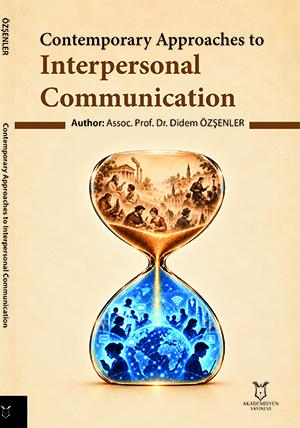
Contemporary Approaches to Interpersonal Communication
Synopsis
-
References
Brown, L. S., & Lewis, K. (2022). The Elementary Forms of Digital Communication. PLOS ONE, 17(9), e0273726. https://doi.org/10.1371/journal.pone.0273726
Çalışkan, O. (2014). Kamusal Alan Bağlamında Ağ Toplumu ve Yeni Kamusal Alan Arayışı. İletişim Fakültesi Dergisi, 1(1), 43-61. Https://Dergipark.Org.Tr/Tr/Download/Article-File/172376
De Souza E Silva, A., Campbell, S. W., & Ling, R. (2025). Hybrid Space Revisited: From Concept Toward Theory. Communication Theory, 35(1), 14-24. Https://Doi.Org/10.1093/Ct/Qtae023
DeVito, J. A. (2023). The Interpersonal Communication Book (16th Ed.). Pearson.
Fernández, A., Hall, J. A., Pouwels, J. L., Beyens, I., Valkenburg, P. M., & Van Driel, I. I. (2025). The Quality of Face-To-Face And Digitally Mediated Social Interaction: A Day Reconstruction Study. Journal of Computer-Mediated Communication, 30(2), Zmaf004. Https://Doi.Org/10.1093/Jcmc/Zmaf004
Floyd, K. (2021). Interpersonal Communication (4th Ed.). Mcgraw-Hill.
Haythornthwaite, C. (2005). Social Networks and Internet Connectivity Effects. Information, Communication & Society, 8(2), 125–147.
Ivan, L. (2023). Interpersonal Communication in The Information Age: Opportunities and Disruptions. American Behavioral Scientist, 67(7), 885-904. Https://Doi.Org/10.1177/00027642221092801
Koca, S., & Öcal, D. (2024). Sosyal Medya Ekseninde Kişilerarası İletişim ve Benlik Sunumu. Communicata, 27, 1-14. Https://Doi.Org/10.32952/Communicata.1441454
Sosik, V. S., & Bazarova, N. N. (2014). Relational maintenance on social network sites: How Facebook communication predicts relational escalation. Computers in Human Behavior, 35, 124–131. https://doi.org/10.1016/j.chb.2014.02.044
Walther, J.B. & Burgoon, J.K. (1992), Relational Communication in Computer-Mediated Interaction. Human Communication Research, 19: 50-88. https://doi.org/10.1111/j.1468-2958.1992.tb00295.x
Walther, J. B. (2007). Selective Self-Presentation in Computer-Mediated Communication: Hyperpersonal Dimensions of Technology, Language, And Cognition. Computers in Human Behavior, 23(5), 2538-2557. Https://Doi.Org/10.1016/J.Chb.2006.05.002
Walther, J. B. (2011). Theories of Computer-Mediated Communication and Interpersonal Relations. In M. L. Knapp & J. A. Daly (Eds.), The SAGE Handbook of Interpersonal Communication (4th Ed., Pp. 443-479). SAGE.
Walther, J. B. (2015). Social Information Processing Theory (CMC). In C. R. Berger, M. E. Roloff, S. R. Wilson, J. P. Dillard, J. Caughlin, & D. Solomon (Eds.), The International Encyclopedia of Interpersonal Communication (pp.1–13). Wiley. https://doi.org/10.1002/9781118540190.wbeic192
Walther, J. B. (2017). The Merger of Mass and Interpersonal Communication via New Media: Integrating Metaconstructs. Human Communication Research, 43(4), 559-572. Https://Doi.Org/10.1111/Hcre.12122
Whittaker, S. (1995). Rethinking Video As A Technology for Interpersonal Communications: Theory and Design Implications. International Journal of Human-Computer Studies, 42(5), 501–529. Https://Doi.Org/10.1006/İjhc.1995.1022
Taylor, S. H., & Bazarova, N. N. (2021). Always Available, Always Attached: A Relational Perspective on The Effects of Mobile Phones And Social Media on Subjective Well-Being. Journal of Computer-Mediated Communication, 26(4), 187-206. Https://Doi.Org/10.1093/Jcmc/Zmab004
Altman, I. and Taylor, D.A. (1973) Social Penetration: The Development of Interpersonal Relationships. Holt, Rinehart, & Winston, New York, 459.
Atlı, Y., & Yücel, N. (2016). Hibrit İletişim Teknolojileri. Süleyman Demirel Üniversitesi İktisadi ve İdari Bilimler Fakültesi Dergisi, 21(3).
Baxter, L. A., & Braithwaite, D. O. (2008). Relational Dialectics Theory. In L. A. Baxter & D. O. Braithwaite (Eds.), Engaging Theories in Interpersonal Communication (pp. 349–362). Thousand Oaks, CA: Sage.
Berger, C. R., & Calabrese, R. J. (1975). Some Explorations in Initial Interaction and Beyond: Toward A Developmental Theory of Interpersonal Communication. Human Communication Research, 1(2), 99-112. Https://Doi.Org/10.1111/J.1468-2958.1975.Tb00258.X
Carpenter, A., & Greene, K. (2016). Social Penetration Theory. In C. R. Berger & M. E. Roloff (Eds.), The International Encyclopedia of Interpersonal Communication. Wiley. Https://Doi.Org/10.1002/9781118540190.Wbeic0160
Çağlar, F. S., & Ulağlı, S. (2024). Kişilerarası İletişim ve Dijital Medya: Üniversite Öğrencileri Üzerine Fenomenolojik Bir Araştırma. Medya Okuryazarlığı Araştırmaları Dergisi, 3(1), 7–28. Https://Doi.Org/10.5281/Zenodo.12595109
Çankal, S. (2024). Dijital Platformlarda Kimlik İnşası ve Sunumu: Z Kuşağı Üyeleri Üzerine Bir Araştırma. Pamukkale Üniversitesi Sosyal Bilimler Enstitüsü Dergisi, (61), 325–342. Https://Doi.Org/10.30794/Pausbed.1430273
De Souza E Silva, A., Campbell, S. W., & Ling, R. (2025). Hybrid Space Revisited: From Concept Toward Theory. Communication Theory, 35(1), 14-24.
Davies, M., Musango, J. K., & Brent, A. C. (2016). A Systems Approach to Understanding The Effect of Facebook Use On The Quality of Interpersonal Communication. Technology in Society, 44, 55–65. Https://Doi.Org/10.1016/J.Techsoc.2015.10.003
Değerli, A. (2016). Ağ Toplumunun İletişimi Ekseninde Yerel Yönetimlerin Sosyal Medya Kullanım Düzeyi: Kadıköy Belediyesi Örneği. Öneri Dergisi, 12(46), 63-80. Https://Doi.Org/10.14783/Od.V12i46.1000010004
Dergach, D. (2024). Linguistic Models of Mass Media Genres’ Stylistic Diffusion in The Communicative Space of Ukraine and Bulgaria. Bulgarian Language and Literature, 66(2), 213–227. Https://Doi.Org/10.53656/Bel2024-2-7D
Fox, K. A., Kuo, C., Berryman, C., & Carlson Jones, L. (2023). Why Haven't You Texted Me Back? Adolescents' Digital Stress and Entrapment in a Best Friendship. Journal of Adolescence, 95(4), 533-547.
Geiger, I. (2020). From Letter to Twitter: A Systematic Review of Communication Media in Negotiation. Group Decision and Negotiation, 29(2), 207–250. Https://Doi.Org/10.1007/S10726-020-09662-6
Hofvenschioeld, E., & Khodadadi, M. (2020). Communication in Futures Studies: A Discursive Analysis of The Literature. Futures, 115, 102493. Https://Doi.Org/10.1016/J.Futures.2019.102493
Ivan, L. (2023). Interpersonal Communication in The Information Age: Opportunities and Disruptions. American Behavioral Scientist, 67(7), 885-897. Https://Doi.Org/10.1177/00027642221092801
Karapınar, D. Ç., Kılıç, C., & Daş, A. (2022). Dijital Bağımlılığın Kişilerarası İletişim Üzerine Etkisi: Atatürk Üniversitesi Örneği. ETÜ Sentez İktisadi ve İdari Bilimler Dergisi, 9, 1-20. Https://Doi.Org/10.47358/Sentez.2022.33
Kaymaz, M., & Kalaycı, H. (2025). Dijital Kimlik Bağlamında Metaverse ve Toplumsal Dönüşüm. Uluslararası Batı Karadeniz Sosyal ve Beşerî Bilimler Dergisi, 9(1), 1–14. Https://Doi.Org/10.46452/Baksoder.1601137
Koca, S., & Öcal, D. (2024). Sosyal Medya Ekseninde Kişilerarası İletişim ve Benlik Sunumu. Communicata, 27, 1-14. Https://Doi.Org/10.32952/Communicata.1441454
Mangold, F., Bachl, M., & Prochazka, F. (2024). How News Audiences Allocate Trust in the Digital Age: A Figuration Perspective. Journalism & Mass Communication Quarterly, 101(4), 955–980. Https://Doi.Org/10.1177/10776990221100515
Özaktaş, F. (2025). Dijital Aktivizm: Dijitalleşme Çağının Toplumsal Hareketi. İzmir Yönetim Dergisi, 6(Özel Sayı), 142–159. Https://Doi.Org/10.56203/İyd.1668399
Pavlova, E., & Paliy, I. (2020). Global Informational Society: Questions and Perspectives (The Problem of Information Systems as Ideal Models of Interpersonal Communication). SHS Web of Conferences, 74, 02012. Https://Doi.Org/10.1051/Shsconf/20207402012
Petronio, S. (2002). Boundaries of Privacy: Dialectics of Disclosure. SUNY Press.
Taylor, S. H., & Bazarova, N. N. (2021). Always Available, Always Attached: A Relational Perspective on The Effects of Mobile Phones and Social Media on Subjective Well-Being. Journal of Computer-Mediated Communication, 26(4), 187-206. Https://Doi.Org/10.1093/Jcmc/Zmab004
Tidwell, L. C., & Walther, J. B. (2002). Computer-Mediated Communication Effects On Disclosure, Impressions, and Interpersonal Evaluations: Getting To Know One Another A Bit At A Time. Human Communication Research, 28(3), 317-348. Https://Doi.Org/10.1111/J.1468-2958.2002.Tb00811.X
Tretyak, O. A. (2017). The Public Sphere of Politics: The Anthropological Dimension in Contemporary Communicative Theory. Anthropological Measurements of Philosophical Research, 12, 62–71. Https://Doi.Org/10.15802/Ampr.V0i12.119125
Walther, J. B. (2007). Selective Self-Presentation in Computer-Mediated Communication: Hyperpersonal Dimensions of Technology, Language, and Cognition. Computers in Human Behavior, 23(5), 2538-2557. Https://Doi.Org/10.1016/J.Chb.2006.05.002
Walther, J. B. (2011). Theories of Computer-Mediated Communication and Interpersonal Relations. In M. L. Knapp & J. A. Daly (Eds.), The Sage Handbook of Interpersonal Communication (4th Ed., Pp. 443-479). Sage.
Walther, J. B. (2017). The Merger of Mass and Interpersonal Communication via New Media: Integrating Metaconstructs. Human Communication Research, 43(4), 559-572. Https://Doi.Org/10.1111/Hcre.12122
Zhou, L., Burgoon, J. K., Zhang, D., & Nunamaker, J. F. (2004). Language Dominance in Interpersonal Deception in Computer-Mediated Communication. Computers in Human Behavior, 20(3), 381–402. Https://Doi.Org/10.1016/S0747-5632(03)00051-7
Alikılıç, Ö. A., & Özer, A. (2019). Y Kuşağının Romantik İlişkilerinde Sosyal Medyanın Rolü Üzerine Bir Araştırma. Erciyes İletişim Dergisi, 6(1), 291–310. Https://Doi.Org/10.17680/Erciyesiletisim.485005
Atalay, G. E., Tanrıverdi, Y., Arıcı, Y. (2024). Romantik İlişkilerde Sosyal Medya Kullanımı: Nitel Bir Araştırma. Yeni Medya, 2024(16), 1–24.
Bevan, J. L., Ball, H., Urbanovich, T., & Craw, E. (2021). Family Caregiving Burden in Romantic Relationships: A Relational Turbulence Theory Analysis. Communication Studies, 72(4), 652–667. Https://Doi.Org/10.1080/10510974.2021.1953095
Blalock, J., Bartle-Haring, S., Et Al. (2022). Transition into Marriage: A Test of Relational Uncertainty, Turbulence, Dyadic Synchrony, and Cohabitation in Newlyweds. Family Relations, 74(4), 1637–1657. Https://Doi.Org/10.1111/Fare.12686
Bolkan, S., Goodboy, A. K., Shin, M., & Quaack, K. R. (2023). Relational Turbulence: A Latent Model Test Of Theoretical Propositions. Southern Communication Journal, 88(5), 479–490. Https://Doi.Org/10.1080/1041794X.2023.2167108
Brisini, K. S. C., & Solomon, D. H. (2023). A Repeated-Measures Study of Relational Turbulence and Transition Processing Communication During The Summer Of COVID-19. Communication Research, 50, 1–28. Https://Doi.Org/10.1177/00936502221146852
Brisini, K. S., & Solomon, D. H. (2021). Distinguishing Relational Turbulence, Marital Satisfaction, and Parenting Stress as Predictors of Ineffective Arguing Among Parents of Children With Autism. Journal of Social and Personal Relationships, 38(1), 65–83. Https://Doi.Org/10.1177/0265407520958197
Brisini, K. S., Riccardi, R., & Wang, N. (2024). Turbulence, Framing, and Planning Among College Daters: Testing Relational Turbulence Theory in A Dyadic, Lab Study. Communication Research Reports, 41(1), 1–12. Https://Doi.Org/10.1080/08824096.2024.2304820
Chiasson, R. M., Goodboy, A. K., & Dillow, M. R. (2024). The Indirect Effect of Relational Turbulence on Received Emotional Support Through Dyadic Synchrony. Communication Research Reports, 41(3), 167–177. Https://Doi.Org/10.1080/08824096.2024.2373192
Çulfa, E., İzgi, F.D., Çulfa, F. (2024). How The Internet and Social Media Affect and Shapes Romantic Relationships. Journal of Human and Social Sciences Researches, 13(4), 1–18.
Daspe, M.-È., Métellus, S., Emond, M., Bigras, N., Larouche, F., Adlhoch-Mathé, E., & Vaillancourt-Morel, M.-P. (2026). A Systematic Review of Technology-Mediated Conflict Management in Couples. Journal of Social and Personal Relationships, 43, 1–32. Https://Doi.Org/10.1177/02654075261420989
Dhillon, A. (2023). Applying Relational Turbulence Theory to Examine Partner (Under)Accommodation During Conversations about Relational Stressors. Personal Relationships, 30(4), 1405–1425. Https://Doi.Org/10.1111/Pere.12512
Dorrance-Hall, E., Sharabi, L., Roaché, D. J., James-Hawkins, L., Croft, A., Alexopoulos, C., Lamarche, V. M., Uhlich, M., & Timmermans, E. (2023). Needing Space During Lockdown: A Test Of Relational Turbulence Theory in The Context Of Conversations About Physical and Emotional Space During The COVID-19 Pandemic. Communication Research, 50(8), 943–964. Https://Doi.Org/10.1177/00936502231174771
Goodboy, A. K., Dillow, M. R., Knoster, K. C., & Howard, H. A. (2021). Relational Turbulence From the COVID-19 Pandemic: Within-Subjects Mediation by Romantic Partner Interdependence. Journal of Social and Personal Relationships, 38(6), 1800–1818. Https://Doi.Org/10.1177/02654075211000135
Goodboy, A. K., Bolkan, S., & Shin, M. (2022). A Mixture Modeling Perspective of Relational Turbulence Theory in Marriage. Communication Monographs, 89(1), 96–117. Https://Doi.Org/10.1080/03637751.2021.1951785
Goodboy, A. K., Bolkan, S., & Shin, M. (2022). Relational Turbulence Processes Among Avoidant and Anxious Spouses. Communication Quarterly, 70(3), 317–343. Https://Doi.Org/10.1080/01463373.2022.2054720
Goodboy, A. K., & Bolkan, S. (2023). Moderated Effects of Partner Interdependence on Relational Turbulence. Western Journal of Communication, 87(3), 392–410. Https://Doi.Org/10.1080/10570314.2022.2131465
Goodboy, A. K., Dillow, M. R., Knoster, K. C., & Howard, H. A. (2023). Dyadic Processes of Relational Turbulence Theory. Personal Relationships, 30(3), 1000–1023. Https://Doi.Org/10.1111/Pere.12487
Jones, H. E., & Theiss, J. A. (2025). Conditions of Relational Turbulence as Antecedents and Outcomes of Relationship Maintenance Behaviors During the COVID-19 Pandemic. Communication Research, 52, 1–29. Https://Doi.Org/10.1177/00936502251378583
Jones, H. E., & Theiss, J. A. (2021). Relational Turbulence During the COVID-19 Pandemic: A Longitudinal Analysis of The Reciprocal Effects Between Relationship Characteristics and Outcomes of Relational Turbulence. Journal of Social And Personal Relationships, 38(10), 3033–3058. Https://Doi.Org/10.1177/02654075211044491
Jones, H. E., Theiss, J. A., Austin, J. T., & Yoon, D. B. (2024). Examining Actor-Partner Effects in The Associations Between Dyadic Resilience and Conditions of Relational Turbulence During The COVID-19 Pandemic. Adversity and Resilience Science, 5(1), 91–103. Https://Doi.Org/10.1007/S42844-023-00107-Y
Jones, H. E., & Theiss, J. A. (2026). A Longitudinal and Dyadic Study of Communal Coping and Relational Turbulence Among Surviving Parents and Emerging Adult Children After the Death of A Partner/Parent. Communication Research. Advance Online Publication. Https://Doi.Org/10.1177/00936502261449286
Kaygas, Y.& Candemir, G. (2023). Romantik İlişkilerde Ghosting: Hayalet Sevgili. Connectist: Istanbul University Journal Of Communication Sciences, 64, 149–174.
Knobloch, L. K., & Solomon, D. H. (1999). Measuring The Sources and Content of Relational Uncertainty. Communication Studies, 50(4), 261–278.
Knobloch, L. K., & Theiss, J. A. (2010). An Actor-Partner Interdependence Model of Relational Turbulence: Cognitions and Emotions. Journal of Social and Personal Relationships, 27(5), 595–619. Https://Doi.Org/10.1177/0265407510368967
Knobloch, L. K., & Theiss, J. A. (2018). Relational Turbulence Theory Applied to The Transition From Deployment to Reintegration. Journal of Family Theory & Review, 10(3), 535–549. Https://Doi.Org/10.1111/Jftr.12281
Knobloch, L. K., Nichols, L. O., & Martindale-Adams, J. (2020). Applying Relational Turbulence Theory to Adult Caregiving Relationships. The Gerontologist, 60(4), 598–606. Https://Doi.Org/10.1093/Geront/Gnz090
Knobloch, L. K., Knobloch-Fedders, L. M., Yorgason, J. B., Wehrman, E. C., & Monk, J. K. (2022). Trajectories of Relational Turbulence and Affectionate Communication Across The Post-Deployment Transition. Communication Monographs, 89(2), 189–210. Https://Doi.Org/10.1080/03637751.2021.1963792
Lağap, A.C. & Güngör, D. (2026). Looking for Stability in Chaos: A Scoping Review of Relational Turbulence Theory from a Dyadic Perspective. Journal of Family Theory & Review, 18, 209-229. https://onlinelibrary.wiley.com/doi/epdf/10.1111/jftr.70033
Li, Y., & Solomon, D. H. (2023). Operationalizing Relational Construal Level to Test Relational Turbulence Theory: Linking Relational Turbulence in Romantic Relationships to Interpersonal Processes. Journal of Social and Personal Relationships, 40(1), 102–129. Https://Doi.Org/10.1177/02654075221113360
Mclaren, R. M., & Steuber, K. R. (2012). Emotions, Communicative Responses, and Relational Consequences of Boundary Turbulence. Journal of Social and Personal Relationships, 30(5), 606–626. Https://Doi.Org/10.1177/0265407512463997
Mclaren, R. M., Solomon, D. H., Knobloch, L. K., & Theiss, J. A. (2026). The Study of Relational Turbulence Theory in Families: Reflections on The Past and Visions for the Future. Journal of Family Communication. Advance Online Publication. Https://Doi.Org/10.1080/15267431.2026.2658450
Mcaninch, K. G., Basinger, E. D., Delaney, A. L., & Wehrman, E. C. (2023). Integrating Relational Turbulence Theory and The Theory of Resilience and Relational Load to Investigate The Relationships of Couples with Chronic IIlness. Communication Quarterly, 71(1), 1–21. Https://Doi.Org/10.1080/01463373.2022.2100267
Mikucki-Enyart, S. L. (2018). Parents-in-Law’s Topic Avoidance: Understanding The Role of Interaction Goals and Relational Characteristics. Personal Relationships, 25(3), 433–457. Https://Doi.Org/10.1111/Pere.12252
Quaack, K. R., Bolkan, S., & Goodboy, A. K. (2022). Interdependence and Affective Processes in Relational Turbulence Theory. Communication Reports, 35(3), 160–172. Https://Doi.Org/10.1080/08934215.2022.2080843
Schrodt, P. & Stager, E. (2025). Emerging Adults’ Relational Turbulence With Parents As A Function Of Parental Involvement In Their Romantic Relationships. Communication Research, 52, 1–27. Https://Doi.Org/10.1177/00936502251345599
Scheinfeld, E., & Worley, T. (2018). Understanding The Parent-Child Relationship During The Transition into College And Emerging Adulthood Using The Relational Turbulence Theory. Communication Quarterly, 66(4), 444–462. Https://Doi.Org/10.1080/01463373.2018.1443954
Solomon, D. H., & Brisini, K. S. C. (2017). Operationalizing Relational Turbulence Theory: Measurement and Construct Validation. Personal Relationships, 24(4), 768–789. Https://Doi.Org/10.1111/Pere.12212
Solomon, D. H., & Brisini, K. S. C. (2019). Relational Uncertainty and Interdependence Processes in Marriage: A Test of Relational Turbulence Theory. Journal of Social and Personal Relationships, 36(8), 2416–2436. Https://Doi.Org/10.1177/0265407518788700
Solomon, D. H., & Knobloch, L. K. (2004). A Model of Relational Turbulence: The Role of Intimacy, Relational Uncertainty, and Interference from Partners in Appraisals of Irritations. Journal of Social and Personal Relationships, 21(6), 795–816. Https://Doi.Org/10.1177/0265407504047838
Solomon, D. H., Knobloch, L. K., Theiss, J. A., & Mclaren, R. M. (2016). Relational Turbulence Theory: Explaining Variation in Subjective Experiences and Communication Within Romantic Relationships. Human Communication Research, 42(4), 507–532. Https://Doi.Org/10.1111/Hcre.12091
Theiss, J. A., Knobloch, L. K., Checton, M. G., & Magsamen-Conrad, K. (2009). Relationship Characteristics Associated with The Experience of Hurt in Romantic Relationships: A Test of The Relational Turbulence Model. Human Communication Research, 35(4), 588–615. Https://Doi.Org/10.1111/J.1468-2958.2009.01364.X
Theiss, J. A., & Solomon, D. H. (2006). A Relational Turbulence Model of Communication about Irritations in Romantic Relationships. Communication Research, 33(5), 391–418. Https://Doi.Org/10.1177/0093650206291482
Ünal, S. (2017). Kişilerarası Gönüllü Dijital Gözetim ve Gençlik: Gündelik İlişkilereYansımaları Bağlamında Siyasal ve Dinsel Kimliklerin İfşası. Connectist: Istanbul University Journal of Communication Sciences, 52, 211–237.
Weigel, D. J., & Shrout, M. R. (2020). Relational Turbulence and Health-Compromising Behaviors: Integrating Relational Turbulence and Stress Theories. Personal Relationships, 27(4), 785–800. Https://Doi.Org/10.1111/Pere.12347
Worley, T., Scheinfeld, E., & Farris, K. L. (2024). Relational Turbulence During Family Transitions: A Lifespan Perspective and Roadmap For Future Research. Annals of The International Communication Association, 48(4), 370–390. Https://Doi.Org/10.1080/23808985.2024.2380298
Barlow, M., Bishop, A., & Lane, T. (2024). The Application of Communication Accommodation Theory to Speaking up in Interprofessional Healthcare Communication. Journal of Interprofessional Care, 38(2), 1–9. Https://Doi.Org/10.1080/13561820.2023.2249939
Bernhold, Q. S., & Giles, H. (2020). Vocal Accommodation and Mimicry. Journal of Nonverbal Behavior, 44(1), 41–62. Https://Doi.Org/10.1007/S10919-019-00317-Y
Bernhold, Q. S., & Giles, H. (2022). Attachment Theory As A Lens to Explain Accommodation, Nonaccommodation, and Loneliness in Relationships Between Middle-Aged Parents and Young Adult Children. Journal of Family Communication, 22(1), 1–17. Https://Doi.Org/10.1080/15267431.2021.1996365
Bernhold, Q. S., & Giles, H. (2022). Emotional Mimicry: A Communication Accommodation Approach. Cognition and Emotion, 36(5), 799–804. Https://Doi.Org/10.1080/02699931.2022.2109599
Bernhold, Q. S., Dunbar, N., & Giles, H. (2021). Accommodation and Nonaccommodation As Predictors of Instrumental Caregiving Intentions and Expectations in Grandparent-Grandchild Relationships. Journal of Social and Personal Relationships, 38(1), 158–179. Https://Doi.Org/10.1177/0265407520960235
Bibi, F., & Hamida, L. (2024). Exploring Communication Patterns among International Students in Indonesia: A Study Using Communication Accommodation Theory. Cogent Arts & Humanities, 11(1), 2397188. Https://Doi.Org/10.1080/23311983.2024.2397188
Bown, C. (2025). Accommodating Speech Style to Non-Native Speakers: Intercultural Competency with Communication Accommodation Theory. Communication Teacher, 39(4), 293–299. Https://Doi.Org/10.1080/17404622.2025.2477025
Eğinli, A. T. (2019). Kişiler Arası İletişim Kuramları. Nobel Akademik Yayıncılık.
Frey, T. K., & Lane, D. R. (2021). Nonaccommodation and Communication Effectiveness: An Application to Instructional Communication. Communication Research Reports, 38(3), 195–205. Https://Doi.Org/10.1080/08824096.2021.1922372
Gallois, C., Ogay, T., & Giles, H. (2005). Communication Accommodation Theory: A Look Back and A Look Ahead. In W. B. Gudykunst (Ed.), Theorizing about Intercultural Communication (121–148). Sage.
Gasiorek, J. (2015). Perspective-Taking, Inferred Motive, and Perceived Accommodation in Nonaccommodative Conversations. Journal of Language and Social Psychology, 34(5), 577–586. Https://Doi.Org/10.1177/0261927X15584681
Gasiorek, J., & Giles, H. (2015). The Role of Inferred Motive in Processing Nonaccommodation: Evaluations of Communication and Speakers. Western Journal of Communication, 79(4), 456–471. Https://Doi.Org/10.1080/10570314.2015.1066030
Giles, H., Edwards, A. L., & Walther, J. B. (2023). Communication Accommodation Theory: Past Accomplishments, Current Trends, and Future Prospects. Language Sciences, 99, 101571. Https://Doi.Org/10.1016/J.Langsci.2023.101571
Giles, H. (2016). Communication Accommodation Theory. In C. R. Berger & M. E. Roloff (Eds.), The International Encyclopedia of Communication Theory and Philosophy. Wiley. Https://Doi.Org/10.1002/9781118766804.Wbiect056
Giles, H., & Gardikiotis, A. (2025). Communication Accommodation Theory: A theory in an evolving digital world. Psychology: The Journal of the Hellenic Psychological Society, 30(2), 233–251. https://doi.org/10.12681/psy_hps.43913
Giles, H., Edwards, A. L., & Walther, J. B. (2023). Communication Accommodation Theory: Past Accomplishments, Current Trends, and Future Prospects. Language Sciences, 99, Article 101571. Https://Doi.Org/10.1016/J.Langsci.2023.101571
Harwood, J., Soliz, J., & Lin, M.-C. (2006). Communication Accommodation Theory: An Intergroup Approach to Family Relationships. in D. O. Braithwaite & L. A. Baxter (Eds.), Engaging Theories In Family Communication: Multiple Perspectives (pp. 19–34). SAGE Publications. https://doi.org/10.4135/9781452204420.n2
Harwood, J., Soliz, J., & Lin, M.-C. (2014). Communication Accommodation Theory: An Intergroup Approach to Family Relationships. In D. O. Braithwaite, E. A. Suter, & K. Floyd (Eds.), Engaging Theories in Family Communication (2nd Ed) (73–88). Routledge.
Hoffman, W. B., & Zhang, Y. B. (2023). Explaining Communication Adjustment: Communication Accommodation Theory and Its Utility in Intercultural Communication. Journal of Intercultural Communication Research, 52(4), 1–15.
Ivan, L. (2023). Interpersonal Communication in The Information Age: Opportunities and Disruptions. The ANNALS Of The American Academy of Political and Social Science, 706(1), 78–95. Https://Doi.Org/10.1177/00027642221092801
Kaya, A. (2024). Sosyal Medya Ekseninde Kişilerarası İletişim ve Benlik Sunumu. Communicata, 6(1), 1–18.
Kırık, A. M. (2017). Yeni Medya Aracılığıyla Değişen İletişim Süreci: Sosyal Paylaşım Ağlarında Gençlerin Konumu. Gümüşhane Üniversitesi İletişim Fakültesi Elektronik Dergisi, 5(1), 230–261.
Maguire, E. R., Hill, S. L., & Brimbal, L. (2024). The Effects of Communication Accommodation On Hispanic İmmigrants’ Willingness to Cooperate With U.S. Police. American Behavioral Scientist. Advance Online Publication. Https://Doi.Org/10.1177/00027642241301659
Muir, K., Joinson, A., Cotterill, R., & Dewdney, N. (2016). Characterizing The Linguistic Chameleon: Personal and Social Correlates of Linguistic Style Accommodation. Human Communication Research, 42(3), 462–484. Https://Doi.Org/10.1111/Hcre.12083
Muir, K., Joinson, A., Cotterill, R., & Dewdney, N. (2017). Linguistic Style Accommodation Shapes Impression Formation and Rapport in Computer-Mediated Communication. Journal of Language and Social Psychology, 36(5), 525–548. Https://Doi.Org/10.1177/0261927X17701327
Mokhtar, M. F., Marhalim, S. N., & Rizal, A. R. A. (2025). A Meta-Analysis on Communication Accommodation Model (CAT) to Understand Intercultural Communication Competence. In N. Tugiman Et Al. (Eds.), Proceedings of the 9th International Conference on Communication and Media (i-COME 24) (pp. 157–166). Atlantis Press. https://doi.org/10.2991/978-94-6463-756-4_16
Nixon, B., & Guajardo, N. R. (2023). The Digital Chameleon: Factors Affecting Perceptions of Convergence in Computer-Mediated Communication. Journal of Language and Social Psychology, 42(3), 355–367. Https://Doi.Org/10.1177/0261927X221146143
Momand B, Sacuevo O, Hamidi M, et al. (2022). Using Communication Accommodation Theory to Improve Communication Between Healthcare Providers and Persons with Dementia. Cureus 14(10): e30618. DOI 10.7759/cureus.30618
Pines, R., Mallard, Y., Jones, L., & Sheeran, N. (2025). Investigating Patient Preferences for their Doctor’s Communication Strategies Across Cultures Using Communication Accommodation Theory. Journal of Language and Social Psychology, 44(5), 789–799. Https://Doi.Org/10.1177/0261927X251318752
Pitts, M. J., & Harwood, J. (2014). Communication Accommodation Competence: The Nature and Nurture of Accommodative Resources Across the Lifespan. Language & Communication, 41, 89–99. Https://Doi.Org/10.1016/J.Langcom.2014.10.002
Riordan, M. A., & Markman, K.M., Stewart (2013). Communication Accommodation in Instant Messaging: An Examination of Temporal Convergence. Journal of Language and Social Psychology, 32(1), 84–95. Https://Doi.Org/10.1177/0261927X12463095
Ryan, E. B., Meredith, S. D., Maclean, M. J., & Orange, J. B. (1995). Changing The Way We Talk With Elders: Promoting Health Using The Communication Enhancement Model. The International Journal of Aging and Human Development, 41(2), 89–107.
Simmons-Mackie, N. (2018). Communication Partner Training in Aphasia: Reflections On Communication Accommodation Theory. Aphasiology, 32(10), 1215–1224. Https://Doi.Org/10.1080/02687038.2018.1428282
Soliz, J., & Giles, H. (2014). Relational and Identity Processes in Communication: A Contextual and Meta-Analytical Review of Communication Accommodation Theory. Annals of The International Communication Association, 38(1), 107–144.
Taylor, S. H., & Bazarova, N. N. (2021). Always Available, Always Attached: How Mobile Communication Shapes Interpersonal Relationships. Journal of Computer-Mediated Communication, 26(4), 187–203. Https://Doi.Org/10.1093/Jcmc/Zmab008
Arikewuyo, A. O., Efe-Özad, B., Dambo, T. H., Abdulbaqi, S. S., & Arikewuyo, H. O. (2021). An Examination of How Multiple Use of Social Media Platforms Influence Romantic Relationships. Journal of Public Affairs, 21(2), E2240. Https://Doi.Org/10.1002/Pa.2240
Balayar, B. B., & Langlais, M. R. (2021). Technology Makes The Heart Grow Fonder? A Test of Media Multiplexity Theory for Family Closeness. Social Sciences, 10(1), Article 25. Https://Doi.Org/10.3390/Socsci10010025
Barakji, F., Maguire, K. C., Reiss, H., Gaule, J., Smith, N., Pelliccio, L., Sellnow-Richmond, S., Jeon, J., & Oshagan, H. (2019). Cultural and Transnational Influences on The Use of Information Communication Technologies in Adult Long-Distance Family Relationships: An Extension of Media Multiplexity Theory. Journal of Family Communication, 19(1), 30–46. Https://Doi.Org/10.1080/15267431.2018.1530675
Chan, M. (2015). Multimodal Connectedness and Quality of Life: Examining the Influences of Technology Adoption and Interpersonal Communication on Well-Being Across The Life Span. Journal of Computer-Mediated Communication, 20(1), 3–18. Https://Doi.Org/10.1111/Jcc4.12089
Chang, H.-J., & Johnson, J. D. (2001). Communication Networks as Predictors of Organizational Members’ Media Choices. Western Journal of Communication, 65(4), 349–369. Https://Doi.Org/10.1080/10570310109374716
Corder, M. D., Hall, J. A., Pennington, N., & Holmstrom, A. J. (2026). Adult Sibling Relationships and Media Multiplexity Theory. Journal of Social and Personal Relationships, 43(1), 181–200. Https://Doi.Org/10.1177/02654075241299463
Dilber, F. (2019). Aile İçi İletişimde Sosyal Medya: Karamanoğlu Mehmetbey Üniversitesi Öğrencileri Üzerine Bir Araştırma. Adıyaman Üniversitesi Sosyal Bilimler Enstitüsü Dergisi, (33), 334–381. Https://Doi.Org/10.14520/Adyusbd.596980
Haythornthwaite, C. (2002). Strong, Weak, and Latent Ties and The Impact of New Media. The Information Society, 18(5), 385–401. Https://Doi.Org/10.1080/01972240290108195
Haythornthwaite, C. (2005). Social Networks and Internet Connectivity Effects. Information, Communication & Society, 8(2), 125–147. Https://Doi.Org/10.1080/13691180500146185
Kahlow, J. A., Coker, M. C., & Richards, R. (2020). The Multimodal Nature of Snapchat in Close Relationships: Toward A Social Presence-Based Theoretical Framework. Computers in Human Behavior, 111, 106409. Https://Doi.Org/10.1016/J.Chb.2020.106409
Koca, S., & Öcal, D. (2024). Sosyal Medya Ekseninde Kişilerarası İletişim ve Benlik Sunumu. Communicata, 27, 1–14. Https://Doi.Org/10.32952/Communicata.1441454
Ledbetter, A. M. (2025). Tie Strength And Media Use in Friendships Across the Course of A Year: Testing Media Multiplexity Theory’s Third Proposition. New Media & Society, 27(4), 2146–2167. Https://Doi.Org/10.1177/14614448231207100
Ledbetter, A. M., & Kuznekoff, J. H. (2012). More Than A Game: Friendship Relational Maintenance and Attitudes Toward Xbox LIVE Communication. Communication Research, 39(2), 269–290. Https://Doi.Org/10.1177/0093650210397042
Ledbetter, A. M., & Mazer, J. P. (2014). Do Online Communication Attitudes Mitigate the Association Between Facebook Use and Relational Interdependence? An Extension of Media Multiplexity Theory. New Media & Society, 16(5), 806–822. Https://Doi.Org/10.1177/1461444813495159
Ledbetter, A. M., Taylor, S. H., & Mazer, J. P. (2016). Enjoyment Fosters Media Use Frequency and Determines Its Relational Outcomes: Toward A Synthesis of Uses and Gratifications Theory and Media Multiplexity Theory. Computers in Human Behavior, 54, 149–157. Https://Doi.Org/10.1016/J.Chb.2015.07.053
Liu, D., & Yang, C.-C. (2016). Media Niche of Electronic Communication Channels in Friendship: A Meta-Analysis. Journal of Computer-Mediated Communication, 21(6), 451–466. Https://Doi.Org/10.1111/Jcc4.12175
Li, X. (2021). The More The Better? A Comparative Study of The Relationships Among Multimodal Connectedness, Online Communication, and Relational Outcomes in China and The United States. Chinese Journal of Communication, 14(3), 239–258. Https://Doi.Org/10.1080/17544750.2020.1814372
Mccurdy, A. L., Benito-Gomez, M., Lee, G. Y., & Fletcher, A. C. (2022). College Students’ Perceptions of Communication Technology Use and Parent–Child Relationships. Emerging Adulthood, 10(5), 1118–1131. Https://Doi.Org/10.1177/21676968211060954
Mesch, G. S., Talmud, I., & Quan-Haase, A. (2012). Instant Messaging Social Networks: Individual, Relational, and Cultural Characteristics. Journal of Social and Personal Relationships, 29(6), 736–759. Https://Doi.Org/10.1177/0265407512448263
Miczo, N. Mariani, T. & Donahue, C. (2011) The Strength of Strong Ties: Media Multiplexity, Communication Motives, and the Maintenance of Geographically Close Friendships, Communication Reports, 24:1, 12-24, DOI: 10.1080/08934215.2011.555322
Parks, M. R. (2017). Embracing The Challenges and Opportunities of Mixed-Media Relationships. Human Communication Research, 43(4), 505–517. Https://Doi.Org/10.1111/Hcre.12125
Ruppel, E. K., Burke, T. J., & Cherney, M. R. (2018). Channel Complementarity and Multiplexity in Long-Distance Friends’ Patterns of Communication Technology Use. New Media & Society, 20(4), 1564–1579. Https://Doi.Org/10.1177/1461444817699995
Schon, J. (2014). “Dad Doesn’t Text”: Examining How Parents’ Use of Information Communication Technologies Influences Satisfaction among Emerging Adult Children. Emerging Adulthood, 2(4), 304–312. Https://Doi.Org/10.1177/2167696814551786
Smyth, B. M., Ainscough, G., & Payne, J. L. (2020). Modes of Communication Between High-Conflict Separated Parents: Exploring The Role of Media Multiplexity and Modality Switching. Journal of Family Communication, 20(3), 189–205. Https://Doi.Org/10.1080/15267431.2020.1754826
Sumner, E. M., Ramirez, A., Jr., & Fletcher, J. (2021). Social Network Site Relational Reconnection Among Older Adults. Communication Studies, 72(5), 850–865. Https://Doi.Org/10.1080/10510974.2021.1975143
Taylor, S. H., & Bazarova, N. N. (2018). Revisiting Media Multiplexity: A Longitudinal Analysis of Media Use in Romantic Relationships. Journal of Communication, 68(6), 1104–1126. Https://Doi.Org/10.1093/Joc/Jqy055
Taylor, S. H., & Bazarova, N. N. (2021). Always Available, Always Attached: A Relational Perspective on The Effects of Mobile Phones and Social Media on Subjective Well-Being. Journal of Computer-Mediated Communication, 26(4), 187–206. Https://Doi.Org/10.1093/Jcmc/Zmab004
Taylor, S. H., & Ledbetter, A. M. (2017). Extending Media Multiplexity Theory to the Extended Family: Communication Satisfaction and Tie Strength as Moderators of Violations of Media Use Expectations. New Media & Society, 19(9), 1369–1387. Https://Doi.Org/10.1177/1461444816638458
Wu, Y. J., Antone, B., Dechurch, L., & Contractor, N. (2023). Information Sharing in A Hybrid Workplace: Understanding The Role of Ease-of-Use Perceptions of Communication Technologies in Advice-Seeking Relationship Maintenance. Journal of Computer-Mediated Communication, 28(4), Zmad025. Https://Doi.Org/10.1093/Jcmc/Zmad025
Zorlu, Y. (2025). Sosyal ve Dijital Medyanın Aile İçi İletişim Üzerindeki Olumsuz Etkileri ve Toplumsal Sonuçları. Erciyes İletişim Dergisi, 12(2), 599–620. Https://Doi.Org/10.17680/Erciyesiletisim.1637314600
Zhou, Y., & High, A. C. (2026). Associations Between Interactions with Support Providers and Depression During Times of Isolation: Integrating Perceived Support and Media Multiplexity. Journal of Social and Personal Relationships, 43(3), 793–814. Https://Doi.Org/10.1177/02654075251390044
Audrin, B., & Audrin, C. (2024). Digital Skills at Work: Conceptual Development and a Validated Scale. Technological Forecasting and Social Change, 201, 123278.
Bakina, E. A. (2025). The Formation of Digital Communicative Competence By Means of the Twee Neural Network. European Journal of Contemporary Education, 14(2), 121–133. Https://Doi.Org/10.13187/Ejced.2025.2.121
Baym, N. K. (2015). Personal Connections in The Digital Age (2nd Ed.). Polity Press.
Begemann, V., Kremer, K., & Marewski, J. N. (2024). Enabling and Constraining Factors of Remote Informal Communication. Journal of Computer-Mediated Communication, 29(5), Zmae008.
Cabezas-González, M., Casillas-Martín, S., & García-Valcárcel Muñoz-Repiso, A. (2021). Basic Education Students’ Digital Competence in The Area of Communication: The Influence of Online Communication and The Use of Social Networks. Sustainability, 13(8), 4442. Https://Doi.Org/10.3390/Su13084442
Deschênes, A. A., Leclercq-Vandelannoitte, A., & De Vaujany, F.-X. (2024). Digital Literacy, the Use of Collaborative Technologies, and Perceived Social Proximity in A Hybrid Work Environment. Internet Policy Review, 13(1), 1–26.
Devito, J. A. (2022). The Interpersonal Communication Book (16th Ed.). Pearson.
Filippov, V. N. (2021). Transformation of Information and Communication Strategies of Commercial Structures During The Post-Pandemic Period and Economic Turbulence. Theoretical and Practical Issues of Journalism, 10(2), 351–365. Https://Doi.Org/10.17150/2308-6203.2021.10(2).351-365
Floyd, K. (2021). Interpersonal Communication (4th Ed.). Mcgraw-Hill.
Glazunova, O. G., Voloshyna, T. V., & Korolchuk, V. I. (2020). Hybrid Cloud-Oriented Learning Environment for IT Student Project Teamwork. Information Technologies and Learning Tools, 77(3), 114–127. Https://Doi.Org/10.33407/İtlt.V77i3.3210
González-González, C. S., Fernández-Manjón, B., Li, F., García-Peñalvo, F. J., Sciarrone, F., Spaniol, M., García-Holgado, A., Area-Moreira, M., Hemmje, M., & Hao, T. (Eds.). (2023). Learning Technologies and Systems: 21st International Conference on Web-Based Learning (ICWL 2022) and 7th International Symposium on Emerging Technologies for Education (SETE 2022), Revised Selected Papers (Lecture Notes in Computer Science, Vol. 13869). Springer. Https://Doi.Org/10.1007/978-3-031-33023-0
Gutor, L., & Sodomora, P. (2024). Hybrid Communication Training Technique to Solve Wartime Academic and Safety Issues: Perception of Medical Students. Advanced Education, 25, 44–55. Https://Doi.Org/10.20535/2410-8286.308207
Güz, N., & Yurdakul, H. (2025). Yeni İletişim Teknolojilerinin Aile İletişimine Etkisi Üzerine Bir Analiz. Eskişehir Osmangazi Üniversitesi Sosyal Bilimler Dergisi, 26(Özel Sayı), 1985–2005.
Hall, J. A., Johnson, R. M., & Ross, E. M. (2023). Which Mediated Social Interactions Satisfy the Need to Belong? Journal of Computer-Mediated Communication, 28(1), Zmac026.
Hian, L. B., Chuan, C. S., Trevor, T. M., & Detenber, B. H. (2004). Getting to Know You: Exploring the Development of Relational Intimacy in Computer-Mediated Communication. Journal of Computer-Mediated Communication, 9(3), JCMC935.
Hwang, Y. (2011). Is Communication Competence Still Good for Interpersonal Media? Mobile Phone and Instant Messenger. Computers in Human Behavior, 27(2), 924–934. Https://Doi.Org/10.1016/J.Chb.2010.11.018
Hu, Y., Wood, J. F., Smith, V., & Westbrook, N. (2004). Friendships Through IM: Examining The Relationship Between Instant Messaging and Intimacy. Journal of Computer-Mediated Communication, 10(1). https://doi.org/10.1111/j.1083-6101.2004.tb00231.x
Ivan, L. (2023). Interpersonal Communication in The Information Age: Opportunities and Disruptions. American Behavioral Scientist, 67(5), 605–622.
Keppler, S. M., Becker, W. J., & Smith, M. B. (2023). Building Relational Confidence in Remote and Hybrid Work. Journal of Computer-Mediated Communication, 28(4), Zmad020.
Kumar, S., Kumar, V., Devi, N., Bhatt, I. K., & Nazma. (2025). Training for Tomorrow: Enhancing Digital Competences among Tourism Students. Current Issues in Tourism. Advance Online Publication. Https://Doi.Org/10.1080/13683500.2025.2490617
Lauring, J., & Jonasson, C. (2025). What is Hybrid Work? Towards Greater Conceptual Clarity of an Evolving Phenomenon. Human Resource Management Review, 35(2), 100977.
Makhachashvili, R., Semenist, I., Zatsnyi, Y., & Klymenko, O. (2021). Digital Interoperability of Foreign Languages Education. In Digital Humanities Workshop (DHW ’21) (Pp. 1–8). Association for Computing Machinery. Https://Doi.Org/10.1145/3526242.3526251
Midtlund, A., Instefjord, E. J., & Lazareva, A. (2021). Digital Communication and Collaboration in Lower Secondary School. Nordic Journal of Digital Literacy, 16(2), 65–76. Https://Doi.Org/10.18261/İssn.1891-943x-2021-02-03
Özdemir, S. (2024). Sosyal Medya Ekseninde Kişilerarası İletişim ve Benlik Sunumu. Communicata, 1(2), 45–63.
Pakhomova, T., Hryhorieva, V., Omelchenko, A., Kalenyk, M., & Semak, L. (2023). The Formation of Digital Competence by Means of Information and Communication Technologies among Students of Higher Education. Eduweb, 17(2), 78–88. Https://Doi.Org/10.46502/İssn.1856-7576/2023.17.02.7
Pan, L., Haq, S. ul, Shi, X., & Nadeem, M. (2024). The Impact of Digital Competence and Personal Innovativeness on the Learning Behavior of Students: Exploring the Moderating Role of Digitalization in Higher Education Quality. Sage Open, 14(3). https://doi.org/10.1177/21582440241265919
Peltekoğlu, F.B. & Askeroğlu, E. D. (2020). Dijital Ortamda Kurum İçi İletişim: İşletmelere Yönelik Bir Değerlendirme. Journal of Academic Value Studies, 6(4), 312–326.
Rodríguez, G., Byrne, S., Álvarez, M., Gutiérrez-Rodríguez, N., Padilla, S., Martín, J. C., & Rodrigo, M. J. (2025). Digital Professional Practice, Digital Competences and Impact on Family Support Services. Child & Family Social Work, 0, 1–11. Https://Doi.Org/10.1111/Cfs.70113
Stefán, F., Ciesielski, M., Weber, A., Choromański, K., Gotlib, D., & Taczanowska, K. (2025). Understanding Generational Differences in Digital Skills and Recreational Behaviour for Effective Visitor Management in Forest Destinations. Scientific Reports, 15, 17887. Https://Doi.Org/10.1038/S41598-025-02036-5
Taylor, S. H., & Bazarova, N. N. (2021). Always Available, Always Attached: A Relational Perspective on Mobile Communication and Connected Availability. Journal of Computer-Mediated Communication, 26(4), 187–203.
Sönmez G. (2025), “Türkiye’de İletişim Alanında Yapay Zekâ Kullanımı: Sorunlar ve Çözümler”, Stratejik ve Sosyal Araştırmalar Dergisi, C.9, S.2, s.309-330.
Valantinaitė, I., & Sederevičiūtė-Pačiauskienė, Ž. (2020). The Change in Students’ Attitude Towards Favourable and Unfavourable Factors of Online Learning Environments. Sustainability, 12(19), 7960. Https://Doi.Org/10.3390/Su12197960
Wang, Y.H. (2020). Exploring the effects of designing a role-playing game with single and peer mode for campus learning. Education Tech Research Dev 68, 1275–1299 https://doi.org/10.1007/s11423-019-09726-8
Wuersch, L., Schmid, T., & Hertel, G. (2024). Using A Digital Internal Communication Strategy for Hybrid Work. International Journal of Business Communication, 61(4), 945–970.
Yu, H., Sang, Y., & Han, E. (2026). Digital Competence of AI Chatbot Users: Scale Development and Its Relationships with Smart Customer Experience, Trust, and Reuse Intention. Telematics and Informatics, 106, 102392. Https://Doi.Org/10.1016/J.Tele.2026.102392
Yu, R., Wang, M., & Hu, J. (2023). The Relationship Between ICT Perceived Competence and Adolescents’ Digital Reading Performance: A Multilevel Mediation Study. Journal of Educational Computing Research, 61(4), 817–846. Https://Doi.Org/10.1177/07356331221137107
Alqasir, A. (2025). The Relational Shift: Why We Need “AI Psychology” Now as a Core Field. Journal of Psychology and AI, 1(1). https://doi.org/10.1080/29974100.2025.2573928
Ateeq A, Milhem M, Alzoraiki M, Dawwas MIF, Ali SA and Yahia Al Astal A (2024) The Impact of AI As a Mediator on Effective Communication: Enhancing Interaction in The Digital Age. Frontiers in Human Dynamics. 6:1467384. doi: 10.3389/fhumd.2024.1467384
Asan, O., Bayrak, A. E., & Choudhury, A. (2020). Artificial Intelligence and Human Trust in Healthcare: Focus on Clinicians. Journal of Medical Internet Research, 22(6), e15154. https://doi.org/10.2196/15154
Boyd, R. L., & Markowitz, D. M. (2026). Artificial Intelligence and the Psychology of Human Connection. Perspectives on Psychological Science, 21(2), 192-220. https://doi.org/10.1177/17456916251404394
Gazit, L., Et Al. (2025). AI as A Group Mediator: A Conceptual Framework for AI-Enabled Group Communication. Annals of the International Communication Association, Advance Online Publication. Https://Doi.Org/10.1080/23808985.2025.2587315.
Göksu, O., Yegen, C., & Kırık, A. M. (2025). Yapay Zekâ ve Siyasal İletişim: Fırsatlar ve Riskler Üzerine Bir Değerlendirme. Akdeniz Üniversitesi İletişim Fakültesi Dergisi, 49, 50-73. https://doi.org/10.31123/akil.1540529
Kim, M., Kim, J., Knotts, T. L., & Albers, N. D. (2025). AI For Academic Success: Investigating The Role of Usability, Enjoyment, and Responsiveness in Chatgpt Adoption. Education and Information Technologies, 30(10), 14393–14414. DOI: 10.1007/s10639-025-13398-8
Koçyiğit, A., & Darı, A. B. (2023). Yapay Zekâ İletişiminde Chatgpt: İnsanlaşan Dijitalleşmenin Geleceği. Stratejik ve Sosyal Araştırmalar Dergisi, 7(2), 427-438. https://doi.org/10.30692/sisad.1311336
Li, X., & Sung, Y. (2021). Anthropomorphism Brings Us Closer: The Mediating Role of Psychological Distance in User–AI Assistant Interactions. Computers in Human Behavior, 118, 106680. Https://Doi.Org/10.1016/J.Chb.2021.106680
Li, H., Zhang, R., Lee, Y.-C., Kraut, R. E., & Mohr, D. C. (2023). Systematic Review and Meta-Analysis Of AI-Based Conversational Agents for Promoting Mental Health and Well-Being. npj Digital Medicine, 6, Article 236. https://doi.org/10.1038/s41746-023-00979-5
Li, H., & Zhang, R. (2024). Finding Love in Algorithms: Deciphering The Emotional Contexts of Close Encounters with AI Chatbots. Journal of Computer-Mediated Communication, 29(5), zmae015. https://doi.org/10.1093/jcmc/zmae015
Liu Y, Yang Y and Xu H (2025) From humans to AI: understanding why AI is perceived as the preferred co-creation partner. Front. Psychol. 16:1695532. doi: 10.3389/fpsyg.2025.1695532
Madika, B., Saha, A., Kang, C., Buyantogtokh, B., Agar, J., Wolverton, C. M., Voorhees, P., Littlewood, P., Kalinin, S., & Hong, S. (2025). Artificial Intelligence for Materials Discovery, Development, and Optimization. ACS Nano, 19(30), 27116–27158. Https://Doi.Org/10.1021/Acsnano.5c04200
Öze, N. (2025). Tr Dizin’de Taranan İletişim Alani İle İlgili Dergilerde ’Yapay Zekâ’ İçerikli Makalelerin Sistematik Literatür Analizi. Yeni Yüzyıl’da İletişim Çalışmaları, 3(12), 14-32. https://izlik.org/JA23XE27GF
Pentina, I., Hancock, T., & Xie, T. (2023). Exploring Relationship Development with Social Chatbots: A Mixed-Method Study of Replika. Computers in Human Behavior, 140, 107600. Https://Doi.Org/10.1016/J.Chb.2022.107600
Saxena, S., Kaurav, R. P. S., Ramasundaram, A., Kataria, S., & Halvadia, N. B. (2025). AI Enabled Travel: A MOA-Nificent Journey. Asia Pacific Journal of Tourism Research, 30(8), 1103–1121. https://doi.org/10.1080/10941665.2025.2486022
Şahin Başfırıncı, Ç., & Koç, N. (2023). İletişim Alanındaki Mesleklerde Yapay Zekâ Uygulamaları: Mevcut Durum Analizi ve Alan Yazın Taraması. Erciyes İletişim Dergisi, 10(2), 121-145.
Smith, M. G., Bradbury, T. N., & Karney, B. R. (2025). Can Generative AI Chatbots Emulate Human Connection? A Relationship Science Perspective. Perspectives on Psychological Science, 20(6), 1081-1099. https://doi.org/10.1177/17456916251351306
Sönmez, G. (2025), “Türkiye’de İletişim Alanında Yapay Zekâ Kullanımı: Sorunlar ve Çözümler” Stratejik ve Sosyal Araştırmalar Dergisi, C.9, S.2, 309-330.
Wu, T.-J., Zhang, R.-X., & Zhang, Z. (2025). Navigating the Human-Artificial Intelligence Collaboration Landscape: Impact on Quality of Work Life and Work Engagement. Journal of Hospitality and Tourism Management, 62, 276–283. Https://Doi.Org/10.1016/J.Jhtm.2025.02.005
Yao, R., Qi, G., Wu, Z., Sun, H., & Sheng, D. (2024). Digital Human Calls You Dear: How Do Customers Respond to Virtual Streamers’ Social-Oriented Language in E-Commerce Livestreaming? A Stereotyping Perspective. Journal of Retailing and Consumer Services, 79, 103872. Https://Doi.Org/10.1016/J.Jretconser.2024.103872
Young, A. T., Amara, D., Bhattacharya, A., & Wei, M. L. (2021). Patient and General Public Attitudes Towards Clinical Artificial Intelligence: A Mixed Methods Systematic Review. The Lancet Digital Health, 3(9), E599–E611. Https://Doi.Org/10.1016/S2589-7500(21)00132-1
Zhang, H., Xiang, Z., & Zach, F. J. (2025). Generative AI Vs. Humans in Online Hotel Review Management: A Task-Technology Fit Perspective. Tourism Management, 110, 105187. Https://Doi.Org/10.1016/J.Tourman.2025.105187
Zhang, W., Zhang, W., Daim, T., & Yalçın, H. (2025). AI Challenges Conventional Knowledge Management: Light the Way for Reframing SECI Model and Ba Theory. Journal of Knowledge Management, 29(5), 1618–1654. https://doi.org/10.1108/JKM-02-2024-0203
Downloads
Published
License
LicenseBu İnternet Sitesi içeriğinde yer alan tüm eserler (yazı, resim, görüntü, fotoğraf, video, müzik vb.) Akademisyen Kitabevine ait olup, 5846 sayılı Fikir ve Sanat Eserleri Kanunu ve 5237 sayılı Türk Ceca Kanunu kapsamında korunmaktadır. Bu hakları ihlal eden kişiler, 5846 sayılı Fikir ve Sanat eserleri Kanunu ve 5237 sayılı Türk Ceza Kanununda yer alan hukuki ve cezai yaptırımlara tabi olurlar. Yayınevi ilgili yasal yollara başvurma hakkına sahiptir.
