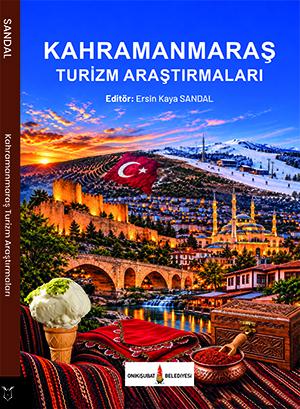
Coğrafi Bilgi Sistemleri (CBS) İle Onikişubat (Kahramanmaraş) İlçesinde Turistik Destinasyonlarının Mekânsal Erişilebilirlik ve Rota Optimizasyonu
Referanslar
Adıgüzel, A. D., & Doğan, Ö. S. (2024). Tarsus Kent Merkezinde Yaya Olarak Turistik Kaynaklara Ulaşılabilirlik: Zaman ve Mesafe Optimizasyonu ile Rota Analizi. Journal of Tourism & Gastronomy Studies, 12(4), 2643-2659.
Alkan, A. (2018). Alternatif bir turizm rotası: Kurtalan Ekspresi. Journal of Tourism and Gastronomy Studies, 6(4), 1016–1038. https://doi.org/10.21325/jotags.2018.346
Astor, Y., Purwandhari, A., & Aprian, K. R. (2020). Determination of effective routes for tourism mass transportation in Bandung City using network analyst and GIS. In Proceedings of the International Seminar of Science and Applied Technology (ISSAT 2020) (pp. 265–269). Atlantis Press. https://doi.org/10.2991/aer.k.201221.045
Barringer, J., Walcroft, A., Forer, P., & Hughey, K. F. (2002). Development of an environmental effects and tourist flow data management system. In W. G. Croy (Ed.), New Zealand tourism and hospitality research conference proceedings (pp. 307–314). School of Tourism and Hospitality, Waikato Institute of Technology.
Becken, S., Vuletich, S., & Campbell, S. (2007). Developing a GIS-supported tourist flow model for New Zealand. In Developments in tourism research (pp. 123–138). Routledge.
Buhalis, D., & Law, R. (2008). Progress in information technology and tourism management: 20 years on and 10 years after the Internet—The state of eTourism research. Tourism Management, 29(4), 609–623. https://doi.org/10.1016/j.tourman.2008.01.005
Caldeira, A. M., & Kastenholz, E. (2017). Tourists’ spatial behaviour in urban attractions: The effect of prior attractions experience. Journal of Vacation Marketing. https://doi.org/10.1177/1356766717706102
Connell, J., & Page, S. J. (2008). Exploring the spatial patterns of car-based tourist travel in Loch Lomond and Trossachs National Park, Scotland. Tourism Management, 29(3), 561–580. https://doi.org/10.1016/j.tourman.2007.03.019
De Freitas, C. R. (2003). Tourism climatology: Evaluating environmental information for decision making and business planning in the recreation and tourism sector. International Journal of Biometeorology, 48(1), 45–54. https://doi.org/10.1007/s00484-003-0177-z
Echols, N. (2003). Finding the fastest route. Paper presented at the ESRI User Conference, Redlands, CA, United States. http://gis.esri.com/library/userconf/proc03/p0320.pdf
Farmaki, A. (2015). Regional network governance and sustainable tourism. Tourism Geographies, 17(3), 385–407.
Dumitrașcu, A. V., Teodorescu, C., & Cioclu, A. (2023). Accessibility and tourist satisfaction—Influencing factors for tourism in Dobrogea, Romania. Sustainability, 15(9), Article 7525. https://doi.org/10.3390/su15097525
Gavilanes Montoya, A. V., Esparza Parra, J. F., Chávez Velásquez, C. R., Tito Guanuche, P. E., Parra Vintimilla, G. M., Mestanza-Ramón, C., & Vizuete, D. D. C. (2021). A nature tourism route through GIS to improve the visibility of the natural resources of the Altar Volcano, Sangay National Park, Ecuador. Land, 10(8), Article 884. https://doi.org/10.3390/land10080884
Giglio, S., Bertacchini, F., Bilotta, E., & Pantano, P. (2019). Using social media to identify tourism attractiveness in six Italian cities. Tourism Management, 72, 306–312. https://doi.org/10.1016/j.tourman.2018.12.007
Gill, N., & Bharath, B. D. (2013). Identification of optimum path for tourist places using GIS-based network analysis: A case study of New Delhi. International Journal of Advancement in Remote Sensing, GIS and Geography, 1(2), 34–38.
Gohari, A. (2010). Route planning system based on geographic information system [Master’s thesis, Universiti Teknologi Malaysia].
Güngör, Ş. (2022). Kapadokya Kültür Yolu’nun alternatif turizm rotası bağlamında değerlendirilmesi. Nevşehir Hacı Bektaş Veli Üniversitesi SBE Dergisi, 12(3), 1784–1802. https://doi.org/10.30783/nevsosbilen.1140505
Güngör, S., Sucu, F., Dinc, Y., et al. (2024). GIS-based daily tourism route proposal for surrounding provinces and districts from Ankara’s Çankaya district (Turkey). Environment, Development and Sustainability. Advance online publication. https://doi.org/10.1007/s10668-024-04800-5
Han, Y., Guan, H., & Duan, J. (2014). Tour route multiobjective optimization design based on tourist satisfaction. Discrete Dynamics in Nature and Society, 2014, Article 603494. https://doi.org/10.1155/2014/603494
Hamilton, J. M., & Tol, R. S. J. (2004). The impacts of climate change on tourism and recreation (Working Paper FNU-52). Research Unit Sustainability and Global Change, Hamburg University and Centre for Marine and Atmospheric Science.
Hamurkoparan, S. (2021). Grafın uzaklık matrisi ile ilgili sınır çalışmaları [Yüksek lisans tezi, Gazi Üniversitesi].
Hernández, J. M., Kirilenko, A. P., & Stepchenkova, S. (2018). Network approach to tourist segmentation via user-generated content. Annals of Tourism Research, 73, 35–47. https://doi.org/10.1016/j.annals.2018.09.002
Hooper, J. (2015). A attractions too far? Modelling attractions accessibility and distance decay in tourism. GeoJournal, 80, 33–46. https://doi.org/10.1007/s10708-014-9536-z
Hu, I. L., Chang, C. C., & Lin, Y. H. (2021). Using big data and social network analysis for cultural tourism planning in Hakka villages. Tourism and Hospitality Research, 21(1), 99–114. https://www.jstor.org/stable/26990912
Hui, T., He, Y., Ran, F., Xu, J., & Zhang, P. (2023). Spatial structure and geographical characteristics of tourist towns in the Wuling Mountain Area. Journal of Resources and Ecology, 14(3), 644–655.
Kang, S., Lee, G., Kim, J., & Park, D. (2018). Identifying the spatial structure of the tourist attraction system in South Korea using GIS and network analysis: An application of anchor-point theory. Journal of Destination Marketing & Management, 9, 358–370. https://doi.org/10.1016/j.jdmm.2018.04.001
Karapınar, E., & Barakazı, M. (2017). Kültürel miras turizminin sürdürülebilir turizm açısından değerlendirilmesi: Göbeklitepe ören yeri. Güncel Turizm Araştırmaları Dergisi, 1(1), 5–18. https://izlik.org/JA52JL72WK
Kranioti, A., Tsiotas, D., & Polyzos, S. (2022). The topology of cultural attractions’ accessibility: The case of Attica, Greece. Sustainability, 14(3), Article 1860. https://doi.org/10.3390/su14031860
Li, J., Xu, L., Tang, L., Wang, S., & Li, L. (2018). Big data in tourism research: A literature review. Tourism Management, 68, 301–323. https://doi.org/10.1016/j.tourman.2018.03.009
Li, W., Guan, H., Han, Y., Zhu, H., & Zhao, P. (2021). Accessibility of multimode transport facilities to suburban tourist attractions: Analysis based on meso- or micro-community scale Beijing. Journal of Urban Planning and Development, 147, Article 04021026. https://doi.org/10.1061/(ASCE)UP.1943-5444.0000708
Li, J., Guo, X., Lu, R., & Zhang, Y. (2022). Analysing urban tourism accessibility using real-time travel data: A case study in Nanjing, China. Sustainability, 14(19), Article 12122. https://doi.org/10.3390/su141912122
Lim, K. H., Chan, J., Karunasekera, S., & Leckie, C. (2019). Tour recommendation and trip planning using location-based social media: A survey. Knowledge and Information Systems, 60(3), 1247–1275. https://doi.org/10.1007/s10115-018-1297-4
Memon, I. A. (2005). Application of geographic information system in transportation for road network analysis [Master's thesis, Universiti Teknologi Malaysia].
Nagy, K., & Piskóti, I. (2016). Route-based tourism product development as a tool for social innovation: History Valley in the Cserehát region. Theory, Methodology, Practice, 12(2), 55–62. http://dx.doi.org/10.18096/TMP.2016.02.07
Özgüç, N. (2007). Turizm coğrafyası. Çantay Kitabevi.
Özüpak, F. N. (2021). Katılımcı yaklaşımla kültürel rota önerisi: Bursa tarihi kentsel peyzajında Hisar örneği [Yüksek lisans tezi, Bursa Uludağ Üniversitesi].
Pei, Q., Wang, L., Du, P., & Wang, Z. (2022). Optimization of tourism routes in Lushunkou District based on ArcGIS. PLoS ONE, 17(3), Article e0264526. https://doi.org/10.1371/journal.pone.0264526
Peng, H., Zhang, J., Liu, Z., Lu, L., & Yang, L. (2016). Network analysis of tourist flows: A cross-provincial boundary perspective. Tourism Geographies, 18(5), 561–586. https://doi.org/10.1080/14616688.2016.1221443
Penpece Demirer, D., & Büyükeke, A. (2025). Unravelling tourism destination's competitiveness using big data analytics: A comparative analysis. Kybernetes, 54(11), 6341–6366. https://www.emerald.com/insight/publication/issn/0368-492X
Prameshwori, T., Wangshimenla, J., Surjit, L., & Ramananda, L. (2021). GIS-based route network analysis for tourist places: A case study of Greater Imphal. International Journal of Scientific Research in Science, Engineering and Technology, 8(2), 233–238. https://doi.org/10.32628/IJSRSET218229
Sadeghi-Niaraki, A., Varshosaz, M., Kim, K., & Jung, J. J. (2011). Real-world representation of a road network for route planning in GIS. Expert Systems with Applications, 38(10), 11999–12008. https://doi.org/10.1016/j.eswa.2010.12.123
Saarinen, J. (2006). Traditions of sustainability in tourism studies. Annals of Tourism Research, 33(4), 1121–1140. https://doi.org/10.1016/j.annals.2006.06.007
Scott, N., Baggio, R., & Cooper, C. (2008). Network analysis and tourism. Channel View Publications.
Scott, D., & Lemieux, C. (2010). Weather and climate information for tourism (White paper commissioned by the World Meteorological Organization). https://doi.org/10.1016/j.proenv.2010.09.011
Şeker, H. (2011). Bölgesel kalkınmada turizmin rolü ve Amasya örneği [Yayımlanmamış yüksek lisans tezi, Süleyman Demirel Üniversitesi].
Shokri, F., Chu, M.-Y., Mokhtarian, H. R., Rahmat, R., & Ismail, A. (2009). Best route based on fuel economy. http://www.eurojournals.com/ejsr.htm
Smith, K. (1993). The influence of weather and climate on recreation and tourism. Weather, 48, 398–404.
Sucu, F. (2022). Geographic information systems supported tourism route planning for Nevşehir province [Master's thesis, Nevşehir Hacı Bektaş Veli University].
Tango, U., & Topçu, M. (2021). Kentsel donatı alanlarının erişilebilirlik analizi: Mardin Kızıltepe örneği. Türkiye Coğrafi Bilgi Sistemleri Dergisi, 3(2), 104–115. https://hdl.handle.net/20.500.13091/2510
Tekin, Ö. (2014). Turistik ürün çeşitlendirmesi kapsamında Konya'da ekoturizm rotaları [Yüksek lisans tezi, Necmettin Erbakan Üniversitesi].
Türker, N. (2013). Batı Karadeniz Bölümü ekoturizm kaynaklarının değerlendirilmesi ve bir ekoturizm rotası önerisi. The Journal of Academic Social Science Studies, 6(4), 1093–1128.
United Nations Environment Programme, & World Tourism Organization. (2005). Making tourism more sustainable: A guide for policy makers. UNEP & UNWTO.
United Nations World Tourism Organization. (2025). Glossary of tourism terms. https://www.unwto.org/glossary-tourism-terms
Ünlü, M., & Yıldırım, S. (2016). CBS ile oluşturulan tematik haritaların kullanımının öğrencilerin başarısına etkisinin değerlendirilmesi. Marmara Coğrafya Dergisi, 33, 77–95.
Wang, L., Li, C. X., & Gao, X. T. (2019). Accessibility comparison and spatial differentiation of Xi'an scenic spots with different modes based on Baidu real-time travel. Chinese Geographical Science, 29, 848–860. https://doi.org/10.1007/s11769-019-1073-8
Winyoopradist, S., & Siangsuebchart, S. (1999). Network analysis for variable traffic speed. Paper presented at the ESRI User Conference.
Wu, X. Y., & Chen, C. Y. (2022). Spatial distribution and accessibility of high-level scenic spots in Inner Mongolia. Sustainability, 14, Article 7329. https://doi.org/10.3390/su14127329
Vansteenwegen, P., Souffriau, W., Van Berghe, G., & Van Oudheusden, D. (2011). The city trip planner: An expert system for tourists. Expert Systems with Applications, 38(6), 6540–6546. https://doi.org/10.1016/j.eswa.2010.11.085
Yazar, Ö. (2019). Gökçeada'nın gastronomi rotalarında slow food ve gastronomi turizmi [Yüksek lisans tezi, Okan Üniversitesi].
Yılmaz, E. (2021). Kültür turizminde kamu-özel sektör iş birliği: Galata Bölgesi turizm rotası [Yüksek lisans tezi, Fatih Sultan Mehmet Vakıf Üniversitesi].
Yiğit, M. (2020). Giresun'un ekoturizm potansiyelinin değerlendirilmesi: Sürdürülebilir turizm için ekoturizm rotası önerisi [Yüksek lisans tezi, Karabük Üniversitesi].
Zhang, Z., Zhang, Z., & Yang, Y. (2016). The power of expert identity: How website-recognized expert reviews influence travelers' online rating behavior. Tourism Management, 55, 15–24. https://doi.org/10.1016/j.tourman.2016.01.004
Zhao, Z., Chen, W., Wu, X., Chen, P. C. Y., & Liu, J. (2017). LSTM network: A deep learning approach for short-term traffic forecast. IET Intelligent Transport Systems, 11(2), 68–75. https://doi.org/10.1049/iet-its.2016.0208