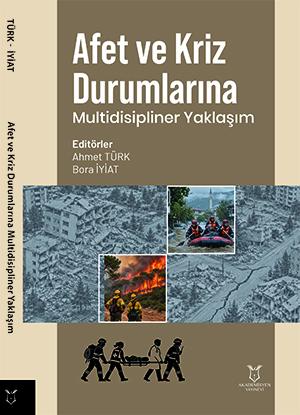
Afet ve Kriz Durumlarında Aile Temelli Psikososyal Müdahaleler
Synopsis
Disasters and crises can affect not only individual psychosocial well-being but also family relationships, caregiving processes, role distribution, and access to social resources. This chapter examines the theoretical foundations, assessment dimensions, and intervention methods of family-based psychosocial interventions in disaster and crisis situations. Drawing on family systems theory, the Double ABC-X Model, and the family resilience framework, it explores the impacts of disasters on family functioning and psychosocial adaptation. Family psychosocial assessment is discussed in relation to safety, basic needs, family functioning, risks, and protective resources. The chapter also examines changing family needs and corresponding interventions across disaster preparedness, acute response, early recovery, and long-term recovery. Psychoeducation, family communication, problem-solving, caregiver support, grief-related interventions, family meetings, and case management are addressed as key intervention methods. Ethical and practical considerations, including confidentiality, self-determination, safety, and cultural responsiveness, are also discussed. The chapter emphasizes the importance of family-based psychosocial interventions that respect individual needs and rights while strengthening adaptive capacities, caregiving relationships, and access to social support resources.
References
Afet ve Acil Durum Yönetimi Başkanlığı. (t.y.). Afete hazır aile. https://bursa.afad.gov.tr/afete-hazir-aile
Bonanno, G. A., Brewin, C. R., Kaniasty, K., & La Greca, A. M. (2010). Weighing the costs of disaster: Consequences, risks, and resilience in individuals, families, and communities. Psychological Science in the Public Interest, 11(1), 1–49. https://doi.org/10.1177/1529100610387086
Boss, P. (1999). Ambiguous loss: Learning to live with unresolved grief. Harvard University Press.
Bowen, M. (1978). Family therapy in clinical practice. Jason Aronson.
Bozkurt Karali, M. N., Özkan, Y., & Foto Özdemir, D. (2026). Child–parent relationship therapy for earthquake-affected preschoolers: A 1-year controlled study. Clinical Psychology & Psychotherapy, 33(2), Article e70264. https://doi.org/10.1002/cpp.70264
CHS Alliance, Groupe URD, & Sphere. (2024). Core humanitarian standard on quality and accountability (2nd ed.). https://www.corehumanitarianstandard.org/the-standard
Çıtak, G., & Toker, S. (2025). Exploring gender-based challenges after the earthquake: A phenomenological study of women in Turkey. BMC Public Health, 25, Article 3555. https://doi.org/10.1186/s12889-025-23907-6
D'Zurilla, T. J., & Nezu, A. M. (2007). Problem-solving therapy: A positive approach to clinical intervention (3rd ed.). Springer Publishing Company.
Enarson, E. (2012). Women confronting natural disaster: From vulnerability to resilience. Lynne Rienner Publishers.
Hartman, A. (1978). Diagrammatic assessment of family relationships. Social Casework, 59(8), 465–476. https://doi.org/10.1177/104438947805900803
Hepworth, D. H., Rooney, R. H., Rooney, G. D., & Strom-Gottfried, K. (2017). Direct social work practice: Theory and skills (10th ed.). Cengage Learning.
Höltge, J., Kuru, N., & Ungar, M. (2025). Family stress and resilience to earthquake-related economic hardship in Turkish families with preschool children. Journal of Family Psychology, 39(8), 1201–1212. https://doi.org/10.1037/fam0001360
Hooper, L. M. (2007). The application of attachment theory and family systems theory to the phenomena of parentification. The Family Journal, 15(3), 217–223. https://doi.org/10.1177/1066480707301290
Inter-Agency Standing Committee. (2007). IASC guidelines on mental health and psychosocial support in emergency settings. https://www.who.int/publications-detail-redirect/iasc-guidelines-for-mental-health-and-psychosocial-support-in-emergency-settings
Inter-Agency Standing Committee. (2012). IASC Reference Group mental health and psychosocial support assessment guide. https://inee.org/sites/default/files/resources/IASC_reference_group_psychosocial_support_assessment_guide.pdf
Inter-Agency Standing Committee. (2015). Guidelines for integrating gender-based violence interventions in humanitarian action: Reducing risk, promoting resilience and aiding recovery. https://gbvguidelines.org/en/
Inter-Agency Standing Committee. (2019). Guidelines: Inclusion of persons with disabilities in humanitarian action. https://www.ungei.org/publication/guidelines-inclusion-persons-disabilities-humanitarian-action
International Committee of the Red Cross. (2024). Guide to incorporating family links into contingency plans. https://www.icrc.org/en/publication/guide-incorporating-family-links-contingency-plans
International Federation of Social Workers. (2018). Global social work statement of ethical principles. https://www.ifsw.org/global-social-work-statement-of-ethical-principles/
Joseph, J. (2013). Resilience as embedded neoliberalism: A governmentality approach. Resilience, 1(1), 38–52. https://doi.org/10.1080/21693293.2013.765741
Kuru, N., & Ungar, M. (2025). A structural equation model of parenting and child's resilience after the earthquake in Türkiye. Family Process, 64(1), Article e13061. https://doi.org/10.1111/famp.13061
Landau, J. (2007). Enhancing resilience: Families and communities as agents for change. Family Process, 46(3), 351–365. https://doi.org/10.1111/j.1545-5300.2007.00216.x
Masten, A. S., & Narayan, A. J. (2012). Child development in the context of disaster, war, and terrorism: Pathways of risk and resilience. Annual Review of Psychology, 63, 227–257. https://doi.org/10.1146/annurev-psych-120710-100356
McCubbin, H. I., & Patterson, J. M. (1983). The family stress process: The double ABCX model of adjustment and adaptation. Marriage & Family Review, 6(1–2), 7–37. https://doi.org/10.1300/J002v06n01_02
McGoldrick, M., Carter, B., & Garcia-Preto, N. (Eds.). (2016). The expanding family life cycle: Individual, family, and social perspectives (5th ed.). Pearson.
McGoldrick, M., Gerson, R., & Petry, S. (2020). Genograms: Assessment and treatment (4th ed.). W. W. Norton & Company.
Miller, K. E., Koppenol-Gonzalez, G. V., Arnous, M., Tossyeh, F., Chen, A., Nahas, N., & Jordans, M. J. D. (2020). Supporting Syrian families displaced by armed conflict: A pilot randomized controlled trial of the Caregiver Support Intervention. Child Abuse & Neglect, 106, Article 104512. https://doi.org/10.1016/j.chiabu.2020.104512
Miller, K. E., Chen, A., Koppenol-Gonzalez, G. V., Bakolis, I., Arnous, M., Tossyeh, F., El Hassan, A., Saleh, A., Saade, J., Nahas, N., Abboud, M., Jawad, L., & Jordans, M. J. D. (2023). Supporting parenting among Syrian refugees in Lebanon: A randomized controlled trial of the Caregiver Support Intervention. Journal of Child Psychology and Psychiatry, 64(1), 71–82. https://doi.org/10.1111/jcpp.13668
Minuchin, S. (1974). Families and family therapy. Harvard University Press.
Neal, D. M. (1997). Reconsidering the phases of disaster. International Journal of Mass Emergencies & Disasters, 15(2), 239–264. https://doi.org/10.1177/028072709701500202
Özer, E., Çetinkaya Şen, Y., Sevimli Güler, D., & Güvenç, G. (2025). Experiences of women relocated due to the February 2023 earthquake in Turkey: A qualitative study. BMC Women's Health, 25, Article 21. https://doi.org/10.1186/s12905-025-03554-0
Patterson, J. M. (2002). Understanding family resilience. Journal of Clinical Psychology, 58(3), 233–246. https://doi.org/10.1002/jclp.10019
Rhamelani, P., Cahaya, A. P., Yunita, S., Wijayanti, R., Nirwana, J. P., Nasution, N., Widiawati, A., Oktaviani, R., Sijabat, Y. S., Febrian, N., Rahayu, R., Rohnenti, O., & Priambodo, A. P. (2026). Family-centered psychosocial interventions for disaster-affected children across developmental stages: A scoping review. Risk Management and Healthcare Policy, 19, Article 622846. https://doi.org/10.2147/RMHP.S622846
Ronan, K. R., & Johnston, D. M. (2005). Promoting community resilience in disasters: The role for schools, youth, and families. Springer.
Sety, M., James, K., & Breckenridge, J. (2014). Understanding the risk of domestic violence during and post natural disasters: Literature review. In L. W. Roeder (Ed.), Issues of gender and sexual orientation in humanitarian emergencies: Risks and risk reduction (pp. 99–111). Springer. https://doi.org/10.1007/978-3-319-05882-5_5
Shear, M. K. (2015). Complicated grief. New England Journal of Medicine, 372(2), 153–160. https://doi.org/10.1056/NEJMcp1315618
Substance Abuse and Mental Health Services Administration. (2014). SAMHSA's concept of trauma and guidance for a trauma-informed approach (HHS Publication No. SMA 14-4884). https://library.samhsa.gov/sites/default/files/sma14-4884.pdf
Türk, A. (2022). Deprem özelinde engelli bireylere duyarlı afet yönetimi modeli. Afet ve Risk Dergisi, 5(1), 61–77. https://doi.org/10.35341/afet.1078869
Türk, A., & Bilican Gökkaya, V. (2023). Deprem sonrası çocukların karşılaşabileceği psikososyal riskler ve sosyal hizmet. İ. Aydemir & M. Öztürk (Ed.), Afet ve krizlerde sosyal hizmet (ss. 163–187) içinde. Akademisyen Kitabevi. https://doi.org/10.37609/akya.2794.c9970
Walsh, F. (2003). Family resilience: A framework for clinical practice. Family Process, 42(1), 1–18. https://doi.org/10.1111/j.1545-5300.2003.00001.x
Walsh, F. (2007). Traumatic loss and major disasters: Strengthening family and community resilience. Family Process, 46(2), 207–227. https://doi.org/10.1111/j.1545-5300.2007.00205.x
Walsh, F. (2016). Applying a family resilience framework in training, practice, and research: Mastering the art of the possible. Family Process, 55(4), 616–632. https://doi.org/10.1111/famp.12260
Walsh, F., & McGoldrick, M. (Eds.). (2004). Living beyond loss: Death in the family (2nd ed.). W. W. Norton & Company.
World Health Organization. (2013). Responding to intimate partner violence and sexual violence against women: WHO clinical and policy guidelines. https://www.who.int/publications/i/item/9789241548595
World Health Organization, War Trauma Foundation, & World Vision International. (2011). Psychological first aid: Guide for field workers. World Health Organization. https://www.who.int/publications/i/item/9789241548205