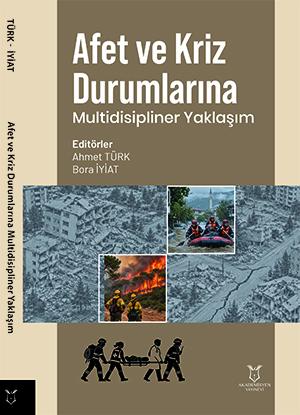
Afet ve Kriz Durumlarında Psikososyal Müdahalede Sosyal Hizmetin Rolü
Synopsis
Disasters and crises are multidimensional processes that affect individuals' psychosocial well-being, social relationships, living conditions, and access to services. This chapter examines the role of social work in psychosocial intervention during disasters and crises, focusing on its theoretical foundations and professional practices. The contributions of social work to addressing diverse needs are discussed through the person-in-environment perspective and the principles of human rights, social justice, and empowerment. Ecological systems theory, crisis intervention, empowerment and strengths-based perspectives, trauma-informed practice, and resilience are examined as complementary theoretical and conceptual foundations of social work practice. The chapter addresses the contributions of social work at micro, mezzo, and macro levels across disaster risk reduction, preparedness, acute response, and recovery. Psychosocial assessment, psychological first aid, case management, referral, protection, advocacy, and mobilization of community resources are discussed as key professional responsibilities of social workers. The importance of professional competence, interdisciplinary collaboration, ethical responsibilities, and psychosocial support for practitioners is also emphasized. The chapter highlights social work as a comprehensive field of professional practice that connects individual psychosocial needs with broader social and structural conditions in disaster and crisis situations.
References
Afet ve Acil Durum Yönetimi Başkanlığı. (2022). Türkiye afet müdahale planı (TAMP). https://www.afad.gov.tr/turkiye-afet-mudahale-plani
Aile ve Sosyal Hizmetler Bakanlığı. (2024). Afet ve acil durumlarda psikososyal destek akreditasyon kılavuzu (2. versiyon). https://www.aile.gov.tr/media/197648/7-afet-ve-acil-durumda-psikososyal-destek-akreditasyon-kilavuzu.pdf
Albayrak, H., Selçuk, O., Güzel, B., & Kelebek Küçükarslan, G. (2026). Struggles in providing psychosocial support services to survivors of the Kahramanmaraş earthquakes from professionals' experiences. European Journal of Psychotraumatology, 17(1), Article 2685932. https://doi.org/10.1080/20008066.2026.2685932
Anderson, M. B., & Woodrow, P. J. (1998). Rising from the ashes: Development strategies in times of disaster. Lynne Rienner Publishers.
Brymer, M., Jacobs, A., Layne, C., Pynoos, R., Ruzek, J., Steinberg, A., Vernberg, E., & Watson, P. (2006). Psychological first aid: Field operations guide (2nd ed.). National Child Traumatic Stress Network & National Center for PTSD.
Caplan, G. (1964). Principles of preventive psychiatry. Basic Books.
Choi, B. C. K., & Pak, A. W. P. (2006). Multidisciplinarity, interdisciplinarity and transdisciplinarity in health research, services, education and policy: 1. Definitions, objectives, and evidence of effectiveness. Clinical and Investigative Medicine, 29(6), 351–364.
Cutter, S. L., Boruff, B. J., & Shirley, W. L. (2003). Social vulnerability to environmental hazards. Social Science Quarterly, 84(2), 242–261. https://doi.org/10.1111/1540-6237.8402002
Dominelli, L. (2015). The opportunities and challenges of social work interventions in disaster situations. International Social Work, 58(5), 659–672. https://doi.org/10.1177/0020872815598353
Ezell, M. (2001). Advocacy in the human services. Brooks/Cole Thomson Learning.
Federal Emergency Management Agency. (2025). Individual assistance program and policy guide (Version 1.1, amended July 2025). U.S. Department of Homeland Security. https://www.fema.gov/sites/default/files/documents/fema_iappg-1.1_amended_july2025.pdf
Gitterman, A., & Germain, C. B. (2008). The life model of social work practice: Advances in theory and practice (3rd ed.). Columbia University Press.
Harris, M., & Fallot, R. D. (2001). Envisioning a trauma-informed service system: A vital paradigm shift. New Directions for Mental Health Services, 2001(89), 3–22. https://doi.org/10.1002/yd.23320018903
Hobfoll, S. E., Watson, P., Bell, C. C., Bryant, R. A., Brymer, M. J., Friedman, M. J., Friedman, M., Gersons, B. P. R., de Jong, J. T. V. M., Layne, C. M., Maguen, S., Neria, Y., Norwood, A. E., Pynoos, R. S., Reissman, D., Ruzek, J. I., Shalev, A. Y., Solomon, Z., Steinberg, A. M., & Ursano, R. J. (2007). Five essential elements of immediate and mid-term mass trauma intervention: Empirical evidence. Psychiatry: Interpersonal and Biological Processes, 70(4), 283–315. https://doi.org/10.1521/psyc.2007.70.4.283
Inter-Agency Standing Committee. (2007). IASC guidelines on mental health and psychosocial support in emergency settings. https://www.who.int/publications-detail-redirect/iasc-guidelines-for-mental-health-and-psychosocial-support-in-emergency-settings
International Federation of Social Workers. (2014). Global definition of social work. https://www.ifsw.org/global-definition-of-social-work/
International Federation of Social Workers. (2018). Global social work statement of ethical principles. https://www.ifsw.org/global-social-work-statement-of-ethical-principles/
Lee, J. A. B. (2001). The empowerment approach to social work practice: Building the beloved community (2nd ed.). Columbia University Press.
Mathbor, G. M. (2007). Enhancement of community preparedness for natural disasters: The role of social work in building social capital for sustainable disaster relief and management. International Social Work, 50(3), 357–369. https://doi.org/10.1177/0020872807076049
National Association of Social Workers. (2021). Code of ethics of the National Association of Social Workers. https://www.socialworkers.org/About/Ethics/Code-of-Ethics/Code-of-Ethics-English
Norris, F. H., Stevens, S. P., Pfefferbaum, B., Wyche, K. F., & Pfefferbaum, R. L. (2008). Community resilience as a metaphor, theory, set of capacities, and strategy for disaster readiness. American Journal of Community Psychology, 41(1–2), 127–150. https://doi.org/10.1007/s10464-007-9156-6
Özmete, E., Serpen, A. S., Akgül Gök, F., Arslan Özdemir, E., Kalayci, E., & Duru, S. (2025). Group work for earthquake survivors: A randomized controlled trial transforming crisis into hope. Research on Social Work Practice, 35(4), 432–442. https://doi.org/10.1177/10497315251325253
Pak, M., & Özmete, E. (2025). Afetlerde sosyal hizmet ve psikososyal destek: Ekolojik yaklaşım çerçevesinde bir değerlendirme. Sosyal Politika Çalışmaları Dergisi, 25(68), 803–840. https://doi.org/10.21560/spcd.vi.1537166
Pyles, L. (2007). Community organizing for post-disaster social development: Locating social work. International Social Work, 50(3), 321–333. https://doi.org/10.1177/0020872807076044
Roberts, A. R. (Ed.). (2005). Crisis intervention handbook: Assessment, treatment, and research (3rd ed.). Oxford University Press.
Saleebey, D. (Ed.). (2013). The strengths perspective in social work practice (6th ed.). Pearson.
Serpen, A. S. (2023). Afetlerde kadınların sağlık ve güvenliğinin korunması: Kadınlarla makro sosyal hizmet uygulamaları. E. Özmete (Ed.), Afet sonrası birey, grup ve toplum temelli psikososyal destek (ss. 141–158) içinde. Akademisyen Kitabevi. https://doi.org/10.37609/akya.2681.c10000
Sim, T., He, M., & Dominelli, L. (2022). Social work core competencies in disaster management practice: An integrative review. Research on Social Work Practice, 32(3), 310–321. https://doi.org/10.1177/10497315211055427
Sisman, E., Cerit, C., & Polat, A. (2025). Hidden cracks from the largest earthquake of Türkiye: Secondary traumatic stress among psychosocial support teams. European Journal of Psychotraumatology, 16(1), Article 2510155. https://doi.org/10.1080/20008066.2025.2510155
Sphere Association. (2018). The Sphere handbook: Humanitarian charter and minimum standards in humanitarian response (4th ed.). https://spherestandards.org/handbook/
Substance Abuse and Mental Health Services Administration. (2014). SAMHSA's concept of trauma and guidance for a trauma-informed approach (HHS Publication No. SMA 14-4884). https://library.samhsa.gov/sites/default/files/sma14-4884.pdf
Türk, A. (2022). Deprem özelinde engelli bireylere duyarlı afet yönetimi modeli. Afet ve Risk Dergisi, 5(1), 61–77. https://doi.org/10.35341/afet.1078869
Türk, A., & Kaya, S. (2023). Deprem sonrası psikososyal destek uygulamalarında merhamet yorgunluğunun psikolojik sağlamlığa etkisi: Sosyal hizmet uzmanları üzerine bir araştırma. Uluslararası Sosyal Hizmet Araştırmaları Dergisi, 3(2), 81–91. https://doi.org/10.57114/jswrpub.1312507
Ungar, M. (2011). The social ecology of resilience: Addressing contextual and cultural ambiguity of a nascent construct. American Journal of Orthopsychiatry, 81(1), 1–17. https://doi.org/10.1111/j.1939-0025.2010.01067.x
United Nations Office for Disaster Risk Reduction. (2015). Sendai framework for disaster risk reduction 2015–2030. https://www.undrr.org/publication/sendai-framework-disaster-risk-reduction-2015-2030
World Health Organization, War Trauma Foundation, & World Vision International. (2011). Psychological first aid: Guide for field workers. World Health Organization. https://www.who.int/publications/i/item/9789241548205
Yanardağ, R. (2025). 6 Şubat 2023 Kahramanmaraş depremleri sonrasında psikososyal destek hizmetlerinde yer alan sosyal hizmet uzmanlarının mesleki deneyimleri. Karamanoğlu Mehmetbey Üniversitesi Sosyal ve Ekonomik Araştırmalar Dergisi, 27(49), 1077–1103. https://doi.org/10.18493/kmusekad.1569642
Zakour, M. J., & Gillespie, D. F. (2013). Community disaster vulnerability: Theory, research, and practice. Springer. https://doi.org/10.1007/978-1-4614-5737-4